

Google fixed CVE-2026-14151 in Chrome 150.0.7871.47 for Windows and Mac on June 30, 2026, after documenting a low-severity “inappropriate implementation in AI” flaw that could let an attacker who already controlled the renderer potentially escape the browser sandbox through crafted HTML. The detail that matters is not the word “AI” by itself, nor even the “Low” label attached by Chromium. It is the collision between browser AI features, renderer compromise assumptions, and the still-messy vulnerability metadata pipeline that enterprises increasingly use to decide what gets patched first.
As documented by Google’s Chrome Releases blog and later enriched by the National Vulnerability Database, CVE-2026-14151 sits inside a vast Chrome 150 security release containing hundreds of fixes. NVD’s record shows the CVE was published on June 30 and modified on July 1, with CISA’s ADP enrichment assigning a high CVSS 3.1 score after first using a lower-complexity vector and then revising it to high attack complexity. That sequence tells a familiar story: Chrome’s internal severity language, government scoring, and enterprise risk tooling are all trying to describe the same bug, but they are not speaking the same dialect.
The apparent contradiction in CVE-2026-14151 is the first thing administrators will notice. Google labels the Chromium security severity as Low, while CISA’s ADP enrichment puts the CVSS 3.1 base score at 8.3, squarely in High territory. That is not necessarily an error; it is a reminder that severity systems answer different questions.
Chromium’s severity rating is usually anchored in exploitability within the browser’s own architecture and the preconditions required to reach meaningful impact. In this case, Google’s description says the attacker must already have compromised the renderer process. That is not a trivial starting point. The renderer is the sandboxed process that handles untrusted web content, and Chrome’s entire security model assumes hostile HTML, JavaScript, images, fonts, and media will be thrown at it constantly.
CVSS, by contrast, is designed to express the impact once the described attack path is available. A sandbox escape that follows renderer compromise can cross a security boundary and potentially expose confidentiality, integrity, and availability at a much broader scope. That is why CISA’s vector includes changed scope and high impact across all three classic categories, even while also recording high attack complexity and required user interaction.
The practical read is simple: this is not a “drive-by, one-click full compromise from scratch” bug as described. It is a post-renderer-compromise escape primitive, and those matter because modern browser exploitation is often chained. One bug gets code running inside the renderer; another gets out of jail.
That number is easy to skim past because Chrome has normalized huge security releases. But it changes the operational reality for defenders. When a single browser update contains critical use-after-free issues, graphics stack flaws, V8 bugs, policy bypasses, WebNN issues, sandbox-adjacent defects, and AI-related implementation mistakes, the old ritual of reading each CVE as a standalone emergency becomes less useful.
For Windows administrators, the actionable unit is the Chrome build, not the individual CVE. If Chrome is below 150.0.7871.47 on Windows or Mac, the system is missing this fix and many others from the same train. The same logic applies to Chromium-based browsers once their vendors ingest the relevant upstream patches, though version numbers and release timing vary.
The scale of Chrome 150 also explains why bug details remain sparse. Google’s advisory repeats its standard warning that access to bug details and links may remain restricted until a majority of users are updated, and restrictions may persist when a bug affects third-party libraries used elsewhere. That leaves defenders with a narrow public description: the component label, the impact class, the affected version boundary, and the fact that crafted HTML is involved.
That scarcity is not accidental. Publishing a sandbox escape recipe while large portions of the installed base remain unpatched would be irresponsible. But the absence of detail creates a vacuum, and in 2026 that vacuum is quickly filled by automated enrichment systems, vulnerability feeds, and dashboards that may disagree with one another.
That should not surprise anyone watching browser development. Chrome is no longer just a document renderer with a JavaScript engine bolted on. It is a permissions broker, password manager, identity surface, payments surface, graphics engine, media stack, storage platform, WebGPU runtime, WebNN experiment host, enterprise policy endpoint, and increasingly an AI delivery vehicle.
Each new capability creates boundaries. Boundaries create trust assumptions. Trust assumptions create bugs.
The term “AI” also risks misleading readers into imagining something exotic: prompt injection causing arbitrary code execution, a malicious model weight file, or a chatbot hallucinating its way through a security boundary. Nothing in the public CVE description supports that. The safer interpretation is that a Chrome AI-related implementation handled some resource, process, permission, or data transfer incorrectly in a way that mattered after renderer compromise.
That is still important. Browser AI features are likely to touch sensitive data, local context, cloud services, model runtimes, device capabilities, and privileged browser processes. Even if CVE-2026-14151 turns out to be a narrow implementation defect, it belongs to a broader class of risks: AI features are being threaded into products whose security models were built before this layer existed.
A renderer compromise by itself is serious, but it is constrained. The attacker is meant to be trapped in a process with limited access to the file system, operating system APIs, credentials, and other browser internals. A sandbox escape is the move from “I control the part of the browser designed to handle hostile content” to “I can reach something I was not supposed to reach.”
That is why security teams care about sandbox escapes even when they are rated Low by the vendor. A standalone escape may not be useful without a first-stage renderer bug. But paired with a memory corruption flaw, a type confusion bug, or a JIT miscompile, it can become the second half of a working exploit chain.
The Chrome 150 release contained plenty of candidates for defenders to worry about at a category level: use-after-free bugs, out-of-bounds reads and writes, insufficient validation, policy enforcement failures, and implementation mistakes across multiple subsystems. The public record does not say CVE-2026-14151 is being exploited, and CISA’s SSVC enrichment listed exploitation as “none.” But lack of known exploitation is not the same as lack of exploit value.
For enterprise environments, the relevant question is not whether this one CVE deserves panic. It is whether the browser update containing it is moving through managed fleets fast enough.
This is exactly the kind of record that can confuse automated vulnerability management. A scanner may ingest the first version of the CVSS vector, another may ingest the corrected one, and a dashboard may show the Chrome severity as Low while a risk engine flags the CVSS score as High. Meanwhile, the NVD page itself displays the familiar “CPEs loading” behavior in the web interface even as the change log records an affected Chrome CPE.
The user-facing question — “Are we missing a CPE here?” — is therefore fair but nuanced. Based on the NVD change history, NIST did add a CPE configuration for Google Chrome versions up to but excluding 150.0.7871.47. If the interactive NVD page does not visibly populate the CPE table, that looks more like a presentation, loading, or enrichment-display issue than proof that no CPE exists in the underlying record.
This matters because CPEs are the glue between a CVE and the asset inventory. Without a usable product mapping, vulnerability management platforms can fail in both directions. They can miss exposed systems, or they can overmatch and produce noisy findings for products that are not actually affected.
The Chrome ecosystem makes that harder. Google Chrome has a clear CPE. Chromium-based browsers, embedded WebView components, Electron apps, Linux distribution packages, and downstream vendor builds may all carry relevant code without sharing the same product identifier or update cadence. A clean CPE for Google Chrome is necessary; it is not sufficient.
Google’s Low rating signals that, inside Chromium’s own security triage, this bug likely has meaningful preconditions or limited standalone exploitability. The public description supports that: the attacker must first compromise the renderer process, and the attack requires a crafted HTML page. There is also no public indication of active exploitation.
CISA’s High CVSS score signals that the security boundary being crossed is important and that successful exploitation could have severe consequences. Its revised vector keeps network attack vector and no privileges required, but it includes user interaction and high attack complexity. That is a reasonable shape for a browser-chain bug: hard to exploit reliably, but powerful if chained correctly.
The lesson for patch prioritization is not “ignore Low” or “panic over High.” The lesson is to interpret browser CVEs as part of a release bundle. Chrome’s auto-update model exists because end users cannot be expected to distinguish a renderer-only issue from a sandbox escape from a UI spoofing bug from a GPU memory safety flaw. Administrators should not build patch policy that depends on doing so perfectly either.
In managed Windows environments, the right policy is boring: keep Chrome on the current stable build, verify update completion, and shorten the time between Google’s stable-channel release and fleet compliance. The exciting part of the CVE is the AI label. The operational answer is still patch management.
CVE-2026-14151 is described exactly like a chain component. It does not say an attacker can arrive from the open internet and immediately take over a machine. It says a remote attacker who has already compromised the renderer may potentially perform a sandbox escape. That makes it less dramatic as a standalone CVE and more interesting as part of the browser exploit economy.
This is where AI-related browser features deserve scrutiny. AI assistants and local inference features want context. Context means access: to page content, user intent, browsing state, files, permissions, enterprise data, or cloud-linked identity. Even when the implementation is careful, the feature’s usefulness pushes it toward sensitive boundaries.
For Windows shops, the concern is not merely Chrome as an application. Chrome is often the front door to SaaS identity, admin consoles, password managers, device trust checks, remote work portals, and privileged web apps. A sandbox escape in the browser can therefore become a stepping stone into higher-value workflows even if the underlying OS remains hardened.
That is why browser hardening still matters alongside patching. Site isolation, extension control, Safe Browsing policy, download restrictions, credential protections, endpoint detection, and least-privilege desktop configuration all reduce the blast radius. None of them replaces the patch. They make the attacker’s chain longer and more fragile.
Security teams often treat CVE records as authoritative facts. In practice, they are living documents assembled from vendor submissions, NVD enrichment, CNA records, CISA ADP updates, CWE mappings, CVSS vectors, references, CPE configurations, and downstream interpretations by scanners. A change made hours after publication can alter how a vulnerability is prioritized across thousands of dashboards.
CVE-2026-14151 demonstrates that drift. CISA initially added a CVSS vector with low attack complexity, then removed it and added one with high attack complexity. NIST added one CWE, CISA added another. The CPE appears in the change history, while the web page’s software configuration section may not render it cleanly for every viewer. None of that changes the fact that Chrome before 150.0.7871.47 is affected, but it can change what an organization sees.
The cure is not to abandon NVD or CVSS. It is to stop pretending that one field in one feed is a complete risk decision. For browser vulnerabilities, product version verification should outrank metadata neatness. If the fleet is at or above the fixed build, the exposure is closed for Google Chrome. If it is below the fixed build, arguing over whether the CPE table rendered properly is a distraction.
Downstream Chromium consumers complicate that answer. Microsoft Edge, Brave, Vivaldi, Opera, Electron-based applications, and Linux Chromium packages may require separate tracking by their own advisories and version schemes. The upstream Chrome CVE tells you where the bug entered public view; it does not guarantee every dependent product has already shipped the fix.
For administrators, the check should be centralized. Chrome Browser Cloud Management, enterprise software inventory, endpoint management platforms, and EDR telemetry can all report installed versions, but the key is to verify actual process restart. Downloading the update is not the same as running the patched browser.
There is also a timing issue. Google said the stable update would roll out over coming days and weeks. That phrasing is normal for consumer channels, but enterprises should not read it as permission to wait weeks when a release contains hundreds of security fixes. Managed deployment rings can still be staged, but the outer ring should not become a parking lot.
The most defensible approach is a short validation window followed by aggressive rollout. Browser updates can break workflows, and Chrome 150’s breadth makes regression testing sensible. But a browser that processes arbitrary internet content is not a quarterly patch candidate. It is frontline attack surface.
That may be the most important signal in the record. The vulnerability is not described as a model safety failure or a prompt manipulation issue. It is an implementation flaw attached to an AI component that could contribute to a sandbox escape after renderer compromise. In other words, AI has entered the same security pipeline as GPU code, rendering engines, media parsers, and extension systems.
That is good news and bad news. It is good because these bugs are being found, assigned CVEs, patched, and tracked through public advisories. It is bad because AI functionality expands the browser’s trusted computing base at the same time attackers are already skilled at chaining browser primitives.
The industry should resist the urge to invent a separate mystique for every AI vulnerability. The sharper question is architectural: which process owns the AI feature, what privileges does it hold, what data can it read, how does the renderer talk to it, and what validation happens at that boundary? CVE-2026-14151 does not answer those questions publicly, but it tells us exactly where to look.
That does not make the CVE unimportant. It makes it a useful case study in how modern browser risk is communicated imperfectly. A Low vendor severity can coexist with a High CVSS score. A CPE can be present in change history while the visible page leaves users wondering. An AI-labeled flaw can be less about sci-fi attacks and more about conventional boundary failure.
The best security teams will read all three layers at once: the vendor release, the enrichment metadata, and the exploit-chain context.
As documented by Google’s Chrome Releases blog and later enriched by the National Vulnerability Database, CVE-2026-14151 sits inside a vast Chrome 150 security release containing hundreds of fixes. NVD’s record shows the CVE was published on June 30 and modified on July 1, with CISA’s ADP enrichment assigning a high CVSS 3.1 score after first using a lower-complexity vector and then revising it to high attack complexity. That sequence tells a familiar story: Chrome’s internal severity language, government scoring, and enterprise risk tooling are all trying to describe the same bug, but they are not speaking the same dialect.
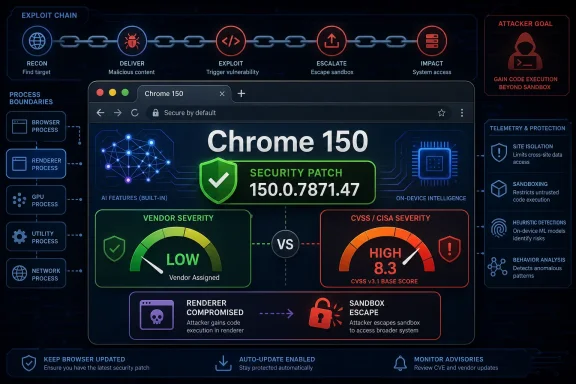 A “Low” Chrome Bug Can Still Describe a Very Bad Day
The apparent contradiction in CVE-2026-14151 is the first thing administrators will notice. Google labels the Chromium security severity as Low, while CISA’s ADP enrichment puts the CVSS 3.1 base score at 8.3, squarely in High territory. That is not necessarily an error; it is a reminder that severity systems answer different questions.Chromium’s severity rating is usually anchored in exploitability within the browser’s own architecture and the preconditions required to reach meaningful impact. In this case, Google’s description says the attacker must already have compromised the renderer process. That is not a trivial starting point. The renderer is the sandboxed process that handles untrusted web content, and Chrome’s entire security model assumes hostile HTML, JavaScript, images, fonts, and media will be thrown at it constantly.
CVSS, by contrast, is designed to express the impact once the described attack path is available. A sandbox escape that follows renderer compromise can cross a security boundary and potentially expose confidentiality, integrity, and availability at a much broader scope. That is why CISA’s vector includes changed scope and high impact across all three classic categories, even while also recording high attack complexity and required user interaction.
The practical read is simple: this is not a “drive-by, one-click full compromise from scratch” bug as described. It is a post-renderer-compromise escape primitive, and those matter because modern browser exploitation is often chained. One bug gets code running inside the renderer; another gets out of jail.
Chrome 150 Was Not a Normal Patch Note
CVE-2026-14151 arrived as one line in a giant Chrome 150 stable-channel update. Google said the release promoted Chrome 150 to stable for Windows, Mac, and Linux, with version 150.0.7871.46 on Linux and 150.0.7871.46/.47 on Windows and Mac. The same release notes said the update included 433 security fixes.That number is easy to skim past because Chrome has normalized huge security releases. But it changes the operational reality for defenders. When a single browser update contains critical use-after-free issues, graphics stack flaws, V8 bugs, policy bypasses, WebNN issues, sandbox-adjacent defects, and AI-related implementation mistakes, the old ritual of reading each CVE as a standalone emergency becomes less useful.
For Windows administrators, the actionable unit is the Chrome build, not the individual CVE. If Chrome is below 150.0.7871.47 on Windows or Mac, the system is missing this fix and many others from the same train. The same logic applies to Chromium-based browsers once their vendors ingest the relevant upstream patches, though version numbers and release timing vary.
The scale of Chrome 150 also explains why bug details remain sparse. Google’s advisory repeats its standard warning that access to bug details and links may remain restricted until a majority of users are updated, and restrictions may persist when a bug affects third-party libraries used elsewhere. That leaves defenders with a narrow public description: the component label, the impact class, the affected version boundary, and the fact that crafted HTML is involved.
That scarcity is not accidental. Publishing a sandbox escape recipe while large portions of the installed base remain unpatched would be irresponsible. But the absence of detail creates a vacuum, and in 2026 that vacuum is quickly filled by automated enrichment systems, vulnerability feeds, and dashboards that may disagree with one another.
The AI Label Is the Signal, Even If the Bug Is Mundane
“Inappropriate implementation in AI” is an awkward phrase, but it is the most interesting part of this CVE. It does not tell us whether the flaw sat in a user-facing AI assistant, a local model interface, an inference-related API, a browser service boundary, or some internal plumbing associated with AI functionality. It only tells us that Chrome’s security taxonomy now has enough AI-adjacent attack surface to classify a sandbox escape bug under that label.That should not surprise anyone watching browser development. Chrome is no longer just a document renderer with a JavaScript engine bolted on. It is a permissions broker, password manager, identity surface, payments surface, graphics engine, media stack, storage platform, WebGPU runtime, WebNN experiment host, enterprise policy endpoint, and increasingly an AI delivery vehicle.
Each new capability creates boundaries. Boundaries create trust assumptions. Trust assumptions create bugs.
The term “AI” also risks misleading readers into imagining something exotic: prompt injection causing arbitrary code execution, a malicious model weight file, or a chatbot hallucinating its way through a security boundary. Nothing in the public CVE description supports that. The safer interpretation is that a Chrome AI-related implementation handled some resource, process, permission, or data transfer incorrectly in a way that mattered after renderer compromise.
That is still important. Browser AI features are likely to touch sensitive data, local context, cloud services, model runtimes, device capabilities, and privileged browser processes. Even if CVE-2026-14151 turns out to be a narrow implementation defect, it belongs to a broader class of risks: AI features are being threaded into products whose security models were built before this layer existed.
The Renderer Is Supposed to Be Hostile Territory
The phrase “attacker who had compromised the renderer process” sounds like a caveat, but it is also the core of modern browser security. Chrome’s multiprocess architecture assumes that untrusted web content may eventually find a way to achieve code execution inside a renderer. The sandbox exists because that assumption is realistic.A renderer compromise by itself is serious, but it is constrained. The attacker is meant to be trapped in a process with limited access to the file system, operating system APIs, credentials, and other browser internals. A sandbox escape is the move from “I control the part of the browser designed to handle hostile content” to “I can reach something I was not supposed to reach.”
That is why security teams care about sandbox escapes even when they are rated Low by the vendor. A standalone escape may not be useful without a first-stage renderer bug. But paired with a memory corruption flaw, a type confusion bug, or a JIT miscompile, it can become the second half of a working exploit chain.
The Chrome 150 release contained plenty of candidates for defenders to worry about at a category level: use-after-free bugs, out-of-bounds reads and writes, insufficient validation, policy enforcement failures, and implementation mistakes across multiple subsystems. The public record does not say CVE-2026-14151 is being exploited, and CISA’s SSVC enrichment listed exploitation as “none.” But lack of known exploitation is not the same as lack of exploit value.
For enterprise environments, the relevant question is not whether this one CVE deserves panic. It is whether the browser update containing it is moving through managed fleets fast enough.
NVD’s Metadata Tells Its Own Story
The NVD record for CVE-2026-14151 is unusually revealing because the change history shows the enrichment process in motion. Chrome submitted the CVE on June 30 with the description, references, and affected product data. NIST then added CWE-669, “Incorrect Resource Transfer Between Spheres,” and a CPE configuration for Google Chrome versions before 150.0.7871.47. CISA’s ADP enrichment later added a CVSS vector, SSVC information, and then revised the CVSS attack complexity from low to high while adding CWE-693, “Protection Mechanism Failure.”This is exactly the kind of record that can confuse automated vulnerability management. A scanner may ingest the first version of the CVSS vector, another may ingest the corrected one, and a dashboard may show the Chrome severity as Low while a risk engine flags the CVSS score as High. Meanwhile, the NVD page itself displays the familiar “CPEs loading” behavior in the web interface even as the change log records an affected Chrome CPE.
The user-facing question — “Are we missing a CPE here?” — is therefore fair but nuanced. Based on the NVD change history, NIST did add a CPE configuration for Google Chrome versions up to but excluding 150.0.7871.47. If the interactive NVD page does not visibly populate the CPE table, that looks more like a presentation, loading, or enrichment-display issue than proof that no CPE exists in the underlying record.
This matters because CPEs are the glue between a CVE and the asset inventory. Without a usable product mapping, vulnerability management platforms can fail in both directions. They can miss exposed systems, or they can overmatch and produce noisy findings for products that are not actually affected.
The Chrome ecosystem makes that harder. Google Chrome has a clear CPE. Chromium-based browsers, embedded WebView components, Electron apps, Linux distribution packages, and downstream vendor builds may all carry relevant code without sharing the same product identifier or update cadence. A clean CPE for Google Chrome is necessary; it is not sufficient.
CISA’s High Score Does Not Overrule Google’s Low Rating
It is tempting to treat the higher number as the “real” severity and the lower vendor label as damage control. That would be too easy. Google and CISA are scoring from different positions, and both views are useful.Google’s Low rating signals that, inside Chromium’s own security triage, this bug likely has meaningful preconditions or limited standalone exploitability. The public description supports that: the attacker must first compromise the renderer process, and the attack requires a crafted HTML page. There is also no public indication of active exploitation.
CISA’s High CVSS score signals that the security boundary being crossed is important and that successful exploitation could have severe consequences. Its revised vector keeps network attack vector and no privileges required, but it includes user interaction and high attack complexity. That is a reasonable shape for a browser-chain bug: hard to exploit reliably, but powerful if chained correctly.
The lesson for patch prioritization is not “ignore Low” or “panic over High.” The lesson is to interpret browser CVEs as part of a release bundle. Chrome’s auto-update model exists because end users cannot be expected to distinguish a renderer-only issue from a sandbox escape from a UI spoofing bug from a GPU memory safety flaw. Administrators should not build patch policy that depends on doing so perfectly either.
In managed Windows environments, the right policy is boring: keep Chrome on the current stable build, verify update completion, and shorten the time between Google’s stable-channel release and fleet compliance. The exciting part of the CVE is the AI label. The operational answer is still patch management.
The Enterprise Risk Is in the Chain, Not the Single Link
Browser exploitation is cumulative. Attackers do not need every bug to be catastrophic on its own; they need compatible primitives. One flaw grants code execution in a renderer. Another weakens IPC validation. Another mishandles a privileged service. Another bypasses a permission boundary. The exploit chain is the product.CVE-2026-14151 is described exactly like a chain component. It does not say an attacker can arrive from the open internet and immediately take over a machine. It says a remote attacker who has already compromised the renderer may potentially perform a sandbox escape. That makes it less dramatic as a standalone CVE and more interesting as part of the browser exploit economy.
This is where AI-related browser features deserve scrutiny. AI assistants and local inference features want context. Context means access: to page content, user intent, browsing state, files, permissions, enterprise data, or cloud-linked identity. Even when the implementation is careful, the feature’s usefulness pushes it toward sensitive boundaries.
For Windows shops, the concern is not merely Chrome as an application. Chrome is often the front door to SaaS identity, admin consoles, password managers, device trust checks, remote work portals, and privileged web apps. A sandbox escape in the browser can therefore become a stepping stone into higher-value workflows even if the underlying OS remains hardened.
That is why browser hardening still matters alongside patching. Site isolation, extension control, Safe Browsing policy, download restrictions, credential protections, endpoint detection, and least-privilege desktop configuration all reduce the blast radius. None of them replaces the patch. They make the attacker’s chain longer and more fragile.
The CPE Question Exposes a Bigger Weakness in Vulnerability Management
The NVD page’s “Are we missing a CPE here?” prompt is almost comic in this context because the record’s change history says a Chrome CPE configuration was added. But it points to a real problem: vulnerability metadata is infrastructure, and infrastructure fails in boring ways.Security teams often treat CVE records as authoritative facts. In practice, they are living documents assembled from vendor submissions, NVD enrichment, CNA records, CISA ADP updates, CWE mappings, CVSS vectors, references, CPE configurations, and downstream interpretations by scanners. A change made hours after publication can alter how a vulnerability is prioritized across thousands of dashboards.
CVE-2026-14151 demonstrates that drift. CISA initially added a CVSS vector with low attack complexity, then removed it and added one with high attack complexity. NIST added one CWE, CISA added another. The CPE appears in the change history, while the web page’s software configuration section may not render it cleanly for every viewer. None of that changes the fact that Chrome before 150.0.7871.47 is affected, but it can change what an organization sees.
The cure is not to abandon NVD or CVSS. It is to stop pretending that one field in one feed is a complete risk decision. For browser vulnerabilities, product version verification should outrank metadata neatness. If the fleet is at or above the fixed build, the exposure is closed for Google Chrome. If it is below the fixed build, arguing over whether the CPE table rendered properly is a distraction.
Downstream Chromium consumers complicate that answer. Microsoft Edge, Brave, Vivaldi, Opera, Electron-based applications, and Linux Chromium packages may require separate tracking by their own advisories and version schemes. The upstream Chrome CVE tells you where the bug entered public view; it does not guarantee every dependent product has already shipped the fix.
Windows Users Should Treat Chrome 150 as a Security Boundary Update
For ordinary Windows users, the advice is blunt: open Chrome’s About page and let the browser update. Chrome normally updates itself, but pending restarts, managed policies, broken update services, and long-lived browser sessions can leave users stranded on older builds. The fixed Windows/Mac version called out by Google is 150.0.7871.47.For administrators, the check should be centralized. Chrome Browser Cloud Management, enterprise software inventory, endpoint management platforms, and EDR telemetry can all report installed versions, but the key is to verify actual process restart. Downloading the update is not the same as running the patched browser.
There is also a timing issue. Google said the stable update would roll out over coming days and weeks. That phrasing is normal for consumer channels, but enterprises should not read it as permission to wait weeks when a release contains hundreds of security fixes. Managed deployment rings can still be staged, but the outer ring should not become a parking lot.
The most defensible approach is a short validation window followed by aggressive rollout. Browser updates can break workflows, and Chrome 150’s breadth makes regression testing sensible. But a browser that processes arbitrary internet content is not a quarterly patch candidate. It is frontline attack surface.
The AI Security Story Is Becoming Ordinary, Which Is the Point
Security coverage of AI often swings between hype and dismissal. Either every AI bug is treated as a new species of cyber doom, or every AI label is waved away as marketing. CVE-2026-14151 deserves a more boring and more useful interpretation: AI is becoming ordinary software, and ordinary software has memory boundaries, permission checks, IPC paths, data flows, and sandbox assumptions.That may be the most important signal in the record. The vulnerability is not described as a model safety failure or a prompt manipulation issue. It is an implementation flaw attached to an AI component that could contribute to a sandbox escape after renderer compromise. In other words, AI has entered the same security pipeline as GPU code, rendering engines, media parsers, and extension systems.
That is good news and bad news. It is good because these bugs are being found, assigned CVEs, patched, and tracked through public advisories. It is bad because AI functionality expands the browser’s trusted computing base at the same time attackers are already skilled at chaining browser primitives.
The industry should resist the urge to invent a separate mystique for every AI vulnerability. The sharper question is architectural: which process owns the AI feature, what privileges does it hold, what data can it read, how does the renderer talk to it, and what validation happens at that boundary? CVE-2026-14151 does not answer those questions publicly, but it tells us exactly where to look.
The Chrome 150 Lesson Fits in One Patch Window
The concrete story here is narrower than the label suggests. Google shipped a Chrome stable update. The update fixed CVE-2026-14151 and hundreds of other vulnerabilities. NVD and CISA enriched the record with mappings and scoring. The public bug details remain restricted. The operational move is to verify Chrome 150.0.7871.47 or later on Windows and Mac.That does not make the CVE unimportant. It makes it a useful case study in how modern browser risk is communicated imperfectly. A Low vendor severity can coexist with a High CVSS score. A CPE can be present in change history while the visible page leaves users wondering. An AI-labeled flaw can be less about sci-fi attacks and more about conventional boundary failure.
The best security teams will read all three layers at once: the vendor release, the enrichment metadata, and the exploit-chain context.
The Patch Notes Are Telling Administrators Where the Browser Is Going
CVE-2026-14151 should leave Windows administrators with a small number of concrete actions rather than a large amount of speculation.- Chrome on Windows and Mac should be updated to 150.0.7871.47 or later, and administrators should verify that users have restarted into the patched build.
- The vulnerability should be treated as a sandbox-escape component that requires prior renderer compromise, not as a publicly documented one-step remote takeover.
- The mismatch between Chromium’s Low severity and CISA’s High CVSS score should be handled as a scoring-context issue, not as proof that one source is useless.
- NVD’s change history indicates that a Google Chrome CPE configuration was added for versions before 150.0.7871.47, even if the visible software configuration panel does not render cleanly for every user.
- Chromium-based browsers and embedded Chromium runtimes should be tracked through their own vendor releases, because the Google Chrome fixed build does not automatically prove downstream coverage.
- AI-related browser features should be reviewed as privileged attack surface, with special attention to process boundaries, permissions, and data access rather than marketing labels.
References
- Primary source: NVD / Chromium
Published: 2026-07-03T07:00:21-07:00
NVD - CVE-2026-14151
 nvd.nist.gov
- Security advisory: MSRC
Published: 2026-07-03T07:00:21-07:00
Original feed URL
Security Update Guide - Microsoft Security Response Center
 msrc.microsoft.com
- Related coverage: cvefeed.io
CVE-2026-14151 - Google Chrome AI Sandbox Escape
Inappropriate implementation in AI in Google Chrome prior to 150.0.7871.47 allowed a remote attacker who had compromised the renderer process to potentially perform a sandbox escape via a crafted HTML page. (Chromium security severity: Low)cvefeed.io - Related coverage: labs.cloudsecurityalliance.org
CSA research note nist nvd riskbased enrichment governance 20260426 csa styled
PDF documentlabs.cloudsecurityalliance.org
