

Google Chrome versions before 150.0.7871.47 contain CVE-2026-13937, a medium-severity Passwords component flaw disclosed June 30, 2026, that can let a remote attacker leak cross-origin data after first compromising Chrome’s renderer process. The vulnerability is not the clean, one-click password theft scenario that its component name may suggest. It is more interesting—and more useful to defenders—because it shows how Chrome’s security model can still be pried open at the seams when a renderer bug is chained with a policy enforcement mistake in a privileged browser feature. As reflected in the NVD entry, CISA’s ADP enrichment, and Google’s Chrome release notes, this is a patch-now issue rather than a panic-now issue.
The phrase “Insufficient policy enforcement in Passwords” sounds narrow, almost clerical. In browser security, however, policy enforcement is the machinery that decides which web origin gets to see which data, which frames can talk to which services, and which browser-side features are safe to expose to content that arrived from the internet.
CVE-2026-13937 lives in that gray area between a webpage and the browser services that make modern Chrome useful. The affected component is Passwords, but the described impact is not simply “saved passwords are dumped.” The public description says a remote attacker who had already compromised the renderer process could leak cross-origin data using a crafted HTML page.
That prerequisite matters. Chrome’s renderer process is the part of the browser that handles web content, and Google has spent years trying to assume that renderers will eventually be compromised. Site Isolation, sandboxing, process separation, and origin checks all exist because arbitrary HTML, JavaScript, images, fonts, and media are a hostile input stream wearing a consumer-friendly face.
The bug therefore sits in the second act of an attack chain. First, the attacker needs a way to compromise or meaningfully control the renderer. Then CVE-2026-13937 can become the bridge from “I can run inside the web-content box” to “I can obtain data that should belong to another origin.” That does not make it harmless. It makes it the kind of vulnerability that matters most when paired with something uglier.
Google’s Chromium severity rating is Medium, and NVD had not yet assigned its own CVSS score at the time reflected in the provided entry. That lack of final NVD scoring is normal early in a CVE’s lifecycle and should not be mistaken for uncertainty about whether the bug exists. Chrome, as the CVE numbering authority source here, has already supplied the core description and affected version range.
The more important operational signal is CISA’s SSVC enrichment. It lists exploitation as “none,” automation as “no,” and technical impact as “partial.” In plain English, there is no public indication in the provided record that this is being actively exploited, the attack is not assessed as easily automatable, and the consequence is limited rather than total compromise.
That is the difference between an emergency fire drill and a disciplined patch cycle. Enterprises should not freeze rollouts waiting for perfect exploit details, but neither should they treat this like a Chrome zero-day already loose in watering-hole attacks. The right response is accelerated validation and deployment, especially on endpoints that handle sensitive web sessions.
Instead, the attacker must already have compromised the renderer process. That phrase often appears in Chrome CVEs because Chrome’s architecture assumes a hostile web and tries to contain damage when a renderer is taken over. The browser process, privileged services, and site boundaries are supposed to keep a compromised renderer from becoming a general-purpose data vacuum.
CVE-2026-13937 suggests that one of those checks failed in the Passwords path. The bug is cataloged as CWE-284, Improper Access Control, which fits the story: the wrong actor could get access to data that a properly enforced policy should have withheld.
This is why “medium” browser bugs can be strategically valuable to attackers. A renderer compromise may come from a separate V8, WebAssembly, graphics, media, or DOM flaw. Once inside that renderer, the attacker wants ways to widen the blast radius. A cross-origin leak bug in a sensitive browser service is not the front door; it is the unlocked interior door after the burglar is already in the building.
The web’s same-origin policy was designed to prevent one site from reading another site’s data. Browser password managers complicate that principle because they must detect when a page is eligible for saved credentials and when it is not. They must distinguish legitimate login fields from lookalikes, embedded frames from top-level origins, and user-approved flows from hostile scripts.
That is hard engineering. The browser must be helpful enough that users do not abandon strong unique passwords, but strict enough that a malicious page cannot trick it into exposing data from somewhere else. CVE-2026-13937 is a reminder that convenience features are security features once they touch credentials.
For sysadmins, the lesson is not necessarily “disable Chrome passwords everywhere.” That may simply push users toward worse behavior, including password reuse, unmanaged extensions, personal vaults, browser profile sprawl, or the oldest enterprise credential store of all: a sticky note. The better lesson is that browser-integrated password storage must be treated as part of the endpoint security surface, governed by policy, monitored for update compliance, and understood as a high-value component.
For WindowsForum readers, the practical implication is boring in the best possible way. If Chrome reports 150.0.7871.47 or later, this specific vulnerability is addressed. If it reports anything earlier, it should be considered exposed to this flaw.
Chrome’s release model can still introduce friction. Updates roll out over time, enterprises often stage deployment rings, and managed environments sometimes pin browser versions to avoid breaking line-of-business applications. That is understandable, but it is also where “we have auto-update” can become a false sense of security.
Administrators should verify the installed version, not just the policy intention. On Windows fleets, that means checking management tooling, endpoint inventory, or registry-reported Chrome versions. On unmanaged or lightly managed systems, it means making sure users have actually relaunched Chrome after the update downloaded, because Chrome often completes the update only after restart.
That is the expected CPE for Google Chrome as an application. If the question is whether the NVD entry should include Chrome itself, the answer appears to be no, not anymore; the Chrome CPE has been added. If the question is whether downstream Chromium-based browsers should also receive CPE mappings, that is more complicated.
Microsoft Edge, Brave, Vivaldi, Opera, and other Chromium-derived browsers share substantial upstream code, but a Chrome CVE entry does not automatically prove each downstream product is affected in the same way, on the same schedule, or with the same version boundary. Vendors may have carried the vulnerable code, modified it, disabled a feature, patched it independently, or shipped the Chromium fix under their own advisory cadence.
That distinction matters for scanners. A vulnerability management platform that maps CVE-2026-13937 only to Google Chrome may miss exposure in a Chromium-derived browser if the downstream vendor later confirms impact. But adding every Chromium browser speculatively can create false positives. The correct posture is to track vendor advisories for each deployed browser, not to assume the Chrome CPE is the entire universe of risk.
But “Chromium-based” is not the same as “automatically affected with identical versioning.” Microsoft ships Edge on its own stable channel, with its own version numbers and advisories. If the vulnerable Passwords component code was present in Edge, Microsoft would typically address it through an Edge stable update and document the relevant Chromium CVEs in its release notes or security update guidance.
That is why administrators should avoid two lazy answers. The first lazy answer is “this is Chrome-only, ignore Edge.” The second is “all Chromium browsers are definitely affected, report them all as vulnerable.” Neither is good enough for compliance or operational security.
The useful middle ground is inventory-driven. Know which Chromium-family browsers are installed, map each to its vendor’s fixed release, and use policy to prevent unsupported browser drift. In 2026, browser sprawl is not a convenience issue; it is an attack-surface management problem.
Browser vulnerabilities age strangely. Some are never exploited because the prerequisite chain is too hard, the bug is too narrow, or the patch diff does not reveal a useful path. Others become more interesting after researchers compare the fix, infer the vulnerable logic, and pair it with another bug.
The public Chromium issue linked from the CVE is marked in a way that requires permissions, which is also normal for security-sensitive bugs. Google often restricts detailed bug tracker access until users have had time to patch. That protects users, but it also means defenders are operating from a compressed public description rather than a full technical write-up.
The absence of a proof-of-concept should influence prioritization, not excuse inaction. If a fleet is already running current Chrome, there is no special incident response step implied by the public data. If a fleet is behind, the correct move is to close the gap before someone else explains the bug more thoroughly.
Modern browsers have added layers around that treaty. Site Isolation tries to separate origins into different processes. SameSite cookie changes reduce ambient credential leakage. Cross-Origin Resource Policy, Cross-Origin Opener Policy, and Cross-Origin Embedder Policy give sites more ways to wall themselves off. Sandboxing and permission prompts limit what hostile content can do even if the user lands on the wrong page.
Yet a browser is still a huge compatibility engine, and compatibility is where purity goes to negotiate. Password managers, autofill, payment handlers, federated login, sync, extension APIs, enterprise policies, and accessibility features all need carefully controlled exceptions to simple isolation rules. Every exception becomes a place where a policy check can be incomplete, stale, or subtly wrong.
CVE-2026-13937 is not evidence that Chrome’s architecture has failed. It is evidence that the architecture is under constant pressure from features that users and enterprises demand. Security boundaries do not merely exist; they have to be reasserted in every component that reaches across them.
A medium-severity Chrome bug can be less dangerous than a high-severity bug on paper, but the difference collapses if the medium bug is patched quickly and the high bug sits unpatched for weeks. Attackers do not need the most elegant vulnerability. They need the vulnerability that remains available on the targets they care about.
For managed Windows environments, the operational questions are familiar. Are Chrome updates allowed to install promptly? Are relaunch prompts enforced? Are update deferrals documented and time-limited? Are users running per-user Chrome installs outside enterprise control? Are packaged application catalogs keeping pace with Google’s stable channel?
Those questions are not glamorous, but they are where browser security succeeds or fails. A fleet that can move from vulnerable Chrome to fixed Chrome within a few days is in a different risk category from a fleet that discovers old browsers during quarterly scans.
It is a story about credential-adjacent browser state. Cross-origin data leakage can expose information that helps an attacker understand a session, target a user, or chain into additional compromise. Depending on the exact data reachable through the flawed path, the value may range from modest metadata to highly sensitive information.
The public description does not say that stored passwords themselves are directly extractable. Responsible coverage should not inflate the bug into “Chrome leaked all passwords.” But neither should it minimize the Passwords component label into a harmless implementation footnote. Anything near credential handling deserves attention because attackers assemble campaigns from partial signals.
Enterprise password policy should therefore focus less on panic-disabling and more on layered containment. Managed password managers, enterprise vaults, phishing-resistant authentication, conditional access, device health checks, and rapid browser updates all reduce the value of any one browser-side leak.
That timeline is normal, but it has consequences. Security tools ingest NVD, vendor feeds, CISA data, EPSS, commercial intelligence, and their own detection logic on different schedules. One scanner may flag Chrome immediately based on version comparison. Another may wait for NVD CPE enrichment. A third may surface the CVE but lack reliable affected software matching until its next content update.
This is why administrators should not treat a quiet dashboard as proof of safety during the first days after a browser advisory. For a widely deployed application like Chrome, direct version inventory is often more reliable than waiting for the vulnerability scanner to settle. If the fleet is below 150.0.7871.47, the fleet is behind for this CVE.
The inverse is also true. If a scanner continues to report CVE-2026-13937 against Chrome 150.0.7871.47 or later, the finding may be stale, based on an alternate install path, or confused by multiple Chrome channels on the same machine. Browser inventory must account for Stable, Beta, Dev, Canary, user-level installs, system-level installs, and portable or embedded Chromium runtimes.
CVE-2026-13937 is most concerning when paired with a renderer compromise. That could be a separate Chrome vulnerability, a bug in a dependency, a malicious extension path, or a carefully crafted web attack that puts the renderer in a compromised state. Once that condition is met, a cross-origin data leak becomes a privilege expansion within the browser’s data universe.
This is why the vulnerability’s lack of integrity and availability impact should not lull defenders. Confidentiality-only bugs can still be powerful when they reveal session-related data, origin-protected content, or information that helps bypass other controls. In browser exploitation, reading the right thing can be as useful as writing the wrong thing.
The strongest practical defense remains boringly layered. Keep Chrome updated, reduce exposure to risky content, control extensions, enforce modern authentication, and isolate sensitive administrative work from general browsing. No single control makes renderer compromise impossible, but layered controls make the chain harder to complete.
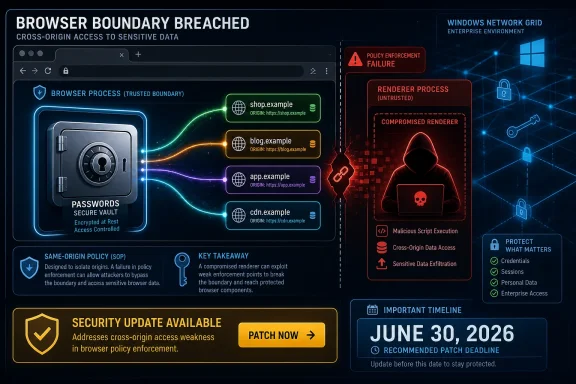 Chrome’s Passwords Bug Is Really a Boundary Bug
The phrase “Insufficient policy enforcement in Passwords” sounds narrow, almost clerical. In browser security, however, policy enforcement is the machinery that decides which web origin gets to see which data, which frames can talk to which services, and which browser-side features are safe to expose to content that arrived from the internet.CVE-2026-13937 lives in that gray area between a webpage and the browser services that make modern Chrome useful. The affected component is Passwords, but the described impact is not simply “saved passwords are dumped.” The public description says a remote attacker who had already compromised the renderer process could leak cross-origin data using a crafted HTML page.
That prerequisite matters. Chrome’s renderer process is the part of the browser that handles web content, and Google has spent years trying to assume that renderers will eventually be compromised. Site Isolation, sandboxing, process separation, and origin checks all exist because arbitrary HTML, JavaScript, images, fonts, and media are a hostile input stream wearing a consumer-friendly face.
The bug therefore sits in the second act of an attack chain. First, the attacker needs a way to compromise or meaningfully control the renderer. Then CVE-2026-13937 can become the bridge from “I can run inside the web-content box” to “I can obtain data that should belong to another origin.” That does not make it harmless. It makes it the kind of vulnerability that matters most when paired with something uglier.
Medium Severity Does Not Mean Marginal Risk
CISA’s ADP scoring gives CVE-2026-13937 a CVSS 3.1 base score of 6.5, with network attack vector, low attack complexity, no privileges required, user interaction required, unchanged scope, high confidentiality impact, and no integrity or availability impact. That profile tells a very specific story. The bug is reachable remotely through browsing, but the user still has to be induced into interacting with malicious content, and the primary damage is data exposure rather than code execution or system takeover.Google’s Chromium severity rating is Medium, and NVD had not yet assigned its own CVSS score at the time reflected in the provided entry. That lack of final NVD scoring is normal early in a CVE’s lifecycle and should not be mistaken for uncertainty about whether the bug exists. Chrome, as the CVE numbering authority source here, has already supplied the core description and affected version range.
The more important operational signal is CISA’s SSVC enrichment. It lists exploitation as “none,” automation as “no,” and technical impact as “partial.” In plain English, there is no public indication in the provided record that this is being actively exploited, the attack is not assessed as easily automatable, and the consequence is limited rather than total compromise.
That is the difference between an emergency fire drill and a disciplined patch cycle. Enterprises should not freeze rollouts waiting for perfect exploit details, but neither should they treat this like a Chrome zero-day already loose in watering-hole attacks. The right response is accelerated validation and deployment, especially on endpoints that handle sensitive web sessions.
The Renderer Prerequisite Is the Whole Plot
The renderer-process condition is the key to understanding both the danger and the limits of CVE-2026-13937. A standalone web page should not, by itself, be able to ask Chrome’s Passwords subsystem for cross-origin data. If it could, the severity would likely be much higher and the language in the advisory would be more alarming.Instead, the attacker must already have compromised the renderer process. That phrase often appears in Chrome CVEs because Chrome’s architecture assumes a hostile web and tries to contain damage when a renderer is taken over. The browser process, privileged services, and site boundaries are supposed to keep a compromised renderer from becoming a general-purpose data vacuum.
CVE-2026-13937 suggests that one of those checks failed in the Passwords path. The bug is cataloged as CWE-284, Improper Access Control, which fits the story: the wrong actor could get access to data that a properly enforced policy should have withheld.
This is why “medium” browser bugs can be strategically valuable to attackers. A renderer compromise may come from a separate V8, WebAssembly, graphics, media, or DOM flaw. Once inside that renderer, the attacker wants ways to widen the blast radius. A cross-origin leak bug in a sensitive browser service is not the front door; it is the unlocked interior door after the burglar is already in the building.
Password Managers Sit at the Most Awkward Trust Boundary
Chrome’s built-in password manager is not just another form-fill convenience. It is a browser-integrated credential broker that watches origins, login forms, saved credentials, sync state, user gestures, and autofill policy. That makes it powerful, useful, and inevitably risky.The web’s same-origin policy was designed to prevent one site from reading another site’s data. Browser password managers complicate that principle because they must detect when a page is eligible for saved credentials and when it is not. They must distinguish legitimate login fields from lookalikes, embedded frames from top-level origins, and user-approved flows from hostile scripts.
That is hard engineering. The browser must be helpful enough that users do not abandon strong unique passwords, but strict enough that a malicious page cannot trick it into exposing data from somewhere else. CVE-2026-13937 is a reminder that convenience features are security features once they touch credentials.
For sysadmins, the lesson is not necessarily “disable Chrome passwords everywhere.” That may simply push users toward worse behavior, including password reuse, unmanaged extensions, personal vaults, browser profile sprawl, or the oldest enterprise credential store of all: a sticky note. The better lesson is that browser-integrated password storage must be treated as part of the endpoint security surface, governed by policy, monitored for update compliance, and understood as a high-value component.
The Patch Line Is Clear, Even if the Exploit Story Is Not
The affected version range is straightforward: Google Chrome before 150.0.7871.47 is vulnerable. NVD’s change history says NIST added a CPE configuration for Google Chrome versions up to, but excluding, 150.0.7871.47, and the original CVE data from Chrome identifies that same threshold.For WindowsForum readers, the practical implication is boring in the best possible way. If Chrome reports 150.0.7871.47 or later, this specific vulnerability is addressed. If it reports anything earlier, it should be considered exposed to this flaw.
Chrome’s release model can still introduce friction. Updates roll out over time, enterprises often stage deployment rings, and managed environments sometimes pin browser versions to avoid breaking line-of-business applications. That is understandable, but it is also where “we have auto-update” can become a false sense of security.
Administrators should verify the installed version, not just the policy intention. On Windows fleets, that means checking management tooling, endpoint inventory, or registry-reported Chrome versions. On unmanaged or lightly managed systems, it means making sure users have actually relaunched Chrome after the update downloaded, because Chrome often completes the update only after restart.
The CPE Question Looks Mostly Answered
The user-facing NVD text asks, “Are we missing a CPE here?” In this case, based on the change history supplied, NIST added the relevant CPE configuration on July 2, 2026:cpe:2.3:a:google:chrome:*:*:*:*:*:*:*:* for versions up to but excluding 150.0.7871.47.That is the expected CPE for Google Chrome as an application. If the question is whether the NVD entry should include Chrome itself, the answer appears to be no, not anymore; the Chrome CPE has been added. If the question is whether downstream Chromium-based browsers should also receive CPE mappings, that is more complicated.
Microsoft Edge, Brave, Vivaldi, Opera, and other Chromium-derived browsers share substantial upstream code, but a Chrome CVE entry does not automatically prove each downstream product is affected in the same way, on the same schedule, or with the same version boundary. Vendors may have carried the vulnerable code, modified it, disabled a feature, patched it independently, or shipped the Chromium fix under their own advisory cadence.
That distinction matters for scanners. A vulnerability management platform that maps CVE-2026-13937 only to Google Chrome may miss exposure in a Chromium-derived browser if the downstream vendor later confirms impact. But adding every Chromium browser speculatively can create false positives. The correct posture is to track vendor advisories for each deployed browser, not to assume the Chrome CPE is the entire universe of risk.
Windows Shops Should Watch Edge Without Collapsing the Distinction
For a Windows audience, the obvious follow-up is Microsoft Edge. Edge is Chromium-based, and many enterprise environments standardize on Edge because it integrates with Microsoft 365, Entra ID, Intune, Defender, Windows Update controls, and legacy Internet Explorer mode policies.But “Chromium-based” is not the same as “automatically affected with identical versioning.” Microsoft ships Edge on its own stable channel, with its own version numbers and advisories. If the vulnerable Passwords component code was present in Edge, Microsoft would typically address it through an Edge stable update and document the relevant Chromium CVEs in its release notes or security update guidance.
That is why administrators should avoid two lazy answers. The first lazy answer is “this is Chrome-only, ignore Edge.” The second is “all Chromium browsers are definitely affected, report them all as vulnerable.” Neither is good enough for compliance or operational security.
The useful middle ground is inventory-driven. Know which Chromium-family browsers are installed, map each to its vendor’s fixed release, and use policy to prevent unsupported browser drift. In 2026, browser sprawl is not a convenience issue; it is an attack-surface management problem.
“No Known Exploitation” Is a Snapshot, Not a Shield
CISA’s enrichment says exploitation is “none,” which is good news. It means defenders are not starting from a public position of known in-the-wild abuse. But that field is not a magical property of the vulnerability; it is an assessment at a point in time.Browser vulnerabilities age strangely. Some are never exploited because the prerequisite chain is too hard, the bug is too narrow, or the patch diff does not reveal a useful path. Others become more interesting after researchers compare the fix, infer the vulnerable logic, and pair it with another bug.
The public Chromium issue linked from the CVE is marked in a way that requires permissions, which is also normal for security-sensitive bugs. Google often restricts detailed bug tracker access until users have had time to patch. That protects users, but it also means defenders are operating from a compressed public description rather than a full technical write-up.
The absence of a proof-of-concept should influence prioritization, not excuse inaction. If a fleet is already running current Chrome, there is no special incident response step implied by the public data. If a fleet is behind, the correct move is to close the gap before someone else explains the bug more thoroughly.
The Web’s Oldest Rule Keeps Getting Tested
Cross-origin data leakage is one of the oldest and most persistent classes of browser failure because the web is built on mutually suspicious documents sharing a single user agent. Your bank, webmail, intranet portal, ad network, SaaS dashboard, and malicious tab all coexist in the same browser session. The same-origin policy is the treaty that keeps that arrangement from collapsing.Modern browsers have added layers around that treaty. Site Isolation tries to separate origins into different processes. SameSite cookie changes reduce ambient credential leakage. Cross-Origin Resource Policy, Cross-Origin Opener Policy, and Cross-Origin Embedder Policy give sites more ways to wall themselves off. Sandboxing and permission prompts limit what hostile content can do even if the user lands on the wrong page.
Yet a browser is still a huge compatibility engine, and compatibility is where purity goes to negotiate. Password managers, autofill, payment handlers, federated login, sync, extension APIs, enterprise policies, and accessibility features all need carefully controlled exceptions to simple isolation rules. Every exception becomes a place where a policy check can be incomplete, stale, or subtly wrong.
CVE-2026-13937 is not evidence that Chrome’s architecture has failed. It is evidence that the architecture is under constant pressure from features that users and enterprises demand. Security boundaries do not merely exist; they have to be reasserted in every component that reaches across them.
Patch Management Is Still the Enterprise Browser Control That Matters Most
There is a temptation in enterprise security to respond to every browser CVE with a new hardening checklist. Disable this feature, block that API, enforce this flag, audit that extension. Some of that is valuable, but CVE-2026-13937 mostly reinforces an older truth: browser patch velocity is the control that wins most often.A medium-severity Chrome bug can be less dangerous than a high-severity bug on paper, but the difference collapses if the medium bug is patched quickly and the high bug sits unpatched for weeks. Attackers do not need the most elegant vulnerability. They need the vulnerability that remains available on the targets they care about.
For managed Windows environments, the operational questions are familiar. Are Chrome updates allowed to install promptly? Are relaunch prompts enforced? Are update deferrals documented and time-limited? Are users running per-user Chrome installs outside enterprise control? Are packaged application catalogs keeping pace with Google’s stable channel?
Those questions are not glamorous, but they are where browser security succeeds or fails. A fleet that can move from vulnerable Chrome to fixed Chrome within a few days is in a different risk category from a fleet that discovers old browsers during quarterly scans.
Password Policy Should Not Be Confused With Password Hygiene
Because this bug sits in the Passwords component, it is easy to veer into a generic sermon about password hygiene. That misses the point. Users should still use strong, unique passwords, and organizations should still prefer phishing-resistant MFA where possible, but CVE-2026-13937 is not primarily a story about weak passwords.It is a story about credential-adjacent browser state. Cross-origin data leakage can expose information that helps an attacker understand a session, target a user, or chain into additional compromise. Depending on the exact data reachable through the flawed path, the value may range from modest metadata to highly sensitive information.
The public description does not say that stored passwords themselves are directly extractable. Responsible coverage should not inflate the bug into “Chrome leaked all passwords.” But neither should it minimize the Passwords component label into a harmless implementation footnote. Anything near credential handling deserves attention because attackers assemble campaigns from partial signals.
Enterprise password policy should therefore focus less on panic-disabling and more on layered containment. Managed password managers, enterprise vaults, phishing-resistant authentication, conditional access, device health checks, and rapid browser updates all reduce the value of any one browser-side leak.
Scanner Output Will Lag the Real World
NVD’s change history is a useful reminder that vulnerability data is not born fully formed. The CVE arrived from Chrome on June 30, 2026. CISA-ADP added CVSS, CWE, and SSVC enrichment on July 2. NIST added CPE configuration and reference typing the same day.That timeline is normal, but it has consequences. Security tools ingest NVD, vendor feeds, CISA data, EPSS, commercial intelligence, and their own detection logic on different schedules. One scanner may flag Chrome immediately based on version comparison. Another may wait for NVD CPE enrichment. A third may surface the CVE but lack reliable affected software matching until its next content update.
This is why administrators should not treat a quiet dashboard as proof of safety during the first days after a browser advisory. For a widely deployed application like Chrome, direct version inventory is often more reliable than waiting for the vulnerability scanner to settle. If the fleet is below 150.0.7871.47, the fleet is behind for this CVE.
The inverse is also true. If a scanner continues to report CVE-2026-13937 against Chrome 150.0.7871.47 or later, the finding may be stale, based on an alternate install path, or confused by multiple Chrome channels on the same machine. Browser inventory must account for Stable, Beta, Dev, Canary, user-level installs, system-level installs, and portable or embedded Chromium runtimes.
The Real Risk Is the Chain, Not the Single CVE
Security teams tend to track vulnerabilities as individual records because CVEs are how vendors, scanners, dashboards, and auditors communicate. Attackers do not think that way. They think in chains.CVE-2026-13937 is most concerning when paired with a renderer compromise. That could be a separate Chrome vulnerability, a bug in a dependency, a malicious extension path, or a carefully crafted web attack that puts the renderer in a compromised state. Once that condition is met, a cross-origin data leak becomes a privilege expansion within the browser’s data universe.
This is why the vulnerability’s lack of integrity and availability impact should not lull defenders. Confidentiality-only bugs can still be powerful when they reveal session-related data, origin-protected content, or information that helps bypass other controls. In browser exploitation, reading the right thing can be as useful as writing the wrong thing.
The strongest practical defense remains boringly layered. Keep Chrome updated, reduce exposure to risky content, control extensions, enforce modern authentication, and isolate sensitive administrative work from general browsing. No single control makes renderer compromise impossible, but layered controls make the chain harder to complete.
The Patch Is Small; the Browser Governance Lesson Is Not
This CVE is not a reason to declare Chrome unsafe or to abandon browser password managers wholesale. It is a reason to treat the browser as a managed, security-critical platform rather than a user preference.- Chrome installations should be updated to 150.0.7871.47 or later to address CVE-2026-13937.
- The vulnerability requires a compromised renderer process, which makes it more likely to matter as part of an exploit chain than as a standalone attack.
- The known public impact is cross-origin data leakage, not confirmed direct theft of all saved passwords.
- NVD’s Chrome CPE mapping appears to have been added on July 2, 2026, covering Google Chrome versions before 150.0.7871.47.
- Chromium-derived browsers should be tracked through their own vendor advisories instead of assumed safe or assumed vulnerable without confirmation.
- Enterprises should verify installed browser versions directly, because update policy and actual endpoint state often diverge.
References
- Primary source: NVD / Chromium
Published: 2026-07-03T07:00:46-07:00
NVD - CVE-2026-13937
 nvd.nist.gov
- Security advisory: MSRC
Published: 2026-07-03T07:00:46-07:00
Original feed URL
Security Update Guide - Microsoft Security Response Center
 msrc.microsoft.com
- Related coverage: cvefeed.io
CVE-2026-13937 - Google Chrome Cross-Origin Data Leak
Insufficient policy enforcement in Passwords in Google Chrome prior to 150.0.7871.47 allowed a remote attacker who had compromised the renderer process to leak cross-origin data via a crafted HTML page. (Chromium security severity: Medium)cvefeed.io - Related coverage: vuldb.com
CVE-2026-13937 Google Chrome Passwords cross-domain policy (ID 513046)
A security flaw has been discovered in Google Chrome. This vulnerability is known as CVE-2026-13937. It is recommended to upgrade the affected component.vuldb.com - Related coverage: radar.offseq.com
CVE-2026-14037: Insufficient policy enforcement in Google Chrome - Live Threat Intelligence - Threat Radar | OffSeq.com
Detailed information about CVE-2026-14037: Insufficient policy enforcement in Google Chrome affecting Google Chrome. Get real-time updates, technical details, aradar.offseq.com
