

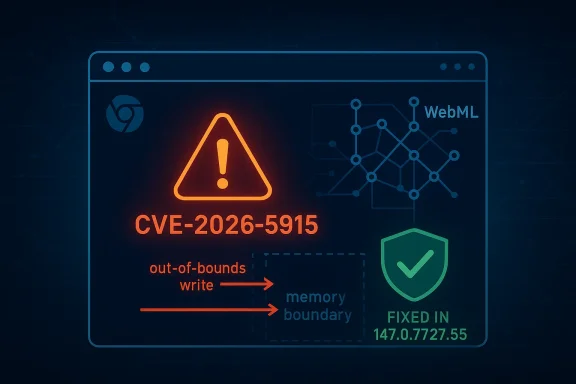
Chrome has shipped a fix for CVE-2026-5915, a WebML memory-corruption flaw that could let a remote attacker trigger an out-of-bounds memory write by luring a victim to a crafted HTML page. The bug affects Google Chrome versions prior to 147.0.7727.55, and it is now appearing in Microsoft’s security guidance as part of the broader Chromium ecosystem risk picture. Although Chromium rates the issue Low severity, the exploit shape matters: browser bugs that start as “just” malformed input handling can still become serious if they provide a stable primitive for exploitation.
The core issue in WebML is straightforward to describe and difficult to get wrong in a way that is safe at scale: browser code ingests untrusted content, translates it into internal structures, and then must ensure every value is validated before it influences memory access or write operations. When that validation slips, the browser can be pushed into writing beyond the bounds of allocated memory, which is the kind of bug attackers prize because it can be paired with a second flaw to gain code execution. The public record for CVE-2026-5915 says the condition was reachable via a crafted HTML page and involved insufficient validation of untrusted input in WebML.
This disclosure lands at a moment when Chrome’s security cadence is moving quickly. Google’s release notes show that the stable channel has already been climbing through version 147 builds during April 2026, with early-stable and stable updates arriving in close succession. That matters because browser patch windows are often short, and attackers tend to measure their opportunity in days, not weeks.
There is also an important distinction between vendor severity labels and practical security impact. Chromium’s own severity classification for this issue is Low, but the ADP-enriched vector shown by NVD-style records indicates a network-reachable issue requiring user interaction with high potential impact on integrity and availability. In plain English: the bug may not be the most dangerous category on paper, yet it still sits in a class of flaws that security teams treat seriously because it lives in a ubiquitous attack surface.
A final point worth stressing is that Microsoft’s Update Guide now tracks this CVE for customers who consume Chromium-derived risk through enterprise tooling and browser management workflows. That does not mean Microsoft invented the vulnerability or fixed it directly; rather, it reflects the reality that Chrome and Chromium issues increasingly affect Windows environments through browser fleets, managed desktop baselines, and security monitoring platforms.
The reported flaw is an out-of-bounds memory write, which is usually more concerning than a simple crash. A crash can be a denial of service; a write primitive can be the foundation for control-flow hijacking if the attacker can shape adjacent memory or combine it with other weaknesses. Even when a vendor says the severity is low, defenders should read the word memory write as a warning sign.
Key implications include:
That is why organizations should be careful not to confuse the label with the operational urgency. A low-severity browser bug can still be important if it is remotely reachable, easy to trigger, or likely to be paired with a second-stage exploit. Low severity in a release note is not the same thing as low value to attackers.
The public change history associated with the CVE indicates that the vulnerability became part of the record on April 8, 2026 and was modified the next day. In the browser security ecosystem, that kind of timing often means defenders get a short runway before exploit research, proof-of-concept work, or copycat analysis begins.
A better approach is to verify:
This class of issue is especially interesting in browser exploitation because attackers do not always need a perfect primitive. They need a repeatable one that can be chained with heap manipulation, corruption of neighboring objects, or a separate out-of-bounds read that reveals layout information. Repeatability is often the more dangerous property than severity labels suggest.
Important defensive observations:
The lesson is not that WebML should disappear. The lesson is that every new platform primitive must be treated as a security boundary, especially when it interacts with untrusted web content. If the browser promises developers powerful capabilities, it also inherits the duty to make those capabilities resilient against hostile inputs.
Relevant takeaways:
That is particularly relevant in Windows-managed fleets where browser updates may lag behind operating system patching. Security teams may spend more time on Patch Tuesday Windows updates and less time auditing browser versions, but attackers know the browser is often the faster route to execution. The browser is the workstation’s soft underbelly.
Consumers should also remember that Chrome is not the only browser in the Chromium family. If another browser or application embeds Chromium components, it may inherit similar risk patterns even if the exact versioning differs. Shared engine, shared exposure is a useful mental model.
What matters most is that a browser-facing bug like this can become a research target quickly after disclosure. Once a CVE number is public, exploit developers, security vendors, and threat intelligence teams all begin examining the same underlying code paths. That means defenders should assume a noisy period of analysis even if no exploit is publicly confirmed.
Another issue is uptake. Chrome’s update machinery is fast, but not every environment benefits from that speed equally. Enterprise management, virtual desktops, and devices with restricted internet access can all slow deployment, which is why exposure tracking should continue after the patch is released rather than stopping at publication.
What to monitor next:
Source: NVD / Chromium Security Update Guide - Microsoft Security Response Center
 Overview
The core issue in WebML is straightforward to describe and difficult to get wrong in a way that is safe at scale: browser code ingests untrusted content, translates it into internal structures, and then must ensure every value is validated before it influences memory access or write operations. When that validation slips, the browser can be pushed into writing beyond the bounds of allocated memory, which is the kind of bug attackers prize because it can be paired with a second flaw to gain code execution. The public record for CVE-2026-5915 says the condition was reachable via a crafted HTML page and involved insufficient validation of untrusted input in WebML.This disclosure lands at a moment when Chrome’s security cadence is moving quickly. Google’s release notes show that the stable channel has already been climbing through version 147 builds during April 2026, with early-stable and stable updates arriving in close succession. That matters because browser patch windows are often short, and attackers tend to measure their opportunity in days, not weeks.
There is also an important distinction between vendor severity labels and practical security impact. Chromium’s own severity classification for this issue is Low, but the ADP-enriched vector shown by NVD-style records indicates a network-reachable issue requiring user interaction with high potential impact on integrity and availability. In plain English: the bug may not be the most dangerous category on paper, yet it still sits in a class of flaws that security teams treat seriously because it lives in a ubiquitous attack surface.
A final point worth stressing is that Microsoft’s Update Guide now tracks this CVE for customers who consume Chromium-derived risk through enterprise tooling and browser management workflows. That does not mean Microsoft invented the vulnerability or fixed it directly; rather, it reflects the reality that Chrome and Chromium issues increasingly affect Windows environments through browser fleets, managed desktop baselines, and security monitoring platforms.
What the Vulnerability Means
CVE-2026-5915 is not a typical logic bug; it is a memory safety problem exposed through the browser’s machine-learning stack. In practical terms, WebML is part of the modern web platform’s push to let web applications use advanced computation paths inside the browser, but that power comes with a larger and more complex attack surface. Whenever untrusted page content can influence ML-related parsing or execution paths, validation becomes the difference between safe computation and memory corruption.Why WebML is a sensitive target
WebML-style features are designed to be fast, flexible, and accessible to web developers, which makes them attractive targets for exploit developers as well. Complex data paths often mean more opportunities for edge cases, especially when content can be constructed by an attacker and delivered through a page the victim merely visits. That is the classic browser threat model: no installation, no privilege, just a page load.The reported flaw is an out-of-bounds memory write, which is usually more concerning than a simple crash. A crash can be a denial of service; a write primitive can be the foundation for control-flow hijacking if the attacker can shape adjacent memory or combine it with other weaknesses. Even when a vendor says the severity is low, defenders should read the word memory write as a warning sign.
Key implications include:
- The bug sits in a high-value browser code path.
- The attack can be launched with a crafted HTML page.
- The issue is in input validation, a recurring source of browser vulnerabilities.
- The most dangerous outcome is not the bug alone, but how it could combine with other flaws.
Why “Low” does not mean “ignore it”
Security labels are contextual. Chromium’s “Low” reflects the project’s internal prioritization model, not the absence of risk for users or enterprises. Browser exploit chains frequently begin with a lower-severity component flaw and escalate through sandbox escapes, renderer bugs, or memory grooming techniques.That is why organizations should be careful not to confuse the label with the operational urgency. A low-severity browser bug can still be important if it is remotely reachable, easy to trigger, or likely to be paired with a second-stage exploit. Low severity in a release note is not the same thing as low value to attackers.
Release Timing and Patch Context
Google’s Chrome release stream around April 2026 shows a browser on a rapid stable-channel cadence, with version 147 builds progressing through early-stable and stable updates. The fix for CVE-2026-5915 is tied to 147.0.7727.55, which means organizations should treat any browser build earlier than that as potentially exposed until confirmed otherwise.The significance of the version boundary
Version cutoffs matter because enterprise patching is often policy-driven rather than immediate. If a fleet is held back on a previous stable branch for compatibility testing, the organization can remain vulnerable even after public disclosure. This is especially true for browsers, where update deferral may happen silently through managed policies or offline devices.The public change history associated with the CVE indicates that the vulnerability became part of the record on April 8, 2026 and was modified the next day. In the browser security ecosystem, that kind of timing often means defenders get a short runway before exploit research, proof-of-concept work, or copycat analysis begins.
Chrome’s stable rhythm and enterprise exposure
Chrome’s release model now includes early stable rollouts and broader stable deployments, which can make patch telemetry look healthier than it really is. A slice of users may get the fix early while long-tail devices remain behind due to policy, packaging, or update channel friction. For enterprise security teams, that creates a false sense of completion if they only look at “first seen” versions.A better approach is to verify:
- Which Chrome channels are allowed.
- Whether managed updates are enabled.
- Which endpoints are pinned to older builds.
- Whether offline or kiosk systems are excluded from auto-update.
- Whether other Chromium-based browsers inherit the same engine behavior.
Technical Risk in Memory Validation
The underlying flaw is described as insufficient validation of untrusted input, which is one of the most common roots of browser memory bugs. In a modern engine, data can travel through many layers before it reaches a write instruction, and each layer has to preserve invariants about size, type, and bounds. If a single assumption fails, the code may write outside allocated memory with consequences that are difficult to predict.What goes wrong when validation slips
The trouble with memory validation bugs is that the compiler and runtime do not protect you from logic errors in the application layer. If WebML assumes a structure is well-formed when it is not, or if it trusts a size field that has not been fully checked, the browser may allocate one shape of memory but use it as another. That mismatch can create a write-what-where style opportunity, or at minimum a reliable crash.This class of issue is especially interesting in browser exploitation because attackers do not always need a perfect primitive. They need a repeatable one that can be chained with heap manipulation, corruption of neighboring objects, or a separate out-of-bounds read that reveals layout information. Repeatability is often the more dangerous property than severity labels suggest.
Why web content remains a powerful delivery vector
The vulnerability is triggered via a crafted HTML page, which means delivery can be as simple as convincing a user to visit a site or load content embedded in a page. That keeps the attack model aligned with classic browser exploitation: malicious ads, compromised sites, or phishing links can all serve as initial vectors.Important defensive observations:
- Attackers do not need local code execution to begin exploitation.
- A single visit may be enough to trigger the bug.
- Social engineering remains part of the chain.
- Attack delivery can be hidden inside ordinary-looking web content.
How This Fits Chromium’s Broader Security Story
Chromium has spent years hardening its browser engine, but memory-safety flaws keep surfacing because the platform is enormous, performance-sensitive, and constantly evolving. WebML is part of the browser’s attempt to serve more ambitious workloads, and every new capability adds complexity that security engineers must defend. This CVE is another reminder that innovation and attack surface often expand together.A pattern seen across browser bugs
This is not the first time a browser feature area has produced a memory-corruption issue. Chromium’s release history shows repeated security fixes across rendering, graphics, JavaScript, and platform integration components, including other WebML-related issues in the same general release era. That pattern suggests the feature area is nontrivial to secure, likely because it bridges inputs from web content to low-level memory operations.The lesson is not that WebML should disappear. The lesson is that every new platform primitive must be treated as a security boundary, especially when it interacts with untrusted web content. If the browser promises developers powerful capabilities, it also inherits the duty to make those capabilities resilient against hostile inputs.
Why browser teams keep shipping rapid fixes
Browser vendors operate in a compressed cycle because the attack community moves quickly once a bug becomes public. A fix arriving in stable release notes is only part of the story; the real challenge is getting that fix onto managed desktops, home machines, and embedded deployments before exploitation attempts appear. The public record for this CVE suggests that remediation is already underway, but real-world protection depends on update uptake.Relevant takeaways:
- Browser security is continuous, not episodic.
- New platform features can increase attack surface.
- Patch publication does not equal patch deployment.
- Attackers often wait for public disclosure, then race defenders.
Enterprise Impact and Windows Ecosystem Considerations
For enterprise Windows environments, a Chrome vulnerability is rarely “just a browser issue.” Browsers are identity front doors, SaaS launchpads, and increasingly the place where business operations happen. If a managed endpoint runs an outdated Chrome build, the blast radius includes internal applications, webmail, collaboration systems, and any authenticated workflow accessed through the browser.Why IT teams should care even if Chromium says “Low”
Enterprises do not experience severity labels in the abstract. They experience incidents, helpdesk tickets, user disruption, and potential compromise. A browser memory-write vulnerability can become a foothold for data theft, session hijacking, or lateral movement if paired with credential access or another exploit.That is particularly relevant in Windows-managed fleets where browser updates may lag behind operating system patching. Security teams may spend more time on Patch Tuesday Windows updates and less time auditing browser versions, but attackers know the browser is often the faster route to execution. The browser is the workstation’s soft underbelly.
Practical enterprise questions to answer now
Organizations should verify whether:- Chrome is centrally managed and auto-updating.
- Devices are blocked from receiving version 147.0.7727.55 or later.
- Remote users are reconnecting with stale browser builds.
- Shared devices, kiosks, and VDI pools are on a compliant channel.
- Browser telemetry flags any older Chromium-derived engines.
Consumer Impact and Everyday Risk
For consumers, the direct story is simpler: update the browser quickly and avoid complacency because the issue sounds low severity. Home users are often the ones who delay updates due to convenience, bandwidth concerns, or the common belief that browser patches are optional. In reality, browser vulnerabilities are one of the easiest ways to convert ordinary browsing into compromise.What a home user should understand
A crafted HTML page sounds harmless until you remember how often people click links from email, chat, social feeds, or search results. The attack does not require downloading a file in the traditional sense; the page itself can be the payload. That lowers friction for the attacker and raises the likelihood that a casual click is enough.Consumers should also remember that Chrome is not the only browser in the Chromium family. If another browser or application embeds Chromium components, it may inherit similar risk patterns even if the exact versioning differs. Shared engine, shared exposure is a useful mental model.
Simple user-facing advice
A sensible personal response is direct:- Check that Chrome is fully updated.
- Restart the browser after updating.
- Avoid unknown links, especially from urgent messages.
- Keep automatic updates enabled.
- Treat browser crashes as signals, not annoyances, if they occur during suspicious browsing.
Threat Modeling and Exploitation Potential
The public description does not prove active exploitation, but it does describe a plausible exploitation primitive. Remote memory write issues are often attractive because they can serve as the first stage in a larger chain. If researchers can stabilize the write, they may look for ways to shape memory, bypass mitigations, or escalate from renderer compromise to broader control.Why attackers like write primitives
An out-of-bounds write can sometimes alter function pointers, object metadata, or neighboring structures in memory. Modern defenses such as address randomization, memory tagging on some platforms, and process isolation make exploitation harder, but not impossible. Attackers adapt by chaining bugs, collecting information leaks, and using repeated attempts in a controlled environment.What matters most is that a browser-facing bug like this can become a research target quickly after disclosure. Once a CVE number is public, exploit developers, security vendors, and threat intelligence teams all begin examining the same underlying code paths. That means defenders should assume a noisy period of analysis even if no exploit is publicly confirmed.
Signals defenders should watch
Indicators worth monitoring include:- Sudden browser crashes tied to web content.
- Repeated visits to unusual HTML payloads.
- User reports of instability after opening specific sites.
- Unexpected renderer faults in endpoint telemetry.
- Abuse of newly disclosed browser-specific bugs in phishing chains.
Strengths and Opportunities
The good news is that the browser ecosystem is mature enough to identify, disclose, and patch issues like this relatively quickly. Google’s release cadence, Microsoft’s documentation ecosystem, and the broader vulnerability disclosure pipeline all help compress the time between discovery and mitigation. That gives defenders a chance to act before the bug becomes a more meaningful threat.- The fix is already associated with a specific safe version threshold.
- The issue has been publicly documented in standard security channels.
- Enterprise teams can use browser version inventory to audit exposure.
- Auto-update systems provide a fast path to remediation.
- The disclosure improves transparency around browser engine risk.
- Security tooling can flag Chromium-derived browsers more consistently.
- The event reinforces secure-development attention on input validation.
Risks and Concerns
The biggest concern is that browser bugs are rarely isolated in practice. Even if this issue is labeled low severity, the combination of remote reachability, user interaction, and memory corruption makes it attractive enough to merit urgent patching. Another concern is that some endpoints will remain exposed simply because browser updates lag behind policy, packaging, or user behavior.- Older Chrome builds may remain on managed or offline devices.
- Users may postpone updates because the browser seems to work normally.
- The flaw could be used as part of a multi-stage exploit chain.
- Security teams may overlook browser CVEs if they focus mainly on OS patches.
- Chromium-based browsers beyond Chrome may require separate verification.
- Crash-only symptoms can mask underlying exploitation attempts.
- The WebML surface may invite additional scrutiny from attackers.
Looking Ahead
The next thing to watch is whether security researchers publish more technical detail about the WebML path involved in CVE-2026-5915. If they do, the industry will get a better sense of whether this was a narrow validation mistake or a sign of a broader structural weakness in the feature area. That distinction matters because narrow bugs are usually easier to harden away than architectural fault lines.Another issue is uptake. Chrome’s update machinery is fast, but not every environment benefits from that speed equally. Enterprise management, virtual desktops, and devices with restricted internet access can all slow deployment, which is why exposure tracking should continue after the patch is released rather than stopping at publication.
What to monitor next:
- Whether Google publishes deeper technical notes or code-context clues.
- Whether other Chromium-based browsers issue aligned fixes.
- Whether exploit researchers identify a practical chain from the write primitive.
- Whether enterprise telemetry shows delayed adoption of 147.0.7727.55.
- Whether similar WebML issues emerge in adjacent versions or code paths.
Source: NVD / Chromium Security Update Guide - Microsoft Security Response Center
