

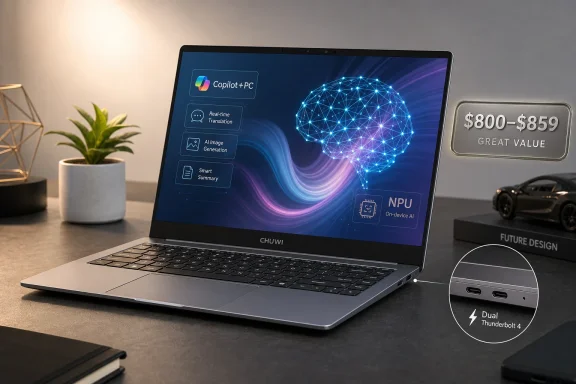
CHUWI has launched the CoreBook Air 226V as a Copilot+ PC, pairing Intel’s Core Ultra 5 226V Lunar Lake processor with a 14-inch 2.8K 90Hz display, a roughly 1kg chassis, claimed all-day battery life, and pricing reported around the $800 to $859 range. The important part is not that CHUWI has made another thin Windows laptop. It is that Microsoft’s once-premium AI PC spec is now being pushed into the value end of the market. That shift will test whether Copilot+ is becoming a real buying category or just another sticker on the palm rest.
When Microsoft introduced Copilot+ PCs, the first wave looked like a familiar industry maneuver: define a new class of hardware, attach it to a handful of showcase devices, and let the label do the work of making last year’s laptop feel obsolete. Qualcomm’s Snapdragon X systems carried much of the early story, with Intel and AMD racing to meet the same neural processing unit threshold. The message was simple enough for retail: if the NPU can hit roughly 40 TOPS, Windows can do certain AI tasks locally.
The CHUWI CoreBook Air 226V matters because it moves that pitch into a more uncomfortable price band. At roughly $800, depending on the outlet and promotion, it is not a bargain-bin laptop in the old sense. But it is also not a Surface Laptop, Dell XPS, or Lenovo Yoga priced for corporate refresh budgets and premium retail shelves.
That is where the Copilot+ PC idea becomes more interesting. If every serious Windows laptop above $1,200 has an NPU, Microsoft has merely created a premium segmentation tool. If lesser-known brands can ship qualifying silicon in slim machines at mainstream prices, the label begins to look more like the next baseline for Windows hardware.
CHUWI’s pitch is also arriving at a moment when the phrase AI PC risks becoming background noise. Every vendor wants to claim local inference, smarter workflows, better video calls, and longer battery life. The CoreBook Air 226V forces a sharper question: what does a Copilot+ badge mean when it is no longer attached only to the safest, most expensive machines?
CHUWI advertises up to 97 TOPS of total AI performance across the CPU, GPU, and NPU, while the NPU itself is rated at up to 40 TOPS. That distinction is not pedantry. Microsoft’s Copilot+ requirement centers on NPU capability because the point is not simply to run an AI workload somewhere in the system; it is to run it efficiently, repeatedly, and without turning battery life into collateral damage.
The Core Ultra 5 226V is not Intel’s highest-end Lunar Lake part, and that is exactly why it is a sensible match for this product. CHUWI does not need to win benchmark charts to make its argument. It needs to show that a thin, light, moderately priced Windows laptop can satisfy the new platform rules without feeling like a compromised science project.
That is a different kind of credibility than CHUWI has typically chased. The company is known for aggressive pricing and spec sheets that often look better than the brand recognition behind them. Lunar Lake lets CHUWI borrow some platform confidence from Intel and Microsoft, then wrap it in a package aimed at buyers who might otherwise be choosing between a discounted mainstream laptop and a refurbished premium one.
The chassis claim is equally direct. Reports place the machine at about 1.0 to 1.2 kg, with CHUWI emphasizing a near-1kg class design. That puts it in conversation with the MacBook Air and other ultraportables, even if build quality, thermals, speakers, trackpad feel, and firmware polish will decide whether the comparison survives actual use.
The 55Wh battery and claimed 12 to 15 hours of mixed use are the numbers CHUWI needs for the story to work. Lunar Lake’s promise is not just that AI runs locally; it is that the whole platform behaves more like the efficient laptops Windows users have envied from the Arm and Apple Silicon worlds. If the CoreBook Air 226V can approach those battery claims in ordinary office and browser workloads, it becomes a far more serious machine than CHUWI’s brand position might suggest.
Ports may be the most quietly important detail. Two Thunderbolt 4 ports give the laptop a modern docking story, which matters for exactly the buyers who might be tempted by a low-cost ultraportable but still need external displays, fast storage, or desk setups. Cheap thin laptops often save money by turning connectivity into a maze of compromises. Thunderbolt 4 does not make the machine premium by itself, but it reduces one of the usual reasons to dismiss it.
That distinction matters for the CoreBook Air 226V. The laptop’s value may be less about what Copilot+ can do on day one and more about what it prevents the buyer from missing over the next several years. Microsoft has made clear that certain AI experiences are tied to new hardware. Whether users love or ignore those features, OEMs now have a strong incentive to meet the bar.
For Windows enthusiasts, this is a familiar pattern. Hardware capabilities often arrive before software catches up. TPM requirements, hybrid CPU scheduling, HDR support, variable refresh displays, and modern standby all went through phases where the checkbox existed before the experience felt universal. Copilot+ is now entering that same awkward middle stage.
The difference is that AI is being sold as a reason to buy now, not merely as plumbing for later. That raises the burden on Microsoft and its partners. If a buyer chooses the CoreBook Air 226V over a cheaper non-Copilot+ laptop, the platform needs to justify that premium with visible, reliable, local features — not just future tense promises and demo-stage workflows.
That is a difficult lane. At $500, CHUWI can win by being surprisingly good for the money. At $800-plus, buyers become less forgiving. The competition includes sale-priced Asus, Lenovo, Acer, HP, and Dell laptops, some of which have better support networks, easier returns, more predictable firmware updates, and stronger resale value.
CHUWI’s counterargument is that the CoreBook Air 226V offers a combination of light weight, high-resolution display, Lunar Lake silicon, Copilot+ eligibility, Thunderbolt 4, and long battery claims that may be hard to match at the same price. That is a legitimate pitch. It is also one that depends heavily on execution.
The bargain in a laptop is rarely the CPU alone. It is the keyboard after six months, the hinge after a year, the fan curve under a Teams call, the sleep behavior in a backpack, the BIOS update that fixes a power drain bug, and the warranty process when something goes wrong. A smaller brand can absolutely compete on hardware value. But at this price, it is competing against the entire ownership experience of larger PC makers.
That matters more in 2026 than it would have a few years ago. Browsers are heavier, collaboration apps are persistent, Windows itself is growing more AI-adjacent, and creative tools increasingly assume more memory headroom. A 16GB ultraportable can still be perfectly reasonable for mainstream work, but it is no longer generous.
For CHUWI’s target buyer, the question is not whether 16GB is enough to open Office, Edge, Slack, and a video call. It is whether the machine will still feel comfortably provisioned in 2029. Copilot+ features are supposed to make the PC more capable over time, yet local AI also makes memory pressure more relevant, not less.
This is where shoppers need to be careful with the word future-proof. The CoreBook Air 226V may be more future-aligned than a discounted older laptop with no qualifying NPU. But it is still a fixed-configuration ultraportable. Its useful life will depend on whether Microsoft and app developers can make local AI efficient enough to live inside mainstream memory budgets.
That is especially true because Copilot+ branding invites a more mainstream audience. A hobbyist might accept rough edges in exchange for value. A student buying one laptop for four years, or a small business owner buying three machines for staff, has less tolerance for surprises.
None of this means the CoreBook Air 226V should be dismissed. In fact, the Windows ecosystem needs pressure from companies like CHUWI. Aggressive entrants force larger vendors to justify their margins and accelerate the downward spread of better panels, lighter chassis, stronger ports, and modern silicon.
But the more ambitious the spec sheet, the more important independent reviews become. Battery life claims need controlled testing. Display brightness and color accuracy need measurement. Fan noise, surface temperatures, SSD behavior, webcam quality, speaker output, and standby drain all need to be experienced rather than assumed. The CoreBook Air 226V is interesting because it promises a lot; it will be important only if the delivered machine behaves like the promise.
This is the old Windows advantage reasserting itself. Apple can make a clean transition because it controls the silicon roadmap, hardware lineup, and operating system. Microsoft has to herd Qualcomm, Intel, AMD, OEMs, retailers, IT departments, and consumers toward a shared baseline. That process is messier, but when it works, it scales across far more price points.
CHUWI’s entry suggests the baseline is becoming attainable. Intel’s Lunar Lake gives smaller OEMs access to a ready-made Copilot+ platform, and Microsoft’s branding gives them a way to communicate that capability without explaining NPUs from scratch. The result is a laptop that can sit in search results beside better-known names and argue, at least on paper, that it belongs in the same AI PC generation.
The risk is dilution. If too many Copilot+ PCs deliver uneven real-world experiences, the label loses authority. Microsoft has to ensure that the badge means more than a TOPS number. It has to mean the machine wakes properly, updates reliably, runs the advertised features, and feels better because of the hardware requirement.
Still, the device matters to enterprise buyers indirectly. It helps establish price pressure around Copilot+ capability. If a smaller vendor can put a qualifying NPU and a high-resolution panel into a lightweight laptop near this range, larger vendors will face harder questions when similar configurations remain expensive.
Small businesses are the more plausible audience. A freelancer, consultant, or five-person office may be willing to buy on value if the machine appears capable and the return policy is acceptable. For those buyers, Copilot+ status may function less as a must-have feature and more as insurance against buying a laptop that already feels one generation behind.
Security-minded readers should also keep the AI claims in perspective. Local AI processing can reduce dependence on cloud round trips for certain workloads, but it does not automatically make a device more private, more manageable, or more secure. The details depend on the feature, the application, the data path, and the controls Microsoft and OEMs expose.
That is why CHUWI’s Copilot+ pitch has to be more than novelty. A buyer comparing machines may see one laptop with a stronger brand and another with newer AI hardware. If the practical benefits of Copilot+ remain fuzzy, the safer brand may win. If Microsoft’s AI features become more visible and useful, the newer hardware becomes easier to defend.
There is also a psychological barrier. CHUWI is not a household PC brand in the United States. Enthusiasts may know it from mini PCs, tablets, and budget laptops, but mainstream shoppers often equate unfamiliarity with risk. A strong spec sheet can get the click; trust closes the sale.
That makes reviews and user reports unusually important for this machine. If early owners report strong battery life, stable firmware, good thermals, and a screen that matches the promise, the CoreBook Air 226V could become one of those word-of-mouth Windows values that punches above its brand weight. If the experience is inconsistent, the Copilot+ badge will not save it.
The broader implication is that the next Windows laptop buying decision may be less about whether a machine has AI hardware and more about how well the rest of the system is built around it. Once the NPU threshold becomes common, the old fundamentals return: display quality, keyboard comfort, battery life, thermals, ports, repairability, warranty, and price.
That is healthy. The PC industry is at its worst when it sells abstractions and at its best when platform shifts turn into better everyday machines. If Copilot+ pressure leads to more efficient chips, better battery life, and higher baseline memory and storage, users benefit even if they rarely invoke an AI feature by name.
CHUWI’s laptop therefore deserves attention less as an AI miracle and more as a market probe. It asks whether buyers will trust a value-oriented brand to deliver the new Windows baseline before some of the old guard makes it affordable. The answer will say as much about the maturity of Copilot+ as it does about CHUWI.
 The AI PC Label Is Finally Drifting Downmarket
When Microsoft introduced Copilot+ PCs, the first wave looked like a familiar industry maneuver: define a new class of hardware, attach it to a handful of showcase devices, and let the label do the work of making last year’s laptop feel obsolete. Qualcomm’s Snapdragon X systems carried much of the early story, with Intel and AMD racing to meet the same neural processing unit threshold. The message was simple enough for retail: if the NPU can hit roughly 40 TOPS, Windows can do certain AI tasks locally.The CHUWI CoreBook Air 226V matters because it moves that pitch into a more uncomfortable price band. At roughly $800, depending on the outlet and promotion, it is not a bargain-bin laptop in the old sense. But it is also not a Surface Laptop, Dell XPS, or Lenovo Yoga priced for corporate refresh budgets and premium retail shelves.
That is where the Copilot+ PC idea becomes more interesting. If every serious Windows laptop above $1,200 has an NPU, Microsoft has merely created a premium segmentation tool. If lesser-known brands can ship qualifying silicon in slim machines at mainstream prices, the label begins to look more like the next baseline for Windows hardware.
CHUWI’s pitch is also arriving at a moment when the phrase AI PC risks becoming background noise. Every vendor wants to claim local inference, smarter workflows, better video calls, and longer battery life. The CoreBook Air 226V forces a sharper question: what does a Copilot+ badge mean when it is no longer attached only to the safest, most expensive machines?
Lunar Lake Gives CHUWI a Shortcut to Credibility
The heart of the CoreBook Air 226V is Intel’s Core Ultra 5 226V, part of the Lunar Lake generation. That matters because Lunar Lake was designed less as a raw performance flex and more as Intel’s answer to the efficiency problem that has haunted Windows ultraportables for years. The chip combines CPU cores, integrated Arc graphics, memory on package, and an Intel AI Boost NPU intended to meet Microsoft’s Copilot+ threshold.CHUWI advertises up to 97 TOPS of total AI performance across the CPU, GPU, and NPU, while the NPU itself is rated at up to 40 TOPS. That distinction is not pedantry. Microsoft’s Copilot+ requirement centers on NPU capability because the point is not simply to run an AI workload somewhere in the system; it is to run it efficiently, repeatedly, and without turning battery life into collateral damage.
The Core Ultra 5 226V is not Intel’s highest-end Lunar Lake part, and that is exactly why it is a sensible match for this product. CHUWI does not need to win benchmark charts to make its argument. It needs to show that a thin, light, moderately priced Windows laptop can satisfy the new platform rules without feeling like a compromised science project.
That is a different kind of credibility than CHUWI has typically chased. The company is known for aggressive pricing and spec sheets that often look better than the brand recognition behind them. Lunar Lake lets CHUWI borrow some platform confidence from Intel and Microsoft, then wrap it in a package aimed at buyers who might otherwise be choosing between a discounted mainstream laptop and a refurbished premium one.
The Spec Sheet Reads Like a MacBook Air Argument in Windows Clothing
The display is the most obvious sign that CHUWI is not aiming this machine at the lowest tier. A 14-inch 2880x1800 IPS panel running at 90Hz is a strong paper specification for a laptop in this class. It gives the CoreBook Air 226V the kind of screen-first pitch that increasingly defines consumer buying decisions, especially for students, writers, remote workers, and light creators who spend far more time looking at text, browsers, and video calls than compiling code or rendering 3D scenes.The chassis claim is equally direct. Reports place the machine at about 1.0 to 1.2 kg, with CHUWI emphasizing a near-1kg class design. That puts it in conversation with the MacBook Air and other ultraportables, even if build quality, thermals, speakers, trackpad feel, and firmware polish will decide whether the comparison survives actual use.
The 55Wh battery and claimed 12 to 15 hours of mixed use are the numbers CHUWI needs for the story to work. Lunar Lake’s promise is not just that AI runs locally; it is that the whole platform behaves more like the efficient laptops Windows users have envied from the Arm and Apple Silicon worlds. If the CoreBook Air 226V can approach those battery claims in ordinary office and browser workloads, it becomes a far more serious machine than CHUWI’s brand position might suggest.
Ports may be the most quietly important detail. Two Thunderbolt 4 ports give the laptop a modern docking story, which matters for exactly the buyers who might be tempted by a low-cost ultraportable but still need external displays, fast storage, or desk setups. Cheap thin laptops often save money by turning connectivity into a maze of compromises. Thunderbolt 4 does not make the machine premium by itself, but it reduces one of the usual reasons to dismiss it.
Copilot+ Is a Hardware Standard Before It Is a Killer App
The uncomfortable truth for Microsoft is that Copilot+ PCs still make more sense as hardware policy than as a software revolution. The label tells buyers that the device has a modern NPU, enough memory, and enough storage to qualify for a particular generation of Windows AI features. It does not guarantee that the user will immediately find those features indispensable.That distinction matters for the CoreBook Air 226V. The laptop’s value may be less about what Copilot+ can do on day one and more about what it prevents the buyer from missing over the next several years. Microsoft has made clear that certain AI experiences are tied to new hardware. Whether users love or ignore those features, OEMs now have a strong incentive to meet the bar.
For Windows enthusiasts, this is a familiar pattern. Hardware capabilities often arrive before software catches up. TPM requirements, hybrid CPU scheduling, HDR support, variable refresh displays, and modern standby all went through phases where the checkbox existed before the experience felt universal. Copilot+ is now entering that same awkward middle stage.
The difference is that AI is being sold as a reason to buy now, not merely as plumbing for later. That raises the burden on Microsoft and its partners. If a buyer chooses the CoreBook Air 226V over a cheaper non-Copilot+ laptop, the platform needs to justify that premium with visible, reliable, local features — not just future tense promises and demo-stage workflows.
The Price Is the Story, and Also the Warning
The reported pricing spread says a lot about where this machine sits. Notebookcheck has reported a pre-order price of $859 with May 21 shipping, while other coverage has framed the system around $800. Either way, CHUWI is trying to land below the obvious premium Copilot+ machines while staying above the ultra-budget Windows segment where compromises are expected and often forgiven.That is a difficult lane. At $500, CHUWI can win by being surprisingly good for the money. At $800-plus, buyers become less forgiving. The competition includes sale-priced Asus, Lenovo, Acer, HP, and Dell laptops, some of which have better support networks, easier returns, more predictable firmware updates, and stronger resale value.
CHUWI’s counterargument is that the CoreBook Air 226V offers a combination of light weight, high-resolution display, Lunar Lake silicon, Copilot+ eligibility, Thunderbolt 4, and long battery claims that may be hard to match at the same price. That is a legitimate pitch. It is also one that depends heavily on execution.
The bargain in a laptop is rarely the CPU alone. It is the keyboard after six months, the hinge after a year, the fan curve under a Teams call, the sleep behavior in a backpack, the BIOS update that fixes a power drain bug, and the warranty process when something goes wrong. A smaller brand can absolutely compete on hardware value. But at this price, it is competing against the entire ownership experience of larger PC makers.
Memory Is the Hidden Trade-Off in Lunar Lake’s Elegant Design
Lunar Lake’s efficiency story comes with a structural caveat: memory is integrated into the package. That helps power consumption and board design, but it also means buyers should treat the memory configuration as permanent. For a Copilot+ PC, 16GB is the functional baseline, not a luxury.That matters more in 2026 than it would have a few years ago. Browsers are heavier, collaboration apps are persistent, Windows itself is growing more AI-adjacent, and creative tools increasingly assume more memory headroom. A 16GB ultraportable can still be perfectly reasonable for mainstream work, but it is no longer generous.
For CHUWI’s target buyer, the question is not whether 16GB is enough to open Office, Edge, Slack, and a video call. It is whether the machine will still feel comfortably provisioned in 2029. Copilot+ features are supposed to make the PC more capable over time, yet local AI also makes memory pressure more relevant, not less.
This is where shoppers need to be careful with the word future-proof. The CoreBook Air 226V may be more future-aligned than a discounted older laptop with no qualifying NPU. But it is still a fixed-configuration ultraportable. Its useful life will depend on whether Microsoft and app developers can make local AI efficient enough to live inside mainstream memory budgets.
CHUWI Is Testing How Much Trust a Spec Sheet Can Buy
There is a reason the big PC vendors spend so much time talking about platform validation, enterprise manageability, service programs, and design testing. Those things are boring until they are the only things that matter. CHUWI’s CoreBook Air 226V has the kind of spec sheet that makes enthusiasts pay attention, but the brand still has to earn trust in areas that do not fit neatly into a launch graphic.That is especially true because Copilot+ branding invites a more mainstream audience. A hobbyist might accept rough edges in exchange for value. A student buying one laptop for four years, or a small business owner buying three machines for staff, has less tolerance for surprises.
None of this means the CoreBook Air 226V should be dismissed. In fact, the Windows ecosystem needs pressure from companies like CHUWI. Aggressive entrants force larger vendors to justify their margins and accelerate the downward spread of better panels, lighter chassis, stronger ports, and modern silicon.
But the more ambitious the spec sheet, the more important independent reviews become. Battery life claims need controlled testing. Display brightness and color accuracy need measurement. Fan noise, surface temperatures, SSD behavior, webcam quality, speaker output, and standby drain all need to be experienced rather than assumed. The CoreBook Air 226V is interesting because it promises a lot; it will be important only if the delivered machine behaves like the promise.
Microsoft’s AI PC Strategy Needs Machines Like This
For Microsoft, the CoreBook Air 226V is strategically useful even if it never becomes a huge seller. Copilot+ cannot remain a boutique category if Microsoft wants developers to target NPUs and users to expect local AI features as part of Windows. The platform needs a broad installed base, and that means hardware must move below the prestige tier.This is the old Windows advantage reasserting itself. Apple can make a clean transition because it controls the silicon roadmap, hardware lineup, and operating system. Microsoft has to herd Qualcomm, Intel, AMD, OEMs, retailers, IT departments, and consumers toward a shared baseline. That process is messier, but when it works, it scales across far more price points.
CHUWI’s entry suggests the baseline is becoming attainable. Intel’s Lunar Lake gives smaller OEMs access to a ready-made Copilot+ platform, and Microsoft’s branding gives them a way to communicate that capability without explaining NPUs from scratch. The result is a laptop that can sit in search results beside better-known names and argue, at least on paper, that it belongs in the same AI PC generation.
The risk is dilution. If too many Copilot+ PCs deliver uneven real-world experiences, the label loses authority. Microsoft has to ensure that the badge means more than a TOPS number. It has to mean the machine wakes properly, updates reliably, runs the advertised features, and feels better because of the hardware requirement.
Enterprise Buyers Will Watch, But Probably Not Jump First
For IT departments, the CoreBook Air 226V is more signal than procurement target. Larger organizations tend to value lifecycle management, repair channels, firmware consistency, driver support, and vendor accountability over headline specifications. CHUWI is unlikely to displace ThinkPads, Latitudes, EliteBooks, or Surface devices in managed fleets simply because it has Lunar Lake and Thunderbolt.Still, the device matters to enterprise buyers indirectly. It helps establish price pressure around Copilot+ capability. If a smaller vendor can put a qualifying NPU and a high-resolution panel into a lightweight laptop near this range, larger vendors will face harder questions when similar configurations remain expensive.
Small businesses are the more plausible audience. A freelancer, consultant, or five-person office may be willing to buy on value if the machine appears capable and the return policy is acceptable. For those buyers, Copilot+ status may function less as a must-have feature and more as insurance against buying a laptop that already feels one generation behind.
Security-minded readers should also keep the AI claims in perspective. Local AI processing can reduce dependence on cloud round trips for certain workloads, but it does not automatically make a device more private, more manageable, or more secure. The details depend on the feature, the application, the data path, and the controls Microsoft and OEMs expose.
The Real Competition Is the Discounted Mainstream Laptop
The CoreBook Air 226V’s toughest rival may not be another AI-branded ultraportable. It may be a discounted mainstream laptop with last year’s processor, a decent screen, and a better-known logo. Windows buyers are trained to shop promotions, and the $700 to $900 band is where retail chaos often produces strange bargains.That is why CHUWI’s Copilot+ pitch has to be more than novelty. A buyer comparing machines may see one laptop with a stronger brand and another with newer AI hardware. If the practical benefits of Copilot+ remain fuzzy, the safer brand may win. If Microsoft’s AI features become more visible and useful, the newer hardware becomes easier to defend.
There is also a psychological barrier. CHUWI is not a household PC brand in the United States. Enthusiasts may know it from mini PCs, tablets, and budget laptops, but mainstream shoppers often equate unfamiliarity with risk. A strong spec sheet can get the click; trust closes the sale.
That makes reviews and user reports unusually important for this machine. If early owners report strong battery life, stable firmware, good thermals, and a screen that matches the promise, the CoreBook Air 226V could become one of those word-of-mouth Windows values that punches above its brand weight. If the experience is inconsistent, the Copilot+ badge will not save it.
The Copilot+ Badge Moves From Luxury to Leverage
The CoreBook Air 226V is not a revolution by itself, but it is a useful marker. It shows that Copilot+ hardware is beginning to escape the launch-window premium. That is exactly what must happen if Microsoft wants AI acceleration to become a normal part of the Windows PC, rather than a feature reserved for buyers already inclined to spend more.The broader implication is that the next Windows laptop buying decision may be less about whether a machine has AI hardware and more about how well the rest of the system is built around it. Once the NPU threshold becomes common, the old fundamentals return: display quality, keyboard comfort, battery life, thermals, ports, repairability, warranty, and price.
That is healthy. The PC industry is at its worst when it sells abstractions and at its best when platform shifts turn into better everyday machines. If Copilot+ pressure leads to more efficient chips, better battery life, and higher baseline memory and storage, users benefit even if they rarely invoke an AI feature by name.
CHUWI’s laptop therefore deserves attention less as an AI miracle and more as a market probe. It asks whether buyers will trust a value-oriented brand to deliver the new Windows baseline before some of the old guard makes it affordable. The answer will say as much about the maturity of Copilot+ as it does about CHUWI.
The CoreBook Air 226V Shows Where the AI PC Fight Gets Practical
The most useful way to read this launch is not as a verdict, but as a checklist for the next phase of Windows laptops. Copilot+ is moving from keynote language into price-sensitive purchasing, and that makes the trade-offs easier to see.- The CoreBook Air 226V appears to meet the key Copilot+ hardware story with Intel Lunar Lake silicon and an NPU rated at the threshold Microsoft has emphasized for local AI features.
- The reported $800 to $859 pricing puts pressure on better-known OEMs to bring Copilot+ configurations down from premium territory.
- The 14-inch 2.8K 90Hz display, light chassis, 55Wh battery, and Thunderbolt 4 ports make the machine interesting beyond the AI label.
- The fixed-memory nature of Lunar Lake means buyers should treat 16GB as a long-term commitment rather than an upgradeable starting point.
- The real test will be independent review data on battery life, thermals, firmware stability, display quality, and support rather than launch specifications alone.
- The laptop’s significance is that it turns Copilot+ from a luxury badge into a mainstream buying variable.
References
- Primary source: Let's Data Science
Published: 2026-05-31T08:22:07.573087
CHUWI Launches CoreBook Air as Copilot+ PC | Let's Data Science
CHUWI announced the **CoreBook Air 226V** as a Copilot+ PC on its official blog, bringing Intel Lunar Lake silicon, a high-resolution display, and long battery life to a near-1kg chassis (CHUWI blog; GizChina). Coverage from **Digital Trends** and **Notebookcheck** reports the laptop is powered... letsdatascience.com
- Related coverage: techradar.com
Chuwi AuBox X 256V mini PC review | TechRadar
A Core Ultra mini PC with faster memorywww.techradar.com - Related coverage: notebookcheck.org
Chuwi CoreBook Air - Notebookcheck.org
Ésta es una lista de análisis y otras informaciones sobre el modelo Chuwi CoreBook Air de la serie CoreBook. www.notebookcheck.org
- Related coverage: store.chuwi.com
CoreBook Air Copilot+ PC Laptop Intel® Core™ Ultra 5 226V – CHUWI Global Store
CoreBook Air 226V Ultra-Light. AI-Powered. All-Day Power. 1.2KG Ultra-Light Carry Less. Do More. Intel® Core™ Ultra 5 226V Low Power. Fast Performance. Intel® Arc™ 130V Up to 2× Faster than Iris® Xe All-Day Battery Life 55Wh Battery 8533 MT/s LPDDR5X RAM Ultra-Low Latency Easy to Upgrade 512GB... store.chuwi.com
- Related coverage: notebookcheck.net
Chuwi CoreBook Air - Notebookcheck Reviews Collection
This page provides reviews and other infos about the Chuwi CoreBook Air of the series CoreBook. www.notebookcheck.net
- Related coverage: gizmochina.com
CHUWI CoreBook Air Launches as a Copilot+ PC with Intel Lunar Lake, 2.8K Display and 15-Hour Battery - Gizmochina
CHUWI CoreBook Air launches with Intel Lunar Lake, 97 TOPS AI performance, 2.8K 120Hz display, 15-hour battery life and Windows 11 Pro. www.gizmochina.com
- Related coverage: notebookcheck-ru.com
Альтернатива MacBook Air? Chuwi CoreBook Air 226V с процессором Intel SoC и интерфейсом Thunderbolt выходит на рынок - Notebookcheck-ru.com
Новый компактный ноутбук обещает приличную вычислительную мощность и может, по крайней мере, с точки зрения форм-фактора, стать реальной альтернативой MacBook Air. CoreBook Air 226V оснащен процессором Intel SoC, а внешние видеокарты можно подключать через Thunderbolt. www.notebookcheck-ru.com
- Related coverage: gizchina.com
CHUWI CoreBook Air Copilot+ PC With Intel Lunar Lake and 2.8K 120Hz Display Unveiled
CHUWI has launched the CHUWI CoreBook Air Copilot+ PC with an Intel Core Ultra 5 226V Lunar Lake processor, 2.8K 120Hz display, and up to 97 TOPS of AI performance.www.gizchina.com - Related coverage: notebookcheck.pl
Chuwi CoreBook Air - Notebookcheck.pl
Ta strona zawiera recenzje i inne informacje na temat laptopa Chuwi CoreBook Air z serii CoreBook. www.notebookcheck.pl
- Related coverage: pcvenus.com
Chuwi CoreBook Air 226V Launches With Dual Thunderbolt 4
Chuwi CoreBook Air 226V launches with Intel Core Ultra 5 226V, a 2.8K 90Hz display, dual Thunderbolt 4 ports, and a lightweight 1kg design. pcvenus.com
- Related coverage: blog.chuwi.com
CHUWI Challenges 1KG High-End Lightweight Laptops with New CoreBook Air Series Starting Around $500 - Chuwi Blog
The premium thin-and-light laptop category—led by devices like the Huawei MateBook X Pro and Honor MagicBook Art 14—has steadily climbed into the $1,000+ bracket. CHUWI is charting a different path with its new CoreBook Air series, bringing a 1 kg–class design at just around $500. Positioned as...blog.chuwi.com - Related coverage: 0e190a550a8c4c8c4b93-fcd009c875a5577fd4fe2f5b7e3bf4eb.ssl.cf2.rackcdn.com
EINPresswire 803021273 chuwi corebook x 2k laptop launched with intel core i9 13900hk 32gb ram and 1tb storage 2
PDF document0e190a550a8c4c8c4b93-fcd009c875a5577fd4fe2f5b7e3bf4eb.ssl.cf2.rackcdn.com
- Related coverage: us.chuwi.com
CoreBook Air Copilot+ PC Laptop Intel® Core™ Ultra 5 226V – CHUWI US Store
CoreBook Air 226V Ultra-Light. AI-Powered. All-Day Power. 1.2kg Ultra-Light Carry Less. Do More. Intel® Core™Ultra 5 226V Low Power. Fast Performance. Intel® Arc™ 130V Up to 2× Faster than Iris® Xe All-Day Battery Life 55Wh Battery 8533 MT/sLPDDR5X RAM Ultra-Low Latency Upgradeable Storage 512GB... us.chuwi.com
- Related coverage: tomshardware.com
Copilot+ PCs: All we know about the AI-ready laptops and exclusive Windows features | Tom's Hardware
Microsoft's shiny new AI innovations for the laptop spacewww.tomshardware.com - Official source: microsoft.com
Shop High-Performance Laptops, Computers, PCs, and Tablets | Microsoft Windows
Shop high-performance laptops, PCs, and tablets built for multitasking, advanced AI capabilities, powerful graphics, and all-day performance. Explore premium, high-spec Windows devices.www.microsoft.com - Related coverage: skywork.ai
Copilot+ PC Requirements — The Ultimate Guide
Understand Microsoft Copilot+ PC AI requirements: 40+ TOPS NPU, RAM, storage, supported processors, and which features need Copilot+. Read the complete guide.skywork.ai - Related coverage: windowscentral.com
Microsoft Copilot+ PC guide: What it is, features, how to access it, and PC requirements, and everything you need to know | Windows Central
Microsoft Copilot+ has been announced for upcoming AI PCs, but what exactly is it? Here's everything you need to know.www.windowscentral.com - Related coverage: howtogeek.com
- Related coverage: pcgamer.com
Microsoft plans to launch a cheaper 8 GB Surface laptop later this year which won't meet the requirements of a Copilot+ PC | PC Gamer
How far we have fallen.www.pcgamer.com

