

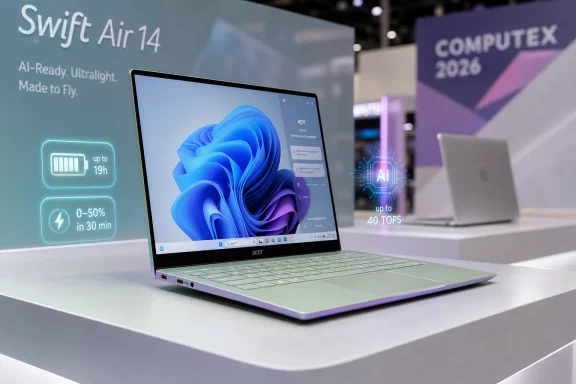
Acer used Computex 2026 to introduce the Swift Air 14, a Windows 11 ultraportable starting at $699 in the United States with Intel Core Series 3 processors, a 14-inch 120Hz display, and a claimed weight of 2.76 pounds. The pitch is not subtle: this is Acer’s pastel-colored answer to the MacBook Air idea, but at a price where Windows laptops have often looked compromised. The real story is not whether Acer has cloned Apple’s formula. It is whether the Windows ecosystem can finally make the affordable thin-and-light feel deliberate rather than discounted.
The Swift Air 14 arrives with the kind of product language that PC makers used to leave to Apple: light, colorful, simple, and easy to understand. At 1.25 kg and 12.9 mm at its thinnest point, Acer is clearly positioning the machine as something you notice first in a backpack, not in a benchmark chart. The four colors — sage green, frost blue, blossom pink, and lilac purple — do more work here than another paragraph about AI acceleration ever could.
That matters because the Windows laptop market has spent years offering technically competent machines that felt like procurement objects. The MacBook Air won not merely because it was thin, but because it turned the everyday laptop into an object with a coherent identity. Acer’s Swift Air 14 is trying to borrow that lesson without pretending to be a workstation, a gaming machine, or a developer rig.
The $699 starting price is the hook. That configuration includes a Core 5 processor, 8GB of RAM, and 512GB of storage, putting it in the zone where buyers are often choosing between a discounted older premium laptop, a Chromebook Plus model, an entry-level Windows notebook, or stretching for a Mac. Acer’s argument is that this tier can still look and feel fresh.
The risk is that the feeling is easier to sell than to sustain. A colorful chassis and low weight get attention at Computex; keyboard quality, display brightness, fan behavior, hinge stiffness, and battery life under real workloads decide whether a laptop becomes someone’s daily machine.
Acer’s most interesting decision is not to chase the highest-end spec. The Swift Air 14 tops out at an Intel Core 7 processor 350, with up to 16GB of RAM and up to 512GB of M.2 SSD storage that can reportedly be upgraded to 1TB. That is a mainstream productivity envelope, not a power-user one. In other words, Acer appears to understand the category.
The display spec is more ambitious than the price might suggest: a 14-inch 1920 x 1200 panel running at up to 120Hz. A 16:10 aspect ratio is now table stakes for serious productivity laptops, but 120Hz still makes a machine feel more expensive than it is, especially for scrolling, window movement, and pen-free touchpad navigation.
Still, the MacBook Air comparison will be won or lost in the dull areas. Apple has trained buyers to expect quiet operation, strong standby battery, and few surprises. Windows laptops in this price class still need to prove that sleep works reliably, firmware updates do not derail the experience, and preloaded software does not turn a clean design into a carnival.
The 0-to-50-percent charge claim in 30 minutes is just as important as the endurance figure. Modern ultraportables are increasingly judged not only by how long they last, but by how quickly they recover from poor planning. A half-hour top-up can matter more than a theoretical all-day benchmark when a student, consultant, or traveler is moving between rooms and outlets.
But the old PC caveat still applies: battery life is a negotiation among screen brightness, refresh rate, background processes, modem or Wi-Fi behavior, power profiles, and the apps users actually run. A 120Hz display can make the laptop feel smoother, but users chasing maximum endurance may need to accept lower refresh rates or more conservative settings.
That is where Windows still has a perception problem. Apple’s battery claims are not immune from ideal conditions, but the company benefits from a reputation for consistency. Acer, Intel, and Microsoft together have to earn that trust one laptop generation at a time.
For most users, the immediate value of an NPU is still fuzzy. Some Windows features, camera effects, transcription workloads, and creative tools can benefit from local acceleration, but the everyday laptop buyer is not shopping by TOPS with the same confidence they once used to compare RAM or storage. The risk for PC makers is that “AI laptop” becomes another sticker with no emotional payoff.
Acer seems to avoid overplaying that hand with the Swift Air 14. The product is not framed primarily as an AI showcase. It is a portable Windows laptop that happens to include enough neural processing capability to participate in Microsoft’s evolving client-AI roadmap.
That is a healthier pitch. The best AI hardware in consumer PCs will be the kind users do not have to think about: background blur that does not drain the battery, search that understands local files, captions that work instantly, and creative tools that feel responsive without sending everything to the cloud.
The entry-level 8GB RAM configuration will be the pressure point. For light browser, school, and office use, it may be adequate, especially if Windows memory management and app behavior are sensible. But in 2026, 8GB on a new Windows laptop increasingly feels like the minimum acceptable floor rather than a comfortable baseline.
The 512GB SSD is more defensible. It avoids the worst old habit of budget Windows machines, which was pairing a nice-looking chassis with storage so cramped that the laptop felt old within a semester. The reported upgrade path to 1TB also gives Acer a practical advantage over sealed-down competitors, assuming the internal design makes service reasonably accessible.
The bigger question is whether the $699 model will be the one people can actually buy in volume. PC makers have a long history of announcing attractive starting prices that correspond to limited configurations, while the model most reviewers test and retailers stock costs meaningfully more. If Acer wants this machine to be a MacBook Air alternative for normal buyers, the entry model cannot be a paper SKU.
That clarity is rarer than it should be. The Windows market is enormous, but its abundance often produces confusion. Two laptops with similar names may differ wildly by panel quality, processor class, battery size, chassis material, and regional configuration. Buyers who do not live inside spec sheets are punished for assuming that a model name means a consistent experience.
Apple has long benefited from the opposite dynamic. A MacBook Air is a MacBook Air; the buyer chooses size, memory, and storage, but the product concept remains stable. Windows OEMs do not need to copy Apple’s constraints, but they do need more disciplined families where the customer understands what the brand promise actually is.
Acer’s Swift line has sometimes suffered from the same naming sprawl as the rest of the PC industry. Swift, Swift Go, Swift Edge, Swift AI, Swift Spin, and now Swift Air all occupy adjacent mental territory. The Swift Air 14 will need a sharper identity if it is to become more than another Computex announcement in a crowded aisle.
Acer is also showing other Qualcomm-based systems at the show, including Snapdragon-powered designs with far higher AI performance claims. That makes the Intel-based Swift Air 14 more interesting, not less. It suggests Acer is not betting on a single architecture story; it is segmenting laptops by user expectation, price, and form factor.
That is what Windows needs. The future of the platform is not one chip vendor winning every socket. It is a more coherent set of choices where x86 remains strong for compatibility and mainstream productivity, ARM pushes battery life and instant-on behavior, and premium machines stop being the only ones allowed to feel carefully designed.
The Swift Air 14 lands in the middle of that argument. It is not the most technically dramatic Windows laptop Acer could build, but it may be the kind of product that matters more commercially: a notebook that makes the default Windows choice look less like a compromise.
Acer’s advantage is price aggression. If the Swift Air 14 delivers a good keyboard, good trackpad, respectable display brightness, and real-world battery life near the MobileMark claim, it could be a compelling campus and travel laptop. If any of those fundamentals fall short, the pastel colors will not save it.
There is also competition from last year’s premium models. A discounted higher-end laptop with more RAM, a better screen, or stronger build quality can easily undercut the emotional appeal of a new midrange machine. The Swift Air 14 needs to be good enough that buyers choose it new rather than treating it as a fallback.
That is especially true for IT buyers and small businesses. A $699 laptop with decent battery life and Windows 11 compatibility sounds attractive, but manageability, repairability, warranty options, driver stability, and docking behavior often matter more than color. Acer has to satisfy both the buyer who wants lilac purple and the admin who wants fewer tickets.
Those missing details are not minor. In a laptop this thin and relatively affordable, every physical choice has trade-offs. A machine can be light because it is elegantly engineered, or because it is less rigid than it should be. It can be thin because the cooling system is efficient, or because performance throttles under sustained load.
The 16GB RAM ceiling may also age quickly. For a laptop intended as a mainstream portable, 16GB is still reasonable today, but the industry’s growing appetite for local AI features, browser memory, and background services makes higher ceilings valuable. A MacBook Air competitor does not need workstation memory, but it should not feel boxed in too early.
The display resolution is sensible rather than flashy. A 1920 x 1200 panel on a 14-inch screen offers good sharpness without the battery penalty of high-density OLED or 3K panels. That is probably the right compromise for the category, assuming Acer uses a quality panel instead of treating refresh rate as a substitute for everything else.
For years, Windows OEMs have had strong answers at the high end and chaotic answers below it. A $1,400 ultrabook could be excellent; a $700 laptop often felt like a list of acceptable compromises. The Swift Air 14 is a bet that a mainstream laptop can lead with design and battery life without abandoning price sensitivity.
That bet is also good for Microsoft. Windows 11 needs hardware that makes the operating system feel modern by default. A pleasant, light, affordable laptop does more for the platform’s reputation than another halo machine that most users will never see outside a review site.
The challenge is execution. If Acer ships the Swift Air 14 with unnecessary bloatware, uneven thermals, a mediocre panel, or a trackpad that feels cheap, the whole argument collapses. If it gets the fundamentals right, it becomes one of the more interesting Windows laptops of the year precisely because it is not trying to be exotic.
 Acer Is Selling the Feeling Before the Spec Sheet
The Swift Air 14 arrives with the kind of product language that PC makers used to leave to Apple: light, colorful, simple, and easy to understand. At 1.25 kg and 12.9 mm at its thinnest point, Acer is clearly positioning the machine as something you notice first in a backpack, not in a benchmark chart. The four colors — sage green, frost blue, blossom pink, and lilac purple — do more work here than another paragraph about AI acceleration ever could.That matters because the Windows laptop market has spent years offering technically competent machines that felt like procurement objects. The MacBook Air won not merely because it was thin, but because it turned the everyday laptop into an object with a coherent identity. Acer’s Swift Air 14 is trying to borrow that lesson without pretending to be a workstation, a gaming machine, or a developer rig.
The $699 starting price is the hook. That configuration includes a Core 5 processor, 8GB of RAM, and 512GB of storage, putting it in the zone where buyers are often choosing between a discounted older premium laptop, a Chromebook Plus model, an entry-level Windows notebook, or stretching for a Mac. Acer’s argument is that this tier can still look and feel fresh.
The risk is that the feeling is easier to sell than to sustain. A colorful chassis and low weight get attention at Computex; keyboard quality, display brightness, fan behavior, hinge stiffness, and battery life under real workloads decide whether a laptop becomes someone’s daily machine.
The MacBook Air Comparison Is Useful, But It Can Also Mislead
Calling the Swift Air 14 a MacBook Air alternative is fair shorthand, but it is also a trap. Apple’s Air is not just a thin laptop; it is a tightly controlled package of silicon, battery efficiency, display quality, standby behavior, trackpad feel, and macOS integration. Windows vendors can match pieces of that equation, but they rarely control the whole stack.Acer’s most interesting decision is not to chase the highest-end spec. The Swift Air 14 tops out at an Intel Core 7 processor 350, with up to 16GB of RAM and up to 512GB of M.2 SSD storage that can reportedly be upgraded to 1TB. That is a mainstream productivity envelope, not a power-user one. In other words, Acer appears to understand the category.
The display spec is more ambitious than the price might suggest: a 14-inch 1920 x 1200 panel running at up to 120Hz. A 16:10 aspect ratio is now table stakes for serious productivity laptops, but 120Hz still makes a machine feel more expensive than it is, especially for scrolling, window movement, and pen-free touchpad navigation.
Still, the MacBook Air comparison will be won or lost in the dull areas. Apple has trained buyers to expect quiet operation, strong standby battery, and few surprises. Windows laptops in this price class still need to prove that sleep works reliably, firmware updates do not derail the experience, and preloaded software does not turn a clean design into a carnival.
Battery Claims Are the Headline, MobileMark Is the Fine Print
Acer claims up to 19 hours of video playback for the Swift Air 14, which is exactly the sort of number that belongs on a retail shelf card. More important is the company’s more conservative MobileMark30 figure of up to 12 hours. That second number is likely closer to what buyers should use when imagining a workday that includes browsers, messaging apps, office documents, and background services.The 0-to-50-percent charge claim in 30 minutes is just as important as the endurance figure. Modern ultraportables are increasingly judged not only by how long they last, but by how quickly they recover from poor planning. A half-hour top-up can matter more than a theoretical all-day benchmark when a student, consultant, or traveler is moving between rooms and outlets.
But the old PC caveat still applies: battery life is a negotiation among screen brightness, refresh rate, background processes, modem or Wi-Fi behavior, power profiles, and the apps users actually run. A 120Hz display can make the laptop feel smoother, but users chasing maximum endurance may need to accept lower refresh rates or more conservative settings.
That is where Windows still has a perception problem. Apple’s battery claims are not immune from ideal conditions, but the company benefits from a reputation for consistency. Acer, Intel, and Microsoft together have to earn that trust one laptop generation at a time.
Intel’s Mainstream AI Pitch Is Becoming Less Exotic And More Ordinary
The Swift Air 14’s AI credentials are modest but telling. Acer says the platform can reach up to 40 TOPS, with the dedicated NPU rated up to 17 TOPS. That is not the kind of number that will impress workstation buyers or anyone tracking the top tier of Copilot+ PC silicon, but it reflects where the market is moving: AI acceleration is becoming a background expectation rather than a premium badge.For most users, the immediate value of an NPU is still fuzzy. Some Windows features, camera effects, transcription workloads, and creative tools can benefit from local acceleration, but the everyday laptop buyer is not shopping by TOPS with the same confidence they once used to compare RAM or storage. The risk for PC makers is that “AI laptop” becomes another sticker with no emotional payoff.
Acer seems to avoid overplaying that hand with the Swift Air 14. The product is not framed primarily as an AI showcase. It is a portable Windows laptop that happens to include enough neural processing capability to participate in Microsoft’s evolving client-AI roadmap.
That is a healthier pitch. The best AI hardware in consumer PCs will be the kind users do not have to think about: background blur that does not drain the battery, search that understands local files, captions that work instantly, and creative tools that feel responsive without sending everything to the cloud.
The $699 Configuration Is Both Aggressive And Fragile
The starting price is the most consequential number in Acer’s announcement. At $699, the Swift Air 14 sits in the zone where compromises usually become visible: dimmer displays, mushier keyboards, plastic flex, small batteries, limited ports, or meager memory. Acer is promising a machine that looks like it belongs above that tier.The entry-level 8GB RAM configuration will be the pressure point. For light browser, school, and office use, it may be adequate, especially if Windows memory management and app behavior are sensible. But in 2026, 8GB on a new Windows laptop increasingly feels like the minimum acceptable floor rather than a comfortable baseline.
The 512GB SSD is more defensible. It avoids the worst old habit of budget Windows machines, which was pairing a nice-looking chassis with storage so cramped that the laptop felt old within a semester. The reported upgrade path to 1TB also gives Acer a practical advantage over sealed-down competitors, assuming the internal design makes service reasonably accessible.
The bigger question is whether the $699 model will be the one people can actually buy in volume. PC makers have a long history of announcing attractive starting prices that correspond to limited configurations, while the model most reviewers test and retailers stock costs meaningfully more. If Acer wants this machine to be a MacBook Air alternative for normal buyers, the entry model cannot be a paper SKU.
Windows Needs More Laptops That Know What They Are
The Swift Air 14 is refreshing because it appears to know its job. It is not trying to be a creator laptop, a gaming laptop, a corporate fleet tank, or a speculative AI appliance. It is a thin, light, cheerful Windows notebook for people who want portability and price without buying something that looks apologetic.That clarity is rarer than it should be. The Windows market is enormous, but its abundance often produces confusion. Two laptops with similar names may differ wildly by panel quality, processor class, battery size, chassis material, and regional configuration. Buyers who do not live inside spec sheets are punished for assuming that a model name means a consistent experience.
Apple has long benefited from the opposite dynamic. A MacBook Air is a MacBook Air; the buyer chooses size, memory, and storage, but the product concept remains stable. Windows OEMs do not need to copy Apple’s constraints, but they do need more disciplined families where the customer understands what the brand promise actually is.
Acer’s Swift line has sometimes suffered from the same naming sprawl as the rest of the PC industry. Swift, Swift Go, Swift Edge, Swift AI, Swift Spin, and now Swift Air all occupy adjacent mental territory. The Swift Air 14 will need a sharper identity if it is to become more than another Computex announcement in a crowded aisle.
Computex 2026 Is Turning Into A Fight Over The Affordable Premium Laptop
The timing is not accidental. Computex 2026 has become a stage for PC makers responding to pressure from both ends of the market. Apple continues to define what mainstream premium laptops should feel like, while cheaper ARM and x86 platforms are making it harder to justify ugly entry-level machines.Acer is also showing other Qualcomm-based systems at the show, including Snapdragon-powered designs with far higher AI performance claims. That makes the Intel-based Swift Air 14 more interesting, not less. It suggests Acer is not betting on a single architecture story; it is segmenting laptops by user expectation, price, and form factor.
That is what Windows needs. The future of the platform is not one chip vendor winning every socket. It is a more coherent set of choices where x86 remains strong for compatibility and mainstream productivity, ARM pushes battery life and instant-on behavior, and premium machines stop being the only ones allowed to feel carefully designed.
The Swift Air 14 lands in the middle of that argument. It is not the most technically dramatic Windows laptop Acer could build, but it may be the kind of product that matters more commercially: a notebook that makes the default Windows choice look less like a compromise.
The Real Competition Is Not Just Apple
The Swift Air 14 will inevitably be compared with the MacBook Air, but Acer’s more immediate competition may come from other Windows machines. Asus, Lenovo, HP, Dell, Samsung, and Microsoft all know that the thin-and-light category is where brand perception is built. A good ultraportable does not just sell units; it tells buyers whether a company understands modern computing.Acer’s advantage is price aggression. If the Swift Air 14 delivers a good keyboard, good trackpad, respectable display brightness, and real-world battery life near the MobileMark claim, it could be a compelling campus and travel laptop. If any of those fundamentals fall short, the pastel colors will not save it.
There is also competition from last year’s premium models. A discounted higher-end laptop with more RAM, a better screen, or stronger build quality can easily undercut the emotional appeal of a new midrange machine. The Swift Air 14 needs to be good enough that buyers choose it new rather than treating it as a fallback.
That is especially true for IT buyers and small businesses. A $699 laptop with decent battery life and Windows 11 compatibility sounds attractive, but manageability, repairability, warranty options, driver stability, and docking behavior often matter more than color. Acer has to satisfy both the buyer who wants lilac purple and the admin who wants fewer tickets.
The Specs Leave Some Unanswered Questions
The announcement gives us the broad outline, but not the lived experience. We know the weight, thinness, display resolution, refresh rate, processor ceiling, memory ceiling, storage range, claimed battery life, and launch windows. We do not yet know enough about the panel’s brightness and color coverage, port selection, webcam quality, speaker performance, fan noise, keyboard travel, or chassis rigidity.Those missing details are not minor. In a laptop this thin and relatively affordable, every physical choice has trade-offs. A machine can be light because it is elegantly engineered, or because it is less rigid than it should be. It can be thin because the cooling system is efficient, or because performance throttles under sustained load.
The 16GB RAM ceiling may also age quickly. For a laptop intended as a mainstream portable, 16GB is still reasonable today, but the industry’s growing appetite for local AI features, browser memory, and background services makes higher ceilings valuable. A MacBook Air competitor does not need workstation memory, but it should not feel boxed in too early.
The display resolution is sensible rather than flashy. A 1920 x 1200 panel on a 14-inch screen offers good sharpness without the battery penalty of high-density OLED or 3K panels. That is probably the right compromise for the category, assuming Acer uses a quality panel instead of treating refresh rate as a substitute for everything else.
The Windows Alternative Finally Looks Like It Has A Point
The most encouraging thing about the Swift Air 14 is that it does not appear to be chasing Apple by imitating only the surface. Yes, the MacBook Air comparison is obvious. But Acer’s move is better understood as an attempt to bring some of the Air’s clarity into the Windows price bands where millions of people actually shop.For years, Windows OEMs have had strong answers at the high end and chaotic answers below it. A $1,400 ultrabook could be excellent; a $700 laptop often felt like a list of acceptable compromises. The Swift Air 14 is a bet that a mainstream laptop can lead with design and battery life without abandoning price sensitivity.
That bet is also good for Microsoft. Windows 11 needs hardware that makes the operating system feel modern by default. A pleasant, light, affordable laptop does more for the platform’s reputation than another halo machine that most users will never see outside a review site.
The challenge is execution. If Acer ships the Swift Air 14 with unnecessary bloatware, uneven thermals, a mediocre panel, or a trackpad that feels cheap, the whole argument collapses. If it gets the fundamentals right, it becomes one of the more interesting Windows laptops of the year precisely because it is not trying to be exotic.
The Swift Air 14’s Promise Comes Down To The Boring Details
The announcement gives Windows buyers something concrete to watch as the machine moves from Computex floor to retail shelves. Acer has the ingredients for a genuinely appealing mainstream ultraportable, but the final judgment belongs to the daily-use details that spec sheets flatten.- The Swift Air 14 starts at $699 in the United States, with the entry model offering a Core 5 processor, 8GB of RAM, and 512GB of storage.
- The laptop weighs 2.76 pounds and measures 12.9 mm at its thinnest point, putting portability at the center of the product rather than treating it as a premium-only feature.
- Acer claims up to 19 hours of video playback and up to 12 hours under MobileMark30, with 0-to-50-percent charging in 30 minutes.
- The 14-inch 1920 x 1200 display runs at up to 120Hz, a spec that could make the machine feel more premium if the panel quality is otherwise strong.
- The AI story is present but restrained, with up to 40 platform TOPS and a dedicated NPU rated up to 17 TOPS.
- Availability begins in Europe, the Middle East, and Africa in July 2026, followed by North America in August and Australia in the third quarter of 2026.
References
- Primary source: Engadget
Published: Fri, 29 May 2026 13:00:00 GMT
The Acer Swift Air 14 Looks Like A Cute And Breezy Windows Alternative To The MacBook Air
There’s also a new 360-degree convertible model, the Swift Spin 14 AI.www.engadget.com - Related coverage: tomshardware.com
Acer is reportedly working on a 'Predator Atlas 8' handheld featuring Intel's Arc G3 chips — Panther Lake-based handhelds expected to be revealed at Computex 2026 | Tom's Hardware
The Arc G3 series would compete directly against AMD's Ryzen Z2 platform.www.tomshardware.com - Related coverage: phonearena.com
Acer is laying down its 2026 laptop playbook with the new Swift models - PhoneArena
Acer bets on portability, toughness, and on-device AI for its refreshed Swift series.www.phonearena.com - Related coverage: techradar.com
Acer Swift Edge 14 AI laptop review | TechRadar
A lightweight yet powerful and capable systemwww.techradar.com - Related coverage: tweaktown.com
Acer's Swift Spin 14 AI is powered by the Snapdragon X2 Series, while the Aspire Go is the first Snapdragon C device
At Computex 2026 Acer is showcasing new Snapdragon powered laptops with the Swift Spin 14 AI and the Aspire Go 15 with the new Snapdragon C processor. www.tweaktown.com
- Related coverage: gadgets360.com
CES 2026: Acer's Swift, Predator and Nitro Laptops Refreshed With Intel's Panther Lake Processors | Technology News
Acer on Tuesday announced a refreshed lineup of laptops across productivity, gaming and mainstream segments at the Consumer Electronics Show (CES) 2026.www.gadgets360.com
- Related coverage: androidguys.com
Acer Unveils Swift Spin 14 AI and Aspire Go 15 Laptops
Discover Acer's new Swift Spin 14 AI and Aspire Go 15 laptops, featuring Snapdragon tech for premium performance and budget-friendly options.androidguys.com - Related coverage: pcworld.com
Acer's new Swift laptops get lighter, thinner, and more intelligent | PCWorld
This year at CES, Acer's Swift laptop lineup lean hard into the whole AI thing.www.pcworld.com - Related coverage: tech.yahoo.com
The Acer Swift Air 14 Looks Like A Cute And Breezy Windows Alternative To The MacBook Air
There's also a new 360-degree convertible model, the Swift Spin 14 AI.tech.yahoo.com - Related coverage: arstechnica.com
We're starting to see some PC makers respond to Apple's MacBook Neo - Ars Technica
Sub-$600 laptops have existed for years, but consistently good ones remain rare.arstechnica.com - Related coverage: bgr.com
5 Laptops With Better Battery Life Than The MacBook Air
If you're looking for a laptop with long-lasting battery life that beats the latest MacBook Air, here are some options from brands like Lenovo, Dell, and more.www.bgr.com - Related coverage: global-download.acer.com
- Related coverage: techxplore.com
