

SymphonyAI’s new CINDE Merchandising Agents fold agentic AI directly into the heartbeat of retail merchandising, promising to move decisions that historically lag by days into the same weekly — or even intra-week — operational rhythm that determines store-level margin.
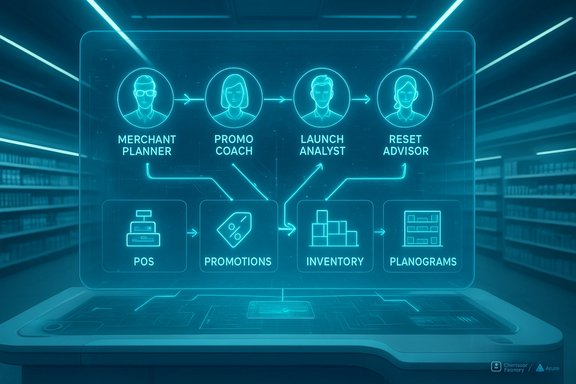
SymphonyAI, a vendor positioned as a leader in verticalized enterprise AI, announced the next generation of CINDE Merchandising Agents in a rollout that explicitly ties the offering to Microsoft Foundry and Azure. The announcement presents a quartet of role-specific agents — the Merchant Planner, Promo Coach, Launch Analyst, and Reset Advisor — each designed to monitor, explain, and recommend prioritized actions across weekly sales, promotions, new-item launches, and planogram resets. The CINDE brand is part of SymphonyAI’s Connected Retail stack, an architecture the company has been promoting at industry showcases and NRF events while citing broad customer traction across retail and CPG accounts. SymphonyAI publicly describes itself as serving more than 2,000 enterprise customers and highlights deep penetration in grocery and CPG verticals — claims the vendor repeats in recent product announcements. Microsoft Foundry — the platform SymphonyAI selected for agent construction and orchestration — is positioned by Microsoft as an enterprise-grade AI app and agent factory that supports multi-agent orchestration, tool integration, model routing, observability, and governance built on Azure infrastructure. The Foundry platform is explicitly designed to host agentic workflows and to connect them securely to enterprise knowledge and systems.
Source: Business Wire https://www.businesswire.com/news/h...sions-Powered-by-Microsoft-Foundry-and-Azure/
 Background
SymphonyAI, a vendor positioned as a leader in verticalized enterprise AI, announced the next generation of CINDE Merchandising Agents in a rollout that explicitly ties the offering to Microsoft Foundry and Azure. The announcement presents a quartet of role-specific agents — the Merchant Planner, Promo Coach, Launch Analyst, and Reset Advisor — each designed to monitor, explain, and recommend prioritized actions across weekly sales, promotions, new-item launches, and planogram resets. The CINDE brand is part of SymphonyAI’s Connected Retail stack, an architecture the company has been promoting at industry showcases and NRF events while citing broad customer traction across retail and CPG accounts. SymphonyAI publicly describes itself as serving more than 2,000 enterprise customers and highlights deep penetration in grocery and CPG verticals — claims the vendor repeats in recent product announcements. Microsoft Foundry — the platform SymphonyAI selected for agent construction and orchestration — is positioned by Microsoft as an enterprise-grade AI app and agent factory that supports multi-agent orchestration, tool integration, model routing, observability, and governance built on Azure infrastructure. The Foundry platform is explicitly designed to host agentic workflows and to connect them securely to enterprise knowledge and systems. What the CINDE Merchandising Agents claim to do
Role-based, merchant-centric agents
SymphonyAI’s agents are described as role-first assistants that map directly to merchant workflows and decision rhythms:- Merchant Planner — continuous weekly sales monitoring, detection of margin opportunities, and prioritized tasks for planners and category managers.
- Promo Coach — causal analysis for promotions, optimization recommendations, and debugging of poor promo lift.
- Launch Analyst — early detection and corrective actions for new-item launches to avoid slow-burn failures.
- Reset Advisor — post-reset impact assessment and next-step recommendations to capture expected lift (or identify execution failures).
Continuous, action-oriented intelligence — not dashboards
The vendor emphasizes that CINDE’s output is not a new dashboard but a continuous decisioning layer that:- ingests POS, inventory, planogram/execution, and promotional data,
- surfaces which stores or SKUs are diverging from expectations,
- explains the causal drivers using domain-aware reasoning, and
- recommends prioritized, merchant-friendly actions (what to change, where, and with what expected impact).
The technical foundation: Microsoft Foundry + Azure
SymphonyAI builds these agents on Microsoft Foundry, leveraging the platform’s agent tooling, model catalog, and enterprise governance capabilities. Microsoft describes Foundry as an end-to-end AI platform that facilitates multi-agent orchestration, knowledge integration (search/knowledge base grounding), model routing, and governance — features directly relevant to production-grade, agentic retail workflows. Foundry’s technical capabilities that matter for a deployment like CINDE include:- integrated Foundry Agent Service for multi-step agents and tool invocation,
- Foundry IQ (search/knowledge integration) to ground agent recommendations in retailer content and policies,
- model routing to choose between multiple models for latency/cost/quality tradeoffs, and
- an enterprise control plane for observability, access controls, and deployment management on Azure.
Why retailers should care — potential benefits
The CINDE Merchandising Agents promise business outcomes that appeal to retail executives and merchants alike:- Faster detection of margin leakage. Where traditional weekly review cycles can miss or misattribute problems for days, the agents aim to surface issues within hours and attach recommended corrective steps, collapsing the time between signal and action.
- Clearer causality. By using domain logic and cross-source analysis, agents claim to distinguish between competitor price pressure, local execution failures (e.g., wrong shelf placement), and supply chain issues — a distinction that materially changes remediation choices.
- Prioritized execution. Instead of an analyst’s generic list of anomalies, the system outputs ranked tasks with store-level specificity, enabling merchant teams to triage work and focus scarce execution resources on the highest-return actions.
- Consistency at scale. For multi-format, multi-region retailers the promise is consistent, explainable recommendations across thousands of stores, reducing reliance on local tribal knowledge and uneven analyst skills.
Critical analysis — strengths
1. Verticalization lowers time-to-value
General-purpose AI assistants struggle in retail because they lack domain models for merchandising cadence, planogram semantics, and promotion mechanics. CINDE’s vertical focus — combined with SymphonyAI’s history of packaged retail applications — reduces the heavy customization usually needed for meaningful suggestions. That verticalization can shorten pilot cycles and speed adoption where data pipelines are mature.2. Workflow alignment
Designing agents to match merchant rhythms (weekly reviews, promo cycles, launch windows, reset periods) is an important adoption lever. Technology that produces recommendations in the merchant’s language and cadence is far more likely to be adopted than one that merely dumps statistical anomalies. SymphonyAI puts the workflow fit front-and-center in messaging.3. Enterprise-grade platform and governance
Building on Microsoft Foundry and Azure gives SymphonyAI a mature foundation for secure, governed deployments. Foundry’s agent orchestration, model routing, and observability features directly address many technical barriers to enterprise deployment for agentic systems. For large retailers these platform assurances matter materially during procurement and security reviews.4. Vendor scale and footprint
SymphonyAI’s public positioning — more than 2,000 enterprise clients and deep penetration in CPG/grocery — suggests the company has both the customer base and retail domain exposure to iterate product-market fit for merchandising agents at scale. Those claims are central to their commercial pitch for moving beyond pilots.Critical analysis — risks and limitations
Data integrity and integration remain the highest barriers
Agents depend on clean, timely inputs: POS, inventory, DSD feeds, planogram/execution metadata, in-store audits, and promotion engines. Many retailers still run hybrid systems with batch transfers, inconsistent SKU mappings, and weak planogram traceability. If the data pipeline is brittle, agent outputs will be noisy or misleading. This is not an implementation detail — it is the gating condition for trust.Explainability vs. plausibility
Vendor marketing emphasizes explanations, but there’s a meaningful difference between an explainer that sounds plausible and one that shows an auditable chain of evidence. Retailers evaluating CINDE should insist the vendor produce: the supporting data points, the reasoning chain, and a confidence estimate for each recommendation. Without this, front-line teams may distrust or — worse — over-trust the agent.Human process and change management
Getting recommendation adoption requires reworking weekly reviews, promo playbooks, and store execution incentives. Even the most accurate agent will deliver no incremental margin if humans ignore recommendations or lack the bandwidth to act. Operational playbooks, acceptance criteria, and a governance forum for exceptions are mandatory.Vendor claims and anecdotal evidence need independent validation
SymphonyAI — like other vendors — uses example-driven storytelling and ROI language such as “Return on Intelligence.” These are compelling but often vendor-framed. Retailers should demand controlled pilot results, hold-out test stores, and independent metrics that evaluate lift, execution rate, and time-to-recovery before committing to fleet-wide rollouts. Some numerical claims in SymphonyAI’s broader marketing materials (e.g., headline uplift numbers or profit multipliers) are vendor-supplied and should be treated as indicative rather than definitive until benchmarked.How to evaluate CINDE Merchandising Agents — a disciplined checklist
- Define the baseline. Establish clear KPIs (gross margin, incremental margin dollars, promo lift, sell-through) and a measurement window. Use matched holdout stores to measure causal impact.
- Start with high-signal pilots. Choose categories where execution can be measured quickly (dairy, produce, impulse) and where planogram/execution visibility is strong.
- Require explainability. For each recommendation, demand the agent’s supporting datapoints, the causal analysis, and the confidence level. Log the chain of reasoning for audits and training.
- Validate integration breadth. Confirm the agent can access POS, promotion feeds, planogram tools, store execution audits, and pricing engines with appropriate latency. If any feed is missing, quantify the blind spots.
- Measure behavioral lift. Track recommendation acceptance rates and time-to-action, not just sales outcomes. A low acceptance rate points to workflow friction, not algorithm failure.
Security, governance, and compliance considerations
SymphonyAI’s choice of Microsoft Foundry and Azure addresses many enterprise concerns: integrated identity (Azure AD), secure key management, region-aware data residency, and platform-level observability. Microsoft’s documentation for Foundry emphasizes governance, model routing, and enterprise controls that help operationalize agents at scale. Retail procurement and security teams should still require architecture reviews, penetration testing, and data-flow diagrams specific to the retailer’s environment before production deployment. Retailers operating in regulated markets or handling sensitive loyalty/customer data must validate data minimization, role-based access, and audit logging. Agents that need to preview or operate on customer-level data should be subject to the retailer’s privacy impact assessment and legal sign-off.Economics and vendor claims — read the fine print
SymphonyAI positions CINDE as a margin-protection and margin-creation tool, and its broader marketing references significant financial outcomes from other product lines. For example, SymphonyAI public materials trumpet enterprise scale and large-client deployments, while other company coverage has discussed revenue run rates and growth plans. These financial and scale claims provide context about vendor stability and delivery capacity but are not direct evidence of product-specific ROI for merchandising agents; retailers should treat them as background when negotiating contracts. Contract negotiations should carve performance SLAs for pilot-to-production transitions, include acceptance criteria for measurable uplift, and define rollback conditions. Pricing models for agentic services may include per-store subscriptions, outcome-based fees, or a hybrid; insist on transparent benchmarking periods before committing to multi-year agreements.Competitive and market context
Agentic AI is rapidly moving from proof-of-concept to productization across enterprise verticals. Microsoft Foundry’s emergence as a mainstream platform for multi-agent orchestration has accelerated vendor activity, and SymphonyAI is one of several specialized suppliers packaging vertical agents for retail, supply chain, and manufacturing. The strategic bet here is that domain-trained, prepackaged agents outperform general-purpose systems when the problem set is narrowly defined and workflow-aligned. For retailers, the choice is less about “agent vs. no agent” and more about which vendor can deliver repeatable, auditable uplift in specific categories and formats. The differentiator will be 1) data integration depth, 2) true causality and explainability, 3) operational adoption, and 4) supplier stability and support.Practical next steps for merchants and CIOs
- Run a focused pilot in a single category with strong data fidelity and quick execution paths (e.g., dairy or deli). Measure both recommendation acceptance and margin recovery.
- Insist on an evidence package for each recommendation (data inputs, causal logic, confidence). Treat explanations as part of acceptance criteria.
- Prepare the integration plumbing — POS mappings, promotion calendars, planogram feeds, and store-execution checks — before scaling. Realize that integration work, not the agent model, will be the majority of implementation cost.
- Assign an operational owner for agent recommendations inside merchandising teams, with clear KPIs and a governance cadence to resolve false positives and tune logic.
Final verdict
SymphonyAI’s CINDE Merchandising Agents represent a concrete, market-oriented attempt to move agentic AI from experimental pilots into the operational cadence that actually moves retail margin. The product’s vertical focus, role-specific design, and reliance on Microsoft Foundry’s agent tooling make it technically plausible and commercially sensible for retailers with mature data pipelines and disciplined execution teams. However, the promise comes with significant implementation caveats: the quality of data and integrations, the requirement for explainable, auditable reasoning, and the hard work of change management. Retailers should treat the CINDE launch as an invitation to test a new operational layer — not as a plug-and-play margin guarantee. Rigorous pilots, holdout controls, and contractual clarity on outcomes will separate vendors’ marketing narratives from measurable returns in the field. SymphonyAI’s announcement is a notable milestone in the march of agentic AI into the retail stack — and it sets a practical bar for what domain-first, workflow-aligned agents must deliver: clear causality, prioritized actions, enterprise-grade governance, and demonstrable uplift that pays for the integration work. For merchants ready to modernize weekly workflows and invest in clean integrations, CINDE is worth a careful, metrics-driven trial; for the rest, the technology will remain promising but conditional on the many operational realities that determine whether an algorithmic recommendation turns into increased margin on the shelf.Source: Business Wire https://www.businesswire.com/news/h...sions-Powered-by-Microsoft-Foundry-and-Azure/
