

CIQ announced on June 4, 2026, that Fuzzball now supports AI, inference, and high-performance computing workflows across CoreWeave, AWS, Google Cloud, Oracle Cloud Infrastructure, Microsoft Azure, and on-premises systems from a single control plane. The news is less about one more cloud checkbox than about a larger shift in how expensive compute is being bought, governed, and moved. CIQ is betting that the next enterprise infrastructure fight will not be won by the cloud with the most GPUs, but by the layer that can decide where each job should run without forcing teams to rebuild the work every time.
The old cloud argument was that enterprises wanted elasticity. The new AI argument is that enterprises want access — access to GPUs, access to regional capacity, access to cheaper cycles, and access to infrastructure they can still control when the data is too sensitive to move. That is a very different kind of demand.
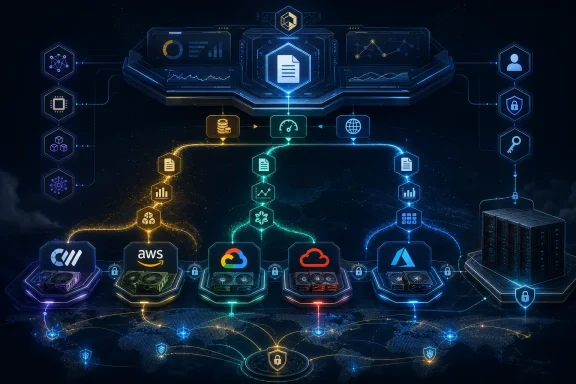
Fuzzball’s expanded multi-cloud support lands in that pressure zone. CIQ says users can define a workflow once and run it across CoreWeave, AWS, Google Cloud, OCI, Azure, or local infrastructure, with Fuzzball deciding where jobs should execute based on cost, performance, and data locality. In practice, that makes Fuzzball less like a traditional scheduler and more like an infrastructure broker for teams whose workloads no longer fit neatly inside one cloud account.
The timing matters. AI training jobs and HPC simulations are not web apps with predictable scaling curves. They are bursty, expensive, hardware-sensitive, and often tied to data sets that cannot casually be copied across regions or providers. A team may want H100 density from a specialist provider one week, compliance-friendly on-premises execution the next, and hyperscale storage or managed services after that.
That is the opening CIQ is trying to exploit. It is not promising that multi-cloud becomes simple, because multi-cloud never becomes simple. It is promising that workflow authors should not have to encode every cloud’s assumptions into every job.
That sounds dry, but it is where the architectural argument lives. In many organizations, the workflow is not really portable even when the container is. The container image may move, but the surrounding machinery — identity, storage paths, instance types, accelerator availability, network policy, job submission, logging, and secrets — tends to be rewritten provider by provider.
Fuzzball’s orchestration layer is meant to absorb that translation. The workflow declares what it needs; Fuzzball maps that intent onto the underlying environment. A genomics pipeline validated on AWS could, in CIQ’s example, move to Azure or OCI without changing the workflow definition. A training job that needs dense GPU access could go to CoreWeave. A sensitive simulation could remain inside an on-premises cluster.
That is the same portability dream infrastructure vendors have been selling for years, but AI gives it sharper teeth. The cost of getting this wrong is no longer a few idle virtual machines or a messy Terraform module. It can be a delayed model release, a seven-figure training bill, or a compliance problem caused by moving data into the wrong jurisdiction.
AI and HPC change the equation because the constraint is no longer just preference. It is capacity. If the GPUs are unavailable in one environment, the workload has to wait or move. If a cloud region is too costly, the team needs a practical alternative. If data cannot leave a site, the compute must come to the data or the job must stay local.
That makes multi-cloud less ideological and more tactical. Enterprises are not necessarily trying to build a grand cloud-neutral utopia. They are trying to keep expensive work moving despite shortages, pricing swings, sovereignty rules, and fragmented infrastructure markets.
CIQ’s pitch is that Fuzzball can turn that fragmentation into something schedulable. The platform federates across five public clouds and on-premises clusters, evaluates available environments at runtime, and routes jobs to what it determines is the best destination. That is a strong claim, and customers will judge it by the ugly details: queue times, data transfer behavior, policy enforcement, hardware matching, and failure handling.
That creates a different kind of cloud market. A company may still use Azure for identity, AWS for storage-heavy pipelines, Google Cloud for data tooling, OCI for price-performance or existing enterprise relationships, and CoreWeave for GPU-heavy training. The resulting architecture is not elegant, but it is increasingly plausible.
Fuzzball is positioning itself as a layer above that mess. CIQ argues that enterprises should not need separate toolchains, deployment scripts, or identity models for each provider. The message is blunt: if AI teams must chase capacity across clouds, the workflow layer should follow them without becoming another cloud-specific rewrite project.
The risk for CIQ is that every provider has its own gravitational pull. Hyperscalers prefer customers to use native schedulers, native AI services, native IAM, native observability, and native billing controls. A neutral orchestration layer must therefore be useful enough to justify sitting above those services rather than being slowly absorbed by them.
Fuzzball’s expanded deployments use a two-stage automated provisioning process that creates a full cluster without manual setup. CIQ says the model preserves one approach to identity and access management, role-based access control, and secrets management across environments. The platform uses cloud-native identity mechanisms rather than static credentials, including Workload Identity on Google Cloud, Managed Identities on Azure, Dynamic Groups on OCI, and IAM Roles on AWS.
That detail matters. Static credentials are the duct tape of rushed cloud automation, and they age badly. They get copied into scripts, rotated inconsistently, over-permissioned, and forgotten. Using each provider’s native identity mechanism is the more defensible approach, even if it complicates the abstraction Fuzzball has to maintain.
This is also where the “single control plane” claim must be tested carefully. A single control plane is powerful when it centralizes policy and visibility. It is dangerous if it becomes a privileged blast radius spanning every environment. CIQ’s design will need to convince security teams that it reduces credential sprawl without creating a new crown jewel that attackers would love to own.
Gregory Kurtzer’s involvement also matters. As CIQ’s founder and CEO, and as a long-running figure in the Enterprise Linux and HPC ecosystem, he is not selling cloud portability as a purely SaaS-native abstraction. CIQ’s pitch is rooted in the reality that many serious compute environments still include bare metal, VMware, Warewulf-provisioned clusters, and local data centers.
That heritage helps explain Fuzzball’s tone. It is not simply saying, “move everything to the cloud.” It is saying that enterprises will run across cloud and on-premises systems, so the workflow layer has to respect both. That is a more credible message for scientific computing, regulated industries, and AI teams dealing with large proprietary data sets.
But credibility is not immunity. HPC users are notoriously demanding because their workloads expose scheduler weaknesses quickly. AI teams are similarly impatient because idle GPU time is expensive and visible. Fuzzball’s success will depend less on the elegance of provider-neutral definitions than on whether real workloads complete reliably, observably, and economically.
That is an attractive idea for organizations trying to operationalize AI without losing control of sensitive data. A model training job may be allowed to run in a public cloud if the data is synthetic or anonymized. A genomics workflow may need to remain in a jurisdiction. A simulation tied to export-controlled research may need to stay on premises. A less sensitive inference job may simply go wherever capacity is cheapest.
The challenge is that policy engines are only as good as the metadata and enforcement around them. The platform must know where data lives, what rules apply to it, what resources satisfy the workload, and what destinations are permitted. If those inputs are wrong, automated routing can make bad decisions faster than a human operator would.
Still, this is the right battlefield. Enterprises do not need multi-cloud because it sounds sophisticated. They need it because the infrastructure estate already fragmented underneath them. The winning layer is the one that can turn that fragmentation into policy-aware execution rather than tribal knowledge in deployment scripts.
The question is not whether Fuzzball replaces those ecosystems. It clearly does not. The question is whether enough AI and HPC work benefits from a layer above them. CIQ is arguing that workflow portability is valuable precisely because the underlying platforms remain distinct.
That argument will resonate most with teams whose work is already containerized, batch-oriented, data-intensive, and hardware-sensitive. It may resonate less with organizations that have deeply committed to a provider’s native AI platform, managed training service, or data warehouse. The more cloud-native the surrounding system becomes, the more difficult true portability gets.
This is the practical tension at the heart of multi-cloud. Vendors sell abstraction; clouds sell integration. Abstraction reduces dependency, but integration reduces friction. Fuzzball has to prove that, for AI and HPC workflows, the abstraction saves more pain than it introduces.
CIQ says on-premises deployment remains supported on Warewulf, VMware, and bare metal systems. That mix is telling. Warewulf speaks to traditional Linux cluster provisioning. VMware speaks to entrenched enterprise virtualization. Bare metal speaks to performance, accelerator access, and the continued importance of direct hardware control.
For administrators, the value proposition is not just “run anywhere.” It is “keep local infrastructure in the same operational conversation as cloud infrastructure.” That matters when organizations are trying to justify existing clusters, integrate new GPU nodes, or decide when a job belongs in a public cloud instead of a data center rack they already own.
The tension, again, is operational reality. On-premises environments vary wildly. Firmware, drivers, networking, storage, GPUs, schedulers, and security controls are rarely as standardized as cloud APIs. If Fuzzball can smooth over enough of that variation without pretending it disappears, CIQ will have a stronger story than vendors that treat on-premises as merely a checkbox.
A workflow that is cheaper to run on another provider may become more expensive if moving the data takes too long or triggers transfer fees. A GPU cluster with a lower nominal price may underperform if networking, storage throughput, or software stack differences slow the job. An on-premises run may look cheaper until power, cooling, depreciation, and staffing are honestly counted.
That does not weaken CIQ’s case. It clarifies what Fuzzball must measure. The platform’s routing logic will need to become more than a scheduling preference; it will need to reflect actual workload economics. For sophisticated customers, “best destination” will mean different things at different times.
The market is ready for this kind of tooling because AI has made waste visible. Idle accelerators are expensive. Repeated validation work is expensive. Human teams rebuilding pipelines for each destination are expensive. CIQ’s job is to show that Fuzzball reduces those costs in production, not just in a clean demo.
Windows environments have already lived through the shift from server-centric management to policy-centric management. Identity moved from local accounts to federated systems. Endpoint management moved toward declarative configuration. Application deployment moved from manual installs to pipelines. Fuzzball is applying a similar logic to AI and HPC workflows: define intent once, enforce policy centrally, and let the execution layer translate.
That has implications for Windows-heavy enterprises adopting AI. Even if model training runs on Linux GPU clusters, the surrounding organization may depend on Microsoft identity, Azure governance, Windows endpoints, SQL Server estates, PowerShell automation, and hybrid management tools. The AI infrastructure layer cannot be treated as a science-project island forever.
The more AI becomes a production function, the more it will collide with enterprise IT norms. Auditability, access control, cost management, lifecycle policy, disaster recovery, and change management will matter as much as raw GPU throughput. CIQ’s announcement is one example of vendors trying to drag AI infrastructure from artisanal engineering into governed operations.
Fuzzball’s provider-neutral workflow model reduces one kind of complexity, but it cannot abolish the physical and operational differences underneath. CoreWeave is not Azure. OCI is not AWS. Google Cloud identity is not Azure Managed Identity. On-premises bare metal is not a public cloud availability zone. Any layer that spans them has to expose enough detail to troubleshoot without making users think in five different provider dialects.
This is the hard balance. Hide too much, and operators cannot fix problems. Expose too much, and the abstraction collapses into a wrapper around cloud-specific scripts. CIQ’s product maturity will be measured by how well it handles that middle ground.
That may be why the company emphasizes reproducibility. In AI and HPC, reproducibility is not a nice-to-have; it is a trust requirement. If the same workflow definition can produce consistent behavior across environments, teams can validate once and move with more confidence. If not, every migration becomes another experiment.
Neutrality is valuable only if customers believe it. CIQ must persuade enterprises that Fuzzball will support the environments they actually use, respect their security models, and avoid becoming a proprietary lock-in layer of its own. The company’s Rocky Linux background helps, but the burden of proof remains with the product.
There is also a broader industry question. If neutral workflow layers gain traction, cloud providers may have to compete more directly on price, capacity, performance, and data-residency guarantees because customers can move work more easily. If they do not, the hyperscalers’ native platforms will continue to pull workloads deeper into provider-specific ecosystems.
That makes Fuzzball’s expansion both a product update and a small referendum on the future of enterprise AI operations. The market is deciding whether AI workloads should be glued to the cloud where they start or described in a way that lets them travel.
 CIQ Is Selling Portability at the Exact Moment AI Made Lock-In Expensive
The old cloud argument was that enterprises wanted elasticity. The new AI argument is that enterprises want access — access to GPUs, access to regional capacity, access to cheaper cycles, and access to infrastructure they can still control when the data is too sensitive to move. That is a very different kind of demand.Fuzzball’s expanded multi-cloud support lands in that pressure zone. CIQ says users can define a workflow once and run it across CoreWeave, AWS, Google Cloud, OCI, Azure, or local infrastructure, with Fuzzball deciding where jobs should execute based on cost, performance, and data locality. In practice, that makes Fuzzball less like a traditional scheduler and more like an infrastructure broker for teams whose workloads no longer fit neatly inside one cloud account.
The timing matters. AI training jobs and HPC simulations are not web apps with predictable scaling curves. They are bursty, expensive, hardware-sensitive, and often tied to data sets that cannot casually be copied across regions or providers. A team may want H100 density from a specialist provider one week, compliance-friendly on-premises execution the next, and hyperscale storage or managed services after that.
That is the opening CIQ is trying to exploit. It is not promising that multi-cloud becomes simple, because multi-cloud never becomes simple. It is promising that workflow authors should not have to encode every cloud’s assumptions into every job.
The Workflow File Becomes the New Unit of Control
The most important part of CIQ’s announcement is not the list of supported providers. It is the claim that the workflow definition itself remains provider-neutral. The same file describes compute jobs, data movement, container images, and resource requirements without embedding cloud-specific logic.That sounds dry, but it is where the architectural argument lives. In many organizations, the workflow is not really portable even when the container is. The container image may move, but the surrounding machinery — identity, storage paths, instance types, accelerator availability, network policy, job submission, logging, and secrets — tends to be rewritten provider by provider.
Fuzzball’s orchestration layer is meant to absorb that translation. The workflow declares what it needs; Fuzzball maps that intent onto the underlying environment. A genomics pipeline validated on AWS could, in CIQ’s example, move to Azure or OCI without changing the workflow definition. A training job that needs dense GPU access could go to CoreWeave. A sensitive simulation could remain inside an on-premises cluster.
That is the same portability dream infrastructure vendors have been selling for years, but AI gives it sharper teeth. The cost of getting this wrong is no longer a few idle virtual machines or a messy Terraform module. It can be a delayed model release, a seven-figure training bill, or a compliance problem caused by moving data into the wrong jurisdiction.
Multi-Cloud Was Once a Strategy Deck; AI Made It an Operations Problem
For years, multi-cloud was often a boardroom aspiration in search of an operational reason. Companies said they wanted to avoid lock-in, negotiate better pricing, and place workloads closer to users. In practice, many discovered that running across several clouds meant multiplying complexity faster than they multiplied leverage.AI and HPC change the equation because the constraint is no longer just preference. It is capacity. If the GPUs are unavailable in one environment, the workload has to wait or move. If a cloud region is too costly, the team needs a practical alternative. If data cannot leave a site, the compute must come to the data or the job must stay local.
That makes multi-cloud less ideological and more tactical. Enterprises are not necessarily trying to build a grand cloud-neutral utopia. They are trying to keep expensive work moving despite shortages, pricing swings, sovereignty rules, and fragmented infrastructure markets.
CIQ’s pitch is that Fuzzball can turn that fragmentation into something schedulable. The platform federates across five public clouds and on-premises clusters, evaluates available environments at runtime, and routes jobs to what it determines is the best destination. That is a strong claim, and customers will judge it by the ugly details: queue times, data transfer behavior, policy enforcement, hardware matching, and failure handling.
CoreWeave’s Presence Tells the Real Story
The inclusion of CoreWeave alongside AWS, Google Cloud, OCI, and Azure is not a cosmetic detail. It reflects how AI infrastructure procurement has changed. Enterprises increasingly look beyond the three classic hyperscalers when they need dense GPU capacity, especially for training and inference workloads that benefit from specialized infrastructure.That creates a different kind of cloud market. A company may still use Azure for identity, AWS for storage-heavy pipelines, Google Cloud for data tooling, OCI for price-performance or existing enterprise relationships, and CoreWeave for GPU-heavy training. The resulting architecture is not elegant, but it is increasingly plausible.
Fuzzball is positioning itself as a layer above that mess. CIQ argues that enterprises should not need separate toolchains, deployment scripts, or identity models for each provider. The message is blunt: if AI teams must chase capacity across clouds, the workflow layer should follow them without becoming another cloud-specific rewrite project.
The risk for CIQ is that every provider has its own gravitational pull. Hyperscalers prefer customers to use native schedulers, native AI services, native IAM, native observability, and native billing controls. A neutral orchestration layer must therefore be useful enough to justify sitting above those services rather than being slowly absorbed by them.
Identity Is Where Portability Usually Goes to Die
CIQ wisely spends part of the announcement on security and identity rather than treating them as afterthoughts. That is because multi-cloud portability is often easy to describe at the compute layer and painful to implement at the trust layer. Credentials, roles, secrets, and access boundaries are where clean architecture diagrams become long audit meetings.Fuzzball’s expanded deployments use a two-stage automated provisioning process that creates a full cluster without manual setup. CIQ says the model preserves one approach to identity and access management, role-based access control, and secrets management across environments. The platform uses cloud-native identity mechanisms rather than static credentials, including Workload Identity on Google Cloud, Managed Identities on Azure, Dynamic Groups on OCI, and IAM Roles on AWS.
That detail matters. Static credentials are the duct tape of rushed cloud automation, and they age badly. They get copied into scripts, rotated inconsistently, over-permissioned, and forgotten. Using each provider’s native identity mechanism is the more defensible approach, even if it complicates the abstraction Fuzzball has to maintain.
This is also where the “single control plane” claim must be tested carefully. A single control plane is powerful when it centralizes policy and visibility. It is dangerous if it becomes a privileged blast radius spanning every environment. CIQ’s design will need to convince security teams that it reduces credential sprawl without creating a new crown jewel that attackers would love to own.
The Rocky Linux Connection Gives CIQ Credibility, but Not a Free Pass
CIQ is not arriving from nowhere. The company is widely associated with Rocky Linux and with enterprise Linux infrastructure work, including provisioning and cluster management. That gives it credibility with the kinds of sysadmins and HPC operators who have long memories and limited patience for orchestration vaporware.Gregory Kurtzer’s involvement also matters. As CIQ’s founder and CEO, and as a long-running figure in the Enterprise Linux and HPC ecosystem, he is not selling cloud portability as a purely SaaS-native abstraction. CIQ’s pitch is rooted in the reality that many serious compute environments still include bare metal, VMware, Warewulf-provisioned clusters, and local data centers.
That heritage helps explain Fuzzball’s tone. It is not simply saying, “move everything to the cloud.” It is saying that enterprises will run across cloud and on-premises systems, so the workflow layer has to respect both. That is a more credible message for scientific computing, regulated industries, and AI teams dealing with large proprietary data sets.
But credibility is not immunity. HPC users are notoriously demanding because their workloads expose scheduler weaknesses quickly. AI teams are similarly impatient because idle GPU time is expensive and visible. Fuzzball’s success will depend less on the elegance of provider-neutral definitions than on whether real workloads complete reliably, observably, and economically.
The Portability Promise Is Also a Governance Promise
CIQ frames Fuzzball partly as a cost and performance tool, but the more durable enterprise story may be governance. If jobs can be routed based on data locality and policy, then the workflow system becomes a place where infrastructure decisions can be encoded and enforced rather than argued over manually.That is an attractive idea for organizations trying to operationalize AI without losing control of sensitive data. A model training job may be allowed to run in a public cloud if the data is synthetic or anonymized. A genomics workflow may need to remain in a jurisdiction. A simulation tied to export-controlled research may need to stay on premises. A less sensitive inference job may simply go wherever capacity is cheapest.
The challenge is that policy engines are only as good as the metadata and enforcement around them. The platform must know where data lives, what rules apply to it, what resources satisfy the workload, and what destinations are permitted. If those inputs are wrong, automated routing can make bad decisions faster than a human operator would.
Still, this is the right battlefield. Enterprises do not need multi-cloud because it sounds sophisticated. They need it because the infrastructure estate already fragmented underneath them. The winning layer is the one that can turn that fragmentation into policy-aware execution rather than tribal knowledge in deployment scripts.
The Hyperscalers Still Hold the Gravity Wells
It would be easy to read CIQ’s announcement as an anti-hyperscaler move, but that is too simple. Fuzzball depends on the clouds being useful. AWS, Azure, Google Cloud, and OCI are not just pools of compute; they are ecosystems of storage, networking, security, data services, monitoring, and enterprise procurement.The question is not whether Fuzzball replaces those ecosystems. It clearly does not. The question is whether enough AI and HPC work benefits from a layer above them. CIQ is arguing that workflow portability is valuable precisely because the underlying platforms remain distinct.
That argument will resonate most with teams whose work is already containerized, batch-oriented, data-intensive, and hardware-sensitive. It may resonate less with organizations that have deeply committed to a provider’s native AI platform, managed training service, or data warehouse. The more cloud-native the surrounding system becomes, the more difficult true portability gets.
This is the practical tension at the heart of multi-cloud. Vendors sell abstraction; clouds sell integration. Abstraction reduces dependency, but integration reduces friction. Fuzzball has to prove that, for AI and HPC workflows, the abstraction saves more pain than it introduces.
The On-Premises Piece Is Not Nostalgia
The on-premises support is not a backward-looking footnote. It is central to why this announcement matters to WindowsForum’s IT pro audience, even though Fuzzball itself sits in the Linux-heavy HPC and AI infrastructure world. Many enterprise environments are hybrid not because they failed to modernize, but because certain workloads, data sets, and operational constraints never fit neatly into public cloud.CIQ says on-premises deployment remains supported on Warewulf, VMware, and bare metal systems. That mix is telling. Warewulf speaks to traditional Linux cluster provisioning. VMware speaks to entrenched enterprise virtualization. Bare metal speaks to performance, accelerator access, and the continued importance of direct hardware control.
For administrators, the value proposition is not just “run anywhere.” It is “keep local infrastructure in the same operational conversation as cloud infrastructure.” That matters when organizations are trying to justify existing clusters, integrate new GPU nodes, or decide when a job belongs in a public cloud instead of a data center rack they already own.
The tension, again, is operational reality. On-premises environments vary wildly. Firmware, drivers, networking, storage, GPUs, schedulers, and security controls are rarely as standardized as cloud APIs. If Fuzzball can smooth over enough of that variation without pretending it disappears, CIQ will have a stronger story than vendors that treat on-premises as merely a checkbox.
The Cost Argument Is Strong, but It Needs Evidence
CIQ says Fuzzball can route jobs based on cost, performance, and data locality. That is the right trio, but it also invites scrutiny. Cost optimization in AI infrastructure is not just about comparing hourly GPU prices. It includes queue time, data movement, storage duplication, failed runs, egress charges, reserved capacity, committed spend, and the human cost of maintaining parallel deployment paths.A workflow that is cheaper to run on another provider may become more expensive if moving the data takes too long or triggers transfer fees. A GPU cluster with a lower nominal price may underperform if networking, storage throughput, or software stack differences slow the job. An on-premises run may look cheaper until power, cooling, depreciation, and staffing are honestly counted.
That does not weaken CIQ’s case. It clarifies what Fuzzball must measure. The platform’s routing logic will need to become more than a scheduling preference; it will need to reflect actual workload economics. For sophisticated customers, “best destination” will mean different things at different times.
The market is ready for this kind of tooling because AI has made waste visible. Idle accelerators are expensive. Repeated validation work is expensive. Human teams rebuilding pipelines for each destination are expensive. CIQ’s job is to show that Fuzzball reduces those costs in production, not just in a clean demo.
Windows Shops Should Watch the Pattern, Even If They Do Not Run Fuzzball Tomorrow
At first glance, this looks like a Linux and HPC story. Fuzzball, Rocky Linux, Warewulf, and bare metal clusters are not everyday vocabulary for many Windows administrators. But the architectural pattern should be familiar to anyone managing modern enterprise infrastructure.Windows environments have already lived through the shift from server-centric management to policy-centric management. Identity moved from local accounts to federated systems. Endpoint management moved toward declarative configuration. Application deployment moved from manual installs to pipelines. Fuzzball is applying a similar logic to AI and HPC workflows: define intent once, enforce policy centrally, and let the execution layer translate.
That has implications for Windows-heavy enterprises adopting AI. Even if model training runs on Linux GPU clusters, the surrounding organization may depend on Microsoft identity, Azure governance, Windows endpoints, SQL Server estates, PowerShell automation, and hybrid management tools. The AI infrastructure layer cannot be treated as a science-project island forever.
The more AI becomes a production function, the more it will collide with enterprise IT norms. Auditability, access control, cost management, lifecycle policy, disaster recovery, and change management will matter as much as raw GPU throughput. CIQ’s announcement is one example of vendors trying to drag AI infrastructure from artisanal engineering into governed operations.
The Five-Cloud Promise Will Be Judged by the First Failed Run
Every orchestration platform sounds persuasive when described from the top down. The real test comes when a job fails halfway through, a provider API changes, a region lacks capacity, a permission boundary blocks storage access, or a container behaves differently on another accelerator stack. That is when portability either proves itself or becomes a debugging tax.Fuzzball’s provider-neutral workflow model reduces one kind of complexity, but it cannot abolish the physical and operational differences underneath. CoreWeave is not Azure. OCI is not AWS. Google Cloud identity is not Azure Managed Identity. On-premises bare metal is not a public cloud availability zone. Any layer that spans them has to expose enough detail to troubleshoot without making users think in five different provider dialects.
This is the hard balance. Hide too much, and operators cannot fix problems. Expose too much, and the abstraction collapses into a wrapper around cloud-specific scripts. CIQ’s product maturity will be measured by how well it handles that middle ground.
That may be why the company emphasizes reproducibility. In AI and HPC, reproducibility is not a nice-to-have; it is a trust requirement. If the same workflow definition can produce consistent behavior across environments, teams can validate once and move with more confidence. If not, every migration becomes another experiment.
CIQ’s Bet Is That AI Infrastructure Needs a Switzerland
The phrase “single control plane” is overused in enterprise software, but here it points to a real market gap. AI infrastructure is becoming too important to be governed by ad hoc scripts, too expensive to leave idle, and too fragmented to manage cloud by cloud. CIQ is trying to make Fuzzball the neutral layer that sits above the fight for compute.Neutrality is valuable only if customers believe it. CIQ must persuade enterprises that Fuzzball will support the environments they actually use, respect their security models, and avoid becoming a proprietary lock-in layer of its own. The company’s Rocky Linux background helps, but the burden of proof remains with the product.
There is also a broader industry question. If neutral workflow layers gain traction, cloud providers may have to compete more directly on price, capacity, performance, and data-residency guarantees because customers can move work more easily. If they do not, the hyperscalers’ native platforms will continue to pull workloads deeper into provider-specific ecosystems.
That makes Fuzzball’s expansion both a product update and a small referendum on the future of enterprise AI operations. The market is deciding whether AI workloads should be glued to the cloud where they start or described in a way that lets them travel.
The Fuzzball Expansion Puts a Price on Every Rewritten Pipeline
The near-term lesson is practical: CIQ is targeting the hidden cost of infrastructure fragmentation. The company’s argument is that every provider-specific pipeline, identity model, and deployment path becomes a tax on AI and HPC teams that need to move quickly.- CIQ announced full multi-cloud Fuzzball support on June 4, 2026, spanning CoreWeave, AWS, Google Cloud, Oracle Cloud Infrastructure, Microsoft Azure, and on-premises systems.
- Fuzzball uses a provider-neutral workflow definition so teams can describe compute, data movement, containers, and resources without rewriting the workflow for each destination.
- The platform routes jobs based on cost, performance, and data locality, which matters most for GPU-heavy AI training, inference, and HPC workloads.
- CIQ says deployments use cloud-native identity mechanisms rather than static credentials, including provider-specific identity systems across Google Cloud, Azure, OCI, and AWS.
- On-premises support remains part of the story through Warewulf, VMware, and bare metal, keeping local clusters inside the same operational model as public cloud resources.
- The strongest test will be production behavior under failure, capacity constraints, policy restrictions, and real workload economics rather than the elegance of the abstraction alone.
References
- Primary source: IT Brief UK
Published: 2026-06-10T15:30:09.658856
CIQ expands Fuzzball across five clouds & on-premises
Users can now route AI and HPC jobs across five clouds and on-premises through one workflow, cutting rebuilds and manual reconfiguration. itbrief.co.uk
- Related coverage: ciq.com
CIQ expands Fuzzball to full multi-cloud so AI and HPC teams ship faster, and spend less, with absolute workflow reproducibility and portability | Press Release
Fuzzball intelligently meta-orchestrates AI and HPC workloads across CoreWeave, AWS, GCP, OCI, Azure, and on-premises infrastructure from one control plane RENO, Nev. — June 4, 2026 — CIQ, the…ciq.com - Related coverage: prnewswire.com
CIQ expands Fuzzball to full multi-cloud so AI and HPC teams ship faster and spend less, with absolute workflow reproducibility and portability
/PRNewswire/ -- CIQ, the enterprise software company behind Rocky Linux and the Fuzzball AI and HPC orchestration platform, today announced full multi-cloud... www.prnewswire.com
- Related coverage: datacenter.news
CIQ expands Fuzzball to span five clouds & on-prem
The update lets AI and HPC teams move workloads across five clouds and on-premises, cutting duplication and simplifying GPU access. datacenter.news
- Related coverage: itbrief.ca
CIQ expands Fuzzball across five clouds & on-premises
Users can now route AI and HPC jobs across five clouds and on-premises through one workflow, cutting rebuilds and manual reconfiguration. itbrief.ca
- Related coverage: datacenters.economictimes.indiatimes.com
Ciq expands fuzzball orchestration for multi cloud deployments, ETDatacenters
Read ciq expands fuzzball orchestration for multi cloud deployments on datacenters. datacenters.economictimes.indiatimes.com
