

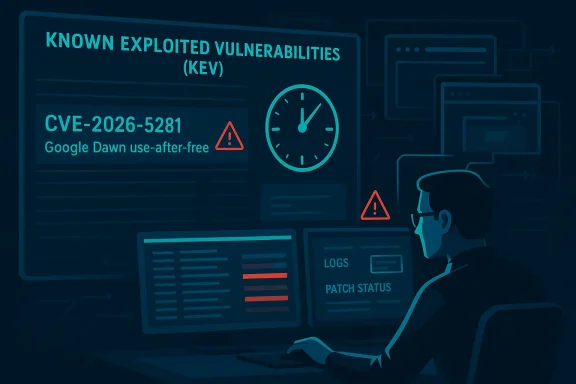
CISA’s April 1 update is a reminder that the Known Exploited Vulnerabilities Catalog remains one of the most operationally important signals in federal cybersecurity. The agency says it has added CVE-2026-5281, described as a Google Dawn use-after-free vulnerability, based on evidence of active exploitation. For defenders, the headline is not just the addition itself, but what it implies: this is the kind of flaw that threat actors can weaponize quickly, and once CISA places it in the KEV Catalog, the clock starts ticking for federal remediation priorities.
The KEV Catalog exists because not all vulnerabilities are created equal. CISA built the program under Binding Operational Directive 22-01 to help federal agencies focus on flaws that are already being exploited in the wild, rather than treating every CVE as an equal emergency. That distinction matters because modern vulnerability management is no longer just a patching exercise; it is a risk-ranking problem under time pressure.
At its core, the catalog is a living list of CVEs with known exploitation activity. CISA’s own guidance stresses that these vulnerabilities pose significant risk to the federal enterprise, and that agencies must remediate them by the assigned due date. Although the directive formally applies to Federal Civilian Executive Branch agencies, CISA repeatedly urges every organization to treat KEV entries as high-priority items in its own patching workflow.
That approach reflects a hard-earned lesson from the last several years: attackers often move faster than enterprise patch cycles. A vulnerability may have a modest CVSS score or look niche on paper, yet still be devastating if it lands in a widely deployed component, a browser engine, a supply-chain-adjacent SDK, or a service that sits on the internet’s front line. In practice, known exploited is often a more actionable label than merely high severity.
The addition of a Google Dawn issue fits that pattern. Dawn is part of the graphics and WebGPU ecosystem tied to Chromium-based rendering stacks, which means the blast radius can extend beyond a single product team and into browsers, applications, and embedded components built on top of the same code path. In other words, when a memory-safety bug appears in a low-level graphics layer, it is rarely “just” a browser bug. It is a platform bug with broad downstream implications.
It is also notable that the new entry is a use-after-free vulnerability, a class of memory corruption issue that has long been a favorite for exploit developers. These flaws are dangerous because they can enable code execution, crashes, or more complex exploit chains depending on where the bug sits and how reliably it can be triggered. CISA’s wording is blunt for a reason: this type of vulnerability remains a frequent attack vector for malicious cyber actors.
For defenders, that means patch queues should change immediately after a KEV entry appears. Systems exposed to the vulnerable component should be verified first, followed by any technology that bundles or depends on the affected code. In practical terms, security teams should not wait for a weekly maintenance window if the vulnerable component touches browsers, desktop software, or developer tools used across the fleet.
A use-after-free in a browser-adjacent graphics subsystem is especially concerning because exploit reliability can improve quickly once attackers understand the code path. That creates a race between defenders applying updates and adversaries refining exploit chains. The earlier CISA can push an issue into KEV, the faster organizations can justify emergency change control.
This also explains why CISA pays attention to such bugs even when they appear to be “just” application-layer problems. A flaw in a shared graphics component can become a mass-exposure event because it affects a wide range of endpoints at once. The more ubiquitous the component, the more valuable it becomes to exploit.
For enterprises, the challenge is discovery. Many asset inventories are strong at tracking major applications but weak at mapping embedded runtimes and bundled libraries. That means Dawn-related exposure may sit inside software that is already approved, already deployed, and not obviously connected to Chrome or a browser update workflow. That hidden dependency problem is where organizations get blindsided.
The federal model matters beyond Washington because it is often copied in spirit by large enterprises. Private-sector security teams may not have the same compliance mandate, but they can adopt the same concept by creating their own “known exploited” tier with executive escalation. In mature environments, KEV becomes a trigger for cross-functional change control, not just a line item in a scanner report.
That said, a catalog-driven process works only if asset owners know what they have. If an organization cannot quickly answer whether its browsers, bundled components, or dependent applications include Dawn code, then even the best KEV workflow will stall at inventory. The hard part is rarely the patch itself; it is the mapping between the patch advisory and the actual fleet.
The Chromium ecosystem also matters because it powers more than Chrome. Many desktop products, enterprise tools, and web-enabled applications embed Chromium-based rendering engines for convenience and consistency. That multiplication effect means a single low-level fix can require coordination across many products and release channels. This is why browser patching is really platform patching.
When CISA adds a browser-ecosystem bug to KEV, it signals that defenders should treat the entire stack as potentially exposed. Security teams should not assume the browser team’s patch announcement fully captures the blast radius. They need to ask where Chromium is embedded, where the component is reused, and which workflows depend on it.
They should also review detection coverage. If a KEV item is already being exploited, endpoint telemetry, browser telemetry, and network logs should be checked for signs of unusual crashes, suspicious child processes, or exploit-delivery patterns. In many incidents, the patch comes after the compromise window has already opened.
Third, organizations should tighten their software supply-chain inventory. A vulnerable component may be present in a product that was certified months ago but never revalidated after a silent dependency update. The old model of “patch the obvious app” is not enough when shared libraries and embedded runtimes are involved.
Packagers and downstream distributors also feel the pressure. If a browser or application bundles Dawn internally, then the remediation timeline may depend on how quickly the upstream fix is merged, tested, and released by the downstream product owner. That delay can be especially painful for enterprises that standardize on a limited set of approved software versions.
This dynamic helps explain why CISA’s alerts matter to more than just federal agencies. In a market where patch velocity can influence trust, a KEV entry becomes a signal to customers that a vendor’s software lifecycle has entered emergency mode. That is not a branding problem; it is an operational one.
In the short term, defenders should expect more entries involving common libraries, browser engines, network-facing appliances, and software platforms with broad downstream reach. That is where the exploitation value tends to be highest, and where remediation complexity can be the greatest. The more widely shared the code, the more urgent the fix.
Source: CISA CISA Adds One Known Exploited Vulnerability to Catalog | CISA
 Background
The KEV Catalog exists because not all vulnerabilities are created equal. CISA built the program under Binding Operational Directive 22-01 to help federal agencies focus on flaws that are already being exploited in the wild, rather than treating every CVE as an equal emergency. That distinction matters because modern vulnerability management is no longer just a patching exercise; it is a risk-ranking problem under time pressure.At its core, the catalog is a living list of CVEs with known exploitation activity. CISA’s own guidance stresses that these vulnerabilities pose significant risk to the federal enterprise, and that agencies must remediate them by the assigned due date. Although the directive formally applies to Federal Civilian Executive Branch agencies, CISA repeatedly urges every organization to treat KEV entries as high-priority items in its own patching workflow.
That approach reflects a hard-earned lesson from the last several years: attackers often move faster than enterprise patch cycles. A vulnerability may have a modest CVSS score or look niche on paper, yet still be devastating if it lands in a widely deployed component, a browser engine, a supply-chain-adjacent SDK, or a service that sits on the internet’s front line. In practice, known exploited is often a more actionable label than merely high severity.
The addition of a Google Dawn issue fits that pattern. Dawn is part of the graphics and WebGPU ecosystem tied to Chromium-based rendering stacks, which means the blast radius can extend beyond a single product team and into browsers, applications, and embedded components built on top of the same code path. In other words, when a memory-safety bug appears in a low-level graphics layer, it is rarely “just” a browser bug. It is a platform bug with broad downstream implications.
It is also notable that the new entry is a use-after-free vulnerability, a class of memory corruption issue that has long been a favorite for exploit developers. These flaws are dangerous because they can enable code execution, crashes, or more complex exploit chains depending on where the bug sits and how reliably it can be triggered. CISA’s wording is blunt for a reason: this type of vulnerability remains a frequent attack vector for malicious cyber actors.
What CISA’s Addition Signals
CISA’s alert format is intentionally spare, but the operational meaning is clear. Once a vulnerability makes the KEV Catalog, it has crossed from theoretical risk into demonstrated adversary behavior. That makes the catalog less a research artifact and more a live response mechanism for security teams, especially those responsible for large fleets of managed endpoints and internet-facing services.From disclosure to exploitation
A useful way to read KEV is as a bridge between disclosure and incident response. Many vulnerability databases tell you what could happen; KEV tells you what is already happening. That is a crucial distinction for prioritization because it shifts the question from “How bad could this be?” to “Where are attackers already getting in?”For defenders, that means patch queues should change immediately after a KEV entry appears. Systems exposed to the vulnerable component should be verified first, followed by any technology that bundles or depends on the affected code. In practical terms, security teams should not wait for a weekly maintenance window if the vulnerable component touches browsers, desktop software, or developer tools used across the fleet.
A use-after-free in a browser-adjacent graphics subsystem is especially concerning because exploit reliability can improve quickly once attackers understand the code path. That creates a race between defenders applying updates and adversaries refining exploit chains. The earlier CISA can push an issue into KEV, the faster organizations can justify emergency change control.
Why the label matters more than the brand
The product label matters, but the bug class matters even more. Use-after-free issues have a long history of turning into practical remote exploitation, particularly where attacker-controlled content can influence memory allocation and object lifetime. When that occurs in an engine like Dawn, the vulnerability is not merely a product defect; it is a pathway into the rendering and acceleration stack.- Active exploitation changes remediation urgency immediately.
- Memory corruption bugs often support chained exploitation.
- Browser-adjacent code can affect multiple products at once.
- Shared components increase the number of downstream consumers.
- Fast patching is usually cheaper than post-compromise response.
- Asset inventory accuracy becomes critical the moment KEV changes.
Why Dawn Matters
Dawn is not a household name, which is exactly why its appearance in KEV deserves attention. Components like Dawn tend to sit below the surface, doing the specialized work that modern web applications rely on without most users ever knowing they exist. That invisibility is a double-edged sword: it improves abstraction for developers, but it also hides risk from administrators who may not realize how many products inherit the same code.A graphics layer with broad reach
Dawn is associated with WebGPU and graphics abstraction in the Chromium ecosystem, which places it close to the rendering paths that matter to browsers and browser-based applications. When a vulnerability exists in that layer, the issue can reach beyond traditional browser tabs and into desktop software that embeds Chromium or relies on the same stack. That broader footprint is one reason browser-engine vulnerabilities so often appear in major exploitation campaigns.This also explains why CISA pays attention to such bugs even when they appear to be “just” application-layer problems. A flaw in a shared graphics component can become a mass-exposure event because it affects a wide range of endpoints at once. The more ubiquitous the component, the more valuable it becomes to exploit.
For enterprises, the challenge is discovery. Many asset inventories are strong at tracking major applications but weak at mapping embedded runtimes and bundled libraries. That means Dawn-related exposure may sit inside software that is already approved, already deployed, and not obviously connected to Chrome or a browser update workflow. That hidden dependency problem is where organizations get blindsided.
Memory safety remains the evergreen problem
The fact that a use-after-free bug in a graphics-related path can make KEV is another data point in a familiar trend: memory-unsafe code remains a persistent security liability. Despite years of industry progress, attackers still find great value in bugs that let them corrupt object lifetimes and steer execution. The lesson is not new, but the persistence of the problem is.- Shared components amplify impact.
- Embedded runtimes complicate patch visibility.
- Memory corruption is still highly exploitable.
- Web-facing paths invite opportunistic weaponization.
- Graphics code often has deep privileges and complex state.
The Federal Remediation Model
The CISA catalog exists inside a federal policy machine, and that machine is designed to force prioritization. Under BOD 22-01, agencies must remediate KEV items by the required due date, which effectively creates a short list of vulnerabilities that should never drift into next quarter’s backlog. That is an important governance mechanism because it removes ambiguity from leadership conversations.Deadline-driven patching
Deadline-driven patching has a virtue that many enterprise programs lack: it is simple. If a vulnerability is in KEV, it gets special handling, special visibility, and accelerated mitigation. That can mean patching, compensating controls, isolation, or retirement of vulnerable systems depending on operational realities.The federal model matters beyond Washington because it is often copied in spirit by large enterprises. Private-sector security teams may not have the same compliance mandate, but they can adopt the same concept by creating their own “known exploited” tier with executive escalation. In mature environments, KEV becomes a trigger for cross-functional change control, not just a line item in a scanner report.
That said, a catalog-driven process works only if asset owners know what they have. If an organization cannot quickly answer whether its browsers, bundled components, or dependent applications include Dawn code, then even the best KEV workflow will stall at inventory. The hard part is rarely the patch itself; it is the mapping between the patch advisory and the actual fleet.
The enterprise vs. consumer gap
Consumer users typically depend on vendors to ship updates automatically, which can make exposure shrink quickly once a fix is available. Enterprises, however, often add delay through validation, line-of-business testing, and change approval. That means a vulnerability can be patched in consumer channels while remaining risky inside corporate environments for days or weeks.- Government agencies face formal deadlines.
- Enterprises face operational tradeoffs.
- Consumers rely on auto-update behavior.
- Managed devices reduce patch lag when configured well.
- Legacy systems complicate urgent remediation.
The Browser and Chromium Factor
Browser-adjacent vulnerabilities are persistently valuable to attackers because they sit near the intersection of user interaction, code execution, and massive deployment scale. Even when the bug is not in the browser core itself, components inside the Chromium ecosystem can be leveraged through normal browsing, document rendering, web apps, or embedded experiences. That makes exploitation opportunities much broader than many organizations realize.Why attackers love memory bugs in browser stacks
Memory bugs in browser stacks are attractive because they can be triggered remotely and at scale. Attackers do not need a physical foothold if they can entice a user to visit content that exercises the vulnerable code path. Once the flaw is dependable enough, it can become part of a drive-by exploit, a phishing lure, or a second-stage payload delivery chain.The Chromium ecosystem also matters because it powers more than Chrome. Many desktop products, enterprise tools, and web-enabled applications embed Chromium-based rendering engines for convenience and consistency. That multiplication effect means a single low-level fix can require coordination across many products and release channels. This is why browser patching is really platform patching.
When CISA adds a browser-ecosystem bug to KEV, it signals that defenders should treat the entire stack as potentially exposed. Security teams should not assume the browser team’s patch announcement fully captures the blast radius. They need to ask where Chromium is embedded, where the component is reused, and which workflows depend on it.
What to verify first
- Confirm whether Chrome, Chromium, or embedded Chromium components are present.
- Check whether the vendor has issued a patched build or mitigation guidance.
- Identify user-facing endpoints that can trigger the vulnerable code path.
- Prioritize internet-connected and high-privilege systems.
- Validate auto-update behavior on managed and unmanaged devices.
- Browser engines are high-value targets.
- Embedded Chromium expands exposure beyond browsers.
- User interaction often determines exploitability.
- Patch adoption can vary by vendor and platform.
- Attack chains may combine browser bugs with privilege escalation.
What This Means for Security Teams
The immediate lesson is that KEV should be treated as an operational queue, not a passive reference page. If a vulnerability is in the catalog, it deserves faster attention than a high-scoring but unexploited issue that may never be used in the wild. Mature teams already understand this, but many organizations still let scanner severity override real-world exploitation data.Practical response priorities
Security teams should begin with asset visibility. They need to know which endpoints, servers, and embedded products use the affected code path, then determine whether patching is available and how fast it can be deployed. Where patching is delayed, compensating controls should be documented and tracked with equal urgency.They should also review detection coverage. If a KEV item is already being exploited, endpoint telemetry, browser telemetry, and network logs should be checked for signs of unusual crashes, suspicious child processes, or exploit-delivery patterns. In many incidents, the patch comes after the compromise window has already opened.
Third, organizations should tighten their software supply-chain inventory. A vulnerable component may be present in a product that was certified months ago but never revalidated after a silent dependency update. The old model of “patch the obvious app” is not enough when shared libraries and embedded runtimes are involved.
The right internal workflow
- Escalate KEV entries to patch-management leadership immediately.
- Map affected software to actual asset groups, not generic product names.
- Validate whether any exception requests are still justified.
- Cross-check detection telemetry for exploitation indicators.
- Confirm vendor guidance for patching, workarounds, or version pins.
- Reconcile exposure across managed, BYOD, and remote systems.
Competitive and Market Implications
Every new KEV entry has a market signal attached to it, whether or not vendors like to admit it. If a vulnerability affects a widely used Google component, vendors competing on browser-based productivity, enterprise application delivery, or secure desktop tooling must pay attention because their own products may inherit the same dependency chain. That can create a fast-moving scramble to assess exposure and publish guidance.Pressure on vendors and packagers
For vendors, the challenge is reputational as much as technical. Customers expect a quick statement about whether they are affected, how they are affected, and when a fix will land. When the vulnerable component is embedded in a shared runtime, vendors must move faster to avoid appearing behind the curve.Packagers and downstream distributors also feel the pressure. If a browser or application bundles Dawn internally, then the remediation timeline may depend on how quickly the upstream fix is merged, tested, and released by the downstream product owner. That delay can be especially painful for enterprises that standardize on a limited set of approved software versions.
This dynamic helps explain why CISA’s alerts matter to more than just federal agencies. In a market where patch velocity can influence trust, a KEV entry becomes a signal to customers that a vendor’s software lifecycle has entered emergency mode. That is not a branding problem; it is an operational one.
Broader ecosystem lessons
- Shared dependencies can create unplanned cross-vendor impact.
- Patch lead time becomes a competitive differentiator.
- Security responsiveness shapes customer confidence.
- Embedded runtimes complicate vendor support commitments.
- Threat intelligence increasingly drives product governance.
Strengths and Opportunities
CISA’s KEV model still stands out because it translates threat intelligence into action. The catalog gives agencies and enterprises a concrete list of issues to treat as emergencies, which is far more useful than asking every team to interpret every CVE from scratch. That operational clarity is the program’s biggest strength, and it is especially valuable when the vulnerable technology sits deep in a complex software stack.- Prioritization is actionable, not theoretical.
- Active exploitation is a better trigger than severity alone.
- Shared-component visibility improves patch discipline.
- Federal requirements create accountability.
- Private-sector adoption can reduce real-world exposure.
- Threat-driven patching aligns security with actual risk.
- Catalog updates help standardize response across organizations.
Risks and Concerns
The biggest risk is complacency. Organizations often acknowledge KEV in the abstract but fail to operationalize it in asset inventories, exception workflows, and rapid change management. A vulnerability can be publicly known, documented, and cataloged, yet still remain exploitable in an enterprise because the affected component is hidden in a bundled dependency or a rarely updated endpoint image.- Hidden dependencies can mask exposure.
- Slow change control can prolong risk.
- Incomplete inventories make prioritization unreliable.
- Vendor lag can delay remediation.
- Telemetry gaps can obscure exploitation.
- Overreliance on CVSS can mis-rank urgency.
- Patch fatigue can cause teams to underreact.
Looking Ahead
The main question now is not whether CISA will keep expanding the catalog, but whether organizations will keep up with the pace of additions. KEV has become one of the clearest indicators of where adversaries are currently active, and that makes it a practical benchmark for both public-sector and private-sector vulnerability programs. The organizations that benefit most will be the ones that treat KEV as a standing operational workflow rather than a periodic compliance check.In the short term, defenders should expect more entries involving common libraries, browser engines, network-facing appliances, and software platforms with broad downstream reach. That is where the exploitation value tends to be highest, and where remediation complexity can be the greatest. The more widely shared the code, the more urgent the fix.
- Watch for vendor advisories tied to Chromium-related components.
- Confirm whether embedded runtimes require separate remediation.
- Track whether exploit activity expands beyond the original product family.
- Review whether your KEV process has executive escalation paths.
- Validate that patching SLAs are measured in days, not months.
Source: CISA CISA Adds One Known Exploited Vulnerability to Catalog | CISA
