
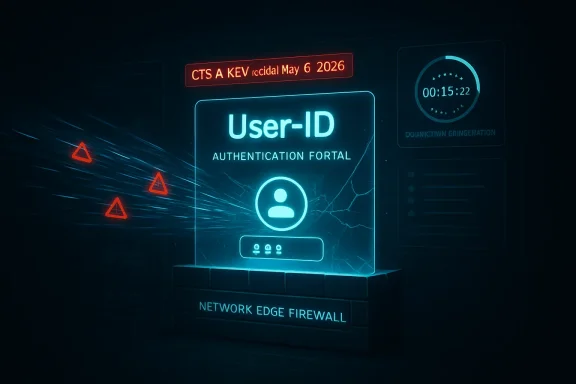
On May 6, 2026, CISA added CVE-2026-0300, a Palo Alto Networks PAN-OS out-of-bounds write flaw in the User-ID Authentication Portal, to its Known Exploited Vulnerabilities catalog after evidence showed active exploitation against exposed firewall portals in the wild and federal agencies were put on a fast remediation clock. This is not just another entry in the vulnerability-management queue. It is a reminder that the network edge has become the attacker’s favorite operating system. Firewalls, VPN portals, identity gateways, and remote-access appliances now sit where Windows servers once sat in the popular imagination: boring, trusted, ubiquitous, and therefore dangerously valuable.
CISA’s alert is short because the KEV catalog is designed to be operational, not literary. A vulnerability either has evidence of exploitation and a remediation deadline, or it does not. In this case, CVE-2026-0300 crossed that line, and the agency’s message to federal civilian agencies is straightforward: treat this as known exploited infrastructure risk, not as a theoretical vendor advisory.
That distinction matters. Security teams drown in CVSS scores, vendor bulletins, scanner output, and “critical” findings that may never be touched by an attacker. KEV is different because it filters for the scarier condition: someone is already using the bug, or credible evidence says they have. In the hierarchy of patching, exploitation evidence beats almost everything else.
The vulnerability itself is serious on paper. Palo Alto Networks describes it as a buffer overflow in the User-ID Authentication Portal, also known as the Captive Portal, that can allow an unauthenticated attacker to execute arbitrary code with root privileges on affected PA-Series and VM-Series firewalls by sending crafted packets. The company rates it critical, with a CVSS 4.0 score of 9.3, and marks exploit maturity as attacked.
But the deeper problem is architectural. The affected feature is an authentication-facing portal tied to a security appliance that often has privileged network placement. When a firewall becomes the beachhead, the compromise is not merely “a server got popped.” It is a compromise of the device that decides which servers, users, and networks can talk to each other.
Attackers have learned the same lesson defenders did: the edge is where trust concentrates. Firewalls and VPN appliances terminate sessions, parse hostile traffic, inspect identity, and frequently bridge the outside world to internal resources. They also run complex software stacks that must support web interfaces, authentication flows, content inspection, logging, updates, and management integrations.
That combination is irresistible. A vulnerable desktop gives an attacker one user. A vulnerable application server gives them one workload. A vulnerable firewall may give them privileged execution on a device with visibility across traffic flows, routes, zones, and security policies. Even if lateral movement is not automatic, the attacker begins from a position of unusual intelligence.
CVE-2026-0300 fits this pattern uncomfortably well. The bug lives in a portal designed to interact with unauthenticated users before access decisions are made. The affected configuration requires the User-ID Authentication Portal to be enabled and response pages exposed through an interface profile reachable from an untrusted or internet-facing zone. That is a narrower exposure condition than “all PAN-OS devices everywhere,” but it is still exactly the kind of configuration that appears in real enterprise environments.
This is why the KEV listing matters beyond federal compliance. CISA is not saying every Palo Alto firewall is instantly doomed. It is saying the attack surface is real, exploitation has been observed, and organizations should stop treating exposed edge services as stable background furniture.
That word “limited” deserves a careful reading. It may mean a small number of observed incidents. It may mean a narrow campaign. It may also mean only that defenders and the vendor have a limited view into attacker activity. Edge-device exploitation is notoriously hard to measure because the compromised system may be precisely the device that would otherwise record, filter, or expose evidence.
The advisory also says Prisma Access, Cloud NGFW, and Panorama appliances are not impacted. That is important for scoping, and it will spare some organizations from emergency change windows. The impacted universe is centered on PA-Series and VM-Series firewalls running affected PAN-OS versions with the relevant portal exposure.
The mitigation guidance is equally telling. Palo Alto is not merely saying “patch when available.” It is telling customers to restrict User-ID Authentication Portal access to trusted zones, disable response pages on interfaces where untrusted traffic can enter, disable the portal if it is not required, and use a Threat Prevention signature where available. In plain English, the vendor’s immediate fix is to shrink the exposed service before the full patch train arrives.
That sequencing is uncomfortable but familiar. In many enterprise environments, the clean patched version is not available for every branch, appliance, and maintenance window at the instant exploitation is confirmed. The practical response becomes layered: reduce exposure now, add detection or blocking where possible, then patch as fixed versions land.
This is not unique to Palo Alto. Modern appliance vendors maintain several supported trains, each with customer dependencies, regression risks, and certification requirements. A hotfix that is simple for one branch can be non-trivial for another. The problem is that attackers do not care about vendor release engineering.
CISA’s KEV model adds pressure because federal agencies have mandatory remediation deadlines under Binding Operational Directive 22-01. The catalog is not a blog roll; it is a compliance mechanism for Federal Civilian Executive Branch agencies. When a vulnerability enters KEV, it becomes a scheduled action item for federal defenders, and the private sector tends to follow because the catalog has become one of the clearest public signals of real-world exploitation.
That tension creates a familiar operational bind. A security team may be told to remediate a known exploited vulnerability while the vendor’s complete patch matrix is still rolling forward. In those cases, “remediate” must include compensating controls, exposure removal, disabling features, or taking systems out of risky configurations. Patch management becomes configuration management under pressure.
For sysadmins, this is where the story stops being abstract. Someone has to identify every PA-Series and VM-Series firewall, determine whether the User-ID Authentication Portal is enabled, check whether response pages are reachable from untrusted zones, validate PAN-OS versions, confirm subscription coverage for Threat Prevention controls, and decide whether disabling the feature breaks business workflows. That is a lot of real work hiding behind one CISA sentence.
That makes them useful. It also makes them exposed by design. A service that receives traffic from unknown clients must parse hostile input before it can decide whether the client should be allowed further in. When that parser lives on a firewall operating system, the blast radius of a memory-corruption flaw can become severe.
CVE-2026-0300 is categorized as CWE-787, an out-of-bounds write. In practice, that means software writes data outside the intended memory boundary, a class of bug long associated with crashes, memory corruption, and, in worst cases, code execution. Palo Alto’s advisory says this particular issue can lead to arbitrary code execution with root privileges on affected firewalls.
The “root privileges” phrase is the one that should make administrators sit upright. Firewalls are usually treated as high-trust devices even when organizations segment management networks and restrict administrator access. If an attacker reaches root on the device, defenders have to consider not only immediate command execution but also configuration tampering, traffic interception, persistence, credential exposure, and manipulation of logs or policy state.
There is a tendency in some boardrooms to think of vulnerabilities as isolated defects: patch the bug, close the ticket, move on. Edge-device vulnerabilities are different because they touch trust boundaries. If exploitation is suspected, the remediation conversation must include incident response, forensic preservation, configuration review, credential rotation where appropriate, and assurance that the device is not simply still functioning but still trustworthy.
Internet exposure is rarely a single decision made by a single person. It accumulates. A remote office needs a portal. A business unit wants a policy exception. A consultant follows an old deployment guide. A firewall gets migrated, restored, cloned, or temporarily opened during troubleshooting. Years later, a critical advisory arrives, and the security team discovers that “we do not expose that” actually means “we do not think we expose that.”
This is why incident response for CVE-2026-0300 should begin with inventory rather than assumption. Query management systems, Panorama where applicable, configuration backups, external attack-surface tools, firewall rule reviews, and network scans. Do not ask whether the organization would intentionally expose the portal. Ask whether it is exposed.
The same applies to interface management profiles and response pages. The advisory’s required exposure conditions are specific enough that administrators can test them, but also subtle enough that a high-level asset database may miss them. A firewall can be “not externally managed” and still present response-page behavior through a data-plane interface if the profile and zone design allow it.
That nuance will matter in the coming days. Many organizations will first search for affected PAN-OS versions and declare victory if they have a narrow version footprint. The smarter move is to pair version analysis with configuration analysis. In a live-exploitation event, exposure determines urgency as much as software lineage does.
Palo Alto says customers with a Threat Prevention subscription can block attacks using Threat ID 510019 from Applications and Threats content version 9097-10022, with PAN-OS 11.1 or later required for the decoder capabilities needed to support that Threat ID. That is useful guidance, but it is not universal protection. Some affected devices may not have the subscription, may be on older branches, may not have current content, or may not be positioned to inspect the relevant traffic path.
Logs are another complication. If a firewall is the target and the attacker achieves root-level execution, administrators should be careful about assuming local logs are complete. The device may still provide valuable telemetry, but a compromise of the logging source changes the evidentiary posture. Centralized log forwarding, SIEM ingestion, NetFlow, packet capture, identity logs, and upstream network telemetry become more important.
There is also the problem of negative evidence. Not seeing a known indicator does not prove a firewall was not targeted. Limited exploitation may remain limited, or it may expand as proof-of-concept details circulate, reverse engineering begins, and opportunistic scanning increases. The KEV listing itself may cause more defenders to look, but it may also alert copycats that a valuable class of target exists.
For WindowsForum readers who manage mixed environments, the lesson is familiar from the last decade of Exchange, VPN, and gateway emergencies: exploited infrastructure bugs demand a different operational tempo. You do not wait for perfect IOCs before reducing exposure. You cut off the reachable attack path first, then hunt with whatever evidence is available.
CISA’s KEV catalog has become a kind of second calendar for this world. It is less predictable than Patch Tuesday but arguably more urgent because inclusion indicates exploitation. For federal agencies, it creates a binding remediation obligation. For everyone else, it functions as a prioritized public shortlist of vulnerabilities that attackers have already promoted from possibility to practice.
That role is valuable, but it also exposes a weakness in many vulnerability programs. Too many organizations still treat scanner severity as the primary queue. A CVSS 9.8 vulnerability on an internal lab system may get more dashboard attention than a CVSS 8.0 vulnerability exploited in the wild on an internet-facing edge device. KEV exists to correct that distortion.
CVE-2026-0300 is an almost perfect case study. The score is high, so it would rank well in any severity-based system. But the reason it should jump the line is not simply 9.3. It is the combination of active exploitation, unauthenticated network reachability, root-level impact, edge-device placement, and a configuration pattern that may be exposed in the wild.
Security programs that already ingest KEV into ticketing, asset-management, and exception workflows will move faster here. Programs that rely on someone manually reading CISA alerts will burn hours translating a public warning into internal action. In a zero-day appliance incident, those hours are expensive.
The federal mandate matters because it sets a floor for one slice of the public sector. Attackers, however, do not divide the internet into FCEB and non-FCEB targets before launching scans. If a private company exposes the vulnerable portal, it is part of the same attack surface, with the same technical risk and none of the formal pressure that forces remediation.
Private organizations should therefore treat the federal deadline as a signal, not a shield. The operational question is not “Are we legally required to comply with BOD 22-01?” The better question is “Would we be comfortable explaining why we left a known exploited firewall RCE exposed after CISA and the vendor told the world it was being attacked?”
That is especially true for managed service providers, regional governments, healthcare systems, schools, manufacturers, and midmarket companies that often rely on edge appliances as the core of their security architecture. These environments may not have the staff depth of a federal SOC, but their firewalls are just as exposed and often less monitored.
The uncomfortable truth is that KEV has become a negligence yardstick. After a vulnerability enters the catalog, ignorance becomes harder to claim. If compromise follows and the exposed condition was preventable, the post-incident conversation will not be kind.
Palo Alto’s mitigation guidance focuses on trusted zones, internal IP restrictions, response pages, and disabling the portal if unnecessary. Those are not glamorous controls. They are the tedious hygiene of minimizing what untrusted networks can touch. They also happen to be the difference between “affected software exists somewhere in the fleet” and “attackers can send packets to the vulnerable service from the internet.”
This is where many organizations underinvest. They buy high-end firewalls, subscribe to threat feeds, integrate cloud logging, and still leave sensitive services reachable because nobody owns continuous exposure validation. The device is treated as a security product, so its own attack surface receives less skepticism than an ordinary web server would.
That mindset has to change. A firewall should be hardened like a high-value server, monitored like an identity system, and lifecycle-managed like a critical application platform. Its configuration should be diffed, reviewed, tested from outside the network, and tied to ownership records that survive staff turnover.
The most resilient organizations will use this incident to ask broader questions. Which edge services are reachable from untrusted networks? Which portals exist only because an old workflow once required them? Which appliances cannot be patched quickly because they sit on unsupported branches or fragile change windows? Which controls depend on a subscription that is not uniformly deployed?
But Windows environments rarely exist in isolation. Active Directory, Entra ID integrations, certificate services, RADIUS, SAML, VPN access, remote desktop gateways, file shares, device management, and privileged admin workflows often sit behind or beside the firewall. If an attacker compromises the edge, Windows infrastructure may be the next target, not because Windows was vulnerable first, but because it remains the operational center of gravity.
This is why Windows administrators should not mentally outsource the incident to the network team. The firewall may control access to domain controllers, admin subnets, management jump boxes, software deployment systems, backup networks, and monitoring platforms. A foothold there can reshape the attacker’s map before a single endpoint alert fires.
There is also an identity angle. User-ID features exist to connect network policy with user identity. That is powerful when working correctly. When the service that mediates identity-aware access is vulnerable, defenders should think carefully about credential exposure, authentication flows, and any logs that might show unusual portal interactions.
For hybrid shops, the boundary between network, identity, and endpoint security is already blurry. CVE-2026-0300 makes that blur operationally important. The right response is not a network-only ticket; it is a coordinated review among firewall administrators, identity teams, SOC analysts, Windows infrastructure owners, and incident response leads.
Underneath, they are software. They parse packets, render portals, manage sessions, expose APIs, update content, integrate third-party components, and carry legacy code paths. They have memory-safety bugs, authentication mistakes, command-injection flaws, and privilege-escalation issues like any other complex platform.
The difference is that appliance software often gets less routine scrutiny from the organizations that depend on it. Server teams know how to inventory Windows builds. Endpoint teams know how to measure agent coverage. Application teams know how to patch frameworks, at least in theory. Firewall firmware and feature exposure may live in a smaller operational silo with fewer automated checks and fewer people authorized to make changes.
That silo is now a liability. Attackers increasingly target the devices that sit between all the other teams. If the firewall team’s patch process is quarterly while the endpoint team’s process is weekly, the attacker will choose the calendar that gives them the longest runway.
Vendors bear responsibility too. Security appliances should be designed as hostile-input systems from the first line of code, especially for unauthenticated portals. Memory-safe languages, privilege separation, sandboxing, attack-surface reduction, and secure-by-default exposure settings are not academic preferences here. They are the difference between a crash, a contained service failure, and root on the box that guards the network.
The practical first move is scoping. Identify affected PAN-OS branches and versions, but do not stop there. Confirm whether User-ID Authentication Portal is enabled, whether response pages are enabled on interface management profiles, and whether any relevant interface is reachable from the internet or other untrusted zones.
The second move is exposure reduction. If the portal is not required, disable it. If it is required, restrict it to trusted internal zones and addresses. Remove response-page exposure from untrusted ingress paths. Validate from outside, not just from the management console.
The third move is compensating control. Where available and supported, ensure Threat Prevention content is current and the relevant Threat ID is enabled. Centralize logs. Preserve evidence. Begin threat hunting around portal access, unexplained firewall behavior, configuration changes, unexpected processes, and traffic anomalies.
The fourth move is patch planning. Track the fixed releases for the exact branches deployed and map them to maintenance windows with executive visibility. If the appliance protects critical operations, leadership should understand that deferring the change is not “avoiding risk”; it is choosing one risk over another while exploitation is known to exist.
Source: CISA CISA Adds One Known Exploited Vulnerability to Catalog | CISA
 CISA’s One-Line Alert Carries a Much Larger Warning
CISA’s alert is short because the KEV catalog is designed to be operational, not literary. A vulnerability either has evidence of exploitation and a remediation deadline, or it does not. In this case, CVE-2026-0300 crossed that line, and the agency’s message to federal civilian agencies is straightforward: treat this as known exploited infrastructure risk, not as a theoretical vendor advisory.That distinction matters. Security teams drown in CVSS scores, vendor bulletins, scanner output, and “critical” findings that may never be touched by an attacker. KEV is different because it filters for the scarier condition: someone is already using the bug, or credible evidence says they have. In the hierarchy of patching, exploitation evidence beats almost everything else.
The vulnerability itself is serious on paper. Palo Alto Networks describes it as a buffer overflow in the User-ID Authentication Portal, also known as the Captive Portal, that can allow an unauthenticated attacker to execute arbitrary code with root privileges on affected PA-Series and VM-Series firewalls by sending crafted packets. The company rates it critical, with a CVSS 4.0 score of 9.3, and marks exploit maturity as attacked.
But the deeper problem is architectural. The affected feature is an authentication-facing portal tied to a security appliance that often has privileged network placement. When a firewall becomes the beachhead, the compromise is not merely “a server got popped.” It is a compromise of the device that decides which servers, users, and networks can talk to each other.
The Edge Device Is Now the Prize, Not the Perimeter
For years, perimeter security was sold as a defensive moat. Put a hardened appliance at the edge, route traffic through it, enforce policy, and let the device absorb the ugliness of the internet. That model never fully disappeared, even as cloud migration and zero-trust slogans chipped away at the old castle-wall metaphor.Attackers have learned the same lesson defenders did: the edge is where trust concentrates. Firewalls and VPN appliances terminate sessions, parse hostile traffic, inspect identity, and frequently bridge the outside world to internal resources. They also run complex software stacks that must support web interfaces, authentication flows, content inspection, logging, updates, and management integrations.
That combination is irresistible. A vulnerable desktop gives an attacker one user. A vulnerable application server gives them one workload. A vulnerable firewall may give them privileged execution on a device with visibility across traffic flows, routes, zones, and security policies. Even if lateral movement is not automatic, the attacker begins from a position of unusual intelligence.
CVE-2026-0300 fits this pattern uncomfortably well. The bug lives in a portal designed to interact with unauthenticated users before access decisions are made. The affected configuration requires the User-ID Authentication Portal to be enabled and response pages exposed through an interface profile reachable from an untrusted or internet-facing zone. That is a narrower exposure condition than “all PAN-OS devices everywhere,” but it is still exactly the kind of configuration that appears in real enterprise environments.
This is why the KEV listing matters beyond federal compliance. CISA is not saying every Palo Alto firewall is instantly doomed. It is saying the attack surface is real, exploitation has been observed, and organizations should stop treating exposed edge services as stable background furniture.
Palo Alto’s Advisory Leaves Little Room for Complacency
Palo Alto Networks’ own advisory is unusually direct in the places that matter. The vulnerability is network reachable, low complexity, requires no privileges, requires no user interaction, and can be automated. The company says limited exploitation has been observed against User-ID Authentication Portals exposed to untrusted IP addresses or the public internet.That word “limited” deserves a careful reading. It may mean a small number of observed incidents. It may mean a narrow campaign. It may also mean only that defenders and the vendor have a limited view into attacker activity. Edge-device exploitation is notoriously hard to measure because the compromised system may be precisely the device that would otherwise record, filter, or expose evidence.
The advisory also says Prisma Access, Cloud NGFW, and Panorama appliances are not impacted. That is important for scoping, and it will spare some organizations from emergency change windows. The impacted universe is centered on PA-Series and VM-Series firewalls running affected PAN-OS versions with the relevant portal exposure.
The mitigation guidance is equally telling. Palo Alto is not merely saying “patch when available.” It is telling customers to restrict User-ID Authentication Portal access to trusted zones, disable response pages on interfaces where untrusted traffic can enter, disable the portal if it is not required, and use a Threat Prevention signature where available. In plain English, the vendor’s immediate fix is to shrink the exposed service before the full patch train arrives.
That sequencing is uncomfortable but familiar. In many enterprise environments, the clean patched version is not available for every branch, appliance, and maintenance window at the instant exploitation is confirmed. The practical response becomes layered: reduce exposure now, add detection or blocking where possible, then patch as fixed versions land.
The Patch Calendar Is Part of the Risk
The most awkward detail in this incident is the patch timeline. Palo Alto’s advisory lists fixed PAN-OS releases with estimated availability dates clustered around May 13 and May 28, depending on version branch and hotfix line. That means many defenders are facing active exploitation before every preferred fixed version is generally available.This is not unique to Palo Alto. Modern appliance vendors maintain several supported trains, each with customer dependencies, regression risks, and certification requirements. A hotfix that is simple for one branch can be non-trivial for another. The problem is that attackers do not care about vendor release engineering.
CISA’s KEV model adds pressure because federal agencies have mandatory remediation deadlines under Binding Operational Directive 22-01. The catalog is not a blog roll; it is a compliance mechanism for Federal Civilian Executive Branch agencies. When a vulnerability enters KEV, it becomes a scheduled action item for federal defenders, and the private sector tends to follow because the catalog has become one of the clearest public signals of real-world exploitation.
That tension creates a familiar operational bind. A security team may be told to remediate a known exploited vulnerability while the vendor’s complete patch matrix is still rolling forward. In those cases, “remediate” must include compensating controls, exposure removal, disabling features, or taking systems out of risky configurations. Patch management becomes configuration management under pressure.
For sysadmins, this is where the story stops being abstract. Someone has to identify every PA-Series and VM-Series firewall, determine whether the User-ID Authentication Portal is enabled, check whether response pages are reachable from untrusted zones, validate PAN-OS versions, confirm subscription coverage for Threat Prevention controls, and decide whether disabling the feature breaks business workflows. That is a lot of real work hiding behind one CISA sentence.
The Captive Portal Was Always a Strange Place to Put Trust
Captive portals occupy an odd corner of enterprise security. They are identity gates that deliberately interact with users who are not yet trusted. They redirect, challenge, present pages, collect credentials or trigger authentication workflows, and then feed identity context back into policy enforcement.That makes them useful. It also makes them exposed by design. A service that receives traffic from unknown clients must parse hostile input before it can decide whether the client should be allowed further in. When that parser lives on a firewall operating system, the blast radius of a memory-corruption flaw can become severe.
CVE-2026-0300 is categorized as CWE-787, an out-of-bounds write. In practice, that means software writes data outside the intended memory boundary, a class of bug long associated with crashes, memory corruption, and, in worst cases, code execution. Palo Alto’s advisory says this particular issue can lead to arbitrary code execution with root privileges on affected firewalls.
The “root privileges” phrase is the one that should make administrators sit upright. Firewalls are usually treated as high-trust devices even when organizations segment management networks and restrict administrator access. If an attacker reaches root on the device, defenders have to consider not only immediate command execution but also configuration tampering, traffic interception, persistence, credential exposure, and manipulation of logs or policy state.
There is a tendency in some boardrooms to think of vulnerabilities as isolated defects: patch the bug, close the ticket, move on. Edge-device vulnerabilities are different because they touch trust boundaries. If exploitation is suspected, the remediation conversation must include incident response, forensic preservation, configuration review, credential rotation where appropriate, and assurance that the device is not simply still functioning but still trustworthy.
Internet Exposure Turns a Feature Into an Attack Surface
Palo Alto’s advisory makes one point repeatedly: risk is greatly reduced when access to the User-ID Authentication Portal is restricted to trusted internal IP addresses. That sounds obvious, but it is the kind of obvious that enterprises violate every day through drift, exception handling, acquisitions, temporary projects, and half-remembered configuration changes.Internet exposure is rarely a single decision made by a single person. It accumulates. A remote office needs a portal. A business unit wants a policy exception. A consultant follows an old deployment guide. A firewall gets migrated, restored, cloned, or temporarily opened during troubleshooting. Years later, a critical advisory arrives, and the security team discovers that “we do not expose that” actually means “we do not think we expose that.”
This is why incident response for CVE-2026-0300 should begin with inventory rather than assumption. Query management systems, Panorama where applicable, configuration backups, external attack-surface tools, firewall rule reviews, and network scans. Do not ask whether the organization would intentionally expose the portal. Ask whether it is exposed.
The same applies to interface management profiles and response pages. The advisory’s required exposure conditions are specific enough that administrators can test them, but also subtle enough that a high-level asset database may miss them. A firewall can be “not externally managed” and still present response-page behavior through a data-plane interface if the profile and zone design allow it.
That nuance will matter in the coming days. Many organizations will first search for affected PAN-OS versions and declare victory if they have a narrow version footprint. The smarter move is to pair version analysis with configuration analysis. In a live-exploitation event, exposure determines urgency as much as software lineage does.
Detection Will Lag Behind Reality
The comforting version of every zero-day story says defenders will find indicators, deploy signatures, hunt logs, patch systems, and move on. Sometimes that happens. More often, detection is partial, delayed, and unevenly distributed across organizations with very different logging maturity.Palo Alto says customers with a Threat Prevention subscription can block attacks using Threat ID 510019 from Applications and Threats content version 9097-10022, with PAN-OS 11.1 or later required for the decoder capabilities needed to support that Threat ID. That is useful guidance, but it is not universal protection. Some affected devices may not have the subscription, may be on older branches, may not have current content, or may not be positioned to inspect the relevant traffic path.
Logs are another complication. If a firewall is the target and the attacker achieves root-level execution, administrators should be careful about assuming local logs are complete. The device may still provide valuable telemetry, but a compromise of the logging source changes the evidentiary posture. Centralized log forwarding, SIEM ingestion, NetFlow, packet capture, identity logs, and upstream network telemetry become more important.
There is also the problem of negative evidence. Not seeing a known indicator does not prove a firewall was not targeted. Limited exploitation may remain limited, or it may expand as proof-of-concept details circulate, reverse engineering begins, and opportunistic scanning increases. The KEV listing itself may cause more defenders to look, but it may also alert copycats that a valuable class of target exists.
For WindowsForum readers who manage mixed environments, the lesson is familiar from the last decade of Exchange, VPN, and gateway emergencies: exploited infrastructure bugs demand a different operational tempo. You do not wait for perfect IOCs before reducing exposure. You cut off the reachable attack path first, then hunt with whatever evidence is available.
KEV Has Become the Patch Tuesday for the Rest of the Stack
Microsoft’s monthly Patch Tuesday still structures much of enterprise vulnerability management, especially in Windows-heavy shops. But the most consequential emergency patches increasingly arrive outside that rhythm, and they often involve the non-Windows systems that make Windows networks reachable: firewalls, VPNs, identity gateways, file-transfer services, hypervisors, and management appliances.CISA’s KEV catalog has become a kind of second calendar for this world. It is less predictable than Patch Tuesday but arguably more urgent because inclusion indicates exploitation. For federal agencies, it creates a binding remediation obligation. For everyone else, it functions as a prioritized public shortlist of vulnerabilities that attackers have already promoted from possibility to practice.
That role is valuable, but it also exposes a weakness in many vulnerability programs. Too many organizations still treat scanner severity as the primary queue. A CVSS 9.8 vulnerability on an internal lab system may get more dashboard attention than a CVSS 8.0 vulnerability exploited in the wild on an internet-facing edge device. KEV exists to correct that distortion.
CVE-2026-0300 is an almost perfect case study. The score is high, so it would rank well in any severity-based system. But the reason it should jump the line is not simply 9.3. It is the combination of active exploitation, unauthenticated network reachability, root-level impact, edge-device placement, and a configuration pattern that may be exposed in the wild.
Security programs that already ingest KEV into ticketing, asset-management, and exception workflows will move faster here. Programs that rely on someone manually reading CISA alerts will burn hours translating a public warning into internal action. In a zero-day appliance incident, those hours are expensive.
Federal Deadlines Should Not Be the Private Sector’s Starting Gun
BOD 22-01 applies to Federal Civilian Executive Branch agencies, not to every company running a Palo Alto firewall. CISA says as much, and it regularly urges all organizations to use KEV as part of vulnerability management. That voluntary language should not lull private-sector teams into treating the catalog as government-only paperwork.The federal mandate matters because it sets a floor for one slice of the public sector. Attackers, however, do not divide the internet into FCEB and non-FCEB targets before launching scans. If a private company exposes the vulnerable portal, it is part of the same attack surface, with the same technical risk and none of the formal pressure that forces remediation.
Private organizations should therefore treat the federal deadline as a signal, not a shield. The operational question is not “Are we legally required to comply with BOD 22-01?” The better question is “Would we be comfortable explaining why we left a known exploited firewall RCE exposed after CISA and the vendor told the world it was being attacked?”
That is especially true for managed service providers, regional governments, healthcare systems, schools, manufacturers, and midmarket companies that often rely on edge appliances as the core of their security architecture. These environments may not have the staff depth of a federal SOC, but their firewalls are just as exposed and often less monitored.
The uncomfortable truth is that KEV has become a negligence yardstick. After a vulnerability enters the catalog, ignorance becomes harder to claim. If compromise follows and the exposed condition was preventable, the post-incident conversation will not be kind.
The Real Work Is Configuration Discipline
Patching gets the headline because it is the cleanest verb. Apply the fixed version. Close the vulnerability. Move on. But CVE-2026-0300 demonstrates again that configuration discipline often determines whether a critical bug becomes an emergency.Palo Alto’s mitigation guidance focuses on trusted zones, internal IP restrictions, response pages, and disabling the portal if unnecessary. Those are not glamorous controls. They are the tedious hygiene of minimizing what untrusted networks can touch. They also happen to be the difference between “affected software exists somewhere in the fleet” and “attackers can send packets to the vulnerable service from the internet.”
This is where many organizations underinvest. They buy high-end firewalls, subscribe to threat feeds, integrate cloud logging, and still leave sensitive services reachable because nobody owns continuous exposure validation. The device is treated as a security product, so its own attack surface receives less skepticism than an ordinary web server would.
That mindset has to change. A firewall should be hardened like a high-value server, monitored like an identity system, and lifecycle-managed like a critical application platform. Its configuration should be diffed, reviewed, tested from outside the network, and tied to ownership records that survive staff turnover.
The most resilient organizations will use this incident to ask broader questions. Which edge services are reachable from untrusted networks? Which portals exist only because an old workflow once required them? Which appliances cannot be patched quickly because they sit on unsupported branches or fragile change windows? Which controls depend on a subscription that is not uniformly deployed?
Windows Shops Should Care Even When Windows Is Not the Bug
At first glance, this is not a Windows story. The vulnerable product is PAN-OS. The affected systems are Palo Alto Networks firewalls. There is no Windows CVE hiding in the middle.But Windows environments rarely exist in isolation. Active Directory, Entra ID integrations, certificate services, RADIUS, SAML, VPN access, remote desktop gateways, file shares, device management, and privileged admin workflows often sit behind or beside the firewall. If an attacker compromises the edge, Windows infrastructure may be the next target, not because Windows was vulnerable first, but because it remains the operational center of gravity.
This is why Windows administrators should not mentally outsource the incident to the network team. The firewall may control access to domain controllers, admin subnets, management jump boxes, software deployment systems, backup networks, and monitoring platforms. A foothold there can reshape the attacker’s map before a single endpoint alert fires.
There is also an identity angle. User-ID features exist to connect network policy with user identity. That is powerful when working correctly. When the service that mediates identity-aware access is vulnerable, defenders should think carefully about credential exposure, authentication flows, and any logs that might show unusual portal interactions.
For hybrid shops, the boundary between network, identity, and endpoint security is already blurry. CVE-2026-0300 makes that blur operationally important. The right response is not a network-only ticket; it is a coordinated review among firewall administrators, identity teams, SOC analysts, Windows infrastructure owners, and incident response leads.
Appliance Security Is Still Software Security
The industry has spent years telling itself that appliances are different. They come from security vendors. They run hardened operating systems. They sit in racks with blinking lights. They are configured through polished management interfaces and sold with the language of protection.Underneath, they are software. They parse packets, render portals, manage sessions, expose APIs, update content, integrate third-party components, and carry legacy code paths. They have memory-safety bugs, authentication mistakes, command-injection flaws, and privilege-escalation issues like any other complex platform.
The difference is that appliance software often gets less routine scrutiny from the organizations that depend on it. Server teams know how to inventory Windows builds. Endpoint teams know how to measure agent coverage. Application teams know how to patch frameworks, at least in theory. Firewall firmware and feature exposure may live in a smaller operational silo with fewer automated checks and fewer people authorized to make changes.
That silo is now a liability. Attackers increasingly target the devices that sit between all the other teams. If the firewall team’s patch process is quarterly while the endpoint team’s process is weekly, the attacker will choose the calendar that gives them the longest runway.
Vendors bear responsibility too. Security appliances should be designed as hostile-input systems from the first line of code, especially for unauthenticated portals. Memory-safe languages, privilege separation, sandboxing, attack-surface reduction, and secure-by-default exposure settings are not academic preferences here. They are the difference between a crash, a contained service failure, and root on the box that guards the network.
The Triage Window Is Narrow and Practical
Organizations responding today should resist both panic and complacency. Panic produces reckless changes to production firewalls. Complacency leaves a known exploited path open because the perfect patch window has not arrived.The practical first move is scoping. Identify affected PAN-OS branches and versions, but do not stop there. Confirm whether User-ID Authentication Portal is enabled, whether response pages are enabled on interface management profiles, and whether any relevant interface is reachable from the internet or other untrusted zones.
The second move is exposure reduction. If the portal is not required, disable it. If it is required, restrict it to trusted internal zones and addresses. Remove response-page exposure from untrusted ingress paths. Validate from outside, not just from the management console.
The third move is compensating control. Where available and supported, ensure Threat Prevention content is current and the relevant Threat ID is enabled. Centralize logs. Preserve evidence. Begin threat hunting around portal access, unexplained firewall behavior, configuration changes, unexpected processes, and traffic anomalies.
The fourth move is patch planning. Track the fixed releases for the exact branches deployed and map them to maintenance windows with executive visibility. If the appliance protects critical operations, leadership should understand that deferring the change is not “avoiding risk”; it is choosing one risk over another while exploitation is known to exist.
The May 6 KEV Entry Is a Small Alert With a Long Tail
The action items are concrete, but the broader lesson is strategic: known exploited edge vulnerabilities deserve a faster and more cross-functional response than ordinary critical findings. CVE-2026-0300 is not merely a Palo Alto problem; it is a test of whether organizations can see their own perimeter clearly enough to defend it under time pressure.- CISA added CVE-2026-0300 to the KEV catalog on May 6, 2026, after evidence of active exploitation.
- The vulnerability affects certain PA-Series and VM-Series firewalls running PAN-OS with User-ID Authentication Portal exposure.
- Palo Alto Networks says the flaw can allow unauthenticated remote code execution with root privileges through specially crafted packets.
- Prisma Access, Cloud NGFW, and Panorama appliances are not impacted according to the vendor advisory.
- Organizations should immediately verify exposure, restrict the portal to trusted internal networks, disable it if unnecessary, deploy available threat-prevention coverage where supported, and prepare for fixed PAN-OS releases as they become available.
- Private-sector defenders should treat the KEV listing as an exploitation signal even if BOD 22-01 does not legally apply to them.
Source: CISA CISA Adds One Known Exploited Vulnerability to Catalog | CISA
