

CISA added CVE-2026-20253, a critical Splunk Enterprise missing-authentication vulnerability, to its Known Exploited Vulnerabilities Catalog on June 18, 2026, after finding evidence that attackers are actively exploiting the flaw against vulnerable systems. The notice is short, but the implication is not: a bug in the security stack has crossed from theoretical emergency to operational incident. For WindowsForum readers running Splunk beside Windows Server estates, Active Directory telemetry, endpoint logs, and SOC workflows, this is exactly the kind of vulnerability that turns a monitoring platform into a beachhead.
Splunk is not just another enterprise application sitting in the corner of the data center. In many organizations it is the nervous system for incident response, compliance evidence, authentication logs, endpoint alerts, firewall events, cloud trails, and the dashboards executives see when they ask whether the company is under attack. That makes a critical flaw in Splunk qualitatively different from a critical flaw in a forgotten line-of-business web app.
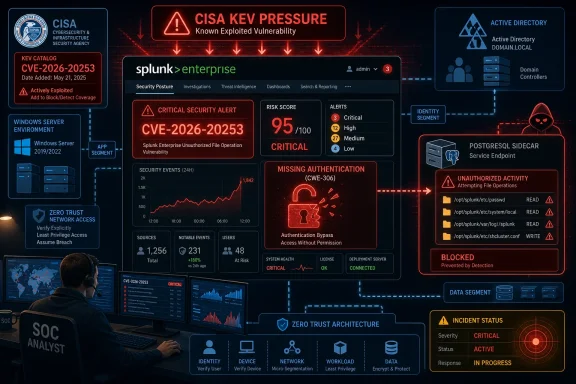
CVE-2026-20253 is especially ugly because it reportedly allows an unauthenticated, network-reachable user to create or truncate arbitrary files through a PostgreSQL sidecar service endpoint. Splunk’s own advisory rates the vulnerability 9.8 on the CVSS 3.1 scale and identifies it as CWE-306, Missing Authentication for Critical Function. In plain English, a service that should have checked who was calling it did not.
The affected Splunk Enterprise branches are 10.0 and 10.2, with fixes in 10.0.7 and 10.2.4. Splunk Enterprise 10.4 is listed as not affected, while Splunk Cloud Platform customers are in a different operational lane because Splunk says it is actively monitoring and patching cloud instances. For self-managed shops, however, the work lands squarely on administrators.
The lesson is not merely “patch Splunk.” The sharper lesson is that security infrastructure now sits in the same blast radius as domain controllers, VPN concentrators, identity providers, and EDR consoles. If an attacker can compromise the system that stores and correlates evidence of compromise, the defender’s visibility becomes part of the attacker’s playbook.
CISA’s June 18 addition is also one of the early tests of the agency’s newer approach under Binding Operational Directive 26-04. That directive updates the older BOD 22-01 model by pushing federal civilian agencies toward risk-based remediation rather than purely severity-based patching. The emphasis is on what attackers can actually use, where the affected asset sits, whether exploitation can be automated, and how much control the attacker gains.
That is why this Splunk bug fits the moment so well. It is critical on paper, but more importantly it affects a product that often has privileged visibility across the enterprise. A successful attacker may not need Splunk to be internet-facing to benefit from the flaw; a foothold inside the network can be enough if management interfaces and sidecar services are reachable from places they should not be.
For federal agencies, KEV inclusion carries binding remediation expectations. For everyone else, it is still a loud siren. CISA’s formal authority may stop at the federal boundary, but attackers do not.
A sidecar is supposed to support the main application, not become an unauthenticated control surface. But once that support component can perform file operations, authentication failure becomes a structural problem. Creating or truncating files may sound less dramatic than “remote code execution,” but file-write primitives are the raw material from which serious exploit chains are often built.
Researchers have reportedly shown ways this class of access can be chained into remote code execution under certain conditions. That does not mean every vulnerable Splunk instance will be exploited in exactly the same way, and administrators should be careful not to overfit their defenses to one public proof-of-concept. But it does mean the bug should be treated as more than a nuisance file-handling issue.
The dangerous part is the combination: unauthenticated access, network reachability, critical file operations, and a high-value enterprise platform. When those ingredients appear together, attackers do not need much imagination.
This is where the impact becomes practical for Windows administrators. A compromised Splunk instance could help an attacker understand detection coverage, identify which hosts are monitored, see where authentication failures are being logged, and determine which alerts generate human response. Even without direct domain compromise, that information is operationally valuable.
There is also the question of credentials and integrations. Splunk deployments often connect to data sources, forwarders, cloud APIs, alerting systems, ticketing tools, and sometimes automation platforms. The specific exposure varies by environment, but a monitoring platform rarely lives in isolation.
Windows estates are also full of segmentation shortcuts made over years of operational convenience. If Splunk management planes, indexers, search heads, deployment servers, or related service endpoints are reachable from broad internal networks, the difference between “not internet-facing” and “safe” becomes thinner than many teams would like to admit.
The harder work begins after the upgrade. CISA’s BOD 26-04 language explicitly reinforces the need to determine whether threat actors compromised a system before the patch was applied in higher-risk cases. That is the part many organizations still treat as optional, because patching is measurable and investigation is messy.
For Splunk, the investigation challenge is awkward. The product may be both the thing you use to investigate and the thing that needs investigation. If logs are stored, transformed, or alerted on by a potentially compromised platform, defenders should preserve raw logs where possible and compare them against independent sources.
Administrators should be looking at network reachability, service exposure, unexpected file changes, suspicious process creation, anomalous service behavior, new or modified scripts, unusual outbound connections, and unexplained changes in Splunk configuration. They should also review which accounts and tokens Splunk can access, because post-exploitation value often comes from what the compromised system can reach next.
That compression is particularly painful for security tooling because these platforms are often treated as mission-critical and change-sensitive. SOC teams do not like taking Splunk offline, even briefly, because outage windows can mean missed alerts and delayed investigations. But the same centrality that makes downtime costly makes compromise worse.
The right operational framing is not “Can we afford to patch Splunk today?” It is “Can we defend the enterprise while our visibility platform may be exploitable?” For most organizations, the answer should push the patch window forward.
This is also where tabletop planning meets reality. Organizations that maintain tested upgrade procedures, clustered architecture, backups, and rollback plans can move faster under pressure. Those that treat Splunk as an artisanal, hand-tuned appliance will feel every minute of the emergency.
The new federal model emphasizes public exposure, known exploitation, automation potential, and technical impact. That framework is not perfect, but it is closer to how attackers behave. They do not sort CVEs by governance category; they look for reachable systems, reliable exploit paths, useful privileges, and repeatability.
CVE-2026-20253 sits near the uncomfortable center of that model. It has a critical score, known exploitation, no authentication requirement, and potentially severe impact if reachable. Even where the service is not exposed to the public internet, internal exposure may still be meaningful because many intrusions move from an initial foothold to higher-value systems.
The private sector should read CISA’s directive less as a federal compliance artifact and more as a preview of where vulnerability management is heading. Boards and auditors increasingly expect security teams to explain why a vulnerability was deferred, not merely whether it was high or critical. “It was not in KEV” used to be a partial answer. Here, it is.
Splunk instances should not be broadly reachable simply because analysts, engineers, and admins all find them useful. Management ports, sidecar endpoints, deployment services, indexer clustering traffic, and administrative interfaces need the same segmentation discipline applied to domain controllers and privileged access workstations. Convenience is not a control.
This incident also argues for independent logging paths. If every meaningful event is routed into one platform and that platform becomes suspect, defenders have a single point of analytical failure. Raw log retention, immutable storage, endpoint-side telemetry, and cloud-native audit trails are not luxuries when the central SIEM is in the blast zone.
Security teams should also revisit how much privilege Splunk has accumulated. Integrations added over years can leave a SIEM with broad read access, service credentials, webhook secrets, API tokens, and automation hooks. A compromised observability platform should not become a skeleton key.
But “cloud” does not erase customer responsibility. Customers still need to understand whether their tenant was in scope, whether any suspicious activity occurred, which integrations could be affected, and whether local forwarders or hybrid components introduce related exposure. Managed patching reduces one class of operational delay; it does not eliminate incident response.
For self-managed Splunk, the responsibility is more direct. Inventory comes first. Teams need to identify every Splunk Enterprise node, confirm its branch and build, determine whether it falls into 10.0.0 through 10.0.6 or 10.2.0 through 10.2.3, and verify whether 10.4 deployments are truly on unaffected builds.
This is also a moment to check whether the asset inventory itself is credible. If a security team cannot quickly answer where Splunk runs, which versions are deployed, and what networks can reach its services, the vulnerability has exposed a governance problem before any attacker arrives.
The uncomfortable truth is that many organizations still treat vendor disclosure as the beginning of a leisurely risk review. Attackers treat it as a starting pistol. When a vulnerability is unauthenticated, remotely reachable, and easy to reason about, the time between disclosure and exploitation can collapse quickly.
CISA’s KEV addition confirms active exploitation, but it should not be the first moment a mature security team cares. KEV is evidence of fire; smoke may be visible earlier through vendor advisories, public exploit research, honeypot chatter, threat-intelligence reporting, and abnormal scanning. Waiting for KEV can be defensible for lower-impact software. For a critical flaw in a core security platform, it is a risky habit.
That does not mean every organization can patch instantly. It means the decision to delay should be explicit, documented, and paired with compensating controls such as network isolation, heightened monitoring, credential review, and forensic preservation. Silence and backlog drift are not strategies.
That starts with exposure mapping. Which hosts can reach the relevant service endpoint? Which firewall rules, load balancers, reverse proxies, VPN routes, and internal network segments permit access? Which of those paths are logged independently of Splunk?
Then comes system review. File creation and truncation events, service restarts, unexpected modifications under Splunk directories, suspicious scripts, anomalous PostgreSQL-related activity, and unusual child processes from Splunk services deserve scrutiny. On Windows-connected estates, defenders should also correlate changes in log forwarding behavior, sudden telemetry gaps, and authentication anomalies around Splunk service accounts.
The key is to avoid treating the patch as the entire incident. If the system was reachable before remediation, the post-patch question is not “Are we fixed?” but “Were we used?” That is a different exercise.
Modern intrusions often begin with phishing, stolen VPN credentials, compromised endpoints, exposed remote access systems, or third-party access. Once inside, attackers look for high-value internal services with weak assumptions. A pre-authentication flaw in a SIEM-like platform is a tempting lateral target.
This is why segmentation is not an academic best practice. If any ordinary workstation, developer subnet, server VLAN, or VPN pool can reach Splunk administrative or sidecar services, an attacker with a modest foothold may be able to turn internal reachability into control. The internal network is not a trust boundary; it is an attack surface with worse visibility.
Administrators should use this incident to draw a harder line between data ingestion and administration. Forwarders need to send data. Analysts need controlled access to search. Very few systems need broad reachability to sensitive service endpoints.
CVE-2026-20253 is a useful governance test because it touches a platform that security teams usually own or heavily influence. If the security organization cannot rapidly patch its own critical tooling, it will struggle to persuade application teams to move faster on theirs. Credibility starts at home.
There is also a procurement lesson. Enterprises increasingly buy security platforms on feature depth, integration breadth, and analytics capability. They should also ask harder questions about secure design, component isolation, service authentication, default exposure, upgrade friction, and vendor transparency when critical bugs appear.
No vendor is immune to vulnerabilities. The issue is how quickly the vendor discloses, how clearly it scopes affected versions, whether mitigations exist, how practical the upgrade path is, and how much evidence customers can use to investigate compromise. Those questions belong in renewal conversations, not just postmortems.
CISA’s June 18 KEV addition turns CVE-2026-20253 from another severe vendor advisory into a live operational priority, and it does so at a moment when federal vulnerability policy is moving away from checkbox severity and toward attacker-informed risk. For Windows and hybrid-enterprise administrators, the message is blunt: the tools built to watch the network must be patched, segmented, and investigated with the same urgency as the systems they monitor. The next phase of defensive maturity will not be defined by bigger dashboards, but by whether organizations can keep their own visibility layer from becoming the attacker’s quietest foothold.
 The Security Tool Has Become the Target
Splunk is not just another enterprise application sitting in the corner of the data center. In many organizations it is the nervous system for incident response, compliance evidence, authentication logs, endpoint alerts, firewall events, cloud trails, and the dashboards executives see when they ask whether the company is under attack. That makes a critical flaw in Splunk qualitatively different from a critical flaw in a forgotten line-of-business web app.CVE-2026-20253 is especially ugly because it reportedly allows an unauthenticated, network-reachable user to create or truncate arbitrary files through a PostgreSQL sidecar service endpoint. Splunk’s own advisory rates the vulnerability 9.8 on the CVSS 3.1 scale and identifies it as CWE-306, Missing Authentication for Critical Function. In plain English, a service that should have checked who was calling it did not.
The affected Splunk Enterprise branches are 10.0 and 10.2, with fixes in 10.0.7 and 10.2.4. Splunk Enterprise 10.4 is listed as not affected, while Splunk Cloud Platform customers are in a different operational lane because Splunk says it is actively monitoring and patching cloud instances. For self-managed shops, however, the work lands squarely on administrators.
The lesson is not merely “patch Splunk.” The sharper lesson is that security infrastructure now sits in the same blast radius as domain controllers, VPN concentrators, identity providers, and EDR consoles. If an attacker can compromise the system that stores and correlates evidence of compromise, the defender’s visibility becomes part of the attacker’s playbook.
CISA’s KEV Catalog Is No Longer a Watchlist
The Known Exploited Vulnerabilities Catalog began life as a forcing function for federal agencies, but it has become a de facto priority list for private-sector security teams as well. A CVE landing in KEV means CISA has seen enough evidence of exploitation to treat the bug as active risk, not speculative risk. That distinction matters in a world where thousands of vulnerabilities arrive every month and most organizations cannot patch everything at once.CISA’s June 18 addition is also one of the early tests of the agency’s newer approach under Binding Operational Directive 26-04. That directive updates the older BOD 22-01 model by pushing federal civilian agencies toward risk-based remediation rather than purely severity-based patching. The emphasis is on what attackers can actually use, where the affected asset sits, whether exploitation can be automated, and how much control the attacker gains.
That is why this Splunk bug fits the moment so well. It is critical on paper, but more importantly it affects a product that often has privileged visibility across the enterprise. A successful attacker may not need Splunk to be internet-facing to benefit from the flaw; a foothold inside the network can be enough if management interfaces and sidecar services are reachable from places they should not be.
For federal agencies, KEV inclusion carries binding remediation expectations. For everyone else, it is still a loud siren. CISA’s formal authority may stop at the federal boundary, but attackers do not.
The Sidecar Detail Is the Story
The most important phrase in the advisory is not “critical” or even “actively exploited.” It is “PostgreSQL sidecar service endpoint.” Modern enterprise software increasingly uses sidecars, helper services, embedded databases, local APIs, agents, collectors, and orchestration glue to provide features that feel seamless to administrators. Those components often have their own security assumptions, and the assumptions are where the trouble starts.A sidecar is supposed to support the main application, not become an unauthenticated control surface. But once that support component can perform file operations, authentication failure becomes a structural problem. Creating or truncating files may sound less dramatic than “remote code execution,” but file-write primitives are the raw material from which serious exploit chains are often built.
Researchers have reportedly shown ways this class of access can be chained into remote code execution under certain conditions. That does not mean every vulnerable Splunk instance will be exploited in exactly the same way, and administrators should be careful not to overfit their defenses to one public proof-of-concept. But it does mean the bug should be treated as more than a nuisance file-handling issue.
The dangerous part is the combination: unauthenticated access, network reachability, critical file operations, and a high-value enterprise platform. When those ingredients appear together, attackers do not need much imagination.
Windows Shops Should Not File This Under “Linux Problem”
Splunk Enterprise is often deployed on Linux, but Windows-heavy organizations should not mentally route this alert away from their own risk register. Splunk commonly ingests Windows Event Logs, Sysmon telemetry, PowerShell logs, Defender data, Entra ID sign-in events, Active Directory signals, and application logs from Windows Server workloads. If Splunk is compromised, the attacker may gain insight into the very telemetry defenders rely on to reconstruct intrusions.This is where the impact becomes practical for Windows administrators. A compromised Splunk instance could help an attacker understand detection coverage, identify which hosts are monitored, see where authentication failures are being logged, and determine which alerts generate human response. Even without direct domain compromise, that information is operationally valuable.
There is also the question of credentials and integrations. Splunk deployments often connect to data sources, forwarders, cloud APIs, alerting systems, ticketing tools, and sometimes automation platforms. The specific exposure varies by environment, but a monitoring platform rarely lives in isolation.
Windows estates are also full of segmentation shortcuts made over years of operational convenience. If Splunk management planes, indexers, search heads, deployment servers, or related service endpoints are reachable from broad internal networks, the difference between “not internet-facing” and “safe” becomes thinner than many teams would like to admit.
The Patch Is Straightforward; the Assurance Is Not
Splunk’s fix guidance is simple: upgrade affected Splunk Enterprise systems to 10.0.7, 10.2.4, 10.4.0, or later supported versions. There are no listed mitigations or workarounds in the advisory, which removes the comfortable middle ground that admins often use when change windows are tight. If you run an affected version, the path is patching.The harder work begins after the upgrade. CISA’s BOD 26-04 language explicitly reinforces the need to determine whether threat actors compromised a system before the patch was applied in higher-risk cases. That is the part many organizations still treat as optional, because patching is measurable and investigation is messy.
For Splunk, the investigation challenge is awkward. The product may be both the thing you use to investigate and the thing that needs investigation. If logs are stored, transformed, or alerted on by a potentially compromised platform, defenders should preserve raw logs where possible and compare them against independent sources.
Administrators should be looking at network reachability, service exposure, unexpected file changes, suspicious process creation, anomalous service behavior, new or modified scripts, unusual outbound connections, and unexplained changes in Splunk configuration. They should also review which accounts and tokens Splunk can access, because post-exploitation value often comes from what the compromised system can reach next.
KEV Inclusion Compresses the Clock
There is a familiar enterprise patching rhythm: advisory arrives, scanners update, tickets open, owners negotiate downtime, CAB meetings happen, and the patch lands days or weeks later. KEV inclusion is designed to break that rhythm. Once exploitation is confirmed, the organization is no longer deciding whether the vulnerability is serious; it is deciding how long it is willing to remain exposed.That compression is particularly painful for security tooling because these platforms are often treated as mission-critical and change-sensitive. SOC teams do not like taking Splunk offline, even briefly, because outage windows can mean missed alerts and delayed investigations. But the same centrality that makes downtime costly makes compromise worse.
The right operational framing is not “Can we afford to patch Splunk today?” It is “Can we defend the enterprise while our visibility platform may be exploitable?” For most organizations, the answer should push the patch window forward.
This is also where tabletop planning meets reality. Organizations that maintain tested upgrade procedures, clustered architecture, backups, and rollback plans can move faster under pressure. Those that treat Splunk as an artisanal, hand-tuned appliance will feel every minute of the emergency.
CISA Is Quietly Rewriting Patch Triage
BOD 26-04 matters because it acknowledges what practitioners have known for years: CVSS alone is a blunt instrument. A 9.8 vulnerability on an isolated lab system is not the same operational risk as an 8.8 vulnerability on an internet-facing identity gateway. Severity scores describe technical potential; defenders need to prioritize real exposure.The new federal model emphasizes public exposure, known exploitation, automation potential, and technical impact. That framework is not perfect, but it is closer to how attackers behave. They do not sort CVEs by governance category; they look for reachable systems, reliable exploit paths, useful privileges, and repeatability.
CVE-2026-20253 sits near the uncomfortable center of that model. It has a critical score, known exploitation, no authentication requirement, and potentially severe impact if reachable. Even where the service is not exposed to the public internet, internal exposure may still be meaningful because many intrusions move from an initial foothold to higher-value systems.
The private sector should read CISA’s directive less as a federal compliance artifact and more as a preview of where vulnerability management is heading. Boards and auditors increasingly expect security teams to explain why a vulnerability was deferred, not merely whether it was high or critical. “It was not in KEV” used to be a partial answer. Here, it is.
The Monitoring Plane Needs Zero-Trust Treatment Too
The industry spent the last decade telling organizations not to trust flat internal networks, but many monitoring and administration planes still operate as if the inside is friendly. That assumption is particularly dangerous for tools that collect, aggregate, and interpret security data. They are attractive precisely because they sit close to everything else.Splunk instances should not be broadly reachable simply because analysts, engineers, and admins all find them useful. Management ports, sidecar endpoints, deployment services, indexer clustering traffic, and administrative interfaces need the same segmentation discipline applied to domain controllers and privileged access workstations. Convenience is not a control.
This incident also argues for independent logging paths. If every meaningful event is routed into one platform and that platform becomes suspect, defenders have a single point of analytical failure. Raw log retention, immutable storage, endpoint-side telemetry, and cloud-native audit trails are not luxuries when the central SIEM is in the blast zone.
Security teams should also revisit how much privilege Splunk has accumulated. Integrations added over years can leave a SIEM with broad read access, service credentials, webhook secrets, API tokens, and automation hooks. A compromised observability platform should not become a skeleton key.
The Cloud Distinction Helps, But It Does Not Absolve
Splunk Cloud customers are not in the same position as self-managed Splunk Enterprise administrators. Splunk says it is monitoring and patching affected Splunk Cloud Platform instances, which means the immediate upgrade burden may sit with the vendor. That is one of the practical advantages of consuming complex security infrastructure as a managed service.But “cloud” does not erase customer responsibility. Customers still need to understand whether their tenant was in scope, whether any suspicious activity occurred, which integrations could be affected, and whether local forwarders or hybrid components introduce related exposure. Managed patching reduces one class of operational delay; it does not eliminate incident response.
For self-managed Splunk, the responsibility is more direct. Inventory comes first. Teams need to identify every Splunk Enterprise node, confirm its branch and build, determine whether it falls into 10.0.0 through 10.0.6 or 10.2.0 through 10.2.3, and verify whether 10.4 deployments are truly on unaffected builds.
This is also a moment to check whether the asset inventory itself is credible. If a security team cannot quickly answer where Splunk runs, which versions are deployed, and what networks can reach its services, the vulnerability has exposed a governance problem before any attacker arrives.
The Exploit Window Opened Before the Federal Alarm
Splunk published its advisory on June 10, and CISA added the flaw to KEV on June 18. That eight-day gap is not unusual, but it is the window that matters most to defenders. Public advisories, researcher write-ups, exploit discussion, scanner updates, and attacker testing all tend to cluster immediately after disclosure.The uncomfortable truth is that many organizations still treat vendor disclosure as the beginning of a leisurely risk review. Attackers treat it as a starting pistol. When a vulnerability is unauthenticated, remotely reachable, and easy to reason about, the time between disclosure and exploitation can collapse quickly.
CISA’s KEV addition confirms active exploitation, but it should not be the first moment a mature security team cares. KEV is evidence of fire; smoke may be visible earlier through vendor advisories, public exploit research, honeypot chatter, threat-intelligence reporting, and abnormal scanning. Waiting for KEV can be defensible for lower-impact software. For a critical flaw in a core security platform, it is a risky habit.
That does not mean every organization can patch instantly. It means the decision to delay should be explicit, documented, and paired with compensating controls such as network isolation, heightened monitoring, credential review, and forensic preservation. Silence and backlog drift are not strategies.
Detection Will Be Harder Than the Dashboard Suggests
Splunk’s advisory lists no detections, which should make defenders cautious about easy answers. A clean dashboard does not prove a clean system, especially when the vulnerable product is itself the dashboard. The absence of a vendor-provided detection recipe means teams must reason from the vulnerability mechanics and their own deployment architecture.That starts with exposure mapping. Which hosts can reach the relevant service endpoint? Which firewall rules, load balancers, reverse proxies, VPN routes, and internal network segments permit access? Which of those paths are logged independently of Splunk?
Then comes system review. File creation and truncation events, service restarts, unexpected modifications under Splunk directories, suspicious scripts, anomalous PostgreSQL-related activity, and unusual child processes from Splunk services deserve scrutiny. On Windows-connected estates, defenders should also correlate changes in log forwarding behavior, sudden telemetry gaps, and authentication anomalies around Splunk service accounts.
The key is to avoid treating the patch as the entire incident. If the system was reachable before remediation, the post-patch question is not “Are we fixed?” but “Were we used?” That is a different exercise.
The False Comfort of Internal-Only Exposure
Many administrators will breathe easier if their Splunk instance is not exposed to the public internet. That is sensible, but it should not become complacency. Internal-only exposure changes the attacker’s required starting point; it does not make exploitation irrelevant.Modern intrusions often begin with phishing, stolen VPN credentials, compromised endpoints, exposed remote access systems, or third-party access. Once inside, attackers look for high-value internal services with weak assumptions. A pre-authentication flaw in a SIEM-like platform is a tempting lateral target.
This is why segmentation is not an academic best practice. If any ordinary workstation, developer subnet, server VLAN, or VPN pool can reach Splunk administrative or sidecar services, an attacker with a modest foothold may be able to turn internal reachability into control. The internal network is not a trust boundary; it is an attack surface with worse visibility.
Administrators should use this incident to draw a harder line between data ingestion and administration. Forwarders need to send data. Analysts need controlled access to search. Very few systems need broad reachability to sensitive service endpoints.
The Splunk Patch Is Also a Governance Test
Every high-profile vulnerability becomes a test of process, not just technology. Can the organization identify affected assets quickly? Can it assign owners without argument? Can it schedule emergency maintenance without a week of escalation theater? Can it preserve evidence before systems are changed?CVE-2026-20253 is a useful governance test because it touches a platform that security teams usually own or heavily influence. If the security organization cannot rapidly patch its own critical tooling, it will struggle to persuade application teams to move faster on theirs. Credibility starts at home.
There is also a procurement lesson. Enterprises increasingly buy security platforms on feature depth, integration breadth, and analytics capability. They should also ask harder questions about secure design, component isolation, service authentication, default exposure, upgrade friction, and vendor transparency when critical bugs appear.
No vendor is immune to vulnerabilities. The issue is how quickly the vendor discloses, how clearly it scopes affected versions, whether mitigations exist, how practical the upgrade path is, and how much evidence customers can use to investigate compromise. Those questions belong in renewal conversations, not just postmortems.
A Short Runbook for a Long Week
This alert deserves a disciplined response, not panic. The organizations that handle it best will do the obvious things quickly, write down what they did, and resist the urge to declare victory after the installer finishes.- Inventory every Splunk Enterprise and Splunk Cloud-connected component, then verify whether any self-managed deployment is running affected 10.0.x or 10.2.x builds.
- Upgrade vulnerable Splunk Enterprise systems to fixed releases immediately, prioritizing internet-facing, broadly reachable, or security-critical nodes first.
- Treat pre-patch exposure as a possible compromise scenario and review file changes, process activity, service behavior, outbound connections, and configuration modifications.
- Restrict network access to Splunk management and sidecar services so ordinary endpoints, broad VPN pools, and unrelated server segments cannot reach them.
- Review Splunk service accounts, API tokens, cloud integrations, alerting webhooks, and automation hooks for unnecessary privilege or signs of abuse.
- Preserve independent logs and raw telemetry where possible, because a compromised logging platform can make its own evidence harder to trust.
CISA’s June 18 KEV addition turns CVE-2026-20253 from another severe vendor advisory into a live operational priority, and it does so at a moment when federal vulnerability policy is moving away from checkbox severity and toward attacker-informed risk. For Windows and hybrid-enterprise administrators, the message is blunt: the tools built to watch the network must be patched, segmented, and investigated with the same urgency as the systems they monitor. The next phase of defensive maturity will not be defined by bigger dashboards, but by whether organizations can keep their own visibility layer from becoming the attacker’s quietest foothold.
References
- Primary source: CISA
Published: 2026-06-18T12:00:00+00:00
- Related coverage: netspi.com
Splunk Enterprise Unauthenticated Arbitrary File Operations/RCE (CVE-2026-20253): Overview and Takeaways - NetSPI
Splunk disclosed CVE-2026-20253 on June 10, 2026, affecting Splunk Enterprise versions in the 10.0.x and 10.2.x branches. The flaw allows any network-reachable attacker to invoke arbitrary file creation or truncation operations without credentials.www.netspi.com - Related coverage: thehackerwire.com
CVE-2026-20253 - Critical Vulnerability - TheHackerWire
TheHackerWire - Your daily source for cybersecurity news, CVE alerts, hacking tutorials, and security tool reviews. Stay ahead of cyber threats.www.thehackerwire.com
- Related coverage: caloes.ca.gov
</rdf:Alt> </dc:title> <dc:description> <rdf:Alt> <rdf:li xml:lang="x-default"/> </rdf:Alt> </dc:description> <dc:creator> <rdf:Seq> <rdf:li>(Contra
</rdf:Alt> </dc:description> <dc:creator> <rdf:Seq> <rdf:li>(Contractor) Melanie, Barlow@CalOESwww.caloes.ca.gov
- Related coverage: hivepro.com
- Related coverage: labs.cloudsecurityalliance.org
CISA KEV Alert: Fortinet, Adobe, and Microsoft Under Attack
PDF documentlabs.cloudsecurityalliance.org

- Related coverage: tlctc.net
CISA BOD 26-04: A Step in the Right Direction — But Still Not an Attack-Path Model | TLCTC
CISA's BOD 26-04 moves federal vulnerability management toward risk-based remediation — but it still lacks a cause-side attack-path grammar. TLCTC provides the missing layer.www.tlctc.net - Related coverage: nucleussec.com
What is CISA BOD 26-04? Prioritizing Security Updates Based on Risk
CISA BOD 26-04 directs federal agencies to prioritize vulnerability remediation based on exposure, exploitability, system control, and known exploitation. Learn what the directive requires and how it impacts agency vulnerability management.nucleussec.com - Related coverage: patrowl.io
BOD 26-04: Risk-Based Vulnerability Prioritization - Patrowl
CISA's BOD 26-04 brings in risk-based vulnerability prioritization: 4 variables, deadlines from 3 days to deferral, and the end of the CVSS score.patrowl.io - Related coverage: vulncheck.com
Helping Federal Agencies Meet CISA’s Accelerated Remediation Timelines outlined in CISA BOD 26-04 | Blog | VulnCheck
VulnCheck provides automated SSVC decisions for federal and enterprise agencies to help address CISA BOD 26-04.www.vulncheck.com - Related coverage: securityweek.com
CISA Directs Federal Agencies to Prioritize Security Patches Based on Risk - SecurityWeek
CISA’s new BOD 26-04 requires federal agencies to prioritize the remediation of vulnerabilities in the KEV catalog, based on risk.www.securityweek.com
- Related coverage: afcea.org
CISA Issues Binding Directive on Security Updates to Federal Agencies
The agency aims to address high-risk cyber vulnerabilities.www.afcea.org - Related coverage: cyberveille.ch
CISA publie BOD 26-04 : nouvelle directive fédérale de priorisation des correctifs de sécurité par risque | CyberVeille
📋 Contexte Le 10 juin 2026, la Cybersecurity and Infrastructure Security Agency (CISA) a publié la Binding Operational Directive 26-04 (BOD 26-04) intitulée Prioritizing Security Updates Based on Risk. Cette directive est contraignante pour l’ensemble des agences fédérales civiles...cyberveille.ch
- Related coverage: tonicsecurity.com
CISA’s New Directive Signals the End of Severity-Based Vulnerability Management - Tonic Security CISA BOD 26-04: The End of Severity-Based Vulnerability Management | Tonic Security
CISA's BOD 26-04 shifts vulnerability management from CVSS scores to risk-based prioritization focused on exposure, exploitability, and impact.www.tonicsecurity.com - Related coverage: techtimes.com
Ivanti Sentry Flaw Triggers CISA's First 3-Day Federal Patch Mandate, Already Exploited
Ivanti Sentry vulnerability patch is mandatory for federal agencies by June 14 under CISA’s BOD 26-04, which replaces flat CVSS deadlines with a four-variable risk model. Attackers backdoored Sentrywww.techtimes.com - Related coverage: cyberscoop.com
CISA directive orders agencies to prioritize vulnerability patching in a new way | CyberScoop
CISA has issued BOD 26-04, ordering federal agencies to prioritize software vulnerabilities using four new criteria to counter accelerating AI-driven threats.cyberscoop.com - Related coverage: flashpoint.io
The Shift to Threat-Informed Prioritization: Operationalizing CISA BOD 26-04 | Flashpoint
We examine how CISA BOD 26-04 shifts away from flat CVSS scoring and how Flashpoint bridges the critical vulnerability data gaps.flashpoint.io
