CISA on June 18, 2026, published a medical device advisory for Apollo Pharmacy’s Blood Glucose Monitoring System APG-01 BT, warning that two vulnerabilities in version 0x0110_v1.1.0 could expose sensitive health information and block legitimate Bluetooth connections. The advisory is narrow, geographically specific, and notably not remotely exploitable. But the larger story is not narrow at all: a consumer health gadget has again reminded the industry that “smart” medicine often inherits the security assumptions of cheap IoT.
The affected device is not a hospital imaging platform, a cloud-hosted electronic health record system, or a remotely administered infusion pump. It is a Bluetooth-enabled blood glucose monitoring system sold under the Apollo Pharmacy brand, with deployment identified in India and the company headquartered there. That matters because the device sits in the everyday space where medical care, retail health, personal smartphones, and lightly managed consumer electronics now overlap.
CISA’s advisory assigns the issue to the Healthcare and Public Health critical infrastructure sector, which may sound grandiose for a glucose meter. It is not. A device that records blood sugar readings is handling data that can reveal diagnosis, treatment patterns, medication adherence, pregnancy status, acute illness, diet, and routine. That is intimate information even before it reaches an app, a clinic, a pharmacy, or an insurer.
The agency says successful exploitation could let an attacker obtain sensitive health-related information and prevent legitimate users from establishing a connection with the device. In plain terms, the bug class points in two directions at once: confidentiality and availability. The first is about who can see the readings. The second is about whether the patient, caregiver, or app can use the device when needed.
That pairing is what makes the advisory more interesting than its CVSS score alone suggests. A 6.5 rating in CVSS v3 lands in the medium range, and CISA also says there is no known public exploitation and that the vulnerabilities are not exploitable remotely. Still, a weakness that touches both health privacy and device usability deserves more attention than the usual “patch when convenient” shrug.
That limitation is important, but it should not be used to dismiss the risk. Bluetooth medical accessories live in crowded physical environments: homes, clinics, pharmacies, dormitories, workplaces, buses, waiting rooms, and elder-care facilities. A proximity requirement is a constraint, not a force field.
The two named weakness categories are also familiar in the worst way. Cleartext transmission of sensitive information means data can be exposed without adequate protection in transit. Missing authorization means the device or protocol may not adequately verify whether a party is allowed to perform an action or access information. Those are foundational design problems, not exotic research-lab corner cases.
For WindowsForum readers, the practical analogy is painfully familiar. We have watched “local only” bugs in printers, routers, webcams, NAS boxes, and Bluetooth peripherals become real-world risks when devices are deployed casually and left unmonitored. Medical devices do not get a magical exemption from that pattern just because their physical purpose is more serious.
A glucose meter that talks to a phone or companion system has to solve several problems at once. It must pair with the right device, protect readings as they move, resist opportunistic eavesdropping, prevent unauthorized control or connection interference, and remain usable for patients who may not be technically confident. Getting one of those pieces wrong can weaken the whole trust model.
In consumer health hardware, vendors often optimize for quick setup. Pairing should be easy. The app should find the meter immediately. Support calls should be minimal. Batteries should last. Firmware should be small. Those are legitimate product constraints, but they can collide directly with security requirements.
The uncomfortable truth is that a bad user experience can itself become a security risk. If pairing is too strict, people fail to connect the device and abandon useful monitoring. If pairing is too permissive, the device may expose data or become vulnerable to connection hijacking. The best medical device engineering lives in that narrow band between “secure enough to trust” and “simple enough to actually use.”
The confidentiality side is obvious. Blood glucose readings are health data, and health data is durable. You can rotate a password. You cannot rotate a chronic condition. If readings are exposed, the harm may not be immediate financial fraud; it may be embarrassment, discrimination risk, coercion, family conflict, or targeted social engineering.
The availability side is subtler. Preventing legitimate users from establishing a connection with the device does not necessarily mean the meter stops measuring glucose altogether. But if the workflow depends on Bluetooth synchronization, mobile app logging, caregiver review, or clinical sharing, breaking the connection can degrade care. A device can remain physically functional while the digital care loop around it fails.
This is where consumer medical IoT differs from generic gadgets. If a smart bulb disconnects, the room is dark. If a glucose monitor workflow breaks, a patient may lose trend history, miss a pattern, or delay a decision. The risk is not always dramatic; sometimes it is cumulative and quiet.
The mismatch is not CISA’s fault alone. The agency’s advisory machinery is built for critical infrastructure, where products range from factory controllers to hospital equipment to embedded healthcare devices. A reusable defensive template keeps the message consistent. But for personal health devices, the most meaningful controls often sit closer to procurement, app behavior, Bluetooth hygiene, mobile OS permissions, and vendor firmware support.
A hospital security team can segment networks and inspect traffic. A patient at home cannot realistically build a zero-trust architecture around a glucose meter. A pharmacy chain can push vendor requirements. A retiree managing diabetes with a phone and a meter may only know that the device is supposed to connect.
That gap is becoming one of the defining problems in medical cybersecurity. Agencies can publish advisories, researchers can report flaws, and vendors can acknowledge affected versions. But unless the mitigation path reaches the person actually holding the device, risk reduction remains largely theoretical.
The medical device market is full of regional brands, white-label hardware, ODM platforms, shared mobile app frameworks, and firmware patterns that appear across multiple products. A vulnerability in one named model does not prove the same flaw exists elsewhere, but it should encourage competitors and suppliers to examine whether they made similar tradeoffs.
Healthcare technology also crosses borders through travelers, online marketplaces, family caregiving, and informal procurement. A device sold in one country can end up in another. Even when it does not, the security economics are international: inexpensive connected medical devices are expected to behave like regulated health tools while being built under consumer electronics cost pressure.
That pressure is not going away. Diabetes care is a massive and growing market, and connected monitoring is attractive because it promises convenience, longitudinal data, and better engagement. The more these devices become routine, the less acceptable it is to treat secure communication as an optional premium feature.
What the advisory does not provide, at least in the material at hand, is the piece users usually want most: a clear vendor patch, firmware update, replacement program, app update, or configuration change. The affected version is named precisely as Blood Glucose Monitoring System model APG-01 BT 0x0110_v1.1.0, and the vulnerabilities are tracked as CVE-2026-50034 and CVE-2026-52866. But the recommended action is generalized defensive posture rather than a product-specific fix.
That absence is not unusual in medical device advisories, but it matters. If the device is already deployed in homes or clinics, someone must decide whether to keep using it, restrict use to low-risk environments, contact the vendor, replace it, or wait for an update. Without a vendor-specific mitigation path, the burden shifts to users and administrators least equipped to assess embedded Bluetooth risk.
For enterprise IT, the answer is clearer: inventory comes first. If a healthcare organization, pharmacy operation, research program, insurer wellness initiative, or occupational health clinic has distributed or integrated these devices, it needs to identify affected units and firmware versions. Only then can it decide whether the advisory is a procurement issue, a patient communication issue, a clinical workflow issue, or all three.
In many healthcare environments, patient-generated data eventually lands on Windows endpoints, web dashboards, exported spreadsheets, EHR terminals, or help-desk workflows. A weakness at the device layer can become a privacy incident upstream, even if every Windows machine is fully patched. The endpoint is secure, but the data arrived already exposed.
For sysadmins, this is another reminder that asset inventory cannot stop at laptops, servers, and network printers. Healthcare and wellness programs increasingly introduce peripherals that do not look like traditional IT assets but still create data flows. If they pair with phones, sync to cloud services, export CSV files, or integrate with patient systems, they belong somewhere in the risk register.
The Windows angle is also operational. Support teams may get the call when a device fails to pair, when a companion app will not sync, or when a clinician cannot retrieve readings. If a missing authorization flaw can interfere with legitimate connections, troubleshooting may look like ordinary Bluetooth flakiness until someone connects it to the advisory.
But “not remotely exploitable” can become a dangerous sedative. Local attack surfaces are still attack surfaces, especially for devices used in semi-public or shared environments. A glucose meter may be used in a clinic room, pharmacy counter, hospital ward, school health office, workplace wellness event, or family setting where proximity is easy.
Local exploitation also aligns with some of the most plausible privacy harms. The attacker may not be a nation-state or ransomware crew. It may be someone nearby with motive and opportunity: an abusive partner, a nosy coworker, a malicious insider, or a opportunistic researcher exceeding ethical bounds. Medical privacy risks do not require Hollywood threat actors.
The better interpretation is measured: this advisory does not justify panic, but it does justify review. The exploitability limits reduce the scale of risk. They do not erase the sensitivity of the data or the need for better device design.
The industry has had enough time to learn that wireless convenience changes the security baseline. Once a medical device communicates, it must authenticate, authorize, encrypt, and fail safely. Those verbs are not enterprise luxuries. They are table stakes for any product that handles patient information.
Regulation has been moving in that direction, especially as agencies and healthcare systems demand better secure-by-design practices from device makers. But market reality remains uneven. Large hospital equipment vendors increasingly understand the scrutiny. Smaller or regional consumer health device makers may lag behind, especially when competing on price and speed.
This is where procurement pressure matters. Retailers, hospitals, pharmacies, insurers, and public health programs can demand security documentation before devices reach patients. They can ask how Bluetooth pairing is protected, whether data is encrypted in transit, how firmware updates are delivered, whether authorization is enforced, and how vulnerabilities are disclosed. If buyers do not ask, vendors will keep treating security as invisible overhead.
For individual users, the most rational first step is to check the exact model and, where possible, firmware or app version. Users should avoid pairing the device in crowded or untrusted environments if they are concerned, and they should contact the vendor or healthcare provider for update guidance. If the device is part of a clinical workflow, users should not abruptly stop monitoring without a replacement plan.
For healthcare organizations, the response should be more formal. Identify whether the APG-01 BT is in use, determine whether version 0x0110_v1.1.0 is present, document exposure, and decide whether patients or staff need instructions. If the device is used only as a standalone meter, the risk may be different than if it is paired to phones and integrated into digital reporting.
The hardest part is that the advisory does not name a clean remediation. That forces organizations to manage uncertainty. In security, uncertainty is not a reason to freeze; it is a reason to record assumptions, limit exposure, and keep watching for vendor updates.
This is the part of medical cybersecurity that rarely gets the spotlight. Ransomware gets headlines because hospitals go dark. Device vulnerabilities like this one are quieter because they are fragmented, local, and operationally messy. Yet they reveal whether the healthcare ecosystem has learned to treat patient-generated data as part of the clinical security perimeter.
A security program that only watches servers will miss the meter. A privacy program that only watches databases will miss the Bluetooth hop. A procurement program that only watches price will miss the authorization model. The advisory is a small object lesson in how modern healthcare risk slips between departments.
 A Glucose Meter Becomes a Security Boundary
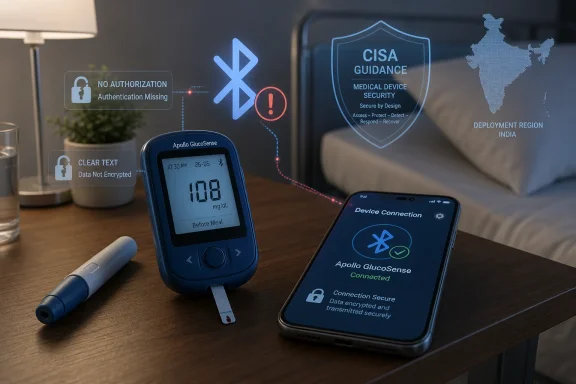
The affected device is not a hospital imaging platform, a cloud-hosted electronic health record system, or a remotely administered infusion pump. It is a Bluetooth-enabled blood glucose monitoring system sold under the Apollo Pharmacy brand, with deployment identified in India and the company headquartered there. That matters because the device sits in the everyday space where medical care, retail health, personal smartphones, and lightly managed consumer electronics now overlap.CISA’s advisory assigns the issue to the Healthcare and Public Health critical infrastructure sector, which may sound grandiose for a glucose meter. It is not. A device that records blood sugar readings is handling data that can reveal diagnosis, treatment patterns, medication adherence, pregnancy status, acute illness, diet, and routine. That is intimate information even before it reaches an app, a clinic, a pharmacy, or an insurer.
The agency says successful exploitation could let an attacker obtain sensitive health-related information and prevent legitimate users from establishing a connection with the device. In plain terms, the bug class points in two directions at once: confidentiality and availability. The first is about who can see the readings. The second is about whether the patient, caregiver, or app can use the device when needed.
That pairing is what makes the advisory more interesting than its CVSS score alone suggests. A 6.5 rating in CVSS v3 lands in the medium range, and CISA also says there is no known public exploitation and that the vulnerabilities are not exploitable remotely. Still, a weakness that touches both health privacy and device usability deserves more attention than the usual “patch when convenient” shrug.
The Bluetooth Label Is Doing Too Much Work
The product name includes “BT,” and the advisory’s impact description points to connection establishment, so Bluetooth is the obvious context. That does not mean the device can be attacked from across the internet. CISA explicitly says these vulnerabilities are not remotely exploitable, which sharply narrows the threat model. An attacker would need proximity or some other local interaction path rather than a cloud-scale scanning operation.That limitation is important, but it should not be used to dismiss the risk. Bluetooth medical accessories live in crowded physical environments: homes, clinics, pharmacies, dormitories, workplaces, buses, waiting rooms, and elder-care facilities. A proximity requirement is a constraint, not a force field.
The two named weakness categories are also familiar in the worst way. Cleartext transmission of sensitive information means data can be exposed without adequate protection in transit. Missing authorization means the device or protocol may not adequately verify whether a party is allowed to perform an action or access information. Those are foundational design problems, not exotic research-lab corner cases.
For WindowsForum readers, the practical analogy is painfully familiar. We have watched “local only” bugs in printers, routers, webcams, NAS boxes, and Bluetooth peripherals become real-world risks when devices are deployed casually and left unmonitored. Medical devices do not get a magical exemption from that pattern just because their physical purpose is more serious.
The Real Failure Is Not Just Encryption
Security advisories often compress the story into a few lines of CWE taxonomy. “Cleartext transmission” sounds like the vendor forgot to turn on encryption, and “missing authorization” sounds like a login prompt was omitted. That framing is useful for triage but too small for the actual design failure.A glucose meter that talks to a phone or companion system has to solve several problems at once. It must pair with the right device, protect readings as they move, resist opportunistic eavesdropping, prevent unauthorized control or connection interference, and remain usable for patients who may not be technically confident. Getting one of those pieces wrong can weaken the whole trust model.
In consumer health hardware, vendors often optimize for quick setup. Pairing should be easy. The app should find the meter immediately. Support calls should be minimal. Batteries should last. Firmware should be small. Those are legitimate product constraints, but they can collide directly with security requirements.
The uncomfortable truth is that a bad user experience can itself become a security risk. If pairing is too strict, people fail to connect the device and abandon useful monitoring. If pairing is too permissive, the device may expose data or become vulnerable to connection hijacking. The best medical device engineering lives in that narrow band between “secure enough to trust” and “simple enough to actually use.”
Medium Severity Can Still Mean High Human Stakes
CVSS is a scoring system, not a moral ranking. A medium-severity vulnerability in a personal medical device can matter more to a patient than a high-severity bug in a test system nobody uses. The advisory’s stated impact is specific enough to avoid panic but serious enough to justify attention.The confidentiality side is obvious. Blood glucose readings are health data, and health data is durable. You can rotate a password. You cannot rotate a chronic condition. If readings are exposed, the harm may not be immediate financial fraud; it may be embarrassment, discrimination risk, coercion, family conflict, or targeted social engineering.
The availability side is subtler. Preventing legitimate users from establishing a connection with the device does not necessarily mean the meter stops measuring glucose altogether. But if the workflow depends on Bluetooth synchronization, mobile app logging, caregiver review, or clinical sharing, breaking the connection can degrade care. A device can remain physically functional while the digital care loop around it fails.
This is where consumer medical IoT differs from generic gadgets. If a smart bulb disconnects, the room is dark. If a glucose monitor workflow breaks, a patient may lose trend history, miss a pattern, or delay a decision. The risk is not always dramatic; sometimes it is cumulative and quiet.
CISA’s Advice Is Sensible, But It Reads Like It Was Written for a Different Device Class
CISA’s recommended practices are the standard defensive language of industrial control and medical device advisories: minimize network exposure, keep control systems away from the internet, place networks behind firewalls, isolate them from business networks, and use secure remote access such as updated VPNs when remote access is required. For hospital networks and industrial environments, that guidance is solid. For a retail Bluetooth glucose meter, it is only partly satisfying.The mismatch is not CISA’s fault alone. The agency’s advisory machinery is built for critical infrastructure, where products range from factory controllers to hospital equipment to embedded healthcare devices. A reusable defensive template keeps the message consistent. But for personal health devices, the most meaningful controls often sit closer to procurement, app behavior, Bluetooth hygiene, mobile OS permissions, and vendor firmware support.
A hospital security team can segment networks and inspect traffic. A patient at home cannot realistically build a zero-trust architecture around a glucose meter. A pharmacy chain can push vendor requirements. A retiree managing diabetes with a phone and a meter may only know that the device is supposed to connect.
That gap is becoming one of the defining problems in medical cybersecurity. Agencies can publish advisories, researchers can report flaws, and vendors can acknowledge affected versions. But unless the mitigation path reaches the person actually holding the device, risk reduction remains largely theoretical.
The India Deployment Detail Should Not Let Global Vendors Relax
CISA identifies the countries and areas deployed as India, and Apollo Pharmacy is an Indian company. That makes this advisory locally grounded, not a broad global warning about every glucose meter with Bluetooth. But the design lessons travel easily.The medical device market is full of regional brands, white-label hardware, ODM platforms, shared mobile app frameworks, and firmware patterns that appear across multiple products. A vulnerability in one named model does not prove the same flaw exists elsewhere, but it should encourage competitors and suppliers to examine whether they made similar tradeoffs.
Healthcare technology also crosses borders through travelers, online marketplaces, family caregiving, and informal procurement. A device sold in one country can end up in another. Even when it does not, the security economics are international: inexpensive connected medical devices are expected to behave like regulated health tools while being built under consumer electronics cost pressure.
That pressure is not going away. Diabetes care is a massive and growing market, and connected monitoring is attractive because it promises convenience, longitudinal data, and better engagement. The more these devices become routine, the less acceptable it is to treat secure communication as an optional premium feature.
Disclosure Worked, But Remediation Is Still the Missing Chapter
The advisory credits Rishitha Pucchakayala and the Centre for Development of Advanced Computing in Hyderabad with reporting the vulnerabilities to CISA. That is the disclosure system functioning as intended. Researchers identify a flaw, coordinate with the relevant body, and the public gets a structured warning with CVE identifiers, affected versions, impact, and mitigation language.What the advisory does not provide, at least in the material at hand, is the piece users usually want most: a clear vendor patch, firmware update, replacement program, app update, or configuration change. The affected version is named precisely as Blood Glucose Monitoring System model APG-01 BT 0x0110_v1.1.0, and the vulnerabilities are tracked as CVE-2026-50034 and CVE-2026-52866. But the recommended action is generalized defensive posture rather than a product-specific fix.
That absence is not unusual in medical device advisories, but it matters. If the device is already deployed in homes or clinics, someone must decide whether to keep using it, restrict use to low-risk environments, contact the vendor, replace it, or wait for an update. Without a vendor-specific mitigation path, the burden shifts to users and administrators least equipped to assess embedded Bluetooth risk.
For enterprise IT, the answer is clearer: inventory comes first. If a healthcare organization, pharmacy operation, research program, insurer wellness initiative, or occupational health clinic has distributed or integrated these devices, it needs to identify affected units and firmware versions. Only then can it decide whether the advisory is a procurement issue, a patient communication issue, a clinical workflow issue, or all three.
Windows Users Are in the Blast Radius Even When Windows Is Not the Target
This is not a Windows vulnerability. There is no indication that Windows PCs are the exploited platform, and CISA’s warning centers on the device itself. Still, Windows users and administrators should care because Windows often sits near the data after the initial Bluetooth hop.In many healthcare environments, patient-generated data eventually lands on Windows endpoints, web dashboards, exported spreadsheets, EHR terminals, or help-desk workflows. A weakness at the device layer can become a privacy incident upstream, even if every Windows machine is fully patched. The endpoint is secure, but the data arrived already exposed.
For sysadmins, this is another reminder that asset inventory cannot stop at laptops, servers, and network printers. Healthcare and wellness programs increasingly introduce peripherals that do not look like traditional IT assets but still create data flows. If they pair with phones, sync to cloud services, export CSV files, or integrate with patient systems, they belong somewhere in the risk register.
The Windows angle is also operational. Support teams may get the call when a device fails to pair, when a companion app will not sync, or when a clinician cannot retrieve readings. If a missing authorization flaw can interfere with legitimate connections, troubleshooting may look like ordinary Bluetooth flakiness until someone connects it to the advisory.
The “Not Remotely Exploitable” Line Is Both Reassuring and Dangerous
CISA says the vulnerabilities are not exploitable remotely. That is a meaningful reassurance. It means defenders are not facing internet-wide exploitation in the style of exposed VPNs, file-transfer appliances, or edge firewalls. There is no reason to inflate the advisory into a remote mass-compromise story.But “not remotely exploitable” can become a dangerous sedative. Local attack surfaces are still attack surfaces, especially for devices used in semi-public or shared environments. A glucose meter may be used in a clinic room, pharmacy counter, hospital ward, school health office, workplace wellness event, or family setting where proximity is easy.
Local exploitation also aligns with some of the most plausible privacy harms. The attacker may not be a nation-state or ransomware crew. It may be someone nearby with motive and opportunity: an abusive partner, a nosy coworker, a malicious insider, or a opportunistic researcher exceeding ethical bounds. Medical privacy risks do not require Hollywood threat actors.
The better interpretation is measured: this advisory does not justify panic, but it does justify review. The exploitability limits reduce the scale of risk. They do not erase the sensitivity of the data or the need for better device design.
Medical IoT Keeps Repeating the Same Old Sins
The two weakness classes in this advisory are depressingly ordinary. Cleartext transmission and missing authorization have been haunting connected products for decades. Their appearance in a blood glucose monitoring system is not surprising, but it is still disappointing.The industry has had enough time to learn that wireless convenience changes the security baseline. Once a medical device communicates, it must authenticate, authorize, encrypt, and fail safely. Those verbs are not enterprise luxuries. They are table stakes for any product that handles patient information.
Regulation has been moving in that direction, especially as agencies and healthcare systems demand better secure-by-design practices from device makers. But market reality remains uneven. Large hospital equipment vendors increasingly understand the scrutiny. Smaller or regional consumer health device makers may lag behind, especially when competing on price and speed.
This is where procurement pressure matters. Retailers, hospitals, pharmacies, insurers, and public health programs can demand security documentation before devices reach patients. They can ask how Bluetooth pairing is protected, whether data is encrypted in transit, how firmware updates are delivered, whether authorization is enforced, and how vulnerabilities are disclosed. If buyers do not ask, vendors will keep treating security as invisible overhead.
The Practical Risk Is Smaller Than the Lesson
The Apollo Pharmacy APG-01 BT advisory is not a five-alarm internet emergency. It is a targeted warning about a specific model and firmware version, with no known public exploitation reported to CISA at publication time. That should shape the response.For individual users, the most rational first step is to check the exact model and, where possible, firmware or app version. Users should avoid pairing the device in crowded or untrusted environments if they are concerned, and they should contact the vendor or healthcare provider for update guidance. If the device is part of a clinical workflow, users should not abruptly stop monitoring without a replacement plan.
For healthcare organizations, the response should be more formal. Identify whether the APG-01 BT is in use, determine whether version 0x0110_v1.1.0 is present, document exposure, and decide whether patients or staff need instructions. If the device is used only as a standalone meter, the risk may be different than if it is paired to phones and integrated into digital reporting.
The hardest part is that the advisory does not name a clean remediation. That forces organizations to manage uncertainty. In security, uncertainty is not a reason to freeze; it is a reason to record assumptions, limit exposure, and keep watching for vendor updates.
The Small Meter That Exposes a Big Procurement Problem
The concrete facts here are modest, but they point to a procurement and governance problem that is anything but modest. If a connected health device enters a patient workflow, somebody should know how it communicates, how it updates, and what happens when a vulnerability appears. Too often, that knowledge is scattered between the vendor, the app store listing, the pharmacy shelf, and the patient’s phone.This is the part of medical cybersecurity that rarely gets the spotlight. Ransomware gets headlines because hospitals go dark. Device vulnerabilities like this one are quieter because they are fragmented, local, and operationally messy. Yet they reveal whether the healthcare ecosystem has learned to treat patient-generated data as part of the clinical security perimeter.
A security program that only watches servers will miss the meter. A privacy program that only watches databases will miss the Bluetooth hop. A procurement program that only watches price will miss the authorization model. The advisory is a small object lesson in how modern healthcare risk slips between departments.
The APG-01 BT Advisory Leaves Defenders With a Short, Uncomfortable Checklist
For all the structural lessons, the immediate response should stay grounded. The affected version is specific, the known exploitation status is reassuring, and the remote attack surface appears limited. The right posture is neither alarmism nor indifference.- Organizations should confirm whether Apollo Pharmacy Blood Glucose Monitoring System APG-01 BT devices are present in their environments before assuming the advisory does or does not apply.
- Administrators should treat version 0x0110_v1.1.0 as the named affected firmware and track vendor communications for any update, replacement, or mitigation guidance.
- Users should avoid pairing or syncing the device in crowded or untrusted settings when practical, because the advisory’s risk model appears tied to local rather than internet-scale exposure.
- Healthcare teams should consider whether connection disruption would affect patient care workflows, not merely whether the meter can still take a reading.
- Procurement teams should use this advisory as a reason to ask sharper questions about Bluetooth security, encryption, authorization, firmware updates, and vulnerability disclosure before buying connected health devices.
- Security teams should remember that “not remotely exploitable” reduces scale but does not eliminate privacy risk for a device that handles sensitive health information.
References
- Primary source: CISA
Published: 2026-06-18T12:00:00+00:00
- Related coverage: community.apollographql.com
Malicious versions of axios npm package affecting @apollo/rover - Other Apollo Topics - Apollo Community
As reported by StepSecurity, a malicious version of the axios npm package (versions 1.14.1 and 0.30.4) was briefly available for three hours and 26 minutes between March 30, 2026 – March 31, 2026. Apollo has investigated… community.apollographql.com
- Related coverage: advisories.gitlab.com
Apache ActiveMQ Vulnerable to Improper Input Validation and Code Injection | GitLab Advisory Database (GLAD)
CVE-2026-40466 Apache ActiveMQ Vulnerable to Improper Input Validation and Code Injection: Improper Input Validation, Improper Control of Generation of Code ('Code Injection') vulnerability in Apache ActiveMQ Broker, …advisories.gitlab.com - Related coverage: apollo.com