

CISA republished ABB’s October 7, 2025 EIBPORT security advisory on May 28, 2026, warning that EIBPORT V3 KNX and EIBPORT V3 KNX GSM firmware before version 3.9.2 contains a high-severity web vulnerability that can expose sensitive device data and allow configuration changes. The advisory is not a Windows story in the narrow sense, but it is very much an IT story: building automation has become another managed endpoint class, and the assumptions around it are aging badly. ABB has a firmware fix, but the real lesson is that web-administered operational technology keeps inheriting the same problems enterprise IT has spent decades learning to contain.
ABB’s EIBPORT sits in a category that rarely gets the same attention as laptops, domain controllers, VPN concentrators, or cloud identity platforms. It is a building management gateway for KNX-based automation, used to connect lighting, HVAC-adjacent controls, sensors, schedules, visualizations, and other building functions into a manageable system. That makes it easy to think of the device as infrastructure furniture: installed once, tucked away, and only revisited when the building misbehaves.
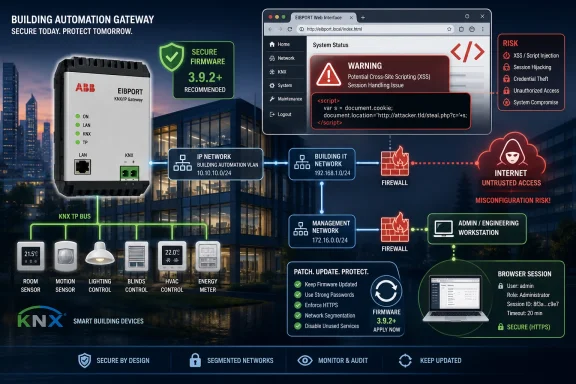
The vulnerability described in ABB’s advisory cuts against that mental model. The affected devices expose web management functionality, and the reported flaw sits in the familiar territory of web session handling and input neutralization. The CSAF summary identifies improper neutralization of input during web page generation, better known as cross-site scripting, while ABB’s own FAQ language also points to insecure session management and fixes around login credentials, tokens, and session identifiers.
That combination matters because it collapses the tidy distinction between “IT vulnerability” and “building system issue.” If an attacker can obtain or abuse session material, access information stored on the device, or change configuration, the device becomes more than a passive gateway. It becomes an administrative foothold into the logic of a physical environment.
ABB says the affected products are EIBPORT V3 KNX with product IDs 2CLA963710W1001 and 2CSM256242R2001, and EIBPORT V3 KNX GSM with product ID 2CLA963720W1001, all running firmware older than 3.9.2. The fix is straightforward on paper: update to firmware 3.9.2 or later. The difficulty, as ever in operational environments, is that “update the firmware” is the beginning of the work, not the end.
That does not make it comfortable. A building gateway that can be reached from the wrong network segment is already a policy failure. A building gateway with a web-session weakness compounds that failure by making the management plane easier to abuse once an attacker is near enough.
ABB’s mitigation language follows the familiar industrial-control script: keep control systems off the open Internet, place them behind firewalls, minimize exposed ports, physically protect them, separate them from business networks, and avoid casual web browsing, email, removable media risk, and other behaviors that belong nowhere near process-control equipment. None of that is surprising. The uncomfortable part is that vendors keep needing to say it.
The advisory explicitly notes that ABB became aware that some customers had commissioned EIBPORT devices in ways that made their IP addresses accessible from the Internet or other untrusted networks. ABB stresses that this is outside the intended use of the system. That sentence is doing a lot of work: it shifts the exploitability discussion from theoretical best practice to observed deployment reality.
In other words, the advisory is not merely saying, “Here is a bug.” It is saying, “Here is a bug in a class of devices that some customers have placed in exactly the exposure model the vendor says not to use.” For defenders, that is the difference between a ticket and a hunt.
The EIBPORT advisory fits neatly into that gap. A KNX building gateway is not glamorous. It will not have the boardroom profile of a ransomware incident or the developer mindshare of a cloud zero-day. But it may sit inside office buildings, campuses, retail locations, industrial facilities, or mixed-use environments where remote management has become convenient and segmentation is uneven.
The fact that the device has an integrated web interface is not inherently bad. Web management is the lingua franca of modern administration, and administrators reasonably expect to configure devices through browsers. The problem is that web interfaces drag in the browser’s threat model, session state, scripting risks, authentication flows, cookie handling, and user-interaction traps.
That is why cross-site scripting is still relevant in 2026. Security professionals have been explaining XSS for a generation, and yet the bug class persists because the web remains the easiest way to administer everything. When the “everything” includes building automation, a stale web bug can become a physical-world configuration issue.
This is also where Windows administrators should pay attention. The vulnerable device may not run Windows, but the people administering it probably use Windows workstations, domain credentials, browser sessions, VPNs, jump boxes, and ticketing systems. The attack surface is not just the firmware image. It is the whole administrative ritual around the device.
But firmware is not distributed like a cumulative update. Windows Update, Intune, WSUS, Configuration Manager, and Autopatch all exist because endpoint patching is hard even in a comparatively mature management ecosystem. Building controllers often live outside that machinery. They may require vendor tooling, maintenance windows, local access, backups of configurations, or coordination with integrators who installed the system years earlier.
The first practical problem is knowing the device exists. Many IT teams maintain excellent inventories of laptops and servers while having only a partial picture of networked power, badge, lighting, HVAC, CCTV, UPS, and building automation gear. A device like EIBPORT can hide in plain sight as a static IP address with a web page no one has logged into for months.
The second problem is knowing who owns the risk. Facilities may own the building function. IT may own the network. Security may own the vulnerability scanner. A third-party integrator may own the original configuration. The advisory only becomes actionable when those ownership boundaries are made explicit.
The third problem is fear of interruption. Even where firmware updates are available, operators may delay because the device is “working,” because no one wants to touch a building control system during business hours, or because rollback procedures are unclear. That caution is understandable. It is also how high-severity vulnerabilities become permanent fixtures in production environments.
The republication does not necessarily mean new exploitation. The text says ABB had not received information indicating public disclosure or exploitation when the original advisory was issued. CISA’s conversion disclaimer also makes clear that this is a republication of ABB’s CSAF advisory, provided as-is for visibility rather than a new technical investigation.
Still, public clocks matter in vulnerability management. Once an advisory is republished in a widely monitored channel, scanning, proof-of-concept speculation, asset searches, and customer questions tend to follow. Even without public exploit code, the shape of the issue is clear enough to invite opportunistic checking: EIBPORT, web interface, firmware below 3.9.2, session and XSS-related behavior, sensitive configuration exposure.
That does not mean defenders should panic. It does mean they should not treat the advisory as stale merely because the vendor fixed it months ago. CISA’s republication is effectively a second notification wave, and second waves often reach the people who missed the first one.
That answer is technically defensible and operationally incomplete. Security is full of statements that are true inside the reference architecture and fragile in the field. A device is not remotely exploitable if it is unreachable from remote networks; that premise can collapse through misconfigured port forwards, exposed management interfaces, flat internal networks, vendor remote-access appliances, weak VPN hygiene, or temporary troubleshooting rules that become permanent.
ABB’s own wording acknowledges that reality by noting that some customers have made EIBPORT IP addresses accessible over the Internet or other untrusted networks. That is the sentence defenders should underline. It turns “not remotely exploitable” from a blanket reassurance into a conditional statement.
For enterprise IT, the lesson is familiar. A vulnerability’s real-world severity is the product of the bug, the asset’s exposure, the value of the configuration, and the attacker’s ability to reach an administrator or browser session. CVSS captures some of that, but it cannot see your firewall exceptions, abandoned NAT rules, forgotten vendor accounts, or facilities VLAN that can route to the corporate LAN.
That is why vulnerability management teams should resist the temptation to sort this advisory into a low-priority bucket merely because it concerns building automation. The right first move is not to debate semantics. It is to determine whether any affected device is reachable from the Internet, from guest networks, from ordinary user subnets, from VPN pools, or from compromised endpoints that an attacker would plausibly control.
The advisory’s framing indicates that a successful attacker could access sensitive information stored inside the device and change its configuration. That is not merely an alert box popping in a browser. It is a path toward administrative consequences, especially if session identifiers, tokens, or credential verification are mishandled.
In a building automation context, sensitive information can include schedules, network settings, user accounts, system configuration, integration details, and operational logic. Configuration changes may not equate to life-safety compromise, and ABB explicitly notes EIBPORT is not designed as a functional safety device. But “not safety” does not mean “not important.”
Buildings depend on automation for comfort, energy efficiency, occupancy routines, and operational continuity. A nuisance change in a small site might be quickly noticed and reversed. A change in a larger deployment could create outages, confusion, after-hours access problems for maintainers, or expensive troubleshooting across teams that do not speak the same operational language.
The more subtle risk is trust erosion. Once administrators know a controller’s configuration may have been modified through a vulnerable interface, they must validate state, not merely patch software. That means comparing backups, reviewing user accounts, checking network configuration, and confirming that schedules and integrations still reflect intended operations.
EIBPORT’s role as a gateway and building management system places it at the intersection of field bus logic, IP networking, web administration, and remote access practices. That intersection is exactly where old operational assumptions break. The field devices may be specialized, but the management path looks increasingly like ordinary IT.
This convergence is why IT and facilities teams need shared processes rather than occasional escalations. A KNX gateway with an IP address should be treated as an asset with firmware state, access control, network exposure, logging expectations, backup requirements, and incident response procedures. That may sound obvious to security teams, but many organizations still lack a single inventory that covers both the office network and the building network.
Microsoft administrators in particular should recognize the pattern. The Windows estate has spent the last decade moving toward identity-first controls, conditional access, device compliance, endpoint detection, and centralized telemetry. Meanwhile, many embedded systems still rely on management pages, local accounts, firmware downloads, and segmentation as the primary line of defense.
That gap is closing, but unevenly. The organizations that handle it well will not be the ones that pretend building automation can be folded instantly into the same tooling as Windows clients. They will be the ones that create practical bridges: network discovery that finds controllers, maintenance windows that respect operations, credential vaulting for shared admin accounts, browser isolation for sensitive management pages, and change records that facilities staff actually use.
The most important word in that guidance is not “VPN.” It is “minimize.” Remote access should be scarce, intentional, monitored, and justified by operational need. Too often, remote access becomes a convenience layer that outlives the project that created it.
VPNs are also not magic. CISA’s reminder that a VPN is only as secure as its connected devices should be read literally. If a contractor laptop with a saved password and a neglected browser profile can reach a building controller, the organization has not solved remote access; it has merely moved the exposure point.
Firewalls help, but only if someone understands the flows. Business networks, facilities networks, guest networks, vendor support networks, and remote management paths often accrete over time. The correct architecture may exist in a diagram, while the actual routing table tells a more complicated story.
The same is true for “no Internet exposure.” Many organizations believe critical devices are internal because no one intended to publish them. Intention is not a control. Verification is a control.
Start with discovery. Security teams should search asset inventories, DHCP records, DNS zones, firewall rules, vulnerability scan results, configuration management databases, and facilities documentation for EIBPORT and related KNX infrastructure. If the organization cannot answer whether it has affected devices, that is already a finding.
Then validate exposure. A building controller should not be reachable from the public Internet, guest Wi-Fi, general user VLANs, or broad VPN address pools. If remote administration is required, it should be mediated through hardened access paths, strong authentication, logging, and explicit approvals.
Next, preserve and review configuration. Before firmware changes, administrators should back up device configuration according to vendor guidance and document current state. After patching, they should verify accounts, network settings, schedules, integrations, and any remote access features.
Finally, assign long-term ownership. Someone must be responsible for tracking ABB advisories, planning firmware lifecycle work, and validating that future building projects follow security architecture from the start. Otherwise, the organization will rediscover the same class of risk during the next advisory.
This is where the article’s WindowsForum audience has an advantage. Windows administrators already know that unowned systems become security liabilities. The challenge is extending that discipline to devices that do not join Active Directory, do not appear in Intune, and do not politely wait for Patch Tuesday.
 The Building Controller Has Become a Web Server With Consequences
ABB’s EIBPORT sits in a category that rarely gets the same attention as laptops, domain controllers, VPN concentrators, or cloud identity platforms. It is a building management gateway for KNX-based automation, used to connect lighting, HVAC-adjacent controls, sensors, schedules, visualizations, and other building functions into a manageable system. That makes it easy to think of the device as infrastructure furniture: installed once, tucked away, and only revisited when the building misbehaves.The vulnerability described in ABB’s advisory cuts against that mental model. The affected devices expose web management functionality, and the reported flaw sits in the familiar territory of web session handling and input neutralization. The CSAF summary identifies improper neutralization of input during web page generation, better known as cross-site scripting, while ABB’s own FAQ language also points to insecure session management and fixes around login credentials, tokens, and session identifiers.
That combination matters because it collapses the tidy distinction between “IT vulnerability” and “building system issue.” If an attacker can obtain or abuse session material, access information stored on the device, or change configuration, the device becomes more than a passive gateway. It becomes an administrative foothold into the logic of a physical environment.
ABB says the affected products are EIBPORT V3 KNX with product IDs 2CLA963710W1001 and 2CSM256242R2001, and EIBPORT V3 KNX GSM with product ID 2CLA963720W1001, all running firmware older than 3.9.2. The fix is straightforward on paper: update to firmware 3.9.2 or later. The difficulty, as ever in operational environments, is that “update the firmware” is the beginning of the work, not the end.
The CVSS Number Is High, but the Architecture Is the Real Risk
The advisory’s CVSS v3 score of 8.0 lands in the high-severity range, and that should be enough to get the attention of anyone responsible for building automation, facilities IT, or segmented industrial networks. But the number is less interesting than the conditions around it. The vulnerability requires a network path and, according to the scoring, some degree of privilege and user interaction, which makes it less dramatic than a wormable unauthenticated remote-code-execution flaw.That does not make it comfortable. A building gateway that can be reached from the wrong network segment is already a policy failure. A building gateway with a web-session weakness compounds that failure by making the management plane easier to abuse once an attacker is near enough.
ABB’s mitigation language follows the familiar industrial-control script: keep control systems off the open Internet, place them behind firewalls, minimize exposed ports, physically protect them, separate them from business networks, and avoid casual web browsing, email, removable media risk, and other behaviors that belong nowhere near process-control equipment. None of that is surprising. The uncomfortable part is that vendors keep needing to say it.
The advisory explicitly notes that ABB became aware that some customers had commissioned EIBPORT devices in ways that made their IP addresses accessible from the Internet or other untrusted networks. ABB stresses that this is outside the intended use of the system. That sentence is doing a lot of work: it shifts the exploitability discussion from theoretical best practice to observed deployment reality.
In other words, the advisory is not merely saying, “Here is a bug.” It is saying, “Here is a bug in a class of devices that some customers have placed in exactly the exposure model the vendor says not to use.” For defenders, that is the difference between a ticket and a hunt.
The Internet-Facing Controller Is No Longer an Edge Case
For years, security teams have treated exposed industrial and building automation systems as a recurring embarrassment rather than a mainstream asset-management problem. Search engines for Internet-connected devices made the issue visible, but visibility did not always translate into budget, ownership, or remediation. In many organizations, facilities systems have sat between departments: too physical for corporate IT, too networked for facilities alone, too low-volume to get the automation given to server fleets.The EIBPORT advisory fits neatly into that gap. A KNX building gateway is not glamorous. It will not have the boardroom profile of a ransomware incident or the developer mindshare of a cloud zero-day. But it may sit inside office buildings, campuses, retail locations, industrial facilities, or mixed-use environments where remote management has become convenient and segmentation is uneven.
The fact that the device has an integrated web interface is not inherently bad. Web management is the lingua franca of modern administration, and administrators reasonably expect to configure devices through browsers. The problem is that web interfaces drag in the browser’s threat model, session state, scripting risks, authentication flows, cookie handling, and user-interaction traps.
That is why cross-site scripting is still relevant in 2026. Security professionals have been explaining XSS for a generation, and yet the bug class persists because the web remains the easiest way to administer everything. When the “everything” includes building automation, a stale web bug can become a physical-world configuration issue.
This is also where Windows administrators should pay attention. The vulnerable device may not run Windows, but the people administering it probably use Windows workstations, domain credentials, browser sessions, VPNs, jump boxes, and ticketing systems. The attack surface is not just the firmware image. It is the whole administrative ritual around the device.
ABB’s Fix Is Firmware, but the Operational Fix Is Inventory
ABB says firmware version 3.9.2 resolves the vulnerability by changing how affected devices verify login credentials and token or session identifiers, while also hardening product configuration where possible. That is the right vendor-level response. If the device is in scope and below 3.9.2, it needs an upgrade plan.But firmware is not distributed like a cumulative update. Windows Update, Intune, WSUS, Configuration Manager, and Autopatch all exist because endpoint patching is hard even in a comparatively mature management ecosystem. Building controllers often live outside that machinery. They may require vendor tooling, maintenance windows, local access, backups of configurations, or coordination with integrators who installed the system years earlier.
The first practical problem is knowing the device exists. Many IT teams maintain excellent inventories of laptops and servers while having only a partial picture of networked power, badge, lighting, HVAC, CCTV, UPS, and building automation gear. A device like EIBPORT can hide in plain sight as a static IP address with a web page no one has logged into for months.
The second problem is knowing who owns the risk. Facilities may own the building function. IT may own the network. Security may own the vulnerability scanner. A third-party integrator may own the original configuration. The advisory only becomes actionable when those ownership boundaries are made explicit.
The third problem is fear of interruption. Even where firmware updates are available, operators may delay because the device is “working,” because no one wants to touch a building control system during business hours, or because rollback procedures are unclear. That caution is understandable. It is also how high-severity vulnerabilities become permanent fixtures in production environments.
CISA’s Republication Turns a Vendor Notice Into a Public Clock
ABB originally issued the advisory on October 7, 2025, and CISA’s May 28, 2026 republication gives it broader visibility through the ICS advisory channel. That timing matters. A vendor advisory reaches customers who subscribe, monitor product pages, or have support relationships. A CISA ICS advisory lands in the feed of defenders, managed security providers, regulators, consultants, journalists, and adversaries alike.The republication does not necessarily mean new exploitation. The text says ABB had not received information indicating public disclosure or exploitation when the original advisory was issued. CISA’s conversion disclaimer also makes clear that this is a republication of ABB’s CSAF advisory, provided as-is for visibility rather than a new technical investigation.
Still, public clocks matter in vulnerability management. Once an advisory is republished in a widely monitored channel, scanning, proof-of-concept speculation, asset searches, and customer questions tend to follow. Even without public exploit code, the shape of the issue is clear enough to invite opportunistic checking: EIBPORT, web interface, firmware below 3.9.2, session and XSS-related behavior, sensitive configuration exposure.
That does not mean defenders should panic. It does mean they should not treat the advisory as stale merely because the vendor fixed it months ago. CISA’s republication is effectively a second notification wave, and second waves often reach the people who missed the first one.
The “Not Remotely Exploitable” Claim Depends on a Network That Often Does Not Exist
One of the more delicate parts of the advisory is ABB’s answer to whether the vulnerability could be exploited remotely. Under recommended practices, ABB says no: building automation control systems should be physically protected, disconnected from the Internet, and isolated behind firewalls with minimal exposure. In that ideal architecture, an attacker cannot simply reach the device from the outside.That answer is technically defensible and operationally incomplete. Security is full of statements that are true inside the reference architecture and fragile in the field. A device is not remotely exploitable if it is unreachable from remote networks; that premise can collapse through misconfigured port forwards, exposed management interfaces, flat internal networks, vendor remote-access appliances, weak VPN hygiene, or temporary troubleshooting rules that become permanent.
ABB’s own wording acknowledges that reality by noting that some customers have made EIBPORT IP addresses accessible over the Internet or other untrusted networks. That is the sentence defenders should underline. It turns “not remotely exploitable” from a blanket reassurance into a conditional statement.
For enterprise IT, the lesson is familiar. A vulnerability’s real-world severity is the product of the bug, the asset’s exposure, the value of the configuration, and the attacker’s ability to reach an administrator or browser session. CVSS captures some of that, but it cannot see your firewall exceptions, abandoned NAT rules, forgotten vendor accounts, or facilities VLAN that can route to the corporate LAN.
That is why vulnerability management teams should resist the temptation to sort this advisory into a low-priority bucket merely because it concerns building automation. The right first move is not to debate semantics. It is to determine whether any affected device is reachable from the Internet, from guest networks, from ordinary user subnets, from VPN pools, or from compromised endpoints that an attacker would plausibly control.
Cross-Site Scripting Is Boring Until It Steals the Session That Runs the Building
Cross-site scripting has a reputation problem. It is old, widely understood, and sometimes dismissed as less serious than memory corruption, authentication bypass, or remote code execution. In consumer web applications, that complacency is already dangerous. In embedded administration panels, it can be worse, because the browser session may be the administrator’s only control plane.The advisory’s framing indicates that a successful attacker could access sensitive information stored inside the device and change its configuration. That is not merely an alert box popping in a browser. It is a path toward administrative consequences, especially if session identifiers, tokens, or credential verification are mishandled.
In a building automation context, sensitive information can include schedules, network settings, user accounts, system configuration, integration details, and operational logic. Configuration changes may not equate to life-safety compromise, and ABB explicitly notes EIBPORT is not designed as a functional safety device. But “not safety” does not mean “not important.”
Buildings depend on automation for comfort, energy efficiency, occupancy routines, and operational continuity. A nuisance change in a small site might be quickly noticed and reversed. A change in a larger deployment could create outages, confusion, after-hours access problems for maintainers, or expensive troubleshooting across teams that do not speak the same operational language.
The more subtle risk is trust erosion. Once administrators know a controller’s configuration may have been modified through a vulnerable interface, they must validate state, not merely patch software. That means comparing backups, reviewing user accounts, checking network configuration, and confirming that schedules and integrations still reflect intended operations.
The KNX World Is Being Pulled Into Enterprise Security Discipline
KNX has long been associated with professional building automation, particularly in commercial and high-end residential environments. Its value proposition is interoperability and structured control across devices from multiple vendors. But interoperability does not exempt the management layer from modern security expectations.EIBPORT’s role as a gateway and building management system places it at the intersection of field bus logic, IP networking, web administration, and remote access practices. That intersection is exactly where old operational assumptions break. The field devices may be specialized, but the management path looks increasingly like ordinary IT.
This convergence is why IT and facilities teams need shared processes rather than occasional escalations. A KNX gateway with an IP address should be treated as an asset with firmware state, access control, network exposure, logging expectations, backup requirements, and incident response procedures. That may sound obvious to security teams, but many organizations still lack a single inventory that covers both the office network and the building network.
Microsoft administrators in particular should recognize the pattern. The Windows estate has spent the last decade moving toward identity-first controls, conditional access, device compliance, endpoint detection, and centralized telemetry. Meanwhile, many embedded systems still rely on management pages, local accounts, firmware downloads, and segmentation as the primary line of defense.
That gap is closing, but unevenly. The organizations that handle it well will not be the ones that pretend building automation can be folded instantly into the same tooling as Windows clients. They will be the ones that create practical bridges: network discovery that finds controllers, maintenance windows that respect operations, credential vaulting for shared admin accounts, browser isolation for sensitive management pages, and change records that facilities staff actually use.
CISA’s Advice Is Familiar Because the Industry Keeps Failing the Basics
CISA’s recommended practices read like the standard canon of ICS security: minimize exposure, keep control systems off the Internet, isolate them behind firewalls, use VPNs when remote access is needed, keep VPNs updated, and perform impact analysis before defensive changes. The repetition is not laziness. It is a sign that the same basic failure modes keep producing risk.The most important word in that guidance is not “VPN.” It is “minimize.” Remote access should be scarce, intentional, monitored, and justified by operational need. Too often, remote access becomes a convenience layer that outlives the project that created it.
VPNs are also not magic. CISA’s reminder that a VPN is only as secure as its connected devices should be read literally. If a contractor laptop with a saved password and a neglected browser profile can reach a building controller, the organization has not solved remote access; it has merely moved the exposure point.
Firewalls help, but only if someone understands the flows. Business networks, facilities networks, guest networks, vendor support networks, and remote management paths often accrete over time. The correct architecture may exist in a diagram, while the actual routing table tells a more complicated story.
The same is true for “no Internet exposure.” Many organizations believe critical devices are internal because no one intended to publish them. Intention is not a control. Verification is a control.
The Patch Should Trigger a Wider Audit, Not a Narrow Ticket
A narrow response to the ABB advisory would identify EIBPORT devices, check firmware, update anything below 3.9.2, and close the vulnerability ticket. That is necessary, but insufficient. The better response uses this advisory as a forcing function to examine how building automation is governed.Start with discovery. Security teams should search asset inventories, DHCP records, DNS zones, firewall rules, vulnerability scan results, configuration management databases, and facilities documentation for EIBPORT and related KNX infrastructure. If the organization cannot answer whether it has affected devices, that is already a finding.
Then validate exposure. A building controller should not be reachable from the public Internet, guest Wi-Fi, general user VLANs, or broad VPN address pools. If remote administration is required, it should be mediated through hardened access paths, strong authentication, logging, and explicit approvals.
Next, preserve and review configuration. Before firmware changes, administrators should back up device configuration according to vendor guidance and document current state. After patching, they should verify accounts, network settings, schedules, integrations, and any remote access features.
Finally, assign long-term ownership. Someone must be responsible for tracking ABB advisories, planning firmware lifecycle work, and validating that future building projects follow security architecture from the start. Otherwise, the organization will rediscover the same class of risk during the next advisory.
This is where the article’s WindowsForum audience has an advantage. Windows administrators already know that unowned systems become security liabilities. The challenge is extending that discipline to devices that do not join Active Directory, do not appear in Intune, and do not politely wait for Patch Tuesday.
The Practical Reading for EIBPORT Owners
The ABB advisory is specific, but its implications are broader. The strongest response is to treat the EIBPORT vulnerability as both a firmware issue and a network-design audit. A patched device on a sloppy network remains a future problem; an isolated device on obsolete firmware remains a present one.- Organizations running EIBPORT V3 KNX or EIBPORT V3 KNX GSM should verify whether firmware is older than 3.9.2 and plan an update if it is.
- Administrators should confirm that EIBPORT management interfaces are not reachable from the Internet or other untrusted networks.
- Security teams should review whether ordinary user subnets, guest networks, or broad VPN pools can reach building automation devices.
- Facilities and IT teams should back up and validate device configurations before and after firmware work.
- Organizations should treat CISA’s republication as a renewed visibility event, even though ABB originally issued the advisory in October 2025.
- Any affected deployment with suspicious exposure should be reviewed for unauthorized configuration changes, not merely patched and forgotten.
References
- Primary source: CISA
Published: 2026-05-28T12:00:00+00:00

ABB EIBPORT | CISA
www.cisa.gov
- Related coverage: cyberpress.org
Critical ABB EIBPORT Vulnerability Exposes Sensitive Configuration Pages to Attackers
ABB has disclosed a critical security vulnerability in its EIBPORT building automation controllers that could allow attackers to gain unauthorized access. cyberpress.org
- Related coverage: advisory.eventussecurity.com
ABB EIBPORT Vulnerability Allows Unauthorized Configuration Access via Web Sessions - Advisories
A session management vulnerability has been CVE-2024-13967 identified in EIBPORT products used in building automation systems, which could allow unauthorized advisory.eventussecurity.com
