

CISA on June 16, 2026 republished Rockwell Automation Security Advisory SD1776 as ICSA-26-167-04, warning that CompactLogix 5370 L1, L2, and L3 controllers used worldwide in critical manufacturing are affected by vulnerabilities that could let an attacker trigger a denial-of-service condition. The advisory is not a cinematic breach story; it is a reminder that the most consequential industrial cyber risks often look boring until a line stops moving. For WindowsForum readers, the interesting part is not merely that a Rockwell PLC has another advisory. It is that modern vulnerability management is now reaching into the operational technology layer with the same metadata-driven urgency that Windows admins have lived with for years.
Industrial control advisories used to read like dispatches from a parallel universe: specialized devices, proprietary software, cautious language, and mitigation advice that assumed a plant network was physically and culturally distant from IT. That wall has been eroding for years. CompactLogix systems sit in plants, machines, skids, packaging lines, and production cells where Ethernet/IP, engineering workstations, remote support tools, Windows laptops, and corporate risk registers increasingly collide.
The CISA advisory frames the immediate risk plainly. Successful exploitation could cause denial of service, not code execution, ransomware deployment, or direct process manipulation. In a consumer software story, that distinction might lower the temperature. In industrial automation, a denial-of-service condition can still mean an interrupted batch, a tripped process, a machine that needs hands-on recovery, or a maintenance window that arrives at the worst possible time.
Rockwell’s CompactLogix 5370 family is not obscure kit. The L1, L2, and L3 lines have been widely deployed as small and midrange controllers in the Allen-Bradley ecosystem, the sort of hardware that becomes invisible precisely because it works, ages in place, and accrues business logic that nobody wants to rewrite. That installed-base reality is why a CVSS 7.5 advisory matters even without public exploitation.
The June 16 notice also matters because it arrived as a CSAF-style advisory. That detail sounds bureaucratic, but it is a signal: industrial vendors, national cyber agencies, and asset owners are trying to make OT vulnerability data machine-readable enough to flow into the same vulnerability operations pipelines that already track servers, browsers, VPNs, and endpoint agents. The factory floor is not becoming “just IT,” but it is becoming impossible to defend without IT-grade inventory and change control.
CISA’s summary says exploitation could allow an attacker to cause a denial-of-service condition. The advisory names two weakness classes: improper validation of an integrity check value and exposure of sensitive system information to an unauthorized control sphere. Those are not colorful bug descriptions, but they point to a familiar pattern in industrial security: devices built for deterministic control and trusted networks are being asked to survive hostile traffic and modern reconnaissance.
That does not mean every affected controller is one packet away from catastrophe. CISA also says there is no known public exploitation specifically targeting these vulnerabilities at the time of the advisory. That caveat is important, and administrators should resist turning every ICS advisory into a panic drill. But “not known to be exploited” is not the same as “safe,” especially for devices that may remain in service for a decade or longer.
The stronger reading is operational: this is a maintenance and exposure-management problem before it is an incident-response problem. The organization that knows where its CompactLogix 5370 controllers are, what firmware they run, who can reach them, and how production would tolerate a firmware update is in a very different risk position from the organization that has to discover all of that after an advisory lands.
The real question for plant operators is not whether they can recite the best practice. It is whether the network topology, firewall rules, asset inventory, and vendor access procedures match the diagram everybody believes is current. In many factories, the most dangerous exposure is not a PLC directly indexed from the public internet. It is the chain of “temporary” connectivity that links a corporate account, a remote-support tool, a Windows workstation, and an engineering network segment.
Rockwell and CISA both push users toward defense-in-depth. That is the right answer, but it is also the answer that exposes how much industrial cybersecurity depends on governance. Segmentation only works if someone owns the firewall policy. VPNs only help if the endpoints are patched, identities are managed, and access is time-bound. Firmware updates only reduce risk if teams have tested the update against ladder logic, communications modules, HMIs, drives, safety assumptions, and vendor support constraints.
This is where the WindowsForum audience should feel the overlap. The plant-floor story is full of PLCs, but the attack paths often start with ordinary IT failures: reused credentials, stale VPN appliances, flat networks, unsupported Windows engineering laptops, weak remote desktop controls, and missing logs. OT security is specialized, but it is not separate from the habits of enterprise IT.
It also makes them sticky. Once a controller is installed, commissioned, validated, and tied into HMI screens, recipes, alarms, historian tags, and maintenance procedures, replacement becomes a business project rather than a purchasing decision. A controller can be technically superseded long before it is economically replaceable. That gap is where advisories accumulate.
The advisory names CompactLogix 5370 L1, L2, and L3 controllers rather than a broad abstract software component. That specificity helps asset owners narrow the blast radius, but it also creates practical work. Many plants do not have a clean, queryable inventory of controller families and firmware versions. They have spreadsheets, electrical drawings, engineering laptops, OEM manuals, tribal knowledge, and asset labels that may or may not match what is actually running.
This is why modern OT security conversations keep returning to inventory. You cannot patch what you cannot identify. You cannot segment what you cannot locate. You cannot assess exploitability if you do not know whether the controller is reachable from a vendor VPN, a Windows HMI, a maintenance subnet, or a corporate network path that nobody has reviewed since the last plant expansion.
The promise is obvious. If vendor advisories are published in a consistent machine-readable format, an organization can map affected products and versions against its own inventory, flag relevant assets, route work orders, and track exceptions. That is the same basic dream behind enterprise vulnerability management, adapted to controllers and control systems that cannot be rebooted on a whim.
The problem is that structured advisories are only as useful as the receiving end. A CSAF file cannot tell you whether a packaging line has a maintenance window next weekend, whether the OEM will bless a firmware update, whether a controller’s program has been backed up, or whether the process engineer who understands the cell is on vacation. Metadata accelerates triage, but it does not eliminate operational judgment.
Still, this is progress. The older model of industrial advisories assumed a human would read, interpret, forward, and remember. The newer model assumes advisories should become data. That matters because OT defenders are drowning in the same asymmetry as everyone else: more vulnerabilities, more vendors, more remote connectivity, more compliance pressure, and not enough engineers who understand both packets and process.
If a controller cannot be reached by an attacker, a remotely triggerable denial-of-service bug becomes much harder to exploit. If engineering workstations are controlled, monitored, and separated from business networks, the path to the controller narrows. If vendor access is brokered through time-limited, logged, patched systems rather than permanent tunnels, the organization gains leverage. None of that requires exotic zero-trust theater; it requires disciplined network hygiene.
But discipline is hard in plants. Production teams are measured by uptime, quality, and throughput. Cybersecurity teams are measured by risk reduction and incident prevention. Vendors are measured by supportability. Corporate IT is measured by standardization. Those incentives do not naturally align around taking a PLC offline to apply firmware unless leadership has already decided that cyber maintenance is part of operational reliability.
The advisory’s warning about VPNs is also worth lingering on. VPNs are often presented as the secure answer to remote access, but CISA correctly notes that VPNs may have vulnerabilities and are only as secure as the connected devices. In 2026, that reads less like a footnote and more like scar tissue from years of perimeter-device exploitation. A VPN that connects an unmanaged contractor laptop into an engineering network is not a security control so much as a formalized path of risk.
There is a predictable cycle in OT security. A vendor advisory appears. Asset owners ask whether they are affected. Someone discovers the inventory is incomplete. Operations asks whether patching can wait. Security asks whether segmentation compensates. The issue is added to a risk register. Months later, a scanner, audit, insurer, or incident drags it back into view.
That cycle is not always negligence. Industrial patching is genuinely harder than desktop patching. Firmware updates can introduce compatibility risk, require controller mode changes, or force scheduled downtime. Even verifying versions may require coordination with controls engineers and careful connection to live systems. But complexity is not an excuse for indefinite deferral.
The more mature response is to treat the advisory as a trigger for exposure review first and patch planning second. If the affected CompactLogix controllers are not reachable from untrusted networks and remote access is tightly controlled, the immediate risk may be manageable while teams validate updates or compensating controls. If the controllers sit on a flat plant network reachable from compromised workstations, the risk calculus changes.
That makes Windows hardening part of PLC protection. Local admin sprawl, stale service accounts, weak remote desktop practices, missing endpoint detection, and unpatched engineering laptops can turn an otherwise segmented control network into a reachable target. The attacker does not need a PLC on the public internet if a compromised Windows box can talk to it.
This is not an argument for blindly installing every enterprise security agent on every plant-floor system. OT environments have compatibility and latency concerns that deserve respect. But the old habit of exempting engineering workstations from modern security because “the plant is different” has aged badly. The plant is different; that is why exceptions need documentation, compensating controls, and review dates rather than folklore.
Backups are another Windows-adjacent concern. For a denial-of-service scenario, recovery may depend on known-good controller programs, firmware files, project archives, network configuration, and documentation. If those live on a single engineer’s laptop or an unprotected file share, the organization has converted a recoverable controller event into a scavenger hunt.
This is especially true in OT, where availability is not merely a security property. Availability is production, contractual obligation, worker routine, and sometimes physical stability. A vulnerability that only causes denial of service may be more important to a manufacturer than a higher-scored confidentiality issue in a less critical system. The score starts the conversation; the process context finishes it.
Administrators should also avoid the opposite mistake: dismissing the issue because it is “only” DoS or because CISA has not reported exploitation. Attackers do not need elegant payloads when disruption is the goal. In industrial environments, a forced restart, nonresponsive controller, or repeated fault condition can create enough operational friction to matter.
The right severity model blends CVSS, reachability, process criticality, recoverability, and maintenance feasibility. A controller behind strict segmentation with a tested recovery plan is one risk. The same controller reachable from a shared engineering VLAN with weak access controls is another. The advisory is common; the risk is local.
Who owns a CompactLogix vulnerability inside a manufacturer? Controls engineering may own the logic. Maintenance may own the machine. IT may own the network. Security may own the risk register. Procurement may own the vendor relationship. Operations may own downtime approval. If the answer is “all of them,” the practical answer may be “none of them” until a leader forces coordination.
That coordination needs to be established before advisories arrive. An organization should know who can identify affected controllers, who can validate Rockwell firmware guidance, who can test updates, who can approve downtime, who can change firewall rules, and who can document accepted risk. Without that map, every advisory becomes a meeting.
Rockwell’s advisory ecosystem, CISA’s ICS portal, and CSAF data can all improve visibility. They cannot create internal accountability. The companies that handle this well tend to treat OT cyber maintenance as reliability work rather than as an external compliance demand. That framing matters because controls engineers already understand reliability. They may resist abstract cyber urgency, but they understand the cost of unplanned downtime.
Good segmentation is more than putting a firewall somewhere between corporate IT and the plant. It means defining which systems can initiate traffic to controllers, which protocols are allowed, which remote users can reach engineering assets, and which logs would show suspicious access. It also means resisting the gradual erosion that happens when every maintenance exception becomes permanent.
The most useful first move is often reachability testing from the attacker’s likely path. Can a standard corporate workstation reach the controller network? Can a VPN user reach engineering stations? Can an HMI network talk laterally to unrelated production cells? Can a compromised historian server become a bridge? These are uncomfortable questions because the answers frequently contradict architecture diagrams.
Once exposure is reduced, patch planning becomes less frantic. Teams can review Rockwell’s corrected versions or mitigations, test in a lab if available, coordinate with OEMs, back up controller projects, and schedule downtime. That is the rhythm OT security needs: reduce exploitability now, remediate deliberately, and document the remaining risk.
This does not mean IT should barge into the plant with a generic patch policy. It means IT’s mature practices need translation. Asset inventory, least privilege, logging, backup discipline, change control, vulnerability intake, and incident escalation all apply. They just need to be adapted to equipment where downtime has physical and financial consequences.
The advisory also highlights a cultural inversion. In enterprise IT, unsupported or hard-to-patch systems are often treated as exceptions to be eliminated. In OT, long-lived systems are normal, and the security program has to operate around that fact. Success looks less like perfect patch velocity and more like defensible risk management: known assets, reduced exposure, tested recovery, and clear accountability.
For WindowsForum’s audience, the practical opportunity is to become useful translators. IT pros who understand both Microsoft-centric enterprise controls and the realities of industrial operations can help close the gap. They can ask better questions, build safer remote access, improve logging without breaking processes, and bring vulnerability data into workflows that operations can actually use.
The larger maintenance debt is not unique to Rockwell. Industrial environments are full of durable systems connected in ways their original designers did not fully anticipate. Remote access expanded. Corporate networks converged. Visibility tools improved. Attackers learned the vocabulary of industrial systems. Meanwhile, many plants kept running on the reasonable assumption that uptime today mattered more than hypothetical risk tomorrow.
That assumption is getting harder to defend. The best security programs do not treat every advisory as a crisis, but they also do not let “no known exploitation” become a sedative. They use the window to clean up exposure, verify inventory, test recovery, and plan updates before the risk becomes urgent.
The uncomfortable truth is that OT security is becoming less about heroic incident response and more about routine maintenance. That may be less dramatic, but it is also more achievable. A controller that is inventoried, segmented, backed up, monitored, and owned is not invulnerable. It is simply much less likely to become the weak link that turns an advisory into a production outage.
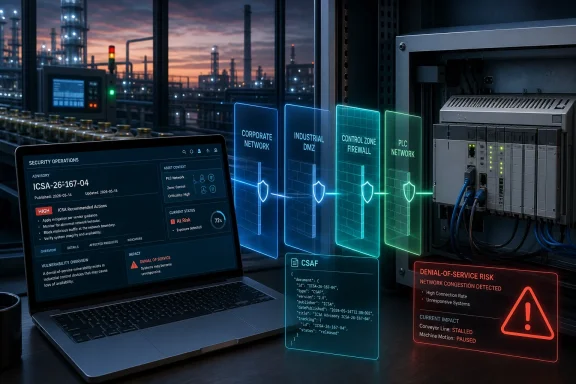 The Factory Floor Gets Its Patch Tuesday Moment
Industrial control advisories used to read like dispatches from a parallel universe: specialized devices, proprietary software, cautious language, and mitigation advice that assumed a plant network was physically and culturally distant from IT. That wall has been eroding for years. CompactLogix systems sit in plants, machines, skids, packaging lines, and production cells where Ethernet/IP, engineering workstations, remote support tools, Windows laptops, and corporate risk registers increasingly collide.The CISA advisory frames the immediate risk plainly. Successful exploitation could cause denial of service, not code execution, ransomware deployment, or direct process manipulation. In a consumer software story, that distinction might lower the temperature. In industrial automation, a denial-of-service condition can still mean an interrupted batch, a tripped process, a machine that needs hands-on recovery, or a maintenance window that arrives at the worst possible time.
Rockwell’s CompactLogix 5370 family is not obscure kit. The L1, L2, and L3 lines have been widely deployed as small and midrange controllers in the Allen-Bradley ecosystem, the sort of hardware that becomes invisible precisely because it works, ages in place, and accrues business logic that nobody wants to rewrite. That installed-base reality is why a CVSS 7.5 advisory matters even without public exploitation.
The June 16 notice also matters because it arrived as a CSAF-style advisory. That detail sounds bureaucratic, but it is a signal: industrial vendors, national cyber agencies, and asset owners are trying to make OT vulnerability data machine-readable enough to flow into the same vulnerability operations pipelines that already track servers, browsers, VPNs, and endpoint agents. The factory floor is not becoming “just IT,” but it is becoming impossible to defend without IT-grade inventory and change control.
A Denial-of-Service Bug Is Not a Minor Bug When the Device Runs the Process
The phrase denial of service undersells industrial consequences. In web infrastructure, a DoS may mean degraded availability, a failed API call, or a service restart. In a programmable logic controller, availability is tied to equipment state, production timing, operator procedures, and safety-adjacent assumptions that may have been validated years ago.CISA’s summary says exploitation could allow an attacker to cause a denial-of-service condition. The advisory names two weakness classes: improper validation of an integrity check value and exposure of sensitive system information to an unauthorized control sphere. Those are not colorful bug descriptions, but they point to a familiar pattern in industrial security: devices built for deterministic control and trusted networks are being asked to survive hostile traffic and modern reconnaissance.
That does not mean every affected controller is one packet away from catastrophe. CISA also says there is no known public exploitation specifically targeting these vulnerabilities at the time of the advisory. That caveat is important, and administrators should resist turning every ICS advisory into a panic drill. But “not known to be exploited” is not the same as “safe,” especially for devices that may remain in service for a decade or longer.
The stronger reading is operational: this is a maintenance and exposure-management problem before it is an incident-response problem. The organization that knows where its CompactLogix 5370 controllers are, what firmware they run, who can reach them, and how production would tolerate a firmware update is in a very different risk position from the organization that has to discover all of that after an advisory lands.
The Vulnerability Is Technical, but the Failure Mode Is Organizational
The most useful sentence in almost every CISA ICS advisory is also the least glamorous: minimize network exposure for all control system devices and ensure they are not accessible from the internet. That advice has become so familiar that it risks sounding like boilerplate. It is not boilerplate when the affected asset is a controller that may be reachable from engineering stations, HMIs, jump boxes, vendor VPNs, poorly segmented plant networks, or temporary remote-access exceptions that never got removed.The real question for plant operators is not whether they can recite the best practice. It is whether the network topology, firewall rules, asset inventory, and vendor access procedures match the diagram everybody believes is current. In many factories, the most dangerous exposure is not a PLC directly indexed from the public internet. It is the chain of “temporary” connectivity that links a corporate account, a remote-support tool, a Windows workstation, and an engineering network segment.
Rockwell and CISA both push users toward defense-in-depth. That is the right answer, but it is also the answer that exposes how much industrial cybersecurity depends on governance. Segmentation only works if someone owns the firewall policy. VPNs only help if the endpoints are patched, identities are managed, and access is time-bound. Firmware updates only reduce risk if teams have tested the update against ladder logic, communications modules, HMIs, drives, safety assumptions, and vendor support constraints.
This is where the WindowsForum audience should feel the overlap. The plant-floor story is full of PLCs, but the attack paths often start with ordinary IT failures: reused credentials, stale VPN appliances, flat networks, unsupported Windows engineering laptops, weak remote desktop controls, and missing logs. OT security is specialized, but it is not separate from the habits of enterprise IT.
CompactLogix 5370 Is Exactly the Kind of System That Ages Into Risk
The affected product family matters. CompactLogix 5370 controllers occupy a practical middle ground in Rockwell’s portfolio: more capable than micro controllers, smaller and cheaper than large ControlLogix systems, and deeply integrated into the Studio 5000/Logix ecosystem. That makes them attractive for OEM equipment, plant expansions, standalone machines, and distributed control tasks.It also makes them sticky. Once a controller is installed, commissioned, validated, and tied into HMI screens, recipes, alarms, historian tags, and maintenance procedures, replacement becomes a business project rather than a purchasing decision. A controller can be technically superseded long before it is economically replaceable. That gap is where advisories accumulate.
The advisory names CompactLogix 5370 L1, L2, and L3 controllers rather than a broad abstract software component. That specificity helps asset owners narrow the blast radius, but it also creates practical work. Many plants do not have a clean, queryable inventory of controller families and firmware versions. They have spreadsheets, electrical drawings, engineering laptops, OEM manuals, tribal knowledge, and asset labels that may or may not match what is actually running.
This is why modern OT security conversations keep returning to inventory. You cannot patch what you cannot identify. You cannot segment what you cannot locate. You cannot assess exploitability if you do not know whether the controller is reachable from a vendor VPN, a Windows HMI, a maintenance subnet, or a corporate network path that nobody has reviewed since the last plant expansion.
CSAF Turns Advisories Into Inputs, Not Reading Material
The “View CSAF” marker in the CISA material is more than a publishing format. CSAF, the Common Security Advisory Framework, is part of a larger shift toward structured vulnerability data that tools can ingest automatically. For ordinary admins, that sounds like a convenience feature. For industrial environments, it could be the difference between reading advisories manually and correlating them against real asset inventories at scale.The promise is obvious. If vendor advisories are published in a consistent machine-readable format, an organization can map affected products and versions against its own inventory, flag relevant assets, route work orders, and track exceptions. That is the same basic dream behind enterprise vulnerability management, adapted to controllers and control systems that cannot be rebooted on a whim.
The problem is that structured advisories are only as useful as the receiving end. A CSAF file cannot tell you whether a packaging line has a maintenance window next weekend, whether the OEM will bless a firmware update, whether a controller’s program has been backed up, or whether the process engineer who understands the cell is on vacation. Metadata accelerates triage, but it does not eliminate operational judgment.
Still, this is progress. The older model of industrial advisories assumed a human would read, interpret, forward, and remember. The newer model assumes advisories should become data. That matters because OT defenders are drowning in the same asymmetry as everyone else: more vulnerabilities, more vendors, more remote connectivity, more compliance pressure, and not enough engineers who understand both packets and process.
CISA’s Mitigations Are Familiar Because the Basics Still Fail
CISA’s recommended practices are the standard canon of ICS defense: reduce exposure, isolate control networks, place remote devices behind firewalls, use secure remote access such as updated VPNs, perform impact analysis, and report suspected malicious activity through established channels. The advice is not novel. The persistence of the advice is the story.If a controller cannot be reached by an attacker, a remotely triggerable denial-of-service bug becomes much harder to exploit. If engineering workstations are controlled, monitored, and separated from business networks, the path to the controller narrows. If vendor access is brokered through time-limited, logged, patched systems rather than permanent tunnels, the organization gains leverage. None of that requires exotic zero-trust theater; it requires disciplined network hygiene.
But discipline is hard in plants. Production teams are measured by uptime, quality, and throughput. Cybersecurity teams are measured by risk reduction and incident prevention. Vendors are measured by supportability. Corporate IT is measured by standardization. Those incentives do not naturally align around taking a PLC offline to apply firmware unless leadership has already decided that cyber maintenance is part of operational reliability.
The advisory’s warning about VPNs is also worth lingering on. VPNs are often presented as the secure answer to remote access, but CISA correctly notes that VPNs may have vulnerabilities and are only as secure as the connected devices. In 2026, that reads less like a footnote and more like scar tissue from years of perimeter-device exploitation. A VPN that connects an unmanaged contractor laptop into an engineering network is not a security control so much as a formalized path of risk.
No Known Exploitation Is a Window, Not a Reprieve
CISA says no known public exploitation specifically targeting these vulnerabilities has been reported. That sentence should lower panic but raise urgency. The best time to handle an industrial vulnerability is before it appears in exploitation playbooks, before proof-of-concept code circulates, and before an incident forces emergency work on a running process.There is a predictable cycle in OT security. A vendor advisory appears. Asset owners ask whether they are affected. Someone discovers the inventory is incomplete. Operations asks whether patching can wait. Security asks whether segmentation compensates. The issue is added to a risk register. Months later, a scanner, audit, insurer, or incident drags it back into view.
That cycle is not always negligence. Industrial patching is genuinely harder than desktop patching. Firmware updates can introduce compatibility risk, require controller mode changes, or force scheduled downtime. Even verifying versions may require coordination with controls engineers and careful connection to live systems. But complexity is not an excuse for indefinite deferral.
The more mature response is to treat the advisory as a trigger for exposure review first and patch planning second. If the affected CompactLogix controllers are not reachable from untrusted networks and remote access is tightly controlled, the immediate risk may be manageable while teams validate updates or compensating controls. If the controllers sit on a flat plant network reachable from compromised workstations, the risk calculus changes.
Windows Machines Remain the Soft Underbelly of Many PLC Incidents
A Rockwell controller advisory might sound far from Windows, but the Windows layer is often where the practical defense begins. Engineering workstations, operator terminals, historian servers, domain controllers, jump hosts, backup servers, and remote-support endpoints are commonly Windows systems. They are the machines from which PLCs are configured, monitored, backed up, and sometimes accidentally exposed.That makes Windows hardening part of PLC protection. Local admin sprawl, stale service accounts, weak remote desktop practices, missing endpoint detection, and unpatched engineering laptops can turn an otherwise segmented control network into a reachable target. The attacker does not need a PLC on the public internet if a compromised Windows box can talk to it.
This is not an argument for blindly installing every enterprise security agent on every plant-floor system. OT environments have compatibility and latency concerns that deserve respect. But the old habit of exempting engineering workstations from modern security because “the plant is different” has aged badly. The plant is different; that is why exceptions need documentation, compensating controls, and review dates rather than folklore.
Backups are another Windows-adjacent concern. For a denial-of-service scenario, recovery may depend on known-good controller programs, firmware files, project archives, network configuration, and documentation. If those live on a single engineer’s laptop or an unprotected file share, the organization has converted a recoverable controller event into a scavenger hunt.
The CVSS Score Is a Starting Point, Not a Business Decision
The advisory lists a CVSS v3 score of 7.5, which places the issue in high-severity territory. That score is useful for triage, but it cannot decide what a plant should do. CVSS measures technical severity under generalized assumptions. It does not know whether the affected controller runs a noncritical test rig, a high-throughput production cell, a safety-adjacent process, or a line with no practical downtime for the next quarter.This is especially true in OT, where availability is not merely a security property. Availability is production, contractual obligation, worker routine, and sometimes physical stability. A vulnerability that only causes denial of service may be more important to a manufacturer than a higher-scored confidentiality issue in a less critical system. The score starts the conversation; the process context finishes it.
Administrators should also avoid the opposite mistake: dismissing the issue because it is “only” DoS or because CISA has not reported exploitation. Attackers do not need elegant payloads when disruption is the goal. In industrial environments, a forced restart, nonresponsive controller, or repeated fault condition can create enough operational friction to matter.
The right severity model blends CVSS, reachability, process criticality, recoverability, and maintenance feasibility. A controller behind strict segmentation with a tested recovery plan is one risk. The same controller reachable from a shared engineering VLAN with weak access controls is another. The advisory is common; the risk is local.
The Hardest Patch Is the One Nobody Owns
The advisory credits Tyler Lentz of Idaho National Laboratory for reporting the vulnerabilities to CISA. That detail underscores a healthier disclosure pipeline: researchers find issues, vendors publish advisories, CISA republishes and amplifies, and asset owners are expected to act. The weak link is often not discovery. It is ownership after disclosure.Who owns a CompactLogix vulnerability inside a manufacturer? Controls engineering may own the logic. Maintenance may own the machine. IT may own the network. Security may own the risk register. Procurement may own the vendor relationship. Operations may own downtime approval. If the answer is “all of them,” the practical answer may be “none of them” until a leader forces coordination.
That coordination needs to be established before advisories arrive. An organization should know who can identify affected controllers, who can validate Rockwell firmware guidance, who can test updates, who can approve downtime, who can change firewall rules, and who can document accepted risk. Without that map, every advisory becomes a meeting.
Rockwell’s advisory ecosystem, CISA’s ICS portal, and CSAF data can all improve visibility. They cannot create internal accountability. The companies that handle this well tend to treat OT cyber maintenance as reliability work rather than as an external compliance demand. That framing matters because controls engineers already understand reliability. They may resist abstract cyber urgency, but they understand the cost of unplanned downtime.
Segmentation Is the Control That Buys Time
For many sites, immediate firmware updates may not be realistic. That is not ideal, but it is reality. In those cases, segmentation becomes the control that buys time without pretending to solve the underlying vulnerability.Good segmentation is more than putting a firewall somewhere between corporate IT and the plant. It means defining which systems can initiate traffic to controllers, which protocols are allowed, which remote users can reach engineering assets, and which logs would show suspicious access. It also means resisting the gradual erosion that happens when every maintenance exception becomes permanent.
The most useful first move is often reachability testing from the attacker’s likely path. Can a standard corporate workstation reach the controller network? Can a VPN user reach engineering stations? Can an HMI network talk laterally to unrelated production cells? Can a compromised historian server become a bridge? These are uncomfortable questions because the answers frequently contradict architecture diagrams.
Once exposure is reduced, patch planning becomes less frantic. Teams can review Rockwell’s corrected versions or mitigations, test in a lab if available, coordinate with OEMs, back up controller projects, and schedule downtime. That is the rhythm OT security needs: reduce exploitability now, remediate deliberately, and document the remaining risk.
The Lesson for IT Pros Is That OT Advisories Are No Longer Someone Else’s Queue
Windows administrators may be tempted to file this under “plant stuff.” That would be a mistake. The boundary between IT and OT is now one of the most contested seams in enterprise security, and attackers have repeatedly shown that identity systems, remote access, endpoint compromise, and network misconfiguration can become bridges into operational environments.This does not mean IT should barge into the plant with a generic patch policy. It means IT’s mature practices need translation. Asset inventory, least privilege, logging, backup discipline, change control, vulnerability intake, and incident escalation all apply. They just need to be adapted to equipment where downtime has physical and financial consequences.
The advisory also highlights a cultural inversion. In enterprise IT, unsupported or hard-to-patch systems are often treated as exceptions to be eliminated. In OT, long-lived systems are normal, and the security program has to operate around that fact. Success looks less like perfect patch velocity and more like defensible risk management: known assets, reduced exposure, tested recovery, and clear accountability.
For WindowsForum’s audience, the practical opportunity is to become useful translators. IT pros who understand both Microsoft-centric enterprise controls and the realities of industrial operations can help close the gap. They can ask better questions, build safer remote access, improve logging without breaking processes, and bring vulnerability data into workflows that operations can actually use.
Rockwell’s Advisory Is a Small Warning About a Larger Maintenance Debt
The CompactLogix 5370 advisory is not a five-alarm cyber event on its face. There is no known public exploitation reported by CISA, the stated impact is denial of service, and the recommended mitigations are familiar. That is precisely why it is a useful test of maturity. If an organization cannot respond calmly and concretely to this kind of advisory, it will struggle when the next one is actively exploited.The larger maintenance debt is not unique to Rockwell. Industrial environments are full of durable systems connected in ways their original designers did not fully anticipate. Remote access expanded. Corporate networks converged. Visibility tools improved. Attackers learned the vocabulary of industrial systems. Meanwhile, many plants kept running on the reasonable assumption that uptime today mattered more than hypothetical risk tomorrow.
That assumption is getting harder to defend. The best security programs do not treat every advisory as a crisis, but they also do not let “no known exploitation” become a sedative. They use the window to clean up exposure, verify inventory, test recovery, and plan updates before the risk becomes urgent.
The uncomfortable truth is that OT security is becoming less about heroic incident response and more about routine maintenance. That may be less dramatic, but it is also more achievable. A controller that is inventoried, segmented, backed up, monitored, and owned is not invulnerable. It is simply much less likely to become the weak link that turns an advisory into a production outage.
The CompactLogix Checklist Belongs in the Maintenance Meeting
The immediate lesson from ICSA-26-167-04 is not to panic over every CompactLogix 5370 deployment. It is to turn the advisory into a short, concrete maintenance conversation that includes controls engineering, security, IT, and operations. The best response is boring on purpose.- Organizations should identify whether CompactLogix 5370 L1, L2, or L3 controllers are present in production, lab, packaged equipment, or vendor-managed environments.
- Teams should verify firmware and exposure before deciding whether the vulnerability is an urgent operational risk or a scheduled remediation item.
- Control networks should not allow broad reachability from corporate workstations, unmanaged remote-access endpoints, or unrelated plant segments.
- Remote access should be patched, logged, time-bound, and limited to the systems required for the maintenance task.
- Controller projects, firmware files, and recovery procedures should be backed up and tested before any update or mitigation work begins.
- “No known public exploitation” should be treated as a planning window, not as a reason to ignore the advisory.
References
- Primary source: CISA
Published: 2026-06-16T12:00:00+00:00
Rockwell Automation CompactLogix | CISA
www.cisa.gov
- Related coverage: rockwellautomation.com
SD1770 | Security Advisory | Rockwell Automation
CompactLogix® 5370 Denial of Service Vulnerabilitywww.rockwellautomation.com - Related coverage: cyber.gc.ca
[Control systems] Rockwell Automation security advisory - Canadian Centre for Cyber Security
[Control systems] Rockwell Automation security advisorywww.cyber.gc.ca - Related coverage: rockwellautomation.com.cn
Security Advisories | Rockwell Automation
 www.rockwellautomation.com.cn
- Related coverage: icscybersecurityconference.com
Rockwell Patches Vulnerability Impacting Safety Controllers From Several Vendors - Industrial Control Systems (ICS) Cybersecurity Conference
Rockwell Automation has released patches for its products to address a serious denial-of-service (DoS) vulnerability affecting safety controllers from several major vendors.www.icscybersecurityconference.com - Related coverage: itsecuritynews.info
Rockwell Automation CompactLogix 5370 - IT Security News
View CSAF Summary Successful exploitation of this vulnerability could allow an attacker to cause a denial-of-service condition. The following versions of Rockwell Automation CompactLogix 5370 are affected: CompactLogix 5370 (CVE-2025-11743) CompactLogix 5370 (CVE-2025-11743) CompactLogix 5370... www.itsecuritynews.info
