

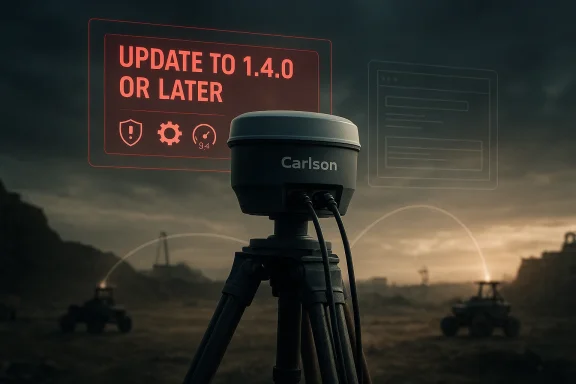
Critical infrastructure operators are being urged to patch Carlson Software’s VASCO-B GNSS Receiver after CISA published a new ICS advisory describing a high-severity authentication flaw that could let a remote attacker change device configuration or interfere with operation. The advisory says versions earlier than 1.4.0 are affected, and the vendor’s remediation is straightforward: update to Version 1.4.0 or later. Because the issue maps to CWE-306 Missing Authentication for Critical Function and carries a CVSS 3.1 score of 9.4, this is not a theoretical lab bug; it is the kind of weakness that can be turned into real-world disruption if exposed on a reachable network.
What makes the warning especially important is the device’s role in machine control and GNSS base-station workflows. Carlson positions the VASCO-B as a high-precision GNSS base for office, harsh-environment, and networked deployments, including remote web interface management and broadcasting RTK corrections over multiple links. That combination of remote configurability and critical positioning data means a missing authentication control can have consequences beyond one device, potentially affecting downstream survey accuracy, machine guidance, and operational continuity.
The VASCO-B sits in a category of equipment that modern infrastructure teams often forget is part of the cyber perimeter. GNSS receivers are not just passive location boxes; in industrial and survey environments, they can be the control point for correction streams, base coordinates, and mission-critical positioning services. Carlson’s product materials describe the VASCO-B as a flexible GNSS base station designed for office or harsh-environment installation, with remote web interface support and multiple correction broadcast options, which immediately raises the stakes for any web-accessible flaw.
CISA’s advisory framework matters because it signals a vulnerability with industrial consequences, not just IT consequences. The agency says the issue can allow an attacker with network access to directly access and modify configuration and operational functions without credentials. In other words, the attack surface is not some obscure local interface; it is a functionally privileged path into the device’s behavior.
The affected version range is narrow but meaningful: VASCO-B GNSS Receiver < 1.4.0. That kind of cutoff often indicates the vendor has already shipped a fix, which is good news for organizations that can move quickly. But in operational technology, the real challenge is not whether a patch exists. The challenge is whether operators can safely deploy it without interrupting services that may be tied to grading, mining, construction, or other time-sensitive field operations.
CISA also notes that no known public exploitation has been reported at the time of publication. That should not be read as a reason to delay. “No known public exploitation” is a temporary status, not a control strategy. For internet-reachable or partner-reachable industrial devices, a serious authentication weakness can become a commodity target quickly once it enters advisories and scanning ecosystems.
The bigger historical context is familiar: GNSS and machine-control vendors have steadily added web UIs, remote management, and networked correction features to make deployments easier. Those conveniences are valuable, but they also blur the line between embedded device and internet-facing appliance. When a product can be configured remotely, the authentication layer becomes the gatekeeper for the entire trust model.
The advisory ties the problem to CWE-306, which is one of the most straightforward but dangerous classes of embedded-device mistakes. If a function that should require identity proof does not, then every network path to that function becomes a potential control channel. For a GNSS receiver, that can translate into altered settings, corrupted operational modes, or degraded positioning output.
A few practical implications stand out:
Carlson’s own product messaging underscores the sensitivity here. The VASCO-B is designed for base station use, can broadcast RTK corrections, and includes remote setup and troubleshooting capabilities. Those features are operationally useful, but they also mean the device is not a dumb appliance; it is a live control endpoint.
Some of the realistic outcomes include:
This is where the advisory lands hard. A receiver intended to be configured over a network should never assume that network access is equivalent to authorization. If it does, the product is effectively relying on obscurity and segmentation alone.
That said, patching industrial devices is never just “click update.” Operators need to consider maintenance windows, upstream dependencies, remote site access, and the possibility that one receiver supports multiple connected workflows. In practice, the patch path may require coordination among field operations, IT, and OT teams.
If the receiver is part of a broader Carlson ecosystem, the upgrade should also be evaluated in light of adjacent software and workflows. Compatibility testing matters, especially where survey controllers or machine-control stacks rely on specific device behavior.
Practical steps include:
Organizations should also validate who can reach the receiver’s management interfaces and from where. Many industrial compromises happen not because a device was wildly exposed, but because an internal segment was assumed to be safe forever.
A useful internal checklist might include:
At the enterprise level, the exposure can affect service guarantees, contract performance, and liability. If a receiver is tied to project delivery, then downtime or misconfiguration can ripple into missed deadlines, rework, and customer dissatisfaction. The cyber issue becomes a business issue very quickly.
The strongest programs usually do the following:
This is one reason security communication has to be operationally translated. Instead of saying only that a product is vulnerable, defenders should explain that unauthorized changes can affect positioning integrity, not just device settings. That framing helps crews understand why the patch and the access controls are worth the inconvenience.
Carlson is not alone in facing this pressure. The sector has seen repeated advisories across GPS, GNSS, and telematics devices because remote interfaces are now standard. As these systems become more connected, vendors that invest in secure-by-design defaults will have an advantage with enterprise buyers and public-sector customers.
That shift changes procurement behavior in a few ways:
For industry as a whole, the lesson is simple: remote convenience must be balanced by real identity controls. The systems are too operationally important to accept default trust.
Manufacturers also tend to have layered vendor ecosystems, which complicates security. A GNSS receiver may be managed by one contractor, used by another, and integrated into a third-party platform. That creates shared responsibility, and shared responsibility often becomes shared ambiguity during an incident.
A few downstream effects to watch for:
That is why defenders should treat GNSS devices like they treat PLC-adjacent systems and remote management gateways. The assets may differ, but the operational impact model is similar: unauthorized change equals operational risk.
The opportunity now is to use the incident as a catalyst for stronger device governance, better segmentation, and more disciplined lifecycle management across GNSS deployments.
The risk is amplified by the fact that the flaw affects critical functions, not just a secondary interface. If an attacker gains control of configuration or operational behavior, the device may continue functioning while doing the wrong thing.
We should also expect this advisory to influence future procurement language and vendor scrutiny. Once customers see that a missing-authentication bug can create a critical exposure in a GNSS base receiver, security requirements will become less optional and more contractual.
Carlson’s vulnerability may be specific to one product line, but the industry message is universal: if a device can shape critical operations, then its control plane must be treated like critical infrastructure. That principle will matter even more as field systems become more connected, more remote, and more dependent on trust that can no longer be assumed.
Source: CISA Carlson Software VASCO-B GNSS Receiver | CISA
What makes the warning especially important is the device’s role in machine control and GNSS base-station workflows. Carlson positions the VASCO-B as a high-precision GNSS base for office, harsh-environment, and networked deployments, including remote web interface management and broadcasting RTK corrections over multiple links. That combination of remote configurability and critical positioning data means a missing authentication control can have consequences beyond one device, potentially affecting downstream survey accuracy, machine guidance, and operational continuity.
 Background
The VASCO-B sits in a category of equipment that modern infrastructure teams often forget is part of the cyber perimeter. GNSS receivers are not just passive location boxes; in industrial and survey environments, they can be the control point for correction streams, base coordinates, and mission-critical positioning services. Carlson’s product materials describe the VASCO-B as a flexible GNSS base station designed for office or harsh-environment installation, with remote web interface support and multiple correction broadcast options, which immediately raises the stakes for any web-accessible flaw.CISA’s advisory framework matters because it signals a vulnerability with industrial consequences, not just IT consequences. The agency says the issue can allow an attacker with network access to directly access and modify configuration and operational functions without credentials. In other words, the attack surface is not some obscure local interface; it is a functionally privileged path into the device’s behavior.
The affected version range is narrow but meaningful: VASCO-B GNSS Receiver < 1.4.0. That kind of cutoff often indicates the vendor has already shipped a fix, which is good news for organizations that can move quickly. But in operational technology, the real challenge is not whether a patch exists. The challenge is whether operators can safely deploy it without interrupting services that may be tied to grading, mining, construction, or other time-sensitive field operations.
CISA also notes that no known public exploitation has been reported at the time of publication. That should not be read as a reason to delay. “No known public exploitation” is a temporary status, not a control strategy. For internet-reachable or partner-reachable industrial devices, a serious authentication weakness can become a commodity target quickly once it enters advisories and scanning ecosystems.
The bigger historical context is familiar: GNSS and machine-control vendors have steadily added web UIs, remote management, and networked correction features to make deployments easier. Those conveniences are valuable, but they also blur the line between embedded device and internet-facing appliance. When a product can be configured remotely, the authentication layer becomes the gatekeeper for the entire trust model.
What CISA Says the Bug Does
CISA’s assessment is blunt: the lack of authentication on a critical function could let a remote attacker alter configuration and operational behavior. That means the flaw is not merely informational; it is an integrity and availability issue with potential safety and productivity effects.The advisory ties the problem to CWE-306, which is one of the most straightforward but dangerous classes of embedded-device mistakes. If a function that should require identity proof does not, then every network path to that function becomes a potential control channel. For a GNSS receiver, that can translate into altered settings, corrupted operational modes, or degraded positioning output.
Why the CVSS 9.4 Matters
The score is 9.4 Critical, and the vector is especially alarming because it requires no privileges and no user interaction. The attack complexity is low, and the impact on integrity and availability is high. Even though confidentiality is listed as low, that does not reduce concern; in industrial systems, changing the behavior of the device can be worse than stealing data.A few practical implications stand out:
- Remote reachability is the main danger signal.
- No credentials needed means weak perimeter assumptions fail fast.
- High integrity impact suggests configuration tampering.
- High availability impact means service disruption is plausible.
- Critical infrastructure context raises the operational stakes.
Operational Consequences
In a GNSS ecosystem, configuration changes can cascade. A misconfigured base receiver can alter corrections, destabilize downstream rover behavior, or create false confidence in positioning. That is why an authentication flaw on the base side deserves the same urgency as a bug in a controller or gateway.Why GNSS Receivers Are High-Value Targets
GNSS receivers are increasingly important in construction, surveying, mining, and machine control. They are often assumed to be niche or isolated, but many are actually networked, remotely managed, and integrated into broader operational workflows. That makes them attractive targets because disrupting timing or positioning can affect productivity without necessarily triggering obvious alarms.Carlson’s own product messaging underscores the sensitivity here. The VASCO-B is designed for base station use, can broadcast RTK corrections, and includes remote setup and troubleshooting capabilities. Those features are operationally useful, but they also mean the device is not a dumb appliance; it is a live control endpoint.
Machine Control and Survey Workflows
In machine control, accurate GNSS data helps equipment know where it is and where it should be. In surveying, GNSS corrections influence whether a point is valid, repeatable, and trustworthy. If an attacker can alter configuration or operational functions, the effect may be subtle at first and expensive later.Some of the realistic outcomes include:
- Wrong correction parameters being applied.
- Unauthorized changes to broadcast settings.
- Interrupted base-station service during active work.
- Degraded rover accuracy in the field.
- Confusion during troubleshooting because the device appears “up” but behaves incorrectly.
The Remote Interface Problem
Vendors have spent years making embedded devices easier to manage remotely, and the VASCO-B is no exception. Remote web interfaces reduce travel, simplify deployment, and support faster response when field teams need help. But each new convenience point expands the attack surface if access control is not implemented rigorously.This is where the advisory lands hard. A receiver intended to be configured over a network should never assume that network access is equivalent to authorization. If it does, the product is effectively relying on obscurity and segmentation alone.
The Vendor’s Fix and What It Means
The vendor’s remediation is clean: update to Version 1.4.0 or greater. That is the best possible outcome from a defensive standpoint because it suggests a direct software remedy rather than a workaround maze of toggles and partial mitigations. When a patch is available, the strategic question becomes deployment sequencing, not theoretical containment.That said, patching industrial devices is never just “click update.” Operators need to consider maintenance windows, upstream dependencies, remote site access, and the possibility that one receiver supports multiple connected workflows. In practice, the patch path may require coordination among field operations, IT, and OT teams.
What a Good Patch Plan Looks Like
A disciplined rollout should include a few basics:- Inventory every VASCO-B deployment.
- Confirm which units are below 1.4.0.
- Schedule upgrade windows around active operations.
- Validate post-update function, especially correction broadcasting.
- Document rollback options in case a site-specific issue appears.
Why Version Floors Matter
Version-floor advisories are useful because they give teams a crisp threshold for action. There is no ambiguity about which releases are affected, and no need to infer whether a firmware branch is safe. Still, organizations should remember that “up to date” is not the same as “secure forever.” Today’s fixed bug can be tomorrow’s entry point if a new issue is discovered or a misconfiguration reopens the path.If the receiver is part of a broader Carlson ecosystem, the upgrade should also be evaluated in light of adjacent software and workflows. Compatibility testing matters, especially where survey controllers or machine-control stacks rely on specific device behavior.
Recommended Defenses Beyond the Patch
CISA’s mitigation guidance goes beyond the vendor fix, and that is appropriate. Industrial defenders should assume that not every site can patch immediately, and not every device can be placed behind the same controls. The agency recommends minimizing network exposure, isolating control systems, and using VPNs only with an understanding that VPNs themselves require maintenance and are not a magic shield.Network Segmentation Still Matters
The most effective control in these cases is often boring: keep the device off the public internet and away from general business networks. That means treating GNSS receivers like critical infrastructure assets rather than ordinary peripherals.Practical steps include:
- Segmenting OT and IT networks.
- Limiting remote access paths to only what is necessary.
- Using firewall rules to reduce unsolicited access.
- Removing direct internet exposure wherever possible.
- Reviewing vendor and partner access paths.
Remote Access Needs Extra Scrutiny
If remote access is required, it should be tightly controlled, logged, and periodically reviewed. A VPN can help, but only if it is hardened, patched, and paired with strong endpoint trust. A VPN is not a substitute for device authentication; it is only one layer in a broader chain.Organizations should also validate who can reach the receiver’s management interfaces and from where. Many industrial compromises happen not because a device was wildly exposed, but because an internal segment was assumed to be safe forever.
Monitoring and Incident Readiness
Security teams should be prepared to spot unusual receiver behavior, especially configuration changes outside normal change windows. That includes unusual reboots, altered correction settings, unexpected web activity, and unexplained loss of service.A useful internal checklist might include:
- Confirming device ownership and administrative contacts.
- Logging all configuration changes.
- Reviewing network paths to management interfaces.
- Setting alerts for unusual operational drift.
- Keeping incident procedures specific to OT assets.
Enterprise Impact Versus Field Impact
For enterprise owners, the vulnerability is primarily a risk management and continuity problem. For field crews, it is a work stoppage and data integrity problem. Those two perspectives often collide in OT environments, and this advisory highlights why they need a shared response plan.At the enterprise level, the exposure can affect service guarantees, contract performance, and liability. If a receiver is tied to project delivery, then downtime or misconfiguration can ripple into missed deadlines, rework, and customer dissatisfaction. The cyber issue becomes a business issue very quickly.
Internal IT and OT Coordination
The best responses tend to come from teams that coordinate before an incident. IT knows segmentation, identity, and logging; OT knows operational tolerances, uptime constraints, and field dependencies. Neither side can solve this alone.The strongest programs usually do the following:
- Assign a clear owner for each asset.
- Track firmware versions centrally.
- Align patch windows with work schedules.
- Test upgrades in a controlled environment first.
- Maintain a fallback plan for remote sites.
Field Reliability and Trust
Field teams care less about CVSS scores than about whether the base station stays up and the corrections remain trustworthy. That is rational. If a receiver is altered silently, the team may keep working while collecting compromised data.This is one reason security communication has to be operationally translated. Instead of saying only that a product is vulnerable, defenders should explain that unauthorized changes can affect positioning integrity, not just device settings. That framing helps crews understand why the patch and the access controls are worth the inconvenience.
Competitive and Industry Implications
This advisory also reflects a broader trend in industrial equipment markets: security maturity is now a differentiator. GNSS vendors compete on accuracy, robustness, and ease of use, but cybersecurity is increasingly part of the product story. Customers now expect that remote management features come with real access control, not just convenience.Carlson is not alone in facing this pressure. The sector has seen repeated advisories across GPS, GNSS, and telematics devices because remote interfaces are now standard. As these systems become more connected, vendors that invest in secure-by-design defaults will have an advantage with enterprise buyers and public-sector customers.
The Market Is Maturing
The market used to treat firmware authentication as an engineering detail. It no longer can. Buyers increasingly ask whether a device can be segmented, audited, updated, and monitored without disrupting operations.That shift changes procurement behavior in a few ways:
- Security questionnaires get longer.
- Patch support becomes a purchase criterion.
- Remote management is scrutinized more heavily.
- Customers ask for clearer lifecycle documentation.
- Exposure history affects vendor trust.
Why Rivals Should Pay Attention
Competitors should view this as a cautionary example rather than a one-off. Once a device line is known for a missing-authentication flaw, buyers may start asking hard questions about adjacent models and management interfaces. That can influence sales cycles in markets where trust and uptime are paramount.For industry as a whole, the lesson is simple: remote convenience must be balanced by real identity controls. The systems are too operationally important to accept default trust.
What This Means for Critical Manufacturing
CISA lists the affected sector as Critical Manufacturing, and that context matters because manufacturing environments increasingly rely on precise positioning and machine guidance. The receiver may not sit on the assembly line, but it can still influence the tools and vehicles that support production. When location integrity is compromised, manufacturing efficiency can degrade in ways that are hard to attribute immediately.Manufacturers also tend to have layered vendor ecosystems, which complicates security. A GNSS receiver may be managed by one contractor, used by another, and integrated into a third-party platform. That creates shared responsibility, and shared responsibility often becomes shared ambiguity during an incident.
Downstream Effects
If a base station is altered, the consequence may not be instant failure. Instead, the result can be subtle drift, reduced confidence in measurements, or intermittent anomalies that disrupt scheduling. In production, those delays can cascade into shipping, materials handling, or site logistics.A few downstream effects to watch for:
- Incorrect positioning on mobile machines.
- Reduced confidence in site measurements.
- Unplanned downtime while teams verify data.
- Contract delays caused by rework.
- Increased troubleshooting burden across vendors.
Security as a Production Control
In modern manufacturing, security is not a side concern. It is a production control function. If a receiver can be modified remotely without authentication, then security has failed at the point where cyber and physical process meet.That is why defenders should treat GNSS devices like they treat PLC-adjacent systems and remote management gateways. The assets may differ, but the operational impact model is similar: unauthorized change equals operational risk.
Strengths and Opportunities
This advisory also points to some positives. There is a clear remediation path, the issue was publicly disclosed through a formal process, and the vendor appears to have issued a fixed version. Those are all signs that the ecosystem can respond responsibly when vulnerabilities surface.The opportunity now is to use the incident as a catalyst for stronger device governance, better segmentation, and more disciplined lifecycle management across GNSS deployments.
- A fixed version is available, which reduces long-term exposure.
- The advisory is explicit about the affected range, which simplifies triage.
- CISA’s mitigation guidance is practical and immediately actionable.
- The flaw has a clear security category, making it easier to communicate internally.
- Vendor and regulator visibility can help speed internal prioritization.
- Organizations can use the event to improve asset inventories.
- The issue may encourage better remote-access discipline across OT environments.
Risks and Concerns
The downside is that this is exactly the kind of flaw that can linger in the field. Industrial devices often remain deployed for years, and not every site has a fast path to firmware updates. If a vulnerable receiver is reachable from a shared network segment, the exposure can persist long after the advisory is published.The risk is amplified by the fact that the flaw affects critical functions, not just a secondary interface. If an attacker gains control of configuration or operational behavior, the device may continue functioning while doing the wrong thing.
- Internet-exposed management interfaces are especially dangerous.
- Delayed patching leaves a known critical issue in place.
- Weak segmentation can turn an internal issue into a site-wide one.
- Operational trust loss may occur even without confirmed exploitation.
- Silent tampering can be harder to detect than outages.
- Vendor update dependencies may slow response in the field.
- Multi-party environments can create confusion about who is responsible.
Looking Ahead
The immediate next step is simple: organizations using Carlson VASCO-B receivers should identify every affected unit and plan the move to 1.4.0 or later as soon as operationally feasible. After that, the broader task is to reassess how the receivers are exposed, who can reach them, and whether the current architecture assumes too much trust.We should also expect this advisory to influence future procurement language and vendor scrutiny. Once customers see that a missing-authentication bug can create a critical exposure in a GNSS base receiver, security requirements will become less optional and more contractual.
- Inventory all deployed VASCO-B units.
- Confirm firmware versions and exposure paths.
- Patch to 1.4.0 or later.
- Review firewall and VPN architecture.
- Audit remote management accounts and access paths.
- Add logging for configuration changes and unusual activity.
Carlson’s vulnerability may be specific to one product line, but the industry message is universal: if a device can shape critical operations, then its control plane must be treated like critical infrastructure. That principle will matter even more as field systems become more connected, more remote, and more dependent on trust that can no longer be assumed.
Source: CISA Carlson Software VASCO-B GNSS Receiver | CISA
