CISA published an industrial control systems advisory on June 30, 2026, warning that all Delta Electronics DVP12SE PLC versions are affected by two critical Modbus TCP vulnerabilities that can be exploited remotely without authentication. The headline is not merely another pair of high CVSS scores; it is that a small programmable logic controller can still become a command surface when old industrial assumptions meet modern network reachability. For WindowsForum readers who live between IT and operational technology, this is the kind of advisory that turns “segmentation” from a diagram into a safety requirement. Delta says it is working on a fix, but the real mitigation begins before a firmware package arrives.
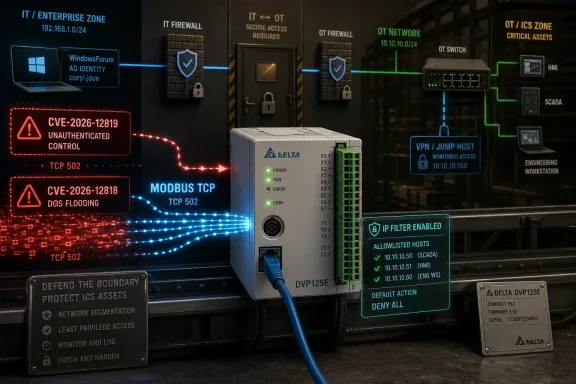
The two flaws now assigned CVE-2026-12819 and CVE-2026-12818 land in the same uncomfortable place: the Modbus TCP service exposed by the DVP12SE. One is a missing-authentication problem for critical functions. The other is a resource-allocation weakness that can be abused by flooding the Modbus port with continuous or malformed traffic.
That combination matters because it collapses two different kinds of risk into one reachable interface. An attacker who can speak to the device over the network may be able to issue unauthorized reads and writes, and may also be able to interfere with availability by exhausting or overwhelming the PLC’s handling of traffic. In operational technology, confidentiality, integrity, and availability are not abstract scorecard categories. They map to production values, relay states, logic behavior, and the physical process the controller is meant to keep boring.
CISA lists the affected product as Delta Electronics DVP12SE PLC, all versions. That phrase should make asset owners pause, because it removes the comforting habit of checking whether “our exact firmware build” is spared. At least for now, the advisory treats the product family as broadly exposed.
Delta’s interim advice is familiar but not trivial: enable the PLC’s IP Filter function, set PLC password protection, isolate the controller in an OT network, place firewalls between it and business systems, and require secure VPN access if remote administration is unavoidable. Those are not novel recommendations. Their importance is that they are currently the control plane while the vendor works on a permanent correction.
CVE-2026-12819 is severe because it reportedly allows unauthenticated interaction with security-sensitive PLC functions. CISA describes unauthorized read and write access to coils, holding registers, operational memory, relay states, and process control functions. That is not a cosmetic configuration leak. It is the difference between observing a process and altering the values that govern it.
For a Windows-heavy IT shop, the temptation is to translate this into server-world language: exposed service, missing authentication, critical score, segment and firewall. That translation is useful, but incomplete. A Windows server behaving badly usually means downtime, data exposure, or lateral movement. A PLC behaving badly may mean equipment stops, actuators change state, or a process drifts outside the envelope its operators expect.
This is why the phrase “without authentication or privilege enforcement” should bother administrators more than the CVSS number itself. CVSS 9.8 tells us the issue is critical. The protocol details tell us why the operational response cannot wait for a normal monthly maintenance window if the device is reachable from untrusted networks.
A PLC that becomes unresponsive at the wrong moment can create cascading problems for operators, HMIs, historians, safety systems, and upstream production planning. Even when a plant has manual fallback procedures, the transition from automated control to manual intervention is itself an operational event. The cost is not just the controller’s reboot time; it is the uncertainty injected into a process that depends on predictable state.
The advisory’s description of raw packets or specially crafted malformed packets also points to a practical defense challenge. This is not the kind of exposure that should be handled by hoping endpoint software catches something suspicious. PLCs are not conventional endpoints, and many are not protected by familiar EDR stacks. The defensive boundary has to move outward to the network.
That is why industrial firewalls, access control lists, and protocol-aware monitoring matter. They are often described as compensating controls, but in cases like this they are the first meaningful controls. If TCP/502 is reachable from general-purpose client networks, engineering laptops, wireless segments, or vendor remote-access jump points without strict filtering, the organization has made exploitation easier than it needed to be.
The DVP12SE is a compact PLC class of device likely to appear in machinery, production cells, building support systems, or OEM-supplied equipment. That creates a visibility problem. The organization may not think of itself as a Delta Electronics shop, but a packaged machine, skid, conveyor, panel, or utility system may contain one of these controllers.
Traditional IT scanning can also be a trap here. Aggressive vulnerability scanning against control devices can cause instability, and many OT teams have learned this the hard way. The right response is deliberate discovery: review engineering documentation, query passive network monitoring where available, consult maintenance teams, and coordinate any active probing with operations staff.
Windows administrators are used to asking, “Is it domain joined?” That question will not help here. Better questions are: does anything in the OT network expose Modbus TCP on port 502; are Delta DVP-series devices present; are HMIs or SCADA nodes communicating with them; and are those conversations limited to known hosts? The advisory turns network flow records into evidence.
The advisory’s central risk is unauthenticated Modbus TCP interaction. If an interface accepts commands from any reachable network source, then password protection elsewhere may reduce some forms of tampering without eliminating the protocol-level exposure. In other words, password protection is a layer, not a cure.
This distinction matters because mixed IT/OT teams often close tickets based on a binary control statement: “Password enabled.” For this advisory, the more meaningful control statement is narrower and more demanding: “Only approved HMI, SCADA, engineering, or gateway hosts can reach the PLC’s Modbus TCP service.” Anything less leaves too much room for a compromised workstation, misrouted subnet, or accidental exposure to become the attacker’s path.
IP filtering on the PLC can help enforce that narrower statement, but it should not be the only place access is controlled. Device-level allowlisting is useful; network-level enforcement is easier to audit, easier to monitor, and usually easier to update during incident response. The best answer is layered: PLC filters, OT firewall policy, routing boundaries, and remote-access controls that do not depend on a single checkbox.
The modern ICS attack path often starts in places that look mundane to IT: phishing, stolen VPN credentials, unmanaged engineering laptops, weak remote desktop paths, or poorly segmented jump hosts. From there, the question becomes what the attacker can touch. A PLC service that trusts every reachable source gives the intruder a shorter walk from foothold to process impact.
This is where WindowsForum’s audience should resist the old divide between enterprise IT and plant-floor engineering. Active Directory hygiene, VPN patching, RDP exposure, endpoint hardening, and credential management all shape the probability that an attacker reaches an OT segment. Once there, protocol-level weaknesses like these shape the blast radius.
The advisory says CISA has not received reports of known public exploitation specifically targeting these vulnerabilities at publication time. That is reassuring only in a limited sense. Absence of known exploitation is not absence of exposure, especially for devices whose security posture depends heavily on network placement and whose exploitation may not generate the same logs defenders expect from Windows servers.
Still, CVSS should guide prioritization, not substitute for local risk assessment. A DVP12SE isolated inside a tightly controlled cell with only a fixed HMI allowed to communicate has a very different exposure profile from one reachable over a shared plant VLAN or a vendor VPN subnet. The vulnerability is the same. The likelihood and potential consequence are not.
That is not an argument for complacency. It is an argument for precision. Security teams should not merely announce that “critical PLC vulnerabilities exist.” They should identify which devices are present, which networks can route to TCP/502, which systems are authorized to communicate, whether the PLC IP Filter is configured, and whether remote access paths bypass the intended segmentation.
The organizations that handle this well will be the ones that can answer those questions quickly. The ones that cannot will discover that the advisory is also an audit of their OT governance.
In IT, “patch it” is often the cleanest answer. In OT, “patch it” may require a maintenance shutdown, regression testing against the machine builder’s application, backup of PLC logic, confirmation with safety and operations teams, and a rollback plan. Even after a fix is released, responsible deployment may take time.
That makes interim mitigations more than a placeholder. Enabling IP filtering and isolating the device are not second-class actions while everyone waits. They are the primary controls that determine whether the vulnerability is reachable during the weeks or months before a permanent fix is deployed.
Administrators should also preserve current PLC logic and configuration backups before making changes. Security hardening that accidentally disrupts HMI communication or engineering access can create its own incident. The goal is not to panic-change the plant network. The goal is to reduce reachability with enough operational discipline that production does not learn about the mitigation from an alarm storm.
Those Windows systems define who can reach the PLC and under what conditions. If an engineering workstation is local administrator soup, runs outdated software, shares credentials with other plant systems, and can reach every controller in the cell, then the PLC’s missing authentication is not an isolated flaw. It is an accelerant.
Practical response should include checking firewall rules on Windows hosts that legitimately communicate with the PLC. It should include reviewing remote access groups, VPN split-tunnel behavior, credential storage, and whether vendors can reach OT assets without a monitored jump path. It should include ensuring that engineering workstations are not browsing email and the web from the same context used to program controllers.
This is where IT can help without pretending to own the process. OT teams understand the machinery. IT teams understand identity, remote access, logging, and network control. The DVP12SE advisory lives exactly at that boundary.
A modern plant can contain newer controllers, newer HMIs, newer switches, and newer remote-access tooling while still preserving the old assumption that anything on the control network is allowed to speak control protocols. That is the assumption attackers love. It turns one compromised endpoint into a process-adjacent position.
The DVP12SE advisory should therefore be read less as an isolated product warning and more as a test case for whether the organization has retired implicit trust from the plant floor. If the answer is no, this vulnerability will not be the last one that matters. It will simply be the latest advisory to expose a design pattern that should already have been dismantled.
Defense-in-depth is an overused phrase because it is often deployed as a slogan. Here, it has concrete meaning. A device-level IP filter reduces casual reachability. A firewall enforces policy independent of the PLC. Segmentation limits lateral movement. VPN controls reduce remote exposure. Monitoring detects unexpected Modbus clients. Backups make recovery possible if logic or parameters are disturbed.
That kind of response is less glamorous than emergency patching, but it is more durable. It also forces organizations to confront exceptions. The vendor support laptop that “temporarily” needs broad access, the maintenance VLAN that grew into a shared services network, and the firewall rule named “PLC any any” are where theoretical risk becomes operational exposure.
There is also a cultural point here. PLC security cannot be handled as an annual compliance pass if the network around the device changes more often than the controller firmware. New remote support tools, new HMIs, plant expansions, contractor access, and business-network integrations can all reopen a path that was once closed.
CISA says no known public exploitation specifically targeting these vulnerabilities has been reported to the agency at the time of the initial advisory. That should shape tone, not urgency. This is not a call to assume compromise everywhere. It is a call to remove easy paths before someone decides to look for them.
 A PLC Advisory That Reads Like a Network Architecture Audit
The two flaws now assigned CVE-2026-12819 and CVE-2026-12818 land in the same uncomfortable place: the Modbus TCP service exposed by the DVP12SE. One is a missing-authentication problem for critical functions. The other is a resource-allocation weakness that can be abused by flooding the Modbus port with continuous or malformed traffic.That combination matters because it collapses two different kinds of risk into one reachable interface. An attacker who can speak to the device over the network may be able to issue unauthorized reads and writes, and may also be able to interfere with availability by exhausting or overwhelming the PLC’s handling of traffic. In operational technology, confidentiality, integrity, and availability are not abstract scorecard categories. They map to production values, relay states, logic behavior, and the physical process the controller is meant to keep boring.
CISA lists the affected product as Delta Electronics DVP12SE PLC, all versions. That phrase should make asset owners pause, because it removes the comforting habit of checking whether “our exact firmware build” is spared. At least for now, the advisory treats the product family as broadly exposed.
Delta’s interim advice is familiar but not trivial: enable the PLC’s IP Filter function, set PLC password protection, isolate the controller in an OT network, place firewalls between it and business systems, and require secure VPN access if remote administration is unavoidable. Those are not novel recommendations. Their importance is that they are currently the control plane while the vendor works on a permanent correction.
Modbus TCP Was Built for Trust, Not Hostile Networks
The DVP12SE case is a reminder that many ICS protocols still carry the design assumptions of closed industrial networks. Modbus TCP is widely used because it is simple, interoperable, and easy to troubleshoot. That same simplicity becomes a liability when the service is reachable by machines that were never meant to be trusted.CVE-2026-12819 is severe because it reportedly allows unauthenticated interaction with security-sensitive PLC functions. CISA describes unauthorized read and write access to coils, holding registers, operational memory, relay states, and process control functions. That is not a cosmetic configuration leak. It is the difference between observing a process and altering the values that govern it.
For a Windows-heavy IT shop, the temptation is to translate this into server-world language: exposed service, missing authentication, critical score, segment and firewall. That translation is useful, but incomplete. A Windows server behaving badly usually means downtime, data exposure, or lateral movement. A PLC behaving badly may mean equipment stops, actuators change state, or a process drifts outside the envelope its operators expect.
This is why the phrase “without authentication or privilege enforcement” should bother administrators more than the CVSS number itself. CVSS 9.8 tells us the issue is critical. The protocol details tell us why the operational response cannot wait for a normal monthly maintenance window if the device is reachable from untrusted networks.
The Denial-of-Service Flaw Is Not the Lesser Story
The second vulnerability, CVE-2026-12818, concerns allocation of resources without limits or throttling in the Modbus TCP service. On paper, denial-of-service risks are sometimes treated as less dramatic than unauthorized command execution or arbitrary writes. In industrial environments, that hierarchy can be misleading.A PLC that becomes unresponsive at the wrong moment can create cascading problems for operators, HMIs, historians, safety systems, and upstream production planning. Even when a plant has manual fallback procedures, the transition from automated control to manual intervention is itself an operational event. The cost is not just the controller’s reboot time; it is the uncertainty injected into a process that depends on predictable state.
The advisory’s description of raw packets or specially crafted malformed packets also points to a practical defense challenge. This is not the kind of exposure that should be handled by hoping endpoint software catches something suspicious. PLCs are not conventional endpoints, and many are not protected by familiar EDR stacks. The defensive boundary has to move outward to the network.
That is why industrial firewalls, access control lists, and protocol-aware monitoring matter. They are often described as compensating controls, but in cases like this they are the first meaningful controls. If TCP/502 is reachable from general-purpose client networks, engineering laptops, wireless segments, or vendor remote-access jump points without strict filtering, the organization has made exploitation easier than it needed to be.
“All Versions” Turns Inventory Into the First Incident Response Step
For many organizations, the hardest part of responding to an ICS advisory is not applying a patch. It is proving where the affected devices are, what they talk to, and who can talk to them. “All versions” sounds simple until the asset inventory is split between maintenance spreadsheets, electrical drawings, engineering workstations, and tribal knowledge.The DVP12SE is a compact PLC class of device likely to appear in machinery, production cells, building support systems, or OEM-supplied equipment. That creates a visibility problem. The organization may not think of itself as a Delta Electronics shop, but a packaged machine, skid, conveyor, panel, or utility system may contain one of these controllers.
Traditional IT scanning can also be a trap here. Aggressive vulnerability scanning against control devices can cause instability, and many OT teams have learned this the hard way. The right response is deliberate discovery: review engineering documentation, query passive network monitoring where available, consult maintenance teams, and coordinate any active probing with operations staff.
Windows administrators are used to asking, “Is it domain joined?” That question will not help here. Better questions are: does anything in the OT network expose Modbus TCP on port 502; are Delta DVP-series devices present; are HMIs or SCADA nodes communicating with them; and are those conversations limited to known hosts? The advisory turns network flow records into evidence.
Password Protection Helps, but It Is Not Authentication for the Protocol
Delta recommends enabling password protection for the PLC within the programming software. That is sensible, particularly to protect core logic and parameters from easy download, overwrite, or tampering. But administrators should be careful not to confuse programming-software password protection with full authentication on every exposed Modbus function.The advisory’s central risk is unauthenticated Modbus TCP interaction. If an interface accepts commands from any reachable network source, then password protection elsewhere may reduce some forms of tampering without eliminating the protocol-level exposure. In other words, password protection is a layer, not a cure.
This distinction matters because mixed IT/OT teams often close tickets based on a binary control statement: “Password enabled.” For this advisory, the more meaningful control statement is narrower and more demanding: “Only approved HMI, SCADA, engineering, or gateway hosts can reach the PLC’s Modbus TCP service.” Anything less leaves too much room for a compromised workstation, misrouted subnet, or accidental exposure to become the attacker’s path.
IP filtering on the PLC can help enforce that narrower statement, but it should not be the only place access is controlled. Device-level allowlisting is useful; network-level enforcement is easier to audit, easier to monitor, and usually easier to update during incident response. The best answer is layered: PLC filters, OT firewall policy, routing boundaries, and remote-access controls that do not depend on a single checkbox.
The Internet Is Not the Only Threat Model
CISA’s standard recommendation to minimize network exposure and avoid internet accessibility is correct, but it can unintentionally narrow the mental model. The scariest deployments are obviously internet-exposed PLCs, but the more common risk may be boring internal reachability. A flat plant network can be just as consequential once any Windows workstation, remote-access appliance, or vendor laptop inside that network is compromised.The modern ICS attack path often starts in places that look mundane to IT: phishing, stolen VPN credentials, unmanaged engineering laptops, weak remote desktop paths, or poorly segmented jump hosts. From there, the question becomes what the attacker can touch. A PLC service that trusts every reachable source gives the intruder a shorter walk from foothold to process impact.
This is where WindowsForum’s audience should resist the old divide between enterprise IT and plant-floor engineering. Active Directory hygiene, VPN patching, RDP exposure, endpoint hardening, and credential management all shape the probability that an attacker reaches an OT segment. Once there, protocol-level weaknesses like these shape the blast radius.
The advisory says CISA has not received reports of known public exploitation specifically targeting these vulnerabilities at publication time. That is reassuring only in a limited sense. Absence of known exploitation is not absence of exposure, especially for devices whose security posture depends heavily on network placement and whose exploitation may not generate the same logs defenders expect from Windows servers.
CVSS 9.8 Is a Siren, but the Network Diagram Is the Evidence
Both vulnerabilities carry a CVSS v3.1 base score of 9.8 and a CVSS v4.0 score of 9.3. The vector tells the story: network attack vector, low complexity, no privileges, no user interaction. In plain language, if the attacker can reach the service, the barrier is low.Still, CVSS should guide prioritization, not substitute for local risk assessment. A DVP12SE isolated inside a tightly controlled cell with only a fixed HMI allowed to communicate has a very different exposure profile from one reachable over a shared plant VLAN or a vendor VPN subnet. The vulnerability is the same. The likelihood and potential consequence are not.
That is not an argument for complacency. It is an argument for precision. Security teams should not merely announce that “critical PLC vulnerabilities exist.” They should identify which devices are present, which networks can route to TCP/502, which systems are authorized to communicate, whether the PLC IP Filter is configured, and whether remote access paths bypass the intended segmentation.
The organizations that handle this well will be the ones that can answer those questions quickly. The ones that cannot will discover that the advisory is also an audit of their OT governance.
The Fix Is Pending, So Compensating Controls Become Production Controls
Delta’s advisory posture, as reflected by CISA, is that the company is aware of the vulnerabilities and working on a fix. Until a corrected firmware or vendor-approved update path is available, the operational burden shifts to asset owners. That is uncomfortable but normal in industrial security, where patch cycles are constrained by uptime requirements, validation testing, and vendor support dependencies.In IT, “patch it” is often the cleanest answer. In OT, “patch it” may require a maintenance shutdown, regression testing against the machine builder’s application, backup of PLC logic, confirmation with safety and operations teams, and a rollback plan. Even after a fix is released, responsible deployment may take time.
That makes interim mitigations more than a placeholder. Enabling IP filtering and isolating the device are not second-class actions while everyone waits. They are the primary controls that determine whether the vulnerability is reachable during the weeks or months before a permanent fix is deployed.
Administrators should also preserve current PLC logic and configuration backups before making changes. Security hardening that accidentally disrupts HMI communication or engineering access can create its own incident. The goal is not to panic-change the plant network. The goal is to reduce reachability with enough operational discipline that production does not learn about the mitigation from an alarm storm.
Windows Shops Have a Role Even When the Device Is Not Windows
A PLC vulnerability can look like someone else’s problem inside a Microsoft-centric organization. It is not. The systems that bridge into OT are often Windows machines: engineering workstations, HMI servers, SCADA hosts, historian collectors, domain-joined jump boxes, VPN clients, and remote support laptops.Those Windows systems define who can reach the PLC and under what conditions. If an engineering workstation is local administrator soup, runs outdated software, shares credentials with other plant systems, and can reach every controller in the cell, then the PLC’s missing authentication is not an isolated flaw. It is an accelerant.
Practical response should include checking firewall rules on Windows hosts that legitimately communicate with the PLC. It should include reviewing remote access groups, VPN split-tunnel behavior, credential storage, and whether vendors can reach OT assets without a monitored jump path. It should include ensuring that engineering workstations are not browsing email and the web from the same context used to program controllers.
This is where IT can help without pretending to own the process. OT teams understand the machinery. IT teams understand identity, remote access, logging, and network control. The DVP12SE advisory lives exactly at that boundary.
The Real Lesson Is That “Legacy Assumption” Is Not the Same as “Legacy Device”
It is easy to frame Modbus security problems as a legacy issue. That is partly true, but it can become too comforting. The deeper problem is not age alone; it is the persistence of architectures that assume reachability equals trust.A modern plant can contain newer controllers, newer HMIs, newer switches, and newer remote-access tooling while still preserving the old assumption that anything on the control network is allowed to speak control protocols. That is the assumption attackers love. It turns one compromised endpoint into a process-adjacent position.
The DVP12SE advisory should therefore be read less as an isolated product warning and more as a test case for whether the organization has retired implicit trust from the plant floor. If the answer is no, this vulnerability will not be the last one that matters. It will simply be the latest advisory to expose a design pattern that should already have been dismantled.
Defense-in-depth is an overused phrase because it is often deployed as a slogan. Here, it has concrete meaning. A device-level IP filter reduces casual reachability. A firewall enforces policy independent of the PLC. Segmentation limits lateral movement. VPN controls reduce remote exposure. Monitoring detects unexpected Modbus clients. Backups make recovery possible if logic or parameters are disturbed.
The June 30 Advisory Leaves Little Room for Cosmetic Compliance
The most useful response to this advisory is not a screenshot proving that a password box has been checked. It is a short, testable set of claims about the environment. Which DVP12SE units exist? Which hosts can reach them? Which hosts should reach them? What blocks everyone else? What would alert if a new source began sending Modbus traffic?That kind of response is less glamorous than emergency patching, but it is more durable. It also forces organizations to confront exceptions. The vendor support laptop that “temporarily” needs broad access, the maintenance VLAN that grew into a shared services network, and the firewall rule named “PLC any any” are where theoretical risk becomes operational exposure.
There is also a cultural point here. PLC security cannot be handled as an annual compliance pass if the network around the device changes more often than the controller firmware. New remote support tools, new HMIs, plant expansions, contractor access, and business-network integrations can all reopen a path that was once closed.
CISA says no known public exploitation specifically targeting these vulnerabilities has been reported to the agency at the time of the initial advisory. That should shape tone, not urgency. This is not a call to assume compromise everywhere. It is a call to remove easy paths before someone decides to look for them.
The Controls That Matter Before Delta Ships a Fix
This advisory is narrow enough to act on and broad enough to expose weak OT habits. The practical path is not complicated, but it does require coordination between people who do not always share tools, vocabulary, or maintenance calendars. Treat the mitigations as production-impacting changes, not background IT chores.- Organizations should identify every Delta Electronics DVP12SE PLC in use, including units embedded in OEM equipment or maintained outside the central IT asset inventory.
- Network teams should verify that Modbus TCP on port 502 is reachable only from approved HMI, SCADA, engineering, or gateway systems.
- OT teams should enable the PLC’s IP Filter function where feasible and restrict access to trusted device addresses rather than broad subnets.
- Administrators should enable PLC password protection while recognizing that it supplements, rather than replaces, network-level access control.
- Remote access should be forced through monitored, patched, and authorized VPN or jump-host paths, with no direct exposure from office networks or the public internet.
- Change plans should include configuration backups, operational testing, and rollback steps before firewall, routing, or PLC access-control changes are enforced.
References
- Primary source: CISA
Published: 2026-06-30T12:00:00+00:00

Delta Electronics DVP12SE PLC | CISA
www.cisa.gov
- Related coverage: cve.imfht.com

Delta Electronics Vulnerabilities (223 CVEs) | Shenlong CVE Platform
Browse all 223 CVE security advisories affecting Delta Electronics. AI-powered Chinese analysis, POCs, and references for each vulnerability.
cve.imfht.com
- Related coverage: praetorian.com
- Related coverage: stack.watch
- Related coverage: beyondmachines.net
Critical Security Flaws Reported in Delta Electronics DVP PLCs
OPSWAT researchers report four vulnerabilities in Delta Electronics DVP-12SE11T PLCs that allow attackers to bypass authentication, corrupt memory, or cause system crashes. Delta released firmware version 2.16 to patch these flaws and recommends isolating industrial controllers from the internet.beyondmachines.net
- Related coverage: filecenter.deltaww.com
</rdf:Alt> </dc:title> <dc:description> <rdf:Alt> <rdf:li xml:lang="x-default"/> </rdf:Alt> </dc:description> <dc:creator> <rdf:Seq> <rdf:li>EMMETT.
</rdf:Alt> </dc:description> <dc:creator> <rdf:Seq> <rdf:li>EMMETT.CHEN 陳惟凡filecenter.deltaww.com