

On June 30, 2026, CISA published an industrial control systems advisory for Frangoteam FUXA SCADA/HMI, warning that versions 1.3.1 and earlier can expose user accounts and role assignments to unauthenticated remote attackers through a REST API authentication bypass. The bug is not a plant-floor takeover in a single packet, but it is exactly the kind of weakness that turns a supposedly segmented operations tool into reconnaissance infrastructure. In industrial environments, knowing who the users are and what roles they hold is not trivia; it is a map. The practical answer for operators is simple, but the strategic lesson is larger: patch to FUXA 1.3.2 or later, and stop treating web-based OT dashboards like ordinary internal web apps.
The vulnerability, tracked as CVE-2026-13207, sits in the awkward borderland between web application plumbing and industrial security. FUXA is a web-based SCADA/HMI/dashboard platform, which means its user interface, API routing, and access controls look familiar to anyone who has worked with modern web stacks. That familiarity is part of the danger.
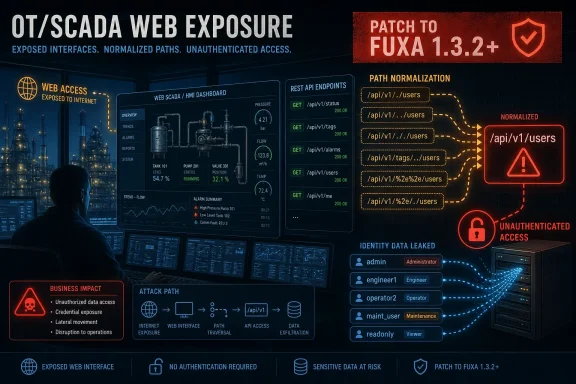
The flaw involves dot-segment path normalization in the REST API. In plain English, the application’s authentication checks do not properly reconcile paths containing sequences such as
That distinction sounds fussy until you translate it into attack behavior. Requests aimed at protected API endpoints such as user and role listings can be reshaped with dot segments and still resolve to sensitive data. The authentication middleware sees one thing; the router ultimately serves another.
CISA’s advisory says successful exploitation could let an unauthenticated remote attacker enumerate all user accounts and role assignments on a FUXA instance. The CVSS 3.1 score is 7.5, high severity, with network attack vector, low complexity, no privileges required, and no user interaction. Under CVSS 4.0, CISA lists the issue at 8.7, also high.
The affected versions are FUXA SCADA/HMI 1.3.1 and earlier. Frangoteam’s remediation is to update to FUXA 1.3.2 or later, a release that was already available before the CISA advisory landed.
A list of accounts and role assignments gives an attacker three things that matter. It shows who has access, which identities are privileged, and how the target organization has divided operational authority. In a Windows enterprise, that might feed phishing, credential stuffing, or lateral movement. In a control-system environment, it can also reveal who is allowed to supervise processes, modify projects, acknowledge alarms, or operate engineering functions.
The vulnerability does not, by itself, prove that an attacker can log in as those users. But reconnaissance is the phase where defenders most often underestimate the value of exposed structure. A control-room application that leaks its human and authorization model has already given an intruder a shortlist.
This is why the “confidentiality only” profile does not make the bug a shrug. The CVSS vector says integrity and availability are not directly affected. Operationally, however, confidentiality in SCADA is not merely about secrecy; it is about denying attackers the context they need to move from blind probing to targeted action.
A username may be a breadcrumb. A role assignment may be a blueprint. In a plant, water utility, or manufacturing line, those details can shape the next stage of an intrusion even if the vulnerable endpoint never changes a process value itself.
That model also pulls FUXA into the blast radius of ordinary web application mistakes. Authentication middleware, route normalization, API endpoint design, token handling, and permission checks are not peripheral implementation details. In a web-native HMI, they are part of the safety boundary.
The dot-segment issue is a classic example of a bug that lives between layers. One component interprets a path for access control. Another component interprets a normalized version of the same path for routing. If those interpretations diverge, attackers look for the gap.
The uncomfortable point for IT and OT teams is that this is not exotic tradecraft. Dot-segment path manipulation is the sort of technique that web security testers learn early because it recurs across frameworks, proxies, routers, and custom middleware. In an industrial product, though, that familiar bug lands in a much more consequential setting.
This is where web-based OT tools need to be judged more harshly than ordinary dashboards. If the application front-ends production visibility, alarm review, schedules, or engineering workflows, then its web controls are not just an admin convenience. They are part of the operational perimeter.
That does not make FUXA uniquely negligent. Popular open-source infrastructure often goes through bursts of scrutiny once researchers start looking closely. A project can become safer over time precisely because flaws are found, assigned CVEs, and patched.
But it does change how defenders should think about patch cadence. If an OT application has had repeated auth-adjacent flaws across recent releases, the question is not merely whether this one bug is exploitable. The question is whether the installation is being maintained like internet-facing software or treated like an appliance that can sit untouched for years.
Industrial environments are notorious for slow patch cycles, and often for good reasons. Uptime matters. Vendor support windows matter. Validation matters. A change to an HMI stack may require testing that a typical SaaS admin never has to contemplate.
Still, the old OT argument for “don’t touch it if it works” gets weaker when the component is a web application with a modern API surface. The more a control environment depends on browser-based tooling, the more it inherits the maintenance expectations of the web.
None of this is glamorous, and none of it is a substitute for applying the vendor update. Network segmentation is not a magic eraser for vulnerable software. But in this case, it is the difference between a bug that requires an attacker to already have some path into an OT network and a bug that can be probed from anywhere.
The phrase “unauthenticated remote attacker” should always force a quick exposure audit. If a FUXA instance is reachable from the internet, this advisory should move from routine patch management into incident-response territory. If it is reachable only from a restricted operations subnet, the work is still urgent, but the risk calculation is different.
VPNs deserve special caution here. CISA’s boilerplate rightly notes that VPNs may themselves contain vulnerabilities and that a VPN is only as secure as the connected devices. In practice, many organizations treat VPN access as if it were equivalent to being inside the castle. That assumption has aged badly.
Remote access into OT should be narrow, logged, conditional, and reviewed. A vulnerable HMI behind a VPN is still vulnerable to stolen credentials, compromised laptops, overbroad contractor access, and flat internal routing. The perimeter moved; it did not disappear.
The harder part is knowing where FUXA actually lives. Open-source visualization tools often arrive through integrators, pilot projects, engineering workstations, proof-of-concept dashboards, or “temporary” monitoring setups that become permanent by neglect. They may not sit in the same asset inventory as PLCs, historian servers, Windows HMIs, or engineering laptops.
That makes this advisory a test of operational visibility. A mature organization should be able to answer a few basic questions quickly: Do we run FUXA? Which versions? On which hosts? Who manages it? Is it reachable from business networks, VPN pools, vendor remote access, or the internet? Are logs retained?
If those answers require a scavenger hunt, CVE-2026-13207 is not the only problem. The vulnerability is merely exposing a governance gap that already existed. The less formal the deployment path, the more likely the tool is to be missed during patching.
Administrators should also consider whether exposed account and role data has already been queried. CISA says it has no reports of known public exploitation specifically targeting this vulnerability at the time of publication, but absence of known exploitation is not evidence of absence. For internet-exposed or broadly reachable systems, reviewing web server and application logs for abnormal API requests containing dot-segment patterns is a practical starting point.
The lack of known exploitation also says little about future activity. Once a vulnerability is described in a public advisory with example path patterns, the cost of testing for it drops sharply. Defenders should assume opportunistic scanning will follow, especially for any instances exposed beyond tightly controlled networks.
That does not mean panic. It means sequence the response intelligently. Patch first where exposure is highest. Restrict network access where patching cannot be immediate. Review logs where sensitive environments were reachable. Validate that the update actually moved the system beyond the affected versions.
The operational question is not whether this one CVE deserves the same urgency as a remote code execution flaw on a domain controller. It does not. The question is whether an unauthenticated leak of the OT identity model is acceptable. It is not.
Identity is the connective tissue. If usernames in FUXA resemble domain usernames, email addresses, contractor accounts, or shared operational roles, the exposed data may help attackers pivot into Microsoft 365 phishing, VPN guessing, or Windows credential attacks. Even where FUXA maintains its own accounts, the naming conventions alone can be useful.
This is the quiet convergence story in industrial security. IT teams bring identity management, patching tools, browsers, TLS certificates, reverse proxies, and VPNs. OT teams bring process knowledge, safety constraints, and production uptime. Web-based SCADA/HMI platforms sit in the overlap, where neither side can pretend the other owns the whole risk.
For sysadmins, the action item is not to become overnight PLC experts. It is to ensure that web applications deployed in OT-adjacent spaces are represented in the same vulnerability management, logging, and access-review processes as other sensitive applications. If the tool can expose operators and roles, it belongs in the security program.
The better lesson is that open-source OT tooling must be operated with clear ownership. Someone needs to track releases. Someone needs to subscribe to advisories. Someone needs to test updates before production rollout. Someone needs to know whether a GitHub release is merely a feature bump or a security-relevant fix.
The advantage of open source is visibility and speed. Researchers can inspect code, vendors can publish fixes, and users can verify behavior. The disadvantage is that organizations sometimes adopt the software without adopting the maintenance discipline that would normally come with a formal vendor relationship.
FUXA’s recent security history should push users toward more structure, not abandonment by reflex. If it solves a real operational problem, keep it — but treat it as critical infrastructure software, not a hobby dashboard. That means version control for projects, backups, staging tests, access reviews, and documented rollback plans.
The same standard should apply to commercial tools. The difference is that open-source deployments make it harder to outsource responsibility. There may be no account manager to call when the advisory lands. The patch is available; the operational discipline has to be local.
 A Small URL Trick Becomes an OT Identity Leak
The vulnerability, tracked as CVE-2026-13207, sits in the awkward borderland between web application plumbing and industrial security. FUXA is a web-based SCADA/HMI/dashboard platform, which means its user interface, API routing, and access controls look familiar to anyone who has worked with modern web stacks. That familiarity is part of the danger.The flaw involves dot-segment path normalization in the REST API. In plain English, the application’s authentication checks do not properly reconcile paths containing sequences such as
./ or ../ before deciding whether a request should be allowed. An endpoint that should require authentication can be reached by presenting the path in a slightly different form.That distinction sounds fussy until you translate it into attack behavior. Requests aimed at protected API endpoints such as user and role listings can be reshaped with dot segments and still resolve to sensitive data. The authentication middleware sees one thing; the router ultimately serves another.
CISA’s advisory says successful exploitation could let an unauthenticated remote attacker enumerate all user accounts and role assignments on a FUXA instance. The CVSS 3.1 score is 7.5, high severity, with network attack vector, low complexity, no privileges required, and no user interaction. Under CVSS 4.0, CISA lists the issue at 8.7, also high.
The affected versions are FUXA SCADA/HMI 1.3.1 and earlier. Frangoteam’s remediation is to update to FUXA 1.3.2 or later, a release that was already available before the CISA advisory landed.
Reconnaissance Is Not Harmless When the Target Is a Control Room
Security teams sometimes triage information disclosure bugs as paperwork problems. If a flaw does not execute code, change a setpoint, or drop a shell, it may get shoved behind whatever vulnerability scanner has most recently shouted “critical.” That habit is dangerous in OT environments.A list of accounts and role assignments gives an attacker three things that matter. It shows who has access, which identities are privileged, and how the target organization has divided operational authority. In a Windows enterprise, that might feed phishing, credential stuffing, or lateral movement. In a control-system environment, it can also reveal who is allowed to supervise processes, modify projects, acknowledge alarms, or operate engineering functions.
The vulnerability does not, by itself, prove that an attacker can log in as those users. But reconnaissance is the phase where defenders most often underestimate the value of exposed structure. A control-room application that leaks its human and authorization model has already given an intruder a shortlist.
This is why the “confidentiality only” profile does not make the bug a shrug. The CVSS vector says integrity and availability are not directly affected. Operationally, however, confidentiality in SCADA is not merely about secrecy; it is about denying attackers the context they need to move from blind probing to targeted action.
A username may be a breadcrumb. A role assignment may be a blueprint. In a plant, water utility, or manufacturing line, those details can shape the next stage of an intrusion even if the vulnerable endpoint never changes a process value itself.
FUXA’s Web Stack Is Both Its Strength and Its Exposure
FUXA’s appeal is easy to understand. A browser-based process visualization and dashboarding platform gives operators, engineers, and integrators a flexible way to build HMI-style interfaces without the cost and rigidity of older proprietary stacks. It is open source, relatively approachable, and designed for the kind of lightweight industrial visualization that many smaller sites actually deploy.That model also pulls FUXA into the blast radius of ordinary web application mistakes. Authentication middleware, route normalization, API endpoint design, token handling, and permission checks are not peripheral implementation details. In a web-native HMI, they are part of the safety boundary.
The dot-segment issue is a classic example of a bug that lives between layers. One component interprets a path for access control. Another component interprets a normalized version of the same path for routing. If those interpretations diverge, attackers look for the gap.
The uncomfortable point for IT and OT teams is that this is not exotic tradecraft. Dot-segment path manipulation is the sort of technique that web security testers learn early because it recurs across frameworks, proxies, routers, and custom middleware. In an industrial product, though, that familiar bug lands in a much more consequential setting.
This is where web-based OT tools need to be judged more harshly than ordinary dashboards. If the application front-ends production visibility, alarm review, schedules, or engineering workflows, then its web controls are not just an admin convenience. They are part of the operational perimeter.
The Advisory Arrives After a Busy FUXA Security Year
CVE-2026-13207 does not appear in isolation. FUXA has already seen multiple 2026 vulnerability disclosures around authentication, authorization, and sensitive API behavior. Earlier issues affected scheduler access, guest or invalid-token access to protected APIs, and other security boundaries in affected versions.That does not make FUXA uniquely negligent. Popular open-source infrastructure often goes through bursts of scrutiny once researchers start looking closely. A project can become safer over time precisely because flaws are found, assigned CVEs, and patched.
But it does change how defenders should think about patch cadence. If an OT application has had repeated auth-adjacent flaws across recent releases, the question is not merely whether this one bug is exploitable. The question is whether the installation is being maintained like internet-facing software or treated like an appliance that can sit untouched for years.
Industrial environments are notorious for slow patch cycles, and often for good reasons. Uptime matters. Vendor support windows matter. Validation matters. A change to an HMI stack may require testing that a typical SaaS admin never has to contemplate.
Still, the old OT argument for “don’t touch it if it works” gets weaker when the component is a web application with a modern API surface. The more a control environment depends on browser-based tooling, the more it inherits the maintenance expectations of the web.
CISA’s Mitigation Advice Is Familiar Because the Failure Pattern Is Familiar
CISA’s recommended practices are predictable, but they are predictable because they remain necessary. Minimize exposure. Keep control systems and remote devices off the public internet. Put them behind firewalls. Isolate control networks from business networks. Use more secure remote-access methods when remote access is needed, and keep those methods patched.None of this is glamorous, and none of it is a substitute for applying the vendor update. Network segmentation is not a magic eraser for vulnerable software. But in this case, it is the difference between a bug that requires an attacker to already have some path into an OT network and a bug that can be probed from anywhere.
The phrase “unauthenticated remote attacker” should always force a quick exposure audit. If a FUXA instance is reachable from the internet, this advisory should move from routine patch management into incident-response territory. If it is reachable only from a restricted operations subnet, the work is still urgent, but the risk calculation is different.
VPNs deserve special caution here. CISA’s boilerplate rightly notes that VPNs may themselves contain vulnerabilities and that a VPN is only as secure as the connected devices. In practice, many organizations treat VPN access as if it were equivalent to being inside the castle. That assumption has aged badly.
Remote access into OT should be narrow, logged, conditional, and reviewed. A vulnerable HMI behind a VPN is still vulnerable to stolen credentials, compromised laptops, overbroad contractor access, and flat internal routing. The perimeter moved; it did not disappear.
The Real Patch Is Version 1.3.2, but the Real Work Is Inventory
Frangoteam recommends moving to FUXA 1.3.2 or later. That is the immediate remediation, and for many sites it will be the only acceptable long-term fix. If FUXA is used in production, staging, labs, or vendor-managed deployments, those instances need to be identified and upgraded.The harder part is knowing where FUXA actually lives. Open-source visualization tools often arrive through integrators, pilot projects, engineering workstations, proof-of-concept dashboards, or “temporary” monitoring setups that become permanent by neglect. They may not sit in the same asset inventory as PLCs, historian servers, Windows HMIs, or engineering laptops.
That makes this advisory a test of operational visibility. A mature organization should be able to answer a few basic questions quickly: Do we run FUXA? Which versions? On which hosts? Who manages it? Is it reachable from business networks, VPN pools, vendor remote access, or the internet? Are logs retained?
If those answers require a scavenger hunt, CVE-2026-13207 is not the only problem. The vulnerability is merely exposing a governance gap that already existed. The less formal the deployment path, the more likely the tool is to be missed during patching.
Administrators should also consider whether exposed account and role data has already been queried. CISA says it has no reports of known public exploitation specifically targeting this vulnerability at the time of publication, but absence of known exploitation is not evidence of absence. For internet-exposed or broadly reachable systems, reviewing web server and application logs for abnormal API requests containing dot-segment patterns is a practical starting point.
Why “No Known Exploitation” Should Not Calm Anyone Down
CISA’s statement that no known public exploitation has been reported is useful, but it should not be overread. Many reconnaissance bugs never generate dramatic public exploitation reports because they are quiet by design. An attacker can query an endpoint, collect the data, and leave little more than a web request behind.The lack of known exploitation also says little about future activity. Once a vulnerability is described in a public advisory with example path patterns, the cost of testing for it drops sharply. Defenders should assume opportunistic scanning will follow, especially for any instances exposed beyond tightly controlled networks.
That does not mean panic. It means sequence the response intelligently. Patch first where exposure is highest. Restrict network access where patching cannot be immediate. Review logs where sensitive environments were reachable. Validate that the update actually moved the system beyond the affected versions.
The operational question is not whether this one CVE deserves the same urgency as a remote code execution flaw on a domain controller. It does not. The question is whether an unauthenticated leak of the OT identity model is acceptable. It is not.
Microsoft-Centric Shops Still Have Skin in This Game
WindowsForum readers may not run FUXA directly, but many Windows-heavy environments touch tools like it. OT networks commonly include Windows jump hosts, Windows-based engineering stations, Active Directory integration patterns, browser-based operator consoles, and remote support workflows that cross from IT into industrial systems. A flaw in a web HMI can therefore become an IT problem faster than the org chart suggests.Identity is the connective tissue. If usernames in FUXA resemble domain usernames, email addresses, contractor accounts, or shared operational roles, the exposed data may help attackers pivot into Microsoft 365 phishing, VPN guessing, or Windows credential attacks. Even where FUXA maintains its own accounts, the naming conventions alone can be useful.
This is the quiet convergence story in industrial security. IT teams bring identity management, patching tools, browsers, TLS certificates, reverse proxies, and VPNs. OT teams bring process knowledge, safety constraints, and production uptime. Web-based SCADA/HMI platforms sit in the overlap, where neither side can pretend the other owns the whole risk.
For sysadmins, the action item is not to become overnight PLC experts. It is to ensure that web applications deployed in OT-adjacent spaces are represented in the same vulnerability management, logging, and access-review processes as other sensitive applications. If the tool can expose operators and roles, it belongs in the security program.
Open Source in OT Needs Adult Supervision, Not Panic
There is a lazy version of this story that says open source does not belong in industrial environments. That conclusion is too broad and too convenient. Proprietary OT software has had plenty of ugly vulnerabilities, slow patches, default credentials, and opaque security practices over the years.The better lesson is that open-source OT tooling must be operated with clear ownership. Someone needs to track releases. Someone needs to subscribe to advisories. Someone needs to test updates before production rollout. Someone needs to know whether a GitHub release is merely a feature bump or a security-relevant fix.
The advantage of open source is visibility and speed. Researchers can inspect code, vendors can publish fixes, and users can verify behavior. The disadvantage is that organizations sometimes adopt the software without adopting the maintenance discipline that would normally come with a formal vendor relationship.
FUXA’s recent security history should push users toward more structure, not abandonment by reflex. If it solves a real operational problem, keep it — but treat it as critical infrastructure software, not a hobby dashboard. That means version control for projects, backups, staging tests, access reviews, and documented rollback plans.
The same standard should apply to commercial tools. The difference is that open-source deployments make it harder to outsource responsibility. There may be no account manager to call when the advisory lands. The patch is available; the operational discipline has to be local.
The FUXA Fix Is Straightforward; the Exposure Story Is Not
The concrete response to CVE-2026-13207 is refreshingly uncomplicated. FUXA 1.3.1 and earlier are affected, and Frangoteam says users should apply FUXA 1.3.2 or later. The more complicated part is determining where the vulnerable systems sit, who can reach them, and whether their API logs show suspicious access attempts.- Organizations running FUXA SCADA/HMI should upgrade affected installations to version 1.3.2 or later.
- Administrators should treat exposed user and role data as sensitive reconnaissance material, not as a low-value leak.
- Security teams should look for dot-segment API request patterns against FUXA endpoints, especially on systems reachable from business networks, VPN pools, or the internet.
- OT operators should reduce network exposure for FUXA and other control-system web applications rather than relying on authentication alone.
- IT and OT teams should add open-source HMI and dashboard tools to formal asset inventory, vulnerability tracking, and access-review workflows.
References
- Primary source: CISA
Published: 2026-06-30T12:00:00+00:00

Frangoteam FUXA SCADA/HMI | CISA
www.cisa.gov
- Related coverage: releasealert.dev
Releases · frangoteam/FUXA - GitHub | Release Alert
Latest releases for frangoteam/FUXA on GitHub. Latest version: v1.3.3, last published: June 21, 2026releasealert.dev - Related coverage: advisories.checkpoint.com
CPAI-2026-1537 - Check Point Software
Frangoteam FUXA Authentication Bypass (CVE-2026-25939) - CPAI-2026-1537 advisories.checkpoint.com
- Related coverage: advisories.gitlab.com
FUXA provides guest and invalid-token access to protected read APIs in secure mode | GitLab Advisory Database (GLAD)
CVE-2026-47718 FUXA provides guest and invalid-token access to protected read APIs in secure mode: When secureEnabled=true, FUXA 1.3.0-2773 still allows guest and invalid-token requests to read project, alarms, and scheduler …advisories.gitlab.com - Related coverage: techjacksolutions.com
CVE-2026-25939: FUXA SCADA/HMI Authorization Bypass Allows Unauthe — CRITICAL Severity Analysis
A critical authorization bypass vulnerability in FUXA, a web-based SCADA/HMI platform used in industrial control environments, allows unauthenticated remote attackers to create and modify operational schedulers without credentials. Versions 1.2.8 through 1.2.10 are affected; a patch is available...techjacksolutions.com - Related coverage: cve.circl.lu
Vulnerability-Lookup
Vulnerability-Lookup - Fast vulnerability lookup correlation from different sources.cve.circl.lu
