

On July 2, 2026, CISA published an industrial-control advisory warning that ST Engineering iDirect iQ-Series satellite terminals running software version 4.5.2.1 or earlier contain two high-severity flaws affecting device information exposure and remote reboot behavior. The affected products sit in communications paths that matter far beyond ordinary office networking. The story is not that another embedded web interface had weak API hygiene. The story is that satellite edge gear is still too often treated like plumbing, even when its management plane can expose identifiers used for trust in a live network.
CISA’s advisory covers Evolution iQ-Series, 3315-Series, and 9-Series terminals at version 4.5.2.1 and earlier. ST Engineering iDirect has fixed the issues and recommends moving to version 4.5.2.2 or newer, with patches available to registered users through the vendor’s support portal.
That sounds like an ordinary patch notice until you look at the affected sectors. CISA lists communications, defense industrial base, energy, government services and facilities, and transportation systems, with worldwide deployment. In other words, these are not consumer routers tucked under a TV stand. They are satellite communications endpoints in the kinds of environments where connectivity may be expensive, remote, operationally sensitive, or all three.
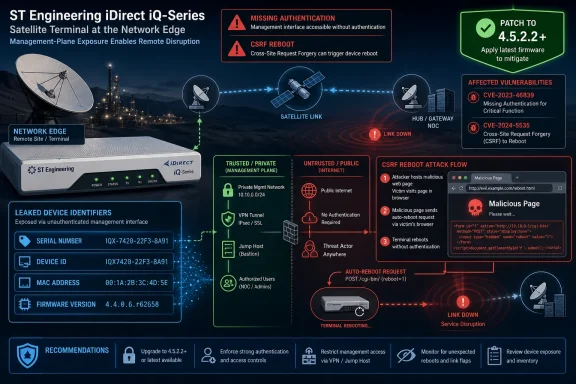
The first vulnerability, CVE-2026-38059, is a missing-authentication flaw in REST API endpoints. An unauthenticated attacker with network access can query exposed endpoints and retrieve sensitive device data including serial number, Device ID, Terminal Private Key identifier, MAC address, and exact firmware version. The advisory specifically notes that the DID and TPK are used for satellite network authentication in the iDirect platform, making this more than a routine inventory leak.
The second flaw, CVE-2026-38057, is a cross-site request forgery weakness affecting state-changing API endpoints after authentication. In practical terms, if an administrator is logged into a device and visits a malicious page, the browser can be tricked into sending a reboot request using the administrator’s existing session cookie. The result is not data theft; it is link loss, and repeated attacks could sustain a denial-of-service condition.
The most concerning part of CVE-2026-38059 is not simply that
That matters because satellite terminals are frequently deployed where physical access is difficult and remote administration is normal. A terminal on a vessel, aircraft support site, energy field office, temporary government facility, or remote industrial location may depend on management access across constrained networks. If those management surfaces are reachable from broader enterprise segments — or worse, from the public internet — the flaw becomes a reconnaissance shortcut.
The advisory says unauthorized access to device information is possible, not full terminal takeover. Administrators should resist both extremes: panic and dismissal. This is not a Hollywood “hack the satellite” button. It is, however, exactly the kind of weak edge-management exposure that sophisticated attackers use before anything louder happens.
The advisory says the
In an enterprise SaaS console, an unwanted reboot might be annoying. In a satellite terminal, it can be operationally visible. A reboot can interrupt a link, disrupt monitoring, break remote access at precisely the wrong moment, and force support staff into a recovery loop in places where hands-on access may be slow or impossible.
The user-interaction requirement in the score should not lull defenders to sleep. Many real-world attacks are built around getting administrators to open something: a vendor-looking email, a troubleshooting page, a support link, a shared document, or a message in an internal ticket. The exploit path depends on social engineering, but social engineering is not a theoretical dependency. It is the daily operating model of intrusion campaigns.
The scoring reflects two different risk profiles. CVE-2026-38059 carries a CVSS v3.1 base score of 7.5 and a CVSS v4.0 score of 8.7, driven by unauthenticated network access and high confidentiality impact. CVE-2026-38057 carries a CVSS v3.1 score of 8.1 and a CVSS v4.0 score of 7.0, reflecting the possibility of integrity and availability impact through authenticated-session abuse.
Those numbers tell administrators where to start, but they do not capture every deployment nuance. A terminal management interface exposed only to a tightly controlled out-of-band network is a different problem from one reachable through a flat corporate LAN. A unit supporting a redundant connection is different from a unit serving as the sole communications path for a remote site.
The correct reading is not “the sky is falling.” It is “inventory and segmentation now decide the blast radius.” Organizations that already isolate management interfaces, require VPN access, enforce role separation, and monitor administrative API behavior have a much smaller problem. Organizations that have allowed satellite gear to become just another IP-addressable appliance have a bigger one.
This is where embedded and OT security always diverge from desktop patch culture. A Windows laptop can often be rebooted after hours. A satellite terminal may be part of a revenue-generating link, an operational safety workflow, a command-and-control path, or a logistics chain. The update still needs to happen, but the rollout has to respect the function of the device.
That reality should not become an excuse for indefinite delay. The existence of a vendor-fixed release changes the risk conversation. Once a patch is available, defenders who cannot immediately update need compensating controls they can describe, test, and monitor — not a vague note in a risk register.
CISA’s recommended mitigations point in the right direction: restrict management interfaces to trusted networks, avoid exposing administrative APIs to the public internet, enforce strong authentication practices, and monitor for anomalous API activity and unexpected device reboots. None of that is exotic. The hard part is making sure it is actually true in the deployed environment, not merely true in the network diagram.
That should make Windows and enterprise administrators pay attention even if they never touch a satellite terminal. The boundary between IT and OT is not as clean as org charts pretend. A phishing email opened on a corporate workstation can become relevant to an authenticated administrator session. A flat management VLAN can put specialized communications gear within reach of ordinary malware-driven reconnaissance. A monitoring blind spot can hide device reboots until users complain that the link is down.
The Windows angle is not that these are Windows vulnerabilities. It is that Windows endpoints, browsers, identity systems, VPN clients, jump boxes, and administrative workstations frequently form the route to the vulnerable device. If the terminal’s web interface trusts a browser session too much, the security posture of the administrator’s workstation becomes part of the satellite link’s availability story.
That is why “do not click suspicious links” is necessary but insufficient. Administrators need browser isolation practices for sensitive management work, short-lived sessions, hardened jump hosts, network allow lists, and telemetry that treats unexpected terminal reboots as security signals rather than mere availability events.
For CVE-2026-38059, public exposure would make the unauthenticated API leak especially dangerous. An attacker would not need credentials, a stolen session, or a phishing success. Network reachability alone would be enough to collect sensitive device information.
For CVE-2026-38057, public exposure is not the only concern, because the exploit path rides through an administrator’s authenticated browser session. But reducing where the interface is reachable still reduces the odds that a malicious web page can successfully target the right internal address. Segmentation does not fix CSRF, but it forces the attacker to solve additional problems.
The right model is boring by design. Terminal management should sit behind VPNs or equivalent private access controls, restricted by ACLs, separated from business networks, and reachable only from hardened administrative systems. If remote access is required, the remote-access layer itself must be patched and monitored. A vulnerable VPN in front of a vulnerable management interface is not defense in depth; it is a queue.
Exact firmware version is itself among the data exposed by the unauthenticated API. That irony should not be lost on defenders. The same information administrators need for patch management is also useful to attackers when exposed without authentication.
A serious response should start with a controlled inventory sweep from trusted management networks, not internet-wide poking and not ad hoc logins from random workstations. Teams should identify affected models, confirm software versions, map management reachability, and determine which terminals support critical services. Only then can they sequence patching in a way that reduces risk without creating avoidable outages.
The work should also include searching logs for unexpected access to the affected API paths and unexplained reboot events. Absence of known exploitation at CISA does not mean absence of probing in your environment. If devices log API access poorly, that is a finding in itself.
Consider the likely attacker workflow. First, find reachable terminals or identify an organization that uses them. Next, pull unauthenticated device metadata where possible. Then use that information for targeting, spoofing research, credential attacks, support impersonation, or vulnerability matching. Separately, attempt to induce an authenticated administrator to load a malicious page and trigger a reboot during a sensitive operating window.
That is not the only path, and the advisory does not claim all of those outcomes have occurred. But defenders should think in sequences because attackers do. A missing-authentication bug that leaks identifiers and a CSRF bug that disrupts availability are not identical flaws, but they sit in the same uncomfortable space: the device trusts the surrounding network and the administrator’s browser too much.
The safest assumption is that the management plane is hostile territory unless proven otherwise. Every exposed API endpoint should require authentication. Every state-changing action should require anti-CSRF protections and appropriate cookie attributes. Every reboot should be attributable to a known user, source, and maintenance reason.
Ownership is often the hidden problem. Satellite communications gear can sit between facilities, telecom, operations, security, and outside providers. Everyone depends on it; nobody wants to reboot it. That ambiguity is tolerable until a security advisory arrives with a fixed version number and a high-severity score.
The best organizations will use this moment to tighten the whole lifecycle. They will document who can access terminal management interfaces, from where, using what authentication path. They will verify that administrative browsers are not casually reused for email and web browsing. They will add reboot events to security monitoring. They will test whether supposed ACLs actually block access from business networks.
The weaker response is to download the patch, apply it to the easiest devices, and declare victory. That may close the named CVEs, but it leaves the architecture that made them dangerous intact.
 A Satellite Terminal Advisory Is Really a Trust Boundary Advisory
CISA’s advisory covers Evolution iQ-Series, 3315-Series, and 9-Series terminals at version 4.5.2.1 and earlier. ST Engineering iDirect has fixed the issues and recommends moving to version 4.5.2.2 or newer, with patches available to registered users through the vendor’s support portal.That sounds like an ordinary patch notice until you look at the affected sectors. CISA lists communications, defense industrial base, energy, government services and facilities, and transportation systems, with worldwide deployment. In other words, these are not consumer routers tucked under a TV stand. They are satellite communications endpoints in the kinds of environments where connectivity may be expensive, remote, operationally sensitive, or all three.
The first vulnerability, CVE-2026-38059, is a missing-authentication flaw in REST API endpoints. An unauthenticated attacker with network access can query exposed endpoints and retrieve sensitive device data including serial number, Device ID, Terminal Private Key identifier, MAC address, and exact firmware version. The advisory specifically notes that the DID and TPK are used for satellite network authentication in the iDirect platform, making this more than a routine inventory leak.
The second flaw, CVE-2026-38057, is a cross-site request forgery weakness affecting state-changing API endpoints after authentication. In practical terms, if an administrator is logged into a device and visits a malicious page, the browser can be tricked into sending a reboot request using the administrator’s existing session cookie. The result is not data theft; it is link loss, and repeated attacks could sustain a denial-of-service condition.
The Leaked Metadata Is Operationally Loud
Security teams sometimes underrate information disclosure because it does not immediately hand an attacker a shell. That instinct is dangerous in operational technology and satellite communications, where the shape of a network is often the prize. A serial number, device ID, firmware version, MAC address, and authentication-related identifier can turn a blind scan into a targeted campaign.The most concerning part of CVE-2026-38059 is not simply that
/api/identity and /api/ answer without authentication. It is that they appear to answer with data useful for understanding how a terminal presents itself inside the satellite ecosystem. A device identifier and a private-key identifier are not equivalent to a stolen private key, but they narrow the attacker’s uncertainty and help map the trust model.That matters because satellite terminals are frequently deployed where physical access is difficult and remote administration is normal. A terminal on a vessel, aircraft support site, energy field office, temporary government facility, or remote industrial location may depend on management access across constrained networks. If those management surfaces are reachable from broader enterprise segments — or worse, from the public internet — the flaw becomes a reconnaissance shortcut.
The advisory says unauthorized access to device information is possible, not full terminal takeover. Administrators should resist both extremes: panic and dismissal. This is not a Hollywood “hack the satellite” button. It is, however, exactly the kind of weak edge-management exposure that sophisticated attackers use before anything louder happens.
The Reboot Bug Turns a Browser Into a Link-Loss Tool
CVE-2026-38057 is more old-fashioned, but no less relevant. CSRF bugs are a web-security classic: the application trusts that a request carrying a valid session cookie must reflect the user’s intent. That assumption has been wrong for decades, and it is especially wrong when the action is rebooting a communications terminal.The advisory says the
/api/reboot endpoint accepts POST requests authenticated solely by a session cookie that lacks the SameSite attribute. That combination is tailor-made for a malicious page that silently submits a cross-site request. If the administrator is already authenticated to the terminal interface, the attacker does not need the password; the browser supplies the session.In an enterprise SaaS console, an unwanted reboot might be annoying. In a satellite terminal, it can be operationally visible. A reboot can interrupt a link, disrupt monitoring, break remote access at precisely the wrong moment, and force support staff into a recovery loop in places where hands-on access may be slow or impossible.
The user-interaction requirement in the score should not lull defenders to sleep. Many real-world attacks are built around getting administrators to open something: a vendor-looking email, a troubleshooting page, a support link, a shared document, or a message in an internal ticket. The exploit path depends on social engineering, but social engineering is not a theoretical dependency. It is the daily operating model of intrusion campaigns.
High Severity Is the Right Label, Even Without Known Exploitation
CISA says it has not received reports of known public exploitation specifically targeting these vulnerabilities. That is reassuring, but only narrowly. Lack of known exploitation is not the same as lack of exposure, and the difference matters in remote-infrastructure environments.The scoring reflects two different risk profiles. CVE-2026-38059 carries a CVSS v3.1 base score of 7.5 and a CVSS v4.0 score of 8.7, driven by unauthenticated network access and high confidentiality impact. CVE-2026-38057 carries a CVSS v3.1 score of 8.1 and a CVSS v4.0 score of 7.0, reflecting the possibility of integrity and availability impact through authenticated-session abuse.
Those numbers tell administrators where to start, but they do not capture every deployment nuance. A terminal management interface exposed only to a tightly controlled out-of-band network is a different problem from one reachable through a flat corporate LAN. A unit supporting a redundant connection is different from a unit serving as the sole communications path for a remote site.
The correct reading is not “the sky is falling.” It is “inventory and segmentation now decide the blast radius.” Organizations that already isolate management interfaces, require VPN access, enforce role separation, and monitor administrative API behavior have a much smaller problem. Organizations that have allowed satellite gear to become just another IP-addressable appliance have a bigger one.
The Patch Is Simple; The Maintenance Window Is Not
The vendor’s fix is straightforward on paper: update affected terminals to software version 4.5.2.2 or newer. For WindowsForum readers who live in ordinary endpoint management, that may sound like the easy part. For satellite infrastructure teams, patching can involve coordination with service providers, maintenance windows, field constraints, regulatory requirements, and uptime commitments.This is where embedded and OT security always diverge from desktop patch culture. A Windows laptop can often be rebooted after hours. A satellite terminal may be part of a revenue-generating link, an operational safety workflow, a command-and-control path, or a logistics chain. The update still needs to happen, but the rollout has to respect the function of the device.
That reality should not become an excuse for indefinite delay. The existence of a vendor-fixed release changes the risk conversation. Once a patch is available, defenders who cannot immediately update need compensating controls they can describe, test, and monitor — not a vague note in a risk register.
CISA’s recommended mitigations point in the right direction: restrict management interfaces to trusted networks, avoid exposing administrative APIs to the public internet, enforce strong authentication practices, and monitor for anomalous API activity and unexpected device reboots. None of that is exotic. The hard part is making sure it is actually true in the deployed environment, not merely true in the network diagram.
The Management Plane Keeps Being the Soft Underbelly
This advisory fits a broader pattern across critical infrastructure devices: the operational function may be specialized, but the management plane often looks like an ordinary web application with ordinary web mistakes. Missing authentication. CSRF. Session-cookie weaknesses. Overly chatty APIs. Publicly reachable administrative surfaces. The hardware may be ruggedized; the software assumptions are often not.That should make Windows and enterprise administrators pay attention even if they never touch a satellite terminal. The boundary between IT and OT is not as clean as org charts pretend. A phishing email opened on a corporate workstation can become relevant to an authenticated administrator session. A flat management VLAN can put specialized communications gear within reach of ordinary malware-driven reconnaissance. A monitoring blind spot can hide device reboots until users complain that the link is down.
The Windows angle is not that these are Windows vulnerabilities. It is that Windows endpoints, browsers, identity systems, VPN clients, jump boxes, and administrative workstations frequently form the route to the vulnerable device. If the terminal’s web interface trusts a browser session too much, the security posture of the administrator’s workstation becomes part of the satellite link’s availability story.
That is why “do not click suspicious links” is necessary but insufficient. Administrators need browser isolation practices for sensitive management work, short-lived sessions, hardened jump hosts, network allow lists, and telemetry that treats unexpected terminal reboots as security signals rather than mere availability events.
The Public Internet Is the Wrong Place for This Interface
The most actionable lesson is also the oldest: management interfaces for critical infrastructure devices should not be reachable from the open internet. That statement has been repeated for years, but Shodan-era reality keeps proving that many organizations still fail at it. Sometimes the exposure is accidental. Sometimes it is a temporary exception that became permanent. Sometimes it is the result of a managed service provider, remote access appliance, or firewall rule nobody wants to own.For CVE-2026-38059, public exposure would make the unauthenticated API leak especially dangerous. An attacker would not need credentials, a stolen session, or a phishing success. Network reachability alone would be enough to collect sensitive device information.
For CVE-2026-38057, public exposure is not the only concern, because the exploit path rides through an administrator’s authenticated browser session. But reducing where the interface is reachable still reduces the odds that a malicious web page can successfully target the right internal address. Segmentation does not fix CSRF, but it forces the attacker to solve additional problems.
The right model is boring by design. Terminal management should sit behind VPNs or equivalent private access controls, restricted by ACLs, separated from business networks, and reachable only from hardened administrative systems. If remote access is required, the remote-access layer itself must be patched and monitored. A vulnerable VPN in front of a vulnerable management interface is not defense in depth; it is a queue.
Version Numbers Are Now Security Boundaries
The affected-version line in the advisory is unusually clean: software version 4.5.2.1 and earlier are affected; version 4.5.2.2 or newer contains the fix. That makes inventory the first job. If an organization cannot quickly answer which iDirect terminals it runs and what software they are on, the vulnerability has already exposed a governance problem.Exact firmware version is itself among the data exposed by the unauthenticated API. That irony should not be lost on defenders. The same information administrators need for patch management is also useful to attackers when exposed without authentication.
A serious response should start with a controlled inventory sweep from trusted management networks, not internet-wide poking and not ad hoc logins from random workstations. Teams should identify affected models, confirm software versions, map management reachability, and determine which terminals support critical services. Only then can they sequence patching in a way that reduces risk without creating avoidable outages.
The work should also include searching logs for unexpected access to the affected API paths and unexplained reboot events. Absence of known exploitation at CISA does not mean absence of probing in your environment. If devices log API access poorly, that is a finding in itself.
The Real Risk Is a Chain, Not a Single CVE
Neither vulnerability needs to be catastrophic in isolation to matter. Modern intrusions are assembled from small advantages: a leaked identifier here, a known firmware version there, a browser session abused at the right moment, a management network that was supposed to be private but is reachable from too many places. The chain is the risk.Consider the likely attacker workflow. First, find reachable terminals or identify an organization that uses them. Next, pull unauthenticated device metadata where possible. Then use that information for targeting, spoofing research, credential attacks, support impersonation, or vulnerability matching. Separately, attempt to induce an authenticated administrator to load a malicious page and trigger a reboot during a sensitive operating window.
That is not the only path, and the advisory does not claim all of those outcomes have occurred. But defenders should think in sequences because attackers do. A missing-authentication bug that leaks identifiers and a CSRF bug that disrupts availability are not identical flaws, but they sit in the same uncomfortable space: the device trusts the surrounding network and the administrator’s browser too much.
The safest assumption is that the management plane is hostile territory unless proven otherwise. Every exposed API endpoint should require authentication. Every state-changing action should require anti-CSRF protections and appropriate cookie attributes. Every reboot should be attributable to a known user, source, and maintenance reason.
This Is a Test of Operational Discipline
The immediate remediation is technical, but the longer-term lesson is procedural. Organizations that manage satellite terminals should have a repeatable playbook for security advisories: intake, triage, asset matching, exposure validation, maintenance planning, patch deployment, monitoring, and executive risk communication. If this advisory triggers a scramble to discover who owns the devices, the process needs repair.Ownership is often the hidden problem. Satellite communications gear can sit between facilities, telecom, operations, security, and outside providers. Everyone depends on it; nobody wants to reboot it. That ambiguity is tolerable until a security advisory arrives with a fixed version number and a high-severity score.
The best organizations will use this moment to tighten the whole lifecycle. They will document who can access terminal management interfaces, from where, using what authentication path. They will verify that administrative browsers are not casually reused for email and web browsing. They will add reboot events to security monitoring. They will test whether supposed ACLs actually block access from business networks.
The weaker response is to download the patch, apply it to the easiest devices, and declare victory. That may close the named CVEs, but it leaves the architecture that made them dangerous intact.
The iQ-Series Warning Lands Where Uptime and Identity Meet
The practical response is not complicated, but it does require focus. Treat this as both a patch event and an exposure audit. The patch closes the specific flaws; the audit determines whether similar assumptions remain embedded in the network.- Organizations should identify all Evolution iQ-Series, 3315-Series, and 9-Series terminals and confirm whether they are running version 4.5.2.1 or earlier.
- Affected deployments should move to version 4.5.2.2 or newer through the vendor’s supported software channel.
- Management interfaces should be reachable only from trusted administrative networks, VPNs, or hardened jump hosts, not from the public internet or broad business LANs.
- Security teams should review logs for access to unauthenticated API endpoints, anomalous API activity, and unexpected device reboots.
- Administrators should treat browser sessions to terminal management interfaces as sensitive and avoid mixing them with ordinary web browsing or email-driven workflows.
- Organizations that cannot patch immediately should document compensating controls and set a real deadline, not an open-ended exception.
References
- Primary source: CISA
Published: 2026-07-02T12:00:00+00:00
ST Engineering iDirect iQ-Series Terminals | CISA
www.cisa.gov
- Related coverage: idirect.net
iQ Series - ST Engineering iDirect
iQ Series modems are a proven solution for modern satellite communication needs, featuring advanced technologies like DVB-S2X and ACMwww.idirect.net - Related coverage: cyber.gc.ca
[Control systems] CISA ICS security advisories (AV26–051) - Canadian Centre for Cyber Security
[Control systems] CISA ICS security advisories (AV26–051)www.cyber.gc.ca - Related coverage: stengg.com
