

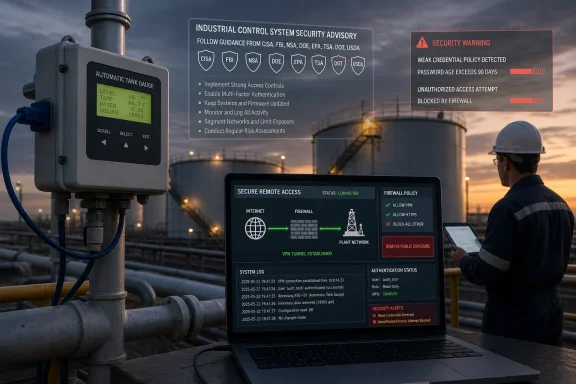
CISA, the FBI, NSA, DOE, EPA, TSA, DOT, USDA, and partner agencies have warned U.S. operators that malicious actors are targeting internet-exposed automatic tank gauge systems used to monitor fuel and liquid storage tanks across critical infrastructure sectors. The practical message is blunt: if an ATG can be reached from the public internet, it should be treated as a liability, not a convenience. This is not a glamorous cyber story about zero-days and elite crews. It is the older, uglier industrial-security problem: equipment built for remote maintenance has quietly become reachable by anyone with a scanner and enough curiosity.
Automatic tank gauges are not household names, but they sit inside systems that Americans rely on every day. They track fuel levels at gas stations, monitor tanks at agricultural and transportation facilities, help detect leaks, and give operators a remote view into equipment that used to require physical inspection. In operational terms, they are boring in exactly the way critical systems often are: small, specialized, widely deployed, and easy to forget until they fail.
That makes the new government warning important. CISA and its partners are not describing a theoretical flaw in an obscure lab setup. They say they are aware of malicious cyber activity targeting U.S.-based ATG systems, including compromises of internet-exposed devices followed by command execution and modification of system settings.
The agencies have not attributed the activity to a nation-state or named threat group. That restraint matters. In the current climate, every industrial-control incident is tempted into a geopolitical frame, but the operational lesson here does not depend on who is behind the keyboard. A publicly reachable device that can influence tank readings, alarms, labels, network settings, or pump-related controls is a problem whether the intruder is a hacktivist, a criminal, a vandal, or a state-backed operator probing for later disruption.
ATGs are a reminder that “critical infrastructure” is not only the electric grid and pipelines. It is also the remote-access box in the back office, the serial-to-Ethernet bridge nobody inventoried, and the maintenance port that was exposed years ago because a vendor or contractor wanted easier access.
The agencies call out exposed serial ports and web interfaces, including common TCP ports such as 8001, 9001, and 10001. If remote access is necessary, operators are told to restrict it with firewalls, access control lists, or VPNs. They are also urged to change default passwords immediately, use strong administrative credentials, apply patches where possible, and enable logging so unauthorized connections and configuration changes do not go unnoticed.
That last point is less mundane than it sounds. In traditional IT, logging is often a compliance nuisance until an incident makes it valuable. In operational technology, missing logs can mean the organization cannot reconstruct whether a false reading was a sensor problem, a configuration mistake, or hostile tampering. If a tank label changes, an alarm threshold disappears, or a remote session modifies settings, someone needs to know before the only remaining evidence is a physical spill, a dry tank, or a failed inspection.
The advice also reflects a broader shift in U.S. critical-infrastructure messaging. Agencies are increasingly treating small operators, local utilities, fuel retailers, agricultural facilities, and transportation sites as front-line cyber targets. They are not being told to build a Fortune 100 security operation overnight. They are being told to stop exposing control systems to the internet and to make sure the few remote pathways that remain are known, authenticated, monitored, and defensible.
That is where OT risk differs from ordinary enterprise compromise. A manipulated spreadsheet can be restored from backup. A manipulated tank reading can lead to bad physical decisions. Operators may overfill, underfill, miss a leak, dispatch fuel unnecessarily, or fail to respond because the system that should warn them has been muted or misconfigured.
CISA’s fact sheet describes attack paths including authentication bypass, hardcoded credentials, operating-system command execution, SQL injection, and privilege escalation. Those are familiar categories to any web-security professional, but they land differently when the vulnerable system bridges software and a physical process. A database injection bug in a business application is bad. A database injection bug in a device that helps track hazardous liquids or fuel inventory can become a safety, environmental, and operational continuity problem.
This does not mean every exposed ATG is equally dangerous. Architecture matters. Some devices may only report data; others may support configuration changes or deeper control functions. Some are isolated behind proper network boundaries; others are directly reachable from the internet. But the government’s warning is pointed because the pattern is familiar: once a specialized OT device is exposed, the internet will find it, index it, fingerprint it, and eventually abuse it.
That history matters because it prevents the story from collapsing into a narrow patch-management tale. Yes, operators should apply available updates. Yes, certified service providers and manufacturers need to verify configurations and close known vulnerabilities. But the larger failure is architectural: devices that should have been reachable only through controlled management paths have been left visible to the world.
Industrial equipment often lives longer than the assumptions that produced it. A tank gauge installed for convenience a decade ago may have been designed for a world where remote access was a service feature, not an attack surface. Contractors change, ownership changes, ISPs change, and the device remains, answering on a port nobody in central IT knows exists.
This is why asset inventory is not bureaucratic busywork in OT. If a company cannot say which ATGs it owns, where they are, how they are connected, who services them, what firmware they run, and whether they are publicly reachable, it cannot meaningfully claim to have accepted the risk. It has merely failed to look.
ATGs fit perfectly into that pattern. They are often managed by fuel retailers, convenience-store chains, transportation operators, farms, chemical facilities, and other organizations whose core business is not cybersecurity. Many rely on third-party service providers to install and maintain the equipment. That dependency can be helpful when providers are competent and security-minded, but it can also create ambiguity about who owns the risk.
CISA’s recommendation to engage third-party providers is therefore both necessary and revealing. The owner of the tank may not know how to harden the gauge. The local technician may know how to make it work but not how to segment it. The corporate IT team may secure Windows endpoints and cloud identity while having no visibility into serial ports, embedded web interfaces, or remote maintenance modems at field sites.
This is the accountability gap attackers exploit. Nobody needs to defeat a mature security program if the exposed device sits just outside the program’s field of view. The tank gauge is not a laptop, not a server, and not a SaaS account, so it does not enter the normal patch cadence, endpoint detection rollout, password policy, or vulnerability scan. Then one day it becomes the entry point or the target.
That creates two practical concerns for sysadmins. First, Windows and identity infrastructure may be the path used to reach the OT device. A compromised technician account, reused VPN credential, exposed remote desktop host, or poorly segmented management workstation can turn a business-network intrusion into an operational incident. The gauge itself may be the headline, but the route to it can still run through familiar enterprise weaknesses.
Second, Windows administrators are often the people who will be asked to “check the network” after something goes wrong. If the OT inventory is incomplete, firewall rules are undocumented, and vendor access is informal, incident response becomes archaeology. The team has to discover the architecture while the clock is already running.
The correct lesson is not that every Windows admin must become an industrial engineer. It is that IT and OT boundaries cannot remain a mystery. If an organization depends on physical systems, its Windows estate, identity provider, VPN configuration, and network segmentation are part of the safety story whether anyone planned it that way or not.
In OT, that convenience has a long tail. A shared service code may survive employee turnover, contractor changes, site acquisitions, and equipment upgrades. The password may be printed in a manual, reused across a fleet, or known by multiple vendors. Even when the device supports credential changes, the business process around it may discourage change because nobody wants to lock out the next service visit.
CISA’s call for phishing-resistant multifactor authentication “wherever feasible” is notable because feasibility is doing a lot of work. Many embedded and legacy systems will not support modern MFA directly. That does not make the recommendation meaningless; it shifts the control point. Remote access to the network segment, jump host, VPN, or management portal should enforce stronger identity protections even when the device itself cannot.
The industry has spent years arguing that OT is different, and it is. But “different” cannot keep meaning “exempt from credential hygiene.” If the device cannot defend itself like a modern system, the network and access path around it must compensate.
The agencies’ hierarchy is implicit but clear. First, eliminate public exposure. Then restrict remote access if it must exist. Then enforce credentials, patch, log, monitor, and report. That order is the right one because it acknowledges the messy reality of industrial equipment: some devices cannot be patched quickly, some require vendor coordination, and some run in environments where downtime must be scheduled carefully.
Reducing exposure buys time. It also reduces dependence on perfect software. No industrial operator should assume that every embedded interface is free of hidden bugs, especially in equipment designed for long service lives and specialized operational needs. If attackers cannot reach the interface from the internet, many classes of opportunistic exploitation become harder immediately.
That is why internet exposure is the real scandal. Vulnerabilities are inevitable. Publicly reachable management interfaces for physical-process equipment are a choice, even if that choice was made accidentally, inherited from a contractor, or buried in a configuration nobody has reviewed in years.
That underreporting has consequences. If a fuel retailer quietly fixes a compromised ATG without reporting it, the broader community loses indicators, tactics, and evidence of scale. If multiple operators see the same pattern but each treats it as an isolated nuisance, defenders may miss the point at which nuisance becomes campaign.
The agencies’ language also suggests they are trying not to overstate attribution. They describe recent malicious cyber activity, probable tactics, and risk factors without naming a culprit. That is appropriate. Premature attribution can distort defensive priorities, making operators think the problem belongs to geopolitics rather than basic exposure management.
Still, the multi-agency lineup is itself a signal. CISA, FBI, NSA, DOE, EPA, TSA, DOT, and USDA do not jointly warn about tank gauges because they are fascinated by fuel inventory displays. They do it because these small systems sit across sectors that touch energy supply, agriculture, transportation, chemicals, environmental protection, and public safety.
Government guidance often assumes a level of administrative maturity that smaller sites lack. “Enable logging,” “monitor networks,” and “apply patches” are easy to write and harder to operationalize when the device is managed through a vendor portal, installed behind undocumented networking gear, or physically located miles from the nearest IT person.
But the alternative is worse. Small operators are not spared by attackers because they are small. Public scanning does not care whether a device belongs to a multinational logistics firm or a family-owned station. If anything, the low-friction targets are more attractive because they are less likely to notice.
The practical answer is to make the first moves narrow and verifiable. Find every ATG. Determine whether it is reachable from the internet. Remove direct exposure. Change default credentials. Confirm who has remote access. Document how to restore known-good configuration. Those steps will not solve every OT security problem, but they will eliminate the most indefensible ones.
This is the recurring asymmetry of operational technology. A digital action can impose physical uncertainty. Once operators cannot trust the display, they have to fall back to slower methods. That alone can be disruptive, even if no fuel is spilled and no pump is disabled.
The most dangerous outcome may be loss of confidence rather than immediate physical damage. If a site cannot trust its alarms, it must treat normal operations as suspect. If tank volumes may have been altered, inventory systems become unreliable. If labels and thresholds can be changed remotely, compliance records may need review.
Security teams often measure incidents by whether systems are encrypted, data is stolen, or malware persists. OT incidents require another lens: did the attack compromise trust in the physical process? With ATGs, that trust is the product.
That pattern should make defenders skeptical of one-off thinking. Today’s headline is tank gauges. Yesterday’s was programmable logic controllers at water facilities. Tomorrow’s may be building automation, generator controllers, refrigeration systems, or another class of embedded device that quietly connects business operations to physical reality.
For attackers, the categories blur. A search engine, scanner, or bot does not care whether the exposed interface belongs to a tank gauge, a pump controller, or a building-management device. It sees a reachable service and a banner, then tries what works.
For defenders, the categories still matter because consequences differ. A compromised HVAC controller, water PLC, and ATG each require different operational response. But the first defensive question is the same across all of them: why is this interface reachable by strangers?
That assumption is the enemy. A mature response starts by assigning ownership. Someone has to be accountable for inventory, remote access approval, credential rotation, patch coordination, backup configuration, monitoring, and incident reporting. Without ownership, even good guidance becomes a PDF in a folder.
Procurement also has a role. Buyers should ask whether equipment supports unique credentials, secure remote access, logging, firmware updates, role-based access, and documented hardening. Service contracts should spell out how remote access is performed, how credentials are protected, how changes are logged, and how incidents are reported.
The cheapest time to secure an ATG is before it is installed. The second-cheapest time is before it is compromised. CISA’s warning is effectively telling operators that the second window is closing.
The CISA warning should be read as a small but telling snapshot of where infrastructure security is headed. The next phase of cyber defense will not be won only in cloud consoles, endpoint agents, or identity dashboards; it will also be won in the unglamorous inventory of field devices, maintenance ports, and embedded systems that convert data into physical decisions. For Windows admins, OT operators, and business owners alike, the lesson is the same: the internet has found the back room, and the back room now has to be defended like the front door.
 The Tank Gauge Has Become the Soft Edge of Critical Infrastructure
Automatic tank gauges are not household names, but they sit inside systems that Americans rely on every day. They track fuel levels at gas stations, monitor tanks at agricultural and transportation facilities, help detect leaks, and give operators a remote view into equipment that used to require physical inspection. In operational terms, they are boring in exactly the way critical systems often are: small, specialized, widely deployed, and easy to forget until they fail.That makes the new government warning important. CISA and its partners are not describing a theoretical flaw in an obscure lab setup. They say they are aware of malicious cyber activity targeting U.S.-based ATG systems, including compromises of internet-exposed devices followed by command execution and modification of system settings.
The agencies have not attributed the activity to a nation-state or named threat group. That restraint matters. In the current climate, every industrial-control incident is tempted into a geopolitical frame, but the operational lesson here does not depend on who is behind the keyboard. A publicly reachable device that can influence tank readings, alarms, labels, network settings, or pump-related controls is a problem whether the intruder is a hacktivist, a criminal, a vandal, or a state-backed operator probing for later disruption.
ATGs are a reminder that “critical infrastructure” is not only the electric grid and pipelines. It is also the remote-access box in the back office, the serial-to-Ethernet bridge nobody inventoried, and the maintenance port that was exposed years ago because a vendor or contractor wanted easier access.
CISA’s Advice Is Simple Because the Failure Mode Is Simple
The core mitigation in the fact sheet is almost aggressively plain: remove ATG systems from the public internet and secure them with strong, unique credentials. That sounds like the kind of advice security teams have been repeating for two decades, because it is. The problem is not that the guidance is novel; it is that too many real environments still fail at the basics.The agencies call out exposed serial ports and web interfaces, including common TCP ports such as 8001, 9001, and 10001. If remote access is necessary, operators are told to restrict it with firewalls, access control lists, or VPNs. They are also urged to change default passwords immediately, use strong administrative credentials, apply patches where possible, and enable logging so unauthorized connections and configuration changes do not go unnoticed.
That last point is less mundane than it sounds. In traditional IT, logging is often a compliance nuisance until an incident makes it valuable. In operational technology, missing logs can mean the organization cannot reconstruct whether a false reading was a sensor problem, a configuration mistake, or hostile tampering. If a tank label changes, an alarm threshold disappears, or a remote session modifies settings, someone needs to know before the only remaining evidence is a physical spill, a dry tank, or a failed inspection.
The advice also reflects a broader shift in U.S. critical-infrastructure messaging. Agencies are increasingly treating small operators, local utilities, fuel retailers, agricultural facilities, and transportation sites as front-line cyber targets. They are not being told to build a Fortune 100 security operation overnight. They are being told to stop exposing control systems to the internet and to make sure the few remote pathways that remain are known, authenticated, monitored, and defensible.
The Attacker Does Not Need Hollywood Control of a Pipeline
The risk described by CISA is not necessarily that attackers will instantly cause cinematic explosions or nationwide fuel shortages. The more credible danger is quieter and more operationally corrosive. An intruder who can access the management interface of a tank gauge may be able to change attributes, interfere with alerts, alter identifiers, manipulate reported volumes, or create a denial-of-view condition that blinds operators to what is actually happening in the tank.That is where OT risk differs from ordinary enterprise compromise. A manipulated spreadsheet can be restored from backup. A manipulated tank reading can lead to bad physical decisions. Operators may overfill, underfill, miss a leak, dispatch fuel unnecessarily, or fail to respond because the system that should warn them has been muted or misconfigured.
CISA’s fact sheet describes attack paths including authentication bypass, hardcoded credentials, operating-system command execution, SQL injection, and privilege escalation. Those are familiar categories to any web-security professional, but they land differently when the vulnerable system bridges software and a physical process. A database injection bug in a business application is bad. A database injection bug in a device that helps track hazardous liquids or fuel inventory can become a safety, environmental, and operational continuity problem.
This does not mean every exposed ATG is equally dangerous. Architecture matters. Some devices may only report data; others may support configuration changes or deeper control functions. Some are isolated behind proper network boundaries; others are directly reachable from the internet. But the government’s warning is pointed because the pattern is familiar: once a specialized OT device is exposed, the internet will find it, index it, fingerprint it, and eventually abuse it.
The Vulnerabilities Were Never Just About One Vendor
The ATG issue has been building for years. Security researchers have repeatedly warned that industrial devices, including tank gauges, are exposed online in large numbers. Bitsight’s research in 2023 highlighted nearly 100,000 exposed industrial control systems globally and drew specific attention to automatic tank gauges as one of the device categories found on the open internet. Later research and industry alerts continued to describe critical flaws in ATG ecosystems, including risks that could range from denial of service to manipulation of safety-relevant settings.That history matters because it prevents the story from collapsing into a narrow patch-management tale. Yes, operators should apply available updates. Yes, certified service providers and manufacturers need to verify configurations and close known vulnerabilities. But the larger failure is architectural: devices that should have been reachable only through controlled management paths have been left visible to the world.
Industrial equipment often lives longer than the assumptions that produced it. A tank gauge installed for convenience a decade ago may have been designed for a world where remote access was a service feature, not an attack surface. Contractors change, ownership changes, ISPs change, and the device remains, answering on a port nobody in central IT knows exists.
This is why asset inventory is not bureaucratic busywork in OT. If a company cannot say which ATGs it owns, where they are, how they are connected, who services them, what firmware they run, and whether they are publicly reachable, it cannot meaningfully claim to have accepted the risk. It has merely failed to look.
Remote Maintenance Became an Attack Surface by Default
The modern industrial internet is full of compromises made in the name of uptime. Vendors need access to troubleshoot. Operators want remote readings. Small sites do not have a dedicated OT security engineer. A cellular modem or port forward solves a practical problem quickly, and the security debt can remain invisible for years.ATGs fit perfectly into that pattern. They are often managed by fuel retailers, convenience-store chains, transportation operators, farms, chemical facilities, and other organizations whose core business is not cybersecurity. Many rely on third-party service providers to install and maintain the equipment. That dependency can be helpful when providers are competent and security-minded, but it can also create ambiguity about who owns the risk.
CISA’s recommendation to engage third-party providers is therefore both necessary and revealing. The owner of the tank may not know how to harden the gauge. The local technician may know how to make it work but not how to segment it. The corporate IT team may secure Windows endpoints and cloud identity while having no visibility into serial ports, embedded web interfaces, or remote maintenance modems at field sites.
This is the accountability gap attackers exploit. Nobody needs to defeat a mature security program if the exposed device sits just outside the program’s field of view. The tank gauge is not a laptop, not a server, and not a SaaS account, so it does not enter the normal patch cadence, endpoint detection rollout, password policy, or vulnerability scan. Then one day it becomes the entry point or the target.
Windows Shops Should Read This as an OT Visibility Story
For WindowsForum readers, the obvious temptation is to file this as an industrial-control niche issue. That would be a mistake. Most organizations with ATGs also have Windows systems around them: back-office PCs, point-of-sale systems, remote desktop jump boxes, domain accounts, vendor laptops, file shares, reporting tools, and help-desk workflows. The ATG may not run Windows, but the management ecosystem around it often does.That creates two practical concerns for sysadmins. First, Windows and identity infrastructure may be the path used to reach the OT device. A compromised technician account, reused VPN credential, exposed remote desktop host, or poorly segmented management workstation can turn a business-network intrusion into an operational incident. The gauge itself may be the headline, but the route to it can still run through familiar enterprise weaknesses.
Second, Windows administrators are often the people who will be asked to “check the network” after something goes wrong. If the OT inventory is incomplete, firewall rules are undocumented, and vendor access is informal, incident response becomes archaeology. The team has to discover the architecture while the clock is already running.
The correct lesson is not that every Windows admin must become an industrial engineer. It is that IT and OT boundaries cannot remain a mystery. If an organization depends on physical systems, its Windows estate, identity provider, VPN configuration, and network segmentation are part of the safety story whether anyone planned it that way or not.
The Old Password Problem Still Has Physical Consequences
The fact sheet’s emphasis on default passwords and strong credentials may feel almost embarrassingly basic. But default and weak credentials remain common because they solve the wrong person’s problem. They make installation easier, reduce support calls, and allow multiple technicians to get into equipment without a formal access process.In OT, that convenience has a long tail. A shared service code may survive employee turnover, contractor changes, site acquisitions, and equipment upgrades. The password may be printed in a manual, reused across a fleet, or known by multiple vendors. Even when the device supports credential changes, the business process around it may discourage change because nobody wants to lock out the next service visit.
CISA’s call for phishing-resistant multifactor authentication “wherever feasible” is notable because feasibility is doing a lot of work. Many embedded and legacy systems will not support modern MFA directly. That does not make the recommendation meaningless; it shifts the control point. Remote access to the network segment, jump host, VPN, or management portal should enforce stronger identity protections even when the device itself cannot.
The industry has spent years arguing that OT is different, and it is. But “different” cannot keep meaning “exempt from credential hygiene.” If the device cannot defend itself like a modern system, the network and access path around it must compensate.
Patching Is Necessary, but Exposure Is the Bigger Sin
Patch guidance often dominates vulnerability stories because it gives everyone a concrete verb: update. In ATG environments, patching matters, but it is not enough. A patched device that remains directly exposed on the public internet is still a bad design, especially if it supports remote command execution pathways, weak authentication models, or management protocols never meant for hostile networks.The agencies’ hierarchy is implicit but clear. First, eliminate public exposure. Then restrict remote access if it must exist. Then enforce credentials, patch, log, monitor, and report. That order is the right one because it acknowledges the messy reality of industrial equipment: some devices cannot be patched quickly, some require vendor coordination, and some run in environments where downtime must be scheduled carefully.
Reducing exposure buys time. It also reduces dependence on perfect software. No industrial operator should assume that every embedded interface is free of hidden bugs, especially in equipment designed for long service lives and specialized operational needs. If attackers cannot reach the interface from the internet, many classes of opportunistic exploitation become harder immediately.
That is why internet exposure is the real scandal. Vulnerabilities are inevitable. Publicly reachable management interfaces for physical-process equipment are a choice, even if that choice was made accidentally, inherited from a contractor, or buried in a configuration nobody has reviewed in years.
The Reporting Push Shows Washington Is Still Mapping the Battlefield
CISA and its partners ask organizations to report suspicious activity to CISA, the FBI’s Internet Crime Complaint Center, EPA, or DOE channels depending on the sector and incident. This is partly about response, but it is also about visibility. The federal government cannot defend what it cannot see, and OT incidents at small facilities are notoriously underreported.That underreporting has consequences. If a fuel retailer quietly fixes a compromised ATG without reporting it, the broader community loses indicators, tactics, and evidence of scale. If multiple operators see the same pattern but each treats it as an isolated nuisance, defenders may miss the point at which nuisance becomes campaign.
The agencies’ language also suggests they are trying not to overstate attribution. They describe recent malicious cyber activity, probable tactics, and risk factors without naming a culprit. That is appropriate. Premature attribution can distort defensive priorities, making operators think the problem belongs to geopolitics rather than basic exposure management.
Still, the multi-agency lineup is itself a signal. CISA, FBI, NSA, DOE, EPA, TSA, DOT, and USDA do not jointly warn about tank gauges because they are fascinated by fuel inventory displays. They do it because these small systems sit across sectors that touch energy supply, agriculture, transportation, chemicals, environmental protection, and public safety.
Small Operators Are Being Asked to Do Enterprise-Grade Risk Management
There is an uncomfortable equity problem at the center of this warning. The organizations most likely to have thin security staffing are often the ones operating the kinds of systems now being targeted. A national fuel chain may have a central security team, vendor governance, and cyber insurance requirements. A small agricultural operator, regional trucking company, or independent fuel retailer may have a part-time IT provider and a service technician on speed dial.Government guidance often assumes a level of administrative maturity that smaller sites lack. “Enable logging,” “monitor networks,” and “apply patches” are easy to write and harder to operationalize when the device is managed through a vendor portal, installed behind undocumented networking gear, or physically located miles from the nearest IT person.
But the alternative is worse. Small operators are not spared by attackers because they are small. Public scanning does not care whether a device belongs to a multinational logistics firm or a family-owned station. If anything, the low-friction targets are more attractive because they are less likely to notice.
The practical answer is to make the first moves narrow and verifiable. Find every ATG. Determine whether it is reachable from the internet. Remove direct exposure. Change default credentials. Confirm who has remote access. Document how to restore known-good configuration. Those steps will not solve every OT security problem, but they will eliminate the most indefensible ones.
The Cyber-Physical Boundary Is Where Cheap Attacks Get Expensive
One reason ATG compromises deserve attention is that they invert the economics of cyber harm. The attacker’s cost may be low: scan, connect, try credentials or a known flaw, execute commands, alter settings. The defender’s cost can be much higher: dispatch technicians, verify tank levels manually, inspect for leaks, restore configurations, prove compliance, handle business interruption, and explain the incident to regulators or customers.This is the recurring asymmetry of operational technology. A digital action can impose physical uncertainty. Once operators cannot trust the display, they have to fall back to slower methods. That alone can be disruptive, even if no fuel is spilled and no pump is disabled.
The most dangerous outcome may be loss of confidence rather than immediate physical damage. If a site cannot trust its alarms, it must treat normal operations as suspect. If tank volumes may have been altered, inventory systems become unreliable. If labels and thresholds can be changed remotely, compliance records may need review.
Security teams often measure incidents by whether systems are encrypted, data is stolen, or malware persists. OT incidents require another lens: did the attack compromise trust in the physical process? With ATGs, that trust is the product.
The ATG Warning Belongs Beside Water, PLC, and Edge-Device Alerts
The ATG advisory fits into a broader pattern of warnings about exposed operational technology. CISA and partner agencies have previously urged operators to reduce exposure across OT and control systems, and recent years have seen repeated concern over small-scale industrial systems in water, energy, transportation, and related sectors. The common thread is not exotic malware. It is reachable equipment, weak access control, and devices that were never meant to face the internet.That pattern should make defenders skeptical of one-off thinking. Today’s headline is tank gauges. Yesterday’s was programmable logic controllers at water facilities. Tomorrow’s may be building automation, generator controllers, refrigeration systems, or another class of embedded device that quietly connects business operations to physical reality.
For attackers, the categories blur. A search engine, scanner, or bot does not care whether the exposed interface belongs to a tank gauge, a pump controller, or a building-management device. It sees a reachable service and a banner, then tries what works.
For defenders, the categories still matter because consequences differ. A compromised HVAC controller, water PLC, and ATG each require different operational response. But the first defensive question is the same across all of them: why is this interface reachable by strangers?
The Security Program Has to Reach the Back Lot
The hardest part of this problem is not technical. It is organizational. ATGs often live at the edge of responsibility, where facilities, operations, environmental compliance, vendors, and IT overlap. Everyone assumes someone else knows how the device is connected.That assumption is the enemy. A mature response starts by assigning ownership. Someone has to be accountable for inventory, remote access approval, credential rotation, patch coordination, backup configuration, monitoring, and incident reporting. Without ownership, even good guidance becomes a PDF in a folder.
Procurement also has a role. Buyers should ask whether equipment supports unique credentials, secure remote access, logging, firmware updates, role-based access, and documented hardening. Service contracts should spell out how remote access is performed, how credentials are protected, how changes are logged, and how incidents are reported.
The cheapest time to secure an ATG is before it is installed. The second-cheapest time is before it is compromised. CISA’s warning is effectively telling operators that the second window is closing.
The Tank-Gauge Lesson Operators Cannot Afford to Shrug Off
The useful response to this warning is not panic; it is disciplined housekeeping with physical consequences in mind. ATG security is now a board-level and owner-level risk only because basic exposure control failed often enough to attract attackers and federal attention.- Operators should identify every automatic tank gauge they own or depend on and verify whether any management interface is reachable from the public internet.
- Direct internet exposure should be removed, and any required remote access should be placed behind a controlled VPN, firewall rule, access list, or equivalent managed pathway.
- Default or shared credentials should be replaced with strong, unique administrative credentials, and stronger authentication should be enforced at the remote-access layer wherever the device cannot support it directly.
- Firmware and software updates should be coordinated with certified service providers or manufacturers, especially where patching may affect operational availability.
- Logging and monitoring should cover unauthorized connections, alarm changes, threshold modifications, tank label changes, and other configuration activity.
- Suspected compromise should be reported promptly, because isolated local incidents can reveal a broader campaign only when operators share what they are seeing.
The CISA warning should be read as a small but telling snapshot of where infrastructure security is headed. The next phase of cyber defense will not be won only in cloud consoles, endpoint agents, or identity dashboards; it will also be won in the unglamorous inventory of field devices, maintenance ports, and embedded systems that convert data into physical decisions. For Windows admins, OT operators, and business owners alike, the lesson is the same: the internet has found the back room, and the back room now has to be defended like the front door.
References
- Primary source: CISA
Published: 2026-06-02T12:00:00+00:00
CISA and Partners Urge Hardening Automatic Tank Gauge Systems | CISA
Cyber threat actors are compromising internet-exposed automatic tank gauge systems in U.S. critical infrastructure and modifying them through command execution
www.cisa.gov
- Related coverage: bitsight.com
Critical Vulnerabilities Discovered in Automated Tank Gauge Systems | Bitsight
Recent investigation by Bitsight TRACE has discovered multiple critical 0-day vulnerabilities across six ATG systems from five different vendors.www.bitsight.com - Related coverage: infoodandfuel.org
- Related coverage: technetnewengland.com
IT Support & Managed IT Services Western MA & CT | TechNet New England
Local IT support for businesses in Western Massachusetts & Connecticut. Managed IT services, cybersecurity, Microsoft 365, VoIP & cloud solutions. Veteran-owned. Fast response. Call (413) 459-9663.www.technetnewengland.com
