

CISA on May 28, 2026, published an industrial control systems advisory for CVE-2026-6824, a stored cross-site scripting flaw in CP Plus CP-UNR-108F1 eight-channel network video recorders deployed in India, Nepal, the United Arab Emirates, and Gambia. The bug is not a Windows vulnerability, but it belongs squarely in the Windows admin’s threat model: browser sessions, credentials, surveillance consoles, and flat office networks all meet at the NVR web interface. This is the kind of appliance flaw that rarely looks dramatic on a network diagram and often looks obvious only after an attacker has turned a maintenance page into a foothold. The lesson is blunt: the camera recorder in the corner is a web application, and it deserves to be patched and isolated like one.
The affected CP Plus device is an eight-channel network video recorder, the sort of appliance that sits between IP cameras, storage, operators, and administrators. In many small and midsize environments, NVRs are treated less like servers and more like fixtures: installed once, checked when video is needed, and otherwise trusted to keep recording. That operational invisibility is exactly why a stored XSS flaw matters.
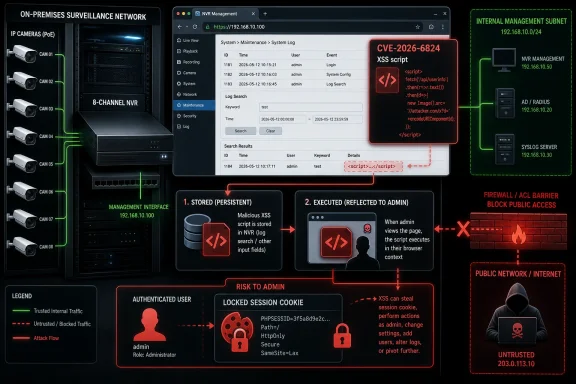
A stored cross-site scripting vulnerability is different from a one-off malicious link. The attacker’s script is saved by the vulnerable application and later served back to legitimate users. In this advisory, CISA says the flaw stems from insufficient sanitization of user-supplied input in functional modules on certain 1xxx series NVR devices, allowing malicious scripts to persist on the device backend.
That persistence changes the risk calculus. The attacker does not merely need to trick an administrator into visiting a hostile website; the poisoned page is inside the management interface the administrator already trusts. When the admin logs in and browses to the affected page, the browser runs the attacker’s script in the context of the NVR interface.
That is why the CVSS score lands at 8.4, rated high, even though the vector requires high privileges and user interaction. The scoring reflects a subtle but important reality: once the script executes in an authenticated user’s browser, the boundary between “viewing a page” and “performing privileged actions” becomes dangerously thin.
That framing does not fit embedded web consoles. A stored XSS vulnerability can be planted by a user with one set of permissions and triggered later by an administrator with broader authority. It can also be useful after a weaker compromise, especially in environments where installer accounts, vendor accounts, or shared maintenance logins exist.
CISA’s advisory describes possible outcomes including session hijacking, unauthorized actions under the victim’s privileges, sensitive data exposure or manipulation, and degradation of system integrity. Those are not abstract browser-security consequences. On an NVR, unauthorized actions can mean changing configuration, tampering with access controls, interfering with logs, altering camera settings, or weakening the surveillance system at the moment it is supposed to provide evidence.
The most uncomfortable part is that the “victim” in this attack path may be the organization’s most trusted operator. The admin who logs in to verify a camera feed or update a setting becomes the delivery mechanism. That inversion is why stored XSS remains a serious class of bug long after the industry learned to stop laughing at “just JavaScript.”
That should be simple. In practice, appliance firmware management is one of the least mature corners of IT operations. Many organizations know exactly which Windows builds they are running, which Microsoft 365 tenant policies changed last quarter, and which endpoint agents are lagging by version. Ask the same team for a precise inventory of NVR firmware, and the room often goes quiet.
The problem is not negligence so much as category confusion. Surveillance appliances are frequently purchased and maintained through facilities, physical security contractors, local integrators, or regional installers. The people who own the risk may not be the people who receive CISA bulletins, and the people who receive the bulletins may not have credentials for the device.
That gap is where vulnerabilities age. A Windows server missing a cumulative update is visible to a patch dashboard; an NVR with an old web build may be visible only to whoever remembers the password. The CP Plus advisory is a reminder that unmanaged firmware is not a procurement detail. It is part of the attack surface.
Video recorders occupy an awkward position in security architecture. They are security devices, but they are also networked computers. They often have web interfaces, cloud features, mobile access options, RTSP streams, storage, administrative roles, and sometimes integrations with access control systems. In other words, they are exactly the kind of device attackers like to find because defenders tend not to watch them with the same rigor applied to laptops and servers.
The countries listed also hint at another operational challenge: support and firmware distribution can be uneven across regions. Customers may rely on installers, resellers, local service teams, or vendor support desks rather than centralized automated update channels. Even when a fix exists, the path from advisory to patched device may run through a phone call, a maintenance window, and a person who knows how not to brick the recorder.
That is not an argument against deploying NVRs. It is an argument against pretending they are passive electronics. If the web interface can execute attacker-supplied script in an administrator’s browser, the device is participating in the same web-security universe as every intranet app and cloud console.
Modern browsers do a great deal to constrain hostile code, but they do not magically protect an authenticated web application from its own failure to neutralize input. If the application stores and reflects attacker-controlled script, the browser treats it as part of the application. That is the whole point of XSS: the attacker borrows the site’s trust.
This is especially relevant where NVRs are managed from shared security desks. A surveillance operator may use the same Windows machine to check camera feeds, export footage, read email, open tickets, and access internal portals. If that machine is also exempted from some restrictions “because the cameras need to work,” it becomes a privileged bridge between physical security and business IT.
The defensive answer is not to panic about every camera box. It is to reduce the number of assumptions. Management interfaces should not be reachable from ordinary user VLANs. Admin browsers should not be casual browsing environments. Credentials used for appliance administration should not be shared, reused, or stored in a way that turns one device flaw into a wider credential incident.
Stored XSS flaws in appliance interfaces are also less likely to create the kind of loud, internet-scale telemetry associated with worms or mass scanning. If an attacker compromises a device in a small facility, plants script, waits for an admin, and uses the session to make changes, the incident may never be classified under the CVE. It may look like a misconfiguration, a strange login, or a support oddity.
That is one of the persistent weaknesses in appliance security reporting. The absence of public exploitation can coexist with real risk because the affected environments lack the instrumentation to prove the negative. A SIEM may know when a Windows endpoint launches PowerShell, but it may not know when an NVR configuration page rendered unexpected script to an administrator.
The right response is proportional urgency. This is not a call to rip out CP Plus hardware or declare every NVR compromised. It is a call to identify affected devices, apply the vendor firmware, and review where the management interface is reachable from. In security operations, boring follow-through is usually what separates a bulletin from an incident.
But patching alone is not a satisfying long-term control because embedded devices rarely receive updates with the cadence defenders would prefer. Even responsible vendors have to support fragmented model lines, regional SKUs, installer channels, and hardware revisions. A patched NVR today may be a lagging NVR next year unless someone owns the lifecycle.
CISA’s recommended practices therefore deserve more attention than they usually get. Minimize network exposure. Keep control-system devices and remote systems off the public internet. Place them behind firewalls. Isolate them from business networks. Use VPNs for remote access, while remembering that a VPN is only as secure as the devices and credentials behind it.
Those recommendations can sound like boilerplate because they appear in many advisories. They are boilerplate only in the sense that seatbelts are boilerplate. The same advice keeps reappearing because many real environments still violate it, often for convenience: a port forward for a vendor, a flat network for ease of installation, a shared admin account because the integrator needed access on a Friday afternoon.
For a CP Plus NVR, segmentation should be the baseline. Camera networks should be separated from user networks. NVR management should be restricted to known admin workstations or jump hosts. Remote access should terminate through controlled services with logging, MFA where possible, and a clear owner. If those measures are in place, the vulnerability’s practical exploitability drops sharply.
The CP Plus advisory exposes that split. The affected product is specific, but the operational pattern is general. There is hardware versioning, web interface versioning, system firmware versioning, and a vendor-supplied update. If an organization cannot answer which of those versions it runs, the advisory cannot be acted on with confidence.
This is where IT and facilities need a more explicit handshake. Security appliances should be assigned an owner, a maintenance path, a network zone, a credential policy, and an update process. That does not mean every sysadmin needs to become a camera technician. It means the organization cannot outsource awareness of its own attack surface.
A practical inventory entry for an NVR should include model, serial number, firmware versions, management IP, network segment, exposure status, support contact, installer or reseller, and the business owner responsible for approving downtime. Without that, every advisory becomes a scavenger hunt. Attackers love scavenger hunts when defenders are the ones doing the searching.
The missing story is how people actually use NVRs. An installer logs in during setup. A guard checks playback. A manager exports footage after an incident. An administrator adds a camera. A vendor support technician asks for remote access. Each step creates an opportunity for the web interface to be touched by a browser with real authority.
Stored XSS abuses that routine. It waits inside an interface until the right person arrives. That makes it less like a smash-and-grab exploit and more like a booby trap placed in the management plane. The attacker’s leverage comes from patience and from the target’s trust in its own equipment.
This is why the vulnerability belongs in the same conversation as identity hygiene. Session cookies, local browser storage, saved passwords, and shared administrative accounts can amplify the impact. If the administrator’s browser session is the thing being attacked, then browser isolation, least privilege, and account separation become part of NVR security rather than desktop hardening trivia.
The bigger action is to make this advisory a forcing function for network hygiene. If an NVR management page is reachable from general-purpose desktops, that should be treated as a design smell. If it is reachable from the internet, it should be treated as an urgent exposure problem. If nobody can say who owns the firmware lifecycle, that is a governance issue wearing a facilities badge.
For Windows-heavy shops, there is also a workstation angle. Administer embedded devices from hardened management systems, not everyday browsing profiles. Avoid saving appliance admin credentials in browsers. Use separate accounts for appliance administration where the product supports it. Log access through a jump host or controlled management subnet when possible.
The best outcome is not merely “firmware updated.” The best outcome is that the organization can answer, next time, within minutes: whether it owns the affected product, where it is, which firmware it runs, who can reach it, and how it will be patched. That is the difference between vulnerability response and vulnerability theater.
The concrete response is straightforward:
 The Surveillance Box Has Become a Browser Attack Surface
The affected CP Plus device is an eight-channel network video recorder, the sort of appliance that sits between IP cameras, storage, operators, and administrators. In many small and midsize environments, NVRs are treated less like servers and more like fixtures: installed once, checked when video is needed, and otherwise trusted to keep recording. That operational invisibility is exactly why a stored XSS flaw matters.A stored cross-site scripting vulnerability is different from a one-off malicious link. The attacker’s script is saved by the vulnerable application and later served back to legitimate users. In this advisory, CISA says the flaw stems from insufficient sanitization of user-supplied input in functional modules on certain 1xxx series NVR devices, allowing malicious scripts to persist on the device backend.
That persistence changes the risk calculus. The attacker does not merely need to trick an administrator into visiting a hostile website; the poisoned page is inside the management interface the administrator already trusts. When the admin logs in and browses to the affected page, the browser runs the attacker’s script in the context of the NVR interface.
That is why the CVSS score lands at 8.4, rated high, even though the vector requires high privileges and user interaction. The scoring reflects a subtle but important reality: once the script executes in an authenticated user’s browser, the boundary between “viewing a page” and “performing privileged actions” becomes dangerously thin.
High Privileges Do Not Make This Harmless
The most tempting dismissal is also the most dangerous one: the CVSS vector lists high privileges required. In ordinary desktop vulnerability triage, “PR:H” can suggest a smaller blast radius. If an attacker already has admin rights, the thinking goes, surely the game is already over.That framing does not fit embedded web consoles. A stored XSS vulnerability can be planted by a user with one set of permissions and triggered later by an administrator with broader authority. It can also be useful after a weaker compromise, especially in environments where installer accounts, vendor accounts, or shared maintenance logins exist.
CISA’s advisory describes possible outcomes including session hijacking, unauthorized actions under the victim’s privileges, sensitive data exposure or manipulation, and degradation of system integrity. Those are not abstract browser-security consequences. On an NVR, unauthorized actions can mean changing configuration, tampering with access controls, interfering with logs, altering camera settings, or weakening the surveillance system at the moment it is supposed to provide evidence.
The most uncomfortable part is that the “victim” in this attack path may be the organization’s most trusted operator. The admin who logs in to verify a camera feed or update a setting becomes the delivery mechanism. That inversion is why stored XSS remains a serious class of bug long after the industry learned to stop laughing at “just JavaScript.”
The Affected Versions Tell a Familiar Firmware Story
CISA lists CP-UNR-108F1 hardware version V1.0, web version V3.2.7.128806, and system version V4.001.00AT009.0.R as affected. CP Plus’s recommended fix is to update firmware to the latest available release, with the advisory naming CP-UNR-AxxxMars_PN_15_Q_00_V1.00.14.01.T.260326 as the relevant mitigation build. The vendor also points customers to support channels for firmware access and upgrade instructions.That should be simple. In practice, appliance firmware management is one of the least mature corners of IT operations. Many organizations know exactly which Windows builds they are running, which Microsoft 365 tenant policies changed last quarter, and which endpoint agents are lagging by version. Ask the same team for a precise inventory of NVR firmware, and the room often goes quiet.
The problem is not negligence so much as category confusion. Surveillance appliances are frequently purchased and maintained through facilities, physical security contractors, local integrators, or regional installers. The people who own the risk may not be the people who receive CISA bulletins, and the people who receive the bulletins may not have credentials for the device.
That gap is where vulnerabilities age. A Windows server missing a cumulative update is visible to a patch dashboard; an NVR with an old web build may be visible only to whoever remembers the password. The CP Plus advisory is a reminder that unmanaged firmware is not a procurement detail. It is part of the attack surface.
CISA’s Deployment List Makes This More Than a Lab Bug
The advisory identifies deployment in India, Nepal, the United Arab Emirates, and Gambia, and places the affected product in commercial facilities, critical manufacturing, and emergency services sectors. That combination matters. A flaw in a consumer gadget is one thing; a flaw in surveillance infrastructure used around factories, offices, and emergency environments is another.Video recorders occupy an awkward position in security architecture. They are security devices, but they are also networked computers. They often have web interfaces, cloud features, mobile access options, RTSP streams, storage, administrative roles, and sometimes integrations with access control systems. In other words, they are exactly the kind of device attackers like to find because defenders tend not to watch them with the same rigor applied to laptops and servers.
The countries listed also hint at another operational challenge: support and firmware distribution can be uneven across regions. Customers may rely on installers, resellers, local service teams, or vendor support desks rather than centralized automated update channels. Even when a fix exists, the path from advisory to patched device may run through a phone call, a maintenance window, and a person who knows how not to brick the recorder.
That is not an argument against deploying NVRs. It is an argument against pretending they are passive electronics. If the web interface can execute attacker-supplied script in an administrator’s browser, the device is participating in the same web-security universe as every intranet app and cloud console.
The Browser Is the Bridge Attackers Actually Want
For WindowsForum readers, the most relevant victim system may not be the CP Plus recorder itself. It may be the Windows workstation used to administer it. A malicious script running in the NVR’s trusted web interface can abuse that session, present convincing prompts, scrape page data, or steer the operator into actions that appear native to the device.Modern browsers do a great deal to constrain hostile code, but they do not magically protect an authenticated web application from its own failure to neutralize input. If the application stores and reflects attacker-controlled script, the browser treats it as part of the application. That is the whole point of XSS: the attacker borrows the site’s trust.
This is especially relevant where NVRs are managed from shared security desks. A surveillance operator may use the same Windows machine to check camera feeds, export footage, read email, open tickets, and access internal portals. If that machine is also exempted from some restrictions “because the cameras need to work,” it becomes a privileged bridge between physical security and business IT.
The defensive answer is not to panic about every camera box. It is to reduce the number of assumptions. Management interfaces should not be reachable from ordinary user VLANs. Admin browsers should not be casual browsing environments. Credentials used for appliance administration should not be shared, reused, or stored in a way that turns one device flaw into a wider credential incident.
The Public-Exploitation Note Is Not a Permission Slip
CISA says it has not received reports of known public exploitation specifically targeting this vulnerability. That is useful information, but it should not be mistaken for reassurance that the risk can sit in the queue indefinitely. For defenders, “no known exploitation” often means only that exploitation has not been publicly observed, confirmed, and reported through the right channels.Stored XSS flaws in appliance interfaces are also less likely to create the kind of loud, internet-scale telemetry associated with worms or mass scanning. If an attacker compromises a device in a small facility, plants script, waits for an admin, and uses the session to make changes, the incident may never be classified under the CVE. It may look like a misconfiguration, a strange login, or a support oddity.
That is one of the persistent weaknesses in appliance security reporting. The absence of public exploitation can coexist with real risk because the affected environments lack the instrumentation to prove the negative. A SIEM may know when a Windows endpoint launches PowerShell, but it may not know when an NVR configuration page rendered unexpected script to an administrator.
The right response is proportional urgency. This is not a call to rip out CP Plus hardware or declare every NVR compromised. It is a call to identify affected devices, apply the vendor firmware, and review where the management interface is reachable from. In security operations, boring follow-through is usually what separates a bulletin from an incident.
The Fix Is Firmware, but the Control Is Segmentation
The vendor’s remediation is firmware update. That is the essential first step, and administrators should verify the exact device model, hardware revision, web version, and system version before applying an update. Firmware mismatches on surveillance equipment can be unforgiving, so change control still matters.But patching alone is not a satisfying long-term control because embedded devices rarely receive updates with the cadence defenders would prefer. Even responsible vendors have to support fragmented model lines, regional SKUs, installer channels, and hardware revisions. A patched NVR today may be a lagging NVR next year unless someone owns the lifecycle.
CISA’s recommended practices therefore deserve more attention than they usually get. Minimize network exposure. Keep control-system devices and remote systems off the public internet. Place them behind firewalls. Isolate them from business networks. Use VPNs for remote access, while remembering that a VPN is only as secure as the devices and credentials behind it.
Those recommendations can sound like boilerplate because they appear in many advisories. They are boilerplate only in the sense that seatbelts are boilerplate. The same advice keeps reappearing because many real environments still violate it, often for convenience: a port forward for a vendor, a flat network for ease of installation, a shared admin account because the integrator needed access on a Friday afternoon.
For a CP Plus NVR, segmentation should be the baseline. Camera networks should be separated from user networks. NVR management should be restricted to known admin workstations or jump hosts. Remote access should terminate through controlled services with logging, MFA where possible, and a clear owner. If those measures are in place, the vulnerability’s practical exploitability drops sharply.
The Real Inventory Problem Sits Outside the SOC Dashboard
Windows administrators have spent years learning to inventory endpoints, servers, browsers, agents, and cloud identities. Physical security devices often remain outside that discipline. They live in racks, ceilings, closets, guard stations, and cabinets, but not always in the asset-management system that drives patching and risk decisions.The CP Plus advisory exposes that split. The affected product is specific, but the operational pattern is general. There is hardware versioning, web interface versioning, system firmware versioning, and a vendor-supplied update. If an organization cannot answer which of those versions it runs, the advisory cannot be acted on with confidence.
This is where IT and facilities need a more explicit handshake. Security appliances should be assigned an owner, a maintenance path, a network zone, a credential policy, and an update process. That does not mean every sysadmin needs to become a camera technician. It means the organization cannot outsource awareness of its own attack surface.
A practical inventory entry for an NVR should include model, serial number, firmware versions, management IP, network segment, exposure status, support contact, installer or reseller, and the business owner responsible for approving downtime. Without that, every advisory becomes a scavenger hunt. Attackers love scavenger hunts when defenders are the ones doing the searching.
The CVSS Vector Hides the Human Workflow
The CVSS vector for this vulnerability is useful, but it cannot capture the entire workflow around a surveillance system. The score says the attack is network-based, low complexity, requires high privileges, requires user interaction, and can have high confidentiality, integrity, and availability impacts with changed scope. That is an efficient technical summary, not a complete operational story.The missing story is how people actually use NVRs. An installer logs in during setup. A guard checks playback. A manager exports footage after an incident. An administrator adds a camera. A vendor support technician asks for remote access. Each step creates an opportunity for the web interface to be touched by a browser with real authority.
Stored XSS abuses that routine. It waits inside an interface until the right person arrives. That makes it less like a smash-and-grab exploit and more like a booby trap placed in the management plane. The attacker’s leverage comes from patience and from the target’s trust in its own equipment.
This is why the vulnerability belongs in the same conversation as identity hygiene. Session cookies, local browser storage, saved passwords, and shared administrative accounts can amplify the impact. If the administrator’s browser session is the thing being attacked, then browser isolation, least privilege, and account separation become part of NVR security rather than desktop hardening trivia.
The Patch Note Every Camera Network Should Force Into the Change Calendar
The immediate path is narrow enough that organizations should be able to move quickly. Identify CP Plus CP-UNR-108F1 units, check for the affected hardware, web, and system versions, obtain the corrected firmware through the vendor’s supported channel, and apply it in a controlled maintenance window. Afterward, validate that camera recording, playback, user roles, time settings, retention, and remote access behave as expected.The bigger action is to make this advisory a forcing function for network hygiene. If an NVR management page is reachable from general-purpose desktops, that should be treated as a design smell. If it is reachable from the internet, it should be treated as an urgent exposure problem. If nobody can say who owns the firmware lifecycle, that is a governance issue wearing a facilities badge.
For Windows-heavy shops, there is also a workstation angle. Administer embedded devices from hardened management systems, not everyday browsing profiles. Avoid saving appliance admin credentials in browsers. Use separate accounts for appliance administration where the product supports it. Log access through a jump host or controlled management subnet when possible.
The best outcome is not merely “firmware updated.” The best outcome is that the organization can answer, next time, within minutes: whether it owns the affected product, where it is, which firmware it runs, who can reach it, and how it will be patched. That is the difference between vulnerability response and vulnerability theater.
The Small Recorder in the Rack Is Part of the Enterprise
This advisory is easy to underestimate because it concerns a specific NVR model, a specific stored XSS flaw, and a vendor firmware update rather than a headline-grabbing Windows zero-day. That would be a mistake. The affected device sits at the intersection of physical security, web application security, endpoint trust, and network segmentation.The concrete response is straightforward:
- Organizations should identify CP Plus CP-UNR-108F1 eight-channel NVRs and compare their hardware, web, and system versions against the affected versions named by CISA.
- Administrators should obtain and apply the vendor-recommended firmware update through CP Plus support or the published firmware channel, using normal backup and maintenance-window discipline.
- Security teams should restrict NVR management interfaces to dedicated management networks, jump hosts, or known administrator workstations instead of broad user VLANs.
- Remote access to surveillance systems should use controlled access paths such as updated VPN infrastructure, not direct internet exposure or unmanaged port forwarding.
- Asset inventories should treat NVRs as maintained networked systems, including firmware version, owner, support contact, and exposure status.
- Teams should review browser and credential practices for appliance administration, because stored XSS attacks target the administrator’s trusted session as much as the device itself.
References
- Primary source: CISA
Published: 2026-05-28T12:00:00+00:00

CP Plus 8 Ch. Network Video Recorder | CISA
www.cisa.gov
- Related coverage: cpplusworld.com
- Related coverage: sbmtechnologies.in

SBM Technologies | CCTV & Security Systems Chennai
Chennai's trusted CCTV camera supplier & security system installer. We handle CCTV, IP cameras, access control, fire alarms & video door phones for homes & businesses. Call 9080313185.
www.sbmtechnologies.in
- Related coverage: pdf4pro.com
