

Citi has named Panasonic Holdings and Mitsubishi Electric as its preferred picks in Japan’s industrial and consumer electronics sector, according to an Investing.com report published on June 23, 2026, putting two old-line Japanese manufacturers back into the spotlight for investors watching AI-adjacent hardware. The call matters less because Citi has discovered a new chip darling than because it points to a broader rotation: away from pure semiconductor euphoria and toward the companies that turn silicon, batteries, motors, sensors, factory systems, and power electronics into deployable infrastructure. For WindowsForum readers, this is not just a Tokyo stock-market footnote. It is another sign that the next phase of the AI hardware boom may be fought in factories, edge devices, energy systems, and industrial platforms rather than only in cloud data centers.
The headline says “Japan electronics,” but the subtext is more interesting: Wall Street is still trying to decide which companies benefit when the AI cycle leaves the GPU rack and enters the physical economy. Panasonic and Mitsubishi Electric are not the first names that come to mind when people talk about generative AI, Copilot PCs, or cloud inference. They are, however, exactly the kind of companies that become more important when computing demand starts showing up as power demand, thermal demand, factory automation demand, battery demand, and edge-device demand.
That distinction matters because the market has spent the last two years rewarding the most obvious AI beneficiaries. Nvidia, Broadcom, memory makers, hyperscalers, and server suppliers have been the cleanest story. But every hardware supercycle eventually spreads into less glamorous layers: industrial control, power conversion, manufacturing equipment, cooling, components, and the consumer electronics brands that decide which technologies make it into mass-market products.
Citi’s reported preference for Panasonic and Mitsubishi Electric fits that rotation. It suggests a belief that Japan’s electronics incumbents can still translate deep manufacturing expertise into earnings leverage, even as the industry’s vocabulary changes from televisions and appliances to automation, electrification, data centers, batteries, and smart infrastructure.
The argument is not that these companies are suddenly nimble software platforms. It is that they own pieces of the physical stack that software increasingly depends on. AI may be sold as a cloud service, but it is built out of metals, motors, capacitors, power modules, battery cells, sensors, air conditioners, factory robots, and energy-management systems.
That makes Citi’s reported preference notable. Panasonic has spent years trying to convince investors that it is more than a declining consumer-electronics name. Its battery operations, automotive exposure, factory systems, and energy-related businesses give it a different kind of relevance in a market obsessed with electrification and compute intensity.
The hard part is that Panasonic’s strengths have often been buried inside a complicated corporate structure. Investors like simple narratives, and Panasonic has not always offered one. It is exposed to EV cycles, consumer demand, industrial conditions, currency swings, and restructuring costs at the same time.
That complexity cuts both ways. It can obscure performance when the company is trying to simplify itself, but it can also create opportunity if the market underprices the parts that are improving. Citi’s call appears to lean toward the latter interpretation: that Panasonic’s restructuring and exposure to energy-related markets may matter more than the drag of its old consumer-electronics image.
For PC and Windows watchers, Panasonic’s relevance is not merely nostalgic. Battery technology, ruggedized devices, industrial mobility, and factory digitization all intersect with the Windows ecosystem in less visible ways. The next generation of enterprise computing is not only about thinner laptops; it is about machines that run on factory floors, in vehicles, in energy facilities, and at the edge of corporate networks.
That matters because Mitsubishi Electric’s fiscal 2026 performance gave analysts something tangible to point to. The company reported full-year revenue growth, stronger profit, and a fourth-quarter result that exceeded expectations. In a market where many AI-adjacent claims still rely on future demand, Mitsubishi Electric has the advantage of showing improvement in current numbers.
The company’s industrial profile also fits the moment. AI is pushing enterprises to modernize factories, warehouses, grid systems, and building controls, but those upgrades do not happen through software subscriptions alone. They require programmable controllers, drives, sensors, power systems, machine vision, cooling, and integration with legacy equipment.
This is where Mitsubishi Electric’s old-fashioned industrial DNA becomes newly fashionable. The company operates in precisely the kind of infrastructure-heavy markets that benefit when businesses move from AI experimentation to capital spending. Automation, electrification, and efficiency are not speculative use cases; they are board-level spending categories.
The risk is that industrial electronics remain cyclical. A weak manufacturing environment, delayed capital expenditure, or margin pressure in China can still hit the business. But Citi’s preference suggests that the bank sees enough earnings quality and structural demand to justify putting Mitsubishi Electric near the top of the sector list.
That is why the phrase “Japan electronics” can be misleading. This is not just about gadgets. It is about the parts of the technology economy where reliability, process knowledge, and manufacturing scale still matter.
The AI boom has intensified that point. Cloud companies can buy GPUs, but they also need power infrastructure. Manufacturers can deploy AI models, but they also need equipment that can measure, move, assemble, inspect, and control physical processes. Automakers can promise software-defined vehicles, but they still need batteries, sensors, power electronics, and production discipline.
Japanese electronics firms sit close to all of those pressure points. They may not own the software interface, but they often own the parts that determine whether the software can be deployed at scale. That is a less glamorous position than owning the user relationship, yet it can be durable.
Citi’s call therefore reads as a vote for hardware discipline. It says that investors may need to look beyond the companies with the best AI marketing and toward the firms whose products are required when AI moves from demo to deployment.
But enterprise Windows has always extended beyond the office laptop. It runs inside rugged tablets, industrial PCs, manufacturing terminals, diagnostic machines, logistics systems, point-of-sale devices, and embedded environments. The health of industrial electronics suppliers affects the devices and systems that Windows administrators eventually have to secure, patch, image, monitor, and support.
The next wave of enterprise AI is likely to make that boundary even blurrier. A factory running machine-vision inference, predictive maintenance, digital twins, and automated quality control may involve Windows endpoints, Linux appliances, cloud services, real-time controllers, and proprietary industrial networks at once. The IT department does not get to opt out just because the equipment sits on a production line.
That is why Japan’s industrial electronics sector belongs in a Windows conversation. The platform wars are no longer confined to PCs and smartphones. They increasingly involve operational technology, edge computing, identity systems, telemetry pipelines, and device-management layers that tie factory hardware back into corporate IT.
Microsoft knows this, which is why Azure IoT, edge management, identity, security, and industrial partnerships have been recurring themes in its enterprise strategy. The companies Citi is highlighting are part of the physical terrain those software platforms must navigate.
Panasonic and Mitsubishi Electric are not identical beneficiaries of that shift, but both sit near it. Panasonic has exposure to energy storage and battery-related markets. Mitsubishi Electric has exposure to power systems, industrial automation, and infrastructure. Those are not side issues in an AI economy; they are preconditions.
This is particularly relevant as inference moves closer to users and machines. Training frontier models remains a hyperscale data-center problem, but inference can happen in many places: cloud regions, enterprise servers, PCs, industrial gateways, vehicles, cameras, and sensors. Each move away from the centralized cloud creates demand for hardware that can operate reliably in less controlled environments.
That is a different kind of AI investment thesis. It is less about who sells the most accelerators this quarter and more about who enables a decade of distributed compute. It rewards companies that understand power budgets, reliability, thermal management, and integration with real-world equipment.
The irony is that AI, the most hyped software story of the decade, may end up strengthening some of the least software-like businesses in the technology sector. The more compute becomes ambient, the more valuable the physical layer becomes.
The attraction is clear. A company like Mitsubishi Electric or Panasonic can be framed as an AI infrastructure beneficiary without requiring investors to buy into the most crowded semiconductor trades. That does not automatically make the stocks cheap, but it gives portfolio managers a different way to express the same macro view.
The danger is equally clear. “AI-adjacent” can become a lazy label. Not every company that sells power electronics, batteries, sensors, or factory equipment will see material earnings upside from AI. Some may benefit only indirectly, slowly, or not at all.
That is why the quality of the business matters more than the buzzword. Panasonic’s restructuring progress, battery economics, margin discipline, and capital allocation will determine whether the thesis works. Mitsubishi Electric’s automation demand, pricing power, execution, and segment profitability will matter more than any generic claim about industrial AI.
Citi’s call should therefore be read as a directional judgment, not a magic stamp. It identifies companies that may sit in attractive lanes, but investors still have to ask whether those lanes translate into cash flow, margins, and returns.
That tension is especially important in AI-era markets. Demand can shift quickly, standards can change, customers can delay projects, and competitors from China, Taiwan, South Korea, Europe, and the United States can move aggressively. The companies that win will not merely be those with the best historic capabilities; they will be those that convert those capabilities into focused execution.
Panasonic’s challenge is to make restructuring feel real rather than perpetual. Investors have heard many conglomerates promise simplification. They tend to reward results only when divestitures, cost cuts, capital discipline, and segment performance become visible in the numbers.
Mitsubishi Electric’s challenge is different. It must show that its industrial and infrastructure portfolio can keep compounding even as global manufacturing cycles wobble. The company’s stronger fiscal 2026 results help, but one good reporting period does not eliminate macro risk.
For IT pros, this is a familiar story in another form. Legacy vendors can be incredibly resilient, but they have to keep proving that resilience is not just installed-base lock-in. The same is true in industrial electronics.
That matters for electronics because the world is no longer comfortable treating supply chains as invisible plumbing. Semiconductors, batteries, industrial controls, and power systems are now strategic assets. Governments subsidize them, companies audit them, and customers increasingly ask where components come from.
Panasonic and Mitsubishi Electric benefit from that environment in different ways. Panasonic’s battery and energy businesses sit inside a global scramble for electrification capacity. Mitsubishi Electric’s automation, power, and infrastructure operations are relevant to countries trying to modernize domestic industry without becoming overly dependent on any one supplier.
This does not mean Japan wins automatically. Costs are high, demographics are challenging, and competitors are formidable. But Japanese firms have credibility in high-reliability manufacturing, and that credibility has become more valuable as customers worry about resilience.
The result is a technology market that increasingly rewards boring strengths. Process control, quality assurance, supplier discipline, and long-term industrial relationships are not exciting on a keynote slide. They are extremely exciting when a factory, grid, battery plant, or data center has to run for years.
Japan adds another layer of complexity. A weaker yen can help exporters, but it can also raise import costs and distort comparisons for international investors. Domestic monetary policy, wage growth, and capital-market reforms all influence how Japanese equities are valued.
Then there is the sector problem. Industrial and consumer electronics is a broad bucket. A company can benefit from automation demand while another segment struggles with consumer softness. A battery business can look strategically important while facing margin pressure. A strong quarter can coexist with uncertain guidance.
That is why the most useful reading of Citi’s call is not “buy these two stocks.” It is that major banks are broadening the AI and electronics conversation beyond the usual U.S. semiconductor complex. The market is asking which industrial companies can monetize the physical demands of digital transformation.
For WindowsForum’s audience, that framing is more useful than the ticker call itself. The practical question is not whether a reader should trade Tokyo-listed shares. It is whether the enterprise technology stack is shifting toward more industrial, distributed, energy-aware computing. The answer increasingly looks like yes.
A laptop with an NPU is electronics. A data-center power module is electronics. A robot arm, a smart meter, a battery-management system, an industrial controller, a heat pump, a sensor array, and a rugged Windows tablet are all electronics. The software story only becomes real when electronics can carry it.
That is why Panasonic and Mitsubishi Electric are plausible names in a market still obsessed with AI. They operate where compute meets energy, motion, manufacturing, and physical reliability. If AI remains trapped in chat windows, their relevance is limited. If AI becomes embedded in work sites, vehicles, factories, grids, and devices, their relevance expands.
This is also where Microsoft’s strategy and Japan’s electronics strategy quietly intersect. Windows, Azure, identity, endpoint security, and management tools increasingly have to operate in environments that were once considered outside conventional IT. Industrial electronics companies provide much of the hardware substrate for that expansion.
The next enterprise endpoint may not look like a laptop. It may be a panel on a production line, a battery diagnostic system, a logistics scanner, a machine-vision station, or a field-service device. That is still an IT problem, and it is increasingly an AI problem.
The broader implications are more practical:
The most interesting thing about Panasonic and Mitsubishi Electric is that they are not fashionable in the same way as the AI names dominating U.S. markets. They are older, messier, more industrial, and more exposed to the physical world. That may be exactly why they are worth watching. If the next stage of AI is deployment rather than demonstration, the winners will not only be the companies that make intelligence cheaper; they will be the companies that make intelligence usable, durable, powered, cooled, secured, and embedded in the places where work actually happens.
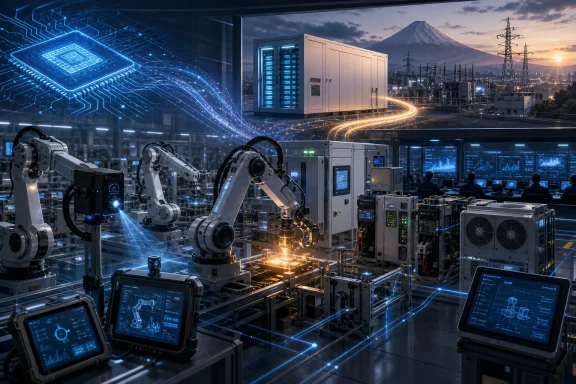 Citi’s Call Is Really About the Second Layer of the AI Trade
The headline says “Japan electronics,” but the subtext is more interesting: Wall Street is still trying to decide which companies benefit when the AI cycle leaves the GPU rack and enters the physical economy. Panasonic and Mitsubishi Electric are not the first names that come to mind when people talk about generative AI, Copilot PCs, or cloud inference. They are, however, exactly the kind of companies that become more important when computing demand starts showing up as power demand, thermal demand, factory automation demand, battery demand, and edge-device demand.That distinction matters because the market has spent the last two years rewarding the most obvious AI beneficiaries. Nvidia, Broadcom, memory makers, hyperscalers, and server suppliers have been the cleanest story. But every hardware supercycle eventually spreads into less glamorous layers: industrial control, power conversion, manufacturing equipment, cooling, components, and the consumer electronics brands that decide which technologies make it into mass-market products.
Citi’s reported preference for Panasonic and Mitsubishi Electric fits that rotation. It suggests a belief that Japan’s electronics incumbents can still translate deep manufacturing expertise into earnings leverage, even as the industry’s vocabulary changes from televisions and appliances to automation, electrification, data centers, batteries, and smart infrastructure.
The argument is not that these companies are suddenly nimble software platforms. It is that they own pieces of the physical stack that software increasingly depends on. AI may be sold as a cloud service, but it is built out of metals, motors, capacitors, power modules, battery cells, sensors, air conditioners, factory robots, and energy-management systems.
Panasonic Is No Longer Just a Consumer Brand
Panasonic’s brand identity in much of the West is still shaped by consumer electronics: TVs, cameras, batteries, appliances, and a long history of home hardware. That memory is not wrong, but it is incomplete. The modern Panasonic story is much more about energy, mobility, industrial systems, supply chains, and a sprawling restructuring effort designed to make a legacy conglomerate more investable.That makes Citi’s reported preference notable. Panasonic has spent years trying to convince investors that it is more than a declining consumer-electronics name. Its battery operations, automotive exposure, factory systems, and energy-related businesses give it a different kind of relevance in a market obsessed with electrification and compute intensity.
The hard part is that Panasonic’s strengths have often been buried inside a complicated corporate structure. Investors like simple narratives, and Panasonic has not always offered one. It is exposed to EV cycles, consumer demand, industrial conditions, currency swings, and restructuring costs at the same time.
That complexity cuts both ways. It can obscure performance when the company is trying to simplify itself, but it can also create opportunity if the market underprices the parts that are improving. Citi’s call appears to lean toward the latter interpretation: that Panasonic’s restructuring and exposure to energy-related markets may matter more than the drag of its old consumer-electronics image.
For PC and Windows watchers, Panasonic’s relevance is not merely nostalgic. Battery technology, ruggedized devices, industrial mobility, and factory digitization all intersect with the Windows ecosystem in less visible ways. The next generation of enterprise computing is not only about thinner laptops; it is about machines that run on factory floors, in vehicles, in energy facilities, and at the edge of corporate networks.
Mitsubishi Electric Looks Like the Cleaner Industrial Bet
Mitsubishi Electric is a different story. It has consumer exposure, but the investment case is more directly tied to industrial automation, power systems, building systems, data-center infrastructure, defense-adjacent electronics, and high-reliability components. If Panasonic is a restructuring-and-energy story, Mitsubishi Electric looks more like a machinery-and-infrastructure story with electronics at its core.That matters because Mitsubishi Electric’s fiscal 2026 performance gave analysts something tangible to point to. The company reported full-year revenue growth, stronger profit, and a fourth-quarter result that exceeded expectations. In a market where many AI-adjacent claims still rely on future demand, Mitsubishi Electric has the advantage of showing improvement in current numbers.
The company’s industrial profile also fits the moment. AI is pushing enterprises to modernize factories, warehouses, grid systems, and building controls, but those upgrades do not happen through software subscriptions alone. They require programmable controllers, drives, sensors, power systems, machine vision, cooling, and integration with legacy equipment.
This is where Mitsubishi Electric’s old-fashioned industrial DNA becomes newly fashionable. The company operates in precisely the kind of infrastructure-heavy markets that benefit when businesses move from AI experimentation to capital spending. Automation, electrification, and efficiency are not speculative use cases; they are board-level spending categories.
The risk is that industrial electronics remain cyclical. A weak manufacturing environment, delayed capital expenditure, or margin pressure in China can still hit the business. But Citi’s preference suggests that the bank sees enough earnings quality and structural demand to justify putting Mitsubishi Electric near the top of the sector list.
The Japan Electronics Trade Is a Bet on Hardware Discipline
Japan’s electronics industry has lived through multiple reinventions. It dominated consumer devices, lost ground in some categories to South Korea, Taiwan, China, and the United States, then rebuilt parts of its relevance around components, industrial systems, materials, equipment, sensors, and specialized manufacturing. The result is an industry that looks less flashy than it once did, but arguably more embedded in global supply chains.That is why the phrase “Japan electronics” can be misleading. This is not just about gadgets. It is about the parts of the technology economy where reliability, process knowledge, and manufacturing scale still matter.
The AI boom has intensified that point. Cloud companies can buy GPUs, but they also need power infrastructure. Manufacturers can deploy AI models, but they also need equipment that can measure, move, assemble, inspect, and control physical processes. Automakers can promise software-defined vehicles, but they still need batteries, sensors, power electronics, and production discipline.
Japanese electronics firms sit close to all of those pressure points. They may not own the software interface, but they often own the parts that determine whether the software can be deployed at scale. That is a less glamorous position than owning the user relationship, yet it can be durable.
Citi’s call therefore reads as a vote for hardware discipline. It says that investors may need to look beyond the companies with the best AI marketing and toward the firms whose products are required when AI moves from demo to deployment.
The Windows Angle Is at the Edge, Not the Desktop
For WindowsForum readers, the obvious question is where this touches the Windows world. Panasonic and Mitsubishi Electric are not Microsoft, Intel, AMD, Qualcomm, or Nvidia. They do not define the Windows roadmap or the Copilot PC spec.But enterprise Windows has always extended beyond the office laptop. It runs inside rugged tablets, industrial PCs, manufacturing terminals, diagnostic machines, logistics systems, point-of-sale devices, and embedded environments. The health of industrial electronics suppliers affects the devices and systems that Windows administrators eventually have to secure, patch, image, monitor, and support.
The next wave of enterprise AI is likely to make that boundary even blurrier. A factory running machine-vision inference, predictive maintenance, digital twins, and automated quality control may involve Windows endpoints, Linux appliances, cloud services, real-time controllers, and proprietary industrial networks at once. The IT department does not get to opt out just because the equipment sits on a production line.
That is why Japan’s industrial electronics sector belongs in a Windows conversation. The platform wars are no longer confined to PCs and smartphones. They increasingly involve operational technology, edge computing, identity systems, telemetry pipelines, and device-management layers that tie factory hardware back into corporate IT.
Microsoft knows this, which is why Azure IoT, edge management, identity, security, and industrial partnerships have been recurring themes in its enterprise strategy. The companies Citi is highlighting are part of the physical terrain those software platforms must navigate.
The AI Boom Is Becoming an Electricity and Automation Boom
The most important market shift here is that AI is forcing investors to rediscover the physical constraints of computing. The industry spent years treating software as weightless. Now the bottlenecks are power, cooling, memory bandwidth, data-center buildout, chip packaging, supply assurance, and factory capacity.Panasonic and Mitsubishi Electric are not identical beneficiaries of that shift, but both sit near it. Panasonic has exposure to energy storage and battery-related markets. Mitsubishi Electric has exposure to power systems, industrial automation, and infrastructure. Those are not side issues in an AI economy; they are preconditions.
This is particularly relevant as inference moves closer to users and machines. Training frontier models remains a hyperscale data-center problem, but inference can happen in many places: cloud regions, enterprise servers, PCs, industrial gateways, vehicles, cameras, and sensors. Each move away from the centralized cloud creates demand for hardware that can operate reliably in less controlled environments.
That is a different kind of AI investment thesis. It is less about who sells the most accelerators this quarter and more about who enables a decade of distributed compute. It rewards companies that understand power budgets, reliability, thermal management, and integration with real-world equipment.
The irony is that AI, the most hyped software story of the decade, may end up strengthening some of the least software-like businesses in the technology sector. The more compute becomes ambient, the more valuable the physical layer becomes.
Investors Are Looking for AI Without Paying Nvidia Multiples
Another reason Citi’s picks matter is valuation psychology. After a long rally in obvious AI names, investors begin hunting for second-order beneficiaries that have not yet been priced as if the future has already arrived. Japan’s industrial and electronics firms offer that possibility, though not without risks.The attraction is clear. A company like Mitsubishi Electric or Panasonic can be framed as an AI infrastructure beneficiary without requiring investors to buy into the most crowded semiconductor trades. That does not automatically make the stocks cheap, but it gives portfolio managers a different way to express the same macro view.
The danger is equally clear. “AI-adjacent” can become a lazy label. Not every company that sells power electronics, batteries, sensors, or factory equipment will see material earnings upside from AI. Some may benefit only indirectly, slowly, or not at all.
That is why the quality of the business matters more than the buzzword. Panasonic’s restructuring progress, battery economics, margin discipline, and capital allocation will determine whether the thesis works. Mitsubishi Electric’s automation demand, pricing power, execution, and segment profitability will matter more than any generic claim about industrial AI.
Citi’s call should therefore be read as a directional judgment, not a magic stamp. It identifies companies that may sit in attractive lanes, but investors still have to ask whether those lanes translate into cash flow, margins, and returns.
Old Conglomerates Have to Prove They Can Move Fast Enough
The bullish case for Japanese electronics comes with an old caveat: conglomerates can be slow. Panasonic and Mitsubishi Electric have deep engineering cultures, long customer relationships, and sophisticated manufacturing operations. They also have legacy businesses, complex reporting structures, and the inertia that comes with scale.That tension is especially important in AI-era markets. Demand can shift quickly, standards can change, customers can delay projects, and competitors from China, Taiwan, South Korea, Europe, and the United States can move aggressively. The companies that win will not merely be those with the best historic capabilities; they will be those that convert those capabilities into focused execution.
Panasonic’s challenge is to make restructuring feel real rather than perpetual. Investors have heard many conglomerates promise simplification. They tend to reward results only when divestitures, cost cuts, capital discipline, and segment performance become visible in the numbers.
Mitsubishi Electric’s challenge is different. It must show that its industrial and infrastructure portfolio can keep compounding even as global manufacturing cycles wobble. The company’s stronger fiscal 2026 results help, but one good reporting period does not eliminate macro risk.
For IT pros, this is a familiar story in another form. Legacy vendors can be incredibly resilient, but they have to keep proving that resilience is not just installed-base lock-in. The same is true in industrial electronics.
Supply Chains Are Becoming Strategy Again
One reason Japan keeps reappearing in technology investment conversations is geopolitical. Companies and governments want supply chains that are less brittle, less concentrated, and less exposed to single-country risk. Japan is not outside geopolitics, but it is a trusted manufacturing base for many Western and Asian partners.That matters for electronics because the world is no longer comfortable treating supply chains as invisible plumbing. Semiconductors, batteries, industrial controls, and power systems are now strategic assets. Governments subsidize them, companies audit them, and customers increasingly ask where components come from.
Panasonic and Mitsubishi Electric benefit from that environment in different ways. Panasonic’s battery and energy businesses sit inside a global scramble for electrification capacity. Mitsubishi Electric’s automation, power, and infrastructure operations are relevant to countries trying to modernize domestic industry without becoming overly dependent on any one supplier.
This does not mean Japan wins automatically. Costs are high, demographics are challenging, and competitors are formidable. But Japanese firms have credibility in high-reliability manufacturing, and that credibility has become more valuable as customers worry about resilience.
The result is a technology market that increasingly rewards boring strengths. Process control, quality assurance, supplier discipline, and long-term industrial relationships are not exciting on a keynote slide. They are extremely exciting when a factory, grid, battery plant, or data center has to run for years.
The Fine Print Still Matters More Than the Headline
The Investing.com items provided with the Citi headline are wrapped in the usual financial-risk disclosure, and that disclosure is not just boilerplate. Analyst picks are not guarantees. They are opinions inside a market that can change quickly, especially when currency moves, rates, global growth, and sector sentiment all push at once.Japan adds another layer of complexity. A weaker yen can help exporters, but it can also raise import costs and distort comparisons for international investors. Domestic monetary policy, wage growth, and capital-market reforms all influence how Japanese equities are valued.
Then there is the sector problem. Industrial and consumer electronics is a broad bucket. A company can benefit from automation demand while another segment struggles with consumer softness. A battery business can look strategically important while facing margin pressure. A strong quarter can coexist with uncertain guidance.
That is why the most useful reading of Citi’s call is not “buy these two stocks.” It is that major banks are broadening the AI and electronics conversation beyond the usual U.S. semiconductor complex. The market is asking which industrial companies can monetize the physical demands of digital transformation.
For WindowsForum’s audience, that framing is more useful than the ticker call itself. The practical question is not whether a reader should trade Tokyo-listed shares. It is whether the enterprise technology stack is shifting toward more industrial, distributed, energy-aware computing. The answer increasingly looks like yes.
The Real Signal Is Hidden in the Word “Electronics”
The word “electronics” used to sound narrower than “technology.” In 2026, it may be the more revealing term. Technology is now a branding category; electronics is where the physics show up.A laptop with an NPU is electronics. A data-center power module is electronics. A robot arm, a smart meter, a battery-management system, an industrial controller, a heat pump, a sensor array, and a rugged Windows tablet are all electronics. The software story only becomes real when electronics can carry it.
That is why Panasonic and Mitsubishi Electric are plausible names in a market still obsessed with AI. They operate where compute meets energy, motion, manufacturing, and physical reliability. If AI remains trapped in chat windows, their relevance is limited. If AI becomes embedded in work sites, vehicles, factories, grids, and devices, their relevance expands.
This is also where Microsoft’s strategy and Japan’s electronics strategy quietly intersect. Windows, Azure, identity, endpoint security, and management tools increasingly have to operate in environments that were once considered outside conventional IT. Industrial electronics companies provide much of the hardware substrate for that expansion.
The next enterprise endpoint may not look like a laptop. It may be a panel on a production line, a battery diagnostic system, a logistics scanner, a machine-vision station, or a field-service device. That is still an IT problem, and it is increasingly an AI problem.
The Citi Note Points Past the Chip Frenzy
The concrete lesson from Citi’s reported picks is not that Panasonic and Mitsubishi Electric are suddenly the center of the AI universe. It is that the AI universe is expanding into markets where Japan’s electronics champions have long experience. That makes the note useful even for readers who never trade a Japanese equity.The broader implications are more practical:
- Investors are looking beyond obvious semiconductor winners toward companies that supply the industrial, energy, and automation layers beneath AI deployment.
- Panasonic’s appeal rests on whether restructuring, batteries, energy systems, and industrial exposure can overcome the drag of its legacy conglomerate image.
- Mitsubishi Electric’s appeal rests on whether strong recent performance in industrial and infrastructure markets can continue through a cyclical manufacturing environment.
- Windows and enterprise IT professionals should watch this sector because edge computing, factory systems, rugged devices, and operational technology increasingly overlap with identity, security, patching, and endpoint management.
- The phrase “AI infrastructure” should be understood broadly enough to include power, cooling, automation, batteries, sensors, and industrial electronics, not just GPUs and cloud servers.
The most interesting thing about Panasonic and Mitsubishi Electric is that they are not fashionable in the same way as the AI names dominating U.S. markets. They are older, messier, more industrial, and more exposed to the physical world. That may be exactly why they are worth watching. If the next stage of AI is deployment rather than demonstration, the winners will not only be the companies that make intelligence cheaper; they will be the companies that make intelligence usable, durable, powered, cooled, secured, and embedded in the places where work actually happens.
References
- Primary source: investing.com
Published: 2026-06-23T13:40:26.834872
Citi Names Top Picks in Japan Electronics Sector By Investing.com
Citi Names Top Picks in Japan Electronics Sectorwww.investing.com - Independent coverage: Investing.com South Africa
Published: 2026-06-23T07:40:26.846048
Citi Names Top Picks in Japan Electronics Sector By Investing.com
Citi Names Top Picks in Japan Electronics Sectorza.investing.com - Related coverage: au.investing.com
Citi Names Top Picks in Japan Electronics Sector By Investing.com
Citi Names Top Picks in Japan Electronics Sectorau.investing.com - Related coverage: m.za.investing.com
Citi Names Top Picks in Japan Electronics Sector By Investing.com
Citi Names Top Picks in Japan Electronics Sectorm.za.investing.com - Related coverage: it.investing.com
Citi indica i titoli preferiti nel Settore elettronico giapponese Da Investing.com
Citi indica i titoli preferiti nel Settore elettronico giapponeseit.investing.com - Related coverage: streetinsider.com
Citi names Broadcom, Texas Instruments, and Applied Materials top chip picks
Investing.com -- As the semiconductor sector navigates a massive market rally, Wall Street is increasingly looking to separate the core secular winners from short-term cyclical plays. In a fresh assessment...www.streetinsider.com
- Related coverage: tr.investing.com
Citi, Japonya elektronik sektöründe en iyi tercihlerini açıkladı Yazar Investing.com
Citi, Japonya elektronik sektöründe en iyi tercihlerini açıkladıtr.investing.com - Related coverage: m.investing.com
Citi names Broadcom, Texas Instruments, and Applied Materials top chip picks By Investing.com
Citi names Broadcom, Texas Instruments, and Applied Materials top chip picksm.investing.com - Related coverage: in.investing.com
Citi names Broadcom, Texas Instruments, and Applied Materials top chip picks By Investing.com
Citi names Broadcom, Texas Instruments, and Applied Materials top chip picksin.investing.com - Related coverage: depositaryreceipts.citi.com
- Related coverage: citigroup.com
- Related coverage: jp.investing.com
- Related coverage: ca.investing.com
Earnings call transcript: Mitsubishi Electric Q4 2026 beats forecasts, stock rises By Investing.com
Earnings call transcript: Mitsubishi Electric Q4 2026 beats forecasts, stock risesca.investing.com
