

StartupHub.ai reported on July 17 that Anthropic is adding live artifacts, a screen-reader-oriented interface, public sharing links, and more granular editing roles to its Claude developer tooling. But the report appears to blur together capabilities associated with Claude’s web artifacts experience and the separate Claude Code command-line product, and Anthropic has not published a matching release announcement or versioned changelog confirming the package of changes.
The distinction matters for Windows developers and IT teams. Claude Code is Anthropic’s terminal-based coding agent, supported on Windows through WSL or Git Bash. Its documented workflow centers on repository access, shell commands, code edits, permission controls, and Model Context Protocol (MCP) servers—not browser-hosted artifacts or collaborative publishing.
According to StartupHub.ai, “live artifacts” would let published artifacts retrieve current data and perform actions through MCP connectors. The report also describes:
StartupHub.ai’s report also refers to “Claude Tag sessions,” a term that does not appear in Anthropic’s public Claude Code documentation. That may be a naming error, an early or limited rollout, or an inaccurate aggregation of separate Claude product updates.
For individual developers, Claude Code’s update mechanism normally installs available updates automatically and applies them when the tool is restarted;
Until Anthropic publishes an official announcement, treat the reported additions as unconfirmed rather than as a Claude Code release requirement.
The distinction matters for Windows developers and IT teams. Claude Code is Anthropic’s terminal-based coding agent, supported on Windows through WSL or Git Bash. Its documented workflow centers on repository access, shell commands, code edits, permission controls, and Model Context Protocol (MCP) servers—not browser-hosted artifacts or collaborative publishing.
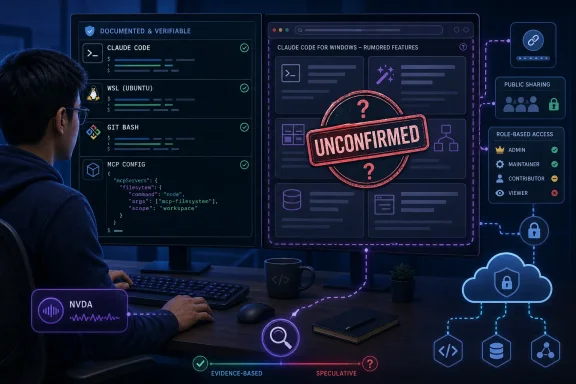 What StartupHub.ai reported
According to StartupHub.ai, “live artifacts” would let published artifacts retrieve current data and perform actions through MCP connectors. The report also describes:- A screen reader mode that replaces a visual terminal presentation with linear text for VoiceOver and NVDA users.
- Public links for sharing artifacts externally.
- Direct artifact generation from Claude chat sessions.
- Granular editor roles for Claude Team and Enterprise customers.
The verification problem
Anthropic’s current Claude Code documentation confirms Windows support, MCP configuration, permission modes, and automatic updates, but does not document a screen reader mode, live published artifacts, public artifact links, or the reported editor-role controls. Anthropic’s MCP documentation does describe connectors across Claude products, so the underlying technology is plausible; it does not establish that these specific artifact features have arrived in Claude Code.StartupHub.ai’s report also refers to “Claude Tag sessions,” a term that does not appear in Anthropic’s public Claude Code documentation. That may be a naming error, an early or limited rollout, or an inaccurate aggregation of separate Claude product updates.
Practical impact for Windows users
Admins should not change Claude Code deployment, proxy, access-control, or MCP policies based on this report alone. In particular, a feature that lets an artifact call MCP-connected services would require the same scrutiny as any other integration that can access internal systems or act on behalf of a user.For individual developers, Claude Code’s update mechanism normally installs available updates automatically and applies them when the tool is restarted;
claude update can be used for a manual check. Before enabling any newly surfaced sharing or connector feature, verify its availability and controls in Anthropic’s release notes or product documentation.Until Anthropic publishes an official announcement, treat the reported additions as unconfirmed rather than as a Claude Code release requirement.
References
- Primary source: startuphub.ai
Published: 2026-07-17T20:22:38.323000+00:00
Claude Code Adds Live Artifacts, Screen Reader Mode | StartupHub.ai
Claude Code's latest update introduces 'artifact features' for live data interaction, alongside screen reader mode and enhanced sharing capabilities.www.startuphub.ai - Official source: docs.anthropic.com
CLI reference - Claude Code Docs
Complete reference for Claude Code command-line interface, including commands and flags.docs.anthropic.com
