

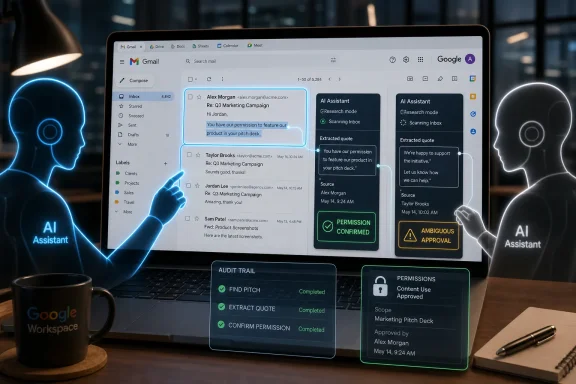
In hands-on testing reported by ZDNet, Anthropic’s Claude Cowork completed a nuanced Gmail research assignment—finding specific pitches, extracting relevant quotes, and locating permission confirmations—while Google’s Gemini reportedly struggled with the same task, exposing a practical gap in productivity AI. The result is not a clean verdict on every use case, but it is a useful warning about the market’s favorite assumption: that the assistant built closest to the inbox will automatically understand the inbox best. For Windows users, Microsoft 365 shops, Google Workspace tenants, and IT departments being asked to bless AI inside work data, the story is less about one win for Claude than about a new standard for judging assistants. The age of impressive demos is giving way to a harsher test: can the AI do the annoying, ambiguous, context-heavy work that people actually need done?
The ZDNet hands-on test, as summarized in the source material, was deliberately mundane in the best possible way. It was not a puzzle, a benchmark prompt, or a lab exercise designed to show off a model’s general intelligence. It was the sort of task that turns an inbox into a time sink: sift through Gmail messages, identify specific pitches, extract the relevant quotes, and locate permission confirmations.
That matters because email is where productivity AI has promised the most and disappointed most visibly. The inbox is already a search engine, a filing cabinet, a compliance record, a negotiation trail, and a social graph. Any AI assistant that claims to help there has to do more than retrieve messages containing a keyword; it has to infer what the user means by “the right pitch,” understand which quote is useful rather than merely present, and distinguish a genuine permission confirmation from a vaguely positive reply.
According to the source material, Claude Cowork handled that complexity while Gemini struggled. The phrasing is important. This was not described as a contest over whether one assistant could summarize an obvious thread faster than another. It was a test of whether a connected AI system could make human-like judgments across messy, real work context.
That is where the result becomes uncomfortable for Google. Gemini’s argument in Workspace has leaned heavily on proximity: the assistant lives inside the productivity suite, has privileged access to the interface, and is backed by the company that operates Gmail. Yet in this reported comparison, a third-party assistant from Anthropic did better work inside Google’s own mail environment than Google’s assistant did.
The immediate temptation is to turn this into a horse-race headline: Claude beat Gemini. The deeper story is more disruptive. If the assistant with “the native advantage in productivity AI” can lose a real-world email task to a connected outsider, then the next phase of enterprise AI may be decided less by ecosystem ownership and more by reasoning quality, context discipline, and whether the model can map ambiguous human requests onto messy corporate records.
That should land hard in Microsoft territory, too. Microsoft’s Copilot integrations are built on the same broad strategic bet as Google’s Workspace AI features: that deep integration into email, documents, calendar, meetings, and identity systems will become a durable advantage. The Claude Cowork test does not disprove that bet, but it narrows it. Integration is necessary. It is not sufficient.
A simple inbox search can find messages containing “pitch.” A competent assistant must understand that a pitch can be phrased as an idea, a proposal, a collaboration note, a suggested angle, or a request for coverage. It must tell the difference between a pitch being discussed, a pitch being accepted, and a pitch being merely referenced in passing.
Extracting quotes is similarly slippery. The useful quote is not always the most quotable sentence, the sentence in quotation marks, or the sentence nearest a keyword. It is the passage that answers the underlying editorial or business need. A poor assistant can produce text that looks plausible while missing the point; a good one can identify the sentence that matters because it understands why the user asked.
Permission confirmations are even harder. Some confirmations are explicit: “You have permission to use this.” Others are procedural, implied, or embedded in a longer exchange. An assistant looking only for fixed phrases may miss the approval. An assistant that over-infers may create a permissions problem by treating casual assent as formal consent.
This is why the source material’s description of the task is so consequential. The test required “actually understand what you need from your messy inbox,” not merely manipulate email metadata. That distinction separates the AI assistant as a convenience layer from the AI assistant as a work delegate.
For years, vendors have sold productivity AI with examples that are emotionally true but operationally thin: summarize this thread, draft this reply, turn this meeting into action items. Those functions can be useful, but they often avoid the hardest problem in office work: determining which facts are relevant, what state a process is in, and what evidence supports a conclusion.
The ZDNet task pressed directly on that weak spot. It asked the assistant to behave like a junior researcher with access to a mailbox, not like a search box with a conversational front end. That is why the reported gap between Claude Cowork and Gemini is meaningful even though it comes from a limited hands-on comparison rather than a broad formal benchmark.
Small tests can be misleading when they are narrow or artificial. This one is narrow, but not artificial. It captures the exact category of work that companies are hoping AI will absorb: context-heavy, interruptive, cognitively annoying work that is too valuable to ignore and too low-leverage to justify repeated human attention.
That is why this reported result stings. The source material says Google has been pushing Gemini’s integration across Workspace for months and positioning that integration as “the native advantage in productivity AI.” The logic is familiar: users will prefer the assistant embedded in the tools they already use, administrators will prefer the vendor already inside their tenant, and the AI will benefit from being closer to the data.
But proximity to data and understanding of data are not the same thing. A model can sit inside the product and still misread the user’s intent. It can have sanctioned access to messages and still fail to connect the right evidence. It can be convenient and still be wrong.
The Claude Cowork result suggests that the competitive axis is shifting. The first wave of productivity AI rewarded vendors that could place an assistant everywhere. The next wave may reward vendors that can decide what to do once the assistant is there. That is a different engineering problem and a different trust problem.
There is also a brand problem for Google. Gemini is not merely another feature name; it is part of Google’s broader AI identity across productivity, search, and cloud. When an outside assistant reportedly performs better inside Gmail than Gemini does, it complicates the story that Google’s ecosystem control will naturally translate into superior AI outcomes.
This does not mean Gemini is broadly inferior. The source material supports only the specific reported comparison: Claude Cowork succeeded on a complex email research task that left Gemini struggling. But the task lands in a strategically important zone. If Google cannot reliably outperform third-party rivals in Gmail research, users and admins will ask where the native advantage actually materializes.
That question has procurement consequences. Enterprises do not buy AI assistants only because they are technically elegant. They buy them because they reduce time spent on routine work, improve consistency, and justify access to sensitive data. If a third-party tool produces better answers, the default-vendor bundle becomes less persuasive.
That shift is risky and necessary. A general AI assistant without work context is often impressive but detached. It can reason about a problem, draft a memo, or summarize text the user pastes into a window. But the real productivity prize requires the assistant to see the calendar invite, the email thread, the shared document, the prior decision, and the permissions note.
The source material uses a blunt phrase for this: “read access to your work context.” That is both the product’s value proposition and its governance hazard. The assistant can only save serious time if it can inspect the material a human would inspect. The more useful it becomes, the more sensitive its access becomes.
Claude Cowork’s reported performance in the Gmail task is therefore not just a model win; it is a product thesis in action. Anthropic is betting that a model known for contextual reasoning can become more valuable when connected to the daily artifacts of work. The ZDNet test gives that thesis a concrete example.
The market has seen plenty of assistants that are good at generating polished text from clean prompts. The harder product is one that can operate against an existing pile of unstructured, inconsistent, user-specific data. Email is the perfect stress test because it contains everything vendors claim their AI can handle: ambiguity, long histories, partial information, social nuance, and business consequences.
If Claude Cowork can repeatedly convert that mess into reliable answers, Anthropic has a credible wedge into enterprise productivity. It does not need to own the productivity suite outright if it can persuade users that it understands the suite’s contents better than the native assistant. That is a profound threat to platform incumbents.
It is also a reminder that enterprise AI may not consolidate as neatly as vendors hope. Companies already live with mixed stacks: Windows endpoints, Microsoft 365 licensing, Google accounts, Slack or Teams, third-party SaaS, and a long tail of internal tools. An assistant that can traverse those boundaries intelligently may be more useful than one that is deeply optimized for a single vendor’s view of the workplace.
The table looks simple, but the strategic difference is large. Gemini’s implied strength is native placement. Claude Cowork’s implied strength, in this example, is practical reasoning over connected context. The ZDNet-reported result suggests that users may care more about the second than the first once the novelty of having AI buttons inside every interface wears off.
This is where Microsoft should be paying attention. Copilot’s value proposition is also inseparable from integration: Microsoft 365, Outlook, Teams, Word, Excel, SharePoint, and Windows all become more compelling if an assistant can operate across them. But if an assistant cannot deliver dependable results on tasks like finding the correct supporting message or extracting the right evidence, integration becomes decoration.
The source material states the market lesson plainly: “integration alone won't keep users if the AI can't deliver on practical tasks.” That line should be read as a warning to every vendor bundling AI into productivity subscriptions. Users may tolerate mediocre AI when it is free, novel, or buried in a plan they already bought. They will not build workflows around it unless it consistently reduces work.
The more subtle issue is trust calibration. A bad assistant is not merely useless; it can be worse than useless if it gives plausible but incomplete answers. In email research, missing a permission confirmation can delay publication or a business process. Inventing one can create legal or reputational risk. Extracting the wrong quote can distort meaning. Pulling the wrong pitch can waste time or misdirect a decision.
For admins, that means productivity AI evaluations need to move beyond interface tours. The relevant question is not whether the assistant can access the inbox. It is whether it can produce answers that stand up to verification, explain where it found them, and avoid overconfident leaps when the evidence is ambiguous.
A clean benchmark can reward the model that reasons best over a prompt. A clean demo can reward the vendor that choreographs the best workflow. Email punishes both. The relevant material may be spread across forwarded messages, stale subject lines, changed thread participants, attachments, calendar follow-ups, and replies that answer a question without restating it.
That is why the phrase “the promise of actually taming email overload” is doing so much work here. Email overload is not only a volume problem. It is a context reconstruction problem. The user is not drowning because there are too many messages; the user is drowning because the inbox contains many half-finished stories, and the human has to remember which ones matter.
A useful assistant must rebuild those stories. It has to know that a pitch from last week connects to a permission confirmation yesterday. It has to identify which message contains the usable quote and which message merely repeats the premise. It has to separate noise from evidence.
That requirement exposes the weakness of AI systems built primarily around retrieval and surface summarization. Retrieval can find candidate messages. Summarization can condense them. But the assistant also has to reason about why the user asked and what proof would satisfy the request.
Claude Cowork reportedly did that better in the ZDNet hands-on test. The result does not make it infallible, and it does not mean every user should immediately replace Gemini. It does mean email research is a more revealing test than the usual “write a reply” demo because it forces the assistant to connect intent, content, and evidence.
For WindowsForum readers, the relevance extends beyond Gmail. Many organizations run Outlook and Exchange, not Gmail, but the core problem is the same. Every mailbox is a private database of decisions and exceptions. The assistant that can reason over that database accurately becomes more than a convenience; it becomes part of the operating layer of work.
Read access is not harmless simply because it is not write access. A system that can read mail, calendars, and documents can inspect confidential plans, customer communications, legal discussions, HR material, product roadmaps, security incidents, and financial details. Even if the assistant never sends a message or edits a document, it may expose, summarize, or surface information in ways that change the risk profile.
This is not an argument against connected assistants. It is an argument against treating them like ordinary add-ons. A browser extension that improves formatting is one thing. An AI assistant that can reason across the work archive is closer to a privileged analyst. It needs governance accordingly.
The productivity AI market often frames the trade-off as convenience versus privacy, but the enterprise version is more specific: permissioning versus utility. Too little context and the assistant becomes a toy. Too much context and it may become a data exposure channel. The winning products will need to make that trade-off visible and controllable.
Admins should also distinguish between model quality and access policy. Claude Cowork’s reported task performance may make it attractive, but better reasoning does not automatically settle questions about data boundaries, retention, auditability, tenant controls, or user consent. Google’s native position may offer administrative familiarity, but native integration does not automatically guarantee better answers.
The correct posture is not blind trust in the incumbent or blind enthusiasm for the challenger. It is controlled evaluation. Give assistants representative work, measure results, inspect failure modes, and map access to the minimum data needed for the use case.
The inbox fights back. It contains missing context, inconsistent language, stale threads, duplicate attachments, ambiguous approvals, and messages written by people who were not trying to make life easy for an AI system. A model that looks strong on abstract reasoning can still fail if the product around it retrieves the wrong context. A product with perfect integration can still fail if the model cannot reason over what it retrieves.
That is why real-world hands-on tests are increasingly important. They are imperfect, subjective, and hard to generalize, but they expose whether the assistant’s advertised capabilities survive contact with the user’s actual data. For productivity AI, that may be more important than a benchmark point difference.
The assistant market is now entering its “prove it in the workflow” phase. Users have heard enough claims about saving hours, reducing busywork, and unlocking organizational knowledge. They are beginning to ask for proof inside the actual systems where work gets stuck.
This creates pressure on every vendor. Anthropic has to show that Claude Cowork’s reported advantage is repeatable across organizations, not just impressive in one test. Google has to show that Gemini can turn Workspace integration into consistently better task completion. Microsoft has to show that Copilot is more than a layer of AI affordances across familiar products.
The common enemy is not another vendor. It is user disappointment. If employees try an assistant, catch it missing obvious evidence, and return to manual search, the product loses more than a task. It loses trust.
Trust is especially hard to win back in enterprise AI because errors are not evenly costly. A weak summary may be annoying. A missed approval may be consequential. A wrong quote may be reputationally damaging. A hallucinated answer from private work context may be worse than no answer at all.
Copilot’s pitch depends on the idea that AI becomes most valuable when embedded across the Microsoft work graph. Outlook, Teams, Word, Excel, OneDrive, SharePoint, and Windows form an environment where context can be collected and acted upon. If that context produces reliable assistance, Copilot becomes a strategic layer. If it produces inconsistent answers, it becomes another feature users selectively ignore.
The Claude Cowork test sharpens the question Microsoft customers should ask: does the assistant complete the actual task, or does it merely sit near the task? The distinction is easy to miss during procurement because demos emphasize flow. A user asks a question, the assistant responds, the interface looks coherent, and the buyer imagines time saved. The operational reality is whether the answer is correct enough to reduce human verification rather than increase it.
Microsoft has the same opportunity and risk as Google. It can build deeply integrated AI experiences because it controls so many surfaces of business computing. But integration raises expectations. If the assistant is everywhere, users will assume it should understand more. When it fails, the failure feels less like a limitation and more like a broken promise.
For Windows users, the practical lesson is to be skeptical of ecosystem determinism. The best assistant for a task may not be the one made by the platform owner. It may be the one with the best combination of model behavior, retrieval design, permission controls, and workflow fit. In some organizations that may be a native tool. In others it may be a third-party assistant.
The enterprise stack has always been more plural than vendor roadmaps suggest. Companies use Microsoft for identity and devices, Google for mail or collaboration, Salesforce for customer records, ServiceNow for operations, and a range of vertical tools for line-of-business work. A productivity AI assistant that can cross boundaries intelligently may fit that reality better than a single-suite assistant that performs best only within its own walls.
The ZDNet-reported task highlights this distinction. Finding pitches, extracting quotes, and locating permission confirmations are not useful unless the result can be trusted. A user still needs to confirm the assistant’s work, but the assistant can dramatically reduce the search space if it brings back the right messages and the right passages.
That is the sweet spot for enterprise AI today. Full autonomy is not required. The assistant does not need to make the final business judgment. It needs to perform the first pass well enough that the human’s job shifts from discovery to review.
Claude Cowork’s reported success suggests it may be closer to that practical threshold for this kind of inbox research. Gemini’s reported struggle suggests that native access alone may not move the user from manual discovery to efficient review. That gap is where purchasing decisions will increasingly be made.
The same principle applies across documents and calendars. An assistant that finds the relevant policy, meeting decision, or customer commitment saves time only if it finds the right one. A fast wrong answer is not productivity. It is a new form of work.
This is why organizations should resist evaluating assistants only on output fluency. Fluent prose can mask weak evidence handling. A polished answer that cites the wrong thread, misses a confirmation, or extracts an irrelevant quote may be more dangerous than a clumsy answer that admits uncertainty.
The best productivity AI systems will likely become less theatrical over time. Users will value assistants that show their work, identify uncertainty, and make verification easier. The magic trick will matter less than the audit trail.
The ZDNet-reported comparison does not crown Claude Cowork forever, and it does not condemn Gemini permanently. It does something more useful: it exposes the standard every connected work assistant now has to meet. The future of productivity AI will belong to systems that can enter the messy archive of work, respect its boundaries, retrieve the right evidence, and turn context into dependable help—not merely claim that being inside the suite is the same thing as understanding it.
 Claude Cowork’s Gmail Win Turns the Productivity AI Argument Inside Out
The ZDNet hands-on test, as summarized in the source material, was deliberately mundane in the best possible way. It was not a puzzle, a benchmark prompt, or a lab exercise designed to show off a model’s general intelligence. It was the sort of task that turns an inbox into a time sink: sift through Gmail messages, identify specific pitches, extract the relevant quotes, and locate permission confirmations.That matters because email is where productivity AI has promised the most and disappointed most visibly. The inbox is already a search engine, a filing cabinet, a compliance record, a negotiation trail, and a social graph. Any AI assistant that claims to help there has to do more than retrieve messages containing a keyword; it has to infer what the user means by “the right pitch,” understand which quote is useful rather than merely present, and distinguish a genuine permission confirmation from a vaguely positive reply.
According to the source material, Claude Cowork handled that complexity while Gemini struggled. The phrasing is important. This was not described as a contest over whether one assistant could summarize an obvious thread faster than another. It was a test of whether a connected AI system could make human-like judgments across messy, real work context.
That is where the result becomes uncomfortable for Google. Gemini’s argument in Workspace has leaned heavily on proximity: the assistant lives inside the productivity suite, has privileged access to the interface, and is backed by the company that operates Gmail. Yet in this reported comparison, a third-party assistant from Anthropic did better work inside Google’s own mail environment than Google’s assistant did.
The immediate temptation is to turn this into a horse-race headline: Claude beat Gemini. The deeper story is more disruptive. If the assistant with “the native advantage in productivity AI” can lose a real-world email task to a connected outsider, then the next phase of enterprise AI may be decided less by ecosystem ownership and more by reasoning quality, context discipline, and whether the model can map ambiguous human requests onto messy corporate records.
That should land hard in Microsoft territory, too. Microsoft’s Copilot integrations are built on the same broad strategic bet as Google’s Workspace AI features: that deep integration into email, documents, calendar, meetings, and identity systems will become a durable advantage. The Claude Cowork test does not disprove that bet, but it narrows it. Integration is necessary. It is not sufficient.
The Test Was Small, but the Task Was Exactly the Right Kind of Hard
The most revealing part of the ZDNet-reported test is not that it involved Gmail. It is that the task combined several distinct forms of judgment that office workers routinely perform without naming them as such. Finding pitches, extracting quotes, and confirming permissions sound like clerical work until an assistant gets them wrong.A simple inbox search can find messages containing “pitch.” A competent assistant must understand that a pitch can be phrased as an idea, a proposal, a collaboration note, a suggested angle, or a request for coverage. It must tell the difference between a pitch being discussed, a pitch being accepted, and a pitch being merely referenced in passing.
Extracting quotes is similarly slippery. The useful quote is not always the most quotable sentence, the sentence in quotation marks, or the sentence nearest a keyword. It is the passage that answers the underlying editorial or business need. A poor assistant can produce text that looks plausible while missing the point; a good one can identify the sentence that matters because it understands why the user asked.
Permission confirmations are even harder. Some confirmations are explicit: “You have permission to use this.” Others are procedural, implied, or embedded in a longer exchange. An assistant looking only for fixed phrases may miss the approval. An assistant that over-infers may create a permissions problem by treating casual assent as formal consent.
This is why the source material’s description of the task is so consequential. The test required “actually understand what you need from your messy inbox,” not merely manipulate email metadata. That distinction separates the AI assistant as a convenience layer from the AI assistant as a work delegate.
For years, vendors have sold productivity AI with examples that are emotionally true but operationally thin: summarize this thread, draft this reply, turn this meeting into action items. Those functions can be useful, but they often avoid the hardest problem in office work: determining which facts are relevant, what state a process is in, and what evidence supports a conclusion.
The ZDNet task pressed directly on that weak spot. It asked the assistant to behave like a junior researcher with access to a mailbox, not like a search box with a conversational front end. That is why the reported gap between Claude Cowork and Gemini is meaningful even though it comes from a limited hands-on comparison rather than a broad formal benchmark.
Small tests can be misleading when they are narrow or artificial. This one is narrow, but not artificial. It captures the exact category of work that companies are hoping AI will absorb: context-heavy, interruptive, cognitively annoying work that is too valuable to ignore and too low-leverage to justify repeated human attention.
Google’s Native Advantage Looks Less Native When Context Gets Messy
Google should, in theory, be in an enviable position. Gmail is not just a mail client; for many users it is the canonical archive of work history. Google Workspace also spans documents, calendars, and collaboration surfaces. If any company could turn email context into reliable AI assistance, Google ought to be high on the list.That is why this reported result stings. The source material says Google has been pushing Gemini’s integration across Workspace for months and positioning that integration as “the native advantage in productivity AI.” The logic is familiar: users will prefer the assistant embedded in the tools they already use, administrators will prefer the vendor already inside their tenant, and the AI will benefit from being closer to the data.
But proximity to data and understanding of data are not the same thing. A model can sit inside the product and still misread the user’s intent. It can have sanctioned access to messages and still fail to connect the right evidence. It can be convenient and still be wrong.
The Claude Cowork result suggests that the competitive axis is shifting. The first wave of productivity AI rewarded vendors that could place an assistant everywhere. The next wave may reward vendors that can decide what to do once the assistant is there. That is a different engineering problem and a different trust problem.
There is also a brand problem for Google. Gemini is not merely another feature name; it is part of Google’s broader AI identity across productivity, search, and cloud. When an outside assistant reportedly performs better inside Gmail than Gemini does, it complicates the story that Google’s ecosystem control will naturally translate into superior AI outcomes.
This does not mean Gemini is broadly inferior. The source material supports only the specific reported comparison: Claude Cowork succeeded on a complex email research task that left Gemini struggling. But the task lands in a strategically important zone. If Google cannot reliably outperform third-party rivals in Gmail research, users and admins will ask where the native advantage actually materializes.
That question has procurement consequences. Enterprises do not buy AI assistants only because they are technically elegant. They buy them because they reduce time spent on routine work, improve consistency, and justify access to sensitive data. If a third-party tool produces better answers, the default-vendor bundle becomes less persuasive.
Anthropic’s Enterprise Push Is Really a Bet on Work Context
Anthropic’s Claude Cowork, according to the source material, launched as part of the company’s broader push into enterprise productivity. That positioning matters because Claude is no longer being framed only as a chat model or a writing assistant. It is being attached to the systems where office work happens: email, calendar, and document systems.That shift is risky and necessary. A general AI assistant without work context is often impressive but detached. It can reason about a problem, draft a memo, or summarize text the user pastes into a window. But the real productivity prize requires the assistant to see the calendar invite, the email thread, the shared document, the prior decision, and the permissions note.
The source material uses a blunt phrase for this: “read access to your work context.” That is both the product’s value proposition and its governance hazard. The assistant can only save serious time if it can inspect the material a human would inspect. The more useful it becomes, the more sensitive its access becomes.
Claude Cowork’s reported performance in the Gmail task is therefore not just a model win; it is a product thesis in action. Anthropic is betting that a model known for contextual reasoning can become more valuable when connected to the daily artifacts of work. The ZDNet test gives that thesis a concrete example.
The market has seen plenty of assistants that are good at generating polished text from clean prompts. The harder product is one that can operate against an existing pile of unstructured, inconsistent, user-specific data. Email is the perfect stress test because it contains everything vendors claim their AI can handle: ambiguity, long histories, partial information, social nuance, and business consequences.
If Claude Cowork can repeatedly convert that mess into reliable answers, Anthropic has a credible wedge into enterprise productivity. It does not need to own the productivity suite outright if it can persuade users that it understands the suite’s contents better than the native assistant. That is a profound threat to platform incumbents.
It is also a reminder that enterprise AI may not consolidate as neatly as vendors hope. Companies already live with mixed stacks: Windows endpoints, Microsoft 365 licensing, Google accounts, Slack or Teams, third-party SaaS, and a long tail of internal tools. An assistant that can traverse those boundaries intelligently may be more useful than one that is deeply optimized for a single vendor’s view of the workplace.
The Assistants Are Competing on More Than Features
The comparison between Claude Cowork and Gemini is not simply a feature checklist. Both are positioned as productivity AI systems, but the reported difference emerged when the task required inference across messy content. That distinction should shape how users and IT leaders evaluate them.| Assistant | Company | Context described | Reported task result | Strategic implication |
|---|---|---|---|---|
| Claude Cowork | Anthropic | Connects to email, calendar, and document systems | Completed the Gmail research task in ZDNet’s hands-on testing | Shows a third-party assistant can compete inside another vendor’s productivity environment |
| Gemini | Integrated across Google’s Workspace ecosystem | Reportedly struggled with the same Gmail assignment | Raises questions about whether native integration guarantees better practical results |
This is where Microsoft should be paying attention. Copilot’s value proposition is also inseparable from integration: Microsoft 365, Outlook, Teams, Word, Excel, SharePoint, and Windows all become more compelling if an assistant can operate across them. But if an assistant cannot deliver dependable results on tasks like finding the correct supporting message or extracting the right evidence, integration becomes decoration.
The source material states the market lesson plainly: “integration alone won't keep users if the AI can't deliver on practical tasks.” That line should be read as a warning to every vendor bundling AI into productivity subscriptions. Users may tolerate mediocre AI when it is free, novel, or buried in a plan they already bought. They will not build workflows around it unless it consistently reduces work.
The more subtle issue is trust calibration. A bad assistant is not merely useless; it can be worse than useless if it gives plausible but incomplete answers. In email research, missing a permission confirmation can delay publication or a business process. Inventing one can create legal or reputational risk. Extracting the wrong quote can distort meaning. Pulling the wrong pitch can waste time or misdirect a decision.
For admins, that means productivity AI evaluations need to move beyond interface tours. The relevant question is not whether the assistant can access the inbox. It is whether it can produce answers that stand up to verification, explain where it found them, and avoid overconfident leaps when the evidence is ambiguous.
Email Is the Most Honest Test of Enterprise AI
Email has survived every attempt to kill it because it is not one thing. It is messaging, recordkeeping, negotiation, escalation, approval, identity, and memory. That makes it messy for humans and brutal for AI.A clean benchmark can reward the model that reasons best over a prompt. A clean demo can reward the vendor that choreographs the best workflow. Email punishes both. The relevant material may be spread across forwarded messages, stale subject lines, changed thread participants, attachments, calendar follow-ups, and replies that answer a question without restating it.
That is why the phrase “the promise of actually taming email overload” is doing so much work here. Email overload is not only a volume problem. It is a context reconstruction problem. The user is not drowning because there are too many messages; the user is drowning because the inbox contains many half-finished stories, and the human has to remember which ones matter.
A useful assistant must rebuild those stories. It has to know that a pitch from last week connects to a permission confirmation yesterday. It has to identify which message contains the usable quote and which message merely repeats the premise. It has to separate noise from evidence.
That requirement exposes the weakness of AI systems built primarily around retrieval and surface summarization. Retrieval can find candidate messages. Summarization can condense them. But the assistant also has to reason about why the user asked and what proof would satisfy the request.
Claude Cowork reportedly did that better in the ZDNet hands-on test. The result does not make it infallible, and it does not mean every user should immediately replace Gemini. It does mean email research is a more revealing test than the usual “write a reply” demo because it forces the assistant to connect intent, content, and evidence.
For WindowsForum readers, the relevance extends beyond Gmail. Many organizations run Outlook and Exchange, not Gmail, but the core problem is the same. Every mailbox is a private database of decisions and exceptions. The assistant that can reason over that database accurately becomes more than a convenience; it becomes part of the operating layer of work.
The Security Trade-Off Is Not Optional
The same access that makes Claude Cowork useful also makes it sensitive. The source material says the product connects to email, calendar, and document systems, giving the AI “read access to your work context.” That phrase should stop every admin for a moment.Read access is not harmless simply because it is not write access. A system that can read mail, calendars, and documents can inspect confidential plans, customer communications, legal discussions, HR material, product roadmaps, security incidents, and financial details. Even if the assistant never sends a message or edits a document, it may expose, summarize, or surface information in ways that change the risk profile.
This is not an argument against connected assistants. It is an argument against treating them like ordinary add-ons. A browser extension that improves formatting is one thing. An AI assistant that can reason across the work archive is closer to a privileged analyst. It needs governance accordingly.
The productivity AI market often frames the trade-off as convenience versus privacy, but the enterprise version is more specific: permissioning versus utility. Too little context and the assistant becomes a toy. Too much context and it may become a data exposure channel. The winning products will need to make that trade-off visible and controllable.
Admins should also distinguish between model quality and access policy. Claude Cowork’s reported task performance may make it attractive, but better reasoning does not automatically settle questions about data boundaries, retention, auditability, tenant controls, or user consent. Google’s native position may offer administrative familiarity, but native integration does not automatically guarantee better answers.
The correct posture is not blind trust in the incumbent or blind enthusiasm for the challenger. It is controlled evaluation. Give assistants representative work, measure results, inspect failure modes, and map access to the minimum data needed for the use case.
Action checklist for admins
- Test AI assistants against real internal workflows, not vendor demos or generic prompts.
- Build evaluation tasks that require evidence retrieval, quote extraction, approval discovery, and ambiguity handling.
- Require users to verify AI outputs against the underlying messages or documents before acting on them.
- Review exactly what mailbox, calendar, and document permissions each assistant receives.
- Separate pilot groups by risk level, keeping legal, HR, finance, and security workflows under tighter review.
- Document failure modes so procurement decisions reflect actual utility, not interface polish.
Benchmarks Matter Less When the Inbox Fights Back
The source material notes that Claude has shown strength in complex reasoning tasks and that benchmark performance and “actual utility” often diverge in AI products. That is the heart of the issue. Benchmarks are useful for comparing capabilities under controlled conditions, but office work is not controlled.The inbox fights back. It contains missing context, inconsistent language, stale threads, duplicate attachments, ambiguous approvals, and messages written by people who were not trying to make life easy for an AI system. A model that looks strong on abstract reasoning can still fail if the product around it retrieves the wrong context. A product with perfect integration can still fail if the model cannot reason over what it retrieves.
That is why real-world hands-on tests are increasingly important. They are imperfect, subjective, and hard to generalize, but they expose whether the assistant’s advertised capabilities survive contact with the user’s actual data. For productivity AI, that may be more important than a benchmark point difference.
The assistant market is now entering its “prove it in the workflow” phase. Users have heard enough claims about saving hours, reducing busywork, and unlocking organizational knowledge. They are beginning to ask for proof inside the actual systems where work gets stuck.
This creates pressure on every vendor. Anthropic has to show that Claude Cowork’s reported advantage is repeatable across organizations, not just impressive in one test. Google has to show that Gemini can turn Workspace integration into consistently better task completion. Microsoft has to show that Copilot is more than a layer of AI affordances across familiar products.
The common enemy is not another vendor. It is user disappointment. If employees try an assistant, catch it missing obvious evidence, and return to manual search, the product loses more than a task. It loses trust.
Trust is especially hard to win back in enterprise AI because errors are not evenly costly. A weak summary may be annoying. A missed approval may be consequential. A wrong quote may be reputationally damaging. A hallucinated answer from private work context may be worse than no answer at all.
Microsoft Is in the Frame Even When It Is Not in the Test
Microsoft was not one of the two assistants in the ZDNet-reported comparison. But the source material explicitly places Claude Cowork in competition with Microsoft’s Copilot integrations and Google’s Workspace AI features. That makes the result relevant to any Microsoft customer planning its AI roadmap.Copilot’s pitch depends on the idea that AI becomes most valuable when embedded across the Microsoft work graph. Outlook, Teams, Word, Excel, OneDrive, SharePoint, and Windows form an environment where context can be collected and acted upon. If that context produces reliable assistance, Copilot becomes a strategic layer. If it produces inconsistent answers, it becomes another feature users selectively ignore.
The Claude Cowork test sharpens the question Microsoft customers should ask: does the assistant complete the actual task, or does it merely sit near the task? The distinction is easy to miss during procurement because demos emphasize flow. A user asks a question, the assistant responds, the interface looks coherent, and the buyer imagines time saved. The operational reality is whether the answer is correct enough to reduce human verification rather than increase it.
Microsoft has the same opportunity and risk as Google. It can build deeply integrated AI experiences because it controls so many surfaces of business computing. But integration raises expectations. If the assistant is everywhere, users will assume it should understand more. When it fails, the failure feels less like a limitation and more like a broken promise.
For Windows users, the practical lesson is to be skeptical of ecosystem determinism. The best assistant for a task may not be the one made by the platform owner. It may be the one with the best combination of model behavior, retrieval design, permission controls, and workflow fit. In some organizations that may be a native tool. In others it may be a third-party assistant.
The enterprise stack has always been more plural than vendor roadmaps suggest. Companies use Microsoft for identity and devices, Google for mail or collaboration, Salesforce for customer records, ServiceNow for operations, and a range of vertical tools for line-of-business work. A productivity AI assistant that can cross boundaries intelligently may fit that reality better than a single-suite assistant that performs best only within its own walls.
The New Buying Criterion Is Whether the AI Saves Verification Time
The productivity AI sales pitch often focuses on time saved. But the more precise measure is verification time. If an assistant produces an answer that a user must fully re-check from scratch, it has not saved much time. If it produces an answer with enough accuracy and traceability that the user can verify quickly, it starts to matter.The ZDNet-reported task highlights this distinction. Finding pitches, extracting quotes, and locating permission confirmations are not useful unless the result can be trusted. A user still needs to confirm the assistant’s work, but the assistant can dramatically reduce the search space if it brings back the right messages and the right passages.
That is the sweet spot for enterprise AI today. Full autonomy is not required. The assistant does not need to make the final business judgment. It needs to perform the first pass well enough that the human’s job shifts from discovery to review.
Claude Cowork’s reported success suggests it may be closer to that practical threshold for this kind of inbox research. Gemini’s reported struggle suggests that native access alone may not move the user from manual discovery to efficient review. That gap is where purchasing decisions will increasingly be made.
The same principle applies across documents and calendars. An assistant that finds the relevant policy, meeting decision, or customer commitment saves time only if it finds the right one. A fast wrong answer is not productivity. It is a new form of work.
This is why organizations should resist evaluating assistants only on output fluency. Fluent prose can mask weak evidence handling. A polished answer that cites the wrong thread, misses a confirmation, or extracts an irrelevant quote may be more dangerous than a clumsy answer that admits uncertainty.
The best productivity AI systems will likely become less theatrical over time. Users will value assistants that show their work, identify uncertainty, and make verification easier. The magic trick will matter less than the audit trail.
What This Gmail Test Should Change in Your AI Rollout
The most concrete lesson from the Claude Cowork and Gemini comparison is that practical task performance must become the center of evaluation. Vendor position, model reputation, and platform integration all matter, but none should substitute for testing against real workflows. The inbox is where assistant claims either become useful or collapse into another layer of automation theater.- Claude Cowork reportedly completed a nuanced Gmail research task that required identifying pitches, extracting quotes, and locating permission confirmations.
- Gemini reportedly struggled with the same assignment despite Google’s broader Workspace integration story.
- Anthropic’s advantage in this example appears tied to contextual reasoning over messy work data, not ownership of the mail platform.
- Google’s challenge is to prove that native Workspace integration translates into better outcomes, not just closer placement.
- Microsoft customers should apply the same scrutiny to Copilot integrations rather than assuming deep suite access equals practical accuracy.
- Admins should evaluate assistants by how much they reduce verification time, not by how impressive their generated text sounds.
The ZDNet-reported comparison does not crown Claude Cowork forever, and it does not condemn Gemini permanently. It does something more useful: it exposes the standard every connected work assistant now has to meet. The future of productivity AI will belong to systems that can enter the messy archive of work, respect its boundaries, retrieve the right evidence, and turn context into dependable help—not merely claim that being inside the suite is the same thing as understanding it.
References
- Primary source: The Tech Buzz
Published: 2026-07-08T16:16:14.597315
Claude Cowork Outperforms Gemini on Email Research Tasks | The Tech Buzz
Anthropic's Claude Cowork handles nuanced Gmail research where Google's Gemini failswww.techbuzz.ai
