

Anthropic has begun extending Claude Desktop’s beta enterprise configuration across Microsoft Foundry, with comparable third-party cloud routing through Amazon Bedrock and Google Vertex AI, giving organizations a way to run Claude’s Chat, Cowork, and Code workflows inside cloud accounts they already govern. The move is less about a prettier desktop app than about control: procurement control, data-boundary control, identity control, and endpoint control. For Windows shops, the important part is not that Claude now has another tab; it is that agentic AI is being packaged like managed enterprise software.
The generative AI market has spent the last two years pretending that model quality was the whole story. It never was. In large organizations, the model is only one clause in a much longer document that also includes data residency, billing, identity, auditability, endpoint deployment, retention, legal review, and the awkward question of who gets blamed when an autonomous assistant writes to the wrong directory.
Claude Desktop’s third-party cloud configuration is Anthropic’s answer to that enterprise reality. Instead of asking every customer to route sensitive work through Anthropic’s own SaaS boundary, the company is leaning into a familiar enterprise pattern: let the customer run inference through the cloud provider they already trust. In Microsoft’s case, that means a Foundry resource; in AWS and Google environments, the equivalent story runs through Bedrock and Vertex AI.
That matters because the enterprise buyer does not experience AI as a chatbot race. A CIO experiences AI as a succession of exception requests. Every new assistant that wants access to documents, source code, calendars, tickets, repositories, and spreadsheets is another vendor-risk review, another procurement workflow, another DPA, and another argument with security architecture.
Anthropic’s bet is that Claude becomes easier to approve when it arrives as a workload inside the customer’s existing cloud perimeter. It is a smart bet, and it is also a revealing one. The center of gravity in enterprise AI is shifting from which model is smartest today to which model can be governed without inventing a new operating model around it.
The distinction between Chat, Cowork, and Code is not cosmetic. Claude Chat is the familiar prompt-and-response interface for writing, summarizing, reasoning, and research. Claude Cowork is the more consequential layer: a visual agent that can handle multi-step tasks, work with local files selected by the user, coordinate sub-tasks, and produce documents, spreadsheets, and presentations. Claude Code is the developer-facing environment for repository-aware coding tasks, multi-file edits, command execution, and engineering workflows.
For enterprises, bundling those experiences into one desktop surface is both attractive and dangerous. It reduces user confusion and makes adoption easier, but it also collapses several risk profiles into a single application. A chat assistant that drafts email is not the same thing as an agent that can write files or run shell commands.
That is why the policy story matters. The useful version of this product is not “everyone gets the full agent.” The useful version is that marketing gets Chat and perhaps Cowork, engineering gets Code under tighter controls, finance gets document workflows with carefully scoped connectors, and high-risk departments get a slower rollout with logging and guardrails. Anthropic appears to understand that the enterprise market will not tolerate a single all-or-nothing switch.
That does not make Claude a Microsoft product. It does, however, make Claude less alien to Microsoft shops. A Windows administrator can think about this as another managed desktop application, another set of registry or configuration profiles, another Intune or Group Policy deployment, and another workload tied to Azure consumption.
Microsoft’s own documentation describes the Foundry setup as a way to route Claude model requests through the customer’s Foundry resource while keeping billing on the Azure account and supporting deployment through enterprise MDM tools. The operational model is familiar: validate on one machine, export configuration, push it to managed devices, and let the app enter third-party mode automatically when the managed configuration is present.
That familiarity is the point. Enterprise AI adoption has often been slowed by the fact that the best tools arrive like consumer apps with enterprise aspirations bolted on later. Claude Desktop’s Foundry path reverses the emphasis. The app still feels user-facing, but the rollout story is aimed at administrators first.
There are caveats. Claude models in Microsoft Foundry have carried preview-language warnings, and model availability can change. Some subscription types and regions are not supported. Organizations also need to pay close attention to whether the data-residency and no-Anthropic-conversation-data guarantees they expect are fully available in the exact deployment route they choose, because those details are where compliance programs live or die.
When a company can buy and meter AI through AWS Marketplace, Google Cloud Marketplace, or Azure billing, it removes one of the dullest but most powerful blockers in enterprise software. The organization may already have negotiated cloud terms, committed spend, budget owners, security reviews, and legal frameworks. Routing Claude consumption through those relationships turns a new AI initiative from a novel vendor event into an expansion of an existing cloud estate.
That is not a small distinction. Many AI pilots fail before technical evaluation because legal and procurement cannot move at the speed of user demand. Employees find consumer tools, departments expense subscriptions, and IT discovers the footprint later. The result is shadow AI: useful, ungoverned, and impossible to defend in a serious audit.
Anthropic’s third-party cloud approach tries to make the sanctioned path as convenient as the unsanctioned one. If the enterprise can say, “Use Claude through our cloud account, under our policies, with our billing and our deployment controls,” it has a better chance of competing with the browser tab employees already opened.
This is also why the desktop packaging matters. A browser-only AI assistant is easy to access but hard to surround with endpoint-specific controls. A desktop app can be distributed, configured, restricted, updated, and monitored through the administrative systems enterprises already operate. That does not solve every governance problem, but it changes the conversation from prohibition to managed enablement.
That is particularly important for Windows environments. Enterprises have spent decades building endpoint management around Microsoft Intune, Group Policy Objects, Defender, certificate stores, application control, data loss prevention, and privileged access boundaries. Claude Cowork and Claude Code do not erase that work; they make it newly relevant.
Anthropic’s current Cowork documentation emphasizes that the agent works with local files the user chooses to share and that code runs in an isolated virtual machine on the computer. That architecture is not the same thing as unlimited disk access, and it is materially better than a background crawler indexing every drive by default. But it still requires careful thinking because the agent can make real changes where it has permission.
The most sensible enterprise deployments will treat Claude Desktop less like a chat client and more like a productivity runtime. It should be packaged, staged, monitored, and segmented. The permissions that make sense for a developer workstation are not necessarily acceptable on an executive assistant’s laptop or a finance analyst’s machine with local exports of payroll data.
This is where Windows admins will feel the practical impact first. They will be asked to push the installer, configure provider routing, manage updates, control network egress, integrate identity, and answer whether the app is permitted to access certain folders. The AI strategy meeting eventually becomes a device-management ticket.
That is why the Microsoft 365 connector story is so important. If Claude can operate through an organization’s own Entra app ecosystem and respect tenant boundaries, it becomes much more useful to the average knowledge worker. It can summarize material in context, help prepare drafts from internal sources, reason across files, and reduce the swivel-chair work that defines much of corporate life.
But usefulness and exposure are twins. The same connector that lets Claude help with a SharePoint knowledge base could also surface overshared documents, stale permissions, or data that employees technically can access but should not casually process with an AI agent. AI does not create bad access control, but it can make bad access control obvious at machine speed.
This is the hard lesson many enterprises learned with search before AI. If permissions are loose, better discovery tools do not merely help employees find what they need; they also help them find what they were never meant to see. Agentic assistants raise the stakes because they can act on that information, not just display it.
The smart rollout starts with identity hygiene and data hygiene, not a launch party. Entra app consent, tenant allowlisting, SharePoint permissions, DLP labels, sensitivity labels, retention policies, and audit logging all become part of the Claude deployment conversation. The connector is the feature users will love, but it is also the feature that should make administrators slow down.
AWS, Google Cloud, and Microsoft have spent years becoming the default compliance wrappers for modern infrastructure. They are not merely compute providers. They are procurement channels, governance planes, identity brokers, region selectors, audit surfaces, and budget frameworks. If Claude runs through them, Claude inherits some of that institutional comfort.
This does not mean customers can outsource responsibility. The cloud provider may supply the channel and the infrastructure boundary, but the customer still decides which models are deployed, which users receive the app, which connectors are enabled, which logs are collected, and which workflows are too sensitive for automation. The shared-responsibility model has not disappeared; it has learned to speak fluent AI.
Anthropic’s advantage is that it can meet enterprises where they already are. Many large companies are not going to standardize on a single AI provider forever. They will use OpenAI through Microsoft, Gemini through Google, Claude through several clouds, open models in private deployments, and specialized tools embedded in SaaS platforms. The winners will be the vendors that can survive that messy, multi-model reality.
For Microsoft, the Foundry integration also fits a broader shift. Microsoft’s AI story is no longer only about OpenAI and Copilot. Foundry is designed to make Azure a place where customers can choose among models, build agents, and govern workloads. Claude Desktop routing through Foundry reinforces that platform argument even when the assistant itself is not Microsoft-branded.
The risks are not theoretical. Agentic tools can misunderstand instructions, take inefficient paths, create plausible but wrong summaries, overwrite drafts, expose poorly permissioned data, or burn through cloud consumption budgets faster than expected. They can also encourage employees to delegate work they do not understand well enough to verify.
That does not mean enterprises should wait forever. Waiting for perfect certainty is another way to guarantee shadow adoption. But the correct first deployment is bounded: limited user groups, known workflows, known data locations, monitored consumption, and a rollback plan.
The most important governance question is not “Is Claude safe?” That question is too broad to be useful. The better question is: “Which Claude capabilities are safe for which users, on which devices, against which data, under which logging and retention conditions?” That is the question serious IT teams will answer policy by policy.
Microsoft-centric organizations should also watch the line between Claude as a Foundry-routed workload and Claude as a first-party SaaS experience. Those are not interchangeable from a compliance perspective. A user launching a consumer-style assistant and a user operating a managed desktop app configured to route inference through a company Foundry resource may feel similar at the keyboard, but they are very different events in a risk register.
Claude Cowork is the broader commercial prize. It takes the same agentic logic and removes the terminal from the center of the experience. Instead of asking a nontechnical worker to become a prompt engineer, it invites them to assign work: organize this folder, synthesize these documents, prepare a spreadsheet, draft the presentation, compare these files, generate the briefing.
That is both powerful and culturally disruptive. Office work has long been structured around micro-tasks: find the file, copy the numbers, clean the table, draft the summary, format the deck. A tool that can absorb several of those steps changes not only productivity but also accountability. If the result is wrong, who owns the error: the user, the model, the team that approved the workflow, or the administrator who enabled the connector?
Enterprises will answer that question unevenly. Some will write careful policies and training materials. Others will deploy broadly and discover the edge cases in production. The organizations that do best will treat Cowork not as magic labor but as supervised automation.
There is also a labor-market subtext that vendors prefer to soften. An agent that can produce formatted documents, spreadsheets, and presentations is not just a convenience feature. It targets the connective tissue of white-collar work. The politically safe phrase is “augmentation,” but the operational reality is that some tasks will disappear, some roles will change, and some managers will ask why a process still takes three days.
Routing Claude through cloud billing relationships makes procurement easier, but it also shifts cost governance into the same world as cloud spend management. Heavy users, inefficient prompts, runaway agents, repeated scheduled tasks, and large document workflows can all become budget issues. The invoice may arrive through Azure, AWS, or Google Cloud, but the surprise will still land on someone’s desk.
This is where telemetry and per-team attribution become critical. If an organization cannot tell which department, workflow, or user group is driving consumption, it cannot govern AI spend rationally. Blanket bans follow opaque bills. Granular visibility enables policy.
The move from seat licensing to consumption also changes adoption incentives. A department does not need to justify a large upfront license pool to begin experimenting, but successful usage can scale rapidly. That is good for Anthropic and the cloud providers. It is tolerable for customers only if finance and IT build controls before usage becomes invisible infrastructure.
The lesson from cloud computing is obvious. Consumption models are wonderful when workloads are understood and monitored. They are brutal when everyone assumes someone else is watching the meter. AI agents make the meter spin in new ways.
Admins will need to decide whether auto-updates are acceptable or whether builds should be redistributed on an internal schedule. They will need to decide whether crash reports and product analytics are enabled, limited, or disabled. They will need egress rules, firewall allowlists, endpoint monitoring, app control policies, identity mappings, and support runbooks for when the agent cannot reach a model endpoint.
They will also need user education that does not read like legal boilerplate. Employees should understand that granting a folder to Cowork is meaningful, that generated output requires review, that sensitive data rules still apply, and that the agent’s confidence is not evidence. The goal is not to scare people away from the tool. The goal is to prevent a productivity assistant from becoming a compliance incident with a friendly UI.
The most overlooked support issue may be expectation management. Users will expect the agent to behave like a tireless junior colleague. Sometimes it will. Other times it will stall, ask for permission, misunderstand local context, fail because a machine slept, or produce a result that looks polished enough to hide a conceptual mistake. IT will inherit many of those complaints, even when the underlying issue is workflow design rather than software deployment.
For Windows environments, this is a familiar pattern with a new surface area. Every transformative desktop tool eventually becomes normal enough to be boring. Before that happens, administrators must drag it through packaging, policy, identity, logging, budgeting, and support. Claude Desktop is entering that phase.
The safer model is segmentation. Chat can reach a broad population with modest controls. Cowork can be piloted around specific document and productivity workflows. Code can be targeted to engineering teams with repository policies, sandbox expectations, and developer-specific monitoring. Connectors can be enabled only where permissions are clean enough to survive AI acceleration.
That segmentation also protects the technology from backlash. When AI tools are rolled out too broadly and too vaguely, the first bad incident becomes a referendum on the entire category. When they are introduced with clear boundaries, failures become manageable lessons.
Enterprises should resist the temptation to let vendor enthusiasm define the rollout. Anthropic wants Claude to be everywhere work happens. That is understandable. IT’s job is to decide where “everywhere” is too much.
The deeper strategic point is that AI agents are becoming a new class of enterprise endpoint software. They are not merely SaaS tools and not merely local applications. They sit between cloud inference, local execution, identity systems, file stores, collaboration platforms, and user intent. That hybrid position is exactly why they are powerful and exactly why governance cannot be an afterthought.
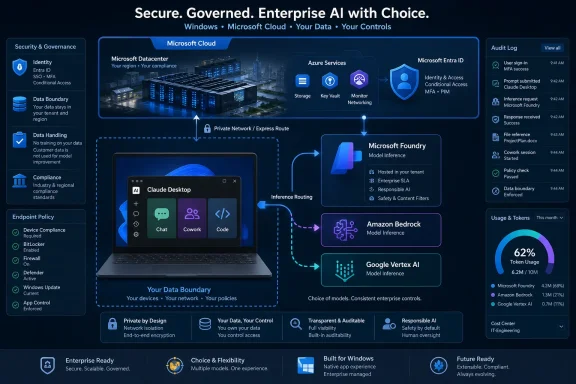 Anthropic Is Selling the Perimeter, Not Just the Model
The generative AI market has spent the last two years pretending that model quality was the whole story. It never was. In large organizations, the model is only one clause in a much longer document that also includes data residency, billing, identity, auditability, endpoint deployment, retention, legal review, and the awkward question of who gets blamed when an autonomous assistant writes to the wrong directory.Claude Desktop’s third-party cloud configuration is Anthropic’s answer to that enterprise reality. Instead of asking every customer to route sensitive work through Anthropic’s own SaaS boundary, the company is leaning into a familiar enterprise pattern: let the customer run inference through the cloud provider they already trust. In Microsoft’s case, that means a Foundry resource; in AWS and Google environments, the equivalent story runs through Bedrock and Vertex AI.
That matters because the enterprise buyer does not experience AI as a chatbot race. A CIO experiences AI as a succession of exception requests. Every new assistant that wants access to documents, source code, calendars, tickets, repositories, and spreadsheets is another vendor-risk review, another procurement workflow, another DPA, and another argument with security architecture.
Anthropic’s bet is that Claude becomes easier to approve when it arrives as a workload inside the customer’s existing cloud perimeter. It is a smart bet, and it is also a revealing one. The center of gravity in enterprise AI is shifting from which model is smartest today to which model can be governed without inventing a new operating model around it.
The Desktop App Becomes the New Enterprise Battleground
Claude Desktop used to look like the consumer-friendly front end to a web assistant. In this new configuration, it looks more like a managed shell for several kinds of work: conversational assistance, agentic office automation, and developer-oriented code execution. That is a different product category, and it lands squarely on the machines Windows administrators already manage.The distinction between Chat, Cowork, and Code is not cosmetic. Claude Chat is the familiar prompt-and-response interface for writing, summarizing, reasoning, and research. Claude Cowork is the more consequential layer: a visual agent that can handle multi-step tasks, work with local files selected by the user, coordinate sub-tasks, and produce documents, spreadsheets, and presentations. Claude Code is the developer-facing environment for repository-aware coding tasks, multi-file edits, command execution, and engineering workflows.
For enterprises, bundling those experiences into one desktop surface is both attractive and dangerous. It reduces user confusion and makes adoption easier, but it also collapses several risk profiles into a single application. A chat assistant that drafts email is not the same thing as an agent that can write files or run shell commands.
That is why the policy story matters. The useful version of this product is not “everyone gets the full agent.” The useful version is that marketing gets Chat and perhaps Cowork, engineering gets Code under tighter controls, finance gets document workflows with carefully scoped connectors, and high-risk departments get a slower rollout with logging and guardrails. Anthropic appears to understand that the enterprise market will not tolerate a single all-or-nothing switch.
Microsoft Foundry Gives Windows Shops a Familiar Control Plane
The Microsoft Foundry configuration is especially relevant to WindowsForum readers because it aligns Claude with the administrative muscle memory of Microsoft-centric organizations. Foundry provides the inference endpoint, Azure billing carries the consumption, and deployment can be handled through the same device-management channels that already push Office, security agents, VPN clients, and line-of-business applications.That does not make Claude a Microsoft product. It does, however, make Claude less alien to Microsoft shops. A Windows administrator can think about this as another managed desktop application, another set of registry or configuration profiles, another Intune or Group Policy deployment, and another workload tied to Azure consumption.
Microsoft’s own documentation describes the Foundry setup as a way to route Claude model requests through the customer’s Foundry resource while keeping billing on the Azure account and supporting deployment through enterprise MDM tools. The operational model is familiar: validate on one machine, export configuration, push it to managed devices, and let the app enter third-party mode automatically when the managed configuration is present.
That familiarity is the point. Enterprise AI adoption has often been slowed by the fact that the best tools arrive like consumer apps with enterprise aspirations bolted on later. Claude Desktop’s Foundry path reverses the emphasis. The app still feels user-facing, but the rollout story is aimed at administrators first.
There are caveats. Claude models in Microsoft Foundry have carried preview-language warnings, and model availability can change. Some subscription types and regions are not supported. Organizations also need to pay close attention to whether the data-residency and no-Anthropic-conversation-data guarantees they expect are fully available in the exact deployment route they choose, because those details are where compliance programs live or die.
Procurement Friction Was the Hidden Adoption Killer
The most underrated feature in enterprise AI is not context length, benchmark performance, or even tool use. It is the ability to avoid a new procurement cycle.When a company can buy and meter AI through AWS Marketplace, Google Cloud Marketplace, or Azure billing, it removes one of the dullest but most powerful blockers in enterprise software. The organization may already have negotiated cloud terms, committed spend, budget owners, security reviews, and legal frameworks. Routing Claude consumption through those relationships turns a new AI initiative from a novel vendor event into an expansion of an existing cloud estate.
That is not a small distinction. Many AI pilots fail before technical evaluation because legal and procurement cannot move at the speed of user demand. Employees find consumer tools, departments expense subscriptions, and IT discovers the footprint later. The result is shadow AI: useful, ungoverned, and impossible to defend in a serious audit.
Anthropic’s third-party cloud approach tries to make the sanctioned path as convenient as the unsanctioned one. If the enterprise can say, “Use Claude through our cloud account, under our policies, with our billing and our deployment controls,” it has a better chance of competing with the browser tab employees already opened.
This is also why the desktop packaging matters. A browser-only AI assistant is easy to access but hard to surround with endpoint-specific controls. A desktop app can be distributed, configured, restricted, updated, and monitored through the administrative systems enterprises already operate. That does not solve every governance problem, but it changes the conversation from prohibition to managed enablement.
Agentic AI Forces IT to Care About the Endpoint Again
For years, cloud software encouraged a convenient illusion: if the app lived in the browser, the endpoint mattered less. Agentic AI breaks that illusion. Once an assistant can read local files, write outputs, run code in an isolated local environment, and interact with user-selected folders, the PC becomes part of the AI control plane again.That is particularly important for Windows environments. Enterprises have spent decades building endpoint management around Microsoft Intune, Group Policy Objects, Defender, certificate stores, application control, data loss prevention, and privileged access boundaries. Claude Cowork and Claude Code do not erase that work; they make it newly relevant.
Anthropic’s current Cowork documentation emphasizes that the agent works with local files the user chooses to share and that code runs in an isolated virtual machine on the computer. That architecture is not the same thing as unlimited disk access, and it is materially better than a background crawler indexing every drive by default. But it still requires careful thinking because the agent can make real changes where it has permission.
The most sensible enterprise deployments will treat Claude Desktop less like a chat client and more like a productivity runtime. It should be packaged, staged, monitored, and segmented. The permissions that make sense for a developer workstation are not necessarily acceptable on an executive assistant’s laptop or a finance analyst’s machine with local exports of payroll data.
This is where Windows admins will feel the practical impact first. They will be asked to push the installer, configure provider routing, manage updates, control network egress, integrate identity, and answer whether the app is permitted to access certain folders. The AI strategy meeting eventually becomes a device-management ticket.
The Microsoft 365 Connector Is Where Usefulness Meets Exposure
Claude’s value inside an enterprise rises sharply when it can reach the places work actually happens. For many organizations, that means Microsoft 365: Outlook, calendars, SharePoint, OneDrive, Teams-adjacent documents, and the permissions model wrapped around Entra ID. Without those connectors, AI assistants remain clever copy boxes. With them, they become workplace actors.That is why the Microsoft 365 connector story is so important. If Claude can operate through an organization’s own Entra app ecosystem and respect tenant boundaries, it becomes much more useful to the average knowledge worker. It can summarize material in context, help prepare drafts from internal sources, reason across files, and reduce the swivel-chair work that defines much of corporate life.
But usefulness and exposure are twins. The same connector that lets Claude help with a SharePoint knowledge base could also surface overshared documents, stale permissions, or data that employees technically can access but should not casually process with an AI agent. AI does not create bad access control, but it can make bad access control obvious at machine speed.
This is the hard lesson many enterprises learned with search before AI. If permissions are loose, better discovery tools do not merely help employees find what they need; they also help them find what they were never meant to see. Agentic assistants raise the stakes because they can act on that information, not just display it.
The smart rollout starts with identity hygiene and data hygiene, not a launch party. Entra app consent, tenant allowlisting, SharePoint permissions, DLP labels, sensitivity labels, retention policies, and audit logging all become part of the Claude deployment conversation. The connector is the feature users will love, but it is also the feature that should make administrators slow down.
Anthropic Is Borrowing the Cloud Giants’ Trust
There is a strategic irony in Anthropic’s move. The company is trying to differentiate its AI experience while relying on the cloud giants’ trust fabric to get through the enterprise door. That is not weakness; it is how enterprise software is now sold.AWS, Google Cloud, and Microsoft have spent years becoming the default compliance wrappers for modern infrastructure. They are not merely compute providers. They are procurement channels, governance planes, identity brokers, region selectors, audit surfaces, and budget frameworks. If Claude runs through them, Claude inherits some of that institutional comfort.
This does not mean customers can outsource responsibility. The cloud provider may supply the channel and the infrastructure boundary, but the customer still decides which models are deployed, which users receive the app, which connectors are enabled, which logs are collected, and which workflows are too sensitive for automation. The shared-responsibility model has not disappeared; it has learned to speak fluent AI.
Anthropic’s advantage is that it can meet enterprises where they already are. Many large companies are not going to standardize on a single AI provider forever. They will use OpenAI through Microsoft, Gemini through Google, Claude through several clouds, open models in private deployments, and specialized tools embedded in SaaS platforms. The winners will be the vendors that can survive that messy, multi-model reality.
For Microsoft, the Foundry integration also fits a broader shift. Microsoft’s AI story is no longer only about OpenAI and Copilot. Foundry is designed to make Azure a place where customers can choose among models, build agents, and govern workloads. Claude Desktop routing through Foundry reinforces that platform argument even when the assistant itself is not Microsoft-branded.
The Beta Label Should Keep Expectations Grounded
The word “beta” matters. Enterprise buyers have a habit of interpreting vendor roadmaps as operational facts, and AI vendors have a habit of moving quickly enough that yesterday’s documentation becomes tomorrow’s archaeological record. A beta enterprise desktop agent routed through third-party cloud infrastructure should be treated as a pilot candidate, not a universal default.The risks are not theoretical. Agentic tools can misunderstand instructions, take inefficient paths, create plausible but wrong summaries, overwrite drafts, expose poorly permissioned data, or burn through cloud consumption budgets faster than expected. They can also encourage employees to delegate work they do not understand well enough to verify.
That does not mean enterprises should wait forever. Waiting for perfect certainty is another way to guarantee shadow adoption. But the correct first deployment is bounded: limited user groups, known workflows, known data locations, monitored consumption, and a rollback plan.
The most important governance question is not “Is Claude safe?” That question is too broad to be useful. The better question is: “Which Claude capabilities are safe for which users, on which devices, against which data, under which logging and retention conditions?” That is the question serious IT teams will answer policy by policy.
Microsoft-centric organizations should also watch the line between Claude as a Foundry-routed workload and Claude as a first-party SaaS experience. Those are not interchangeable from a compliance perspective. A user launching a consumer-style assistant and a user operating a managed desktop app configured to route inference through a company Foundry resource may feel similar at the keyboard, but they are very different events in a risk register.
Developers Will Push First, Knowledge Workers Will Normalize It
Claude Code has already made Anthropic difficult for engineering organizations to ignore. Developers are usually the first group willing to tolerate rough edges if a tool saves enough time. They also have workflows that map naturally to agentic systems: inspect the repository, understand the issue, edit files, run tests, explain the diff.Claude Cowork is the broader commercial prize. It takes the same agentic logic and removes the terminal from the center of the experience. Instead of asking a nontechnical worker to become a prompt engineer, it invites them to assign work: organize this folder, synthesize these documents, prepare a spreadsheet, draft the presentation, compare these files, generate the briefing.
That is both powerful and culturally disruptive. Office work has long been structured around micro-tasks: find the file, copy the numbers, clean the table, draft the summary, format the deck. A tool that can absorb several of those steps changes not only productivity but also accountability. If the result is wrong, who owns the error: the user, the model, the team that approved the workflow, or the administrator who enabled the connector?
Enterprises will answer that question unevenly. Some will write careful policies and training materials. Others will deploy broadly and discover the edge cases in production. The organizations that do best will treat Cowork not as magic labor but as supervised automation.
There is also a labor-market subtext that vendors prefer to soften. An agent that can produce formatted documents, spreadsheets, and presentations is not just a convenience feature. It targets the connective tissue of white-collar work. The politically safe phrase is “augmentation,” but the operational reality is that some tasks will disappear, some roles will change, and some managers will ask why a process still takes three days.
Cost Control Moves From Seats to Tokens
Traditional enterprise software procurement likes seats because seats are legible. You can count users, assign licenses, forecast annual spend, and negotiate renewals. Token-based consumption is more elastic and, therefore, more dangerous.Routing Claude through cloud billing relationships makes procurement easier, but it also shifts cost governance into the same world as cloud spend management. Heavy users, inefficient prompts, runaway agents, repeated scheduled tasks, and large document workflows can all become budget issues. The invoice may arrive through Azure, AWS, or Google Cloud, but the surprise will still land on someone’s desk.
This is where telemetry and per-team attribution become critical. If an organization cannot tell which department, workflow, or user group is driving consumption, it cannot govern AI spend rationally. Blanket bans follow opaque bills. Granular visibility enables policy.
The move from seat licensing to consumption also changes adoption incentives. A department does not need to justify a large upfront license pool to begin experimenting, but successful usage can scale rapidly. That is good for Anthropic and the cloud providers. It is tolerable for customers only if finance and IT build controls before usage becomes invisible infrastructure.
The lesson from cloud computing is obvious. Consumption models are wonderful when workloads are understood and monitored. They are brutal when everyone assumes someone else is watching the meter. AI agents make the meter spin in new ways.
Windows Admins Get the Hard Part After the Demo Ends
The demo version of Claude Desktop is simple: install the app, connect the provider, ask for something impressive, watch the agent produce work. The production version is more complicated because every impressive capability corresponds to an administrative decision.Admins will need to decide whether auto-updates are acceptable or whether builds should be redistributed on an internal schedule. They will need to decide whether crash reports and product analytics are enabled, limited, or disabled. They will need egress rules, firewall allowlists, endpoint monitoring, app control policies, identity mappings, and support runbooks for when the agent cannot reach a model endpoint.
They will also need user education that does not read like legal boilerplate. Employees should understand that granting a folder to Cowork is meaningful, that generated output requires review, that sensitive data rules still apply, and that the agent’s confidence is not evidence. The goal is not to scare people away from the tool. The goal is to prevent a productivity assistant from becoming a compliance incident with a friendly UI.
The most overlooked support issue may be expectation management. Users will expect the agent to behave like a tireless junior colleague. Sometimes it will. Other times it will stall, ask for permission, misunderstand local context, fail because a machine slept, or produce a result that looks polished enough to hide a conceptual mistake. IT will inherit many of those complaints, even when the underlying issue is workflow design rather than software deployment.
For Windows environments, this is a familiar pattern with a new surface area. Every transformative desktop tool eventually becomes normal enough to be boring. Before that happens, administrators must drag it through packaging, policy, identity, logging, budgeting, and support. Claude Desktop is entering that phase.
The Winners Will Be the Organizations That Segment the Agent
The worst way to deploy Claude Desktop is to treat it as a single thing. It is not. It is a bundle of capabilities with different risk levels, different user populations, and different operational consequences.The safer model is segmentation. Chat can reach a broad population with modest controls. Cowork can be piloted around specific document and productivity workflows. Code can be targeted to engineering teams with repository policies, sandbox expectations, and developer-specific monitoring. Connectors can be enabled only where permissions are clean enough to survive AI acceleration.
That segmentation also protects the technology from backlash. When AI tools are rolled out too broadly and too vaguely, the first bad incident becomes a referendum on the entire category. When they are introduced with clear boundaries, failures become manageable lessons.
Enterprises should resist the temptation to let vendor enthusiasm define the rollout. Anthropic wants Claude to be everywhere work happens. That is understandable. IT’s job is to decide where “everywhere” is too much.
The deeper strategic point is that AI agents are becoming a new class of enterprise endpoint software. They are not merely SaaS tools and not merely local applications. They sit between cloud inference, local execution, identity systems, file stores, collaboration platforms, and user intent. That hybrid position is exactly why they are powerful and exactly why governance cannot be an afterthought.
The Claude Desktop Rollout Is Really a Governance Test
The practical lessons from this launch are less glamorous than the agent demos, but they are the ones that will determine whether Claude becomes sanctioned infrastructure or another shadow IT headache.- Organizations should distinguish carefully between Claude’s direct SaaS experiences and third-party cloud-routed configurations because the compliance and data-flow assumptions are not the same.
- Microsoft-centric enterprises should evaluate the Foundry path as an Azure-governed deployment model, not merely as another way to open a chatbot.
- Windows administrators should treat Claude Desktop as a managed productivity runtime that needs packaging, policy, update control, identity integration, and support documentation.
- Security teams should review Microsoft 365, SharePoint, local folder, and developer-tool permissions before broadening access to Cowork or Code.
- Finance and platform teams should build token-consumption monitoring early because cloud-billed AI can become expensive before anyone thinks of it as a budget line.
- Business leaders should pilot agentic workflows around specific tasks with measurable outcomes rather than declaring a company-wide AI transformation from the top down.
References
- Primary source: Lapaas Voice
Published: 2026-06-23T06:45:14.042874
Anthropic Launch Claude Desktop Beta on AWS, Google & Microsoft Foundry - Lapaas Voice
Anthropic has expanded its enterprise reach by launching the full Claude Desktop experience across the industry’s major cloud computing environments: Amazon Web Services (AWS), Google Cloud,…voice.lapaas.com - Official source: learn.microsoft.com
Configure Claude Desktop for Microsoft Foundry - Microsoft Foundry | Microsoft Learn
Configure Claude Desktop to use Microsoft Foundry as its inference provider for enterprise deployments.learn.microsoft.com - Official source: code.claude.com
Claude Code on Amazon Bedrock - Claude Code Docs
Learn about configuring Claude Code through Amazon Bedrock, including setup, IAM configuration, and troubleshooting.code.claude.com - Official source: docs.anthropic.com
- Related coverage: therouter.ai
Claude Code Auto Mode on AWS Bedrock, Vertex, and Foundry — Enable It, Route It, Audit It — TheRouter.ai | TheRouter.ai
Claude Code auto mode now runs on AWS Bedrock, Google Vertex AI, and Microsoft Foundry — set CLAUDE_CODE_ENABLE_AUTO_MODE=1 and your coding agent runs inside your VPC. Here's what changes for billing, latency, and fallback routing when you switch from the Anthropic API.therouter.ai - Related coverage: remoteopenclaw.com
Claude Opus 4.7 on Bedrock, Vertex AI, and Foundry | Remote OpenClaw
Claude Opus 4.7 on Bedrock, Vertex AI, and Microsoft Foundry: what Anthropic officially says, what the platform docs show today, and where launch-day docs still lag.www.remoteopenclaw.com
- Official source: support.anthropic.com
Install Claude Desktop | Claude Help Center
support.anthropic.com
- Official source: support.claude.com
Get started with Claude Cowork | Claude Help Center
- Related coverage: windowscentral.com
This is Microsoft's new "Copilot Cowork": An experiment with Anthropic's Claude AI models that plans and delegates your work | Windows Central
Microsoft ships Copilot Cowork to its Frontier program.www.windowscentral.com - Related coverage: techradar.com
Claude Cowork is now available for enterprise use, adds analytics, access controls and more | TechRadar
Anthropic makes Claude Cowork available for all paying customerswww.techradar.com - Related coverage: axios.com
Microsoft launches AI tool that competes with Anthropic
Anthropic's product threatened to kill Microsoft's software business, then Microsoft took the name and made it a Copilot feature.www.axios.com
- Related coverage: tomshardware.com
Anthropic signs deal with Google Cloud to expand TPU chip capacity — AI company expects to have over 1GW of processing power in 2026 | Tom's Hardware
Why build your own data centers when you can just as easily rent them?www.tomshardware.com - Related coverage: publicservicesalliance.org
Hands On With Anthropics Claude Cowork an AI Agent That Actually Works WIRED
PDF documentpublicservicesalliance.org
- Related coverage: gsaglobal.org
Slide 1: Frontier AI for Semiconductors: Automated Verification, Design Agents, and Faster Cycles
PDF documentwww.gsaglobal.org
- Official source: www-cdn.anthropic.com
- Related coverage: labs.cloudsecurityalliance.org
Pentagon Designates Anthropic: Enterprise AI Vendor Risk
PDF documentlabs.cloudsecurityalliance.org
