

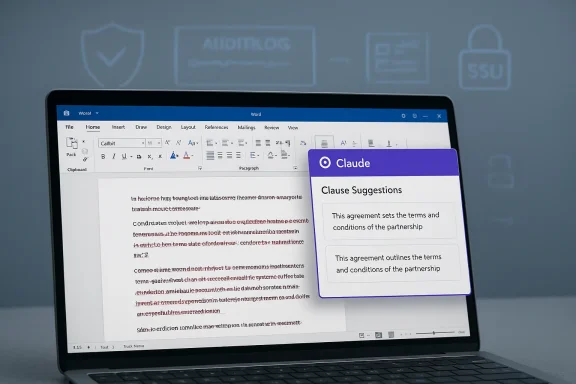
Anthropic’s push into Microsoft Word is best understood as more than a product launch. It is a direct attempt to move AI from a chat window into the center of enterprise productivity, where documents, approvals, audits, and repetitive drafting work actually happen. By embedding Claude as a Word add-in, Anthropic is betting that the real moat in enterprise AI is not just model quality, but workflow proximity and admin-friendly deployment. Microsoft, meanwhile, already has its own deep Word and Microsoft 365 Copilot integration, which makes this a contest about distribution, trust, and speed as much as raw capability.
The enterprise AI race has steadily shifted from standalone assistants to embedded assistants. In the early phase, buyers experimented with general-purpose chatbots for drafting and summarization, but those tools often lived outside the software where knowledge work actually occurs. That created friction: copy-pasting, context switching, lost formatting, and governance headaches.
Microsoft has spent years turning Microsoft 365 into a platform rather than a suite. Word is no longer just a word processor; it is part of a broader fabric that includes Copilot, Graph-based personalization, admin controls, and centralized deployment of add-ins. Microsoft’s own documentation makes clear that Office add-ins can be deployed through the Microsoft 365 admin center or integrated apps portal, and that users can encounter them directly inside Word through the ribbon or the Manage your apps experience.
Anthropic has approached the market differently. Instead of trying to out-Microsoft Microsoft on every surface at once, it has repeatedly emphasized enterprise controls, secure deployment, and integration with systems where work already lives. Its enterprise offering includes SSO, SCIM, audit logs, role-based permissions, and custom retention controls, all of which are crucial in regulated environments. That positioning matters because the battle for office productivity software is not won by novelty; it is won by being safe enough for IT to approve and useful enough for employees to keep.
The current wave of AI software is also increasingly about model access through familiar interfaces. Microsoft’s own Copilot strategy now includes Word, Excel, PowerPoint, and even specialized agents that create files and interact with documents. Microsoft Learn notes that these Word, Excel, and PowerPoint agents are installed by Microsoft and can use organizational data governed by permissioning and compliance policies. In other words, Microsoft is not standing still; it is extending AI deeper into the Office stack even as third parties try to do the same.
Anthropic’s broader enterprise arc has been visible for months. Partnerships with companies such as Salesforce and Snowflake, plus its enterprise plan features, show a deliberate pattern: bring Claude closer to sensitive business systems and let administrators control the rollout. That makes the reported Claude for Word beta less like an isolated experiment and more like one more step in a wider distribution strategy.
That distinction matters because format preservation is a real enterprise pain point. Legal teams, finance teams, and policy authors do not just need text generation; they need clause-level editing, tracked changes, and outputs that slot into existing review workflows. An assistant that breaks structure, renumbers sections incorrectly, or wipes formatting quickly loses trust, no matter how smart the underlying model is.
Microsoft’s own documentation on Office add-ins underscores how these tools are designed to appear inside Office applications and can be centrally deployed to users or groups. That makes an embedded assistant easier for IT to govern than a shadow AI tool employees adopt on their own. It also means vendors can scale through the same administrative rails already used for other workplace software.
That means Anthropic is, in effect, trying to ride Microsoft’s own rails to reach Microsoft’s customers. This is clever, because it reduces adoption friction. But it is also dangerous, because Microsoft can surface competing capabilities inside the same environment and can do so with first-party authority and native distribution. Microsoft already documents how add-ins are deployed, updated, and surfaced to users through its admin center and marketplace pathways.
But centralized deployment cuts both ways. If a rival product becomes compelling, Microsoft can also propagate its own solution at the same scale. The distribution advantage that helps Anthropic get into the door is the same mechanism that helps Microsoft retain the room. In enterprise software, permission is often the first moat and default state is the second.
That is why enterprise workflow integration is a more meaningful differentiator than raw benchmark performance. A model can be impressive in abstraction and still fail at the mundane but critical tasks that define workplace usefulness. Anthropic’s enterprise plans, with audit logs and permission controls, are a sign that the company understands this.
This means any third-party add-in faces a two-layer challenge. First, it must justify why it exists when Microsoft already ships AI inside Word. Second, it must prove it can outperform or complement the native option in ways that matter to procurement, compliance, and end-user satisfaction. That is a high bar, especially when Microsoft controls the core interface.
In practice, that could mean Anthropic wins where Microsoft’s own tools remain broad and general. If Claude for Word becomes the preferred assistant for a narrow but lucrative audience—say, legal professionals who care deeply about track changes and clause fidelity—it can carve out a defensible niche. If not, it risks becoming one more add-in users test and then forget.
Microsoft, however, has an enormous structural advantage because AI is being layered on top of an already dominant subscription and cloud business. Microsoft 365 and Azure give the company multiple ways to capture value from AI adoption. So even if Anthropic successfully introduces a Word add-in, Microsoft may still benefit if that usage ultimately reinforces the centrality of Microsoft 365 itself.
That is why the crucial question is penetration depth, not just downloads. Does the assistant become part of daily drafting habits? Does it survive procurement review? Does it spread from one pilot team to a wider organization? Those are the indicators that matter more than launch-day excitement.
Microsoft’s own platform similarly emphasizes authorization boundaries, compliance policy respect, and tenant-level control for Copilot experiences. Its Word and PowerPoint agents, for example, are described as operating with organizational data and honoring sensitivity labels and compliance policies. That means the competitive battleground is not “secure versus insecure,” but whose security model is easier to accept and easier to operationalize.
That is one reason the “native sidebar” concept matters. It is not just about usability; it is about making AI behavior visible in the same environment where review and approval already happen. Visibility is a form of governance.
Anthropic’s enterprise plan already reflects this philosophy. The company highlights deeper workflows, enhanced security, and larger context windows for document-heavy work. That is particularly relevant for enterprise documents, which are often long, interconnected, and edited iteratively across teams.
Still, Microsoft remains extraordinarily well-positioned. It controls the application, the admin center, and a large share of enterprise identity and document infrastructure. That means Microsoft can respond not only with features, but with integration depth, packaging, and licensing leverage. In enterprise markets, those levers often matter more than product headlines.
That would be a very Microsoft-like outcome, ironically. The company has long thrived by making its ecosystem broad enough that third parties can build around it while still benefiting from its gravity. Anthropic may be trying to do the same thing from inside the walls.
Anthropic’s challenge is to prove that its product is not merely compatible with Microsoft Word, but indispensable within it. That means winning trust in sensitive workflows, showing measurable productivity gains, and sustaining a rate of innovation fast enough to stay ahead of Microsoft’s counterpunch. If it can do that, Claude in Word may become a template for how third-party AI companies penetrate dominant productivity ecosystems. If it cannot, the add-in may still be useful—but only as a reminder of how hard it is to challenge a platform owner on its own turf.
Source: Bitget Anthropic's Integrated AI Challenge: Expanding Deeply Into Microsoft's Office 365 Ecosystem With Robust Enterprise Workflow Integration | Bitget News
 Background
The enterprise AI race has steadily shifted from standalone assistants to embedded assistants. In the early phase, buyers experimented with general-purpose chatbots for drafting and summarization, but those tools often lived outside the software where knowledge work actually occurs. That created friction: copy-pasting, context switching, lost formatting, and governance headaches.Microsoft has spent years turning Microsoft 365 into a platform rather than a suite. Word is no longer just a word processor; it is part of a broader fabric that includes Copilot, Graph-based personalization, admin controls, and centralized deployment of add-ins. Microsoft’s own documentation makes clear that Office add-ins can be deployed through the Microsoft 365 admin center or integrated apps portal, and that users can encounter them directly inside Word through the ribbon or the Manage your apps experience.
Anthropic has approached the market differently. Instead of trying to out-Microsoft Microsoft on every surface at once, it has repeatedly emphasized enterprise controls, secure deployment, and integration with systems where work already lives. Its enterprise offering includes SSO, SCIM, audit logs, role-based permissions, and custom retention controls, all of which are crucial in regulated environments. That positioning matters because the battle for office productivity software is not won by novelty; it is won by being safe enough for IT to approve and useful enough for employees to keep.
The current wave of AI software is also increasingly about model access through familiar interfaces. Microsoft’s own Copilot strategy now includes Word, Excel, PowerPoint, and even specialized agents that create files and interact with documents. Microsoft Learn notes that these Word, Excel, and PowerPoint agents are installed by Microsoft and can use organizational data governed by permissioning and compliance policies. In other words, Microsoft is not standing still; it is extending AI deeper into the Office stack even as third parties try to do the same.
Anthropic’s broader enterprise arc has been visible for months. Partnerships with companies such as Salesforce and Snowflake, plus its enterprise plan features, show a deliberate pattern: bring Claude closer to sensitive business systems and let administrators control the rollout. That makes the reported Claude for Word beta less like an isolated experiment and more like one more step in a wider distribution strategy.
Why a Word Add-In Matters
A Word add-in is not a cosmetic feature. Word remains one of the highest-value surfaces in enterprise productivity because contracts, memos, policies, drafts, and internal approvals all converge there. If an AI assistant can operate inside Word while preserving numbering, styles, and formatting, it becomes part of the document lifecycle rather than a tool people consult after the fact.That distinction matters because format preservation is a real enterprise pain point. Legal teams, finance teams, and policy authors do not just need text generation; they need clause-level editing, tracked changes, and outputs that slot into existing review workflows. An assistant that breaks structure, renumbers sections incorrectly, or wipes formatting quickly loses trust, no matter how smart the underlying model is.
The enterprise case for in-document AI
The strongest argument for a Word-native assistant is that it reduces friction at the exact point where the work happens. Instead of asking users to export a document, paste text into a separate AI tool, and then reconcile revisions manually, the assistant can operate in place. That is especially valuable in document-heavy industries where speed and precision must coexist.Microsoft’s own documentation on Office add-ins underscores how these tools are designed to appear inside Office applications and can be centrally deployed to users or groups. That makes an embedded assistant easier for IT to govern than a shadow AI tool employees adopt on their own. It also means vendors can scale through the same administrative rails already used for other workplace software.
- Reduces copy-paste friction
- Keeps revision history visible
- Fits existing review loops
- Lowers training overhead
- Aligns with IT deployment controls
The Microsoft Distribution Advantage
Anthropic’s challenge is not whether it can build a competent Word add-in. The harder question is whether it can sustain adoption in an ecosystem Microsoft already owns. Microsoft 365 is not just an application suite; it is an administrative and security framework that already supports enterprise deployment, tenant governance, and user assignment by group.That means Anthropic is, in effect, trying to ride Microsoft’s own rails to reach Microsoft’s customers. This is clever, because it reduces adoption friction. But it is also dangerous, because Microsoft can surface competing capabilities inside the same environment and can do so with first-party authority and native distribution. Microsoft already documents how add-ins are deployed, updated, and surfaced to users through its admin center and marketplace pathways.
Centralized deployment as a growth lever
If an enterprise administrator can push a Word add-in to hundreds or thousands of users through centralized deployment, adoption can accelerate very quickly. That is especially true when the add-in is positioned for a narrow, high-value use case such as legal review or financial drafting. The IT team sees a controlled rollout, while business users experience a new productivity layer without having to learn a separate platform.But centralized deployment cuts both ways. If a rival product becomes compelling, Microsoft can also propagate its own solution at the same scale. The distribution advantage that helps Anthropic get into the door is the same mechanism that helps Microsoft retain the room. In enterprise software, permission is often the first moat and default state is the second.
Enterprise Workflow Integration
The big shift in this story is the move from generic AI assistance to workflow-specific augmentation. A legal team does not want a chatbot that merely writes “better” prose; it wants a system that respects markup, clause hierarchy, citations, and redlines. Likewise, finance teams need language that can be drafted, checked, and revised without destabilizing the document’s formal structure.That is why enterprise workflow integration is a more meaningful differentiator than raw benchmark performance. A model can be impressive in abstraction and still fail at the mundane but critical tasks that define workplace usefulness. Anthropic’s enterprise plans, with audit logs and permission controls, are a sign that the company understands this.
Where the real value sits
The highest-value use cases are usually not the flashiest ones. They are the repetitive, high-stakes activities where human time is expensive and errors are costly. Editing contract language, restructuring board memos, drafting policy updates, and summarizing diligence materials all fit that description.- Legal redlining and clause revision
- Financial memo drafting
- Policy and compliance editing
- Executive summary generation
- Repetitive boilerplate transformation
Microsoft’s Counterposition
Microsoft is not facing a blind spot here. Its own Copilot strategy already embeds AI in Word and other Microsoft 365 apps, and its current documentation suggests an ongoing expansion of specialized AI agents that can create and edit Office files. Microsoft also notes that these experiences can leverage organizational data and operate under enterprise data protection and copyright commitments.This means any third-party add-in faces a two-layer challenge. First, it must justify why it exists when Microsoft already ships AI inside Word. Second, it must prove it can outperform or complement the native option in ways that matter to procurement, compliance, and end-user satisfaction. That is a high bar, especially when Microsoft controls the core interface.
Copilot versus add-ins
There is also a subtle difference between a platform-native AI and a third-party add-in. Microsoft can embed AI in a way that feels like part of the product, while an add-in must always justify its extra layer. That does not doom third-party tools, but it does mean they need sharper specialization.In practice, that could mean Anthropic wins where Microsoft’s own tools remain broad and general. If Claude for Word becomes the preferred assistant for a narrow but lucrative audience—say, legal professionals who care deeply about track changes and clause fidelity—it can carve out a defensible niche. If not, it risks becoming one more add-in users test and then forget.
Competitive and Financial Implications
The financial story here is not only about who has the better model. It is about where enterprise AI monetization actually accrues. If users spend more time inside Claude-powered workflows, Anthropic can increase paid plan adoption, deepen customer stickiness, and strengthen its enterprise brand. That is valuable even if the immediate revenue pool is smaller than Microsoft’s.Microsoft, however, has an enormous structural advantage because AI is being layered on top of an already dominant subscription and cloud business. Microsoft 365 and Azure give the company multiple ways to capture value from AI adoption. So even if Anthropic successfully introduces a Word add-in, Microsoft may still benefit if that usage ultimately reinforces the centrality of Microsoft 365 itself.
The market share question
Investors often focus on market share as though it were a single thing. In reality, enterprise software share is fragmented by workflow, department, geography, and compliance posture. A product can win a very specific use case without dislodging the incumbent suite.That is why the crucial question is penetration depth, not just downloads. Does the assistant become part of daily drafting habits? Does it survive procurement review? Does it spread from one pilot team to a wider organization? Those are the indicators that matter more than launch-day excitement.
- Paid conversions from pilots
- Expansion within accounts
- Departmental standardization
- IT approval cycles
- Renewal and upsell behavior
Security, Compliance, and Trust
For enterprise customers, AI in Word is not just about productivity. It is about whether the assistant can operate inside a governed environment without exposing sensitive data or undermining controls. Anthropic’s enterprise positioning emphasizes security, data retention controls, SSO, audit logs, and role-based permissions, which are all central to enterprise trust.Microsoft’s own platform similarly emphasizes authorization boundaries, compliance policy respect, and tenant-level control for Copilot experiences. Its Word and PowerPoint agents, for example, are described as operating with organizational data and honoring sensitivity labels and compliance policies. That means the competitive battleground is not “secure versus insecure,” but whose security model is easier to accept and easier to operationalize.
Why auditability is a differentiator
Audit logs are often underappreciated outside procurement and security teams, but they are critical in regulated industries. If an AI assistant changes text in a contract or memo, administrators may need to know who initiated the change, when it occurred, and what version history exists. An assistant that supports traceability is much easier to defend internally.That is one reason the “native sidebar” concept matters. It is not just about usability; it is about making AI behavior visible in the same environment where review and approval already happen. Visibility is a form of governance.
How the Enterprise Rollout Can Scale
Anthropic’s reported distribution approach is strategically important. When an AI product can be deployed through familiar enterprise software channels and managed by administrators, it behaves less like consumer software and more like a controlled business application. That reduces adoption friction and expands the pool of potential users from early adopters to entire departments.Anthropic’s enterprise plan already reflects this philosophy. The company highlights deeper workflows, enhanced security, and larger context windows for document-heavy work. That is particularly relevant for enterprise documents, which are often long, interconnected, and edited iteratively across teams.
What successful scaling looks like
Successful scaling will likely follow a familiar enterprise pattern. First comes a pilot in a control group. Then a departmental rollout. Only after the tool has proven value does it become a broad deployment candidate.- Identify a high-friction document workflow.
- Run a small pilot with compliance oversight.
- Measure time saved and error reduction.
- Expand to adjacent teams.
- Standardize usage if governance checks out.
Strategic Implications for Microsoft 365
If Anthropic gains traction in Word, the implications go beyond a single add-in. It would show that even inside Microsoft’s own productivity environment, there is room for specialized AI competitors. That would matter to software buyers who want leverage, and to Microsoft because it would signal that the company’s AI layer is not automatically the only one enterprises trust.Still, Microsoft remains extraordinarily well-positioned. It controls the application, the admin center, and a large share of enterprise identity and document infrastructure. That means Microsoft can respond not only with features, but with integration depth, packaging, and licensing leverage. In enterprise markets, those levers often matter more than product headlines.
The ecosystem effect
The more interesting long-term outcome may be ecosystem layering. Anthropic does not necessarily need to replace Microsoft 365 Copilot to win value; it may only need to become the preferred assistant for certain high-value tasks. If that happens, the enterprise AI market becomes a stack of overlapping tools rather than a winner-take-all platform.That would be a very Microsoft-like outcome, ironically. The company has long thrived by making its ecosystem broad enough that third parties can build around it while still benefiting from its gravity. Anthropic may be trying to do the same thing from inside the walls.
Strengths and Opportunities
Anthropic’s biggest strengths are clear: a credible enterprise security story, strong model reputation, and a willingness to meet users in the software they already use. If the company executes well, it could become the default AI assistant for document-centric teams that care more about precision than novelty. The opportunity is especially strong in regulated sectors where compliance, auditability, and formatting integrity are non-negotiable.- Native workflow placement inside Word
- Enterprise controls such as SSO, SCIM, and audit logs
- Formatting preservation for professional documents
- Fast admin deployment through Microsoft channels
- High-value niches like legal and financial drafting
- Strong partner ecosystem momentum
- Expanded context capacity for long documents
Risks and Concerns
The main risk is that Anthropic could end up validating Microsoft’s own platform rather than displacing it. If Microsoft quickly matches the key features or bundles them more deeply into Copilot, third-party differentiation may shrink fast. There is also the risk that enterprise buyers will prefer first-party tools over add-ins, even when the third-party experience is better.- Microsoft can respond quickly with native features
- Add-in fatigue may slow user adoption
- Procurement friction can stall rollouts
- Security concerns may delay approval
- Narrow use cases may limit expansion
- Enterprise buyers may default to first-party tools
- Product overlap could blur Anthropic’s value proposition
Looking Ahead
The next phase of this competition will be measured less by launch posts and more by deployment evidence. The most important questions are whether enterprises actually use Claude for Word daily, whether IT departments approve it at scale, and whether Microsoft responds by tightening its own embedded AI story. Microsoft’s April 29, 2026 earnings report is a near-term marker, but adoption data over the next several quarters will matter much more.Anthropic’s challenge is to prove that its product is not merely compatible with Microsoft Word, but indispensable within it. That means winning trust in sensitive workflows, showing measurable productivity gains, and sustaining a rate of innovation fast enough to stay ahead of Microsoft’s counterpunch. If it can do that, Claude in Word may become a template for how third-party AI companies penetrate dominant productivity ecosystems. If it cannot, the add-in may still be useful—but only as a reminder of how hard it is to challenge a platform owner on its own turf.
Source: Bitget Anthropic's Integrated AI Challenge: Expanding Deeply Into Microsoft's Office 365 Ecosystem With Robust Enterprise Workflow Integration | Bitget News
