

In March 2026, Comscore’s U.S. desktop rankings showed consumer AI chatbot usage reaching 44.4 million unique visitors, with ChatGPT still far ahead but Claude posting the month’s standout 130.1 percent jump. That single data point does not overturn the chatbot hierarchy. It does, however, make the market look less like a coronation and more like the beginning of a durable platform fight.
The easy story is that OpenAI remains the scale leader. The more interesting story is that the second wave of consumer AI adoption is no longer being driven only by curiosity, novelty, or the occasional viral prompt. Users are starting to sort these tools by purpose, trust, workflow fit, and brand identity — and in that sorting process, Anthropic’s Claude is suddenly much harder to dismiss as a niche product for AI obsessives.
For most of the generative AI boom, consumer chatbot rankings have been treated as a proxy for public fascination. If ChatGPT was up, AI was hot. If rivals gained, the story was framed as a horse race against OpenAI.
March’s Comscore numbers point to something more mature. Total U.S. desktop unique visitors in the category rose 21.3 percent from February to 44.4 million, a substantial gain for a market that is already several years into mainstream visibility. That is not the profile of a fad burning off early interest. It is the profile of a software category settling into routine use.
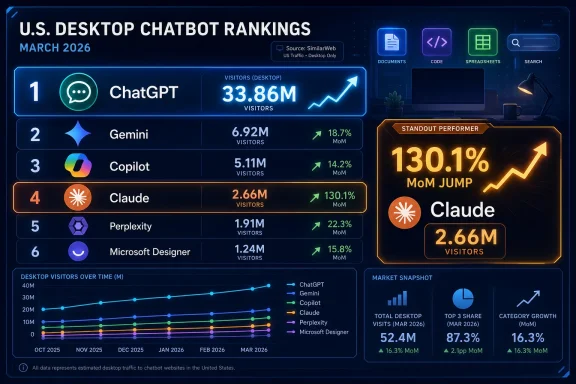
The platforms at the top all grew. ChatGPT reached 33.86 million unique visitors, up 18.9 percent month over month. Google Gemini climbed to 10.66 million, up 29.1 percent. Microsoft Copilot reached 5.02 million, up 44.4 percent. Claude, meanwhile, moved from 1.16 million visitors in February to 2.66 million in March.
Those totals are desktop-only and U.S.-specific, so they should not be mistaken for global active-user numbers or total consumer reach. But desktop usage matters because it is where many higher-value tasks still happen: writing, coding, research, document work, spreadsheets, presentations, and professional browsing. In other words, this is not merely a count of people amusing themselves with chatbots on phones. It is a signal about where AI tools are starting to sit in the workday.
That dominance matters because habits compound. The first chatbot a user learns often becomes the one they trust with ambiguous tasks. It accumulates saved chats, custom instructions, paid subscriptions, browser bookmarks, mobile app muscle memory, and workplace lore. In software markets, that kind of behavioral gravity can be as important as raw technical quality.
But gravity is not the same as invulnerability. The March data shows that users are not treating ChatGPT as the only serious destination. Gemini and Copilot both benefited from obvious distribution advantages: Google can surface Gemini across search, Android, Workspace, and the broader Google account universe, while Microsoft can push Copilot through Windows, Edge, Bing, Microsoft 365, and enterprise identity systems.
Claude’s rise is different. Anthropic does not own Windows, Chrome, Gmail, Office, Android, or iOS. It does not have the same consumer distribution machine as Microsoft or Google. That makes Claude’s 130.1 percent month-over-month gain more interesting than its absolute audience size. It suggests users are making an affirmative choice to seek it out.
The platform’s growth rate matters because consumer software markets often shift first at the margins. A tool becomes visible among writers, developers, analysts, students, researchers, and productivity obsessives. Then it starts appearing in screenshots, workplace recommendations, social posts, YouTube comparisons, and subscription debates. Eventually, it stops being a specialty option and becomes part of the standard consideration set.
Claude appears to be moving through that threshold. Anthropic has spent years presenting itself as a more safety-conscious AI company, with an emphasis on careful model behavior, enterprise reliability, and a brand tone that feels less frantic than some of the broader AI market. Whether that positioning is always earned in practice is a fair question. But brand clarity counts in consumer adoption, especially when the product category asks users to hand over messy drafts, sensitive questions, code, business plans, and private uncertainty.
OpenAI’s brand is synonymous with the category. Google’s brand is tied to search and productivity. Microsoft’s brand is tied to workplace computing. Anthropic’s challenge has been to make Claude stand for something legible. March suggests that it may be succeeding.
That trust has several layers. Users want to know whether the model is useful, whether it will hallucinate less often, whether it can handle complicated instructions, whether it will preserve context, and whether the company behind it is reckless with their data or reputation. These are not abstract concerns. They shape whether someone asks a chatbot to summarize a medical bill, draft an HR complaint, troubleshoot a server, explain a contract clause, or rewrite a tense email to a manager.
Anthropic has leaned into this trust narrative more explicitly than most competitors. Claude’s public identity is not only “smart chatbot,” but “careful chatbot.” That is a subtle but meaningful difference in a market where many users have become accustomed to AI systems that sound confident while being wrong.
There is a commercial reason this positioning resonates. As AI moves from toy to tool, users become less tolerant of chaos. The first wave of chatbot usage rewarded surprise. The second wave rewards reliability. If Claude is perceived as a place where users can do serious writing, analysis, coding, and decision support with fewer rough edges, that perception alone can drive trial.
The risk for Anthropic is that trust is easier to market than to maintain. A single bad product decision, confusing policy shift, or high-profile failure can puncture the aura. But the March numbers imply that trust, or at least the perception of it, is now a competitive wedge.
For Windows users, Copilot is the most structurally important of the challengers. Microsoft does not need every consumer to visit a standalone chatbot site if it can make Copilot part of the ambient Windows and Microsoft 365 experience. The company’s long game is not simply to win a chatbot tab in the browser. It is to make AI feel native to the PC.
That strategy gives Microsoft a built-in advantage among enterprise customers and Windows-heavy households. If Copilot becomes the place where a user asks questions about files, meetings, email, spreadsheets, system settings, and business data, then Microsoft’s position improves even if standalone chatbot traffic understates its reach. Desktop visitor rankings capture an important slice of behavior, but they do not fully capture embedded AI inside applications.
Google has a parallel advantage with Gemini. Search, Gmail, Docs, Android, and Chrome give Google countless opportunities to push users toward AI experiences without requiring a clean break from existing habits. If Gemini becomes an extension of search and productivity, its growth may look less like a chatbot adoption curve and more like a gradual interface migration across Google’s empire.
Yet distribution alone does not settle the market. Microsoft had enormous advantages in mobile and lost the smartphone platform war. Google has launched and retired enough messaging products to remind everyone that integration does not guarantee user affection. AI assistants will be judged by whether they produce better outcomes, not merely by where they appear.
That makes Comscore’s desktop rankings more commercially meaningful than they might appear at first glance. A user who visits a chatbot on a desktop is more likely to be integrating it into a task that has economic value. The chatbot is not just answering trivia; it is helping produce work.
This is why Claude’s growth should worry competitors even at a smaller base. Anthropic does not need to match ChatGPT’s raw consumer footprint overnight to become influential. It needs to win high-value use cases among people who shape organizational buying decisions, build internal workflows, recommend tools to colleagues, or pay for premium AI subscriptions.
The same logic applies to Copilot. Microsoft’s consumer numbers may look modest compared with ChatGPT, but Copilot’s strategic value lies in its proximity to enterprise work. If AI becomes a normal layer inside Word, Excel, PowerPoint, Outlook, Teams, Edge, and Windows itself, then Microsoft’s consumer chatbot traffic is only one measurement of a larger campaign.
The broader lesson is that AI chatbot competition will not be settled by a single leaderboard. The market is splitting into overlapping contests: consumer attention, workplace integration, developer adoption, search substitution, subscription loyalty, enterprise governance, and platform control. March’s rankings illuminate one of those contests, but they also hint at the rest.
That position helps OpenAI convert curiosity into usage. It gives ChatGPT cultural shorthand that no rival can buy quickly. People do not say they are going to “use a large language model”; they say they are going to ask ChatGPT, even when they sometimes mean a chatbot in general.
But category leadership attracts scrutiny. If consumers become anxious about privacy, accuracy, copyright, workplace dependence, AI slop, or the social effects of automation, ChatGPT absorbs much of that anxiety first. Rivals can then position themselves as alternatives: more integrated, more private, more careful, more enterprise-ready, more creative, more transparent, or simply different.
That is where Claude’s rise becomes strategically important. It gives users a plausible escape hatch without forcing them to abandon the chatbot paradigm. A dissatisfied ChatGPT user does not have to reject AI. They can try Claude, Gemini, Copilot, Perplexity, Grok, or another assistant. The existence of credible alternatives makes the market healthier, but it also means OpenAI must keep earning the default slot.
This is the point at which consumer AI starts to resemble other mature software categories. Users may keep one dominant tool while testing others for specific jobs. They may subscribe to one, use another at work, and keep a third for search-like tasks. The winner may not take all.
A chatbot that drafts text is useful. A chatbot that can find the relevant document, understand the company policy, edit the draft in the right format, send it through the approved channel, and remember the user’s preferences is a platform. This is where Microsoft, Google, OpenAI, and Anthropic are all converging, even if they arrive from different directions.
Microsoft wants Copilot to be the AI layer for work. Google wants Gemini to be the AI layer for information and productivity. OpenAI wants ChatGPT to become a general-purpose assistant, developer tool, search surface, and consumer operating layer for tasks. Anthropic wants Claude to be trusted enough for deep work, enterprise reasoning, coding, and complex collaboration.
These strategies overlap, but they are not identical. Microsoft and Google can rely on existing software estates. OpenAI has brand dominance and product velocity. Anthropic has a reputation for carefulness and a growing audience that appears willing to seek it out directly.
For WindowsForum readers, the practical effect is that the AI assistant is becoming another layer of platform lock-in. The choice of chatbot may soon influence where users store documents, which browser they use, which office suite feels most productive, which cloud provider gets developer attention, and which security model an IT department must govern.
If tens of millions of U.S. desktop users are visiting consumer chatbot services, some portion of that activity is almost certainly happening on work devices, work networks, or with work-adjacent data. Even when users have good intentions, they may paste sensitive information into tools that procurement, legal, and security teams have not approved. The more useful chatbots become, the more tempting that behavior gets.
This creates a familiar enterprise dilemma. Blocking everything is unrealistic and often counterproductive. Allowing everything is reckless. The hard work is building a governance model that recognizes that employees are using AI because it helps them move faster, not because they are trying to create compliance nightmares.
The competitive dynamics matter here. If employees increasingly use multiple AI tools, organizations cannot write policy around a single vendor. They need rules about data classification, retention, model training settings, acceptable use, auditing, procurement, and incident response. They also need to understand that the “best” AI tool may differ by department.
A developer may prefer Claude for code explanation, ChatGPT for experimentation, Copilot for IDE integration, and Gemini for Google Workspace tasks. A communications team may care more about writing quality and brand voice. A finance team may care about spreadsheet integration and data leakage. A legal team may care about retention and defensibility. The chatbot leaderboard is becoming an enterprise risk map.
Unique desktop visitors are useful, but they do not tell us how many people are paying, how long sessions last, how many prompts are submitted, how often users return, or whether the chatbot produced valuable output. They also do not capture every embedded AI interaction inside operating systems, browsers, office suites, IDEs, mobile apps, or APIs.
That does not make the rankings meaningless. It makes them a snapshot of a specific behavior: direct consumer visitation on desktop. The mistake would be to inflate that into a complete map of the AI economy. The equally bad mistake would be to dismiss it because it is incomplete.
For brands and advertisers, these rankings are a warning that AI assistants are becoming discovery surfaces. If consumers ask chatbots for product advice, travel planning, software recommendations, financial explanations, health-adjacent research, or shopping comparisons, then influence shifts away from traditional search results and social feeds. The assistant becomes an intermediary.
That has obvious implications for publishers and forums as well. WindowsForum and similar communities have long depended on search visibility, expert discussion, and archived troubleshooting value. If AI systems summarize forum wisdom without sending users back to the source, communities may become invisible infrastructure for answers. The chatbot usage boom is therefore not just another tech adoption story; it is a distribution story for the entire web.
Anthropic does not have Microsoft’s operating system reach or Google’s search monopoly. It does not have OpenAI’s first-mover cultural dominance. Yet Claude still posted the strongest month-over-month growth among the major platforms in Comscore’s ranking. That does not prove product quality beat distribution, but it does prove distribution is not the only force in play.
This matters because AI users are unusually willing to comparison-shop. Unlike switching operating systems or office suites, trying another chatbot is cheap. A user can keep ChatGPT open in one tab, Claude in another, Gemini in a third, and Copilot embedded in the browser or OS. The switching cost is low enough that reputation can travel quickly.
That dynamic favors visible product improvements. If a model gets better at coding, long-form writing, document reasoning, or multi-step planning, users notice. If a chatbot becomes annoying, evasive, slow, expensive, or unreliable, users also notice. In a market this fluid, brand loyalty has to be renewed constantly.
Claude’s challenge is to turn a surge into a habit. Anthropic needs users to return after the curiosity spike, pay for higher tiers, recommend the tool to colleagues, and trust it with recurring workflows. March got Claude attention. Retention will decide whether the moment becomes a movement.
The easy story is that OpenAI remains the scale leader. The more interesting story is that the second wave of consumer AI adoption is no longer being driven only by curiosity, novelty, or the occasional viral prompt. Users are starting to sort these tools by purpose, trust, workflow fit, and brand identity — and in that sorting process, Anthropic’s Claude is suddenly much harder to dismiss as a niche product for AI obsessives.
 The Chatbot Market Has Moved Past the Demo Phase
For most of the generative AI boom, consumer chatbot rankings have been treated as a proxy for public fascination. If ChatGPT was up, AI was hot. If rivals gained, the story was framed as a horse race against OpenAI.March’s Comscore numbers point to something more mature. Total U.S. desktop unique visitors in the category rose 21.3 percent from February to 44.4 million, a substantial gain for a market that is already several years into mainstream visibility. That is not the profile of a fad burning off early interest. It is the profile of a software category settling into routine use.
The platforms at the top all grew. ChatGPT reached 33.86 million unique visitors, up 18.9 percent month over month. Google Gemini climbed to 10.66 million, up 29.1 percent. Microsoft Copilot reached 5.02 million, up 44.4 percent. Claude, meanwhile, moved from 1.16 million visitors in February to 2.66 million in March.
Those totals are desktop-only and U.S.-specific, so they should not be mistaken for global active-user numbers or total consumer reach. But desktop usage matters because it is where many higher-value tasks still happen: writing, coding, research, document work, spreadsheets, presentations, and professional browsing. In other words, this is not merely a count of people amusing themselves with chatbots on phones. It is a signal about where AI tools are starting to sit in the workday.
ChatGPT Still Owns the Mountain, but the Slopes Are Getting Crowded
OpenAI’s lead remains enormous. ChatGPT’s 33.86 million U.S. desktop unique visitors in March put it in a different class from every named rival in Comscore’s consumer chatbot ranking. Even after strong growth from Gemini, Copilot, and Claude, ChatGPT is still the default reference point for the category.That dominance matters because habits compound. The first chatbot a user learns often becomes the one they trust with ambiguous tasks. It accumulates saved chats, custom instructions, paid subscriptions, browser bookmarks, mobile app muscle memory, and workplace lore. In software markets, that kind of behavioral gravity can be as important as raw technical quality.
But gravity is not the same as invulnerability. The March data shows that users are not treating ChatGPT as the only serious destination. Gemini and Copilot both benefited from obvious distribution advantages: Google can surface Gemini across search, Android, Workspace, and the broader Google account universe, while Microsoft can push Copilot through Windows, Edge, Bing, Microsoft 365, and enterprise identity systems.
Claude’s rise is different. Anthropic does not own Windows, Chrome, Gmail, Office, Android, or iOS. It does not have the same consumer distribution machine as Microsoft or Google. That makes Claude’s 130.1 percent month-over-month gain more interesting than its absolute audience size. It suggests users are making an affirmative choice to seek it out.
Claude’s March Was Not a Victory Lap; It Was a Market Signal
Claude’s 2.66 million March visitors still trail ChatGPT, Gemini, and Copilot by wide margins. There is no honest reading of the numbers in which Anthropic suddenly becomes the consumer AI leader. But there is also no honest reading in which Claude remains a quiet tool hiding in the corner.The platform’s growth rate matters because consumer software markets often shift first at the margins. A tool becomes visible among writers, developers, analysts, students, researchers, and productivity obsessives. Then it starts appearing in screenshots, workplace recommendations, social posts, YouTube comparisons, and subscription debates. Eventually, it stops being a specialty option and becomes part of the standard consideration set.
Claude appears to be moving through that threshold. Anthropic has spent years presenting itself as a more safety-conscious AI company, with an emphasis on careful model behavior, enterprise reliability, and a brand tone that feels less frantic than some of the broader AI market. Whether that positioning is always earned in practice is a fair question. But brand clarity counts in consumer adoption, especially when the product category asks users to hand over messy drafts, sensitive questions, code, business plans, and private uncertainty.
OpenAI’s brand is synonymous with the category. Google’s brand is tied to search and productivity. Microsoft’s brand is tied to workplace computing. Anthropic’s challenge has been to make Claude stand for something legible. March suggests that it may be succeeding.
Trust Has Become a Product Feature, Not a Press Release
Consumer AI adoption is not just a race to the largest context window, the highest benchmark score, or the slickest app interface. Those things matter, particularly to power users. But for ordinary users, trust is increasingly part of the product.That trust has several layers. Users want to know whether the model is useful, whether it will hallucinate less often, whether it can handle complicated instructions, whether it will preserve context, and whether the company behind it is reckless with their data or reputation. These are not abstract concerns. They shape whether someone asks a chatbot to summarize a medical bill, draft an HR complaint, troubleshoot a server, explain a contract clause, or rewrite a tense email to a manager.
Anthropic has leaned into this trust narrative more explicitly than most competitors. Claude’s public identity is not only “smart chatbot,” but “careful chatbot.” That is a subtle but meaningful difference in a market where many users have become accustomed to AI systems that sound confident while being wrong.
There is a commercial reason this positioning resonates. As AI moves from toy to tool, users become less tolerant of chaos. The first wave of chatbot usage rewarded surprise. The second wave rewards reliability. If Claude is perceived as a place where users can do serious writing, analysis, coding, and decision support with fewer rough edges, that perception alone can drive trial.
The risk for Anthropic is that trust is easier to market than to maintain. A single bad product decision, confusing policy shift, or high-profile failure can puncture the aura. But the March numbers imply that trust, or at least the perception of it, is now a competitive wedge.
Microsoft and Google Are Winning Distribution, but Distribution Is Not Destiny
Gemini and Copilot’s growth should not be minimized. Gemini’s 29.1 percent month-over-month increase brought it to 10.66 million U.S. desktop unique visitors, while Copilot’s 44.4 percent growth pushed it above 5 million. Those are strong performances from companies that can place AI in front of users through operating systems, browsers, search engines, productivity suites, and account ecosystems.For Windows users, Copilot is the most structurally important of the challengers. Microsoft does not need every consumer to visit a standalone chatbot site if it can make Copilot part of the ambient Windows and Microsoft 365 experience. The company’s long game is not simply to win a chatbot tab in the browser. It is to make AI feel native to the PC.
That strategy gives Microsoft a built-in advantage among enterprise customers and Windows-heavy households. If Copilot becomes the place where a user asks questions about files, meetings, email, spreadsheets, system settings, and business data, then Microsoft’s position improves even if standalone chatbot traffic understates its reach. Desktop visitor rankings capture an important slice of behavior, but they do not fully capture embedded AI inside applications.
Google has a parallel advantage with Gemini. Search, Gmail, Docs, Android, and Chrome give Google countless opportunities to push users toward AI experiences without requiring a clean break from existing habits. If Gemini becomes an extension of search and productivity, its growth may look less like a chatbot adoption curve and more like a gradual interface migration across Google’s empire.
Yet distribution alone does not settle the market. Microsoft had enormous advantages in mobile and lost the smartphone platform war. Google has launched and retired enough messaging products to remind everyone that integration does not guarantee user affection. AI assistants will be judged by whether they produce better outcomes, not merely by where they appear.
The Desktop Numbers Reveal Where the Real Money Is
Mobile reach is crucial for consumer scale, but desktop usage remains a particularly telling measure for AI chatbots. The desktop is where many users do the work that justifies paid subscriptions and enterprise licensing. It is where documents are edited, code is written, dashboards are checked, tickets are triaged, and browser research turns into deliverables.That makes Comscore’s desktop rankings more commercially meaningful than they might appear at first glance. A user who visits a chatbot on a desktop is more likely to be integrating it into a task that has economic value. The chatbot is not just answering trivia; it is helping produce work.
This is why Claude’s growth should worry competitors even at a smaller base. Anthropic does not need to match ChatGPT’s raw consumer footprint overnight to become influential. It needs to win high-value use cases among people who shape organizational buying decisions, build internal workflows, recommend tools to colleagues, or pay for premium AI subscriptions.
The same logic applies to Copilot. Microsoft’s consumer numbers may look modest compared with ChatGPT, but Copilot’s strategic value lies in its proximity to enterprise work. If AI becomes a normal layer inside Word, Excel, PowerPoint, Outlook, Teams, Edge, and Windows itself, then Microsoft’s consumer chatbot traffic is only one measurement of a larger campaign.
The broader lesson is that AI chatbot competition will not be settled by a single leaderboard. The market is splitting into overlapping contests: consumer attention, workplace integration, developer adoption, search substitution, subscription loyalty, enterprise governance, and platform control. March’s rankings illuminate one of those contests, but they also hint at the rest.
OpenAI’s Lead Is Real, but So Is the Burden of Being the Default
The default product in a new category gets enormous advantages. It also gets blamed for the category’s failures. ChatGPT is both the beneficiary and the burden-bearer of being the name most people associate with generative AI.That position helps OpenAI convert curiosity into usage. It gives ChatGPT cultural shorthand that no rival can buy quickly. People do not say they are going to “use a large language model”; they say they are going to ask ChatGPT, even when they sometimes mean a chatbot in general.
But category leadership attracts scrutiny. If consumers become anxious about privacy, accuracy, copyright, workplace dependence, AI slop, or the social effects of automation, ChatGPT absorbs much of that anxiety first. Rivals can then position themselves as alternatives: more integrated, more private, more careful, more enterprise-ready, more creative, more transparent, or simply different.
That is where Claude’s rise becomes strategically important. It gives users a plausible escape hatch without forcing them to abandon the chatbot paradigm. A dissatisfied ChatGPT user does not have to reject AI. They can try Claude, Gemini, Copilot, Perplexity, Grok, or another assistant. The existence of credible alternatives makes the market healthier, but it also means OpenAI must keep earning the default slot.
This is the point at which consumer AI starts to resemble other mature software categories. Users may keep one dominant tool while testing others for specific jobs. They may subscribe to one, use another at work, and keep a third for search-like tasks. The winner may not take all.
The Real Competition Is Becoming Workflow Ownership
The early chatbot race was about who had the most impressive answer box. The next race is about who owns the workflow around the answer. That is a far more consequential contest.A chatbot that drafts text is useful. A chatbot that can find the relevant document, understand the company policy, edit the draft in the right format, send it through the approved channel, and remember the user’s preferences is a platform. This is where Microsoft, Google, OpenAI, and Anthropic are all converging, even if they arrive from different directions.
Microsoft wants Copilot to be the AI layer for work. Google wants Gemini to be the AI layer for information and productivity. OpenAI wants ChatGPT to become a general-purpose assistant, developer tool, search surface, and consumer operating layer for tasks. Anthropic wants Claude to be trusted enough for deep work, enterprise reasoning, coding, and complex collaboration.
These strategies overlap, but they are not identical. Microsoft and Google can rely on existing software estates. OpenAI has brand dominance and product velocity. Anthropic has a reputation for carefulness and a growing audience that appears willing to seek it out directly.
For WindowsForum readers, the practical effect is that the AI assistant is becoming another layer of platform lock-in. The choice of chatbot may soon influence where users store documents, which browser they use, which office suite feels most productive, which cloud provider gets developer attention, and which security model an IT department must govern.
IT Departments Will Inherit the Mess Consumers Are Creating
Consumer adoption rarely stays consumer-only. Employees bring habits to work, and IT departments eventually have to turn those habits into policy. The March numbers are therefore not just marketing trivia; they are an early warning about shadow AI.If tens of millions of U.S. desktop users are visiting consumer chatbot services, some portion of that activity is almost certainly happening on work devices, work networks, or with work-adjacent data. Even when users have good intentions, they may paste sensitive information into tools that procurement, legal, and security teams have not approved. The more useful chatbots become, the more tempting that behavior gets.
This creates a familiar enterprise dilemma. Blocking everything is unrealistic and often counterproductive. Allowing everything is reckless. The hard work is building a governance model that recognizes that employees are using AI because it helps them move faster, not because they are trying to create compliance nightmares.
The competitive dynamics matter here. If employees increasingly use multiple AI tools, organizations cannot write policy around a single vendor. They need rules about data classification, retention, model training settings, acceptable use, auditing, procurement, and incident response. They also need to understand that the “best” AI tool may differ by department.
A developer may prefer Claude for code explanation, ChatGPT for experimentation, Copilot for IDE integration, and Gemini for Google Workspace tasks. A communications team may care more about writing quality and brand voice. A finance team may care about spreadsheet integration and data leakage. A legal team may care about retention and defensibility. The chatbot leaderboard is becoming an enterprise risk map.
Measurement Is Now Part of the AI Power Struggle
Comscore’s framing is naturally measurement-centric. The company is in the business of helping advertisers, brands, and publishers understand where audiences are spending attention. But in AI, measurement is unusually political because no single metric captures what “usage” really means.Unique desktop visitors are useful, but they do not tell us how many people are paying, how long sessions last, how many prompts are submitted, how often users return, or whether the chatbot produced valuable output. They also do not capture every embedded AI interaction inside operating systems, browsers, office suites, IDEs, mobile apps, or APIs.
That does not make the rankings meaningless. It makes them a snapshot of a specific behavior: direct consumer visitation on desktop. The mistake would be to inflate that into a complete map of the AI economy. The equally bad mistake would be to dismiss it because it is incomplete.
For brands and advertisers, these rankings are a warning that AI assistants are becoming discovery surfaces. If consumers ask chatbots for product advice, travel planning, software recommendations, financial explanations, health-adjacent research, or shopping comparisons, then influence shifts away from traditional search results and social feeds. The assistant becomes an intermediary.
That has obvious implications for publishers and forums as well. WindowsForum and similar communities have long depended on search visibility, expert discussion, and archived troubleshooting value. If AI systems summarize forum wisdom without sending users back to the source, communities may become invisible infrastructure for answers. The chatbot usage boom is therefore not just another tech adoption story; it is a distribution story for the entire web.
Claude’s Rise Is a Warning Against Lazy Platform Narratives
The most tempting narrative in tech is that distribution always wins. It is clean, cynical, and often correct. But Claude’s March performance complicates it.Anthropic does not have Microsoft’s operating system reach or Google’s search monopoly. It does not have OpenAI’s first-mover cultural dominance. Yet Claude still posted the strongest month-over-month growth among the major platforms in Comscore’s ranking. That does not prove product quality beat distribution, but it does prove distribution is not the only force in play.
This matters because AI users are unusually willing to comparison-shop. Unlike switching operating systems or office suites, trying another chatbot is cheap. A user can keep ChatGPT open in one tab, Claude in another, Gemini in a third, and Copilot embedded in the browser or OS. The switching cost is low enough that reputation can travel quickly.
That dynamic favors visible product improvements. If a model gets better at coding, long-form writing, document reasoning, or multi-step planning, users notice. If a chatbot becomes annoying, evasive, slow, expensive, or unreliable, users also notice. In a market this fluid, brand loyalty has to be renewed constantly.
Claude’s challenge is to turn a surge into a habit. Anthropic needs users to return after the curiosity spike, pay for higher tiers, recommend the tool to colleagues, and trust it with recurring workflows. March got Claude attention. Retention will decide whether the moment becomes a movement.
The March Leaderboard Points to a Less Settled AI Future
The concrete lesson from March is not that Claude is about to dethrone ChatGPT. It is that the consumer AI market is widening while it grows. The default remains powerful, but alternatives are gaining enough traction to shape user expectations.- ChatGPT remains the clear U.S. desktop leader, with 33.86 million unique visitors in March 2026.
- Gemini and Copilot both posted strong month-over-month gains, showing the continuing value of distribution through Google and Microsoft ecosystems.
- Claude’s 130.1 percent jump from February to March made Anthropic the month’s most important momentum story.
- Desktop chatbot usage is especially important because it often maps to writing, coding, research, and other high-value work.
- IT departments should assume employees are experimenting across multiple AI tools, not standardizing neatly on one assistant.
- The next phase of competition will be decided less by novelty and more by workflow ownership, trust, integration, and repeat use.
References
- Primary source: Comscore
Published: 2026-06-18T10:50:08.314344
Consumer AI Chatbots Keep Climbing in March — and Claude Is the Story to Watch
March 2026 was another strong month for consumer AI Chatbot usage, with total unique desktop visitors in the U.S. rising to 44.4 million, up 21.3% from February. The category is no longer growing on hype alone; it is expanding because users are beginning to embed AI chatbots into daily work...www.comscore.com - Related coverage: ir.comscore.com
Comscore March 2026 Consumer AI Chatbot Usage Rankings Show Claude Gaining Share | Comscore, Inc.
The Investor Relations website contains information about Comscore, Inc.'s business for stockholders, potential investors, and financial analysts.ir.comscore.com
- Related coverage: stocktitan.net
ChatGPT leads as Claude’s U.S. desktop visitors more than double
U.S. AI chatbots drew 44.4M desktop visitors in March, up 21.3% from February as Comscore ranks ChatGPT No.1 and shows momentum for Gemini, Copilot and Claude.www.stocktitan.net - Related coverage: globenewswire.com
Comscore’s Q1 2026 AI Intelligence Report Shows Scale of
New report shows ChatGPT retains category leadership, Claude emerges as a fast-rising challenger, and women over-index on mobile AI assistant usage...www.globenewswire.com - Related coverage: markets.financialcontent.com
- Related coverage: briefglance.com
Claude Surges 130% as AI Chatbot Market Hits 44.4M Users — Comscore, Inc. | BriefGlance
Comscore's March 2026 rankings show U.S. desktop AI chatbot usage grew 21.3% MoM to 44.4M unique visitors.briefglance.com
- Related coverage: techradar.com
ChatGPT’s workplace dominance is collapsing fast as Gemini and Claude rapidly steal attention from office professionals worldwide | TechRadar
Gemini and Claude are ChatGPT’s biggest challengerswww.techradar.com - Related coverage: tomsguide.com
Google Gemini’s dominance is over — Anthropic’s new Claude is now the best AI for real work | Tom's Guide
The launch of Claude Opus 4.6 underscores how Anthropic quietly pulled ahead of Google’s Gemini 3 Flash. I break down the benchmarks, real-world performance, pricing and why Claude is now the best chatbot for serious work.www.tomsguide.com - Related coverage: goodwatercap.com
