

Cloud technology is no longer an optional utility for finance teams — it’s a strategic platform that reshapes budgeting, forecasting, compliance, and the speed at which finance can support business decisions. Recent industry reporting highlights how cloud vendors and specialized FinOps vendors are racing to provide finance-focused capabilities: from multi-cloud budgeting and automated cost governance to cloud-native ERP and finance-aware AI agents that live inside Excel and Teams. These shifts matter because they change who owns financial outcomes in the cloud era: finance, engineering, and procurement must now operate as partners rather than siloed stakeholders.
Cloud adoption in finance has matured beyond lift-and-shift projects. Today's finance teams are asking for three distinct capabilities from cloud partners:
This is a practical era: vendor roadmaps promise automation, but achieving reliable cost control and audit-grade AI requires deliberate pilots, evidence-based procurement, and cross-functional governance. Finance teams that institutionalize FinOps, enforce tagging and accountability, and insist on provenance for AI outputs will be the ones to turn cloud investments into measurable strategic advantage.
Source: analyticsinsight.net Best Cloud Technology Providers for Finance Teams in 2025
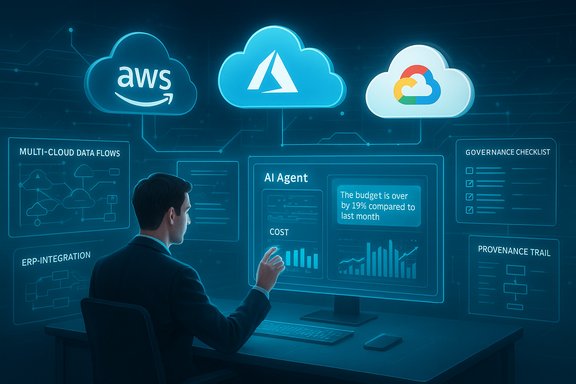 Background / Overview
Cloud adoption in finance has matured beyond lift-and-shift projects. Today's finance teams are asking for three distinct capabilities from cloud partners:- proactive cost intelligence that maps technical usage into business metrics;
- audit-grade governance and compliance suitable for regulated reporting; and
- native integrations to the tools finance uses daily (spreadsheets, ERPs, BI, collaboration platforms).
The hyperscalers: what each offers finance teams
Amazon Web Services (AWS)
AWS remains the broadest cloud in terms of service breadth and global regions, making it a go-to choice for organizations that require extreme scale or a wide catalog of managed services. For finance teams, AWS’s advantages include:- extensive cost controls and pricing options (Savings Plans, Reserved Instances, Spot Instances) to tune long‑term commitments vs. flexibility;
- mature analytics services (Redshift, Athena) and a robust marketplace of third‑party FinOps tools.
Microsoft Azure
Azure’s positioning is uniquely attractive to finance teams operating in Microsoft-centric shops. Dynamics 365 Finance, Excel, Power BI and Microsoft 365 are tightly integrated with Azure platform services, making governance, identity, and workflow automation simpler to manage. The recent trend of embedding finance-focused AI agents inside Microsoft productivity surfaces emphasizes a platform play: vendors like OneStream are integrating finance-aware agents directly into Copilot, Teams and Excel, and running them on Azure to reduce friction for CFOs and FP&A teams. This deep integration shortens the path from data to decision and can speed adoption across finance teams. Azure’s strengths:- native identity and compliance integration (Entra ID, Sentinel) that simplifies audit and traceability for finance;
- a strong go-to-market with enterprise licensing and procurement vehicles that can tie Copilot seats to cloud consumption.
Google Cloud Platform (GCP)
GCP has earned a reputation among data-first finance teams for BigQuery and analytics primitives that simplify large-scale financial modeling, scenario analysis and forecasting. For finance teams that prioritize data engineering and analytics-first workflows, BigQuery’s separation of storage and compute and fast SQL analytics make it a compelling backend for cash forecasting, scenario simulations and rolling forecasts. Google’s tooling for data pipelines and ML accelerates adoption of predictive analytics in FP&A.Oracle Cloud and Others
Oracle’s cloud portfolio is particularly relevant where organizations already run Oracle ERP and NetSuite. Oracle Fusion Cloud ERP and NetSuite continue to be primary ERP plays for finance, offering cloud-native financial suites that reduce integration complexity for accounting and statutory reporting. SAP S/4HANA Cloud remains the standard for many large enterprises with complex manufacturing and supply chains. The practical choice often comes down to existing application footprints and the team’s ability to manage upgrades and integration workstreams. Independent comparisons show the market remains diverse — no single ERP dominates all use cases — and selection should be based on data gravity, compliance needs, and vendor roadmap fit.FinOps and cloud-cost platforms: where finance gets visibility and control
Finance teams cannot manage what they do not measure. This is the core premise behind the growing FinOps ecosystem — vendors that translate meter-level cloud usage into financial views that matter to CFOs.Who to consider in 2025 (representative list)
- Apptio (Cloudability): Strong at cost allocation, chargeback/showback models, and enterprise-grade financial mapping. Well-suited for organizations that need robust allocation frameworks and cross-team cost accountability.
- CloudHealth by VMware: Good for governance, rightsizing recommendations and cross-cloud reporting in multi-cloud estates.
- ProsperOps: Emerging as an autonomous FinOps vendor that automates committed-purchase decisions and claims significant customer savings; their ADM (Autonomous Discount Management) and Scheduler capabilities show how procurement and engineering schedules can be coupled to improve discount outcomes. Note: savings figures are vendor-reported and deserve validation in pilots.
- Kubecost, CloudZero, Harness, Spot (NetApp): These vendors address Kubernetes, CI/CD and spot-instance optimization, which are especially relevant for engineering-led workloads that still need finance oversight.
- Newer AI-driven tools (CloudPilot AI, CAST AI, Densify): Aim to combine workload scheduling, predictive spot handling and AI-based rightsizing to unlock savings that traditional rule-based tools might miss. These are particularly valuable for cloud-native, containerized deployments.
What finance teams should know about vendor claims
Vendor-reported savings (for example, cumulative savings claims or percentage reductions) are common in marketing materials. These figures are useful directional signals but should be treated with caution unless backed by independent audits or validated via pilot programs. Robust procurements ask for historical customer case studies, audit logs, and conservative ROI models that account for implementation and governance costs.Cloud-native ERP and finance platforms: moving beyond spreadsheets
Modern finance stacks are converging around cloud-native ERPs and finance management platforms that reduce manual reconciliations and embedded data silos. Important platforms to evaluate:Oracle Fusion Cloud ERP & NetSuite
Oracle offers both NetSuite (cloud-native, popular with mid-market) and Oracle Fusion Cloud ERP (for larger enterprises), giving it a broad ERP portfolio. These suites simplify financial close, statutory reporting, and intercompany eliminations while providing pre-built integrations for tax and banking. NetSuite’s cloud-only architecture ensures a single version of the product across customers, which simplifies upgrades.SAP S/4HANA Cloud
SAP targets large enterprises with complex operations. S/4HANA Cloud is the route to modernizing finance in organizations with heavy supply chain and manufacturing dependencies. Migration complexity and upgrade cycles should be planned carefully because of the high customization some organizations require.Microsoft Dynamics 365 Finance
Dynamics 365 Finance benefits teams heavily invested in Microsoft stacks. It pairs tightly with Microsoft governance, identity and productivity tooling, and may shorten time-to-value when used alongside Azure and Power Platform services. However, some features still require partner integrations and Dynamics 365 can have multiple codebase origins that complicate large-scale upgrades.Finance-first platforms: OneStream and the rise of AI agents
OneStream positions itself as a finance-centric platform that unifies consolidations, planning and reporting. In 2025 OneStream announced deeper integration of its SensibleAI Agents into Microsoft 365 and Azure — a real sign of the next phase: embedding explainable, auditable AI inside tools finance already uses (Excel, Teams, Copilot). This model aims to reduce the friction between FP&A analysis and final reporting by keeping analytics in context and enhancing provenance. While promising, these agent-driven workflows must meet auditors’ expectations for traceability and reproducibility before they can be relied on for statutory reporting.Multi-cloud budgeting and governance: practical patterns
Finance teams increasingly adopt a multi-cloud stance to avoid over-dependence on a single provider or to optimize for specialized workloads (e.g., Google BigQuery for analytics, Azure for Microsoft-first workloads, AWS for global scale). That approach introduces governance complexity that must be managed with disciplined practices.Core controls finance should require
- Unified tagging and cost-centre mapping enforced at provisioning. Tags feed chargeback/showback and must be non-optional.
- Centralized budgeting and reserved capacity planning: tie budget approvals to commitment purchases like Savings Plans and Reserved Instances.
- Per-request telemetry and immutable logs for any AI agent actions that modify financial models or produce reporting outputs — auditors will require proof of inputs, outputs and approvals.
Recommended implementation steps
- Inventory: map where data "lives" (ERP, ledger, raw telemetry) and identify regulatory constraints (data residency, retention).
- Pilot: choose a measurable use case (monthly close automation, cloud spend forecast) and instrument it end-to-end for accuracy and auditability.
- Implement FinOps toolchain: adopt a cost platform that supports your primary cloud providers and provides allocation and forecast features.
- Govern: create cross-functional runbooks for procurement, engineering and finance sign-offs that include escalation paths for unexpected overages.
The role of AI and finance agents — promise and prudence
AI is rapidly moving from a novelty into embedded assistance for finance teams. Two trends are particularly significant:- Agentification of productivity flows — vendors embed domain-aware agents into Copilot/Teams/Excel to answer finance queries, run scenario analysis, or even apply reconciliations within the workbook context.
- Model provenance and auditability — vendors are racing to add cell-level explanations, tracked edits, and immutable logs to make agent outputs auditable for finance use.
Regulatory and operational risks finance teams must plan for
Increasing regulator attention
Regulators are explicitly focusing on large technology providers that support the financial sector. European regulators in 2025 designated major cloud and technology companies as "critical" third-party providers under financial operational resilience frameworks, meaning these vendors face direct supervision and stricter operational expectations. For finance teams, this increases the importance of vendor risk assessments, contractual SLAs, and clear incident response playbooks.Common risks and mitigation
- Vendor lock-in: mitigate by designing portability into data exports, using open formats and isolating business logic from provider-specific managed services.
- Uncontrolled spend: institute tagging, automated budget alerts, and commit-to-usage policies with periodic reviews.
- Auditability gaps from AI outputs: require immutable logs, pre-flight approvals and test/validation datasets for any automated financial output.
- Data residency and privacy: map workloads to regions and verify that DPA and encryption standards meet statutory obligations.
How to choose the best cloud partner and FinOps stack for your finance team
Decision criteria (ranked)
- Data gravity and ERP footprint: if your core financial ledgers run on Oracle or SAP, evaluate their cloud ERP options first.
- Integration to productivity tools: if Excel/Teams are dominant, favor platforms with tight Microsoft integrations to reduce context switching.
- Regulatory posture and geography: choose vendors with local data centers or explicit sovereign offerings if data residency is required.
- Cost transparency and FinOps maturity: shortlist vendors that integrate with mature FinOps platforms or offer first‑party cost management features.
- AI governance capabilities: ensure any vendor roadmap includes explainability, provenance and audit trails for automated outputs.
Recommended procurement checklist
- Request a joint architecture review with finance, engineering and procurement stakeholders.
- Ask for sample audit logs or redacted telemetry to evaluate traceability.
- Run a 90-day pilot on a narrow but meaningful use case (e.g., cloud spend forecasting or automated reconciliations).
- Negotiate exit and data-extract terms up front; preserve the ability to export data and models in portable formats.
Quick vendor guide: strengths & suggested use cases
- AWS: Best for global scale, breadth of AI/ML services, and specialized compute. Use for high-performance analytics or multi-region architectures.
- Azure: Best where Microsoft productivity and ERP integration matter; strong for identity, compliance and embedded Copilot scenarios.
- GCP: Best for analytics-first finance teams who need BigQuery-scale SQL analytics and ML tooling.
- Oracle / NetSuite / SAP: Choose based on existing ERP investments; these vendors reduce reconciliation work when your ledgers and statutory reporting already sit with them.
- Apptio / CloudHealth / ProsperOps / CloudZero / Kubecost: Deploy as your FinOps backbone to translate cloud usage into chargebacks, budgets and audit-ready reports. Validate vendor savings claims in a pilot and require conservative ROI estimates.
Practical roadmap for finance teams (12–18 months)
- Baseline and tag (0–3 months)
- Build an authoritative inventory of cloud assets.
- Enforce tagging policy mapped to cost centers.
- Pilot FinOps and one cloud-native ERP integration (3–6 months)
- Run a FinOps tool in parallel to validate cost allocation and forecast models.
- Pilot a cloud-native ERP function (e.g., automated intercompany reconciliations).
- Governance and AI controls (6–12 months)
- Implement immutable logging for any AI-driven financial actions.
- Codify review and approval workflows for agent-suggested changes.
- Scale and optimize (12–18 months)
- Expand FinOps across clouds, negotiate commitment discounts informed by tool outputs.
- Move production financial close and reporting workflows to cloud-hosted, auditable platforms.
Strengths and strategic upside
- Speed to decision: Cloud + FinOps + embedded AI reduces time from insight to action.
- Cost discipline: Automation and better procurement for committed discounts reduce waste.
- Modernized workflows: Agent-enabled Excel and Teams integrations keep finance teams in familiar tools while raising productivity.
- Resilience and compliance: Hyperscalers’ enterprise-grade security stacks and emerging regulator supervision improve operational resilience for regulated financial workloads.
Potential risks and blind spots
- Over-reliance on vendor claims: savings and performance numbers must be validated.
- Governance gaps with AI agents: without audit-grade telemetry, agent outputs are risky for statutory filings.
- Skill gaps and operational overhead: multi-cloud and data engineering demands require investment in skills and FinOps staffing.
- Regulatory complexity: design, contracts and controls must be aligned to jurisdictional requirements; regulatory scrutiny of cloud providers is rising.
Conclusion
Finance teams that treat cloud adoption as a financial modernization program — not merely an infrastructure migration — will capture the most value. The right technology partner in 2025 is not just the cloud provider with the largest data center footprint but the one that delivers: clear cost transparency, native fit with finance workflows, enterprise-grade governance, and a credible roadmap for auditable AI. Combine a hyperscaler choice that aligns with your ERP and productivity footprint, a FinOps platform validated through pilots, and strict governance for AI-driven workflows, and finance moves from reactive bill payer to strategic business partner.This is a practical era: vendor roadmaps promise automation, but achieving reliable cost control and audit-grade AI requires deliberate pilots, evidence-based procurement, and cross-functional governance. Finance teams that institutionalize FinOps, enforce tagging and accountability, and insist on provenance for AI outputs will be the ones to turn cloud investments into measurable strategic advantage.
Source: analyticsinsight.net Best Cloud Technology Providers for Finance Teams in 2025
