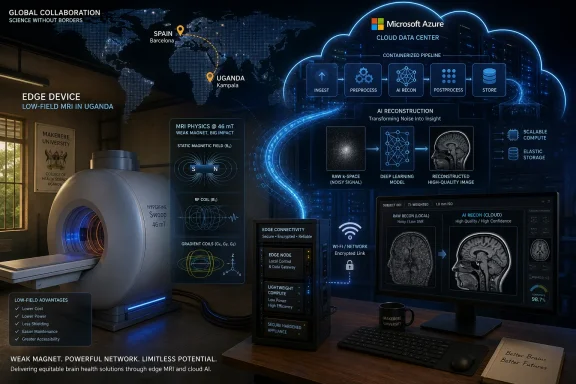
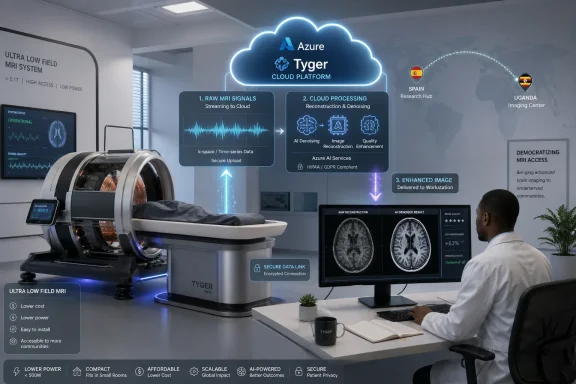
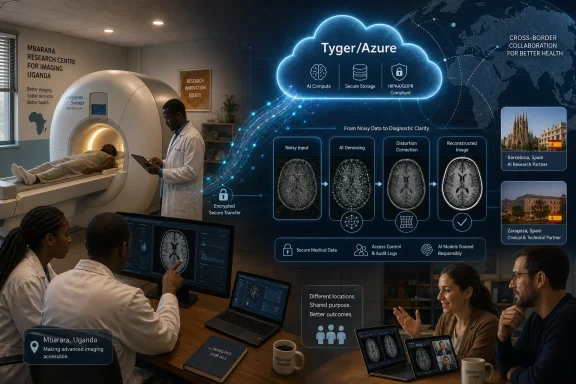
Researchers at Spain’s Institute of Instrumentation for Molecular Imaging and Uganda’s Mbarara University of Science and Technology are using Microsoft Research’s Tyger cloud platform in 2026 to reconstruct and clean up MRI scans from a low-cost scanner in Mbarara, Uganda. The point is not that Azure has magically turned a cheap magnet into a top-end hospital machine. It is that Microsoft and its academic partners are testing a more disruptive idea: move the most expensive intelligence in MRI away from the room where the patient lies. If that model survives the jump from research validation to clinical use, it could redraw the map of who gets access to diagnostic imaging.
MRI has always been a triumph of physics wrapped in a brutally expensive procurement problem. A conventional hospital scanner is not just a machine; it is an ecosystem of superconducting magnets, helium cooling, shielding, power stability, service contracts, trained operators, and radiology workflows. That ecosystem works brilliantly in wealthy medical centers and collapses quickly in places where capital budgets, maintenance pipelines, and infrastructure are thin.
Tyger attacks that problem from an angle familiar to anyone who has watched computing migrate from local hardware to remote platforms. The scanner captures raw signals. The cloud performs the heavy reconstruction. AI-assisted denoising and correction methods improve what comes back.
That sounds almost too neat, and in medicine neat stories deserve suspicion. But the Uganda project is compelling precisely because it starts with the constraint rather than the marketing slogan. The scanner at Mbarara University of Science and Technology is not being presented as a polished clinical device ready for mass deployment. It is a low-field research system whose value depends on whether software, networking, and local engineering skill can compensate for the limits of cheap hardware.
The broader thesis is more important than the demo. For decades, better MRI has usually meant stronger magnets and more specialized infrastructure. Tyger suggests another path: lower the burden on the device itself and shift reconstruction into a shared computational layer that researchers can improve continuously. In places where the traditional MRI stack has never been economically realistic, that inversion matters.
The drawback is just as obvious to physicists and radiologists. A weaker magnetic field produces a weaker signal, and a weaker signal makes images noisy, blurry, and harder to trust. In diagnostic medicine, “almost clear enough” is not a category clinicians can safely build around.
That is why this project should not be read as Microsoft claiming that cloud software eliminates the physics of MRI. It does not. Low-field imaging remains a compromise, and the question is whether the compromise can be pushed far enough for specific medical needs in specific settings.
In Uganda, the practical barrier is not academic. If the nearest MRI scanner is hundreds of kilometres away, the alternative to a lower-quality local scan may not be a high-quality scan. It may be no scan at all. That is the uncomfortable baseline against which low-cost imaging has to be judged.
The Microsoft Research account describes the Mbarara system as able to capture signals but limited by the quality and speed of local reconstruction. That distinction is crucial. The bottleneck was not only the magnet; it was the computing and reconstruction pipeline around the magnet. Tyger’s bet is that this is the part of the system most ready to be externalized.
The model reframes the scanner as a signal-capture instrument rather than a self-contained imaging appliance. That is a subtle but radical shift. The scanner does not need to carry every algorithm, every software update, and every compute-heavy experiment inside the local installation.
Microsoft Research has also tied Tyger to denoising work such as SNRAware, a model designed to improve noisy MRI signals. In the low-field context, denoising is not cosmetic. It is part of the difference between a research curiosity and an image a trained reader can interpret with some confidence.
The practical benefit for researchers is speed. Instead of rewriting software on a constrained local system, teams can test reconstruction approaches in the cloud and iterate quickly. That matters in a lab in Redmond or Valencia, but it matters even more in Mbarara, where every local hardware dependency can become a maintenance and training burden.
This is also where Microsoft’s role becomes commercially and politically interesting. Tyger is open source, but the Uganda workflow described by Microsoft uses Azure. The open framework lowers the barrier to experimentation; the cloud platform supplies the scalable compute. That combination is powerful, but it also means the long-term governance of medical infrastructure cannot be separated from cloud dependence.
In parts of East Africa, the distance to advanced imaging can turn diagnosis into a logistical ordeal. For conditions such as stroke, traumatic brain injury, tumors, and hydrocephalus, delays are not merely inconvenient. They can determine whether treatment happens early enough to matter.
Hydrocephalus is especially relevant because it has long been a major neurosurgical concern in East Africa, particularly among infants. Diagnosing and managing fluid buildup in the brain requires imaging that can guide decisions. When imaging is geographically or financially unreachable, families and clinicians are left with late presentation and narrower treatment options.
The Mbarara project therefore sits at the intersection of engineering and health equity. The scanner is not valuable because it resembles the machines in wealthy hospitals. It is valuable if it can answer clinically meaningful questions in places where wealthy-hospital infrastructure will not arrive soon.
That is why the reported progress from partial head imaging to full-head acquisitions matters. It is not the same as clinical validation. But in a field where capability is built incrementally — signal quality, reconstruction, operator training, anatomical coverage, workflow reliability — it is a concrete step rather than a press-release abstraction.
Microsoft’s own reporting acknowledges that data can travel over less-than-ideal networks. In research, that may be tolerable. In clinical operations, unreliable connectivity can become the difference between a useful imaging service and a machine that works only when the network cooperates.
There is a second issue: medical data governance. Streaming raw imaging data to cloud infrastructure raises questions about patient consent, jurisdiction, storage, auditability, and health-ministry oversight. Those questions are solvable, but they are not optional.
The most optimistic reading is that cloud reconstruction allows low-resource settings to leapfrog a generation of local infrastructure. The more cautious reading is that it exchanges one kind of dependence for another. Instead of depending on imported high-end MRI hardware and specialist maintenance, clinics may depend on cloud availability, platform policy, and cross-border data arrangements.
Neither reading cancels the other. The same architecture can be liberating in one context and constraining in another. The difference will come down to implementation: local control, transparent software, regulatory approval, cost predictability, and whether national health systems can negotiate cloud use on their own terms.
The Mbarara collaboration appears to understand this. The project is not only about sending scanner data to Azure; it is also about training students, engineers, medical workers, and local researchers in MRI technology, electronics, signal processing, and reconstruction. That is the difference between “bringing technology to Uganda” and helping build a Ugandan MRI knowledge base.
Still, open source does not automatically solve sustainability. A framework can be open while the practical deployment depends on proprietary cloud services, specialized expertise, or grant-funded support. The software license matters, but so do documentation, community, maintainership, hardware availability, and procurement pathways.
The best version of this project would not be a fleet of Microsoft-dependent scanners dropped into low-income health systems. It would be an ecosystem in which universities, hospitals, ministries, and local engineers can adapt low-field MRI platforms to local constraints while using cloud resources where they make sense.
That is a harder story to sell than “AI fixes MRI.” It is also the only story that has a chance of being durable.
That matters because global tech companies often speak about emerging markets in two registers: as growth opportunities or as social-impact theaters. The Uganda MRI work is more interesting because it is technically specific. It does not claim that generic AI will improve healthcare. It identifies a precise bottleneck — reconstruction from low-field MRI data — and applies cloud compute to that bottleneck.
It also aligns with a broader pattern in Microsoft’s research portfolio. The company has increasingly treated the cloud not merely as enterprise infrastructure but as a scientific instrument. Azure becomes a place where genomics, materials science, climate models, medical imaging, and AI methods can be run by institutions that could not build equivalent computing environments locally.
There is a strategic benefit for Microsoft, of course. Every compelling research use case strengthens the case for cloud platforms in public-sector and health-sector modernization. It would be naïve to ignore that. But it would be equally naïve to dismiss the technical contribution because it sits inside a corporate cloud strategy.
The uncomfortable truth is that many meaningful health technologies now require both public-interest research and industrial-scale compute. The policy challenge is to make sure the second does not swallow the first.
That distinction should be held firmly. In medical imaging, a clearer picture in a research setting is not the same as a diagnostic standard. Radiologists and clinicians need to know what the system can detect, what it misses, how it behaves across patient groups, and how often reconstruction artifacts might mislead interpretation.
The low-field context makes validation especially important. If a system is intended for stroke triage, hydrocephalus assessment, or traumatic injury evaluation, each use case has different requirements. A scan that is useful for one anatomical or clinical question may not be adequate for another.
There is also the matter of who reads the images. Better reconstruction does not eliminate the shortage of radiologists. It may shift the burden by producing images in places where specialist interpretation is scarce. That could invite teleradiology, AI triage, or new training models, but each of those carries its own governance and quality-control problems.
In other words, Tyger can help make imaging possible. It cannot by itself create a functioning diagnostic system. That system includes clinicians, referral pathways, patient records, maintenance, regulation, reimbursement, and accountability.
That has implications beyond Uganda. If reconstruction can be updated remotely, tested quickly, and shared across sites, MRI research becomes less tied to bespoke local installations. Low-field projects in different countries could compare methods, reproduce improvements, and build on a common framework.
For high-end scanners, remote reconstruction may improve prototyping and workflow. For low-field scanners, it may be existential. A cheap scanner without strong reconstruction may be little more than an engineering demonstration. A cheap scanner connected to a robust reconstruction ecosystem becomes a candidate for real deployment.
This is why Microsoft Research’s framing of Tyger as a way to scale reconstruction is apt. The system does not simply make one scanner better. It proposes a reusable pattern: collect data where the patient is, process it where the compute is, and return a clinically useful image.
That pattern is not unique to MRI. It echoes what has happened in other fields where edge devices gather imperfect signals and cloud systems refine them. The difference is that medicine raises the stakes. A bad reconstruction is not a blurry vacation photo. It can affect diagnosis, treatment, and trust.
Imported medical technology often fails quietly when maintenance becomes impossible. A machine arrives, works for a while, breaks, and waits for parts, expertise, or a service contract that the local institution cannot access quickly. In that pattern, the technology is present but not truly owned.
The Mbarara model points in a different direction. If local engineers understand the scanner, local researchers understand reconstruction, and local clinicians understand the limits of the images, the technology becomes part of an institutional learning process. That is slower than procurement, but it is more resilient.
The involvement of I3M in Spain also matters because it gives the project an academic bridge rather than a purely corporate one. International collaboration can still reproduce dependency, but it can also transfer tacit knowledge that documentation alone cannot. The key is whether Ugandan teams gain enough autonomy to modify, repair, teach, and eventually lead.
That is where the project’s educational ambitions may prove as important as its imaging milestones. A full-head scan is newsworthy. A generation of engineers who can build and improve low-cost imaging systems is the deeper prize.
The international dimension complicates matters. A scanner in Uganda, researchers in Spain, cloud infrastructure operated by Microsoft, and possible routing through multiple regions create a governance problem that cannot be waved away with standard privacy language. Even when data is encrypted and access-controlled, responsibility must be explicit.
There is also a sovereignty question. Low-resource health systems should not have to choose between no imaging and opaque data export. If cloud reconstruction becomes part of national healthcare infrastructure, ministries will need leverage over hosting regions, audit requirements, disaster recovery, pricing, and exit options.
Microsoft can help by making the technical architecture transparent and by supporting deployments that respect local data rules. But the company cannot be the only author of the governance model. Public health authorities, hospitals, ethics boards, clinicians, and patient advocates will need a voice.
This is not a reason to stop the work. It is a reason to design the next phase with governance built in rather than bolted on. The history of digital health is littered with tools that worked technically and failed institutionally.
That middle tier could be important for district hospitals, regional clinics, mobile units, teaching institutions, and humanitarian settings. The device would not need to perform every exam. It would need to perform enough useful exams reliably, safely, and affordably.
The economics would look different from conventional MRI. Instead of one large capital purchase plus expensive infrastructure, health systems might face a combination of lower-cost hardware, network requirements, cloud processing fees, service support, and training. That could be better, but only if total cost remains predictable.
There is also a danger that “affordable MRI” becomes a euphemism for second-tier medicine. The standard should not be that poorer patients get whatever image the cheap machine can produce. The standard should be clinical appropriateness: use low-field systems where evidence shows they are useful, and preserve referral pathways where higher-field imaging is necessary.
That distinction will matter as the technology is marketed. A democratizing tool can quickly become a cost-cutting excuse if deployed without clinical guardrails. The point is to expand access, not to normalize inferior care.
That does not make the system ready for routine diagnosis. It does make the old assumption — that useful MRI must always arrive as a large, expensive, self-contained machine — look less inevitable.
The concrete takeaways are narrower than the slogan, and stronger because of it.
 Microsoft Moves the MRI’s Brain Out of the Scanner Room
MRI has always been a triumph of physics wrapped in a brutally expensive procurement problem. A conventional hospital scanner is not just a machine; it is an ecosystem of superconducting magnets, helium cooling, shielding, power stability, service contracts, trained operators, and radiology workflows. That ecosystem works brilliantly in wealthy medical centers and collapses quickly in places where capital budgets, maintenance pipelines, and infrastructure are thin.Tyger attacks that problem from an angle familiar to anyone who has watched computing migrate from local hardware to remote platforms. The scanner captures raw signals. The cloud performs the heavy reconstruction. AI-assisted denoising and correction methods improve what comes back.
That sounds almost too neat, and in medicine neat stories deserve suspicion. But the Uganda project is compelling precisely because it starts with the constraint rather than the marketing slogan. The scanner at Mbarara University of Science and Technology is not being presented as a polished clinical device ready for mass deployment. It is a low-field research system whose value depends on whether software, networking, and local engineering skill can compensate for the limits of cheap hardware.
The broader thesis is more important than the demo. For decades, better MRI has usually meant stronger magnets and more specialized infrastructure. Tyger suggests another path: lower the burden on the device itself and shift reconstruction into a shared computational layer that researchers can improve continuously. In places where the traditional MRI stack has never been economically realistic, that inversion matters.
Low-Field MRI Is Cheap Because It Gives Up Signal
The attraction of ultra-low-field MRI is obvious. Weaker magnets are smaller, cheaper, easier to install, and less demanding to operate. They do not require the same elaborate cryogenic systems or shielded facilities that make conventional scanners so costly to buy and maintain.The drawback is just as obvious to physicists and radiologists. A weaker magnetic field produces a weaker signal, and a weaker signal makes images noisy, blurry, and harder to trust. In diagnostic medicine, “almost clear enough” is not a category clinicians can safely build around.
That is why this project should not be read as Microsoft claiming that cloud software eliminates the physics of MRI. It does not. Low-field imaging remains a compromise, and the question is whether the compromise can be pushed far enough for specific medical needs in specific settings.
In Uganda, the practical barrier is not academic. If the nearest MRI scanner is hundreds of kilometres away, the alternative to a lower-quality local scan may not be a high-quality scan. It may be no scan at all. That is the uncomfortable baseline against which low-cost imaging has to be judged.
The Microsoft Research account describes the Mbarara system as able to capture signals but limited by the quality and speed of local reconstruction. That distinction is crucial. The bottleneck was not only the magnet; it was the computing and reconstruction pipeline around the magnet. Tyger’s bet is that this is the part of the system most ready to be externalized.
Tyger Turns Reconstruction Into a Cloud Service
Tyger is an open-source framework from Microsoft Research for remote signal processing, with MRI reconstruction as one of its most visible applications. In the Uganda collaboration, raw data from the scanner is streamed to Azure, where reconstruction, distortion correction, and AI-based denoising can run with far more compute than the local machine can reasonably provide.The model reframes the scanner as a signal-capture instrument rather than a self-contained imaging appliance. That is a subtle but radical shift. The scanner does not need to carry every algorithm, every software update, and every compute-heavy experiment inside the local installation.
Microsoft Research has also tied Tyger to denoising work such as SNRAware, a model designed to improve noisy MRI signals. In the low-field context, denoising is not cosmetic. It is part of the difference between a research curiosity and an image a trained reader can interpret with some confidence.
The practical benefit for researchers is speed. Instead of rewriting software on a constrained local system, teams can test reconstruction approaches in the cloud and iterate quickly. That matters in a lab in Redmond or Valencia, but it matters even more in Mbarara, where every local hardware dependency can become a maintenance and training burden.
This is also where Microsoft’s role becomes commercially and politically interesting. Tyger is open source, but the Uganda workflow described by Microsoft uses Azure. The open framework lowers the barrier to experimentation; the cloud platform supplies the scalable compute. That combination is powerful, but it also means the long-term governance of medical infrastructure cannot be separated from cloud dependence.
Uganda Is the Test Case Because the Usual MRI Economics Fail There
The Uganda setting is not incidental. It is the argument. Conventional MRI economics assume a health system can absorb high capital costs, maintain specialized infrastructure, and distribute patients across a network of imaging centers. Many regions cannot.In parts of East Africa, the distance to advanced imaging can turn diagnosis into a logistical ordeal. For conditions such as stroke, traumatic brain injury, tumors, and hydrocephalus, delays are not merely inconvenient. They can determine whether treatment happens early enough to matter.
Hydrocephalus is especially relevant because it has long been a major neurosurgical concern in East Africa, particularly among infants. Diagnosing and managing fluid buildup in the brain requires imaging that can guide decisions. When imaging is geographically or financially unreachable, families and clinicians are left with late presentation and narrower treatment options.
The Mbarara project therefore sits at the intersection of engineering and health equity. The scanner is not valuable because it resembles the machines in wealthy hospitals. It is valuable if it can answer clinically meaningful questions in places where wealthy-hospital infrastructure will not arrive soon.
That is why the reported progress from partial head imaging to full-head acquisitions matters. It is not the same as clinical validation. But in a field where capability is built incrementally — signal quality, reconstruction, operator training, anatomical coverage, workflow reliability — it is a concrete step rather than a press-release abstraction.
The Cloud Solves One Bottleneck and Creates Another
The strength of Tyger’s architecture is also its vulnerability. By moving reconstruction into the cloud, the system avoids the need for expensive local computing infrastructure. But it now depends on connectivity, latency, data transfer reliability, cloud cost structures, and trust.Microsoft’s own reporting acknowledges that data can travel over less-than-ideal networks. In research, that may be tolerable. In clinical operations, unreliable connectivity can become the difference between a useful imaging service and a machine that works only when the network cooperates.
There is a second issue: medical data governance. Streaming raw imaging data to cloud infrastructure raises questions about patient consent, jurisdiction, storage, auditability, and health-ministry oversight. Those questions are solvable, but they are not optional.
The most optimistic reading is that cloud reconstruction allows low-resource settings to leapfrog a generation of local infrastructure. The more cautious reading is that it exchanges one kind of dependence for another. Instead of depending on imported high-end MRI hardware and specialist maintenance, clinics may depend on cloud availability, platform policy, and cross-border data arrangements.
Neither reading cancels the other. The same architecture can be liberating in one context and constraining in another. The difference will come down to implementation: local control, transparent software, regulatory approval, cost predictability, and whether national health systems can negotiate cloud use on their own terms.
Open Source Matters, But It Is Not a Magic Word
Microsoft’s decision to position Tyger as open source is not a footnote. In global health technology, openness can determine whether a project becomes local capability or remains a vendor demonstration. If researchers can inspect, adapt, and build on the framework, the work has a better chance of surviving beyond the original partnership.The Mbarara collaboration appears to understand this. The project is not only about sending scanner data to Azure; it is also about training students, engineers, medical workers, and local researchers in MRI technology, electronics, signal processing, and reconstruction. That is the difference between “bringing technology to Uganda” and helping build a Ugandan MRI knowledge base.
Still, open source does not automatically solve sustainability. A framework can be open while the practical deployment depends on proprietary cloud services, specialized expertise, or grant-funded support. The software license matters, but so do documentation, community, maintainership, hardware availability, and procurement pathways.
The best version of this project would not be a fleet of Microsoft-dependent scanners dropped into low-income health systems. It would be an ecosystem in which universities, hospitals, ministries, and local engineers can adapt low-field MRI platforms to local constraints while using cloud resources where they make sense.
That is a harder story to sell than “AI fixes MRI.” It is also the only story that has a chance of being durable.
Microsoft’s Africa Research Ambition Gets a Tangible Use Case
Microsoft has spent years framing its African research and development work around local innovation, talent development, and socially useful computing. Tyger in Uganda gives that strategy a concrete artifact. It is not a chatbot pilot or a dashboard; it is a medical imaging pipeline tied to a real scanner, real researchers, and real anatomical images.That matters because global tech companies often speak about emerging markets in two registers: as growth opportunities or as social-impact theaters. The Uganda MRI work is more interesting because it is technically specific. It does not claim that generic AI will improve healthcare. It identifies a precise bottleneck — reconstruction from low-field MRI data — and applies cloud compute to that bottleneck.
It also aligns with a broader pattern in Microsoft’s research portfolio. The company has increasingly treated the cloud not merely as enterprise infrastructure but as a scientific instrument. Azure becomes a place where genomics, materials science, climate models, medical imaging, and AI methods can be run by institutions that could not build equivalent computing environments locally.
There is a strategic benefit for Microsoft, of course. Every compelling research use case strengthens the case for cloud platforms in public-sector and health-sector modernization. It would be naïve to ignore that. But it would be equally naïve to dismiss the technical contribution because it sits inside a corporate cloud strategy.
The uncomfortable truth is that many meaningful health technologies now require both public-interest research and industrial-scale compute. The policy challenge is to make sure the second does not swallow the first.
The Research Milestone Is Not Yet a Clinical Product
The strongest caveat is the simplest: this is still research. The scans being produced are part of validation and development, not a routine clinical service. Before low-field, cloud-reconstructed MRI can guide patient care, it will need regulatory review, clinical evidence, safety processes, and integration into medical workflows.That distinction should be held firmly. In medical imaging, a clearer picture in a research setting is not the same as a diagnostic standard. Radiologists and clinicians need to know what the system can detect, what it misses, how it behaves across patient groups, and how often reconstruction artifacts might mislead interpretation.
The low-field context makes validation especially important. If a system is intended for stroke triage, hydrocephalus assessment, or traumatic injury evaluation, each use case has different requirements. A scan that is useful for one anatomical or clinical question may not be adequate for another.
There is also the matter of who reads the images. Better reconstruction does not eliminate the shortage of radiologists. It may shift the burden by producing images in places where specialist interpretation is scarce. That could invite teleradiology, AI triage, or new training models, but each of those carries its own governance and quality-control problems.
In other words, Tyger can help make imaging possible. It cannot by itself create a functioning diagnostic system. That system includes clinicians, referral pathways, patient records, maintenance, regulation, reimbursement, and accountability.
The Real Breakthrough Is Architectural, Not Algorithmic
The temptation is to focus on the AI denoising, because AI is the fashionable part. But the more consequential breakthrough is architectural. Tyger separates acquisition from reconstruction in a way that makes the scanner less isolated and the imaging pipeline more programmable.That has implications beyond Uganda. If reconstruction can be updated remotely, tested quickly, and shared across sites, MRI research becomes less tied to bespoke local installations. Low-field projects in different countries could compare methods, reproduce improvements, and build on a common framework.
For high-end scanners, remote reconstruction may improve prototyping and workflow. For low-field scanners, it may be existential. A cheap scanner without strong reconstruction may be little more than an engineering demonstration. A cheap scanner connected to a robust reconstruction ecosystem becomes a candidate for real deployment.
This is why Microsoft Research’s framing of Tyger as a way to scale reconstruction is apt. The system does not simply make one scanner better. It proposes a reusable pattern: collect data where the patient is, process it where the compute is, and return a clinically useful image.
That pattern is not unique to MRI. It echoes what has happened in other fields where edge devices gather imperfect signals and cloud systems refine them. The difference is that medicine raises the stakes. A bad reconstruction is not a blurry vacation photo. It can affect diagnosis, treatment, and trust.
The Scanner Becomes a Training Ground, Not Just a Machine
One of the most promising parts of the Mbarara work is the skills pipeline around it. Students and local healthcare workers are reportedly learning the electronics, software, signal processing, and practical operation behind MRI. That is not a side benefit. It is the mechanism by which the project can become locally meaningful.Imported medical technology often fails quietly when maintenance becomes impossible. A machine arrives, works for a while, breaks, and waits for parts, expertise, or a service contract that the local institution cannot access quickly. In that pattern, the technology is present but not truly owned.
The Mbarara model points in a different direction. If local engineers understand the scanner, local researchers understand reconstruction, and local clinicians understand the limits of the images, the technology becomes part of an institutional learning process. That is slower than procurement, but it is more resilient.
The involvement of I3M in Spain also matters because it gives the project an academic bridge rather than a purely corporate one. International collaboration can still reproduce dependency, but it can also transfer tacit knowledge that documentation alone cannot. The key is whether Ugandan teams gain enough autonomy to modify, repair, teach, and eventually lead.
That is where the project’s educational ambitions may prove as important as its imaging milestones. A full-head scan is newsworthy. A generation of engineers who can build and improve low-cost imaging systems is the deeper prize.
The Privacy Debate Will Arrive Before the Clinical Rollout
If Tyger-like systems move toward clinical use, data protection will become a front-line issue. MRI data is sensitive, and raw imaging data may carry more information than patients realize. Health systems will need clear rules about what leaves the scanner site, where it is processed, how long it is stored, and who can access it.The international dimension complicates matters. A scanner in Uganda, researchers in Spain, cloud infrastructure operated by Microsoft, and possible routing through multiple regions create a governance problem that cannot be waved away with standard privacy language. Even when data is encrypted and access-controlled, responsibility must be explicit.
There is also a sovereignty question. Low-resource health systems should not have to choose between no imaging and opaque data export. If cloud reconstruction becomes part of national healthcare infrastructure, ministries will need leverage over hosting regions, audit requirements, disaster recovery, pricing, and exit options.
Microsoft can help by making the technical architecture transparent and by supporting deployments that respect local data rules. But the company cannot be the only author of the governance model. Public health authorities, hospitals, ethics boards, clinicians, and patient advocates will need a voice.
This is not a reason to stop the work. It is a reason to design the next phase with governance built in rather than bolted on. The history of digital health is littered with tools that worked technically and failed institutionally.
The Uganda Experiment Points to a Different MRI Market
If low-field, cloud-reconstructed MRI matures, it could create a market that incumbent imaging vendors have not fully served. The goal would not be to replace top-end hospital scanners. It would be to fill the diagnostic desert between no imaging and million-dollar imaging.That middle tier could be important for district hospitals, regional clinics, mobile units, teaching institutions, and humanitarian settings. The device would not need to perform every exam. It would need to perform enough useful exams reliably, safely, and affordably.
The economics would look different from conventional MRI. Instead of one large capital purchase plus expensive infrastructure, health systems might face a combination of lower-cost hardware, network requirements, cloud processing fees, service support, and training. That could be better, but only if total cost remains predictable.
There is also a danger that “affordable MRI” becomes a euphemism for second-tier medicine. The standard should not be that poorer patients get whatever image the cheap machine can produce. The standard should be clinical appropriateness: use low-field systems where evidence shows they are useful, and preserve referral pathways where higher-field imaging is necessary.
That distinction will matter as the technology is marketed. A democratizing tool can quickly become a cost-cutting excuse if deployed without clinical guardrails. The point is to expand access, not to normalize inferior care.
The Mbarara Signal Is Clearer Than the Hype Around It
The Tyger story is easy to oversell because it sits at the intersection of cloud computing, AI, open source, and global health. The more grounded reading is also the more impressive one. Researchers have taken a low-cost MRI system in a resource-constrained setting and improved the path from raw signal to interpretable image by moving reconstruction into a cloud pipeline.That does not make the system ready for routine diagnosis. It does make the old assumption — that useful MRI must always arrive as a large, expensive, self-contained machine — look less inevitable.
The concrete takeaways are narrower than the slogan, and stronger because of it.
- Tyger shifts compute-heavy MRI reconstruction away from local scanner hardware and into a cloud environment.
- The Uganda collaboration involves Microsoft Research, I3M in Spain, and Mbarara University of Science and Technology.
- The work is especially relevant to ultra-low-field MRI, where cheaper magnets produce weaker and noisier signals.
- The reported progress from partial-head imaging to full-head acquisitions suggests meaningful technical improvement, but not yet clinical deployment.
- The model depends on reliable connectivity, data governance, local training, and regulatory approval before it can safely influence patient care.
- The most durable impact may come from building local MRI expertise as much as from improving any single scan.
References
- Primary source: tech-ish.com
Published: Wed, 10 Jun 2026 11:11:35 GMT
How Microsoft Research's Tyger is Bringing Clearer MRI Scans to Uganda Through the Cloud - Tech-ish
Microsoft Research's Tyger platform helps Ugandan and Spanish researchers turn noisy low-field MRI signals into clear, usable medical images.tech-ish.com - Official source: microsoft.com
When MRI images come into focus: How Tyger scales image reconstruction - Microsoft Research
Tyger moves the most demanding MRI processing to the cloud, helping researchers turn raw signals into readable images – meaning results in hours rather than days or weeks.www.microsoft.com - Official source: news.microsoft.com
- Related coverage: researchgate.net
(PDF) A fully open-source framework for streaming and cloud-processing of low-field MRI data
PDF | Purpose: To present a fully open-source framework for quasi-real-time streaming and cloud-based processing of low-field (LF) MRI data, addressing... | Find, read and cite all the research you need on ResearchGate www.researchgate.net
- Official source: azure.microsoft.com
Open Source on Azure | Microsoft Azure
Discover cloud network security with Azure to protect your organization’s apps and workloads from cyberattacks. Learn about Azure network security services.azure.microsoft.com
- Official source: github.com
GitHub - microsoft/opendatacloud: An Open Source version of the Microsoft Research Open Data Repository · GitHub
An Open Source version of the Microsoft Research Open Data Repository - microsoft/opendatacloud github.com

- Official source: azure-int.microsoft.com
- Official source: download.microsoft.com
- Official source: cdn-dynmedia-1.microsoft.com
The Next Wave of AI Innovation: Microsoft Introduces Azure AI Foundry, A New Unified AI, and GenAI Platform at Ignite 2024
PDF documentcdn-dynmedia-1.microsoft.com