

Quibim launched QP-Breast in Europe and the United Kingdom on July 2, 2026, as a CE- and UKCA-marked artificial intelligence tool that detects suspicious breast-cancer lesions on MRI scans and generates structured reports for radiologists. The announcement is not another generic “AI in healthcare” press release. It is a sign that medical AI is moving from conference demos into regulated imaging workflows where missed findings, false positives, audit trails, and integration pain all matter. For hospitals, the question is no longer whether AI can see a lesion; it is whether AI can be trusted, governed, and maintained inside the clinical machinery that already struggles to keep up.
Breast imaging has always been a high-stakes corner of radiology because it sits at the intersection of population screening, individual anxiety, and expensive follow-up care. Mammography remains the frontline tool in many national programs, but MRI is increasingly important for high-risk patients, dense breast tissue, diagnostic clarification, and pre-treatment assessment. That makes MRI a natural target for AI vendors: the scans are information-rich, the workload is real, and the cost of delay can be human as well as financial.
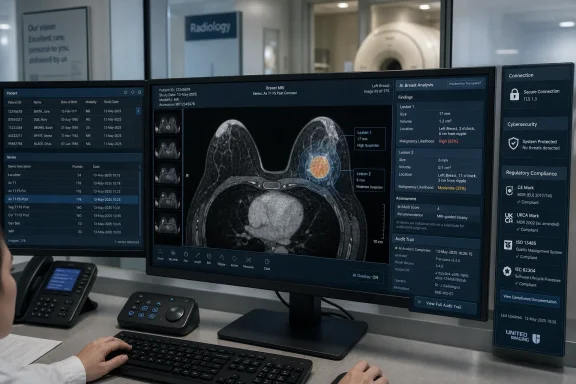
Quibim’s QP-Breast is pitched as a decision-support system rather than a replacement for radiologists. It automatically flags suspicious areas on breast MRI, reports lesion measurements such as size, volume, and location, and assigns a malignancy likelihood for clinicians to consider. The company says the tool can be used for clinically indicated MRI exams in both screening and diagnostic settings.
The language matters. In regulated medicine, “assist” is not a throwaway verb. It defines the boundary between software that supports a licensed professional and software that effectively makes a diagnosis. QP-Breast’s arrival is therefore less a robot-doctor moment than a workflow moment: another layer of machine triage and structured interpretation sliding into the systems radiology departments already use.
That is where the story becomes relevant beyond healthcare trade publications. AI in medicine is not just about models; it is about infrastructure. The winning tools will be those that can survive hospital procurement, cybersecurity review, medical-device regulation, PACS integration, version control, and clinician skepticism.
The regulatory details are more important than the marketing superlative. QP-Breast carries a CE mark under the European Union’s Medical Device Regulation as a Class IIb device and a UKCA mark as a Class IIa device. Those classifications put the product in the serious end of clinical software, not the wellness-app end of the AI economy.
CE and UKCA marks do not prove perfection, and they do not guarantee real-world benefit at every hospital. They indicate conformity with applicable regulatory requirements, including the manufacturer’s evidence, quality systems, and intended use. In practice, they are the ticket that lets a vendor sell into hospitals; clinical adoption still depends on procurement, validation, reimbursement, training, and trust.
This is the first misunderstanding that needs clearing away. A regulated AI medical device is not like a consumer chatbot receiving a model update overnight. Hospitals need to know what changed, whether performance shifted, how errors are logged, and whether the new version still fits the clinical claims that justified deployment in the first place. In medicine, software lifecycle management is patient safety.
That is the practical promise. Faster reads can mean shorter reporting queues. More consistent lesion measurements can mean cleaner follow-up comparisons. Better-structured outputs can make downstream decisions easier for oncology teams, surgeons, and breast units.
But the risk hides in the same place as the benefit. If a tool flags too much, radiologists learn to ignore it. If it flags too little, they will fear relying on it. If it is technically accurate but clumsy inside the reading environment, it becomes another window, another login, another thing to reconcile before signing a report.
Healthcare AI companies often underestimate this last point. Radiology departments are not short on software; they are short on time. A model that adds five minutes of administrative fiddling to save three minutes of image review is not an advance. It is a tax.
The same complexity makes validation harder. Breast MRI protocols can vary by institution, scanner, contrast timing, patient positioning, acquisition parameters, and local clinical practice. A model trained and validated under one set of conditions may perform differently when deployed across a broader mix of hospitals and imaging equipment.
That is why the phrase ground truth deserves scrutiny. Quibim says biopsies were used as ground truth, which is exactly the kind of evidence clinicians want to hear. But real-world breast imaging includes many cases that are not biopsied, many lesions that are followed over time, and many clinical decisions shaped by risk profile and prior imaging rather than a single definitive pathology result.
The challenge for QP-Breast and tools like it is not merely to find cancers in retrospect. It is to behave predictably in the messy middle of clinical care, where some findings are ambiguous, some patients are anxious, some exams are technically imperfect, and every additional biopsy has consequences.
AI could help here if it improves specificity without sacrificing clinically important sensitivity. That is the dream: catching dangerous cancers earlier while reducing avoidable invasive workups. In practice, that balance is difficult, because radiology often operates under the moral pressure of the miss. A false positive is harmful, but a false negative can be devastating.
This is why adoption will depend on more than a headline sensitivity figure. Clinicians will want to know how the system performs across tumor subtypes, breast densities, scanner vendors, age groups, indications, and prior-treatment contexts. Administrators will want to know whether it reduces report turnaround time and downstream costs. Patients will want to know whether it changes the recommendation they receive.
The harsh reality is that an AI tool can increase both cancer detection and workload if it uncovers more indeterminate findings. That may still be clinically worthwhile, but it complicates the simplistic story that AI automatically makes healthcare cheaper.
That wider context matters. Europe and the UK are becoming unusually important proving grounds for regulated medical AI because they combine public-health pressure, large hospital networks, strong data-protection expectations, and formal device regulation. If a tool can make it through those gates and deliver measurable benefits, the evidence can travel.
The UK is especially interesting because the National Health Service has both the incentive and the pain. It faces imaging demand, workforce strain, and political pressure to improve cancer diagnosis timelines. It also has centralized structures that can support large trials and deployments, at least in theory. The same centralization can slow procurement, but once a tool is accepted, the path to scale can be clearer than in fragmented markets.
For IT professionals, this is the part of medical AI worth watching. The story is not “AI detects cancer.” The story is that AI is becoming part of national clinical infrastructure, with all the reliability, security, and governance expectations that phrase implies.
Medical imaging is one of the least forgiving IT environments in the enterprise. Files are large. Workflows are time-sensitive. Systems are old and new at the same time. Some hospitals run modern cloud-connected platforms; others depend on legacy imaging stacks that were never designed for AI inference, automated lesion overlays, or structured outputs from third-party algorithms.
Security also cannot be bolted on afterward. Imaging data is highly sensitive, and AI systems may require movement of DICOM studies, metadata, model outputs, and audit logs across multiple systems. Whether inference happens on-premises, in a private cloud, or through a vendor-hosted service, hospitals will need clarity about data residency, access controls, encryption, logging, retention, and incident response.
Then there is uptime. A radiologist can continue reading without AI if the tool fails, but a half-integrated tool that clinicians come to depend on can still create operational disruption. The more AI becomes embedded in reporting and triage, the more it becomes part of clinical business continuity planning.
That means AI medical-device deployments will increasingly land on the desks of IT teams that do not think of themselves as AI teams. They will be asked to approve clients, agents, viewers, browser integrations, GPU servers, cloud connectors, or DICOM routers. They will be asked to troubleshoot latency that clinicians experience as a patient-care problem. They will be asked to document access for auditors and regulators.
This is the hidden connective tissue between a breast MRI AI launch and the everyday work of sysadmins. The most glamorous part of the system is the model. The least glamorous part is making sure the right result appears in the right place, for the right clinician, at the right time, without exposing patient data or breaking the reading workflow.
AI adoption in hospitals will not look like a single magical platform. It will look like dozens of regulated tools attached to narrow use cases: prostate MRI, breast MRI, stroke detection, lung nodules, brain volumetry, liver quantification, fracture detection, triage queues. Each will arrive with its own vendor portal, integration guide, regulatory documentation, and support contract. The operational burden will accumulate one “assistive” tool at a time.
Hospitals will need to know who is responsible when model performance drifts. They will need processes for reviewing incidents, handling clinician feedback, and deciding whether a software update requires retraining or revalidation. They will need to distinguish between a model that performs poorly and a workflow that causes humans to use a good model badly.
This is where the consumer AI analogy collapses. In a hospital, the user is not merely asking for a better answer. The user is participating in a regulated chain of clinical responsibility. The AI’s output becomes part of a decision environment that may lead to biopsy, treatment, or reassurance.
For vendors, that means the durable advantage may not be raw model performance alone. It may be evidence, monitoring, support, integration, and the ability to explain exactly what the tool is doing without burying clinicians in mathematical fog.
The breast AI market is already active, especially in mammography. Vendors have spent years developing tools for screening mammograms, double-reading support, triage, and risk stratification. MRI is a different modality, and that distinction is the point of Quibim’s claim. Still, buyers will compare the company’s breast strategy against a crowded field of imaging AI offerings.
The deeper issue is whether first matters. In medical technology, being first can help a company shape expectations and gather early customers. But hospitals often prefer mature products with published evidence, stable support, and references from comparable institutions. A “first” product must become a trusted product quickly.
This is particularly true in cancer diagnostics. Clinicians are open to tools that make them faster and more consistent, but they are wary of systems that create unexplained outputs. If QP-Breast earns trust, its launch could mark a shift in MRI-based breast care. If it produces friction or ambiguity, the first-mover label will not save it.
What AI can do is change how radiologists spend their attention. It can surface suspicious regions, automate repetitive measurements, standardize reports, and reduce some forms of visual search burden. In a strained department, that matters.
But re-tasking is not always comfortable. If AI handles the easiest negatives or pre-fills the obvious measurements, radiologists may spend more of their day on complex, ambiguous, emotionally loaded cases. That is clinically valuable work, but it may not feel like a reduction in workload. It may feel like a concentration of difficulty.
Administrators should be honest about this. AI may improve throughput and quality, but it is not a magic staffing substitute. If hospitals deploy it as a way to avoid investing in people, training, and workflow redesign, they will likely be disappointed.
Yet patients also carry the consequences when the infrastructure fails. A false negative can delay treatment. A false positive can trigger a biopsy and weeks of fear. An unclear AI-assisted finding can lead to more imaging, more appointments, and more uncertainty.
That does not argue against adoption. It argues for humility. Breast cancer detection is too important to be left untouched by useful technology, but it is also too important to be transformed by marketing alone. Every deployment should be measured against patient outcomes, not just reading-room efficiency.
Transparency will matter. Patients do not need a lecture on neural networks, but they deserve to know when AI is being used in their care and how responsibility remains with qualified clinicians. Trust is easier to maintain when AI is presented as part of a supervised clinical process rather than a mysterious second opinion from a black box.
 The AI Hype Cycle Has Reached the MRI Reading Room
Breast imaging has always been a high-stakes corner of radiology because it sits at the intersection of population screening, individual anxiety, and expensive follow-up care. Mammography remains the frontline tool in many national programs, but MRI is increasingly important for high-risk patients, dense breast tissue, diagnostic clarification, and pre-treatment assessment. That makes MRI a natural target for AI vendors: the scans are information-rich, the workload is real, and the cost of delay can be human as well as financial.Quibim’s QP-Breast is pitched as a decision-support system rather than a replacement for radiologists. It automatically flags suspicious areas on breast MRI, reports lesion measurements such as size, volume, and location, and assigns a malignancy likelihood for clinicians to consider. The company says the tool can be used for clinically indicated MRI exams in both screening and diagnostic settings.
The language matters. In regulated medicine, “assist” is not a throwaway verb. It defines the boundary between software that supports a licensed professional and software that effectively makes a diagnosis. QP-Breast’s arrival is therefore less a robot-doctor moment than a workflow moment: another layer of machine triage and structured interpretation sliding into the systems radiology departments already use.
That is where the story becomes relevant beyond healthcare trade publications. AI in medicine is not just about models; it is about infrastructure. The winning tools will be those that can survive hospital procurement, cybersecurity review, medical-device regulation, PACS integration, version control, and clinician skepticism.
Quibim Is Selling Certainty in a Field Built on Probability
The company’s boldest claim is that QP-Breast is the first AI tool in Europe and the UK to detect breast cancer using MRI. That is a carefully framed claim, and it should be read carefully. It does not mean AI has never been used in breast imaging, nor does it mean radiologists have not used software assistance in adjacent tasks. It means Quibim is asserting a first-mover position for a regulated MRI-based breast cancer detection product in these markets.The regulatory details are more important than the marketing superlative. QP-Breast carries a CE mark under the European Union’s Medical Device Regulation as a Class IIb device and a UKCA mark as a Class IIa device. Those classifications put the product in the serious end of clinical software, not the wellness-app end of the AI economy.
CE and UKCA marks do not prove perfection, and they do not guarantee real-world benefit at every hospital. They indicate conformity with applicable regulatory requirements, including the manufacturer’s evidence, quality systems, and intended use. In practice, they are the ticket that lets a vendor sell into hospitals; clinical adoption still depends on procurement, validation, reimbursement, training, and trust.
This is the first misunderstanding that needs clearing away. A regulated AI medical device is not like a consumer chatbot receiving a model update overnight. Hospitals need to know what changed, whether performance shifted, how errors are logged, and whether the new version still fits the clinical claims that justified deployment in the first place. In medicine, software lifecycle management is patient safety.
The Real Product Is Not Detection, It Is Throughput
Quibim’s pitch lands because breast MRI interpretation is time-consuming. A radiologist is not simply glancing at a single image; they are reading multi-sequence studies, assessing enhancement patterns, comparing prior exams, correlating with clinical context, and deciding whether the next step is reassurance, follow-up, biopsy, or treatment planning. If AI can reliably draw attention to suspicious areas and pre-populate structured report elements, it can remove friction from the reading process.That is the practical promise. Faster reads can mean shorter reporting queues. More consistent lesion measurements can mean cleaner follow-up comparisons. Better-structured outputs can make downstream decisions easier for oncology teams, surgeons, and breast units.
But the risk hides in the same place as the benefit. If a tool flags too much, radiologists learn to ignore it. If it flags too little, they will fear relying on it. If it is technically accurate but clumsy inside the reading environment, it becomes another window, another login, another thing to reconcile before signing a report.
Healthcare AI companies often underestimate this last point. Radiology departments are not short on software; they are short on time. A model that adds five minutes of administrative fiddling to save three minutes of image review is not an advance. It is a tax.
MRI Is Where AI Can Help, But Also Where It Can Mislead
MRI has strengths that make it appealing for breast cancer detection. It can be highly sensitive, especially in certain high-risk groups and in women with dense breast tissue, where mammography can be more limited. It also produces complex data, which makes it a rich hunting ground for machine-learning systems trained to recognize patterns across large numbers of exams.The same complexity makes validation harder. Breast MRI protocols can vary by institution, scanner, contrast timing, patient positioning, acquisition parameters, and local clinical practice. A model trained and validated under one set of conditions may perform differently when deployed across a broader mix of hospitals and imaging equipment.
That is why the phrase ground truth deserves scrutiny. Quibim says biopsies were used as ground truth, which is exactly the kind of evidence clinicians want to hear. But real-world breast imaging includes many cases that are not biopsied, many lesions that are followed over time, and many clinical decisions shaped by risk profile and prior imaging rather than a single definitive pathology result.
The challenge for QP-Breast and tools like it is not merely to find cancers in retrospect. It is to behave predictably in the messy middle of clinical care, where some findings are ambiguous, some patients are anxious, some exams are technically imperfect, and every additional biopsy has consequences.
False Positives Are Not a Footnote
Quibim points to a familiar problem in breast imaging: many biopsied breast lesions turn out not to be cancer. Reducing unnecessary biopsies would be a major achievement, because false positives impose costs on patients and health systems. They also generate fear, waiting, missed work, complications, and follow-up procedures that do not appear neatly in a model-performance metric.AI could help here if it improves specificity without sacrificing clinically important sensitivity. That is the dream: catching dangerous cancers earlier while reducing avoidable invasive workups. In practice, that balance is difficult, because radiology often operates under the moral pressure of the miss. A false positive is harmful, but a false negative can be devastating.
This is why adoption will depend on more than a headline sensitivity figure. Clinicians will want to know how the system performs across tumor subtypes, breast densities, scanner vendors, age groups, indications, and prior-treatment contexts. Administrators will want to know whether it reduces report turnaround time and downstream costs. Patients will want to know whether it changes the recommendation they receive.
The harsh reality is that an AI tool can increase both cancer detection and workload if it uncovers more indeterminate findings. That may still be clinically worthwhile, but it complicates the simplistic story that AI automatically makes healthcare cheaper.
The NHS and Europe Are Becoming the Proving Ground
Quibim already has a foothold in European medical imaging AI through products such as QP-Prostate, QP-Brain, and QP-Liver. Its prostate MRI tool has received CE and UKCA marks and FDA 510(k) clearance, and it has been selected for deployment in parts of the UK health system. The company has also partnered with Vara around mammography AI in Spain, suggesting a broader strategy around breast imaging rather than a one-off product launch.That wider context matters. Europe and the UK are becoming unusually important proving grounds for regulated medical AI because they combine public-health pressure, large hospital networks, strong data-protection expectations, and formal device regulation. If a tool can make it through those gates and deliver measurable benefits, the evidence can travel.
The UK is especially interesting because the National Health Service has both the incentive and the pain. It faces imaging demand, workforce strain, and political pressure to improve cancer diagnosis timelines. It also has centralized structures that can support large trials and deployments, at least in theory. The same centralization can slow procurement, but once a tool is accepted, the path to scale can be clearer than in fragmented markets.
For IT professionals, this is the part of medical AI worth watching. The story is not “AI detects cancer.” The story is that AI is becoming part of national clinical infrastructure, with all the reliability, security, and governance expectations that phrase implies.
Hospital IT Will Decide Whether the Promise Survives Contact With Reality
Quibim says QP-Breast integrates into existing hospital systems without disrupting workflows. Every hospital CIO has heard some version of that sentence before. The real test is what happens when the software meets local PACS, RIS, electronic health records, identity management, network segmentation, storage constraints, and clinical reporting templates.Medical imaging is one of the least forgiving IT environments in the enterprise. Files are large. Workflows are time-sensitive. Systems are old and new at the same time. Some hospitals run modern cloud-connected platforms; others depend on legacy imaging stacks that were never designed for AI inference, automated lesion overlays, or structured outputs from third-party algorithms.
Security also cannot be bolted on afterward. Imaging data is highly sensitive, and AI systems may require movement of DICOM studies, metadata, model outputs, and audit logs across multiple systems. Whether inference happens on-premises, in a private cloud, or through a vendor-hosted service, hospitals will need clarity about data residency, access controls, encryption, logging, retention, and incident response.
Then there is uptime. A radiologist can continue reading without AI if the tool fails, but a half-integrated tool that clinicians come to depend on can still create operational disruption. The more AI becomes embedded in reporting and triage, the more it becomes part of clinical business continuity planning.
Medical AI Is Becoming a Windows Problem, Even When Nobody Says Windows
Most hospital desktops still live in the world WindowsForum readers understand: managed endpoints, locked-down applications, identity policies, patch cycles, endpoint detection, remote access, and brittle compatibility with mission-critical software. Radiology reading rooms may be full of specialized workstations and medical displays, but they are still part of the broader enterprise estate.That means AI medical-device deployments will increasingly land on the desks of IT teams that do not think of themselves as AI teams. They will be asked to approve clients, agents, viewers, browser integrations, GPU servers, cloud connectors, or DICOM routers. They will be asked to troubleshoot latency that clinicians experience as a patient-care problem. They will be asked to document access for auditors and regulators.
This is the hidden connective tissue between a breast MRI AI launch and the everyday work of sysadmins. The most glamorous part of the system is the model. The least glamorous part is making sure the right result appears in the right place, for the right clinician, at the right time, without exposing patient data or breaking the reading workflow.
AI adoption in hospitals will not look like a single magical platform. It will look like dozens of regulated tools attached to narrow use cases: prostate MRI, breast MRI, stroke detection, lung nodules, brain volumetry, liver quantification, fracture detection, triage queues. Each will arrive with its own vendor portal, integration guide, regulatory documentation, and support contract. The operational burden will accumulate one “assistive” tool at a time.
The Model Is Only as Good as the Governance Around It
The European AI Act adds another layer to this story. Healthcare AI already sits inside medical-device regulation, but broader AI governance is pushing vendors and deployers toward stronger documentation, risk management, transparency, and post-market monitoring. Radiology is one of the fields where these requirements will be tested in practice because the tools are useful enough to deploy and risky enough to regulate.Hospitals will need to know who is responsible when model performance drifts. They will need processes for reviewing incidents, handling clinician feedback, and deciding whether a software update requires retraining or revalidation. They will need to distinguish between a model that performs poorly and a workflow that causes humans to use a good model badly.
This is where the consumer AI analogy collapses. In a hospital, the user is not merely asking for a better answer. The user is participating in a regulated chain of clinical responsibility. The AI’s output becomes part of a decision environment that may lead to biopsy, treatment, or reassurance.
For vendors, that means the durable advantage may not be raw model performance alone. It may be evidence, monitoring, support, integration, and the ability to explain exactly what the tool is doing without burying clinicians in mathematical fog.
The First-Mover Claim Will Invite Scrutiny
Calling QP-Breast the first AI tool to detect breast cancer via MRI in Europe and the UK is a strong market-positioning move. It gives Quibim a clean headline and a useful sales narrative. It also invites competitors, clinicians, and procurement teams to examine the claim’s boundaries.The breast AI market is already active, especially in mammography. Vendors have spent years developing tools for screening mammograms, double-reading support, triage, and risk stratification. MRI is a different modality, and that distinction is the point of Quibim’s claim. Still, buyers will compare the company’s breast strategy against a crowded field of imaging AI offerings.
The deeper issue is whether first matters. In medical technology, being first can help a company shape expectations and gather early customers. But hospitals often prefer mature products with published evidence, stable support, and references from comparable institutions. A “first” product must become a trusted product quickly.
This is particularly true in cancer diagnostics. Clinicians are open to tools that make them faster and more consistent, but they are wary of systems that create unexplained outputs. If QP-Breast earns trust, its launch could mark a shift in MRI-based breast care. If it produces friction or ambiguity, the first-mover label will not save it.
Radiologists Are Not Being Replaced; They Are Being Re-Tasked
The replacement narrative remains the least useful way to understand radiology AI. Radiologists are not simply image classifiers. They integrate imaging findings with clinical context, prior studies, risk factors, patient history, multidisciplinary discussions, and the practical realities of what happens next.What AI can do is change how radiologists spend their attention. It can surface suspicious regions, automate repetitive measurements, standardize reports, and reduce some forms of visual search burden. In a strained department, that matters.
But re-tasking is not always comfortable. If AI handles the easiest negatives or pre-fills the obvious measurements, radiologists may spend more of their day on complex, ambiguous, emotionally loaded cases. That is clinically valuable work, but it may not feel like a reduction in workload. It may feel like a concentration of difficulty.
Administrators should be honest about this. AI may improve throughput and quality, but it is not a magic staffing substitute. If hospitals deploy it as a way to avoid investing in people, training, and workflow redesign, they will likely be disappointed.
Patients Will See the Benefits Last, But They Carry the Risk First
For patients, the visible outcome of QP-Breast will not be a model score or a segmented lesion overlay. It will be a shorter wait, a clearer report, a recommendation for biopsy, or a decision that no invasive follow-up is needed. The technology disappears into the clinical pathway, which is exactly how good infrastructure should work.Yet patients also carry the consequences when the infrastructure fails. A false negative can delay treatment. A false positive can trigger a biopsy and weeks of fear. An unclear AI-assisted finding can lead to more imaging, more appointments, and more uncertainty.
That does not argue against adoption. It argues for humility. Breast cancer detection is too important to be left untouched by useful technology, but it is also too important to be transformed by marketing alone. Every deployment should be measured against patient outcomes, not just reading-room efficiency.
Transparency will matter. Patients do not need a lecture on neural networks, but they deserve to know when AI is being used in their care and how responsibility remains with qualified clinicians. Trust is easier to maintain when AI is presented as part of a supervised clinical process rather than a mysterious second opinion from a black box.
The Launch That Shows Where Medical AI Is Actually Going
The practical lessons from QP-Breast are narrower and more useful than the usual AI debate. This is not about machines becoming doctors. It is about regulated software being inserted into one of the most consequential diagnostic workflows in medicine.- QP-Breast is a regulated decision-support tool for breast MRI, not a consumer AI app or an autonomous diagnostic service.
- Its value will depend as much on workflow integration and clinician trust as on model performance.
- CE and UKCA marks open the door to deployment, but they do not replace local validation, monitoring, and governance.
- Hospital IT teams will play a decisive role because imaging AI depends on secure data movement, PACS integration, endpoint management, and operational resilience.
- The strongest case for the tool is not simply faster cancer detection, but more consistent MRI interpretation under rising demand.
- The biggest risk is that poorly integrated AI adds complexity to departments already operating near capacity.
References
- Primary source: Imaging Technology News
Published: Thu, 02 Jul 2026 19:34:09 GMT
Quibim Launches QP-Breast MRI Tool in Europe, UK for Detecting Breast Cancer
Quibim announce the European and UK launch of QP-Breast, its CE and UKCA-marked AI tool which automatically identifies suspected lesions on breast MRI.www.itnonline.com - Independent coverage: AuntMinnieEurope
Published: Thu, 02 Jul 2026 19:14:07 GMT
Quibim launches AI breast MRI tool across Europe, UK | AuntMinnieEurope
The tool, QP-Breast, highlights suspicious areas on MRI and generates reports from imaging findings. www.auntminnieeurope.com
- Independent coverage: AZoRobotics
Published: Thu, 02 Jul 2026 11:18:00 GMT
Quibim Launches CE and UKCA-Marked QP-Breast®, the First AI Tool to Detect Breast Cancer via MRI in Europe and the UK
Quibim, a global leader in precision imaging and artificial intelligence (AI) solutions, today announces the European and UK launch of QP-Breast®, its CE and UKCA-marked AI tool - the first in Europe and the United Kingdom to detect breast cancer using magnetic resonance imaging - which...www.azorobotics.com - Independent coverage: Femtech Insider
Published: Thu, 02 Jul 2026 08:20:15 GMT
Quibim Launches AI Tool for Breast Cancer Detection via MRI in Europe and the UK | Femtech Insider
Spain-based Quibim has launched QP-Breast, a CE and UKCA-marked AI tool for detecting breast cancer using MRI in Europe and the UK. The solution automatically identifies suspected lesions on breast MRI scans, generating structured reports with lesion size, volume, location, and likelihood of...femtechinsider.com - Related coverage: quibim.ai
- Related coverage: quibim.com

- Related coverage: who.int
Cancer
WHO fact sheet on cancer providing information on the health burden of different types of cancer, causes, risk factors, prevention, early diagnosis, treatment, palliative care, and WHO's work in this area.www.who.int
- Related coverage: iarc.who.int
- Related coverage: healthday.com
2.3 Million New Female Breast Cancer Cases Seen Globally in 2022
In 2022, there were 2.3 million new breast cancer cases globally and 670,000 deaths from female breast cancer.www.healthday.com - Related coverage: seer.cancer.gov
- Related coverage: cancer.org
Key Statistics for Breast Cancer | American Cancer Society
Read the American Cancer Society’s latest statistics for breast cancer in women in the United States.www.cancer.org
- Related coverage: scienceinsights.org
How Many People Are Diagnosed With Breast Cancer Each Year? - ScienceInsights
Breast cancer affects millions globally each year. Here’s a clear look at diagnosis rates by age, stage, type, and country.scienceinsights.org - Related coverage: stopbreastcancer.org
Incidence & Mortality Graph_R2
Ductal carcinoma of the breast; English languagewww.stopbreastcancer.org
- Related coverage: nationalbreastcancer.org
- Related coverage: flasco.org

