• Thread Author
Cloudflare confirmed that it restored services after a brief but widespread outage on December 5, 2025, that left dozens of high‑profile websites and apps — including professional networks, videoconferencing platforms, shopping and gaming services — intermittently unreachable for roughly half an hour, and which the company attributes to a change in how its firewall parses requests while responding to a recently disclosed vulnerability.

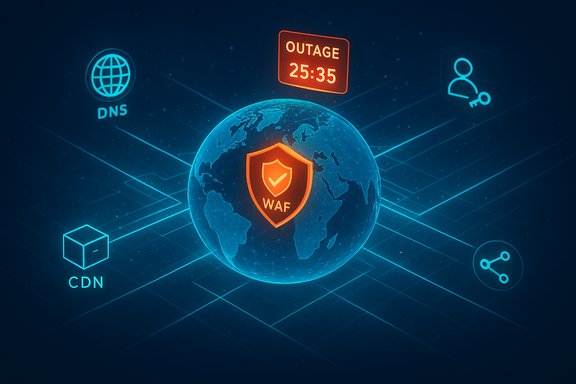
Blue globe with an orange WAF shield, connected to DNS/CDN icons and an outage timer.Background​

Cloudflare operates one of the largest edge networks on the internet, providing content delivery, DDoS protection, DNS, and web application firewall (WAF) services to millions of websites and apps. When the company’s systems hiccup, the effects cascade because so many services route traffic, security controls, or APIs through Cloudflare’s global network.
This December incident follows a major Cloudflare disruption in mid‑November and sits alongside a run of high‑visibility cloud outages in 2025 — most notably a large Amazon Web Services outage in October and a significant Microsoft Azure incident in late October — reinforcing a broader pattern: outages at a small number of critical providers can produce outsized, global interruptions.
The December outage was short but sharp: Cloudflare deployed a change intended to mitigate a software vulnerability and, according to the company’s post‑incident notes, the specific change to how the Web Application Firewall parses requests caused a transient overload that made parts of Cloudflare’s network unavailable for several minutes. The company said there was no evidence the outage was the result of a cyberattack.

What happened on December 5, 2025​

Timeline and scope​

  • Around early morning UTC on December 5, Cloudflare customers and downstream users began reporting failures and elevated errors across numerous services.
  • Reports peaked quickly on real‑time outage trackers and social feeds as sites including major collaboration and communication platforms, e‑commerce storefronts, cryptocurrency exchanges, and game services displayed errors or became unreachable for some users.
  • The disruption lasted roughly 25–35 minutes from detection to wide recovery after engineers rolled back or corrected the change that triggered the problem.
  • Cloudflare’s dashboard and related APIs experienced intermittent issues during and after the recovery window.

Cloudflare’s stated cause​

Cloudflare says the trigger was a deliberate change to how the Web Application Firewall (WAF) handles or parses incoming requests, a change made to mitigate an industry vulnerability affecting certain server components. That change produced unexpected behavior that overloaded internal systems and briefly rendered portions of the Cloudflare edge unavailable.
The company asserted the incident was not an external attack and emphasized that the change was part of a security mitigation effort — not routine maintenance — that simply went slightly awry.

Secondary effects​

  • Some public infrastructure — for example, local flight operations at one regional airport — initially reported interruptions that coincided with the Cloudflare outage; the airport later stated the disruption was a localized issue and not caused by Cloudflare.
  • Market reaction was visible in pre‑market trading, where Cloudflare’s shares declined amid growing investor scrutiny of repeated outages.
  • The outage also revived customer discussions around resilience, SLAs, and the operational risk of depending on a small number of global providers.

Technical breakdown: what likely failed​

WAF parsing and the risk of configuration changes​

A Web Application Firewall inspects incoming HTTP(s) requests to block malicious traffic and apply security rules. Parsing logic is critical: a malformed rule, a sudden spike in rule table size, or a new parsing routine can consume CPU, memory, or database I/O and ripple across systems that assume bounded rule sizes and processing time.
In this incident, the change to the WAF parsing logic — intended to counter a publicly disclosed vulnerability — appears to have increased processing demands or changed how internal configuration data was consumed. That, in turn, overloaded critical internal services and caused request handling to fail across affected edge nodes.

Database/configuration propagation and cascading failures​

Large CDNs and edge providers push configuration or rule changes across many nodes. If a configuration artifact unexpectedly grows in size or requires more I/O, the propagation mechanism itself can become a bottleneck. That can result in:
  • Overloaded configuration databases or caches
  • Nodes failing to load configs and rejecting traffic
  • System‑wide latency spikes that trigger automated failover or throttling mechanisms
Past incidents show that a seemingly minor change to config generation, parsing, or propagation can cascade into global service failures when safeguards don’t catch abnormal growth or resource consumption.

Why short incidents can be so disruptive​

Even a 20–30 minute outage matters when it affects authentication, payment flows, or widely used APIs. Modern services often integrate Cloudflare for everything from TLS termination and bot mitigation to CDN caching and DNS — creating tight coupling. Short outages interrupt login sequences, OAuth token refreshes, API calls, and client‑side fetching, producing a domino effect that surfaces as downtime across multiple brands and services.

How this fits into the wider pattern: centralization and complexity​

The December outage is not an isolated curiosity. It is part of a growing pattern:
  • Large cloud and edge providers operate at massive scale and are increasingly responsible for layered security, routing, and traffic management.
  • Providers frequently push rapid security mitigations after vulnerabilities are disclosed — a necessary and responsible action — but that urgency increases risk, especially when mitigations are applied globally with complex dependencies.
  • The industry has seen several high‑impact outages recently (cloud provider incidents in October and November), and the common thread is systemic complexity and concentration of dependencies.
This trend raises a hard truth: as organizations consolidate infrastructure onto fewer providers to gain performance, security, and operational simplicity, the systemic risk from a single provider failure grows.

Practical takeaways for IT professionals and site owners​

For WindowsForum readers — IT administrators, site operators, and enthusiasts who manage services or rely on cloud providers — there are concrete steps to improve resilience and reduce the blast radius of provider outages.

Immediate operational checks (triage)​

  • Verify your application health endpoints and CDN/edge routing status.
  • Confirm fallback DNS and cache TTL settings remain appropriate; avoid TTLs that are too long for critical records if you want faster failover.
  • Check authentication and session refresh behavior; long‑lived sessions can mask problems, while short lived tokens can be problematic during provider instability.
  • Validate monitoring and alerting: make sure you are alerted by multiple channels (email, SMS, paging) so alerts are still visible if a single channel is affected.

Architectures to reduce single‑provider dependence​

  • Multi‑CDN / multi‑WAF strategy: Use at least two independent edge providers for critical assets and route traffic with DNS‑level failover or intelligent load balancing. This reduces single‑provider failure risk.
  • DNS redundancy: Host DNS with multiple authoritative providers or ensure your DNS provider has robust failover and API reliability.
  • Graceful degradation: Design clients and UX to operate in degraded mode when third‑party services are unreachable (e.g., read‑only cache mode, limited feature set).
  • Local caching and offline mode: For client apps, cache essential assets and permit basic functionality offline or via local caches.
  • Circuit breakers and backpressure: Implement client and server circuit breakers to avoid cascading failures and to provide graceful error messages rather than timeouts that cascade upstream.
  • Failover origin strategies: Use origin fallback options and split traffic so that origin services can handle baseline traffic when edge services are degraded.

Deployment and change controls​

  • Canary releases and staged rollouts: Never roll critical security mitigations globally in a single change. Stage changes and monitor carefully on a small percentage of traffic first.
  • Feature flags & kill switches: Have the ability to disable features or rulesets quickly if an update causes unexpected load.
  • Configuration size limits and validation: Enforce maximum sizes and preflight validation for auto‑generated configuration files and rule tables.
  • Automated rollback: Integrate rollback paths and automated checks to revert harmful changes faster than manual intervention.

Testing and preparedness​

  • Chaos engineering: Regularly run controlled experiments that simulate partial provider failures to validate failover behavior.
  • Incident runbooks: Maintain and practice runbooks covering common failure modes (DNS failure, CDN outage, WAF misconfiguration).
  • Vendor communication drills: Test contact procedures with your providers during non‑critical times to ensure you can reach support during an incident.

Recommendations tailored to Windows sysadmins and small IT teams​

Many WindowsForum readers manage Windows servers, Active Directory, Exchange, or line‑of‑business apps that depend on external services. Here are focused recommendations.
  • Use local reverse proxies and internal caching for critical web assets to avoid total dependency on external edge services.
  • Ensure Windows Update and endpoint management tools are not singularly dependent on one CDN or distribution path; set caching servers (WSUS/WSUS Replacement) where possible.
  • For cloud‑backed Windows apps, configure secondary authentication paths (e.g., local accounts for emergency admin access) and validate RDP gateway fallbacks.
  • Monitor external dependencies with out‑of‑band checks (simple curl/ping from multiple networks) so you can distinguish between local connectivity problems and provider outages.
  • Document and test manual failover procedures for services that don’t automatically fail over; ensure IT staff can perform them under pressure.

Business, legal and reputational considerations​

SLAs and contractual preparedness​

Service Level Agreements (SLAs) matter — but they are rarely full compensation for reputational damage or lost revenue. Focus on operational readiness: know your provider’s incident notification timelines, remediation commitments, and the steps required to trigger credits or escalations.

Insurance and risk transfer​

Evaluate cyber and business interruption insurance policies and ensure they cover third‑party outages and dependency failures. Understand policy triggers and required documentation ahead of time.

Communications and PR playbook​

Prepare customer communications templates for outages that include succinct status information, expected timeframes for next updates, and mitigation steps customers can take. Transparency during incidents rebuilds trust.

The broader industry implications​

This outage highlights two competing realities:
  • Centralization delivers huge benefits: economies of scale, global edge distribution, integrated security, and superior performance for many customers.
  • Centralization also concentrates risk. The more mission‑critical systems depend on a single provider or a small set of providers, the greater the systemic exposure.
Regulators, enterprise risk teams, and industry groups are increasingly paying attention to “concentration risk” in internet infrastructure. Expect more scrutiny of provider reliability, incident transparency, and vendor risk practices going forward.

What Cloudflare and peers can do (and should be doing)​

  • Adopt stricter staging and canary policies for security mitigations that are applied globally.
  • Improve preflight validation of any generated configuration files or rule tables to prevent runaway growth.
  • Provide more robust and multi‑channel incident signaling paths so customers can receive reliable status updates during network incidents.
  • Invest in independent auditing of change management processes for configuration propagation and WAF rules.
  • Offer easier multi‑provider and hybrid deployment patterns for customers who want to distribute risk.

Caution on unverified and emerging details​

Some early reports tied the change to a specific recently disclosed software vulnerability affecting server component frameworks; other details about which internal system was the primary failure point remain under investigation. Where root causes are still being analyzed, avoid firm conclusions: incident post‑mortems typically add new context after deeper log and telemetry analysis. Any single technical explanation in the immediate aftermath should be treated as provisional until a full post‑incident report is published.

Practical incident checklist you can use now​

  • Confirm your critical DNS records and TTLs; shorten TTLs if you need faster manual failover in the near term.
  • Validate authentication and token refresh flows for resilience against upstream idempotent failures.
  • Test local caching layers and configure clients to tolerate partial CDN failures.
  • Ensure contact info and escalation paths for each critical vendor are documented and tested.
  • Prepare customer‑facing status templates and internal incident playbooks; rehearse them quarterly.

Conclusion​

The December 5 Cloudflare outage was short, visible and instructive: it showed that even brief configuration or mitigation changes at a major edge provider can have immediate, global impact. The event is the latest reminder that resilience is not a single‑vendor property; it is an architectural and operational commitment that must be engineered, practiced, and funded.
For administrators and small‑to‑medium enterprises that depend on these providers — the options are practical and actionable: design for partial failure, adopt multi‑provider patterns where practicable, build robust monitoring, and practice incident response. Those steps are not cheap, but they are far less costly than the reputational and operational risk of being caught off‑guard by the next short but disruptive outage.
The web will keep evolving; the question is whether architectures and organisations evolve faster than the complexity that threatens them. The most resilient teams will be the ones that plan for “when,” not “if,” the next partial outage arrives.

Source: Naharnet Cloudflare says service restored after outage
 

Cloudflare’s network hiccup on December 5, 2025, briefly left hundreds of apps and millions of users scrambling as login attempts, trading orders and AI sessions failed — the company’s second high‑visibility outage in under a month and a stark reminder of how concentrated the public web’s edge infrastructure has become.

Global network map illustrating resilience vs concentration in edge rollout.Background​

Cloudflare has evolved into one of the internet’s dominant edge providers, offering CDN, DNS, Web Application Firewall (WAF), bot mitigation and a suite of zero‑trust and developer services that many modern apps use as a front door. That functional centralization buys speed and security for customers, but it also creates a single choke point: when an edge provider experiences an internal failure, the failure often looks identical to an application or origin outage for downstream services. This most recent incident — detected on December 5, 2025 at 08:47 UTC and resolved roughly 25 minutes later — affected a material slice of Cloudflare’s HTTP traffic (Cloudflare estimated about 28% of HTTP traffic was impacted) and touched a long list of consumer and enterprise services including trading platforms in India (Zerodha, Angel One, Groww), several conversational AI front ends, collaboration apps and travel booking services. Cloudflare and multiple independent news outlets confirmed the timeline and the short duration of the outage. Two weeks earlier, on November 18, 2025, a separate but related outage had already exposed similar failure modes: a configuration/data propagation problem produced a malformed “feature” file that was distributed across the network and caused edge proxies to return 5xx errors or fail closed on challenge flows. That event disrupted services such as ChatGPT and X (Twitter), and set the stage for heightened scrutiny when December’s disruption arrived.

What happened on December 5: the technical summary​

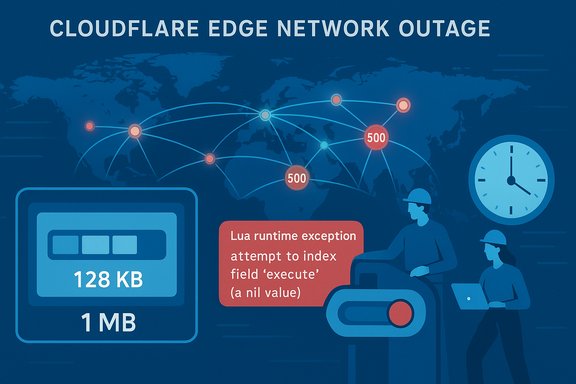
Cloudflare’s published post‑mortem for the December 5 outage summarizes the load‑bearing technical facts: engineers were rolling a change to how the WAF buffers and parses HTTP request bodies to protect customers against a newly disclosed vulnerability in React Server Components. The team increased the body buffer size (from 128 KB to 1 MB) as a security mitigation, and during related configuration adjustments they disabled an internal test/logging tool via a global configuration system. That configuration change propagated instantly across Cloudflare’s global edge rather than through a staged rollout, and in a subset of Cloudflare’s older proxy (FL1) the change triggered a runtime error in the rules module that caused HTTP 500 responses for affected customers until the change was reverted. Key technical details verified in Cloudflare’s account and corroborated by multiple reporting outlets:
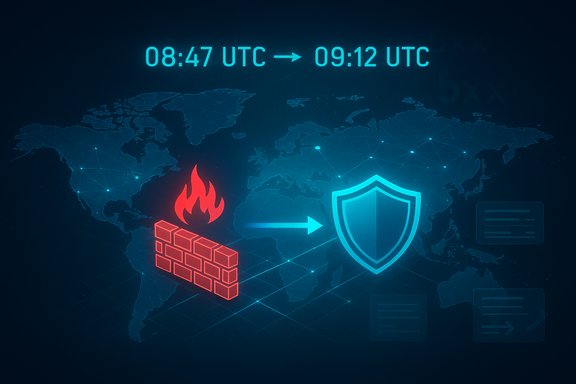
  • The incident window lasted approximately 25 minutes (08:47–09:12 UTC) and affected a subset of customer traffic that matched specific proxy/version and ruleset conditions.
  • The root trigger was a change made while mitigating a security vulnerability (a proactive security hardening), not an external attack; Cloudflare explicitly stated there was no evidence of malicious activity.
  • The symptomatic responses were HTTP 5xx errors and challenge/Turnstile failures that prevented users from authenticating or reaching front‑end pages; in many cases the origin back ends were healthy but unreachable because the edge layer failed to proxy requests successfully.
These facts matter because they show two recurring patterns: (1) protective features and automation — when misapplied or when their control plane changes propagate too broadly — can flip from being defensive to being failure catalysts; and (2) incremental fixes that cut corners on rollout or isolation can produce outsized blast radii across globally distributed edge fleets.

Who and what were affected​

The visible impact list was long and varied. Major product categories and representative services that reported or were widely observed to have symptoms during the outage window include:
  • Trading and fintech front ends — Indian retail trading platforms such as Zerodha, Angel One and Groww reported login and order‑placement issues while Cloudflare was degraded. Markets and retail traders experienced transient inability to place or fetch live market data until Cloudflare restored service.
  • Conversational AI and web apps — front ends for ChatGPT and third‑party AI tools (Claude, Perplexity) experienced intermittent failures or challenge pages when their web UI or API ingestion depended on Cloudflare Turnstile or WAF checks.
  • Collaboration and enterprise tools — LinkedIn, Zoom, Google Meet and other collaboration endpoints intermittently returned errors or refused to authenticate through Cloudflare‑mediated paths.
  • E‑commerce, payment rails and booking sites — MakeMyTrip, Shopify storefronts and various payment gateways reported partial outages or degraded behavior where the front end relied on Cloudflare’s edge filtering.
  • Gaming and media CDNs — matchmaking, asset downloads and media delivery experienced interruptions for titles and streaming services that use Cloudflare’s CDN and WAF.
Not every report that surfaced on social media represented a global outage for a vendor; many were regional or temporary, and some outage‑tracker anomalies were self‑inflicted because the tracker itself used Cloudflare. Still, the combination of high‑profile consumer brands and mission‑critical services among the impacted set turned the incident into more than a technical curiosity: it had immediate downstream business and user‑productivity costs.

Why edge provider failures cascade​

The modern web architecture funnels many responsibilities — TLS termination, caching, WAF rules, bot scoring, human verification (Turnstile), API gateway protection and DNS — into the edge layer. That consolidation is efficient, but it concentrates control: if the edge refuses or mishandles requests, the origin cannot be reached and downstream services appear down even if their compute and storage layers are unaffected.
Two operational design choices amplify this risk:
  • Fail‑closed security posture: bot management and challenge flows generally default to blocking or presenting a verification step when validation cannot be completed. During an internal control‑plane failure that prevents validation, normal traffic is blocked rather than allowed through.
  • Rapid global propagation of configuration: staging and gradual rollouts reduce blast radius. When an urgent fix or configuration change uses a global propagation channel without the same staged safeguards, a single mistake or unexpected interaction can ripple instantly across the fleet. Both the November 18 and December 5 incidents were aggravated by configuration propagation mechanics that allowed a problematic change or generated artifact to reach many edge nodes quickly.
These patterns are not unique to Cloudflare; they apply to any large CDN, edge or cloud provider. But the business reality is simple: the fewer independent providers a service uses at the public ingress layer, the more likely a single provider fault is to cause broad downstream impact.

Short‑term operator playbook: practical resilience steps​

For IT teams, the recurring incidents underline a concrete triage and resilience checklist to reduce single‑provider exposure and shorten mean time to recovery:
  • Maintain an origin direct path: keep a tested origin‑direct URL and credentials so operations teams can serve critical content or accept orders if the CDN edge is impaired.
  • Multi‑CDN strategy for critical paths: route critical APIs and sign‑in endpoints through multiple edge providers or implement vendor failover where feasible.
  • Avoid coupling authentication to a single global challenge flow: design authentication and token issuance to accept alternate validation channels when the primary verification widget fails.
  • Prepare customer communications templates: have pre‑approved incident messages and status page copy to reduce confusion and avoid knee‑jerk blame.
  • Test runbooks for staged rollbacks: simulate configuration rollbacks and kill switches for edge‑applied rulesets so that field engineers can revert problematic changes with low friction.
These are not new recommendations, but repeated high‑profile outages make them operational imperatives rather than optional best practices.

Business and regulatory fallout​

Short outages like December 5’s can still have outsized economic and reputational effects. Market reaction was visible: Cloudflare’s shares fell in pre‑market trading after investors reacted to the recurrence and short remediation window, reflecting renewed scrutiny of provider risk. For customers, even a 20–30 minute inability to authenticate or process transactions can mean lost orders, escalated support costs and long tail customer dissatisfaction. Regulators and enterprise procurement teams are beginning to ask harder questions about single‑provider dependence for public endpoints. Expect to see:
  • Tighter contract clauses and SLAs tied to multi‑region failover and demonstrable staged rollout practices.
  • More forensic and post‑incident reporting expectations for core infrastructure providers.
  • Heightened public sector guidance on dependency mapping for essential digital services such as transit booking, municipal portals and payment systems.

Cloudflare’s public response and proposed mitigations​

Cloudflare acknowledged the December 5 incident rapidly and published a short incident report that described the trigger (WAF/body buffer change and a global configuration adjustment), the quick rollback and the company’s intent to accelerate projects that add safety to global configuration propagation and ruleset versioning. The company framed the outage as another unacceptable failure — especially coming so soon after November 18 — and committed to publish further technical detail and mitigations. Publicly‑announced operational remediation plans included:
  • Hardened rollout systems and versioning for configuration artifacts used in rapid mitigation.
  • Killswitches and global safety checks to prevent full fleet propagation of internal test toggles.
  • Greater isolation of internal tooling from the customer‑serving path so disabling or enabling internal features does not affect production traffic.
Those are sensible next steps; the challenge for Cloudflare (and peers) is completing these projects while continuing to support urgent security mitigations for thousands of customers.

Critical assessment: strengths and risks​

Strengths​

  • Global reach and performance: Cloudflare’s edge brings demonstrable latency and reliability benefits in normal operation. The ability to quickly push security mitigations (e.g., WAF changes) is an operational advantage that helps protect millions of sites from new vulnerabilities.
  • Rapid detection and rollback capability: in the December 5 incident, Cloudflare identified the problem, reverted the change and restored service in under half an hour — an operational win in minimizing customer impact.
  • Transparency: Cloudflare published public incident writeups that explain root causes and remediation steps, which is essential for industry learning and customer trust.

Risks and unresolved weaknesses​

  • Configuration propagation and global killswitch gaps: both November 18 and December 5 expose a systemic weakness in how certain configuration channels propagate. Fast propagation is valuable when you need to mitigate an active exploit, but it is dangerous without staged validation and versioning. Cloudflare has pledged fixes but the repeated incidents show risk remains during the remediation window.
  • Edge as single point of failure for auth and payments: many vendors put authentication, payment APIs and rate limiting behind the edge. When the edge returns 5xxs or blocks challenge flows, the business impact is immediate — and many vendors lack tested fallbacks.
  • Perception vs. reality trade‑off: Cloudflare’s market share is a strength, but public perception of fragility can cause customer churn or push enterprises to seek multi‑provider architectures. The practical cost and complexity of multi‑CDN or multi‑edge strategies, however, is nontrivial and will be a commercial tension point going forward.

The user experience: what customers saw and could (and could not) do​

For most end users the options were limited. The visible symptoms were:
  • A generic “500 Internal Server Error” or a Cloudflare branded challenge page instructing the browser to “Please unblock challenges.cloudflare.com to proceed.” These messages are ambiguous to non‑technical users and often led to frustrated troubleshooting attempts (clearing cookies, reinstalling apps) that did not address the root cause.
  • Partial regional or client differences: mobile clients that route differently or apps with direct API paths sometimes continued working, offering a narrow workaround (switching to mobile data or another device). For many users, patience and waiting for the provider fix were the only practical options.
For operators, the right immediate steps were clearer: consult vendor status pages, switch to origin‑direct routes if available, and enable alternative routing to secondary CDNs or cached landing pages to preserve critical flows. But these require prior planning — they are not ad‑hoc fixes.

Broader implications for internet resilience​

Two dominant themes emerge from the November–December incidents that should reshape enterprise architecture and public policy conversations:
  • Decentralization vs. operational complexity: multi‑provider redundancy reduces single‑point risk but adds complexity — more integration points, duplicated configuration and testing burdens. Organizations will need to weigh that cost against the business risk of occasional but consequential outages.
  • Stronger expectations for change management at scale: customers and regulators may demand demonstrable staged rollouts, independent verification of global configuration propagation logic, and clearer post‑incident commitments for providers that operate at systemic scale. These are governance questions as much as engineering ones.
Cloudflare’s repeated outages in a short period make these discussions urgent. The company’s technical remedies — killswitches, stricter rollout controls and isolating internal tooling — are necessary. However, the larger systemic challenge of concentration in the public‑facing edge layer will require diversified operator strategies, improved observability across supply chains and potentially new regulatory guardrails for services that function as public‑internet utilities.

What remains unverified and what to watch for​

Cloudflare’s public blog posts and status updates are authoritative for the company’s engineering narrative and timeline. Independent reporting from Reuters, AP and major outlets corroborates the high‑level facts about timing, affected services and the lack of external attack indicators. Nevertheless, some lower‑level details remain proprietary and dependent on Cloudflare’s internal telemetry; those will only be confirmed if Cloudflare publishes a more extensive post‑incident report with logs, timelines and code traces.
Points to treat with caution until Cloudflare’s full post‑incident technical report is released:
  • Precise internal causal chain for the November 18 “feature file” generation (Cloudflare explained the ClickHouse query/permission change and duplicate rows as the cause, but the exact upstream permission change is an internal detail).
  • The full extent of collateral impacts inside specific enterprise stacks (some vendor outage notices were regionally limited or partial). Cross‑checking vendor status pages is the best way to confirm individual service impact.
Expect Cloudflare to publish additional technical detail and possibly code snippets or timeline artifacts; those will be essential for independent post‑mortem reconstruction and for informing prevention across the industry.

Conclusion​

The December 5 outage and the mid‑November disruption together are an operational wake‑up call. Cloudflare’s global edge provides irreplaceable performance and security benefits for a significant fraction of the public web, but those benefits come with concentrated systemic risk when configuration and control planes are not protected by rigorous rollouts, versioning and isolation. The immediate injuries were short — a 25–30 minute outage for many customers — but the strategic damage is longer lived: increased scrutiny from customers and investors, renewed pressure to harden change‑management systems, and a fresh argument for multi‑provider resilience in internet architecture. For enterprises, the practical takeaway is unchanged but more urgent: plan, test and maintain fallbacks for critical ingress flows. For providers, the imperative is to complete the promised hardening work that prevents rapid global propagation of risky internal changes. Both sides will need to cooperate to keep the web fast, safe and — crucially — reliable when automation and security fixes are deployed at global scale.
Source: The Economic Times Cloudflare’s second outage in a month leaves apps and users in limbo
 

Cloudflare’s global edge briefly faltered on the morning of December 5, 2025, knocking dozens of well-known services — including LinkedIn, Zoom and other high‑profile sites — into visible 500‑level errors before engineers rolled back a configuration change and restored normal routing within roughly half an hour.

A cybersecurity analyst triggers a WAF rollback as a neon world map glows.Background​

Cloudflare has grown into one of the internet’s most critical edge infrastructure providers, offering Content Delivery Network (CDN), DNS, Web Application Firewall (WAF), TLS termination, bot mitigation and API gateway services to millions of websites and applications. Its role as the “front door” for so many services means that control‑plane or parsing failures at Cloudflare can present exactly as an application outage to end users, even when origin servers are healthy.
The December 5 disruption was the second high‑visibility Cloudflare incident in less than a month, following an earlier mid‑November outage that produced hours of intermittent 500 errors, challenge interstitials and Dashboard/API failures. This pattern of repeated, short outages has placed renewed scrutiny on how large edge providers roll out changes, validate configuration, and isolate failures.

What happened (concise timeline and scope)​

  • Detection: Cloudflare monitoring flagged elevated HTTP 5xx errors across parts of its global edge beginning at about 08:47 UTC on December 5. Reports and outage trackers spiked almost immediately as end‑users and services saw login failures, challenge screens and generic “500 Internal Server Error” pages.
  • Root trigger (as reported publicly): The company attributed the disruption to a deliberate change in how its WAF and request‑handling logic buffered and parsed incoming request bodies — a security hardening made to mitigate a disclosed vulnerability — which unexpectedly overloaded or pushed a subset of edge proxies into an error state. Cloudflare said the incident was not caused by any external attack.
  • Impact window and recovery: Engineers identified the change as the proximate cause, reverted the configuration, and returned traffic to normal within roughly 25–35 minutes for most users. Cloudflare subsequently reported that approximately 28% of HTTP traffic experienced elevated errors at the event’s peak, though the visible impact varied regionally and by product configuration.
  • Aftermath: Cloudflare continued to investigate intermittently affected Dashboard and API operations and committed to remedial work around safer deployment and configuration propagation.
These points form the basic, corroborated narrative: the outage was short in absolute terms but struck a broad set of services because of the edge provider’s central role in request validation and routing.

Technical summary: WAF parsing, buffering and the single‑change cascade​

Cloudflare’s public account and independent reconstructions converge on a plausible technical chain:
  • A security mitigation required altering how the Web Application Firewall buffers or parses HTTP request bodies. Implementing such a change can modify memory usage, parse logic and I/O patterns at the proxy layer.
  • The new buffering behavior (reported in post‑incident notes as an increase to body buffer sizes as part of the mitigation) interacted unexpectedly with older proxy code paths in some edge nodes, producing a runtime error path that surfaced as HTTP 5xx responses. The global configuration system propagated the change broadly rather than in a staged canary rollout, which amplified the blast radius.
  • The error mode meant that the edge layer — which performs TLS termination, challenge/Turnstile checks, WAF rule evaluation and proxying — failed to complete request validation and proxying, so legitimate traffic never reached healthy backends. The visible symptom was identical to an origin outage for many downstream services.
This is a classic example of a “protective change” flipping into a failure catalyst: defensive code intended to reduce exposure to a vulnerability instead stressed a dependency or an older code path, which then propagated globally. That is why rapid staged rollouts, canarying and automated health validation at the edge are essential for minimizing systemic impact.
Caveat on technical specifics: some low‑level implementation details reported in public summaries (for example, exact buffer sizes or the internal module names that triggered exceptions) come from Cloudflare’s own post‑incident notes circulated to customers and engineering summaries. Where those specific numbers are quoted in public reconstructions, they are attributed to Cloudflare’s internal analysis; independent source confirmation of line‑by‑line code changes is generally not public and should be treated as Cloudflare’s working technical assessment unless the company publishes source artifacts or a full post‑mortem.

Who was affected and why it felt larger than a “few minutes”​

Although the outage window for most users was under an hour, the number of recognizable brand‑level impacts made the event feel much larger.
  • Consumer and collaboration platforms: Several widely used apps — including LinkedIn and Zoom — returned 500 errors or challenge pages for some users during the disruption window. Because these services rely on Cloudflare for TLS termination, bot mitigation or WAF protection, edge failures translated immediately into user‑visible outages.
  • AI front ends and API surfaces: ChatGPT and other AI web front ends that route user requests through Cloudflare experienced intermittent blocking or challenge pages in related incidents earlier in November, and some third‑party AI interfaces again saw degraded behaviour during the December event. That placed further pressure on real‑time services that require low‑latency, always‑available ingress.
  • Financial trading UIs and e‑commerce: Retail trading platforms in India and various e‑commerce storefronts reported login failures or interrupted sessions during the window, highlighting that even very short edge outages can have outsized financial and user‑trust costs.
Even where origin infrastructure remained healthy, the edge’s failure mode — refusing, timing out, or returning 5xx responses — meant downstream systems could not authenticate or proxy traffic. For any service that uses the edge as an essential hop, the perceived outage duration includes time to detect, diagnose, rollback and propagate the restoration across caches and DNS, which multiplies the user impact beyond the core rollback window.

How this event fits into a broader pattern of concentrated edge risk​

2025 has seen several highly visible cloud‑edge incidents across multiple providers: Microsoft Azure's October incident tied to Azure Front Door configuration changes, a major Amazon Web Services outage in October, and repeat Cloudflare interruptions in November and December. These events are not random noise; they illustrate systemic concentration risk:
  • Fewer providers control more of the public ingress, and a single misconfiguration or over‑eager propagation can cascade across many independent services.
  • The complexity and scale of modern edge fabrics increase the probability that an otherwise benign change will interact with older code paths, unexpected datasets or regional configuration variance.
  • Rapid, global configuration mechanisms that are invaluable for urgent fixes become a liability when staged rollouts, canaries and health gates are bypassed or are insufficiently protective.
Cybersecurity and cloud‑operations experts have pointed out that this concentration is a structural reality: organizations have consolidated to buy performance, security and simplicity, but that creates shared single points of failure. Expect more frequent, short but high‑visibility outages unless architectural and deployment practices across providers improve.

Notable strengths in Cloudflare’s response — and remaining operational questions​

What Cloudflare did well:
  • Rapid detection and rollback: The company’s monitoring detected anomalies and its engineers reverted the triggering change quickly, restoring service to most customers within a comparatively short window. That response limited business losses and reduced the chance of prolonged outage.
  • Transparent immediate messaging: Cloudflare posted public status updates acknowledging the issue, stating that the outage was not the result of an attack, and describing the high‑level cause as a firewall/configuration change — important steps that reduced rumor and misattribution in the wild.
  • Commitment to remedial guardrails: Early follow‑ups emphasized safer rollout mechanisms, additional health validation for globally propagated configuration data, and architectural options to “fail open” for non‑safety critical paths to reduce future blast radius. Those categories of mitigations are the right direction.
Open issues and risks that still require scrutiny:
  • Why a global propagation channel was used for a security hardening that would have been safer as a staged canary rollout. The absence of proper canaries or protective gating for certain control‑plane updates remains a key concern.
  • Whether older proxy code paths and regional heterogeneity were adequately isolated from modern mitigations. Regressions caused by legacy nodes point to the challenge of maintaining consistent behavior across a large fleet while rapidly patching security vulnerabilities.
  • Dashboard and API availability during outages: many customers depend on the provider’s own management consoles during recovery. If those consoles are fronted by the same control plane that is failing, incident response becomes materially harder. Cloudflare has acknowledged this class of risk and signaled plans to separate critical management paths; implementation details and timelines remain to be seen.

Practical, actionable guidance for WindowsForum readers and IT teams​

The December 5 outage is a practical wake‑up call for application owners, platform engineers and IT leaders. Short outages at the edge can cause disproportionate damage, but there are proven mitigations that reduce exposure.
  • Architectural recommendations
  • Implement multi‑CDN and multi‑path ingress for critical customer‑facing flows to avoid single‑provider control‑plane dependence.
  • Keep short DNS TTLs for critical endpoints and automate failover testing so traffic can switch reliably when a primary edge provider fails.
  • Avoid placing every control and recovery console behind the same third‑party edge that fronts your production traffic; maintain an out‑of‑band management path that remains usable during edge incidents.
  • Operational and process recommendations
  • Exercise incident runbooks regularly with realistic degraded‑edge scenarios.
  • Verify that canary and staged rollout processes are effective and mandatory for any configuration that touches request parsing, WAF rules, or control‑plane behavior.
  • Monitor both provider status pages and independent, multi‑path telemetry (synthetic checks from different networks and DNS resolvers) to reduce blind spots when the provider’s own monitoring is impacted.
  • Developer and product recommendations
  • Build client‑side UX that tolerates short edge interruptions gracefully (queues, retries with backoff, user‑facing messages that advise about temporary connectivity issues instead of generic 500 pages).
  • Avoid placing critical authentication or token issuance solely behind a single validation flow; design fallback token validation flows where feasible.
  • Legal and procurement recommendations
  • Revisit SLAs with edge and cloud providers; ensure contractual clarity on downtime credit, incident communication timelines and the provider’s obligation to provide out‑of‑band management paths.
Putting this into a short checklist for on‑call teams:
  • Confirm whether the symptom is edge‑returned 5xx (look for provider headers or challenge pages).
  • Switch to preconfigured failover DNS or alternate CDN if available.
  • Use out‑of‑band management consoles to roll back or reconfigure origin acceptance rules.
  • Notify users proactively if sessions or purchases may be affected.
  • After recovery, gather telemetry and conduct a post‑incident review that includes the provider’s post‑mortem and your own incident log.

Broader implications for enterprise IT and cloud strategy​

The frequency and visibility of edge provider incidents in 2025 make three strategic points inescapable for enterprise IT:
  • Consolidation buys features and speed — but concentrates risk. Enterprises must soberly weigh the operational risk of single‑provider dependence against the performance and security benefits those providers offer.
  • Change governance at hyperscale matters. A single misapplied security mitigation can become the largest operational hazard when control‑plane propagation is global and immediate. Providers and customers both must improve canary discipline, observability and rollback automation.
  • Resilience is a combination of technology and process. Multi‑path architectures, resilient UX patterns, and practiced incident responses deliver the best chance of minimizing user impact when an edge provider hiccups.
These are not theoretical risks for WindowsForum readers who run enterprise services, hosted applications or customer‑facing portals; they are immediate operational choices that shape user experience, revenue continuity and brand trust.

What to watch for next (post‑incident signals)​

  • Detailed Cloudflare post‑mortem: The most important public artifact will be Cloudflare’s full engineering post‑incident report with exact root‑cause analysis, the precise configuration changes, and the remedial guardrails it commits to implement. Expect a technical post that outlines code paths, proxy versions affected and the rollout mechanics.
  • Provider commitments on staged rollouts and canaries: Watch for concrete changes in deployment tooling and global configuration gating, not just high‑level promises. True improvement requires both software fixes and stricter operational controls.
  • Customer tooling for resilience: Vendors and third‑party tooling companies will accelerate multi‑CDN orchestration, synthetic monitoring across multiple egress points, and automated DNS failover products. Those are practical investments enterprises should evaluate.

Conclusion​

The December 5, 2025 Cloudflare disruption was a short but sharp reminder that the internet’s performance and reliability now hinge on a very small set of global edge providers. A carefully intended WAF buffering change — rolled out broadly to mitigate a vulnerability — interacted with older proxy code paths and configuration propagation mechanics to produce a fast‑moving, high‑visibility outage that affected major consumer and enterprise services. Cloudflare’s rapid rollback contained the damage, but the event highlights persistent operational gaps: inadequate canarying, fragile management paths, and the systemic risk that comes from concentrating ingress into fewer “baskets.”
For IT teams and WindowsForum readers, the lessons are immediate and actionable: plan for partial failure, design multi‑path ingress for truly critical flows, separate management channels from production ingress, and practice incident response for edge failures until the next event becomes a survivable routine rather than a crisis. The pattern of repeated short outages across multiple providers in 2025 makes resilience engineering — and the governance of change at scale — one of the most important operational priorities for the next year.

Source: The Detroit News Cloudflare says service restored after outage that brought down sites including Zoom and LinkedIn
 

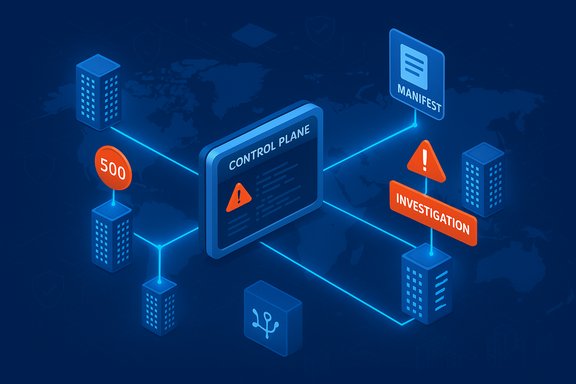
Isometric network map featuring a central control plane, alerts, and a manifest for investigation.
The internet didn’t “stop working” — it tripped over a concentrated vulnerability in the edge layer that most modern sites rely on, and in doing so exposed how a single provider’s internal control‑plane error can make healthy back ends look like they’re offline.

Background / Overview​

Cloudflare operates one of the world’s largest edge networks: CDN caching, TLS termination, DNS, Web Application Firewall (WAF), bot management, and human verification (Turnstile) all run from its global edge fabric. That combination makes Cloudflare a performance and security multiplier for millions of websites and apps — and when something inside that fabric fails, the visible effect can be immediate and wide‑reaching. Multiple contemporaneous accounts describe outages where widely used services returned HTTP 5xx errors or challenge interstitials during Cloudflare degradations.
Two recent incidents illustrate this dynamic. On 18 November 2025 Cloudflare reported an “internal service degradation” that produced widespread 500‑class errors and challenge failures; engineers later traced the proximate fault to a malformed/oversized feature artifact used by Bot Management. On 5 December 2025 Cloudflare posted a separate incident tied to a change in WAF/request‑parsing logic deployed as a security mitigation; that change briefly overloaded parts of the proxy fleet and caused transient global disruption. Both events were internal failures — not successful external attacks — but both had the same user‑visible symptom: legitimate traffic blocked or failing at the edge.

What actually happened — a concise technical summary​

November 18 incident: bot‑management feature file overflow (high level)​

  • Engineers observed a sudden spike in HTTP 5xx rates and intermittent challenge failures beginning around mid‑day UTC. Cloudflare’s own post‑incident narrative (and independent reporting) indicates the immediate technical chain involved a database query returning duplicate rows that doubled the size of a feature configuration file used by Bot Management. That oversized file exceeded runtime safety limits on edge proxies and triggered crashes/panic states in the proxy code. The bad feature file was propagated repeatedly, producing an oscillating pattern of “good” and “bad” configurations on different nodes until propagation was stopped and a known‑good file rolled out.

December 5 incident: WAF parsing change and transient overload​

  • Cloudflare deployed a deliberate change to how the Web Application Firewall handled or parsed certain requests as a mitigation for a disclosed vulnerability. That change — combined with an operational tweaking of an internal testing tool and a globally propagated configuration toggle — produced unexpected behavior in a subset of proxy code (older FL1 proxies and Lua paths were implicated in independent technical reconstructions). The result was elevated internal errors and HTTP 500 responses for a portion of customer traffic until the change was reverted and services restored. Cloudflare reported no evidence this was an attack and described the outage as a brief internal control‑plane fault.
Both events share a structural root cause: a centralized control plane that pushes configuration, security rules, and feature artifacts to a globally distributed fleet. When that control plane produces unexpected or oversized artifacts, the edge nodes that consume those artifacts can fail in ways that fail closed — i.e., block or challenge traffic rather than allowing it through.

Timeline and observable symptoms​

Typical public timeline (compiled from status updates and observer telemetry)​

  1. Rapid spike in 500‑class error rates reported by monitoring and users.
  2. Outage trackers and social feeds show simultaneous complaints for multiple services.
  3. Affected websites return Cloudflare‑branded 500 pages or the interstitial “Please unblock challenges.cloudflare.com to proceed.”
  4. Cloudflare posts an “Investigating” status, then “Identified,” then “Fix in progress” as engineers isolate and contain the faulty artifact or configuration.
  5. Engineers stop propagation of the bad artifact/configuration, inject a known‑good file or roll back the change, and progressively restart affected proxy nodes.
  6. Services recover in waves; residual tails linger while caches, queues and dashboards re‑stabilize.

What users saw​

  • Generic “500 Internal Server Error” pages for sites that normally “just work.”
  • Interactive or passive challenge pages referencing challenges.cloudflare.com that blocked access or required intervention.
  • Short, sharp disruptions for many mainstream services (conversational AI front ends, social media feeds, collaboration tools, e‑commerce checkout flows) while origin servers themselves often remained healthy.

Why an edge failure makes a healthy service appear down​

Edge providers like Cloudflare sit on the critical path for client connections: TLS termination, routing, routing host headers, WAF inspection, bot scoring and sometimes authentication all happen at the edge. If the edge returns a 500 or cannot complete a token/challenge exchange, the client never reaches the origin.
Two operational patterns amplify the blast radius:
  • Fail‑closed security posture. Bot management, WAF and Turnstile are designed to block or challenge suspicious requests rather than risk forward passage. When the verification pieces can’t run reliably, legitimate traffic can be blocked systemically.
  • Rapid global propagation. Many CDNs and edge providers propagate configuration and rule changes quickly to many nodes. A single malformed artifact that propagates globally can create simultaneous failures across regions rather than a contained regional outage.
These mechanics explain how a provider’s internal control‑plane bug can translate into visible outages for otherwise unrelated services.

Services affected and scale of impact​

Because so many services use Cloudflare for parts of their public delivery stack, the visible impact list is long and varied. Reported or observed effects included major conversation and productivity platforms (ChatGPT/OpenAI front ends), social media clients, streaming and creative platforms, payment or commerce checkouts, gaming matchmaking and even outage‑tracking websites that themselves use Cloudflare protection. Some outlets and telemetry suggested Cloudflare handles on the order of roughly one‑fifth of the public web’s traffic — an order‑of‑magnitude share that helps explain why a single vendor outage can feel like “the internet” is down. Treat precise market‑share numbers with appropriate caution — they are estimates used to explain scale rather than an exact audited metric.
Important caveat: social‑media threads and crowd reports tend to overreach early in an incident. Not every tweet naming a brand indicates a global outage for that vendor — some reports later prove regional, partial, or the downstream service was unaffected while an intermediary failed. Where vendor status pages disagree, vendor announcements are the most reliable single record of impact.

Deep technical anatomy — unpacking the internal failure modes​

Bot Management feature file blowup (November 18)​

  • The bot‑management system relies on a compact configuration or feature file that encodes model or rule metadata consumed by edge proxies.
  • A change in a ClickHouse database query — reportedly a permissions tweak that produced duplicate rows — doubled the size of that file. When the edge proxy loaded the file, it exceeded assumed safety bounds and triggered an unhandled panic or crash path in the proxy code.
  • Because that feature file was regenerated and propagated periodically, some nodes received the bad file while others had the good one; the fleet therefore oscillated between functional and faulty states until propagation was halted and a rollback applied.
This sequence illustrates a classic production hazard: a seemingly minor metadata or query change upstream can produce an oversized artifact that breaks assumptions downstream.

WAF parsing & buffer changes (December 5)​

  • Mitigations for newly disclosed vulnerabilities sometimes require runtime changes (for example, increased buffering for request bodies or altered parsing logic).
  • A security hardening intended to protect certain server frameworks changed how the WAF parsed request bodies. In a subset of older proxy instances or in specific Lua paths, that change produced unexpected exception behavior and elevated 500s.
  • Cloudflare’s own analysis emphasized the change was part of protective work and not the result of attack traffic. Quick global propagation of the change, however, removed the protective benefit of staged rollouts and caused a brief global impact.

Why these problems are not trivial to avoid​

  • Edge software is highly optimized and often written to assume bounded rule sizes and predictable feature sets. Safety checks do exist, but they can be bypassed if upstream data violates assumptions.
  • Global rollouts that are not staged or are tied to emergency mitigations can trade safe deployment practices (canaries, progressive rollouts) for speed — increasing the probability that a defensive change becomes disruptive.

What Cloudflare said — and what remains technical confirmation vs. hypothesis​

Cloudflare publicly declared both incidents were internal degradations and has described root‑cause factors: an oversized bot‑management feature file linked to a ClickHouse query for the November event, and a WAF/parsing change tied to a security mitigation for the December event. Independent reporting and operator analysis corroborated these narratives at a high level while adding implementation details (e.g., proxy versions, Lua or Rust error paths) that are consistent with, but not always exhaustively detailed by, Cloudflare’s public statements. Where details diverge across reports, treat the vendor post‑mortem as authoritative for confirmed facts and other investigative reconstructions as useful supplement until full forensic logs are released.

Practical resilience advice for site owners and IT teams​

For organizations that rely on Cloudflare or any single edge provider, outages like these are a wake‑up call — not a reason to abandon centralized edge services, but a reason to design for graceful degradation and operational alternatives.
Key mitigation strategies:
    • Implement multi‑CDN and DNS failover.
    • Use a primary CDN/edge provider and a fallback path that can be activated automatically or manually.
    • Decouple critical authentication and payment endpoints from third‑party edge dependencies.
    • Host sensitive token exchanges or payment endpoints behind alternative, proven paths or keep an origin‑accessible failback route that bypasses edge checks when necessary.
    • Use staged rollouts and canarying for your own edge‑delivered features.
    • For customers who control WAF rules or edge logic, deploy changes gradually and validate on low‑traffic canaries before broad propagation.
    • Harden monitoring and alerting to detect edge‑vs‑origin failure modes.
    • Correlate edge error rates with origin health metrics; an origin that reports “healthy” while user 5xx counts rise is a red flag for edge problems.
    • Maintain a compact incident runbook.
    • Predefine steps to switch DNS records, flush caches, rotate feature toggles or re‑route traffic through alternate ingress when needed.
    • Contractually define SLA and incident support expectations.
    • Ensure your provider SLAs, credits, and incident communications meet your operational needs, and test support escalation paths.
A pragmatic, prioritized checklist for small and medium operations:
  1. Verify whether critical endpoints (auth, checkout, APIs) are fronted by your edge provider.
  2. If yes, implement or test an origin fallback that bypasses edge checks for emergency windows.
  3. Deploy DNS TTLs that balance failover speed and risk of mis‑routing.
  4. Subscribe to provider status feeds and integrate them into support escalation channels.
  5. Exercise your failover plan in tabletop drills at least twice a year.

Broader systemic lessons and risk tradeoffs​

These incidents illuminate a recurring theme in modern cloud architecture: centralization for efficiency creates concentration risk. Consolidating TLS termination, bot management, and firewalling at the edge simplifies operations and improves latency and security under normal conditions, but it also creates single points of public ingress whose failure modes are highly visible.
Three strategic lessons:
    • Edge consolidation increases attack surface and systemic risk.
    • Even when outages are not attacks, they look like them; automated defenses that are conservative by design (fail‑closed) are most dangerous when their validation path itself is the element that fails.
    • Rapid global propagation of emergency mitigations is a tradeoff.
    • Speed matters for security, but so does staged validation; providers and customers alike must balance urgency with safe rollout practices.
    • Observability across control planes is essential.
    • Instrumentation that distinguishes control‑plane errors from data‑plane or origin failures reduces diagnosis time and helps avoid misdirected mitigation (e.g., treating the event as an external DDoS when it is an internal artifact propagation bug).

Risks and open questions (what’s still uncertain)​

  • Exact impact quantification across all affected tenants remains noisy; crowd reports and outage trackers give scale but not definitive counts. Use caution with absolute figures and treat them as illustrative rather than audited.
  • Some of the lower‑level implementation details (specific proxy versions, the exact panic trace or stack traces, the full ClickHouse query text) are only available in a full forensic post‑mortem; public summaries are accurate at a high level but will lack complete executable detail until Cloudflare or independent incident responders publish full logs. Where public accounts differ on language (Rust panic vs. Lua exception), mark the divergent points as provisional until the vendor’s full technical report appears.
  • The longer term business and market effects — for example, whether major customers will accelerate multi‑provider strategies or whether regulators will press for operational transparency — are predictable in direction but uncertain in pace and scale. The repeated high‑visibility outages in a short timeframe do increase pressure on customers to diversify and on vendors to strengthen rollout controls.

How to interpret “was this an attack?”​

Public signals, vendor statements, and independent reporting converge on the same answer for both incidents: not an external compromise. The November event was traced to a configuration/query change that produced malformed artifacts; the December event was tied to a deliberate security mitigation whose side effects caused transient failures. In both cases, engineers stopped propagation, rolled back or injected known‑good artifacts, and restored service. That pattern of remediation — identify, stop propagation, rollback, validate — is consistent with internal configuration or control‑plane errors rather than an ongoing external attack that would typically exhibit different telemetry (sustained, originating from many external IPs, and not solved by rolling back internal configuration). Still, early symptoms can mimic attacks, which is why quick diagnosis and correct classification matter operationally.

Final takeaways​

  • The visible “internet outage” was not a universal collapse but a concentrated failure at a highly leveraged control point — Cloudflare’s edge — whose role in terminating, inspecting and routing traffic means its failures show up across many services simultaneously.
  • The technical triggers differed (a bot‑management feature file overflow in November; a WAF parsing/buffering change in December), but both incidents expose the same systemic fragility: rapid global configuration propagation combined with fail‑closed security logic can transform protective features into failure catalysts.
  • For operators, the practical response is to assume edge providers will occasionally experience faults and to design fallbacks and exercises accordingly: multi‑provider strategies, origin fallbacks, canary deployments, and rigorous incident runbooks will reduce business risk without abandoning the performance and security benefits edge providers provide.
  • For everyday users, the outage is a reminder that major online services are tightly woven together: a single vendor’s internal bug can interrupt widely used apps for minutes to hours. That is disruptive, but not mysterious — it’s a plain technical consequence of centralized edge architectures and global, automated control planes.
The problem can be fixed — and likely will be — but fixing it requires both engineering changes (better propagation safeguards, stricter safety bounds, canarying) and a sober acceptance from enterprises that dependence on a single edge provider is a measurable business risk that should be managed, not simply accepted.

Source: NationalWorld Why has the internet stopped working - Cloudflare outage explained
 

Cloudflare said it restored services after a brief but high‑visibility outage on the morning of December 5, 2025, that intermittently knocked major websites — including LinkedIn, Zoom and dozens of other services — offline for roughly 25–35 minutes before engineers rolled back a configuration change and returned traffic to normal.

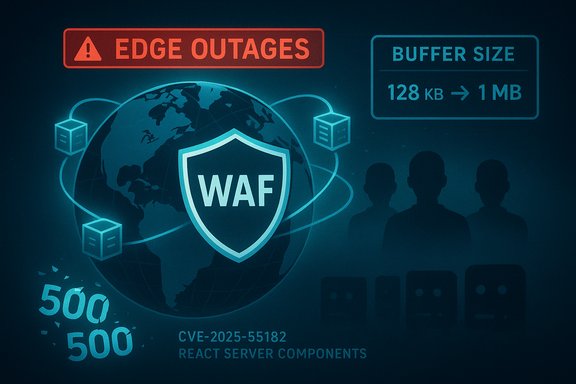
Global WAF shield amid edge outages and buffer-size warnings.Background​

Cloudflare is one of the world’s largest edge infrastructure providers, delivering CDN, DNS, TLS termination, Web Application Firewall (WAF), bot mitigation, API gateway and related services for millions of websites and applications. Its edge sits directly in front of many consumer and enterprise services, so control‑plane or parsing failures at Cloudflare frequently appear to end users as application outages even when origin servers remain healthy. This centrality is the reason a short outage at Cloudflare can look like a major internet incident; the December 5 disruption made that reality painfully visible. This episode followed an earlier Cloudflare outage on November 18, 2025, and the clustering of high‑visibility cloud incidents through October–December 2025 (including significant outages at other major cloud providers) has focused attention on the systemic risks that come with concentrated internet infrastructure. The pattern raises engineering, operational and commercial questions about resilience, rollout practices and single‑vendor dependency.

What happened: concise timeline and scope​

  • 08:47 UTC — automated monitoring flagged elevated HTTP 5xx errors across a portion of Cloudflare’s network. Cloudflare later recorded this as the incident start time.
  • ~08:48–09:11 UTC — error rates remained elevated; outage trackers and customer reports spiked as recognized brands returned “500 Internal Server Error” pages or challenge interstitials.
  • 09:11–09:12 UTC — Cloudflare engineers reverted the configuration change; traffic returned to normal and the incident was declared over at 09:12 UTC. The visible impact window lasted roughly 25 minutes.
Cloudflare estimated that approximately 28% of HTTP traffic it serves experienced elevated errors at the incident’s peak, though the actual user‑visible impact varied by region, product configuration and proxy version. That figure comes directly from Cloudflare’s post‑incident notes and was repeated by major news outlets.

The trigger: a defensive change that misfired​

Cloudflare’s public post‑mortem states that the outage was triggered by a deliberate change to how its Web Application Firewall (WAF) buffers and parses incoming HTTP request bodies. The aim of the change was to protect customers from a newly disclosed and high‑impact vulnerability affecting React Server Components (identified in the industry as CVE‑2025‑55182). To harden protection, Cloudflare increased the request body buffer limit from 128 KB to 1 MB for WAF inspection. That increase was intended to align with defaults used by many Next.js/React workloads. During the rollout, an operational decision was made to disable an internal testing tool via Cloudflare’s global configuration system. That global toggle — unlike the gradual rollout mechanism used for many deployments — propagated instantly across the fleet. In an older proxy version (referred to internally as the FL1 proxy), the combination of the buffer change and the disabled internal tool produced a runtime error path that surfaced as a Lua exception and caused the proxy to return HTTP 500 responses for affected requests. Cloudflare’s published post included the relevant runtime error text as produced by the proxy: [lua] Failed to run module rulesets callback late_routing: /usr/local/nginx-fl/lua/modules/init.lua:314: attempt to index field 'execute' (a nil value). Engineers identified this chain quickly and reverted the configuration.

Why this looks like a classic “protective change” failure​

The December 5 incident is a textbook case of a defensive modification — deployed to mitigate a real vulnerability — transforming into a failure catalyst because of scope, propagation method and interaction with legacy code paths.
  • Scope: The change expanded buffer sizes, altering memory usage and parsing semantics at the proxy layer.
  • Propagation: A global configuration toggle (not subject to staged canarying) propagated in seconds to the entire network.
  • Legacy interaction: Some edge nodes still run older proxy software (FL1) that contained a latent path unable to handle the modified configuration, producing an uncaught exception.
Cloudflare has acknowledged that the global configuration system used for the killswitch behavior does not perform gradual rollouts and is under review. That admission sits at the core of the remediation commitments Cloudflare announced the same day.

Cross‑verification of key claims​

Multiple independent sources align with Cloudflare’s account:
  • Cloudflare’s official incident blog (detailed post‑mortem) describes the timeline, the buffer increase to 1 MB, the FL1 proxy interaction, the Lua exception and the 08:47–09:12 UTC window.
  • Reuters summarized the same timeline and reported the outage window as 08:47–09:13 GMT, noting the outage was not an attack and linking the cause to an internal firewall change intended to mitigate a React Server Components vulnerability.
  • The Associated Press reporting reproduced the basic facts — service restored after a short outage that affected LinkedIn and Zoom, Cloudflare’s denial of malicious activity, and an initial conclusion pointing at an internal change to firewall handling of requests.
These independent confirmations make the central technical narrative — a well‑intentioned WAF/body‑handling change that interacted poorly with an older proxy code path and a global config toggle — the most plausible public explanation. Where granular internals (for example, precise internal test tool behavior or low‑level memory metrics) were cited, they came from Cloudflare’s own notes and therefore should be treated as the company’s technical assessment pending any third‑party forensic publication.

Who was affected and how it presented​

The outage produced a familiar set of symptoms for affected end users:
  • Generic HTTP 500 pages and “Internal server error” messages.
  • Cloudflare challenge or Turnstile interstitials appearing when the challenge system itself was disrupted.
  • Dashboard and API disruptions for Cloudflare customers, limiting the ability of affected teams to use Cloudflare’s control plane during the recovery window.
A non‑exhaustive list of public brands and services that reported disruptions or were widely reported as affected includes LinkedIn, Zoom, Canva, Coinbase, Anthropic/Claude, and multiple gaming platforms. The outage also produced regionally notable impacts — for example, several stock trading UIs and e‑commerce checkout flows briefly failed in markets where those applications depend on Cloudflare. The apparent scale follows directly from Cloudflare’s market position at the edge rather than a single application failure. Important nuance: not every report naming a brand indicates a global outages for that brand; the visible impact depended on whether a given customer used the affected FL1 proxy and had the relevant managed ruleset configured. Cloudflare’s blog explicitly notes that only customers meeting the combination of conditions (FL1 proxy + managed ruleset + buffer change) returned 500s; other customers were unaffected. That explains the partial, sometimes regionally inconsistent reporting.

Comparison with November 18, 2025 — pattern recognition​

The November 18 incident and the December 5 event are distinct in proximate cause but similar in structure: both were internal changes intended to protect customers that propagated too broadly and interacted with fragile code paths or configuration assumptions.
  • November 18, 2025: Cloudflare traced the outage to a database permissions change that doubled the size of a feature file used by Bot Management; that oversize file propagated to nodes and triggered software limits, producing hours of intermittent 5xx errors. Cloudflare’s November blog provides an in‑depth post‑mortem and a set of mitigations planned after that incident.
  • December 5, 2025: A WAF buffer change rolled into an older proxy code path and, combined with a global killswitch toggle, produced a short but high‑visibility outage that affected roughly 28% of HTTP traffic at peak.
Taken together, these incidents reveal a systemic vulnerability: critical configuration and security updates — precisely the sorts of changes that must be deployed rapidly to protect customers — are being propagated by systems that lack sufficiently protective staging, health gating and failure containment. That tension between speed of mitigation and safety of propagation sits at the heart of modern edge risk.

Technical analysis: why staged rollouts and health gating matter​

The December 5 event highlights several specific technical lessons relevant to edge operators and customers:
  • Global configuration vs. gradual rollout: Global toggles that propagate within seconds are valuable in emergencies but dangerous when they are used for changes that should be canaried. Finer‑grained rollouts, health checks and automated rollback thresholds reduce blast radius.
  • Legacy code path exposure: Large networks inevitably run heterogeneous software versions. Changes that are safe for modern proxy versions can trigger exceptions in older agents. Clear versioning, automatic canary targeting by version and preflight tests against older code paths are essential.
  • Fail‑open vs. fail‑closed defaults: Many security controls default to fail‑closed to block potentially malicious traffic. That default defends customers in adversarial conditions but converts edge faults into client‑visible outages. Selective fail‑open logic for non‑critical inspections and configurable defaults for high‑risk updates can reduce user impact. Cloudflare said it is evaluating these options as part of its remedial plan.
Cloudflare’s immediate and actionable technical commitments — improving rollout/versioning, adding health validation, enhancing killswitches and shifting certain components toward fail‑open behavior where safe — are the right categories of remediation. The work becomes meaningful only if accompanied by measurable changes in deployment pipelines and independent verification.

Business, operational and market implications​

The December 5 outage had immediate and longer‑term consequences:
  • Short‑term customer impact: businesses dependent on Cloudflare for ingress, authentication and API gateway functions experienced partial outages, lost transactions, and degraded user experience during the incident window. Some trading and commerce operations reported lost orders or failed sessions — even brief outages can have outsized financial and reputational costs.
  • Market reaction and reputation: Cloudflare’s share price experienced selling pressure in premarket trading on December 5, reflecting investor concern about repeated outages and the reputational risk of core‑network failures. News outlets reported a premarket fall as investors reassessed operational risk.
  • Supplier concentration risk: The repeated pattern of high‑visibility outages across a small set of providers (Cloudflare, AWS, Microsoft Azure) has renewed interest among enterprise architects in multi‑provider ingress, provider diversification, and resilient design practices. These architectural choices come with cost and complexity tradeoffs but reduce concentration risk.
Regulatory and procurement consequences are also possible. Enterprises and public sector buyers increasingly assess resilience metrics and incident history as part of vendor selection. Repeated outages at major edge providers will likely influence contractual terms, SLAs, and insurer pricing in the months ahead.

Practical recommendations for IT teams and site owners​

The outage was short, but the consequences highlight that minutes of unavailability at the edge can cause outsized harm. For WindowsForum readers, IT operators and site owners, the following steps are concrete, actionable, and prioritized:
  • Implement multi‑path ingress and DNS redundancy:
  • Use multiple CDN/WAF providers where feasible.
  • Configure DNS with multiple authoritative providers and short TTLs to enable rapid failover.
  • Design origin fallbacks and graceful degradation:
  • Allow authenticated direct origin access for critical APIs when the edge is unavailable.
  • Implement cached or read‑only modes for non‑critical flows to keep user experience acceptable during short outages.
  • Canary, test and validate changes:
  • Require canary deployments of edge‑affecting configuration changes, including against older proxy versions.
  • Run preflight health checks that validate both the newest code and legacy pathways.
  • Harden incident runbooks and exercise them:
  • Ensure runbooks assume control‑plane loss or Dashboard/API unavailability.
  • Practice failover steps with dry runs and tabletop exercises.
  • Monitor third‑party dependency risk:
  • Map which public services depend on Cloudflare (or other edge vendors) for authentication, CDN, or API gateway duties; treat those dependencies as critical in continuity plans.
  • Negotiate operational SLAs and resiliency commitments with vendors:
  • Include incident reporting timelines, independent verification rights and remediation milestones in contracts where business impact is high.
These are practical defenses that reduce business exposure without abandoning the performance and security benefits that edge providers deliver. They are not costless — but the cost of a well‑executed redundancy plan is often lower than the business impact of repeated outages.

Broader reflections: concentration, complexity and the future of the edge​

The December 5 outage is a microcosm of a larger tradeoff: centralizing security and delivery at the edge buys speed, scale and advanced features, but it concentrates risk. As organizations accelerate use of AI services, API‑driven workflows and global SaaS integrations, those edge touchpoints become business‑critical.
A few high‑level observations:
  • Expect more frequent, short, high‑visibility outages as complexity grows and a shrinking set of providers control more ingress. Experts have warned that consolidation amplifies blast radius; the December 5 and November 18 incidents illustrate that dynamic.
  • Fixes require technical work and organizational discipline: safer rollouts, versioned configuration, stronger health gating and transparent incident disclosure. Cloudflare’s announced remediation categories are aligned with these needs, but execution and measurable follow‑through will determine whether trust is restored.
  • Customers must treat edge dependency as a risk to be managed, not an inevitability to be accepted. Architectural choices and procurement practices need to evolve in response to the reality that minutes of edge unavailability can equal hours of business disruption.

What remains uncertain and what to watch next​

Cloudflare’s posts and media coverage provide clear outlines of the proximate technical failures and the immediate remediation steps. Still, several items warrant follow‑up and verification:
  • The durability of Cloudflare’s planned mitigations: Cloudflare has promised detailed resilience projects and a public breakdown of changes. Independent audits, customer confirmations and observable changes in deployment behavior will be the best evidence that the fixes are real and effective.
  • Full forensic detail: Cloudflare published the Lua exception and an explanation of FL1 proxy behavior. Line‑by‑line code changes and formal third‑party reviews would further corroborate the internal narrative, but those typically take time and may not be released. Treat internal implementation specifics that originate solely from Cloudflare as its working assessment until external validation is available.
  • Broader vendor behavior: Whether sustained improvements in rollout safety will be adopted across other major edge and cloud providers is an open question. The market and customers will be watching whether the November and December incidents lead to industry‑wide best practice changes or simply produce short‑term band‑aids.
Where claims are hard to independently validate (for instance, low‑level memory measurements or precise internal timing down to sub‑second granularity), they should be treated cautiously until confirmed by multiple independent artifacts or third‑party analyses.

Conclusion​

The December 5 Cloudflare interruption was brief in absolute time but notable for its breadth and the clarity of its lesson: security‑motivated changes at the global edge can backfire when propagation mechanisms, legacy code paths and fail‑closed defaults intersect. Cloudflare’s prompt rollback and public post‑mortem gave a coherent technical account that independent reporting corroborated, and the company’s stated remediation priorities — safer rollouts, better killswitches, and more resilient fail‑open options — are the right ones.
For operators and organizations that rely on edge providers, the incident is a practical wake‑up call: invest in redundancy where it matters, test failure modes regularly, and assume that critical third‑party components will, at times, be unavailable. The modern web runs on a small set of fabrics; that concentration delivers scale and security, but it also demands new operational rigor to keep global traffic moving when the unexpected happens.
Source: WGAU Radio | Athens, GA Cloudflare says service restored after outage that brought down sites including Zoom and LinkedIn
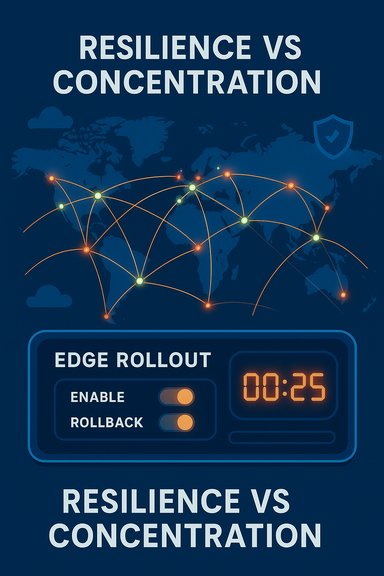
 

Cloudflare says its network is back to normal after a brief but highly visible outage on the morning of December 5, 2025, that intermittently knocked major sites — including LinkedIn and Zoom — offline for roughly 25–35 minutes while engineers rolled back a firewall-related configuration change.

Global map with a fiery red firewall transforming into a blue shield, symbolizing cyber protection.Background​

Cloudflare operates one of the world’s largest edge networks, providing Content Delivery Network (CDN), DNS, Web Application Firewall (WAF), TLS termination, bot mitigation and API gateway services for millions of domains. That footprint places Cloudflare squarely on the critical path for a vast range of consumer and enterprise applications; when the edge layer falters, end users often experience what looks like an application outage even if origin servers remain healthy. The December 5 outage was the second high‑profile Cloudflare disruption in under a month and comes amid a cluster of large cloud incidents during the latter half of 2025. That clustering has sharpened attention on the systemic risks created when a handful of providers control so much of the internet’s ingress and security tooling.

What happened: concise timeline and the company’s account​

Cloudflare’s timeline, posted in its incident blog, places the start of the incident at 08:47 UTC and full restoration at 09:12 UTC, giving a visible impact window of roughly 25 minutes. The company estimated that about 28% of the HTTP traffic it serves experienced elevated errors at the peak.
  • 08:47 UTC — Configuration change began propagating across Cloudflare’s global network.
  • ~08:48–09:11 UTC — Elevated HTTP 5xx responses and challenge interstitials were observed; outage trackers and customer reports spiked.
  • 09:11–09:12 UTC — Engineers reverted the change; traffic returned to normal and the incident was declared resolved.
Cloudflare says the outage was not the result of an external attack; the proximate trigger was a deliberate change to how the WAF buffers and parses incoming HTTP request bodies, deployed as part of a security mitigation for a disclosed vulnerability affecting React Server Components (CVE‑2025‑55182). The company increased the WAF body buffer from 128 KB to 1 MB for inspection and protection of common Next.js/React workloads, and that change — in combination with an operational tweak to an internal tool — interacted badly with an older proxy version (internally called FL1), producing a runtime Lua exception that caused edge proxies to return HTTP 500 errors for affected requests. Cloudflare published the exact runtime error observed in the faulty proxies:
[lua] Failed to run module rulesets callback late_routing: /usr/local/nginx-fl/lua/modules/init.lua:314: attempt to index field 'execute' (a nil value).

Who and what were affected​

The outage’s visible footprint included a long and recognizable list of consumer and enterprise platforms that present Cloudflare-proxied front doors. Reports and outage trackers logged intermittent failures or 500-level errors for:
  • Collaboration and communication platforms: LinkedIn, Zoom, and similar services.
  • AI web front ends and conversational services: AI UIs that use Cloudflare for bot and WAF protections.
  • E‑commerce and payments: various storefronts and checkout flows fronted by Cloudflare.
  • Trading UIs and financial dashboards (regional impacts reported in India and elsewhere).
  • Gaming and media services that rely on Cloudflare’s CDN for asset delivery and matchmaking.
It is important to emphasize that impact varied by customer configuration and proxy version. Cloudflare’s own analysis shows only customers that matched a specific conjunction of conditions — using the older FL1 proxy and the Cloudflare Managed Ruleset while receiving the new buffer configuration — returned 500s; others were unaffected. That nuance explains the partially regional and sometimes inconsistent symptom patterns seen on social feeds. Edinburgh Airport briefly shut operations in the same morning window; the airport later clarified its temporary shutdown was a localized issue unrelated to Cloudflare’s outage. Early reporting initially conflated the two events.

The technical chain: defensive change turned failure catalyst​

This outage is a textbook example of a protective code or configuration change flipping into a failure catalyst due to scope, propagation method and latent legacy code paths.
  • The WAF body buffer increase changed memory usage and parsing semantics at the proxy layer; such changes are normal when hardening for new vulnerabilities but can expose latent bugs.
  • An internal testing/logging tool was disabled via Cloudflare’s global configuration system, which propagates instantly across the fleet and — crucially — is not governed by the same staged-canary safeguards used for software rollouts. That global toggle is now under review.
  • Some edge nodes still run older proxy code (FL1). In those nodes the combined configuration changes produced an uncaught Lua exception, which manifested as HTTP 500 responses en masse for customers in that execution path.
Two engineering design choices amplified the blast radius:
  • Fail‑closed security posture: Bot management and WAF typically default to blocking or presenting verification when validation cannot be completed. When the validation subsystem itself fails, normal traffic is blocked rather than allowed through, instantly converting an edge problem into an application outage.
  • Rapid global propagation of configuration: The global config system propagated the change within seconds rather than via staged canaries, meaning a single operational decision reached many nodes immediately and removed time for detection and rollback before wide impact.
Multiple independent outlets and Cloudflare’s own incident blog align on this high‑level technical narrative, which provides a coherent explanation for the oscillating symptoms (traffic sometimes recovered and then failed again) and the short but high‑visibility window of user impact.

Broader context: repeated outages and concentrated risk​

Cloudflare’s December 5 incident followed a disruptive mid‑November outage and sits alongside several large cloud and edge incidents in 2025 — including outages at other major providers — that collectively demonstrate a structural concentration risk: the modern web funnels increasing responsibilities (TLS termination, bot mitigation, WAF inspection, API gateway) into a small set of global operators. When those operators experience control‑plane or parsing failures, the user-visible effect is immediate and broad. Industry reaction has been blunt: frequent, short outages are becoming more common as organizations “put more eggs in fewer baskets,” increasing systemic exposure when a single provider has a software or configuration hiccup. That dynamic raises engineering, operational and commercial questions about resilience, rollout practices and vendor lock-in.

Notable strengths in Cloudflare’s response — and outstanding questions​

What Cloudflare did well:
  • Rapid detection and rollback: Cloudflare’s monitoring detected the anomaly and its engineers reverted the configuration quickly, restoring most services within a handful of minutes. That rapid action limited the duration of the outage compared with multi‑hour incidents seen elsewhere.
  • Transparent initial messaging: Cloudflare publicly acknowledged the incident, denied an attack, described the high‑level cause and committed to remedial changes — steps that help limit rumor and misattribution in real time.
Remaining operational questions and risks:
  • Global configuration rollout safety: Cloudflare says the global configuration system used for the disablement does not use gradual rollouts; the company has committed to reviewing and improving the safety of data and config propagation. Execution and timelines for those changes will be critical.
  • Legacy code exposure: The persistence of older proxy versions (FL1) in the fleet means latent bugs can still be triggered by new mitigations. How rapidly Cloudflare can deprecate or isolate legacy proxies without disrupting customers is an important metric to watch.
  • Monitoring and chaos-proofing: The eyebrow‑raising oscillation in failures indicates an environment where intermittent regeneration of distributed configuration produced on/off failure patterns. Robust guardrails — including pre-deployment validation, canary health checks, and “fail‑open” modes for non-safety-critical checks — are essential to reduce blast radius.
Where public reporting diverges or remains tentative, it is typically about fine-grained upstream changes (for example, exactly which database query or permission tweak initially produced malformed configuration data) — details Cloudflare has indicated live in internal logs and will likely expand on in a fuller post‑incident technical report. Until such forensic artifacts are published, readers should treat low‑level implementation specifics beyond the published Lua exception and buffer-size numbers as provisional.

Practical takeaways and tactical guidance for IT teams and WindowsForum readers​

The December 5 outage is a practical wake‑up call for system administrators, site reliability engineers and architects responsible for business‑critical services. The event was short, but its consequences were immediate and painful for many organizations. The following recommendations are designed to be actionable for Windows-focused enterprises that rely on SaaS or web apps fronted by edge providers.
  • Diversify ingress where it matters: Use multi‑CDN and multi‑DNS strategies for high‑importance domains. A second edge provider or DNS failover can buy minutes to hours while you diagnose a primary provider incident.
  • Implement origin fallback and graceful degradation: Design web apps so basic functionality (login, status pages, critical dashboards) can be accessed directly at origin or through alternate endpoints if edge checks fail.
  • Shorten DNS TTLs carefully: For fast failover you may want shorter TTLs for critical A/CNAME records, but be mindful of DNS caching and propagation behavior across clients and resolvers.
  • Canary and test your own dependencies: Run periodic failure-mode drills that simulate edge outages and verify that users can still complete essential flows. Include your status page and incident communication plan in these drills.
  • Harden runbooks for edge provider outages: Ensure escalation pathways do not rely solely on the provider’s dashboard if that dashboard is affected; maintain out‑of‑band contact methods and pre-authorized emergency changes with providers.
  • Monitor provider advisories and config flags: Track edge provider status pages and subscribe to API/incident feeds; build internal automation that can automatically switch traffic to fallback routes when provider‑level incidents are detected.
Practical implementation steps (ordered):
  • Audit critical domains to determine which Cloudflare products are in use (WAF, Turnstile, Bot Management, CDN).
  • For each critical domain, identify whether your traffic is subject to legacy proxy versions or specialized managed rulesets that could increase your vulnerability footprint.
  • Implement one or more failover strategies: alternate CDN, direct origin access URL, or a secondary DNS provider with health checks.
  • Run an outage tabletop and then a live failover drill quarterly to verify configurations and communications.
  • Track provider change windows and request staged deployment options; make canary traffic routing a contractual or architectural requirement when possible.

Business and regulatory implications​

Short outages at core infrastructure providers produce tangible business costs: lost transactions, degraded user trust, operational overhead for incident response, and potential contractual liability for service-level failures. The December 5 incident also underscores a reputational risk for providers that market reliability and security as core differentiators; repeat outages erode confidence with enterprise customers and public markets, as seen in premarket share movements reported after the incident. For regulated industries (financial services, healthcare, critical infrastructure), repeated edge outages raise compliance questions: are failover and business continuity measures commensurate with regulatory expectations for availability and incident reporting? Organizations in these sectors should work with legal and compliance teams to validate recovery time objectives (RTOs), recovery point objectives (RPOs), and contractual commitments with primary providers.

How Cloudflare says it will respond​

Cloudflare’s post‑incident notes outline several remedial categories that aim to reduce the likelihood and impact of similar incidents:
  • Enhanced rollout and versioning for data and configuration that today propagate rapidly.
  • More rigorous health validation for fast‑propagated configuration updates.
  • Exploration of “fail‑open” options for some non-critical validations, reducing the chance that a validation failure blocks legitimate traffic by default.
These are sensible, engineering‑level commitments, but they are difficult to implement perfectly in a globally distributed edge fabric. The critical question will be execution and external verification: will Cloudflare adopt staged canaries for configuration/data propagation, and can customers observe or audit those canary deployments in meaningful ways? The broader internet will watch those steps closely.

Risks to watch going forward​

  • Concentration risk remains the dominant structural exposure: the web is still fronted by a small number of large providers whose mistakes cascade widely. This is fundamentally a market and architecture problem that technical fixes can mitigate but not fully eliminate.
  • Legacy-code interactions will continue to be a ticking time bomb unless providers aggressively deprecate and isolate older proxies or maintain stronger compatibility shims and tests.
  • Human operational decisions (choosing to disable an internal tool globally, for example) can be as consequential as code changes; governance and pre‑approval flows for rapid mitigations must be tightened.
Where the public narrative remains incomplete, readers should treat fine-grained claims about internal databases or precise permissions changes as provisional until Cloudflare publishes an expanded forensic post‑mortem. Several independent technical reconstructions and forum threads line up with Cloudflare’s broad account — the buffer increase, global config propagation, FL1 proxy interaction and the Lua exception — which makes the central story credible, but line‑level forensic detail remains the vendor’s to disclose.

Final assessment for WindowsForum readers​

The December 5 Cloudflare outage was short but instructive: it shows how a targeted security mitigation — increasing WAF request buffers to defend against a real vulnerability — can accidentally trigger a large, visible outage when combined with global configuration propagation and older proxy code paths. The incident underscores three immutable realities for modern IT teams:
  • Edge providers give enormous benefits in speed and security, but they also centralize risk.
  • Operational safety nets (canaries, staged rollouts, fail‑open fallbacks) are not optional luxuries when an entire application stack depends on a single provider’s correctness.
  • Short outages can have outsized business impact; planning, redundancy and regular failover drills are the most cost‑effective insurance against the next such event.
Cloudflare’s quick rollback limited damage this time, but the recurrence of high‑visibility incidents across providers this season makes clear that organizations must plan for partial failure as a normal operational condition rather than an exceptional one. The practical next step for teams is to audit their dependency graph, implement measured redundancy where it matters, and bake edge-failure scenarios into routine incident preparedness.
The outage is a reminder that infrastructure scale and security hardening are not substitutes for disciplined rollout practices and safety engineering. The internet will not de‑centralize overnight, so the immediate responsibility falls to SREs, architects and procurement teams to ensure their services survive the next ripple in the edge.
Source: WRAL Cloudflare says service restored after outage that brought down sites including Zoom and LinkedIn
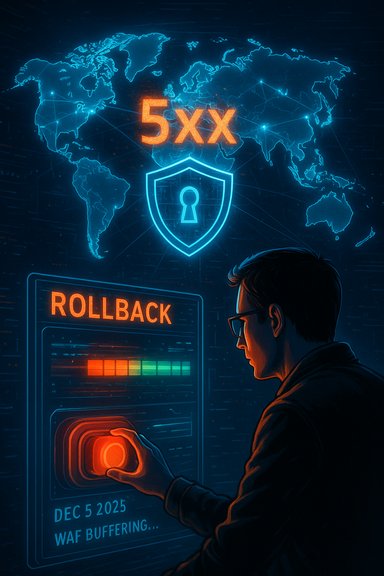
 

Cloudflare’s network hiccup on December 5 produced another visible reminder that the modern web rides on a handful of colossal providers: for roughly 25 minutes a deliberate WAF change rolled too far, some edge proxies threw runtime errors, and widely used sites — from AI front ends to Korean delivery and crypto platforms — briefly failed to load for millions of users worldwide. The company says the outage was the result of a configuration change intended to mitigate a newly disclosed React Server Components vulnerability, not a cyberattack, but the impact and timing have amplified scrutiny of single‑vendor exposure across the internet stack.

Global Internet Edge: interconnected world nodes with WAF shields and a fail-open challenge.Background​

Cloudflare is an edge and CDN heavyweight: it terminates TLS, operates a global Web Application Firewall (WAF), runs bot‑management and challenge flows, provides DNS and CDN caching, and fronts millions of websites and APIs. That breadth is why a localized failure inside Cloudflare’s control or data plane can look, to end users, like an outage of otherwise healthy application servers. Cloudflare itself estimated that about 28% of the HTTP traffic it serves was affected at peak during the December 5 incident. The December outage followed a similar high‑visibility incident on November 18, when a different configuration bug produced widespread 5xx errors and challenge pages. The close cadence — two significant Cloudflare incidents within three weeks — added urgency to industry conversations about resilience, vendor concentration, and whether the internet’s edge is now a systemic single point of failure for modern web services.

What happened on December 5 — timeline and technical summary​

  • 08:47 UTC — Cloudflare monitoring detected elevated HTTP 500 responses across a portion of its global edge.
  • ~08:50–09:11 UTC — User reports and outage trackers spiked as many sites returned 500 errors or showed challenge pages that blocked normal access.
  • 09:12 UTC — Engineers reverted the problematic configuration and traffic returned to normal; Cloudflare declared the incident resolved after ongoing validation.
Cloudflare’s post‑incident summary explains the proximate cause in concrete terms: to mitigate a disclosed vulnerability in React Server Components (CVE‑2025‑55182), engineers increased the WAF body buffer from 128 KB to 1 MB so the proxy could inspect larger request bodies used by common Next.js/React workloads. During the rollout, an internal testing/logging tool was disabled through Cloudflare’s global configuration system (a mechanism that propagates changes instantly rather than through a staged canary). That global toggle reached older proxy instances (internally named FL1) and triggered a Lua runtime exception in the rules module, which caused those proxies to issue HTTP 500 responses for affected requests. The change was identified and reverted within about 25 minutes. Cloudflare says there was no evidence the outage was caused by malicious activity. Why did this brief window matter so much? The WAF and challenge flows sit on the critical path for many applications: if the edge fails to proxy or validate a session, the origin server never receives the request. Many deployments default to fail‑closed for safety — better to block suspicious traffic than to permit potential abuse — but that default turns protective controls into availability hazards when the controls themselves fail. The December event illustrated that a defensive change, when propagated too broadly or applied to legacy code paths, can become a failure catalyst.

Who and what were affected — the visible footprint​

The outage’s observable impact varied by customer configuration, region, and proxy version. Cloudflare’s analysis indicates only customers that matched a specific conjunction of conditions — using the older FL1 proxy and the Cloudflare Managed Ruleset while receiving the new buffer configuration — were fully affected; others were largely unaffected. Still, end‑user reports and regional media captured a long roll call of impacted services:
  • International consumer and productivity platforms — LinkedIn, Zoom, Canva, and various AI front ends (Perplexity, Claude) — reported intermittent access failures.
  • Gaming services, matchmaking backends and multiplayer titles experienced matchmaking or asset delivery errors when their front doors were Cloudflare‑fronted.
  • Financial and trading UIs were disrupted regionally (reports surfaced from India and elsewhere about trading platforms experiencing login and order placement errors).
  • In South Korea specifically, high‑traffic domestic services reported temporary access failures: major cryptocurrency exchange front ends such as Upbit, delivery platforms like Baemin (배달의민족), mapping apps (T Map), and retail platforms including Olive Young experienced intermittent 500 errors or blocked sessions before services recovered. Local news outlets and incident trackers captured these symptoms.
Two practical observations about impact: (1) lists compiled from social media and outage trackers are noisy and can over‑ or under‑report certain brands; (2) because Cloudflare’s products are widely used for security checks, some services displayed challenge pages instructing users to “please unblock challenges.cloudflare.com” — a fail‑closed symptom that appeared during both November and December incidents.

Cross‑checking the claims: how much of the internet is affected when Cloudflare glitches?​

The repeated characterization that Cloudflare “handles around 20% of global internet traffic” deserves precision. Cloudflare’s public materials and telemetry describe serving or protecting a substantial fraction of requests and nearly 20% of websites on the public web; other analyses and news outlets have paraphrased or rounded those figures into “roughly 20% of internet traffic.” The nuance matters: claiming 20% of all internet packets is different from saying Cloudflare serves ~20% of HTTP requests on the public web or serves nearly 20% of websites. Cloudflare’s own traffic and Radar papers provide the most direct context for the figure commonly cited in media coverage. Treat the rounded “20%” figure as a useful indicator of scale — not a precise census of all global traffic types.

The bigger pattern: concentrated cloud and CDN markets and recent outages​

This December outage did not occur in a vacuum. The second half of 2025 saw several high‑visibility cloud incidents that together have sharpened concerns about concentration risk:
  • Amazon Web Services suffered a major outage on October 20, 2025 centered in its US‑EAST‑1 region; DNS and DynamoDB endpoint resolution problems cascaded into hours of elevated error rates for many services and popular consumer apps. News and incident threads documented a long day of degraded functionality across global platforms.
  • Microsoft Azure reported a configuration‑related outage toward the end of October that impacted Azure Front Door and several downstream Microsoft services, producing timeouts and degraded portal access for many customers. Downdetector tallies and vendor status posts confirmed thousands of affected users.
Those events helped prompt a rare and rapid convergence among hyperscalers: on November 30, Amazon and Google announced a jointly developed multicloud networking offering intended to let customers establish private, high‑speed links between AWS and Google Cloud in minutes — a move Reuters described as driven in part by the need to minimize the business fallout from single‑cloud outages. AWS said the service is in preview with Google and that it plans to add Microsoft Azure later, signaling an industry push toward engineered cross‑cloud interconnectivity as a resilience mechanism.

Why hyperscaler interconnects matter — and why they aren’t a silver bullet​

The new AWS–Google multicloud interconnect and planned AWS–Azure cooperation are pragmatic, pragmatic moves: private, dedicated links reduce the friction and time cost of moving data and workloads between clouds, and they can let customers failover critical flows more quickly. But such interconnects have limits:
  • They address connectivity and routing between provider backbones, not the internal control‑plane or operational mistakes that can disable a provider’s edge or WAF logic. In Cloudflare’s December incident, the problem was an internal configuration change and legacy proxy code path; cross‑cloud links would not have prevented an edge provider from mis‑parsing request bodies.
  • Interconnects can shift dependence rather than eliminate it: enterprises that stitch primary services across two suppliers may reduce single‑cloud outage exposure but still depend on a small set of vendors for networking, DDoS mitigation, or bot mitigation. The global market share concentration — AWS, Azure, and Google together control the lion’s share of public cloud capacity — means outages at any of the top providers can still produce large economic and user‑impact effects.
  • Operational complexity rises: multi‑cloud failover demands consistent application architecture, synchronized security policies, and testing across providers. Without disciplined architecture and well‑practiced runbooks, a theoretical interconnect can become another source of outage complexity.
In short: interconnects are a constructive tool for resilience, but they must be paired with application design, multi‑CDN strategies, and thorough operational playbooks to realize full value.

Technical and operational lessons — what went wrong, and what to change​

Cloudflare’s post‑incident notes list sensible technical mitigations: safer rollout mechanisms for critical configuration data, health validation and canarying for global toggles, “fail‑open” defaults for non‑safety‑critical data paths, and streamlined break‑glass capabilities for control‑plane actions. These changes are necessary, but the deeper operational lessons apply to operators across cloud and edge services.
Key technical lessons:
  • Global toggles with instant propagation are dangerous for telemetry/test hooks. Internal tools must never be disabled globally without staged canaries and fast rollback windows; control‑plane changes need the same health checks applied to software rollouts.
  • Fail‑closed defaults amplify blast radius. For bot management and WAFs, deliberate, well‑tested fail‑open fallback behaviours for non‑critical checks reduce the chance of blocking legitimate traffic when validation services are degraded.
  • Legacy code paths require explicit guardrails. When large fleets run mixed versions, configuration changes must be assessed against known older variants (FL1 in Cloudflare’s case) and those variants must be either upgraded or isolated.
Operational practices that should be widespread:
  • Use multi‑CDN and multi‑DNS strategies for critical public assets, with automated health checks and route failover.
  • Keep incident response consoles and fallback tools on paths that do not depend on the same fragile front doors used to restore traffic.
  • Regularly rehearse cross‑cloud failover scenarios and validate that security tokens, rate limits, and authentication flows function under degraded edge conditions.
  • Negotiate SLAs and incident escalation rules that explicitly cover third‑party edge providers and CDNs.

Practical guidance for WindowsForum readers, sysadmins and site owners​

For IT teams, developers, and Windows Forum readers building or supporting public web services, the December Cloudflare event — and the broader autumn of cloud outages — reiterates that resilience is a design discipline. Concrete actions to prioritize:
  • Multi‑vendor architecture:
  • Run static assets and public landing pages behind at least two CDNs with DNS‑level failover.
  • Separate authentication/payment endpoints from non‑critical static content; if possible, place minimum viable fallbacks that can accept traffic without edge bot checks.
  • Canary and control‑plane hygiene:
  • Insist on staged rollouts for all control‑plane changes: global configuration toggles should have throttle limits and health gates identical to software deployments.
  • Maintain a hardened “break‑glass” path (out‑of‑band) to emergency controls that does not depend on the provider’s primary control plane.
  • Monitoring and runbooks:
  • Instrument health checks that validate both origin and edge‑fronted behaviour; alert on discrepancies where origin is healthy but edge returns 5xx.
  • Pre‑author and rehearse runbooks for CDN provider failures: DNS failover, origin bypass, and alternate authentication flows.
  • Customer communication:
  • Prepare user‑facing degraded experiences (cached landing pages, delayed checkout notices) and canonical channels (status pages outside the primary provider) to reduce user confusion during an outage.
  • Business continuity:
  • For services with high financial risk (payments, trading), implement contractual multi‑region/multi‑cloud commitments and test recovery objectives regularly.
These steps won’t eliminate incidents, but they materially reduce recovery time and user impact when a provider misconfiguration or internal bug manifests.

Strengths, shortcomings and systemic risks: a critical assessment​

Strengths visible in the response cycle
  • Rapid detection and rollback: Cloudflare’s telemetry and rollback capabilities limited the disruption to a short window and restored normal traffic within roughly 25 minutes. That operational speed is a necessary first line of defense and shows the value of real‑time observability.
  • Transparency and follow‑up commitments: Cloudflare published a detailed incident blog and committed to specific resilience projects — enhanced rollout safety, improved fail modes, and more robust health validation — which are the right classes of remediation.
Notable risks and remaining concerns
  • Recurrence risk: Two similar high‑impact incidents within weeks raise legitimate questions about whether the planned mitigations will be delivered quickly enough and with sufficient external verification. The root pattern — rapid global propagation of operational changes into legacy code paths — is fixable but not trivial to eradicate across a massive, distributed fleet.
  • Concentration risk persists: Even with AWS–Google and potential AWS–Azure interconnects, the cloud and edge markets remain oligopolistic. Interconnects reduce friction for multicloud failover, but they do not remove dependence on internal control‑plane correctness. In other words, rerouting helps when a datacenter or region has a routing fault; it does not avert a provider’s internal parsing bug or misapplied global toggle.
  • Operational complacency: Many organizations still treat CDNs and edge security as “platform plumbing” and centralize identity, payment, and auth flows behind a single front door to simplify operations. That convenience amplifies the blast radius when the front door trips. The long tail of smaller sites and developer projects is particularly exposed.
Where claims are hard to verify
  • Precise market‑share metrics such as “Cloudflare handles 20% of all global internet traffic” are useful shorthand but require care: Cloudflare’s own metrics refer to large fractions of HTTP or of websites served/protected, not every type of upstream traffic across all protocols and private networks. Treat round numbers as scale indicators rather than exact statistical fact.

The path forward — what to expect from providers and what enterprises should demand​

Providers will — and should — take steps to harden control‑planes, version fences, and staging systems. Customers and regulators should press for measurable outcomes:
  • Public post‑incident audits that include high‑level telemetry and verification that promised mitigations are implemented and tested.
  • Contractual clauses that require providers to demonstrate rollout safety mechanisms (canarying for config data, health‑checks for global toggles) as part of enterprise SLAs.
  • Independent resilience testing and third‑party verification for key control‑plane functions, akin to the “chaos engineering” exercises many large cloud customers already run inside their own environments.
For administrators and architects, the practical imperative is simple: assume any single provider can and will fail, and design systems so short outages do not translate into service‑stopping events for customers. That means redundancy, rehearsed failover, and careful separation of critical flows from convenience plumbing.

Conclusion​

The December 5 Cloudflare outage was a compact, revealing episode: brief in duration but broad in visibility. It exposed a persistent structural risk in modern cloud architecture — namely, the concentration of critical edge and control‑plane functions among a few dominant providers — and it underscored that defensive features, when rolled out hurriedly or without adequate guards, can metamorphose into outages. The industry‑level response — new cross‑cloud interconnects, promises of safer rollouts and fail‑open defaults — is constructive, but the fixes will only matter if they are implemented quickly, tested publicly, and embedded in contractual resilience obligations.
For IT teams, developers, and infrastructure owners the takeaway is actionable and unchanged: build for failure, diversify critical dependencies, test your fallbacks, and never let a single vendor’s control‑plane be the only path to recovery. The next time an edge provider’s WAF or a cloud region hiccups, those measures will determine whether your users see a transient blip or a business‑stopping outage.
Source: 알파경제 Cloudflare Suffers Another Network Outage, Disrupting Korean Crypto Exchanges and Key Online Services
 

Cloudflare’s edge network hiccup on December 5 produced a short, high‑visibility outage that returned “500 Internal Server Error” pages for many well‑known sites and exposed the same brittle dependency patterns that caused a major Cloudflare incident in November.

Cloudflare edge network outage shown with a Lua runtime error and a global connectivity map.Background / Overview​

Cloudflare operates one of the internet’s largest edge platforms, offering CDN, DNS, TLS termination, Web Application Firewall (WAF), bot mitigation (Turnstile), and API gateway services that sit in front of millions of web properties. When that edge layer fails, it often looks identical to an application outage from the end‑user perspective: origin servers may be perfectly healthy, but requests are blocked, challenged, or returned as 5xx errors before they ever reach the backend. On December 5, a configuration change intended to harden protection against a recent React Server Components vulnerability triggered runtime errors in a subset of Cloudflare’s proxies. The visible impact window lasted roughly 25 minutes (08:47–09:12 UTC), and Cloudflare estimated that about 28% of the HTTP traffic it serves experienced elevated errors at the incident’s peak. Reuters and Cloudflare’s own post‑incident note provide matching timelines and core details. This was Cloudflare’s second major disruption within a few weeks. On November 18, a separate internal change generated a malformed Bot Management “feature file” that propagated across edge nodes, producing hours of instability and widespread 5xx errors. The November incident and its November postmortem explain similar systemic risks: global configuration propagation, fail‑closed security behaviors, and latent interactions with older proxy code.

What happened on December 5: concise timeline​

  • 08:47 UTC — A body‑parsing/WAF configuration change began propagating across Cloudflare’s global network.
  • ~08:48–09:11 UTC — Elevated HTTP 5xx responses and challenge interstitials were observed as some services returned 500 errors and outage trackers spiked. Major consumer services reported intermittent failures.
  • 09:11–09:12 UTC — Engineers reverted the change; traffic returned to normal and the incident was declared resolved shortly afterwards. Cloudflare stated there was no evidence of malicious activity.
Cloudflare’s public technical narrative explains the proximate trigger: a deliberate increase to the WAF request‑body buffer (from 128 KB to 1 MB) to improve detection of threats against React/Next.js workloads. During the rollout, a separate operational change—disabling an internal testing tool via a global configuration toggle that does not canary—reached older proxy instances (internally named FL1) and caused a Lua runtime exception. That exception manifested as HTTP 500 errors for affected requests until the configuration was reverted.

The technical chain explained​

Why a buffer increase caused errors​

The WAF inspects HTTP request bodies to apply rules and signatures. Increasing the buffer from 128 KB to 1 MB changes memory allocations, parsing behavior, and code‑path activation in the proxy. Those changes are benign for most modern proxies but can expose latent bugs in older binaries that were not designed to handle different memory or parsing semantics.
In this case, the new buffer combined with a disabled internal tool in certain FL1 proxies produced an uncaught Lua exception in a rules module: “attempt to index field 'execute' (a nil value)”. That exception prevented normal request handling and led to 500 responses from the edge. Cloudflare identified and reverted the change within the incident window.

Fail‑closed behavior amplifies impact​

Security components like WAF, bot management, and human‑challenge systems typically adopt a fail‑closed posture when validation cannot be completed: they block or challenge traffic rather than allowing potentially malicious requests to pass. That conservative design is correct from a security standpoint but creates availability risk when the validation plane itself is unreliable. During the outage, fail‑closed logic meant legitimate user sessions were blocked at the edge even though origin servers were fine.

Configuration propagation and canarying​

A recurring theme between the November and December incidents is the propagation method for configuration changes. Gradual rolling canaries limit blast radius by exposing changes to a small subset of nodes first. Cloudflare’s global configuration toggle used for disabling an internal tool propagated instantly across the fleet — a faster response for some emergencies, but also a mechanism that removes the safety valve of staged rollouts. Cloudflare has signalled it will review and change its deployment guardrails.

Who and what were affected​

The user‑visible impact varied by customer profile, region, and proxy version. Cloudflare’s analysis shows only domains that matched a specific conjunction of conditions — traffic served by FL1 proxies plus the Cloudflare Managed Ruleset receiving the new buffer configuration — returned 500s. However, because Cloudflare sits in front of countless consumer and enterprise properties, even a condition affecting a subset of traffic included many recognizable brands.
Services reported to have seen intermittent errors during the incident window include:
  • Professional collaboration and social platforms (LinkedIn, Zoom).
  • E‑commerce and storefronts (Shopify storefronts, various retailers that front assets through Cloudflare).
  • Crypto and fintech front ends (Coinbase, regional trading UIs).
  • AI front ends and bot‑managed services (some ChatGPT/AI UIs and third‑party tools saw challenge pages or denied requests).
Outage monitoring services and social feeds spiked during the window; even some outage trackers experienced degraded visibility when their own front ends used Cloudflare. This produced a perception of a far broader failure than the technical profile strictly required, but the economic and reputational impact was nonetheless real for affected customers.

Cross‑check and verification of key claims​

To avoid repeating a single narrative, the core facts are corroborated by multiple independent sources: Cloudflare’s own incident blog for December 5 provides the detailed timeline and technical explanation; Reuters independently reported the timeframe and cause; mainstream outlets such as The Guardian and industry outlets documented the brand‑level impacts and placed the outage in context with November’s disruption. These independent confirmations converge on the key points: short but visible outage, WAF/body parsing change as the trigger, a rollback restored service, and no evidence of malicious activity. Where granular internal details (for example, exact internal tool behavior or line‑by‑line code changes) are reported, they originate from Cloudflare’s own post‑incident notes. Those specific low‑level artifacts are Cloudflare’s technical assessment and are not independently reconstructable without access to internal logs and binaries; readers should treat such details as Cloudflare’s working account unless a third‑party forensic report is published.

Why this matters: systemic risk and concentration at the edge​

The December and November outages together illustrate a structural risk in the modern web: a handful of edge and cloud providers mediate critical security and traffic functions for a very large share of the web. That concentration delivers performance and security benefits but also creates correlated failure modes.
Key implications:
  • Single‑vendor dependency increases systemic fragility: when an edge provider fails, dozens or hundreds of unrelated businesses can appear offline simultaneously.
  • Security‑first design choices (fail‑closed) can amplify availability risk when the validation plane fails.
  • Rapid, global propagation mechanisms are operationally powerful but require robust staging, preflight checks, and targeted rollback paths. The choice to disable an internal tool globally, rather than via a rolling canary, was a proximate operational root cause in December.
From an enterprise resilience perspective, a short outage—25 minutes in this case—can still produce meaningful business damage: failed checkouts, dropped trading orders, missed deadlines, and customer support surges. For services that rely on always‑on availability (payments, trading, critical communications), even brief edge failures are unacceptable and costly.

Strengths shown by Cloudflare’s response—and where it fell short​

What Cloudflare did well:
  • Rapid detection and rollback: engineers identified the problematic change and reverted it within the ~25‑minute window. That rapid action limited the total impact window and reduced the chance of a prolonged outage.
  • Transparent public accounting: Cloudflare published detailed incident blog posts for both November 18 and December 5 that explain root causes and remediation steps in substantive technical terms. That level of disclosure helps customers and operators understand failure modes and adapt their resilience plans.
Where Cloudflare needs to improve:
  • Deployment governance: using a global, non‑canary configuration toggle for changes that touch the request‑path increases systemic exposure. Cloudflare has acknowledged this and pledged to review its configuration propagation controls.
  • Legacy code handling: older FL1 proxies were implicated in the December incident; running heterogeneous proxy versions without strong mitigation or per‑version canarying raises risk. A stronger strategy is to ensure that global control changes are either proven safe across legacy code paths or limited to modernized fleets.
  • Fail‑open options for specific non‑security critical flows: while security must remain primary, pragmatic fail‑open configurations for certain endpoints or customer classes could reduce availability impact when the validation plane itself is degraded.

Practical resilience advice for IT teams and WindowsForum readers​

For Windows admins, SaaS operators, and IT teams that rely on Cloudflare or similar edge providers, there are concrete, testable mitigations you can apply now.
Technical measures (short list):
  • Multi‑CDN / multi‑edge strategy: deploy a secondary CDN or reverse proxy that can receive traffic if your primary edge provider is unavailable. This can be automated via DNS failover or programmable application gateways.
  • Short DNS TTLs and health‑checked failover: reduce DNS TTLs on critical hosts and use an active health‑check + failover system that points traffic to an alternate provider when the primary health check fails.
  • Don’t put all control plane tools behind the same provider: host critical remediation consoles (APIs, dashboards) outside of the provider’s front door when possible to ensure you can change configuration even if the provider’s dashboard is partially degraded.
  • Harden origin authentication: where allowed, put origin ACLs and mutual TLS in place so traffic can be accepted from secondary CDNs or direct clients without re‑introducing excessive risk.
  • Graceful degradation: build user experiences that tolerate short outages (e.g., cached pages, read‑only modes, queueing forms) rather than immediate transaction failures.
  • Monitor multiple vantage points: use external synthetic monitors and multiple ISPs to detect edge provider failures quickly and confidently.
Operational measures (ranked steps):
  • Audit dependencies: create a single‑page inventory of which public endpoints use the edge provider for TLS/WAF/DNS and which APIs or login flows depend on Turnstile or similar services.
  • Test failover quarterly: run scheduled, planned failover drills that simulate the edge provider being unreachable and validate your fallback paths.
  • Use contractual SLAs and operational playbooks: review contracts for credits and remedies; ensure runbooks and escalation paths are clear and exercised.
  • Review logging/observability: ensure logs and alerting do not rely exclusively on the same provider that could fail. Host critical observability sensors externally.
  • Engage in vendor risk reviews: demand detailed post‑incident reports, deployment guardrail commitments, and a roadmap for safer rollout mechanisms.
These steps are not theoretical: organizations that ran multi‑CDN failover or hosted management consoles outside their primary edge provider were measurably less disrupted in both the November and December incidents.

Business, regulatory, and reputational implications​

Repeated, visible outages at a company that brands itself on performance and security have several downstream consequences:
  • Customer churn and procurement scrutiny: enterprise buyers will add operational requirements (multi‑vendor architecture, proof of DR tests) to RFPs and contracts, increasing friction for the provider.
  • Stock and market reaction: brief outages can still prompt share moves and analyst questions about systemic vendor risk and governance controls. Reuters noted a premarket dip in Cloudflare shares after the December incident.
  • Regulatory and contractual scrutiny: as critical internet infrastructure providers become more central, regulators and enterprise compliance teams may demand stronger incident reporting, external audits, and minimum resilience standards.
  • Reputation risk: for customers whose brand depends on 24/7 availability (finance, healthcare, public services), being fronted by a provider with repeated outages is a reputational hazard that can accelerate migration to multi‑vendor strategies.

What to expect next from Cloudflare and the industry​

Cloudflare has already published technical postmortems for both the November and December incidents and signalled commitments to:
  • review global configuration propagation controls;
  • improve canarying and health checks for body‑parsing/WAF rollouts;
  • invest in safer deployment processes and legacy‑path mitigations.
Expect more granular engineering changes in the near term: stronger per‑proxy version gating for global toggles, automated preflight tests that exercise legacy binaries, and optional fail‑open modes for low‑risk routes. Operators should watch for follow‑up engineering reports and validate changes with their own tests rather than relying only on vendor statements.
At an industry level, these incidents will accelerate adoption of multi‑edge architectures and push large customers to demand more durable controls from providers — or to build their own ingress diversity strategies.

Final analysis and recommendations​

Cloudflare’s December 5 outage is a cautionary tale about the tradeoffs between security, speed of response, and systemic resilience. A security‑driven change — the WAF buffer increase to guard against a real vulnerability in React Server Components — was the right impulse. The failure came not from the intent but from execution details: a global configuration propagation that bypassed staged canarying and an interaction with legacy proxy code that hadn’t been adequately exercised under the new behavior. The company rolled back quickly and published a technical explanation, but the incident nonetheless underscored a broader truth: centralized edge services increase efficiency and reduce complexity for developers, but they also concentrate failure modes. For WindowsForum readers and IT teams, the practical takeaway is straightforward:
  • Assume the edge can and will fail; design for it.
  • Implement redundancy for critical ingress and control planes.
  • Test failover and verify that management paths remain accessible if your edge provider’s dashboard is compromised or degraded.
  • Demand stronger deployment and configuration governance from vendors that act as your front door.
Cloudflare remains a foundational piece of the modern web, delivering critical security and performance benefits. The challenge for the industry is to reconcile those benefits with robust operational guardrails so that protective changes do not become systemic failure catalysts. The December outage reinforced that balance is still a work in progress — and that resilience is now a top priority for any organization that relies on cloud edge services.
Conclusion
Short outages can produce outsized business impact when they occur at infrastructure choke points; the December 5 Cloudflare incident — following a major November disruption — is a timely reminder to treat the edge as a component that requires the same redundancy, testing, and operational discipline traditionally reserved for datacenter and application layers. Operators should act now: audit, diversify, and test, because the next protective change could be the next outage unless deployment guardrails are strengthened and fallbacks are practiced.
Source: Daily Express Cloudflare down again as outage hammers network and Copilot hit
 

A WAF shield guards a network of servers against 5XX errors.
Cloudflare’s network hiccup this month was short in clock time but brutally effective in perception: a defensive change rolled to protect against a disclosed React Server Components vulnerability caused a slice of Cloudflare’s edge to return HTTP 5xx errors, briefly knocking dozens of high‑profile sites and services offline and reigniting debate about how much of the public web should ride through a single vendor’s edge.

Background​

Cloudflare is one of the internet’s largest edge and security providers, terminating TLS, running Web Application Firewall (WAF) inspections, hosting DNS, and providing bot‑management and challenge flows for millions of domains. That combination of services makes Cloudflare functionally the “front door” for a substantial portion of web traffic — a design choice that brings performance and security benefits, and also concentrates systemic risk.
Two high‑visibility incidents in rapid succession framed the most recent outage: a major configuration‑propagation failure in mid‑November that produced extended 5xx errors across the network, and a shorter but widely visible event on December 5 that lasted roughly 25–35 minutes while engineers reverted a problematic configuration. These events were not attributed to an external cyberattack by Cloudflare; both have been described publicly as internal configuration or software interactions that unexpectedly produced failure modes in edge proxies.

What happened this time — concise timeline​

The visible facts​

  • Detection: Cloudflare’s internal monitors detected elevated HTTP 5xx responses across a portion of its global edge beginning at about 08:47 UTC on December 5.
  • Impact window: The observable disruption lasted roughly until 09:12–09:13 UTC; most user‑visible symptoms were concentrated in a ~25‑minute window.
  • Blast radius: Cloudflare estimated that about 28% of the HTTP traffic it serves experienced elevated errors at the peak; the real user impact varied by region and customer configuration.
  • Symptoms: End users saw “500 Internal Server Error” pages or Cloudflare challenge interstitials that blocked normal flows; affected services included high‑traffic consumer and enterprise properties such as LinkedIn, Zoom, Canva and several gaming and fintech front ends.

The root trigger described publicly​

Cloudflare’s public post‑incident narrative explains that the outage was caused by a defensive WAF configuration change intended to mitigate a newly disclosed vulnerability related to React Server Components. Engineers increased the WAF’s request‑body buffer limit (from smaller defaults to a larger size used by many Next.js/React workloads) and, during related operational tweaks, disabled an internal testing/logging tool via a global configuration toggle. That toggle propagated instantly across the fleet; on some older edge proxies (internally referred to as the “FL1” proxy), the combined configuration produced an uncaught Lua runtime exception that caused those proxies to return 500 responses for affected requests. Reverting the configuration restored normal traffic.

Why a short outage felt so large​

Edge providers do many things at once: TLS termination, routing, WAF inspection, bot scoring, CAPTCHA‑style challenge flows, DNS resolution and CDN caching. When the edge refuses or fails to forward a request, origin servers are invisible to clients — the user sees an application outage even while backends are healthy.
Two architectural and operational design choices amplified the blast radius in this incident:
  • Fail‑closed security posture. Bot challenges, WAF decisions and Turnstile checks typically default to blocking when validation cannot be completed. That conservative stance protects sites from abuse, but it also converts transient control‑plane failures into user‑visible outages.
  • Rapid global propagation. The change at the heart of this outage propagated via a global configuration system that did not enforce staged canary rollouts for this particular toggle. That instant propagation reached legacy proxies that contained latent code paths unable to handle the new buffer semantics. The lack of a gradual rollout removed the usual early‑warning window in which a staged failure would be contained.
The result: a defensive change aimed at reducing risk from a publicly disclosed vulnerability briefly produced a different kind of systemic risk — availability loss — at scale.

What was affected — typical downstream consequences​

The set of observed impacts is familiar from other edge incidents, but the business consequences are concrete and immediate:
  • Transactional interruption: e‑commerce checkouts and payment flows that rely on Cloudflare‑fronted APIs can time out or return 5xx errors, causing lost revenue and manual support overhead.
  • User authentication and SSO failures: If challenge flows or API token validation are handled at the edge, login flows fail and employees or customers cannot access accounts.
  • Trading and market data blips: Time‑sensitive trading UIs that use Cloudflare for TLS termination or CDN fronting can miss orders or lose market ticks for the outage window; regional markets reported transient trading UI faults.
  • Developer and operator blind spots: Cloudflare Dashboard and APIs were intermittently degraded during recovery in this incident, which can hamper incident response for customers whose remediation consoles are fronted by the same edge.
The visible list of brands that surfaced in social reports — LinkedIn, Zoom, Canva, Coinbase, Shopify, Vinted, Deliveroo, gaming services and several AI front ends — reflects the reality that many consumer and enterprise apps use Cloudflare’s edge for front‑line protections and performance. Not every named brand experienced a global outage; the observed symptoms depended on each customer’s proxy version and ruleset configuration.

Cross‑checking the narrative: independent corroboration​

Multiple independent newsrooms and outage trackers reported the same short, high‑visibility disruption and cited Cloudflare’s own status updates and post‑incident notes. Coverage from major outlets confirmed the core facts: detection in the morning UTC hours on December 5, visible 500 errors across many Cloudflare‑fronted services, a rapid rollback and restoration of service, and Cloudflare’s public denial of an external attack. In addition, independent incident reconstructions that aggregated telemetry and vendor statements produced consistent technical detail: the buffer increase for WAF inspection, the global toggle that bypassed staged canaries, and the runtime exception observed on older proxy software. These independent reconstructions line up with Cloudflare’s own technical explanation and reinforce the root cause: a defensive configuration change that interacted with legacy code paths and propagation mechanics.
Caveat: a few tabloid or aggregated headlines have described the event with imprecise timing or broader counts (for example, asserting a different outage start time or claiming this was “the third outage in less than a month”). Those specific phrases — especially when they present absolute counts or local timestamps — should be treated with caution unless they cite Cloudflare’s incident timeline or are corroborated by Cloudflare’s formal post‑mortem. Some summaries conflate multiple incidents across October–December; accurate attribution matters for remediation and for customer risk assessments.

Strengths and responsible design choices Cloudflare showed​

Cloudflare’s rapid detection and rollback demonstrate a number of operational strengths that prevented a longer outage:
  • Fast identification and response: Engineers identified the problematic configuration and reverted it quickly, restoring the bulk of affected traffic within about 25 minutes. That cadence is exemplary for large, globally distributed systems facing cascading control‑plane failures.
  • Transparent messaging: Cloudflare posted status updates and admitted the change was a defensive mitigation, reducing early speculation about a malicious attack. Clear, timely communication is critical during incidents to reduce misinformation.
  • Commitment to remediation: Public statements indicated Cloudflare plans to review its global configuration tooling and rollout safeguards to prevent similar instant‑propagation failures. Those promised investments — staged propagation, health‑checks, and fail‑open options for non‑critical validation paths — are the right engineering directions.
These responses limited the absolute duration and likely prevented additional collateral outages.

Risks, weaknesses, and outstanding questions​

Despite the swift rollback, the incident exposes structural problems that go beyond a single bug:
  • Control‑plane concentration and shared fate. When one provider controls authentication, TLS, WAF, and CDN for a service, a single control‑plane failure can make otherwise healthy backends appear down. This single‑vendor dependency is an operational risk that many organizations accept for convenience — but the cost is systemic fragility.
  • Legacy code paths and partial fleet diversity. The outage narrative points to older proxy versions (FL1) running in parts of the fleet. Maintaining backward compatibility is necessary, but unremoved legacy paths that are not exercised in canaries can suddenly become failure surfaces when global configuration semantics change. The existence of these latent paths creates a brittle upgrade and rollout ecosystem.
  • Global toggles without staged rollback. The use of a global configuration mechanism that propagated instantly — bypassing canaries — removed the time window where engineers would otherwise observe a problem in a small cohort before the change reached the entire fleet. This design choice magnified the blast radius.
  • Operational blind spots for customers. When Cloudflare’s Dashboard and APIs are degraded, customers lose the very tools they need to respond, isolate, and fail over. Designing recovery plans that don’t rely entirely on an impacted provider’s management plane is essential but often overlooked.
Outstanding technical questions that require the full post‑mortem include line‑by‑line details of the internal toggle, why FL1 proxies remained in production without staged regression checks, and whether additional telemetry gaps mask other failure modes. Until a complete technical post‑incident report from Cloudflare is published, the highest‑confidence facts remain Cloudflare’s timeline and the high‑level sequence described above.

Practical guidance for WindowsForum readers and IT teams​

Short outages can cause outsized business pain. The following checklist distills pragmatic actions to reduce risk and shorten recovery time when an edge or CDN provider falters.
  • Review ingress and origin reachability:
    1. Ensure at least one direct origin‑check endpoint exists that bypasses the CDN/WAF for monitoring and synthetic tests.
    2. Verify health‑check alerts are triggered by origin reachability as well as edge behavior.
  • Harden failover and DNS strategies:
    1. Use DNS TTLs and secondary DNS providers to enable faster cutovers.
    2. Consider multi‑CDN or multi‑edge architectures for mission‑critical endpoints, acknowledging the complexity tradeoffs.
  • Revisit WAF and challenge fail modes:
    1. Audit WAF and bot mitigation rules for fail‑open vs fail‑closed defaults; document the decision and risk tradeoffs.
    2. For critical flows (payments, trading, authentications), prefer degraded but usable fallback behaviors rather than strict blocking on validation failure.
  • Prepare runbooks and test them:
    1. Create an origin bypass playbook and test it in staging.
    2. Run annual or semi‑annual resilience drills that simulate an edge provider outage and validate incident tasks under degraded Dashboard/API conditions.
  • Avoid over‑reliance on a single management plane:
    1. Keep emergency API keys, alternate consoles and out‑of‑band contact lists that are not fronted by the same provider path.
    2. Ensure security‑sensitive rollbacks can be executed with minimal reliance on a vendor’s control plane during an active outage.
  • Contractual and procurement steps:
    1. Seek stronger SLAs and measurable remediation commitments for critical services.
    2. Ask vendors for documented staged rollout policies, canarying guarantees, and third‑party verification of control‑plane safety mechanisms.
These steps are practical, testable and can be implemented incrementally to reduce single‑vendor fragility without forfeiting the benefits of edge services.

Regulatory and industry implications​

Repeated, short outages at major infrastructure providers raise questions that go beyond engineering:
  • Regulators in multiple jurisdictions are increasingly focused on operational resilience for critical digital services. Repeated incidents at dominant providers could invite closer scrutiny under frameworks like DORA and regional operational resilience rules. Businesses that rely on large edge providers should expect regulators to ask about multi‑path designs and risk mitigation.
  • The market may demand greater transparency around deployment and rollback practices. Independent verification of rollout guardrails and public post‑incident analyses will be central to restoring confidence for enterprise buyers.
  • Vendors and large customers are likely to accelerate procurement conversations about diversity of supply — not as a blanket move away from major platforms, but as an added resilience layer for critical systems.
These are structural conversations the industry has deferred while chasing speed and efficiency; the recent cluster of large cloud and edge incidents makes those conversations urgent.

Assessing the Daily Express headline and popular reporting​

Tabloid and aggregated headlines have been effective at capturing public attention, but some widely shared lines — such as precise local timestamp claims or absolute counts of outages in short windows — sometimes conflate separate events or present timezone‑dependent details without context. Specifically, claims that this was the “third outage in less than a month” require precision: Cloudflare experienced a high‑visibility outage on November 18 and the December 5 incident described above; whether a third qualifying outage fits that timeframe depends on the exact incidents included and the timezones referenced. Treat such rounded headlines as alerts rather than definitive technical timelines until they are corroborated by vendor timelines or multiple independent incident reports.

Conclusion​

The December 5 Cloudflare incident is a reminder that the defensive controls designed to protect the web can — under certain propagation and legacy‑code conditions — become availability hazards themselves. Cloudflare’s quick rollback and public communications limited the outage duration, but the root issues are architectural and procedural: global configuration toggles that bypass canaries, latent legacy proxies that are not exercised in staged deployments, and the fail‑closed defaults of edge protection systems.
For businesses and WindowsForum readers, the lessons are practical and immediate: assume edge providers will occasionally fail, design fallback paths that are frequently tested, revisit fail‑open vs fail‑closed decisions for critical flows, and consider multi‑path ingress for the most important endpoints. For the broader internet ecosystem, the incident underscores a hard truth: the efficiencies that come from centralized edge platforms create shared failure modes that require better engineering guardrails, clearer vendor transparency, and an industry willingness to reintroduce measured redundancy where it matters most.
Source: Daily Express Cloudflare down LIVE: Huge outage cripples major websites again | Express.co.uk
 

Back
Top