

Cognizant and Microsoft announced a multi‑year strategic expansion of their partnership that will see the two companies co‑build industry‑grade AI solutions, embed agentic AI and Copilot capabilities into mission‑critical workflows, and jointly pursue large‑scale deals across Financial Services, Healthcare & Life Sciences, Retail and Manufacturing.
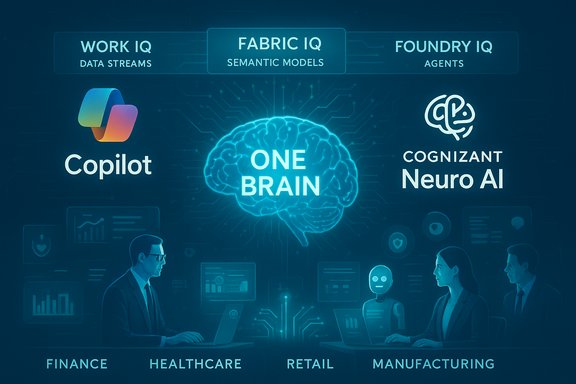
Cognizant’s Dec. 18, 2025 press release frames the pact as a deliberate shift from cloud and managed‑services collaboration toward industrializing generative and agentic AI inside large enterprises. The announcement ties Cognizant’s Neuro® AI Suite and several proprietary platforms — TriZetto, Skygrade and FlowSource™ — to Microsoft’s cloud, Copilot and the so‑called “IQ” intelligence layers (Work IQ, Fabric IQ, Foundry IQ), which Microsoft presents as the operational primitives required to put agents into production. This move is contemporaneous with a broader Microsoft partner and regional strategy: Microsoft has publicly committed US$17.5 billion for cloud, AI infrastructure and skilling in India, and positioned Cognizant alongside other large systems integrators in a coordinated Copilot-scale push that Microsoft says will exceed 200,000 Copilot licenses across its partners. Those headline figures were stated by Microsoft in public briefings and independently reported by major outlets. Treat the scale targets as commercial intent: license counts, activation timelines and revenue impact are commitments that require later verification through deployment metrics and customer case studies.
For enterprise architects and IT leaders, the announcement is an inflection point — a clear signal that the next wave of AI projects will be judged not on model accuracy alone but on how reliably and audibly models become part of everyday systems. Those who prepare with governance, semantic engineering, and a measured rollout plan will be best positioned to convert vendor promises into measurable business outcomes.
Source: TipRanks Cognizant and Microsoft expand partnership to co-build AI solutions - TipRanks.com
 Background
Cognizant’s Dec. 18, 2025 press release frames the pact as a deliberate shift from cloud and managed‑services collaboration toward industrializing generative and agentic AI inside large enterprises. The announcement ties Cognizant’s Neuro® AI Suite and several proprietary platforms — TriZetto, Skygrade and FlowSource™ — to Microsoft’s cloud, Copilot and the so‑called “IQ” intelligence layers (Work IQ, Fabric IQ, Foundry IQ), which Microsoft presents as the operational primitives required to put agents into production. This move is contemporaneous with a broader Microsoft partner and regional strategy: Microsoft has publicly committed US$17.5 billion for cloud, AI infrastructure and skilling in India, and positioned Cognizant alongside other large systems integrators in a coordinated Copilot-scale push that Microsoft says will exceed 200,000 Copilot licenses across its partners. Those headline figures were stated by Microsoft in public briefings and independently reported by major outlets. Treat the scale targets as commercial intent: license counts, activation timelines and revenue impact are commitments that require later verification through deployment metrics and customer case studies. What exactly did the partners announce?
- Co‑build: Joint product engineering to create verticalized, industry‑grade AI solutions that pair Microsoft’s cloud, Copilot and Azure AI Foundry with Cognizant’s domain IP and delivery frameworks.
- Co‑sell: A coordinated go‑to‑market and sales motion to pursue large enterprise deals globally in the named sectors.
- Embedded agentic AI: Intent to embed Microsoft 365 Copilot, GitHub Copilot and agentic actions built on Work IQ, Fabric IQ and Foundry IQ into mission‑critical workflows.
- Internal activation and skilling: Cognizant will scale Microsoft 365 Copilot and GitHub Copilot across delivery and consulting teams and upskill associates on Azure, Azure AI Foundry and related tooling.
- Platform integration: Cognizant will leverage TriZetto (payer workflows), Skygrade (risk/compliance scoring) and FlowSource™ (engineering modernization) as accelerators for sector‑specific solutions.
The technical spine — what are Work IQ, Fabric IQ and Foundry IQ?
The announcement centers on Microsoft’s emerging “IQ” stack. Understanding what these layers claim to provide clarifies why the partnership focuses on industrializing Copilot and agents.Work IQ (identity + context)
- Purpose: capture people‑ and role‑aware signals (mail, chat, files, calendar) and build identity‑bound memory so Copilot and agents can act with context and continuity.
- Practical value: reduces prompt friction, keeps multi‑step workflows coherent, and ties actions to appropriate permissions and authorizations.
- Caveat: value depends on correct data classification, permission hygiene and integration with enterprise governance controls.
Fabric IQ (semantic data layer)
- Purpose: create a shared semantic model of business entities (Customer, Order, Inventory) inside Microsoft Fabric/OneLake so agents operate on business meaning rather than raw tables.
- Practical value: enables agents to reason across analytics, time‑series and transactional systems with consistent semantics — critical for scenarios like supply‑chain orchestration or claims adjudication.
- Caveat: effectiveness depends on up‑front semantic modeling and connectors that keep the ontology synchronized with live operational systems.
Foundry IQ / Azure AI Foundry (grounding, routing, governance)
- Purpose: serve as a model catalogue, routing plane and managed knowledge grounding service that controls model selection, retrieval, observability and tenant isolation for agent runtimes.
- Practical value: provides the governance and observability enterprises demand for regulated workflows — audit trails, model choice, retrievability and policy enforcement.
- Caveat: enterprises must validate performance SLAs, observability fidelity and access controls in their own tenant environments.
Why this matters strategically
This partnership matters for three broad reasons:- Platform alignment and scale: Standardizing on Microsoft 365 + Azure reduces integration friction for clients on that stack and helps Cognizant package repeatable, Azure‑native AI solutions. Co‑selling with Microsoft brings prioritized go‑to‑market motion and potential access to Microsoft’s enterprise customers at scale.
- Last‑mile delivery: Enterprises repeatedly cite the “last‑mile” problem — pilots that don’t become production systems. Cognizant’s emphasis on Neuro® AI Suite and FlowSource™ is pitched as accelerators to take models into governed, monitored, production workflows. The recent agreement to acquire 3Cloud (announced Nov. 13, 2025) boosts Cognizant’s Azure engineering bench, making it more capable of delivering production‑grade Azure‑native AI systems.
- Commercial scale and regional strategy: Microsoft’s $17.5B commitment to India and coordinated partner activations (partners projected to exceed 200,000 Copilot seats collectively) create a commercial and geopolitical backdrop that accelerates demand for local delivery, sovereign processing and large licensing deals. These figures were reported by multiple outlets and reiterated in partner briefings. Treat them as strategic scale targets rather than immediate, fully realized activations.
Sector focus and use cases
The partnership explicitly prioritizes four verticals: Financial Services, Healthcare & Life Sciences, Retail and Manufacturing. Each has distinct drivers and constraints.Financial Services
- Opportunities: automation of reconciliation, compliance monitoring, risk scoring, and customer servicing via identity‑aware agents that understand contracts and regulatory rules.
- Constraints: strict data residency, auditability, model explainability and vendor due‑diligence in regulated jurisdictions.
- Practical note: integrating Fabric IQ ontologies with core banking systems and clearing houses will be non‑trivial and likely require staged rollouts.
Healthcare & Life Sciences
- Opportunities: payer workflows, claims adjudication and population health analytics (TriZetto is cited as a payer workflow accelerator).
- Constraints: HIPAA and equivalent privacy laws, clinical safety, and the need for medically validated outputs and provenance for any clinical recommendations.
- Practical note: proofs of concept will need rigorous validation and clinical review before production use.
Retail
- Opportunities: demand forecasting, inventory orchestration, customer personalization and contact center automation.
- Constraints: integrating point‑of‑sale, inventory, and e‑commerce data into a synchronized Fabric IQ ontology; latency for real‑time decisioning in omnichannel scenarios.
Manufacturing
- Opportunities: operations agents for supply‑chain orchestration, field‑service automation and predictive maintenance using streaming telemetry and Fabric IQ’s time‑series support.
- Constraints: OT/IT integration, safety and change‑management for control systems.
Strengths of the agreement
- Integrated stack approach: Combining Microsoft’s IQ layers with Cognizant’s vertical IP offers a coherent path from model to workflow, which many enterprises say they lack today.
- Scale and go‑to‑market muscle: Co‑selling with Microsoft gives Cognizant reach into enterprise accounts and Microsoft customers; conversely, Microsoft gains accelerators and a delivery partner that can operationalize Copilot at scale.
- Engineering capacity: The 3Cloud acquisition, when closed, will materially increase Cognizant’s Azure engineering bench and accelerate delivery of Azure‑native solutions — a tangible capability for production‑grade AI.
- Governance focus: The IQ stack explicitly addresses identity‑bound context, semantic grounding and model governance — the sort of guardrails that enterprises require for regulated use cases.
Risks, open questions and practical caveats
- Seat counts and timelines are promises, not instant metrics.
- Microsoft and partners announced ambitions to deploy tens of thousands of Copilot seats per partner (aggregate >200,000) and Microsoft’s $17.5B India package provides infrastructure and skilling context. These are material commitments but require later verification via usage reports and customer case studies.
- Data residency, export controls and cross‑border governance.
- Embedding Copilot into regulated workflows will force careful handling of connectors and in‑country processing options. Enterprises should demand contractual clarity on where inference and retrieval occur and what logs or telemetry are retained.
- Vendor lock‑in and portability.
- Heavy investment in Fabric IQ semantics and Foundry grounding may create migration friction. Organizations should plan for portability of ontologies, model artifacts and RAG indexes where possible.
- Model governance and auditability.
- The Foundry IQ control plane promises observability, but enterprises must validate the fidelity of telemetry (what is logged, retention, explainability) and be able to tie decisions to data provenance for audits and regulatory inquiries.
- Operational complexity and cost.
- Running agentic systems at scale involves new costs: inference, vector store operations, telemetry retention, and platform licensing. Pricing mechanics for agent runtime and Foundry services remain previewed in some materials; confirm commercial terms directly with Microsoft and partners.
- Security: short‑lived credentials and least privilege.
- Agents acting in workflows must use short‑lived credentials and central registries. Operational security teams need new runbooks for credentials, approvals and emergency revocation.
- Unknown financials on acquisitions.
- Cognizant’s announced acquisition of 3Cloud described personnel and capability additions but did not publicly disclose purchase price or integration timeline details; treat financial synergies as aspirational until filings disclose final terms.
Competitive context
Microsoft’s strategy of pairing large cloud investments (the $17.5B India commitment) with partner activations positions the company to convert infrastructure spending into recurring revenue through Copilot licensing, Azure consumption and partner‑led services. Other large systems integrators have taken similar postures with hyperscalers; the differentiator will be who can deliver repeatable vertical playbooks, measurable KPIs, and transparent governance. Cognizant’s investment in Azure depth via 3Cloud is a direct bet on that path.What IT leaders and architects should do now
- Inventory dependencies and data flows.
- Map where sensitive data lives, how it flows to Microsoft 365, OneLake, Fabric or external stores, and which endpoints agents will access.
- Validate governance features in a sandbox.
- Test Work IQ, Fabric IQ and Foundry IQ behaviors in a controlled tenant; verify identity‑binding, telemetry, and retrieval accuracy.
- Demand contractual clarity.
- For co‑sold solutions ask for SLAs around agent runtime, data residency assurances, telemetry access, and audit logs.
- Plan semantic modeling as infrastructure.
- Treat Fabric IQ ontologies as first‑class artifacts; design versioning, CI/CD and portability from day one.
- Start small, measure deeply.
- Pilot narrow, high‑value workflows (claims triage, invoice processing, field‑service dispatch) and instrument detailed success metrics before broader rollouts.
- Build a skills and change program.
- Upskilling developers and operators on Azure AI Foundry, model observability and Copilot Studio will determine how quickly pilots can scale safely.
- Prepare an exit and portability plan.
- Design migration paths for ontologies, vector stores and model artifacts to reduce lock‑in risk.
A pragmatic checklist for procurement and security teams
- Confirm where inference occurs for each connector (in‑country vs. global).
- Request model catalog visibility and an inventory of models used for your tenant.
- Require access to logs, audit trails and retrieval provenance.
- Insist on role‑based approvals for agent actions that can change state in core systems.
- Validate short‑lived credential patterns for agents and emergency revocation processes.
- Model a cost forecast that includes agent runtime, vector store costs and telemetry retention.
Conclusion
The Cognizant–Microsoft expansion is a consequential step in the shift from AI experimentation to operationalization. By stitching Cognizant’s vertical platforms and delivery scale to Microsoft’s Copilot and the IQ intelligence layers, the partners offer a credible pathway to build frontier firms — organizations that place agentic AI at the center of work. The partnership’s strengths are clear: integrated technical primitives, co‑sell scale, and increased Azure engineering capacity via the 3Cloud acquisition. At the same time, important caveats remain. Seat counts and big license targets are contractual intentions that need verification through activation metrics. Data residency, model governance, cost management and vendor portability are practical and legal risks that enterprise buyers must manage proactively. Finally, the operational success of this strategy will hinge less on marketing and more on execution: robust semantic modeling, airtight governance, observability in production and a pragmatic change program for people and processes.For enterprise architects and IT leaders, the announcement is an inflection point — a clear signal that the next wave of AI projects will be judged not on model accuracy alone but on how reliably and audibly models become part of everyday systems. Those who prepare with governance, semantic engineering, and a measured rollout plan will be best positioned to convert vendor promises into measurable business outcomes.
Source: TipRanks Cognizant and Microsoft expand partnership to co-build AI solutions - TipRanks.com
