

Cohesity’s recent announcement that its partnership with Microsoft has deepened across Azure, Microsoft 365, and Microsoft Security marks a consequential step in the industry’s push to couple data resilience with generative AI capabilities—an initiative the vendor says produced near‑term commercial momentum and practical customer outcomes.
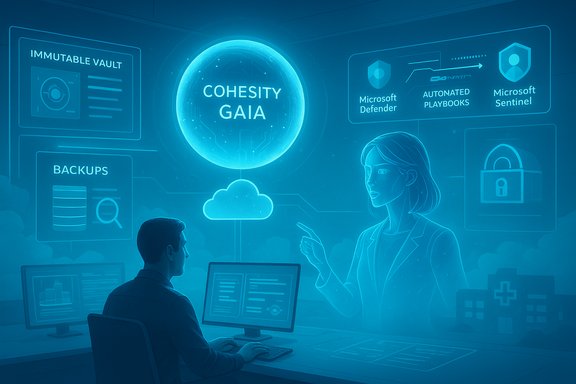
Cohesity and Microsoft have broadened both technical integrations and go‑to‑market activity, presenting a combined value proposition that links enterprise backup, immutable vaulting, and AI‑driven search and detection. The announcement highlights expanded use of Azure OpenAI, Microsoft 365 Copilot, Microsoft Sentinel, and Microsoft Defender as foundational elements of Cohesity’s AI and threat‑detection workflows.
Behind the headlines, Cohesity frames the collaboration as responding to three simultaneous market pressures: a continuing ransomware threat landscape, enterprises’ rapid cloud migration to Azure, and growing expectations that generative AI should extract operational value from secondary data (backups, archives, file shares). This context explains why backup vendors are repositioning from passive vaults to active security and intelligence platforms.
Key implementation notes:
Caveats and verification:
Buyers should expect competitors to accelerate similar offerings, increasing the emphasis on technical differentiation (model governance, immutable vault architecture, recovery verification speed) and commercial clarity (transparent pricing for inference and Copilot usage, exportability guarantees).
That said, the most consequential claims in the announcement—Marketplace growth and co‑sell multipliers—are company‑reported and should be validated with joint Microsoft data or anonymized deal evidence when they influence procurement decisions. Operational realities—RTO impacts from verification, AI governance requirements, and layered licensing costs—remain the practical gatekeepers to realizing the vendor‑promised value. Prospective buyers and IT leaders should combine strategic pilots, contractual SLA negotiation, and rigorous governance testing before scaling these integrations broadly.
Source: SecurityBrief Asia Cohesity & Microsoft deepen AI-driven data security & growth
 Background
Cohesity and Microsoft have broadened both technical integrations and go‑to‑market activity, presenting a combined value proposition that links enterprise backup, immutable vaulting, and AI‑driven search and detection. The announcement highlights expanded use of Azure OpenAI, Microsoft 365 Copilot, Microsoft Sentinel, and Microsoft Defender as foundational elements of Cohesity’s AI and threat‑detection workflows.Behind the headlines, Cohesity frames the collaboration as responding to three simultaneous market pressures: a continuing ransomware threat landscape, enterprises’ rapid cloud migration to Azure, and growing expectations that generative AI should extract operational value from secondary data (backups, archives, file shares). This context explains why backup vendors are repositioning from passive vaults to active security and intelligence platforms.
What the announcement actually says
Cohesity’s public remarks and the accompanying partner messaging made four headline claims:- Nearly 200% year‑over‑year growth in sales through the Microsoft Marketplace during the company’s fiscal year 2025.
- More than a tenfold increase in joint co‑selling engagements year‑on‑year.
- Deeper product integrations that leverage Azure OpenAI (Foundry Models), Microsoft Copilot Studio, Sentinel, and Defender, and the launch/expansion of AI‑enabled features such as Cohesity Gaia for legal, compliance, and security workflows.
- A named healthcare customer, Bethany Children’s Health Center, as a practical example of the combined solution improving anomaly detection, PHI/PII classification, and ransomware recovery.
Technical integrations and product highlights
Cohesity Gaia and Copilot connectivity
At the center of the technical messaging is Cohesity Gaia, an AI assistant that indexes secondary data (backups, archives, file systems) and exposes that content via natural‑language search, classification, and automation workflows. The Gaia integration into Microsoft 365 Copilot is positioned to let knowledge workers and security/legal teams query backup artifacts directly inside Copilot‑driven interfaces, using Retrieval‑Augmented Generation (RAG) patterns and role‑based access control.Key implementation notes:
- Indexing includes emails, documents and spreadsheets found in backup snapshots.
- Role‑based access control and sensitivity label enforcement are required to limit exposure.
Threat detection, Sentinel and Defender integration
Cohesity’s product suite—DataProtect, Threat Protection, SmartFiles, and FortKnox (air‑gapped vaulting)—is stated to interoperate with Microsoft Sentinel and Microsoft Defender for SIEM enrichment, automated playbooks, and cross‑tool incident orchestration. Exported Cohesity alerts and anomaly scores can be consumed in Sentinel for correlation with endpoint and mail signals, enabling end‑to‑end detection-to-recovery automation.Azure native deployment and Foundry routing
Cohesity’s messaging emphasizes running services on Azure, leveraging Azure native protections and optionally routing inference through Azure OpenAI/Foundry models when customers require Microsoft‑hosted LLM inference and governance. This supports scenarios where model lineage, telemetry, and data residency are key compliance factors.Real‑world example: healthcare case study
Bethany Children’s Health Center (BCHC) in Oklahoma is presented as a production customer that migrated to Cohesity on Azure and used the integrated stack to:- Improve anomaly detection and early flags for suspicious behavior.
- Prevent data compromise through immutable backups and vaulting.
- Accelerate ransomware recovery via AI‑scanned, verified restore points.
- Enhance compliance posture using PHI/PII classification dashboards and audit workflows.
Market and GTM momentum: reading the numbers with care
Cohesity’s reported Marketplace growth (~200%) and 10× co‑sell engagement increase are striking headline metrics that signal momentum inside Microsoft’s ecosystem. Microsoft’s co‑sell and Marketplace incentives can accelerate time‑to‑purchase for ISVs with transactable listings and private offers—so vendor claims of outsized Marketplace growth are plausible given macro trends.Caveats and verification:
- These figures are company‑reported and presented as directional evidence of traction. Independent, third‑party verification (e.g., anonymized joint deal counts, Microsoft partner dashboards) is not included in the public announcement. Procurement and technical teams should request dated, auditable evidence when these metrics are used in vendor selection or contract negotiation.
Strengths and strategic upside
- Platform breadth with AI focus: Cohesity combines backup, immutable third‑copy vaulting, and an AI envelope (Gaia) that turns backup data into searchable, actionable assets—this is a meaningful evolution away from passive archiving.
- Deep Azure alignment: Running on Azure and integrating with Sentinel and Defender reduces friction for Azure‑centric enterprises and simplifies procurement via Microsoft Marketplace. These are tangible operational advantages for customers already committed to Microsoft cloud services.
- Vertical traction: Having healthcare references and a large installed base (13,000+ organizations, strong Fortune Global 500 exposure) provides confidence for enterprise buyers concerned about scale and vendor viability—especially after Cohesity’s broader consolidation activity.
- Operational value of secondary data: By making backup stores searchable and governance‑aware, organizations can extract legal, compliance, and intelligence value from data that was previously dormant. This can shorten investigations, accelerate discovery, and reduce manual audit workloads.
Key risks, limitations, and governance concerns
- Company‑reported metrics need corroboration: The Marketplace and co‑sell growth numbers paint a positive momentum story, but independent verification is limited in public materials; treat these metrics as vendor‑reported and verify with Microsoft or anonymized deal data when contracting.
- AI governance and hallucination risk: Any LLM‑enabled layer that synthesizes backup content requires strict governance: model lineage tracking, RAG source controls, prompt logging, red‑team testing, and human‑in‑the‑loop approval for high‑impact outputs. Copilot integrations are powerful but introduce prompt‑injection and data‑exposure vectors that must be mitigated through label enforcement and DLP.
- Restore‑time tradeoffs: AI‑scanning and IOC/malware verification of candidate restore points increases confidence but can extend Recovery Time Objectives (RTOs). Organizations must define and validate RTOs that include verification times in live drills.
- Cost and licensing complexity: Combining Microsoft 365 Copilot licensing, Azure OpenAI/Foundry inference costs, Copilot Studio agent usage, plus Cohesity subscriptions multiplies cost drivers. Customers must evaluate three‑year TCO models that include model inference and Copilot credits.
- Operational complexity and potential lock‑in: High‑value agentic workflows built on Copilot Studio plus Cohesity Gaia indexes can create operational dependencies. Buyers should request exportability guarantees, documented APIs, and handover plans as part of SaaS or managed services contracts.
Practical checklist for IT decision‑makers
To evaluate Cohesity + Microsoft in a real environment, follow a focused, evidence‑based approach:- Run a scoped proof‑of‑concept that includes:
- End‑to‑end restore tests under realistic RTO constraints.
- A Copilot‑enabled query using Gaia to validate grounding, citation, and RBAC enforcement.
- Ask vendors for contractual SLAs and telemetry:
- Restore time windows that explicitly account for verification/scanning.
- Data residency, prompt log retention, and model lineage transparency.
- Validate governance and DLP:
- Demonstrate Purview‑style label enforcement and DLP blocking of Copilot processing for regulated data classes.
- Get joint proof points for GTM claims:
- Request anonymized co‑sell deal counts or a Microsoft partner contact who can confirm co‑sell status and private offer outcomes.
- Produce a three‑year TCO that includes:
- Copilot seat costs, Azure model inference (Foundry) estimates, and any managed services fees.
- Conduct security validation:
- Perform red‑team testing that includes model outputs and agentic workflows. Ensure human review for any actions that touch production systems.
Implementation patterns and operational best practices
- Start small and stage adoption: pilot the Copilot‑Gaia workflow in a non‑production legal or compliance use case to validate RBAC and grounding before expanding to security‑critical scenarios.
- Treat verification as part of the RTO: include AI‑scan and malware verification time in recovery playbooks and tabletop exercises. This prevents surprises when an actual restore is required.
- Insist on auditable trails: require evidence of which backup snapshot fragments contributed to any generated answer from Gaia or Copilot, and log model prompts, inferences, and index locations for audits.
- Budget for inference: model routing to Foundry or other high‑cost inference engines must be forecasted and monitored. Implement guardrails to limit expensive model calls for routine queries.
Competitive and ecosystem implications
Cohesity’s moves reflect a broader market trend where backup vendors seek to monetize secondary data through AI and integrate recovery tools into the security operations stack. This blurs traditional lines between backup and detection/response vendors and raises the bar for integrated, vendor‑aligned offerings inside large cloud ecosystems. Microsoft’s marketplace push and co‑sell incentives are accelerating this dynamic by making procurement and joint selling more attractive for ISVs.Buyers should expect competitors to accelerate similar offerings, increasing the emphasis on technical differentiation (model governance, immutable vault architecture, recovery verification speed) and commercial clarity (transparent pricing for inference and Copilot usage, exportability guarantees).
Final assessment
Cohesity’s partnership deepening with Microsoft is an important, pragmatic step toward making backups both safer and more useful in an era dominated by ransomware and demand for AI‑driven insights. The combination of immutable backups, AI‑scanned restore points, and Copilot‑enabled search addresses clear customer pain points: faster identification of incidents, better compliance workflows, and verified restores that reduce business disruption.That said, the most consequential claims in the announcement—Marketplace growth and co‑sell multipliers—are company‑reported and should be validated with joint Microsoft data or anonymized deal evidence when they influence procurement decisions. Operational realities—RTO impacts from verification, AI governance requirements, and layered licensing costs—remain the practical gatekeepers to realizing the vendor‑promised value. Prospective buyers and IT leaders should combine strategic pilots, contractual SLA negotiation, and rigorous governance testing before scaling these integrations broadly.
Conclusion
The Cohesity‑Microsoft story is a case study in how cloud platform partnerships are reshaping enterprise data protection: backup is becoming a proactive, AI‑enabled layer in security operations rather than a passive vault. For organizations committed to Azure and Microsoft 365, the tighter integrations—when validated through POC, contractual SLAs, and governance checks—can reduce risk and unlock practical benefits from previously dormant backup data. Yet, the path to value requires disciplined verification: audit trails, RTO testing that includes verification phases, model governance, and transparent cost modeling to ensure that the promise of faster, safer, and smarter recovery becomes a repeatable operational reality rather than a hopeful projection.Source: SecurityBrief Asia Cohesity & Microsoft deepen AI-driven data security & growth
