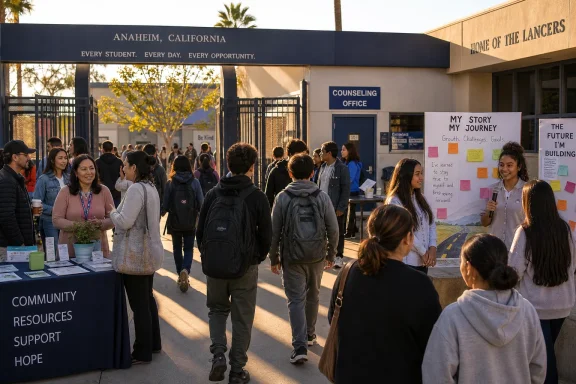
Psychology Today published a May 2026 interview with retiring Dale Junior High School principal Rafael Santiago in Anaheim, California, describing how his campus uses the community-school model to support students’ academics, mental health, family needs, after-school life, and sense of belonging. The most important part of the story is not that a school added services. It is that Santiago describes the school as civic infrastructure, a place where academics cannot be separated from housing stress, anxiety, family access, and whether a child believes adults are still betting on them. In a moment when public education is often measured by dashboards, Dale’s argument is stubbornly human: the operating system of a school is trust.
The interview’s plainest sentence may also be its most radical: students “don’t leave life at the front gate.” That sounds obvious until you consider how much of American schooling is built around pretending the opposite. Attendance systems, grading policies, assessment calendars, and discipline procedures all tend to assume that the child who arrives at 8 a.m. is a clean academic endpoint, ready to be measured.
Santiago’s view is that this assumption is operationally false. Students arrive with anxiety, family stress, responsibilities, isolation, and unmet needs that may not appear in a lesson plan but can determine whether the lesson lands at all. A community school, in his telling, is not a sentimental add-on to real schooling. It is an attempt to stop designing schools around an imaginary student.
That distinction matters because Dale Junior High is not being described as a boutique experiment for families already rich in options. It is a public junior high in Anaheim Union High School District, serving grades seven and eight in a community where many families face real economic pressure. The community-school model is therefore not merely a nicer version of school; it is a practical response to the conditions under which learning actually happens.
The phrase Santiago returns to is “one student, one story, one family at a time.” It could sound like branding if it were not attached to such concrete work: wellness supports, family resources, after-school programs, partnerships, and student voice. The throughline is that Dale’s staff has tried to make connection repeatable, not accidental.
That is a useful lesson for IT pros and systems thinkers, even outside education. Institutions often mistake scale for abstraction. Dale’s model suggests the opposite: scale comes from making individualized attention part of the system rather than a heroic exception to it.
Santiago’s answers keep pulling the frame wider. He talks about anxiety, stress, isolation, family access, and belonging. He talks about families not always knowing where to go for help. He talks about students needing to see that they have grown before they can believe they are capable of more.
That is the philosophical center of the piece. A community school does not say academics are unimportant. It says academics are fragile when the surrounding support structure is weak. The question is not whether a school should teach math and reading or help families navigate basic needs. The question is whether pretending those are separate systems has been working.
For decades, schools have been asked to solve social problems while being scolded for acknowledging them. Community schools make that contradiction explicit. If policymakers expect campuses to raise achievement in communities facing poverty, instability, trauma, and limited access to services, then schools need the authority and partnerships to address those realities.
Santiago is careful not to present Dale as a social-service agency wearing a school badge. His definition starts with relationships and belonging, not paperwork. But that is precisely what makes the model interesting. It is not a referral factory; it is a trust engine.
At Dale, listening appears to have served a different function. It was diagnostic. Staff asked students, families, and colleagues what they were experiencing, what they needed, and what was getting in the way. That kind of listening is not public relations; it is requirements gathering.
The tech analogy is imperfect but useful. Bad systems fail when designers build for the user they wish they had. Good systems begin by observing the user they actually serve. Santiago’s community-school approach works from that premise: understand the friction first, then build around it.
This is also why his answer about strengths matters. He says Dale tried to build on the resilience and potential families already bring, rather than defining them by what is missing. That is not just kinder language. It changes the posture of the institution.
A deficit model turns families into cases to be managed. A strengths model turns families into partners who may need access, translation, confidence, time, or a trusted doorway. The difference is subtle in a mission statement and enormous at the front desk.
The point is not merely presentation practice. Santiago argues that when students narrate their own growth, they begin to see themselves differently. That is a profound claim because it treats identity as part of academic development, not as decoration around it.
Middle school is a particularly volatile time for that work. Seventh and eighth graders are old enough to absorb institutional labels and young enough to be reshaped by them. A student who has internalized failure may not respond to another worksheet, another warning, or another score report. But a structured opportunity to say, “I have changed,” can create a different kind of evidence.
That does not mean reflection replaces rigor. It means rigor without reflection can leave students unable to recognize their own progress. In the adult world, we take this for granted. Professionals build portfolios, write performance reviews, maintain résumés, and narrate career growth in interviews. LancerX gives adolescents a version of that civic and professional muscle earlier.
There is also a democratic argument here. Students who can speak about their learning are less dependent on institutions to define them. They become witnesses to their own development. For young people at the margins, that is not a soft skill. It is power.
This is the part of school reform that resists easy procurement. A district can buy software, contract services, adopt curriculum, and announce initiatives on a predictable timeline. Trust operates on a different clock. It is cumulative, local, and vulnerable to being destroyed by one bad interaction.
That makes it difficult to measure but impossible to ignore. Families who distrust a school may avoid asking for help until a problem has escalated. Students who do not feel known may interpret discipline as rejection rather than correction. Partners who do not understand the campus culture may deliver services that technically exist but practically go unused.
Santiago’s point is that access is not just a matter of availability. A resource that families are afraid or embarrassed to use is not fully accessible. A counselor, pantry, wellness program, or after-school opportunity becomes meaningful only when families believe the institution offering it will treat them with dignity.
This is where the community-school model becomes more demanding than its warm language suggests. It requires schools to audit every interaction for relational cost. The office greeting, the phone call home, the translation process, the meeting tone, the follow-up after a crisis — all of these become part of the intervention.
Most communities have organizations that want to help children. The harder problem is alignment. Schools are busy, partners have their own mandates, and families can experience outside help as fragmented or intimidating. Santiago’s approach was to give partners a real entry point into the life of the campus.
That changes the relationship. A partner who sees students, meets staff, and understands the atmosphere is less likely to treat the school as just another service location. The work becomes relational before it becomes programmatic.
It also protects the school from initiative clutter. Every principal knows the danger of well-intentioned programs that arrive with posters, binders, and acronyms but no lasting integration into campus life. Dale’s model, as Santiago describes it, seems to begin with culture and then absorb partners into that culture.
That order matters. If the school has no coherent purpose, partners can become a patchwork. If the school has a strong relational center, partners can extend the mission rather than dilute it.
Families may not use services because they do not know they exist, because the process is confusing, because language barriers intervene, because work schedules make participation difficult, or because previous experiences with institutions have taught them caution. None of that means they do not care. It means the system has made care hard to express.
Dale’s community-school work appears to treat access as a design problem. If families need support but do not know where to go, the school becomes a trusted connector. If students need wellness help but do not know how to ask, the campus culture lowers the threshold. If partners want to help but lack a doorway, the school creates one.
This reframing is especially important in public debates about education. The rhetoric around struggling schools often implies that families need to value education more. Santiago’s account points in the other direction: many families value education deeply but are navigating barriers that the school system did not design itself to see.
A community school does not solve every structural inequality. It cannot make housing affordable, wages higher, or healthcare universally accessible. But it can refuse to let those external problems remain invisible until they show up as absences, suspensions, or failing grades.
That is not a slogan. It is a governance claim. It means the school’s responsibilities cannot be defined only by the narrowest academic inputs if the expected outcomes depend on broader human conditions.
The hard part is that this view complicates management. A school that takes whole-family needs seriously must coordinate across counseling, teaching, administration, community partnerships, after-school programming, and family engagement. It must avoid silos. It must decide what belongs on campus, what belongs with partners, and what exceeds the school’s capacity.
Santiago does not pretend this is easy. His advice to other principals is to start with people before programs and to listen a lot. That is less a roadmap than a warning. The community-school model cannot be dropped onto a campus like a software update.
It has to be grown through culture. Teachers, counselors, staff, families, and partners must feel connected to the same purpose. Without that shared purpose, the model risks becoming a directory of services rather than a community.
This is the paradox of strong school leadership. The people who transform institutions often do so through presence, consistency, and personal credibility. But the deeper test of leadership is whether the work becomes durable enough to outlast the leader.
Santiago’s own language suggests he understands that. He does not describe himself as the program. He describes a vision, a campus culture, a set of relationships, a student capstone, and a partnership model. Those are the pieces that can become institutional memory if the district protects them.
Still, transitions are risky. A new principal can inherit the vocabulary of community schooling without the habits that make it real. Partners can drift. Staff can revert to silos. Families can wait to see whether the welcome they experienced was tied to one person or embedded in the school itself.
That is why Santiago’s retirement should not be read only as a farewell. It is a stress test. If Dale’s approach continues, it will show that hope and connection were not merely personality traits at the top but operating principles distributed across the campus.
In that environment, the community-school model offers a more coherent theory than many reform packages. It says students learn inside ecosystems. Strengthen the ecosystem and academic work has a better chance. Ignore the ecosystem and the school will spend its energy treating symptoms.
For WindowsForum readers, the connection may seem indirect, but it is not. Many of this community’s members run systems that only work when identity, access, support, security, and user experience are aligned. Education faces a human version of the same architecture problem. You cannot optimize the endpoint while ignoring the network.
The comparison should not be stretched too far. Children are not devices, families are not tickets, and schools are not platforms in the Silicon Valley sense. But the systems lesson holds: fragmented support creates failure modes that look like individual noncompliance until someone maps the whole environment.
Santiago’s interview is valuable because it maps that environment without drowning it in jargon. Students need belonging. Families need trust. Partners need entry points. Staff need shared purpose. Reflection helps students claim growth. None of this is mysterious, but much of it is absent from how schools are judged.
Santiago’s answers argue against that kind of imitation. He says start with people before programs. He says listen. He says avoid silos. He says culture comes first. These are not decorative implementation notes; they are the implementation.
The temptation for policymakers will be to treat community schools as a scalable package. Some parts are scalable, of course. Funding streams, staffing models, partnership agreements, wellness supports, and after-school programs all require structure. But the living part of the model depends on whether families experience the school as a place that genuinely cares about their child.
That cannot be faked for long. Families are expert readers of institutional tone. Students are even better. They know when adults are performing concern and when adults are practicing it.
The lesson from Dale is therefore both inspiring and inconvenient. Community schooling works only if the school is willing to change how it sees its own job. It must become less obsessed with guarding the boundary between academic and nonacademic needs, and more serious about the conditions that make academic growth possible.
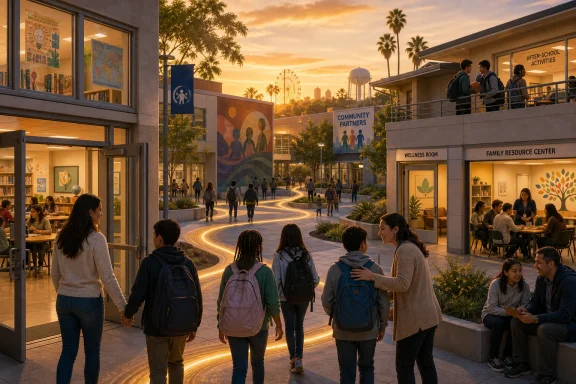 Dale Junior High Treats Belonging as a Core Service
The interview’s plainest sentence may also be its most radical: students “don’t leave life at the front gate.” That sounds obvious until you consider how much of American schooling is built around pretending the opposite. Attendance systems, grading policies, assessment calendars, and discipline procedures all tend to assume that the child who arrives at 8 a.m. is a clean academic endpoint, ready to be measured.Santiago’s view is that this assumption is operationally false. Students arrive with anxiety, family stress, responsibilities, isolation, and unmet needs that may not appear in a lesson plan but can determine whether the lesson lands at all. A community school, in his telling, is not a sentimental add-on to real schooling. It is an attempt to stop designing schools around an imaginary student.
That distinction matters because Dale Junior High is not being described as a boutique experiment for families already rich in options. It is a public junior high in Anaheim Union High School District, serving grades seven and eight in a community where many families face real economic pressure. The community-school model is therefore not merely a nicer version of school; it is a practical response to the conditions under which learning actually happens.
The phrase Santiago returns to is “one student, one story, one family at a time.” It could sound like branding if it were not attached to such concrete work: wellness supports, family resources, after-school programs, partnerships, and student voice. The throughline is that Dale’s staff has tried to make connection repeatable, not accidental.
That is a useful lesson for IT pros and systems thinkers, even outside education. Institutions often mistake scale for abstraction. Dale’s model suggests the opposite: scale comes from making individualized attention part of the system rather than a heroic exception to it.
The Community-School Model Is a Rejection of the Single-Variable School
The modern school accountability machine loves single-variable explanations. If test scores are low, improve instruction. If attendance dips, tighten enforcement. If behavior worsens, revise discipline. Each of these may matter, but none of them is sufficient when the student’s real bottleneck is outside the neat boundary of the classroom.Santiago’s answers keep pulling the frame wider. He talks about anxiety, stress, isolation, family access, and belonging. He talks about families not always knowing where to go for help. He talks about students needing to see that they have grown before they can believe they are capable of more.
That is the philosophical center of the piece. A community school does not say academics are unimportant. It says academics are fragile when the surrounding support structure is weak. The question is not whether a school should teach math and reading or help families navigate basic needs. The question is whether pretending those are separate systems has been working.
For decades, schools have been asked to solve social problems while being scolded for acknowledging them. Community schools make that contradiction explicit. If policymakers expect campuses to raise achievement in communities facing poverty, instability, trauma, and limited access to services, then schools need the authority and partnerships to address those realities.
Santiago is careful not to present Dale as a social-service agency wearing a school badge. His definition starts with relationships and belonging, not paperwork. But that is precisely what makes the model interesting. It is not a referral factory; it is a trust engine.
Listening Became the First Implementation Step
One of the more revealing parts of Santiago’s interview is that he does not begin with a grant, a committee, or a shiny program name. He says the first step was listening. That answer is easy to underestimate because every institution claims to listen, usually after it has already decided what it wants to do.At Dale, listening appears to have served a different function. It was diagnostic. Staff asked students, families, and colleagues what they were experiencing, what they needed, and what was getting in the way. That kind of listening is not public relations; it is requirements gathering.
The tech analogy is imperfect but useful. Bad systems fail when designers build for the user they wish they had. Good systems begin by observing the user they actually serve. Santiago’s community-school approach works from that premise: understand the friction first, then build around it.
This is also why his answer about strengths matters. He says Dale tried to build on the resilience and potential families already bring, rather than defining them by what is missing. That is not just kinder language. It changes the posture of the institution.
A deficit model turns families into cases to be managed. A strengths model turns families into partners who may need access, translation, confidence, time, or a trusted doorway. The difference is subtle in a mission statement and enormous at the front desk.
LancerX Turns Reflection Into a Public Skill
The most distinctive detail in the interview is Dale’s capstone experience, LancerX. Santiago describes it as a moment when students reflect on their growth, share their learning, and tell their story out loud. In a school culture often dominated by grades and standardized performance, that is a different kind of assessment.The point is not merely presentation practice. Santiago argues that when students narrate their own growth, they begin to see themselves differently. That is a profound claim because it treats identity as part of academic development, not as decoration around it.
Middle school is a particularly volatile time for that work. Seventh and eighth graders are old enough to absorb institutional labels and young enough to be reshaped by them. A student who has internalized failure may not respond to another worksheet, another warning, or another score report. But a structured opportunity to say, “I have changed,” can create a different kind of evidence.
That does not mean reflection replaces rigor. It means rigor without reflection can leave students unable to recognize their own progress. In the adult world, we take this for granted. Professionals build portfolios, write performance reviews, maintain résumés, and narrate career growth in interviews. LancerX gives adolescents a version of that civic and professional muscle earlier.
There is also a democratic argument here. Students who can speak about their learning are less dependent on institutions to define them. They become witnesses to their own development. For young people at the margins, that is not a soft skill. It is power.
Trust Is the Slow Technology Nobody Wants to Fund
Santiago’s answer on family trust is almost defiantly unglamorous. Trust, he says, does not happen quickly. It is built through small moments: conversations, phone calls, showing up, following through, and making families feel welcomed rather than judged.This is the part of school reform that resists easy procurement. A district can buy software, contract services, adopt curriculum, and announce initiatives on a predictable timeline. Trust operates on a different clock. It is cumulative, local, and vulnerable to being destroyed by one bad interaction.
That makes it difficult to measure but impossible to ignore. Families who distrust a school may avoid asking for help until a problem has escalated. Students who do not feel known may interpret discipline as rejection rather than correction. Partners who do not understand the campus culture may deliver services that technically exist but practically go unused.
Santiago’s point is that access is not just a matter of availability. A resource that families are afraid or embarrassed to use is not fully accessible. A counselor, pantry, wellness program, or after-school opportunity becomes meaningful only when families believe the institution offering it will treat them with dignity.
This is where the community-school model becomes more demanding than its warm language suggests. It requires schools to audit every interaction for relational cost. The office greeting, the phone call home, the translation process, the meeting tone, the follow-up after a crisis — all of these become part of the intervention.
Partners Come When the Campus Has a Real Doorway
Santiago says community partners were not persuaded with a hard sell. They were invited in. That answer is deceptively important because it suggests Dale’s partnerships were built around proximity and purpose rather than institutional transaction.Most communities have organizations that want to help children. The harder problem is alignment. Schools are busy, partners have their own mandates, and families can experience outside help as fragmented or intimidating. Santiago’s approach was to give partners a real entry point into the life of the campus.
That changes the relationship. A partner who sees students, meets staff, and understands the atmosphere is less likely to treat the school as just another service location. The work becomes relational before it becomes programmatic.
It also protects the school from initiative clutter. Every principal knows the danger of well-intentioned programs that arrive with posters, binders, and acronyms but no lasting integration into campus life. Dale’s model, as Santiago describes it, seems to begin with culture and then absorb partners into that culture.
That order matters. If the school has no coherent purpose, partners can become a patchwork. If the school has a strong relational center, partners can extend the mission rather than dilute it.
The Interview Is Really About Access, Not Charity
There is a quiet but crucial line in Santiago’s answer about family needs: for some families, the issue was not willingness but access. That distinction should be printed above the entrance of every public agency in America. Too often, institutions mistake nonparticipation for indifference.Families may not use services because they do not know they exist, because the process is confusing, because language barriers intervene, because work schedules make participation difficult, or because previous experiences with institutions have taught them caution. None of that means they do not care. It means the system has made care hard to express.
Dale’s community-school work appears to treat access as a design problem. If families need support but do not know where to go, the school becomes a trusted connector. If students need wellness help but do not know how to ask, the campus culture lowers the threshold. If partners want to help but lack a doorway, the school creates one.
This reframing is especially important in public debates about education. The rhetoric around struggling schools often implies that families need to value education more. Santiago’s account points in the other direction: many families value education deeply but are navigating barriers that the school system did not design itself to see.
A community school does not solve every structural inequality. It cannot make housing affordable, wages higher, or healthcare universally accessible. But it can refuse to let those external problems remain invisible until they show up as absences, suspensions, or failing grades.
The Whole-Child Argument Has Become a Governance Argument
“Whole child” is one of those education phrases that has been softened by overuse. Santiago gives it sharper edges. If a district believes in the whole child, he says, it cannot ignore the whole child.That is not a slogan. It is a governance claim. It means the school’s responsibilities cannot be defined only by the narrowest academic inputs if the expected outcomes depend on broader human conditions.
The hard part is that this view complicates management. A school that takes whole-family needs seriously must coordinate across counseling, teaching, administration, community partnerships, after-school programming, and family engagement. It must avoid silos. It must decide what belongs on campus, what belongs with partners, and what exceeds the school’s capacity.
Santiago does not pretend this is easy. His advice to other principals is to start with people before programs and to listen a lot. That is less a roadmap than a warning. The community-school model cannot be dropped onto a campus like a software update.
It has to be grown through culture. Teachers, counselors, staff, families, and partners must feel connected to the same purpose. Without that shared purpose, the model risks becoming a directory of services rather than a community.
Retirement Turns a Leadership Story Into a Sustainability Test
The article’s emotional hook is Santiago’s retirement. For Dale families and staff, that makes the story personal. For everyone else, it raises the central institutional question: can a culture built under a charismatic principal survive the principal’s departure?This is the paradox of strong school leadership. The people who transform institutions often do so through presence, consistency, and personal credibility. But the deeper test of leadership is whether the work becomes durable enough to outlast the leader.
Santiago’s own language suggests he understands that. He does not describe himself as the program. He describes a vision, a campus culture, a set of relationships, a student capstone, and a partnership model. Those are the pieces that can become institutional memory if the district protects them.
Still, transitions are risky. A new principal can inherit the vocabulary of community schooling without the habits that make it real. Partners can drift. Staff can revert to silos. Families can wait to see whether the welcome they experienced was tied to one person or embedded in the school itself.
That is why Santiago’s retirement should not be read only as a farewell. It is a stress test. If Dale’s approach continues, it will show that hope and connection were not merely personality traits at the top but operating principles distributed across the campus.
Anaheim’s Lesson Travels Further Than Anaheim
It would be easy to file this story under local education and move on. That would miss why it resonates. The Dale interview captures a national tension: schools are being asked to produce academic recovery, mental-health support, family engagement, attendance improvement, and workforce readiness while public trust in institutions remains brittle.In that environment, the community-school model offers a more coherent theory than many reform packages. It says students learn inside ecosystems. Strengthen the ecosystem and academic work has a better chance. Ignore the ecosystem and the school will spend its energy treating symptoms.
For WindowsForum readers, the connection may seem indirect, but it is not. Many of this community’s members run systems that only work when identity, access, support, security, and user experience are aligned. Education faces a human version of the same architecture problem. You cannot optimize the endpoint while ignoring the network.
The comparison should not be stretched too far. Children are not devices, families are not tickets, and schools are not platforms in the Silicon Valley sense. But the systems lesson holds: fragmented support creates failure modes that look like individual noncompliance until someone maps the whole environment.
Santiago’s interview is valuable because it maps that environment without drowning it in jargon. Students need belonging. Families need trust. Partners need entry points. Staff need shared purpose. Reflection helps students claim growth. None of this is mysterious, but much of it is absent from how schools are judged.
The Risk Is Turning Community Schooling Into Another Checkbox
Every successful education idea faces the same danger once it gains attention: replication without soul. A district sees a model that works, extracts the visible components, and mandates them elsewhere. Suddenly there is a community-school coordinator, a family-resource night, a partner spreadsheet, and a student-presentation event — but not necessarily trust.Santiago’s answers argue against that kind of imitation. He says start with people before programs. He says listen. He says avoid silos. He says culture comes first. These are not decorative implementation notes; they are the implementation.
The temptation for policymakers will be to treat community schools as a scalable package. Some parts are scalable, of course. Funding streams, staffing models, partnership agreements, wellness supports, and after-school programs all require structure. But the living part of the model depends on whether families experience the school as a place that genuinely cares about their child.
That cannot be faked for long. Families are expert readers of institutional tone. Students are even better. They know when adults are performing concern and when adults are practicing it.
The lesson from Dale is therefore both inspiring and inconvenient. Community schooling works only if the school is willing to change how it sees its own job. It must become less obsessed with guarding the boundary between academic and nonacademic needs, and more serious about the conditions that make academic growth possible.
Dale’s Real Inheritance Is a Different Definition of School
The concrete takeaways from Santiago’s interview are less about copying Dale and more about adopting its logic. The school’s work matters because it turns “support” from a peripheral service into part of the academic mission.- A community school begins by assuming students bring their lives with them, and that learning improves when those realities are acknowledged rather than ignored.
- Family engagement depends on trust built through repeated ordinary interactions, not just events, announcements, or emergency meetings.
- Community partners are most useful when they are integrated into a school’s culture and purpose instead of bolted on as disconnected services.
- Student voice becomes more powerful when students are asked to reflect publicly on growth, identity, and learning rather than merely receive scores.
- The model’s hardest challenge after Santiago’s retirement will be preserving the habits of belonging, listening, and follow-through that made the work credible.
References
- Primary source: Psychology Today
Published: Mon, 01 Jun 2026 12:06:53 GMT
A School Can Serve an Entire Community | Psychology Today Australia
Principal Rafael Santiago on how a school can address the needs of entire families.www.psychologytoday.com - Related coverage: greatschools.org
Dale Junior High School - Anaheim, California - CA | GreatSchools
Dale Junior High School is a public school in Anaheim, CA, offering a Gifted & Talented program. It is one of 12 middle schools in Anaheim Union High School District.www.greatschools.org - Related coverage: ed-data.org
- Related coverage: high-schools.com
- Related coverage: studentambassadors.org
Dale Junior High
Dale Junior High is part of Anaheim Union High in Orange County. Dale Junior High offers grades 7 to 8 and is a Middle School. The address is 900 South Dale St, Anaheim, CA, 92804. For more information about Dale Junior High, please call (714) 220-4210. www.studentambassadors.org
- Related coverage: nces.ed.gov

Search for Public Schools - Dale Junior High (060263000173)
Use the Search For Public Schools locator to retrieve information on all U.S. public schools. This data is collected annually directly from State Education Agencies (SEAs).
nces.ed.gov
- Related coverage: schooldigger.com
Dale Junior High School in Anaheim CA - SchoolDigger
Dale Junior High school profile, performance trends and CA state ranking. See how Dale Junior High ranks with other Anaheim schools.www.schooldigger.com
- Related coverage: k12jobspot.com
Dale Junior High School | K12JobSpot
Dale Junior High School is a regular public school. It is one of 20 schools in Anaheim Union High School District. Dale Junior High School has an enrollment of 1,200 students in grades 07-08. Enrollment has decreased -5% to -10% over the last year.www.k12jobspot.com