

In a June 1, 2026 Psychology Today interview, retiring Dale Junior High School principal Rafael Santiago described how the Anaheim, California, campus became a community school by treating student achievement as inseparable from family stress, mental health, belonging, access to services, and local partnerships. His point was not that schools should become catchall social-service agencies. It was sharper than that: a school that ignores the lives students bring through the gate is pretending its academic mission happens in a vacuum. At Dale, the experiment appears to be less about adding programs than rebuilding the school’s operating system around trust.
Santiago’s central argument is deceptively simple: students do not “leave life at the front gate.” For anyone who has worked in a school, that is less an insight than a daily fact. The seventh grader worried about rent, immigration status, family conflict, food insecurity, depression, isolation, or a parent’s work schedule does not become a clean academic unit when the bell rings.
The traditional school model has often depended on a polite fiction. Academics happen here; life happens elsewhere. Counselors, nurses, after-school staff, parent liaisons, and community nonprofits may orbit the building, but instruction remains the supposed core, with everything else treated as support, enrichment, or crisis response.
Community schooling challenges that hierarchy. It says the “everything else” is not peripheral to learning but part of the conditions that make learning possible. That does not mean math and reading stop mattering. It means the adult system around a student stops acting surprised when a child’s ability to learn is shaped by whether the family feels safe, connected, informed, and welcomed.
What is striking about Santiago’s framing is how little bureaucratic language he uses. He talks about belonging, listening, family, student voice, and hope. Those words can become education-sector wallpaper, but in his telling they describe a sequence: listen first, build trust, connect partners, let students narrate their own growth, and only then expect academic ambition to have somewhere to land.
That statewide language can sound grand, and sometimes grand language is where reform goes to die. “Whole child” can mean everything and nothing. “Community engagement” can mean a meeting no one attends, a survey no one reads, or a glossy implementation plan that turns lived experience into compliance evidence.
Santiago’s comments are useful because they translate the abstraction back into school-level practice. At Dale Junior High, the model he describes begins with listening to students, families, and staff before deciding what to build. That sequence matters. Schools are famously good at launching initiatives and then discovering that families do not trust the messenger, students do not see the relevance, and staff see one more program arriving without oxygen.
Dale’s version appears to reverse the order. The school asks what students and families are experiencing, what they need, and what is getting in the way. Then it looks for resources, partnerships, and rituals that fit the answers. That is a slower way to build reform, but it is also the only way to avoid mistaking activity for change.
A parent who does not attend a meeting may be working two jobs, sharing transportation, navigating language barriers, caring for younger children, or carrying their own history of being judged by schools. A family that does not seek help may not know where to start, may fear stigma, or may have learned that institutions are more likely to scrutinize them than support them. The school sees absence; the family experiences friction.
Community schools try to reduce that friction by bringing support closer to where children already are. The concept can include mental health services, wellness supports, after-school programs, family resources, tutoring, health partnerships, and parent engagement structures. But the heart of the model is not the menu. It is the idea that access improves when the school becomes a trusted front door.
That trust is not a communications strategy. Santiago describes it as built through “small moments”: phone calls, conversations, showing up, following through, and making families feel welcomed rather than judged. In an era when public institutions often try to solve legitimacy problems with dashboards and messaging campaigns, there is something almost radical about the claim that trust still depends on whether a human being calls back.
Reflection can become sentimental quickly, especially when schools package it as a showcase event. But Santiago frames LancerX as a mechanism for students to recognize growth they might otherwise miss. The student who says, “I’ve actually grown. I can do this,” is not just performing confidence. They are connecting effort, identity, and future possibility.
That matters in middle school, where the architecture of identity is still wet cement. Junior high students are old enough to absorb failure as a verdict but young enough for a different adult environment to interrupt that verdict. A capstone that asks students to narrate growth can become a counterweight to the daily sorting mechanisms of grades, discipline, attendance, and social status.
The deeper point is that student voice is not decoration. In Santiago’s model, it is part of the school’s accountability to the child. If students cannot describe their own development, then the system may be producing outputs without producing agency.
There is a vendor version of partnership. A district identifies a need, signs an agreement, schedules services, and hopes the provider fits into school life. Sometimes that works. Often it creates another disconnected layer, useful to some families but invisible to others.
The community-school version asks partners to become part of the campus ecosystem. Santiago describes inviting them in, letting them meet students, see the environment, and feel the purpose already operating on campus. That may sound intangible, but it is operationally important. Partners who understand a school’s culture are more likely to adapt their support to actual need rather than impose a prewritten program.
There is also a political dimension. Public schools sit at the center of local arguments over taxes, safety, curriculum, discipline, mental health, and parental rights. A school that can convene credible community partners around visible student need may build a broader constituency for public education itself. It becomes harder to caricature a school when the neighborhood sees it feeding, counseling, tutoring, mentoring, and listening.
Santiago’s interview avoids triumphalism, but the broader policy conversation must be careful. Community schools can mitigate barriers to learning; they cannot erase poverty. They can connect families to services; they cannot guarantee those services are adequate. They can build belonging; they cannot by themselves solve teacher shortages, unstable funding, or the bureaucratic churn that exhausts school staff.
That is why implementation matters. A community school without staffing becomes a slogan. A community school without time becomes another burden on teachers. A community school without shared leadership becomes a principal’s charisma project, vulnerable the moment that principal retires.
Santiago’s retirement makes that last point immediate. Dale’s work is being described at the very moment its most visible champion is leaving. The test of a community school is not whether it can flourish under an exceptional leader. The test is whether the culture, routines, partnerships, and expectations are durable enough to outlast him.
But Santiago’s formulation makes the case that whole-child support is not a substitute for academics. It is a precondition for many students to access academics at all. If anxiety, isolation, family stress, or lack of belonging is blocking a student’s path, then ignoring those conditions is not academic rigor. It is institutional denial.
The sharper critique should not be that community schools care too much about nonacademic needs. It should be whether they can show that their supports are coherent, targeted, and connected to learning. A pantry, counseling referral, after-school club, parent workshop, and student showcase may all be good things. The question is whether they form a strategy rather than a scrapbook.
Dale’s answer, at least as Santiago tells it, is culture. Relationships and belonging come before programs. Listening comes before implementation. Student voice comes before adult certainty. That does not automatically produce achievement gains, but it does describe an environment where academic work has a better chance of meaning something to the student doing it.
Trust is slow, uneven, and difficult to reduce to a dashboard. It lives in whether a parent answers the school’s call, whether a student tells an adult the truth, whether a partner returns after the grant cycle, whether a teacher believes an initiative is worth emotional investment. It is also fragile. One broken promise can undo months of careful relationship-building.
That creates a problem for policymakers who want scalable models. The state can fund coordinators, define pillars, require plans, and evaluate outcomes. It cannot mandate that a family feel respected when they walk into the office. It cannot procurement-code its way into belonging.
Yet dismissing trust because it is hard to measure would be a mistake. In schools serving students “at the margins,” as Santiago puts it, trust may be the difference between early intervention and late crisis. A family that trusts the school may ask for help before eviction, grief, depression, or conflict spills into attendance and behavior. A student who trusts an adult may disclose a problem before it becomes a disciplinary event.
The junior high years often expose the cracks that elementary school can conceal. Academic expectations rise. Peer pressure intensifies. Mental health challenges become more visible. Families may begin to step back just as students need a different kind of adult network. The transition to high school looms, and with it the pathways that shape course placement, confidence, attendance, and long-term opportunity.
A community-school model in this setting can act as an early warning system. If the school is listening closely, it can detect when a student’s disengagement is not laziness but loneliness, not defiance but anxiety, not apathy but exhaustion. That does not mean lowering expectations. It means diagnosing the barrier before punishing the symptom.
LancerX also fits the developmental moment. Asking young adolescents to articulate growth is not merely a feel-good exercise; it is identity work. At an age when students are deciding whether school is a place where they belong, being asked to tell a story of capability can be powerful.
Santiago’s language suggests that Dale’s work has been distributed across a team. He credits staff, families, partners, and the Anaheim Union High School District’s focus on students at the margins. That matters because a community school cannot function as the private philosophy of a principal. It has to become the public grammar of the campus.
Succession will reveal whether the grammar holds. Do families still feel welcomed when the familiar face is gone? Do partners still understand their role? Do staff still see community schooling as the way Dale operates rather than something Santiago cared about? Do students still encounter structured chances to reflect and speak?
The best version of Santiago’s legacy would be a school that no longer needs to invoke him to explain itself. The culture would carry the work forward because it had become ordinary. That is the paradox of lasting leadership: success means the exceptional becomes routine.
Santiago’s advice to other principals is to start with people before programs. That sounds almost too simple, but it is a direct rebuke to the way school reform is often packaged. Districts buy platforms, adopt frameworks, schedule trainings, and name initiatives. People are then asked to inhabit the initiative, whether or not it matches the community’s lived reality.
Starting with people means the first act is not branding. It is inquiry. It requires schools to ask who they are not reaching and why. It also requires humility from educators, because the answers may implicate school practices, not just family circumstances.
The broader lesson for public education is that reform cannot keep treating relationships as soft infrastructure. They are infrastructure. Without them, programs fail to reach the families they were designed for. With them, even limited resources can travel farther because families are more likely to trust the route.
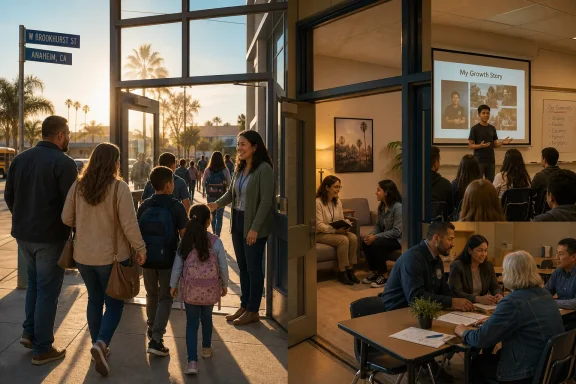 The School Gate Was Always a Fiction
Santiago’s central argument is deceptively simple: students do not “leave life at the front gate.” For anyone who has worked in a school, that is less an insight than a daily fact. The seventh grader worried about rent, immigration status, family conflict, food insecurity, depression, isolation, or a parent’s work schedule does not become a clean academic unit when the bell rings.The traditional school model has often depended on a polite fiction. Academics happen here; life happens elsewhere. Counselors, nurses, after-school staff, parent liaisons, and community nonprofits may orbit the building, but instruction remains the supposed core, with everything else treated as support, enrichment, or crisis response.
Community schooling challenges that hierarchy. It says the “everything else” is not peripheral to learning but part of the conditions that make learning possible. That does not mean math and reading stop mattering. It means the adult system around a student stops acting surprised when a child’s ability to learn is shaped by whether the family feels safe, connected, informed, and welcomed.
What is striking about Santiago’s framing is how little bureaucratic language he uses. He talks about belonging, listening, family, student voice, and hope. Those words can become education-sector wallpaper, but in his telling they describe a sequence: listen first, build trust, connect partners, let students narrate their own growth, and only then expect academic ambition to have somewhere to land.
California’s Community-School Push Meets a Principal’s Street-Level Version
California has spent the past several years making community schools a major plank of its education strategy. The state’s Community Schools Partnership Program defines the model as a whole-child school improvement strategy built around collaboration among districts, teachers, students, families, and community partners. It is not merely a grant category; it is a bet that schools can become neighborhood hubs rather than isolated instructional sites.That statewide language can sound grand, and sometimes grand language is where reform goes to die. “Whole child” can mean everything and nothing. “Community engagement” can mean a meeting no one attends, a survey no one reads, or a glossy implementation plan that turns lived experience into compliance evidence.
Santiago’s comments are useful because they translate the abstraction back into school-level practice. At Dale Junior High, the model he describes begins with listening to students, families, and staff before deciding what to build. That sequence matters. Schools are famously good at launching initiatives and then discovering that families do not trust the messenger, students do not see the relevance, and staff see one more program arriving without oxygen.
Dale’s version appears to reverse the order. The school asks what students and families are experiencing, what they need, and what is getting in the way. Then it looks for resources, partnerships, and rituals that fit the answers. That is a slower way to build reform, but it is also the only way to avoid mistaking activity for change.
Access Is the Quiet Crisis Beneath the Academic One
One of Santiago’s most important points is that families may not lack willingness. They may lack access. That distinction should make policymakers uncomfortable, because it exposes how often schools interpret distance as disinterest.A parent who does not attend a meeting may be working two jobs, sharing transportation, navigating language barriers, caring for younger children, or carrying their own history of being judged by schools. A family that does not seek help may not know where to start, may fear stigma, or may have learned that institutions are more likely to scrutinize them than support them. The school sees absence; the family experiences friction.
Community schools try to reduce that friction by bringing support closer to where children already are. The concept can include mental health services, wellness supports, after-school programs, family resources, tutoring, health partnerships, and parent engagement structures. But the heart of the model is not the menu. It is the idea that access improves when the school becomes a trusted front door.
That trust is not a communications strategy. Santiago describes it as built through “small moments”: phone calls, conversations, showing up, following through, and making families feel welcomed rather than judged. In an era when public institutions often try to solve legitimacy problems with dashboards and messaging campaigns, there is something almost radical about the claim that trust still depends on whether a human being calls back.
LancerX Turns Reflection Into Infrastructure
The most distinctive feature in Santiago’s interview is Dale’s capstone experience, LancerX. Students reflect on their growth, share their learning, and tell their story out loud. That may sound soft compared with test scores, but it addresses a hard problem: many students do not experience school as evidence of their own capability.Reflection can become sentimental quickly, especially when schools package it as a showcase event. But Santiago frames LancerX as a mechanism for students to recognize growth they might otherwise miss. The student who says, “I’ve actually grown. I can do this,” is not just performing confidence. They are connecting effort, identity, and future possibility.
That matters in middle school, where the architecture of identity is still wet cement. Junior high students are old enough to absorb failure as a verdict but young enough for a different adult environment to interrupt that verdict. A capstone that asks students to narrate growth can become a counterweight to the daily sorting mechanisms of grades, discipline, attendance, and social status.
The deeper point is that student voice is not decoration. In Santiago’s model, it is part of the school’s accountability to the child. If students cannot describe their own development, then the system may be producing outputs without producing agency.
The Community Partner Is Not a Vendor
Santiago says community partners did not need to be “sold” on helping students. They needed an authentic entry point into the school. That is an important distinction, particularly as schools become increasingly dependent on outside organizations to provide services they are not staffed or funded to deliver alone.There is a vendor version of partnership. A district identifies a need, signs an agreement, schedules services, and hopes the provider fits into school life. Sometimes that works. Often it creates another disconnected layer, useful to some families but invisible to others.
The community-school version asks partners to become part of the campus ecosystem. Santiago describes inviting them in, letting them meet students, see the environment, and feel the purpose already operating on campus. That may sound intangible, but it is operationally important. Partners who understand a school’s culture are more likely to adapt their support to actual need rather than impose a prewritten program.
There is also a political dimension. Public schools sit at the center of local arguments over taxes, safety, curriculum, discipline, mental health, and parental rights. A school that can convene credible community partners around visible student need may build a broader constituency for public education itself. It becomes harder to caricature a school when the neighborhood sees it feeding, counseling, tutoring, mentoring, and listening.
The Model Works Only If It Does Not Excuse the System
There is a danger in praising community schools too easily. If the model becomes a heartwarming story about heroic principals and resilient families, it can quietly absolve larger systems that created the gaps in the first place. A school should not have to become a miniature welfare state because health care, housing, transportation, child care, and mental health systems are difficult to navigate.Santiago’s interview avoids triumphalism, but the broader policy conversation must be careful. Community schools can mitigate barriers to learning; they cannot erase poverty. They can connect families to services; they cannot guarantee those services are adequate. They can build belonging; they cannot by themselves solve teacher shortages, unstable funding, or the bureaucratic churn that exhausts school staff.
That is why implementation matters. A community school without staffing becomes a slogan. A community school without time becomes another burden on teachers. A community school without shared leadership becomes a principal’s charisma project, vulnerable the moment that principal retires.
Santiago’s retirement makes that last point immediate. Dale’s work is being described at the very moment its most visible champion is leaving. The test of a community school is not whether it can flourish under an exceptional leader. The test is whether the culture, routines, partnerships, and expectations are durable enough to outlast him.
Whole-Child Education Is Not a Retreat From Academics
Critics of community schooling often worry that the academic mission gets diluted when schools take on family and social needs. That concern is not frivolous. Schools have limited hours, finite staff, and expanding obligations. Every new initiative claims to support learning; not every initiative does.But Santiago’s formulation makes the case that whole-child support is not a substitute for academics. It is a precondition for many students to access academics at all. If anxiety, isolation, family stress, or lack of belonging is blocking a student’s path, then ignoring those conditions is not academic rigor. It is institutional denial.
The sharper critique should not be that community schools care too much about nonacademic needs. It should be whether they can show that their supports are coherent, targeted, and connected to learning. A pantry, counseling referral, after-school club, parent workshop, and student showcase may all be good things. The question is whether they form a strategy rather than a scrapbook.
Dale’s answer, at least as Santiago tells it, is culture. Relationships and belonging come before programs. Listening comes before implementation. Student voice comes before adult certainty. That does not automatically produce achievement gains, but it does describe an environment where academic work has a better chance of meaning something to the student doing it.
Trust Is the Metric Schools Struggle to Measure
Education systems are built to count. Attendance, test scores, suspension rates, graduation rates, course completion, college readiness, chronic absenteeism, survey responses — all of these numbers matter. But Santiago’s account keeps returning to a harder variable: trust.Trust is slow, uneven, and difficult to reduce to a dashboard. It lives in whether a parent answers the school’s call, whether a student tells an adult the truth, whether a partner returns after the grant cycle, whether a teacher believes an initiative is worth emotional investment. It is also fragile. One broken promise can undo months of careful relationship-building.
That creates a problem for policymakers who want scalable models. The state can fund coordinators, define pillars, require plans, and evaluate outcomes. It cannot mandate that a family feel respected when they walk into the office. It cannot procurement-code its way into belonging.
Yet dismissing trust because it is hard to measure would be a mistake. In schools serving students “at the margins,” as Santiago puts it, trust may be the difference between early intervention and late crisis. A family that trusts the school may ask for help before eviction, grief, depression, or conflict spills into attendance and behavior. A student who trusts an adult may disclose a problem before it becomes a disciplinary event.
Middle School Is the Right Place for This Fight
Dale Junior High is not incidental to the story. Middle school is one of the most consequential and least romanticized stages of public education. Students are old enough to test institutions and young enough to be transformed by them.The junior high years often expose the cracks that elementary school can conceal. Academic expectations rise. Peer pressure intensifies. Mental health challenges become more visible. Families may begin to step back just as students need a different kind of adult network. The transition to high school looms, and with it the pathways that shape course placement, confidence, attendance, and long-term opportunity.
A community-school model in this setting can act as an early warning system. If the school is listening closely, it can detect when a student’s disengagement is not laziness but loneliness, not defiance but anxiety, not apathy but exhaustion. That does not mean lowering expectations. It means diagnosing the barrier before punishing the symptom.
LancerX also fits the developmental moment. Asking young adolescents to articulate growth is not merely a feel-good exercise; it is identity work. At an age when students are deciding whether school is a place where they belong, being asked to tell a story of capability can be powerful.
The Principal Cannot Be the Program
The emotional hook of the Psychology Today interview is Santiago’s retirement. The institutional question is what happens next. Charismatic school leadership can catalyze transformation, but it can also mask how dependent a model is on one person’s credibility.Santiago’s language suggests that Dale’s work has been distributed across a team. He credits staff, families, partners, and the Anaheim Union High School District’s focus on students at the margins. That matters because a community school cannot function as the private philosophy of a principal. It has to become the public grammar of the campus.
Succession will reveal whether the grammar holds. Do families still feel welcomed when the familiar face is gone? Do partners still understand their role? Do staff still see community schooling as the way Dale operates rather than something Santiago cared about? Do students still encounter structured chances to reflect and speak?
The best version of Santiago’s legacy would be a school that no longer needs to invoke him to explain itself. The culture would carry the work forward because it had become ordinary. That is the paradox of lasting leadership: success means the exceptional becomes routine.
The National Lesson Is Smaller Than the Slogan and Bigger Than the Program
The temptation is to turn Dale into a model others can copy. That would be both useful and dangerous. Schools can learn from Dale’s emphasis on listening, belonging, student voice, family trust, and authentic partnerships. But the most important lesson is not a template.Santiago’s advice to other principals is to start with people before programs. That sounds almost too simple, but it is a direct rebuke to the way school reform is often packaged. Districts buy platforms, adopt frameworks, schedule trainings, and name initiatives. People are then asked to inhabit the initiative, whether or not it matches the community’s lived reality.
Starting with people means the first act is not branding. It is inquiry. It requires schools to ask who they are not reaching and why. It also requires humility from educators, because the answers may implicate school practices, not just family circumstances.
The broader lesson for public education is that reform cannot keep treating relationships as soft infrastructure. They are infrastructure. Without them, programs fail to reach the families they were designed for. With them, even limited resources can travel farther because families are more likely to trust the route.
The Dale Lesson Is Practical Before It Is Inspirational
The story of Dale Junior High should not be reduced to a nice farewell profile for a beloved principal. Its value is in the practical challenge it poses to every school trying to serve students whose lives are more complicated than the master schedule admits. Community schooling is not magic, and it is not cheap, but Santiago’s account offers a usable theory of action.- Schools cannot separate student achievement from the family conditions, mental health pressures, and belonging needs students bring with them each day.
- Community-school work begins with listening to students, families, and staff before choosing programs or partners.
- Families are more likely to use support when the school has already earned trust through ordinary, repeated acts of respect.
- Student voice is not an accessory to reform; it can help young people recognize their own growth and imagine a different academic future.
- Partnerships work best when outside organizations are invited into the culture of the campus rather than bolted onto it as vendors.
- The real test of Dale’s model will be whether its practices survive Santiago’s retirement as shared institutional habits.
References
- Primary source: Psychology Today
Published: Mon, 01 Jun 2026 12:06:53 GMT
A School Can Serve an Entire Community | Psychology Today South Africa
Principal Rafael Santiago on how a school can address the needs of entire families.www.psychologytoday.com - Related coverage: learningpolicyinstitute.org
How Community Schools Improve Outcomes
Investments in the community schools strategy have increased in recent years as has the research on major state and district community school initiatives. Findings show that community schools are linked to improved student attendance, achievement, and school climate.learningpolicyinstitute.org - Related coverage: rcoe.us
- Related coverage: mcoe.org
California Community Schools Partnership Program - Merced County Office of Education
California Community Schools Partnership Program - Merced County Office of Educationwww.mcoe.org
- Related coverage: roselandsd.org

California Community Schools Partnership (CCSP) Plan - Roseland
California Community Schools Partnership (CCSP) Plan - Roseland
www.roselandsd.org

