

Computacenter Hosted SAP on Azure is a managed enterprise service, described by AD HOC NEWS on July 6, 2026, that packages SAP migration planning, Azure infrastructure design, operational management, and cost optimization for organizations moving critical SAP ECC or S/4HANA workloads to Microsoft’s cloud. The offer is not a shrink-wrapped product so much as a bet on accountability: enterprises do not merely need Azure capacity; they need someone to own the messy middle between SAP Basis, cloud architecture, compliance, finance, and outage risk. That is why this otherwise unglamorous managed service matters to WindowsForum readers. It sits exactly where modern enterprise IT now lives — between legacy systems nobody can turn off and cloud platforms nobody can safely improvise.
The AD HOC NEWS piece frames Computacenter Hosted SAP on Azure as a practical answer to a familiar enterprise problem: SAP is too important to leave untouched, but too dangerous to move casually. That framing is right, even if the promotional language around “flagships” and “bestsellers” should be read with caution. SAP landscapes are usually not moved because an executive wants a prettier cloud diagram; they are moved because hardware refresh cycles, data-center exits, S/4HANA programs, disaster-recovery gaps, or cost pressure have made the old operating model untenable.
In that context, “hosted SAP on Azure” undersells the real work. Hosting is the easy word. The hard work is sizing HANA correctly, mapping dependencies, aligning storage throughput with database behavior, building landing zones, setting up high availability, testing failover, validating backups, and keeping the business calm during cutover weekend.
Microsoft’s own Azure architecture guidance for SAP S/4HANA emphasizes high availability, disaster recovery, certified virtual machines, storage design, network segmentation, load balancing, and operational monitoring. That is not a shopping list for a casual lift-and-shift. It is a reminder that SAP on Azure is a disciplined engineering program, not a cloud migration checkbox.
Computacenter’s pitch lands because most customers do not want to become expert in every layer of that stack. They want the platform to run, the month-end close to complete, the warehouse postings to flow, and the CFO not to learn the phrase “HANA log volume saturation” during a crisis call.
But reference architecture is not implementation. A Microsoft diagram does not know that a manufacturer’s oldest plant still depends on a brittle interface written during the Windows Server 2008 era. It does not know that a custom ABAP job runs only once a quarter and fails silently if latency crosses a threshold. It does not know that a finance team in Chicago, a procurement team in Düsseldorf, and a logistics hub in Poland all experience the same SAP system differently.
This is where Computacenter’s role becomes commercially interesting. The company is not trying to replace Azure or SAP; it is monetizing the operational gap between hyperscaler capability and enterprise reality. That gap is wide enough to sustain a large services market because enterprise platforms do not migrate themselves, and because the people who understand old SAP estates are often not the same people designing modern Azure foundations.
For WindowsForum’s IT-pro audience, the lesson is familiar from every major platform transition. The winning architecture is rarely the one with the most fashionable cloud primitives. It is the one that survives contact with identity, networking, monitoring, backup windows, business calendars, and the one undocumented dependency someone discovers at 2 a.m.
The article includes human-sounding anecdotes about dashboards turning green and reports opening faster. Because the piece itself says it was AI-assisted and editorially reviewed, those anecdotes should not be treated as verified customer testimony unless Computacenter or named customers have separately published them. Still, the scenes are plausible because they describe the actual emotional texture of SAP migrations: fear before downtime, relief after reconciliation, and intense scrutiny of performance once users return.
For enterprises, that lived experience matters more than the abstract claim that Azure is scalable. The business wants to know whether MRP runs before the planners arrive, whether payroll completes, whether the sales order interface still works, and whether finance can close the month without inventing manual workarounds. SAP performance is not just a systems metric; it is a corporate rhythm.
That is why runbooks, rehearsals, rollback plans, and load testing are not bureaucratic overhead. They are the insurance policy against the kind of outage that turns a cloud strategy into a board-level postmortem. A provider that can impose discipline on those steps earns its fee before the first production VM is resized.
Microsoft’s guidance for SAP on Azure repeatedly returns to storage and availability because HANA and traditional SAP databases are unforgiving under load. The wrong disk layout can turn a theoretically powerful VM into a slow production system. The wrong clustering pattern can turn a local failure into a business outage. The wrong backup design can satisfy a checkbox while still failing the restore test that matters.
Computacenter’s value proposition, as described in public cloud and SAP-oriented materials, is to combine SAP operational knowledge with Azure platform engineering. That combination is important because optimizing one layer while misunderstanding the other creates expensive failure modes. A cloud engineer may know how to deploy scalable infrastructure, while an SAP Basis specialist may know how the application behaves under batch load; SAP on Azure requires both instincts in the same room.
This is especially relevant for large ECC and S/4HANA estates. These are not stateless web applications that can be redeployed casually across regions. They are transactional systems with years of customization, compliance obligations, and deeply embedded business processes. The cloud can improve resilience and flexibility, but only if the architecture respects the workload’s old-fashioned seriousness.
SAP workloads are particularly vulnerable to conservative overprovisioning. Nobody wants to be the person who undersized the HANA database before quarter close, so initial deployments often err on the side of excess. That may be rational at go-live, but it becomes an expensive habit if no one revisits actual consumption, batch patterns, storage tiers, and reserved-capacity options after the system stabilizes.
A managed service provider can earn trust by doing the unglamorous work of optimization. That means reviewing CPU and memory trends, watching storage throughput, identifying idle non-production systems, tuning backup policies, and helping finance understand why a given SAP module or process drives Azure consumption. Cloud cost control is not a one-time procurement negotiation; it is an operational practice.
This is also where investor interest intersects with customer interest. For Computacenter, recurring managed services can provide more durable revenue than one-off resale transactions. For customers, the same recurring relationship is tolerable only if the provider keeps proving that it is reducing risk, improving service levels, or controlling spend. The business model depends on operational credibility.
The company’s investor materials have emphasized services, cloud, data center, workplace, networking, and managed operations as part of its broader portfolio. SAP on Azure is not necessarily broken out as a separate revenue line, and investors should be wary of treating one service description as a material disclosure about the company’s financial trajectory. But the service is representative of the direction in which enterprise IT providers have been pushed.
The economics are straightforward. Hardware resale can be large but cyclical and margin-constrained. Managed services, migration projects, optimization work, and platform operations can create longer relationships and more defensible value. SAP customers, because they are sticky and mission-critical, are especially attractive if a provider can win and retain their trust.
That does not make Computacenter immune to competition. Accenture, Capgemini, Atos/Eviden, IBM, T-Systems, local SAP specialists, cloud-native consultancies, and Microsoft-aligned partners all chase pieces of this market. The differentiator is not simply claiming SAP expertise. It is demonstrating enough repeatable delivery muscle that a CIO will hand over the most sensitive workload in the company.
Azure’s regional footprint gives customers options for locality, latency, and resilience, but SAP architecture is rarely a simple matter of choosing the nearest region. Data residency, disaster-recovery distance, network latency, licensing, integration endpoints, and business continuity all shape the final design. A multinational may need US performance for finance users while preserving European compliance expectations and plant-level reliability.
That makes the managed-service conversation more complex than “move SAP to the cloud.” Some systems may remain on-premises longer than expected. Some workloads may move to Azure quickly. Some customers may adopt RISE with SAP, while others retain more control through infrastructure-as-a-service deployments. Hybrid reality is not a transitional accident; for many SAP estates, it is the operating model for years.
For Windows administrators, this means the SAP migration may show up as changes in identity, monitoring, network routing, endpoint access, backup integration, and security operations. Even if the SAP team owns the application, the surrounding Windows and Microsoft ecosystem will feel the blast radius. Azure-based SAP is still an enterprise platform woven into Active Directory histories, Entra ID futures, Power BI ambitions, Teams workflows, and security tooling.
A partner-managed Azure model can appeal to organizations that want infrastructure transparency, direct Azure integration, or a specific operational partner. RISE can appeal to organizations that want a more SAP-led commercial and operational framework. Neither path is universally superior. The choice depends on contracts, customization, compliance, transformation appetite, and how much responsibility the enterprise wants to retain.
Computacenter’s offer sits in the space where customers still want or need a partner to manage the Azure and SAP operating environment directly. That may include ECC systems not yet ready for S/4HANA, complex hybrid landscapes, or organizations that prefer staged modernization over a single vendor-led transformation bundle. The market exists because SAP customers rarely move in clean, vendor-approved straight lines.
This also means buyers should press hard on scope. Who manages the database? Who handles OS patching? Who owns SAP transports? Who responds during a Severity 1 incident? Who pays when reserved capacity is misjudged? Who coordinates with Microsoft support and SAP support? The answers matter more than the brochure.
Microsoft’s SAP on Azure guidance emphasizes network segmentation, secure administration, private connectivity, backup, and monitoring. Those details align with a broader security reality: cloud-hosted SAP must be protected from both classic infrastructure failure and modern identity-driven compromise. The admin path into the environment can be as important as the database tier itself.
A managed provider therefore needs more than SAP credentials. It needs credible security operations, patch discipline, privileged-access controls, logging, incident response, and change management. The most dangerous SAP outage may not be caused by a failed VM; it may begin with a compromised credential, a misconfigured firewall rule, or a maintenance change that was never tested against the business calendar.
This is another reason enterprises buy managed services rather than raw capacity. They are buying process. In mission-critical environments, process is not a paperwork tax. It is how organizations keep talented engineers from making isolated decisions that accidentally endanger the business.
That does not invalidate the underlying story. Computacenter does operate in the enterprise services market, Microsoft does support SAP workloads on Azure, and the need for managed migration and operations is real. But investors should not mistake a product explainer for evidence of revenue scale, margin contribution, or competitive win rate.
For holders of Computacenter shares, the right question is not whether Hosted SAP on Azure sounds important. It is whether services like this are expanding recurring revenue, strengthening customer retention, improving margins, and positioning the company against larger integrators. Those answers live in financial reports, contract announcements, customer references, and management commentary — not in a single syndicated product write-up.
For customers, the equivalent caution is procurement discipline. Ask for references. Ask for migration runbooks. Ask who is on call. Ask how the provider handles failed cutovers. Ask for cost-optimization examples. Ask what happens when Microsoft, SAP, and the service provider disagree about root cause. In SAP operations, confidence without evidence is just another risk.
Computacenter’s bundled approach is designed to reduce those seams by giving customers a named partner across assessment, build, migration, and run. That is the right idea. But buyers should verify whether the operating model truly spans those phases or merely sells them under one commercial umbrella.
A good SAP managed service should remember what the migration team learned. It should carry design assumptions into monitoring thresholds. It should turn cutover risks into permanent runbook entries. It should revisit sizing decisions after real workloads arrive. It should explain cloud costs in language finance can use. It should treat disaster recovery as a rehearsed capability, not a slide.
This is where the market will separate serious providers from capacity brokers. The next wave of enterprise cloud work is less about convincing companies that Azure can run big workloads. Microsoft has already won that argument often enough. The harder question is who can operate those workloads with enough discipline that the business stops thinking about the platform at all.
That can be a sensible model, especially for organizations that know their SAP estate is too customized for a simplistic cloud migration but too strategically important to leave on aging infrastructure. It is also a model that demands strong governance from the buyer. Outsourcing operations does not outsource accountability to shareholders, regulators, customers, or employees when SAP fails.
The concrete lessons are less glamorous than the marketing, but more useful:
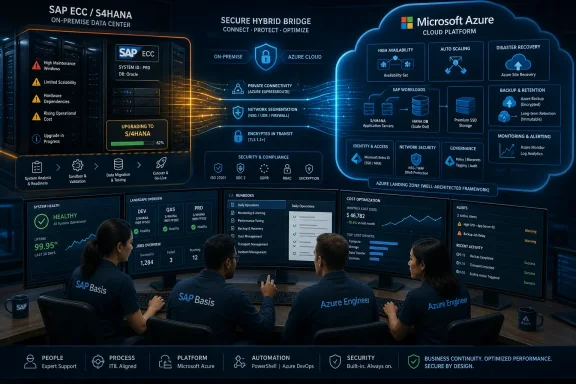 The Real Product Is Not Hosting, It Is Nerve
The AD HOC NEWS piece frames Computacenter Hosted SAP on Azure as a practical answer to a familiar enterprise problem: SAP is too important to leave untouched, but too dangerous to move casually. That framing is right, even if the promotional language around “flagships” and “bestsellers” should be read with caution. SAP landscapes are usually not moved because an executive wants a prettier cloud diagram; they are moved because hardware refresh cycles, data-center exits, S/4HANA programs, disaster-recovery gaps, or cost pressure have made the old operating model untenable.In that context, “hosted SAP on Azure” undersells the real work. Hosting is the easy word. The hard work is sizing HANA correctly, mapping dependencies, aligning storage throughput with database behavior, building landing zones, setting up high availability, testing failover, validating backups, and keeping the business calm during cutover weekend.
Microsoft’s own Azure architecture guidance for SAP S/4HANA emphasizes high availability, disaster recovery, certified virtual machines, storage design, network segmentation, load balancing, and operational monitoring. That is not a shopping list for a casual lift-and-shift. It is a reminder that SAP on Azure is a disciplined engineering program, not a cloud migration checkbox.
Computacenter’s pitch lands because most customers do not want to become expert in every layer of that stack. They want the platform to run, the month-end close to complete, the warehouse postings to flow, and the CFO not to learn the phrase “HANA log volume saturation” during a crisis call.
Microsoft Built the Runway, but Partners Fly the Plane
Microsoft has spent years making Azure a serious home for SAP workloads. Its documentation and reference architectures now cover the dull but decisive details: SAP Central Services clustering, HANA System Replication, availability zones, ExpressRoute connectivity, Azure Backup, Azure Site Recovery, Azure Monitor for SAP solutions, and certified VM families for large databases. That body of guidance matters because SAP customers are conservative for good reason.But reference architecture is not implementation. A Microsoft diagram does not know that a manufacturer’s oldest plant still depends on a brittle interface written during the Windows Server 2008 era. It does not know that a custom ABAP job runs only once a quarter and fails silently if latency crosses a threshold. It does not know that a finance team in Chicago, a procurement team in Düsseldorf, and a logistics hub in Poland all experience the same SAP system differently.
This is where Computacenter’s role becomes commercially interesting. The company is not trying to replace Azure or SAP; it is monetizing the operational gap between hyperscaler capability and enterprise reality. That gap is wide enough to sustain a large services market because enterprise platforms do not migrate themselves, and because the people who understand old SAP estates are often not the same people designing modern Azure foundations.
For WindowsForum’s IT-pro audience, the lesson is familiar from every major platform transition. The winning architecture is rarely the one with the most fashionable cloud primitives. It is the one that survives contact with identity, networking, monitoring, backup windows, business calendars, and the one undocumented dependency someone discovers at 2 a.m.
SAP Migration Is a Business Event Wearing an Infrastructure Badge
The most revealing part of the AD HOC NEWS article is not the product description but the emphasis on migration weekends. That is where SAP projects become real. A cutover is a technical sequence, but it is also a trust exercise: users are locked out, data is copied or synchronized, checks are run, interfaces are restarted, and everyone waits to see whether the system still behaves like the business expects.The article includes human-sounding anecdotes about dashboards turning green and reports opening faster. Because the piece itself says it was AI-assisted and editorially reviewed, those anecdotes should not be treated as verified customer testimony unless Computacenter or named customers have separately published them. Still, the scenes are plausible because they describe the actual emotional texture of SAP migrations: fear before downtime, relief after reconciliation, and intense scrutiny of performance once users return.
For enterprises, that lived experience matters more than the abstract claim that Azure is scalable. The business wants to know whether MRP runs before the planners arrive, whether payroll completes, whether the sales order interface still works, and whether finance can close the month without inventing manual workarounds. SAP performance is not just a systems metric; it is a corporate rhythm.
That is why runbooks, rehearsals, rollback plans, and load testing are not bureaucratic overhead. They are the insurance policy against the kind of outage that turns a cloud strategy into a board-level postmortem. A provider that can impose discipline on those steps earns its fee before the first production VM is resized.
The Hidden Battleground Is Storage, Not Slogans
Cloud migration marketing tends to talk about agility, innovation, and transformation. SAP Basis teams talk about IOPS, latency, enqueue replication, database growth, transport paths, and backup restore times. The second vocabulary is less exciting, but it is where projects succeed or fail.Microsoft’s guidance for SAP on Azure repeatedly returns to storage and availability because HANA and traditional SAP databases are unforgiving under load. The wrong disk layout can turn a theoretically powerful VM into a slow production system. The wrong clustering pattern can turn a local failure into a business outage. The wrong backup design can satisfy a checkbox while still failing the restore test that matters.
Computacenter’s value proposition, as described in public cloud and SAP-oriented materials, is to combine SAP operational knowledge with Azure platform engineering. That combination is important because optimizing one layer while misunderstanding the other creates expensive failure modes. A cloud engineer may know how to deploy scalable infrastructure, while an SAP Basis specialist may know how the application behaves under batch load; SAP on Azure requires both instincts in the same room.
This is especially relevant for large ECC and S/4HANA estates. These are not stateless web applications that can be redeployed casually across regions. They are transactional systems with years of customization, compliance obligations, and deeply embedded business processes. The cloud can improve resilience and flexibility, but only if the architecture respects the workload’s old-fashioned seriousness.
Cost Control Is the Sales Pitch After the First Bill Arrives
The AD HOC NEWS article correctly points to cost management as a major part of the offer. That may sound secondary beside migration and uptime, but in 2026 it is increasingly central. Enterprises have learned that public cloud does not automatically lower costs; it changes the shape of spending, exposes waste faster, and punishes designs that were sized for fear rather than evidence.SAP workloads are particularly vulnerable to conservative overprovisioning. Nobody wants to be the person who undersized the HANA database before quarter close, so initial deployments often err on the side of excess. That may be rational at go-live, but it becomes an expensive habit if no one revisits actual consumption, batch patterns, storage tiers, and reserved-capacity options after the system stabilizes.
A managed service provider can earn trust by doing the unglamorous work of optimization. That means reviewing CPU and memory trends, watching storage throughput, identifying idle non-production systems, tuning backup policies, and helping finance understand why a given SAP module or process drives Azure consumption. Cloud cost control is not a one-time procurement negotiation; it is an operational practice.
This is also where investor interest intersects with customer interest. For Computacenter, recurring managed services can provide more durable revenue than one-off resale transactions. For customers, the same recurring relationship is tolerable only if the provider keeps proving that it is reducing risk, improving service levels, or controlling spend. The business model depends on operational credibility.
Computacenter’s Strategic Shift Is the Bigger Story for Investors
Computacenter has long been known as a European IT services and solutions provider with deep roots in infrastructure procurement, integration, and enterprise support. Like many firms born in the reseller era, it has had to move up the value chain as customers shift spending from boxes to outcomes. Hosted SAP on Azure fits that transition neatly.The company’s investor materials have emphasized services, cloud, data center, workplace, networking, and managed operations as part of its broader portfolio. SAP on Azure is not necessarily broken out as a separate revenue line, and investors should be wary of treating one service description as a material disclosure about the company’s financial trajectory. But the service is representative of the direction in which enterprise IT providers have been pushed.
The economics are straightforward. Hardware resale can be large but cyclical and margin-constrained. Managed services, migration projects, optimization work, and platform operations can create longer relationships and more defensible value. SAP customers, because they are sticky and mission-critical, are especially attractive if a provider can win and retain their trust.
That does not make Computacenter immune to competition. Accenture, Capgemini, Atos/Eviden, IBM, T-Systems, local SAP specialists, cloud-native consultancies, and Microsoft-aligned partners all chase pieces of this market. The differentiator is not simply claiming SAP expertise. It is demonstrating enough repeatable delivery muscle that a CIO will hand over the most sensitive workload in the company.
The US Angle Is Global SAP, Not a British Stock Ticker
AD HOC NEWS addresses Computacenter stockholders and notes the London listing, but for US IT readers the more relevant angle is operational. Many American companies run SAP globally, with European plants, shared-service centers, tax entities, suppliers, and customers tied into the same landscape. A provider with European depth may therefore matter even when the executive sponsor sits in the United States.Azure’s regional footprint gives customers options for locality, latency, and resilience, but SAP architecture is rarely a simple matter of choosing the nearest region. Data residency, disaster-recovery distance, network latency, licensing, integration endpoints, and business continuity all shape the final design. A multinational may need US performance for finance users while preserving European compliance expectations and plant-level reliability.
That makes the managed-service conversation more complex than “move SAP to the cloud.” Some systems may remain on-premises longer than expected. Some workloads may move to Azure quickly. Some customers may adopt RISE with SAP, while others retain more control through infrastructure-as-a-service deployments. Hybrid reality is not a transitional accident; for many SAP estates, it is the operating model for years.
For Windows administrators, this means the SAP migration may show up as changes in identity, monitoring, network routing, endpoint access, backup integration, and security operations. Even if the SAP team owns the application, the surrounding Windows and Microsoft ecosystem will feel the blast radius. Azure-based SAP is still an enterprise platform woven into Active Directory histories, Entra ID futures, Power BI ambitions, Teams workflows, and security tooling.
RISE With SAP Complicates the Managed Azure Story
Any serious discussion of hosted SAP on Azure has to acknowledge RISE with SAP. SAP has been pushing customers toward subscription-based cloud transformation bundles, and many enterprises now evaluate RISE alongside partner-managed Azure deployments. That creates a strategic fork: how much control does the customer want, and which vendor should be accountable for which layer?A partner-managed Azure model can appeal to organizations that want infrastructure transparency, direct Azure integration, or a specific operational partner. RISE can appeal to organizations that want a more SAP-led commercial and operational framework. Neither path is universally superior. The choice depends on contracts, customization, compliance, transformation appetite, and how much responsibility the enterprise wants to retain.
Computacenter’s offer sits in the space where customers still want or need a partner to manage the Azure and SAP operating environment directly. That may include ECC systems not yet ready for S/4HANA, complex hybrid landscapes, or organizations that prefer staged modernization over a single vendor-led transformation bundle. The market exists because SAP customers rarely move in clean, vendor-approved straight lines.
This also means buyers should press hard on scope. Who manages the database? Who handles OS patching? Who owns SAP transports? Who responds during a Severity 1 incident? Who pays when reserved capacity is misjudged? Who coordinates with Microsoft support and SAP support? The answers matter more than the brochure.
Security Is Not an Add-On When SAP Holds the Crown Jewels
SAP systems contain the facts a company runs on: revenue, payroll, suppliers, production plans, inventory, customer orders, pricing, and financial postings. Moving that core to Azure does not reduce its sensitivity. It changes the control plane around it.Microsoft’s SAP on Azure guidance emphasizes network segmentation, secure administration, private connectivity, backup, and monitoring. Those details align with a broader security reality: cloud-hosted SAP must be protected from both classic infrastructure failure and modern identity-driven compromise. The admin path into the environment can be as important as the database tier itself.
A managed provider therefore needs more than SAP credentials. It needs credible security operations, patch discipline, privileged-access controls, logging, incident response, and change management. The most dangerous SAP outage may not be caused by a failed VM; it may begin with a compromised credential, a misconfigured firewall rule, or a maintenance change that was never tested against the business calendar.
This is another reason enterprises buy managed services rather than raw capacity. They are buying process. In mission-critical environments, process is not a paperwork tax. It is how organizations keep talented engineers from making isolated decisions that accidentally endanger the business.
The Article’s Weakest Claims Are the Ones Investors Should Ignore
The AD HOC NEWS piece contains useful product framing, but readers should separate grounded description from market-flavored embellishment. The article calls the service a “Flagship / Bestseller” category offering, yet managed SAP on Azure is not the kind of product whose market rank is easily verified from public data. It also includes imagined or anonymized operational scenes that may capture reality without proving any specific customer outcome.That does not invalidate the underlying story. Computacenter does operate in the enterprise services market, Microsoft does support SAP workloads on Azure, and the need for managed migration and operations is real. But investors should not mistake a product explainer for evidence of revenue scale, margin contribution, or competitive win rate.
For holders of Computacenter shares, the right question is not whether Hosted SAP on Azure sounds important. It is whether services like this are expanding recurring revenue, strengthening customer retention, improving margins, and positioning the company against larger integrators. Those answers live in financial reports, contract announcements, customer references, and management commentary — not in a single syndicated product write-up.
For customers, the equivalent caution is procurement discipline. Ask for references. Ask for migration runbooks. Ask who is on call. Ask how the provider handles failed cutovers. Ask for cost-optimization examples. Ask what happens when Microsoft, SAP, and the service provider disagree about root cause. In SAP operations, confidence without evidence is just another risk.
The Service Lives or Dies in the Hand-Offs
The most difficult parts of SAP on Azure are often the seams. The seam between application and infrastructure. The seam between Microsoft support and SAP support. The seam between project team and run team. The seam between European governance and US business ownership. The seam between cloud cost dashboards and actual business accountability.Computacenter’s bundled approach is designed to reduce those seams by giving customers a named partner across assessment, build, migration, and run. That is the right idea. But buyers should verify whether the operating model truly spans those phases or merely sells them under one commercial umbrella.
A good SAP managed service should remember what the migration team learned. It should carry design assumptions into monitoring thresholds. It should turn cutover risks into permanent runbook entries. It should revisit sizing decisions after real workloads arrive. It should explain cloud costs in language finance can use. It should treat disaster recovery as a rehearsed capability, not a slide.
This is where the market will separate serious providers from capacity brokers. The next wave of enterprise cloud work is less about convincing companies that Azure can run big workloads. Microsoft has already won that argument often enough. The harder question is who can operate those workloads with enough discipline that the business stops thinking about the platform at all.
A Practical Reading of Computacenter’s SAP-on-Azure Pitch
For IT leaders weighing a service like this, the headline is not transformation. It is controlled risk transfer. Computacenter is offering to absorb some of the complexity that customers struggle to staff internally, while Microsoft provides the certified cloud substrate and SAP remains the application heart of the enterprise.That can be a sensible model, especially for organizations that know their SAP estate is too customized for a simplistic cloud migration but too strategically important to leave on aging infrastructure. It is also a model that demands strong governance from the buyer. Outsourcing operations does not outsource accountability to shareholders, regulators, customers, or employees when SAP fails.
The concrete lessons are less glamorous than the marketing, but more useful:
- Computacenter Hosted SAP on Azure should be understood as a managed service engagement, not a fixed-price software product sitting on a shelf.
- The strongest customer case is for mid-sized and large enterprises with complex SAP ECC or S/4HANA landscapes that need both SAP Basis and Azure architecture expertise.
- Microsoft’s SAP on Azure reference architectures make the platform credible, but implementation quality still depends on sizing, storage, high availability, monitoring, and operational process.
- Cost optimization becomes most important after go-live, when conservative sizing and forgotten non-production systems can turn cloud flexibility into waste.
- Investors should treat the service as evidence of Computacenter’s broader move toward managed cloud operations, not as a standalone financial indicator unless the company discloses more detail.
- Buyers should demand clarity on support boundaries among Computacenter, Microsoft, SAP, and any internal teams before moving production workloads.
References
- Primary source: AD HOC NEWS
Published: Mon, 06 Jul 2026 03:40:10 GMT
The Computacenter Hosted SAP on Azure. A practical path for enterprises moving mission-critical work
Computacenter Hosted SAP on Azure bundles migration, management, and cost control for complex SAP landscapes. Anyone holding Computacenter stock (LSE: CCC, ISIN GB00BV9FP302) should know this product.www.ad-hoc-news.de - Official source: learn.microsoft.com
Run SAP BW/4HANA with Linux Virtual Machines - Azure Architecture Center | Microsoft Learn
Learn about the SAP BW/4HANA application tier and how it's suitable for a high availability, small-scale production environment of SAP BW/4HANA on Azure.learn.microsoft.com - Official source: azure.microsoft.com
- Official source: techcommunity.microsoft.com
- Official source: info.microsoft.com
SAP on Azure Implementation Guide | Microsoft Azure
Get practical guidance to move your on-premises SAP workloads to the cloud in this free SAP on Azure implementation guide by Packt.info.microsoft.com - Related coverage: acom-sandbox.azure.net
SAP solutions on Azure | Microsoft Azure
Learn more about running SAP solutions on Microsoft Azure with detailed information, technical scenarios, support documentation, and more.acom-sandbox.azure.net
- Related coverage: azurelessons.com
SAP HANA On Azure - Azure Lessons
Migrating SAP HANA to Azure? Master the certified M-Series compute topologies and design sub-millisecond /hana/log paths.azurelessons.com - Related coverage: investors.computacenter.com
- Related coverage: veritas.com
Whitepaper Front Cover
High Availability and Disaster Recovery Reference Architecturewww.veritas.com
- Related coverage: enlyft.com

Computacenter Technologies Stack and Company Profile
Computacenter uses 5 different technologies from 487 different vendors. View recently detected technologies, product categories and more.
enlyft.com
- Related coverage: careers.computacenter.com
Training Specialist & SME (Sales Processes), SAP (Buffalo Grove, Norcross, Plano) › Computacenter North America
Get to know us and join us as "Training Specialist & SME (Sales Processes), SAP" at Computacenter North America. careers.computacenter.com
- Official source: azuremarketplace.microsoft.com
Database Relational Migration to Azure
<p>Professional service migration service enabling customers to migrate existing relational Database workloads into Microsoft Azure. Providing modernisation of legacy applications and infrastructure whil</p>azuremarketplace.microsoft.com
- Related coverage: marketscreener.com
