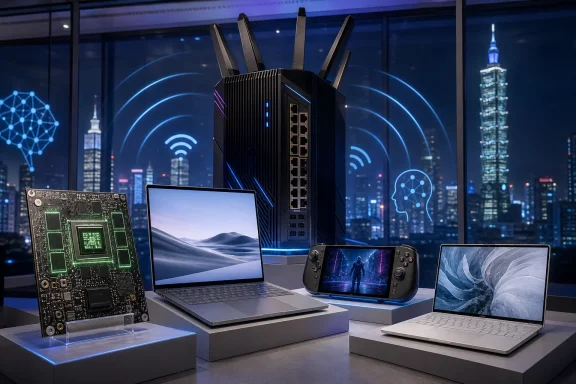
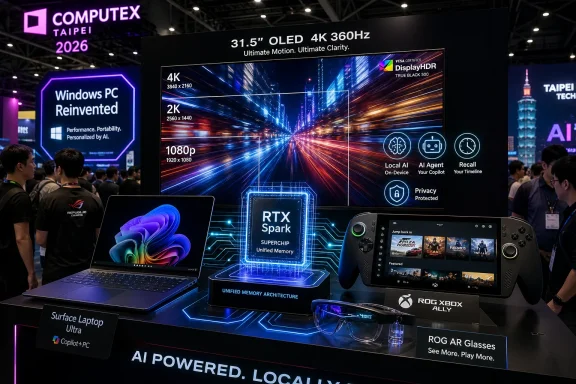
Pocket-lint’s top Computex 2026 picks are Nvidia’s RTX Spark platform, Asus’ ROG Xbox Ally X20 Bundle, Microsoft’s Surface Laptop Ultra, MSI’s MPG OLED 322URDX36 monitor, and Intel’s Arc G3 handheld processors, all shown or announced around the Taipei trade show this week. The list reads like a gadget roundup, but the through-line is bigger than five shiny products. Computex 2026 has become a referendum on whether the Windows PC can reinvent itself around local AI, handheld gaming, and displays fast enough to make last year’s hardware feel abruptly old.
For years, the PC industry has tried to sell reinvention through thinner bezels, faster SSDs, and a procession of CPU generations that mattered most to benchmark charts. Computex 2026 feels different because the announcements are not merely faster versions of familiar machines. They point to a Windows ecosystem being pulled in three directions at once: AI workstations that look like laptops, game consoles that run PC operating systems, and monitors that treat refresh rate as a competitive weapon.
That does not mean every product on Pocket-lint’s list will become a market-defining hit. Trade shows are built for spectacle, and Computex has always rewarded companies willing to bolt tomorrow’s ambitions onto today’s prototypes. But the significance of this year’s crop is that the spectacle is clustering around real platform bets rather than novelty accessories.
Nvidia’s RTX Spark is the gravitational center. Microsoft’s Surface Laptop Ultra becomes the clearest vote of confidence in that silicon. Asus’ ROG Xbox Ally X20 and Intel’s Arc G3 chips show the handheld PC market maturing from enthusiast curiosity into a proper battleground. MSI’s OLED monitor, meanwhile, reminds everyone that the PC’s oldest promise — better pixels, faster — still has teeth.
Pocket-lint’s choices are therefore less interesting as awards than as a map. Follow the map and you see an industry trying to escape the commoditization trap by making the PC personal again: a local AI node, a portable game library, a creator workstation, and a high-refresh competitive display.
The important phrase is unified memory. For years, Windows PCs have had the raw horsepower to embarrass many Macs in isolated workloads, while Apple’s tightly integrated silicon won mindshare by making the whole system feel like one coherent machine. Nvidia appears to be borrowing the most persuasive part of that model while keeping the RTX software ecosystem — CUDA, Tensor cores, DLSS, ray tracing, professional rendering tools — firmly in the picture.
That is why Spark is being called a “superchip,” even if the term is marketing in its Sunday best. The company is not just selling speed. It is selling a computing model in which creative applications, AI agents, local language models, 3D rendering, and gaming can all draw from the same large pool of memory and acceleration.
For Windows users, the pitch is obvious: a machine that can run serious creative workloads and AI models locally without feeling like a portable workstation from 2018. For developers, it offers a more direct bridge between desktop experimentation and accelerated AI deployment. For Microsoft, it offers something even more valuable — a story about Windows on Arm that is not dependent solely on Qualcomm and battery-life charts.
The risk is equally obvious. Nvidia has enormous software gravity, but Windows on Arm still carries the baggage of compatibility, driver maturity, and user suspicion. A platform can look stunning on a show floor and still stumble if the plug-ins, games, peripherals, and old utilities people depend on behave unpredictably.
The significance is not only that Microsoft is using Nvidia’s chip. It is that Microsoft is putting the Surface brand behind a creator-grade Windows on Arm laptop with up to 128GB of unified memory, serious graphics ambitions, broad port selection, and a cooling system designed around sustained performance. That combination says Microsoft does not want Arm Windows to remain the domain of thin-and-light machines whose best feature is standby time.
This also changes the Surface story. The Surface Pro once existed to prove that Windows could define a new category rather than merely chase iPad and MacBook trends. The Surface Laptop Ultra now appears designed to prove that Windows can host a new class of AI-native creator machine without conceding the premium narrative to Apple.
The curiously large USB-C-style connector reported around the device only adds to the sense that Microsoft is experimenting with what a next-generation Surface should be. If it is merely a port oddity, it will be forgotten. If it signals a rethink of docking, power, or external expansion, it could become part of a broader effort to make high-end Surface hardware feel less constrained.
The price, shipping configuration, and real-world thermals will decide whether this is a halo product or a practical workstation. But as a strategic move, it is unmistakable. Microsoft is using Computex to say that the next flagship Windows laptop may not be an x86 machine at all.
That is a major shift. A power user does not buy a machine because it is philosophically elegant; they buy it because the software they need runs faster, cooler, or more conveniently. If Spark-based systems can run large local AI models, accelerate creator workflows, and still handle gaming credibly, Windows on Arm gains a use case that is not merely defensive.
This is where Microsoft and Nvidia’s interests align neatly. Microsoft wants Copilot and local AI features to feel like platform-level advantages rather than cloud subscriptions with keyboard shortcuts. Nvidia wants AI workloads to normalize the idea that a PC needs serious local acceleration. OEMs want premium machines that can command premium margins.
The uncomfortable question is whether the rest of the Windows ecosystem can move at the same pace. Creative workflows are messy. They involve codecs, plug-ins, capture cards, calibration tools, device drivers, licensing managers, and ancient helper applications that nobody remembers until they break. A powerful chip does not erase that complexity.
Still, this is the first Windows-on-Arm argument in years that feels aimed at the high end rather than the compromise aisle. If the Surface Laptop Ultra and other Spark PCs deliver, Arm Windows could stop being the laptop you recommend with caveats and start being the machine you recommend because it does something x86 laptops cannot do as gracefully.
The handheld PC market is rapidly moving from “Steam Deck alternative” to a segmented hardware category with its own identities. Some devices chase price. Some chase performance. Some chase Windows compatibility. Asus, with the ROG Xbox Ally line, is chasing a console-like relationship with the player while keeping the flexibility of a PC.
The X20 Bundle leans into that by treating the handheld not as a small laptop with controls, but as the center of a portable gaming setup. The OLED display, improved controls, refreshed exterior, and AR glasses all suggest a device intended to be shown, worn, packed, docked, and personalized. It is less beige-box PC and more gaming culture object.
The Xbox branding matters here. Windows handhelds have often suffered because Windows is powerful but not graceful at seven inches. Microsoft’s deeper involvement with handheld interfaces, Xbox services, and game-library cohesion could help turn these devices from tinker toys into mainstream gaming hardware. It could also expose how much work remains before Windows feels natural with thumbsticks.
There is a danger in bundling spectacle with uncertainty. Pocket-lint notes that it is unclear whether the X20 will be sold separately or in less celebratory colorways. If this remains a limited collector’s bundle, its industry impact will be more symbolic than practical. But symbols matter at trade shows, and Asus’ symbol is clear: the handheld PC is no longer a side project.
The architecture story is straightforward enough: handheld-focused chips derived from Intel’s Core Ultra Series 3, better known as Panther Lake, with integrated Arc graphics designed for performance-per-watt gains. The business story is more interesting. Intel cannot afford to let an entire fast-growing PC form factor become shorthand for AMD silicon.
Handhelds are not just small gaming PCs. They are a stress test for everything silicon companies claim to be good at: efficiency, graphics drivers, sleep behavior, frame pacing, display support, thermals, battery life, and platform integration. A chip can win a benchmark and still lose the device if it drains too quickly, stutters under real games, or needs too much fan noise.
Intel’s problem is that PC gamers have long memories. Arc graphics have improved dramatically since Intel’s awkward discrete GPU debut, but driver reputation does not reset overnight. Handheld buyers are especially unforgiving because they tend to play a wide variety of older, weirder, and less predictable games than reviewers use in polished test suites.
The opportunity is that Intel can differentiate through features as much as raw frame rate. XeSS, frame generation, media engines, NPU capabilities, and tight Windows integration could matter if device makers package them well. The first wave of Arc G3 handhelds will therefore be judged less like laptops and more like consoles: does the game launch, does it feel smooth, does the battery last, and does the device stay comfortable?
The monitor’s triple-mode pitch is especially telling. Running 4K at 360Hz is for the buyer who wants uncompromising image quality and speed in the same panel. Dropping to 2K at 520Hz or 1080p at 680Hz is for competitive players who will gladly sacrifice resolution for responsiveness. MSI is acknowledging that high-end PC gaming is no longer one market but several overlapping performance cultures.
OLED also complicates the display race in productive ways. Refresh rate alone is not enough if motion clarity, black levels, pixel response, and HDR handling do not match. MSI’s claimed DarkArmor Film improvements and certification stack suggest that display makers are competing on perceived quality as much as headline numbers.
The practical audience is smaller than the marketing audience. Most PC gamers do not have hardware that can drive modern games anywhere near 4K at 360 frames per second, and many esports players will remain perfectly happy on smaller, lower-resolution panels. But halo monitors matter because they drag expectations upward. Today’s absurd spec becomes tomorrow’s sale item.
For Windows users, the broader effect is a renewed pressure on the whole graphics stack. High-refresh OLED panels demand better GPU scheduling, better variable refresh behavior, better HDR handling, and more consistent game support. The monitor is a peripheral, but it forces the PC around it to grow up.
RTX Spark is not interesting because it has an AI accelerator in the abstract. It is interesting because it promises a system-level environment where large models, visual workloads, rendering, video, and gaming share the same local compute fabric. That is a much more convincing proposition than telling buyers they need a new chip to blur a webcam background more efficiently.
The term agentic AI is doing a lot of work in the marketing. Vendors are imagining assistants that can manipulate files, interpret projects, automate repetitive creative tasks, and operate across applications. Whether users actually want software agents crawling through their local workspaces is another matter entirely, especially in business environments where compliance teams already flinch at cloud AI.
This is where local compute becomes politically useful. Microsoft and Nvidia can argue that on-device AI gives organizations more control over data, latency, and cost. IT departments will counter that local AI also creates new governance problems: model management, data leakage, auditability, patching, and user permissions for tools that may act semi-autonomously.
The winners will be the companies that make AI feel like a capability rather than a mascot. If Spark PCs help editors search hours of footage, developers test local models, architects manipulate heavy scenes, or analysts process sensitive data without shipping it offsite, buyers will understand the upgrade. If the experience devolves into more pop-ups, branded assistants, and vague productivity claims, the backlash will be swift.
Intel’s Arc G3 needs day-one game compatibility and long-term driver trust. MSI’s OLED monitor needs Windows, GPUs, and games to handle extreme refresh modes without turning configuration into ritual. The hardware is glamorous, but the user experience will be decided in settings panels, firmware updates, drivers, and app compatibility matrices.
That is the uncomfortable truth of the modern PC. The platform’s greatest strength is its openness, and its greatest weakness is the same thing. A Windows machine can be a workstation, a game console, a development box, a streaming rig, a lab instrument, and a media editor. It can also be a driver conflict wearing RGB lighting.
Computex 2026 shows the PC industry trying to build more console-like experiences without giving up PC freedom. That is a difficult balance. Make the system too locked down and enthusiasts rebel. Leave it too raw and mainstream buyers return the device after the third launcher update.
Microsoft sits in the middle of this mess. Its partners are producing the hardware, but Windows remains the stage on which these bets either work or collapse. If Microsoft wants this year’s Computex story to become next year’s sales story, it will need to treat local AI, Arm performance, handheld navigation, HDR, and driver delivery as one connected platform problem.
Nvidia’s RTX Spark could become the foundation for a new class of Windows machines, but its success will depend on pricing, thermals, battery life, application compatibility, and whether developers treat it as a platform rather than a curiosity. Microsoft’s Surface Laptop Ultra could redefine the Surface brand, but it must prove that a premium Arm workstation can survive real creator workloads.
Asus’ ROG Xbox Ally X20 Bundle looks like the handheld category gaining confidence, but its actual importance depends on availability, pricing, and whether the Xbox-flavored Windows experience becomes better for everyone rather than just for a limited-edition device. Intel’s Arc G3 chips could break AMD’s handheld momentum, but only if drivers and battery behavior meet the expectations of console-trained players.
MSI’s monitor is the easiest to understand because displays are brutally empirical. It will either look stunning, run cleanly, and justify its price, or it will become another extravagant panel for a tiny market of competitive obsessives and spec collectors. Even there, the product matters because it pushes the ceiling higher.
The deeper lesson is that Computex 2026 is no longer just about component suppliers showing parts to OEMs. It is about ecosystem companies trying to define the next premium PC. Nvidia wants the AI workstation. Microsoft wants the flagship Windows machine. Asus wants the portable gaming identity. Intel wants the handheld silicon comeback. MSI wants the display crown.
 Computex Stops Pretending the PC Is Boring
For years, the PC industry has tried to sell reinvention through thinner bezels, faster SSDs, and a procession of CPU generations that mattered most to benchmark charts. Computex 2026 feels different because the announcements are not merely faster versions of familiar machines. They point to a Windows ecosystem being pulled in three directions at once: AI workstations that look like laptops, game consoles that run PC operating systems, and monitors that treat refresh rate as a competitive weapon.That does not mean every product on Pocket-lint’s list will become a market-defining hit. Trade shows are built for spectacle, and Computex has always rewarded companies willing to bolt tomorrow’s ambitions onto today’s prototypes. But the significance of this year’s crop is that the spectacle is clustering around real platform bets rather than novelty accessories.
Nvidia’s RTX Spark is the gravitational center. Microsoft’s Surface Laptop Ultra becomes the clearest vote of confidence in that silicon. Asus’ ROG Xbox Ally X20 and Intel’s Arc G3 chips show the handheld PC market maturing from enthusiast curiosity into a proper battleground. MSI’s OLED monitor, meanwhile, reminds everyone that the PC’s oldest promise — better pixels, faster — still has teeth.
Pocket-lint’s choices are therefore less interesting as awards than as a map. Follow the map and you see an industry trying to escape the commoditization trap by making the PC personal again: a local AI node, a portable game library, a creator workstation, and a high-refresh competitive display.
Nvidia’s RTX Spark Is the Showpiece Because It Changes the Center of Gravity
The RTX Spark announcement matters because it is not simply another GPU launch hiding inside a new product name. Nvidia is pitching Spark as an Arm-based computing platform with a Blackwell-class RTX GPU, a 20-core Grace CPU design, up to 128GB of unified memory, and enough AI compute to make local agentic workloads plausible without immediately punting everything to the cloud. That is a very different proposition from the familiar laptop split between a general-purpose CPU and a discrete GPU fighting over power, thermals, and memory.The important phrase is unified memory. For years, Windows PCs have had the raw horsepower to embarrass many Macs in isolated workloads, while Apple’s tightly integrated silicon won mindshare by making the whole system feel like one coherent machine. Nvidia appears to be borrowing the most persuasive part of that model while keeping the RTX software ecosystem — CUDA, Tensor cores, DLSS, ray tracing, professional rendering tools — firmly in the picture.
That is why Spark is being called a “superchip,” even if the term is marketing in its Sunday best. The company is not just selling speed. It is selling a computing model in which creative applications, AI agents, local language models, 3D rendering, and gaming can all draw from the same large pool of memory and acceleration.
For Windows users, the pitch is obvious: a machine that can run serious creative workloads and AI models locally without feeling like a portable workstation from 2018. For developers, it offers a more direct bridge between desktop experimentation and accelerated AI deployment. For Microsoft, it offers something even more valuable — a story about Windows on Arm that is not dependent solely on Qualcomm and battery-life charts.
The risk is equally obvious. Nvidia has enormous software gravity, but Windows on Arm still carries the baggage of compatibility, driver maturity, and user suspicion. A platform can look stunning on a show floor and still stumble if the plug-ins, games, peripherals, and old utilities people depend on behave unpredictably.
Microsoft’s Surface Laptop Ultra Is a Statement Machine, Not Just a Surface
Microsoft’s Surface Laptop Ultra is the kind of product the Surface line has not always dared to be. Surface has often been elegant, influential, and occasionally weird, but it has rarely been the machine that forced workstation buyers and MacBook Pro loyalists to stop and reassess. With RTX Spark inside, the Surface Laptop Ultra is clearly meant to do that.The significance is not only that Microsoft is using Nvidia’s chip. It is that Microsoft is putting the Surface brand behind a creator-grade Windows on Arm laptop with up to 128GB of unified memory, serious graphics ambitions, broad port selection, and a cooling system designed around sustained performance. That combination says Microsoft does not want Arm Windows to remain the domain of thin-and-light machines whose best feature is standby time.
This also changes the Surface story. The Surface Pro once existed to prove that Windows could define a new category rather than merely chase iPad and MacBook trends. The Surface Laptop Ultra now appears designed to prove that Windows can host a new class of AI-native creator machine without conceding the premium narrative to Apple.
The curiously large USB-C-style connector reported around the device only adds to the sense that Microsoft is experimenting with what a next-generation Surface should be. If it is merely a port oddity, it will be forgotten. If it signals a rethink of docking, power, or external expansion, it could become part of a broader effort to make high-end Surface hardware feel less constrained.
The price, shipping configuration, and real-world thermals will decide whether this is a halo product or a practical workstation. But as a strategic move, it is unmistakable. Microsoft is using Computex to say that the next flagship Windows laptop may not be an x86 machine at all.
The Windows-on-Arm Bet Finally Gets a Workstation Argument
Windows on Arm has had a long habit of arriving with asterisks. Battery life was promising, compatibility was improving, and performance was often “good enough,” but the platform struggled to create a positive reason for demanding users to choose it. RTX Spark changes that conversation by moving the argument from efficiency to capability.That is a major shift. A power user does not buy a machine because it is philosophically elegant; they buy it because the software they need runs faster, cooler, or more conveniently. If Spark-based systems can run large local AI models, accelerate creator workflows, and still handle gaming credibly, Windows on Arm gains a use case that is not merely defensive.
This is where Microsoft and Nvidia’s interests align neatly. Microsoft wants Copilot and local AI features to feel like platform-level advantages rather than cloud subscriptions with keyboard shortcuts. Nvidia wants AI workloads to normalize the idea that a PC needs serious local acceleration. OEMs want premium machines that can command premium margins.
The uncomfortable question is whether the rest of the Windows ecosystem can move at the same pace. Creative workflows are messy. They involve codecs, plug-ins, capture cards, calibration tools, device drivers, licensing managers, and ancient helper applications that nobody remembers until they break. A powerful chip does not erase that complexity.
Still, this is the first Windows-on-Arm argument in years that feels aimed at the high end rather than the compromise aisle. If the Surface Laptop Ultra and other Spark PCs deliver, Arm Windows could stop being the laptop you recommend with caveats and start being the machine you recommend because it does something x86 laptops cannot do as gracefully.
Asus Turns the Handheld PC Into a Lifestyle Object
The Asus ROG Xbox Ally X20 Bundle is almost comically Computex: a limited-edition handheld gaming PC commemorating 20 years of Republic of Gamers, packaged with branded XREAL augmented reality glasses and dressed for maximum booth appeal. It is easy to dismiss as anniversary merch. That would miss the point.The handheld PC market is rapidly moving from “Steam Deck alternative” to a segmented hardware category with its own identities. Some devices chase price. Some chase performance. Some chase Windows compatibility. Asus, with the ROG Xbox Ally line, is chasing a console-like relationship with the player while keeping the flexibility of a PC.
The X20 Bundle leans into that by treating the handheld not as a small laptop with controls, but as the center of a portable gaming setup. The OLED display, improved controls, refreshed exterior, and AR glasses all suggest a device intended to be shown, worn, packed, docked, and personalized. It is less beige-box PC and more gaming culture object.
The Xbox branding matters here. Windows handhelds have often suffered because Windows is powerful but not graceful at seven inches. Microsoft’s deeper involvement with handheld interfaces, Xbox services, and game-library cohesion could help turn these devices from tinker toys into mainstream gaming hardware. It could also expose how much work remains before Windows feels natural with thumbsticks.
There is a danger in bundling spectacle with uncertainty. Pocket-lint notes that it is unclear whether the X20 will be sold separately or in less celebratory colorways. If this remains a limited collector’s bundle, its industry impact will be more symbolic than practical. But symbols matter at trade shows, and Asus’ symbol is clear: the handheld PC is no longer a side project.
Intel’s Arc G3 Is a Bid to Stop AMD From Owning the Handheld Future
Intel’s Arc G3 and Arc G3 Extreme chips are the more consequential handheld announcement because they attack the category from below the product shell. AMD’s APUs have defined much of the handheld PC wave, from the Steam Deck’s custom silicon lineage to the Ryzen Z series used across Windows handhelds. Intel needs a credible answer, and Arc G3 is designed to be that answer.The architecture story is straightforward enough: handheld-focused chips derived from Intel’s Core Ultra Series 3, better known as Panther Lake, with integrated Arc graphics designed for performance-per-watt gains. The business story is more interesting. Intel cannot afford to let an entire fast-growing PC form factor become shorthand for AMD silicon.
Handhelds are not just small gaming PCs. They are a stress test for everything silicon companies claim to be good at: efficiency, graphics drivers, sleep behavior, frame pacing, display support, thermals, battery life, and platform integration. A chip can win a benchmark and still lose the device if it drains too quickly, stutters under real games, or needs too much fan noise.
Intel’s problem is that PC gamers have long memories. Arc graphics have improved dramatically since Intel’s awkward discrete GPU debut, but driver reputation does not reset overnight. Handheld buyers are especially unforgiving because they tend to play a wide variety of older, weirder, and less predictable games than reviewers use in polished test suites.
The opportunity is that Intel can differentiate through features as much as raw frame rate. XeSS, frame generation, media engines, NPU capabilities, and tight Windows integration could matter if device makers package them well. The first wave of Arc G3 handhelds will therefore be judged less like laptops and more like consoles: does the game launch, does it feel smooth, does the battery last, and does the device stay comfortable?
MSI’s OLED Monitor Is the Old PC Arms Race at Ludicrous Speed
MSI’s MPG OLED 322URDX36 may have the least elegant name on Pocket-lint’s list, but it represents the most familiar kind of PC progress: a monitor that makes yesterday’s flagship specs look timid. A 31.5-inch OLED panel running 4K at 360Hz is the sort of number that would have sounded absurd not long ago. Computex exists partly to make absurd numbers feel inevitable.The monitor’s triple-mode pitch is especially telling. Running 4K at 360Hz is for the buyer who wants uncompromising image quality and speed in the same panel. Dropping to 2K at 520Hz or 1080p at 680Hz is for competitive players who will gladly sacrifice resolution for responsiveness. MSI is acknowledging that high-end PC gaming is no longer one market but several overlapping performance cultures.
OLED also complicates the display race in productive ways. Refresh rate alone is not enough if motion clarity, black levels, pixel response, and HDR handling do not match. MSI’s claimed DarkArmor Film improvements and certification stack suggest that display makers are competing on perceived quality as much as headline numbers.
The practical audience is smaller than the marketing audience. Most PC gamers do not have hardware that can drive modern games anywhere near 4K at 360 frames per second, and many esports players will remain perfectly happy on smaller, lower-resolution panels. But halo monitors matter because they drag expectations upward. Today’s absurd spec becomes tomorrow’s sale item.
For Windows users, the broader effect is a renewed pressure on the whole graphics stack. High-refresh OLED panels demand better GPU scheduling, better variable refresh behavior, better HDR handling, and more consistent game support. The monitor is a peripheral, but it forces the PC around it to grow up.
The AI PC Story Is Becoming Less About NPUs and More About Workflows
The last two years of AI PC marketing have leaned heavily on NPUs. The neural processing unit became the tidy answer to every uncomfortable question about why a user needed a new laptop. But Computex 2026 suggests the industry is already moving past that single-component story.RTX Spark is not interesting because it has an AI accelerator in the abstract. It is interesting because it promises a system-level environment where large models, visual workloads, rendering, video, and gaming share the same local compute fabric. That is a much more convincing proposition than telling buyers they need a new chip to blur a webcam background more efficiently.
The term agentic AI is doing a lot of work in the marketing. Vendors are imagining assistants that can manipulate files, interpret projects, automate repetitive creative tasks, and operate across applications. Whether users actually want software agents crawling through their local workspaces is another matter entirely, especially in business environments where compliance teams already flinch at cloud AI.
This is where local compute becomes politically useful. Microsoft and Nvidia can argue that on-device AI gives organizations more control over data, latency, and cost. IT departments will counter that local AI also creates new governance problems: model management, data leakage, auditability, patching, and user permissions for tools that may act semi-autonomously.
The winners will be the companies that make AI feel like a capability rather than a mascot. If Spark PCs help editors search hours of footage, developers test local models, architects manipulate heavy scenes, or analysts process sensitive data without shipping it offsite, buyers will understand the upgrade. If the experience devolves into more pop-ups, branded assistants, and vague productivity claims, the backlash will be swift.
The Best Hardware at Computex Is Also the Most Dependent on Software
There is a recurring tension across Pocket-lint’s list: nearly every product depends on software maturity as much as hardware brilliance. RTX Spark needs Arm-native Windows performance, CUDA workflows, driver stability, and application support. Surface Laptop Ultra needs Windows on Arm to feel invisible rather than exceptional. ROG Xbox Ally X20 needs Windows handheld UX to stop feeling like a desktop squeezed into a console shell.Intel’s Arc G3 needs day-one game compatibility and long-term driver trust. MSI’s OLED monitor needs Windows, GPUs, and games to handle extreme refresh modes without turning configuration into ritual. The hardware is glamorous, but the user experience will be decided in settings panels, firmware updates, drivers, and app compatibility matrices.
That is the uncomfortable truth of the modern PC. The platform’s greatest strength is its openness, and its greatest weakness is the same thing. A Windows machine can be a workstation, a game console, a development box, a streaming rig, a lab instrument, and a media editor. It can also be a driver conflict wearing RGB lighting.
Computex 2026 shows the PC industry trying to build more console-like experiences without giving up PC freedom. That is a difficult balance. Make the system too locked down and enthusiasts rebel. Leave it too raw and mainstream buyers return the device after the third launcher update.
Microsoft sits in the middle of this mess. Its partners are producing the hardware, but Windows remains the stage on which these bets either work or collapse. If Microsoft wants this year’s Computex story to become next year’s sales story, it will need to treat local AI, Arm performance, handheld navigation, HDR, and driver delivery as one connected platform problem.
Buyers Should Read the Spec Sheets Like Promises, Not Proof
The sensible reaction to Computex is excitement with a raised eyebrow. The show exists to demonstrate possibility, not to guarantee polish. Pocket-lint’s five picks are compelling precisely because they show where the industry wants to go, but none should be judged final until independent testing catches up with the demos.Nvidia’s RTX Spark could become the foundation for a new class of Windows machines, but its success will depend on pricing, thermals, battery life, application compatibility, and whether developers treat it as a platform rather than a curiosity. Microsoft’s Surface Laptop Ultra could redefine the Surface brand, but it must prove that a premium Arm workstation can survive real creator workloads.
Asus’ ROG Xbox Ally X20 Bundle looks like the handheld category gaining confidence, but its actual importance depends on availability, pricing, and whether the Xbox-flavored Windows experience becomes better for everyone rather than just for a limited-edition device. Intel’s Arc G3 chips could break AMD’s handheld momentum, but only if drivers and battery behavior meet the expectations of console-trained players.
MSI’s monitor is the easiest to understand because displays are brutally empirical. It will either look stunning, run cleanly, and justify its price, or it will become another extravagant panel for a tiny market of competitive obsessives and spec collectors. Even there, the product matters because it pushes the ceiling higher.
The deeper lesson is that Computex 2026 is no longer just about component suppliers showing parts to OEMs. It is about ecosystem companies trying to define the next premium PC. Nvidia wants the AI workstation. Microsoft wants the flagship Windows machine. Asus wants the portable gaming identity. Intel wants the handheld silicon comeback. MSI wants the display crown.
The Computex 2026 Shortlist Says the PC Is Splintering Again
Pocket-lint’s picks are useful because they capture a market that is fragmenting in productive ways. The old consumer PC ladder — cheap laptop, nicer laptop, gaming laptop, workstation — no longer explains where the energy is. Buyers are being offered more specialized machines, and that specialization is both exciting and risky.- Nvidia’s RTX Spark is the most strategically important announcement because it gives Windows PCs a high-end local AI and creator platform that can compete on integration rather than raw component assembly.
- Microsoft’s Surface Laptop Ultra is the clearest sign that Windows on Arm is moving from battery-life messaging toward premium workstation ambition.
- Asus’ ROG Xbox Ally X20 Bundle shows that handheld PCs are becoming branded gaming experiences, not just miniature desktops with controller grips.
- Intel’s Arc G3 and Arc G3 Extreme chips matter because the handheld PC market is now important enough for Intel to fight AMD at the silicon level.
- MSI’s MPG OLED 322URDX36 proves that traditional PC hardware races still matter, especially when OLED, high refresh rates, and flexible resolution modes converge.
- The biggest unresolved question across all five products is not whether the hardware is impressive, but whether Windows, drivers, applications, and pricing can make the experience feel coherent.
References
- Primary source: Pocket-lint
Published: 2026-06-05T16:52:07.254655
Best in show Computex 2026: Pocket-lint's top picks for the year
Computex 2026 was brimming with exciting new tech gizmos, gadgets, and platforms - here are five of our favorite reveals right from the show floor. www.pocket-lint.com
- Related coverage: windowscentral.com
Surface Laptop Ultra: Microsoft and NVIDIA reveal the 128GB RAM, mini‑LED, RTX Spark powerhouse redefining Windows on Arm | Windows Central
Uncompromising raw NVIDIA N1x power meets legendary Surface craft, but can people afford it?www.windowscentral.com - Related coverage: tomsguide.com
Best of Computex 2026: The 17 greatest gadgets from the world’s largest computing show | Tom's Guide
From chips and handhelds to monitors and laptops, these are our top picks of the best 17 products and innovations at Computex 2026.www.tomsguide.com - Related coverage: technobezz.com
Intel Unveils Arc G3 and G3 Extreme Chips for Windows Gaming Handhelds at Computex 2026 | Technobezz
Intel's new Arc G3 and G3 Extreme chips aim to rival AMD in Windows gaming handhelds with optimized performance and faster game loading.www.technobezz.com - Related coverage: tomshardware.com
Nvidia unveils RTX Spark Superchip for laptops and desktop PCs at Computex 2026 – new platform promises to turn Windows into an agentic AI OS with Arm CPU, Blackwell GPU, and 128GB unified memory | Tom's Hardware
Over 30 laptops and 10 desktops coming this fall with "the most efficent platform ever built"www.tomshardware.com - Related coverage: pcworld.com
Best of Computex 2026: The most intriguing and innovative PC hardware | PCWorld
This is the best PC gear from the best PC show.www.pcworld.com
- Related coverage: de.msi.com
MSI stellt auf der COMPUTEX 2026 die Claw 8 EX AI+ vor: Das erste Gaming-Handheld mit Intel® Arc™ G3 Extreme Prozessor
Auf der COMPUTEX 2026 präsentiert MSI mit der Claw 8 EX AI+ ein neues Gaming-Handheld, das auf Intels ersten speziell für Handhelds optimierten Prozessoren basiert – dem Intel® Arc™ G3 Extreme. Das Gerät wurde für mobiles AAA-Gaming entwickelt und erweitede.msi.com