

TechPowerUp’s Best of Computex 2026 list, published after the June 2–6 Taipei show, highlights a hardware industry less interested in safe refreshes and more willing to gamble on strange cases, exotic cooling, premium motherboards, and handheld gaming PCs. The through-line is not AI, even if AI dominated the banners and keynote language. It is physical computing: metal, coolant, copper, hinges, handles, screens, desks, and devices built around how PCs are actually assembled and used. Computex 2026 looked like the year the enthusiast market remembered that differentiation still has to be touched.
For the last several years, the PC hardware business has lived under a strange split personality. On one side, every vendor wants to talk about AI acceleration, TOPS, NPUs, and the inevitability of local inference. On the other, the products that still make enthusiasts stop in a booth are far more tactile: a motherboard with an absurd VRM heatsink, a case that folds flat, a cooler with visible flow, or a handheld that promises console-like mobility without surrendering PC flexibility.
That tension makes TechPowerUp’s Best of Computex 2026 list more interesting than a simple awards roundup. The site covered 125 brands and more than 1,500 products at the show, but its selections skew heavily toward products that make a visual, mechanical, or thermal argument. This is not a list of the fastest benchmarks. It is a list of objects that show where the enthusiast PC market thinks emotional appeal still lives.
Computex has always been the place where the supply chain comes out from behind the curtain. CES sells narratives to consumers; Computex shows the parts those narratives will be built from. In 2026, the most compelling parts were not merely faster versions of last year’s gear. They were attempts to make the PC feel less like a commodity box and more like a personal machine again.
That matters because the desktop PC has been under aesthetic pressure from both ends. Laptops are sealed, efficient, and increasingly powerful. Game consoles are cheap, quiet, and simple. The enthusiast tower has to justify its mess of cables, fans, glass panels, and firmware menus by offering something those devices cannot: visible authorship.
Alphacool’s Xbox Series X/S cooler prototype is the purest example of that logic jumping category lines. Water-cooling an Xbox is obviously not a mainstream upgrade path. It asks users to replace the console’s chassis and stock thermal solution, which puts it firmly in the realm of modding rather than consumer accessory design.
But the idea is revealing. Consoles used to be the sealed alternative to PC tinkering. Alphacool’s prototype treats the Xbox more like a fixed-form PC with a powerful AMD system-on-chip waiting to be liberated from its acoustical compromises. The company reportedly also mentioned work on a PlayStation 5 variant, which would make the larger point even clearer: the culture of PC cooling is pushing against the walls of closed gaming hardware.
Amiiba’s ferrofluid cooling aesthetic is stranger and possibly more important as a market signal. A magnetized blob suspended in fluid and shaped by electromagnets sounds like something designed for a trade-show crowd, because it is. But the underlying move is familiar: once everyone can buy decent fans, competent pumps, and bright LCD blocks, visual identity becomes the new battlefield.
The ferrofluid element is not a better temperature chart; it is a signature. It says the cooler is not just managing heat but performing it. That may sound frivolous, but enthusiast hardware has always carried a performative layer, from cathode tubes and UV-reactive cables to RGB ecosystems and glass-panel show builds. Computex 2026 simply pushed that impulse into weirder materials.
ASRock’s Taichi Aqua 360 lands in a more practical middle ground. The cooler borrows cues from custom loops by exposing coolant movement and adding a wheel-type flow indicator, while keeping the closed-loop convenience most builders actually want. The detachable OLED screen and cableless interlocking fans are modern flourishes, but the central appeal is old-school: the user can see that the system is alive.
That is why the cooler feels smarter than yet another pump-block LCD. A screen can show anything, which eventually means it shows nothing special. Visible coolant, acrylic, and flow indicators reconnect the product to the physical work it is doing.
Traditional tower air coolers may be bulky, but their incidental airflow helps cool VRMs, memory, and nearby M.2 slots. AIOs often remove that airflow and relocate the heat exchange to a radiator, leaving the socket area cleaner but sometimes warmer. The G11M’s claim of 400 W cooling capacity inside a standard 360 mm AIO format is eye-catching, but the more interesting part is the return of directed local airflow.
This is a mature enthusiast problem. Builders who chase a clean AIO layout sometimes rediscover that motherboards and SSDs still have thermal needs beyond the CPU package. Cooler Master’s prototype suggests the market is ready for AIOs that behave less like sealed appliances and more like integrated thermal systems.
Thermal Grizzly’s DeltaMate water blocks, with a proprietary aluminium-oxynitride coating, represent the other end of the enthusiast cooling spectrum. This is not for the average builder who wants a safe install and a warranty-friendly weekend. It is for the user who buys a GeForce RTX 5090-class card and immediately thinks about replacing the factory thermal solution.
The promised support for Founders Edition and major custom-board designs is significant. Full-cover GPU blocks have always been part engineering product, part faith exercise: buyers need to believe their exact board revision will be supported, that the block will arrive in time, and that the thermal improvement will justify the risk. Thermal Grizzly’s Computex showing suggests the ultra-premium water-cooling niche remains alive precisely because GPUs have become so expensive.
The design works because ROG itself is now old enough to have heritage. What once looked like aggressive gamer branding has become a recognizable lineage. A copper-heavy board with callbacks to the mid-2000s is not merely retro; it is a reminder of the period when enthusiast motherboards were often the center of the build rather than the thing hidden beneath a GPU and an AIO tube bundle.
The specifications are predictably maximal: a beefed-up X870E-class design, 20+2+2 power stages rated at 110 A, dual high-speed Ethernet, Wi-Fi 7, USB4, an OLED display over the primary M.2 slot, and modern convenience hardware like an AIO Q-Connector. On paper, much of this is overkill for a gaming PC. In practice, overkill is the product.
That does not make it irrational. High-end motherboards sell confidence, not just ports. They promise fewer compromises, stronger power delivery, easier building, and a platform that feels worthy of a flagship CPU and GPU. Whether most users need 10 Gb Ethernet or a tiny onboard OLED is beside the point; the buyer wants a board that looks like it was engineered with no apology.
Gigabyte’s X870E AORUS Infinity Next makes a different argument with similar pricing gravity. Its aluminium-magnesium alloy mesh heatsinks and shrouds turn motherboard cooling into industrial design. The board is not trying to evoke the past; it is trying to make the motherboard look like a finished product from a luxury equipment catalog.
This is where the PC market borrows from both automotive and sneaker culture. Materials matter because they communicate identity before a benchmark runs. Copper, aluminium-magnesium alloy, mesh, OLED, and sculpted shrouds all signal that the motherboard has become something to display.
The practical consequence is that motherboard vendors are being pulled into case-design territory. If the board is visible through glass, it must carry the build’s visual theme. That raises costs and sometimes complicates repairability, but it also gives desktop PCs a reason to remain expressive in an age when most consumer electronics are sealed slabs.
The Warthog is a reminder that case design used to be much more varied before tempered glass and RGB turned half the market into variations of the same aquarium. Its appeal is not that every gamer secretly wants a weapons locker under the desk. It is that Corsair is willing to ship a case with a strong opinion again.
That opinion is also practical. Handles matter when PCs are heavy. Reverse-connector support matters as motherboard makers push cabling to the back. Cable routing systems matter because modern high-end builds are both more powerful and more visually exposed. The Warthog wraps those needs in a theme that enthusiasts will either love or dismiss instantly, which is exactly what distinctive design should do.
Geometric Future’s Model O takes a more radical route by questioning the case as a shipped object. A small-form-factor chassis that arrives flat and folds into shape with sleeved plastic and Velcro sounds almost suspicious until you remember that furniture, camping gear, and shipping logistics have spent decades refining collapsible structures. PC cases, by comparison, remain strangely inefficient objects to package and move.
The Model O’s value is not only novelty. If it can be sturdy, thermally competent, and pleasant to build in, it points toward a less wasteful way to ship small cases. Enthusiast PCs have an ecological blind spot: large boxes, foam, steel, glass, and international shipping routes for products that are often mostly air. A foldable chassis does not solve that problem by itself, but it at least admits the problem exists.
Lian Li’s DK-B desk-case hybrid shows the opposite instinct: instead of shrinking the case, absorb it into the furniture. The sit-stand walnut-topped desk with an integrated ATX-capable chassis, monitor armature, touchscreen, peg board, full-size PSU support, and room for a 360 mm AIO is the kind of product that sounds indulgent until you consider how many enthusiasts already build their entire workspaces around the PC.
At a reported $499.99 target price and Q3 2026 availability, the DK-B is not positioned like a museum piece. It is a product for the gamer-tinkerer who wants the machine to become part of the desk rather than sit on or below it. That is a very Lian Li idea: elegant, slightly excessive, and rooted in the belief that the PC is not merely a device but a workspace anchor.
That distinction matters. A handheld gaming PC is not just a small laptop without a keyboard. It has different thermal constraints, battery expectations, display behavior, controller integration, firmware needs, sleep/resume sensitivities, and driver pain points. The chip has to be part of a platform, not simply a SKU.
MSI’s Claw 8 EX AI+ is the first major test case in TechPowerUp’s roundup. It pairs Intel’s Arc G3 Extreme with a 9-inch 1920×1200 IPS-level touchscreen, 48–120 Hz variable refresh rate support, Hall-effect controls, an 80 Wh battery, up to 32 GB of LPDDR5X memory, dual Thunderbolt 4 ports, Wi-Fi 7, Bluetooth 6, and a reported 785 g weight. That is an ambitious spec sheet, but ambition is not the hard part in handhelds.
The hard part is price, software, and sustained efficiency. Recent listings and reporting around the Claw 8 EX AI+ suggest pricing may land well above the earlier $1,499 rumor in some configurations, with figures around $1,699 to $1,799 appearing in the channel. That pushes the device into a very different psychological bracket from the Steam Deck and even from many premium Windows handhelds.
This is where Intel’s opportunity and risk converge. If Arc G3 delivers excellent low-wattage gaming performance, strong drivers, and good battery life, Intel suddenly has a credible wedge into a category AMD has treated as its natural territory. If the device is merely fast but expensive and power-hungry, it becomes another reminder that handheld PCs are not won by silicon alone.
The Windows angle is unavoidable. These devices keep proving that Microsoft’s desktop operating system can run anywhere while also proving that it does not always feel good everywhere. Every new handheld pressures Microsoft to take the form factor more seriously, whether through Xbox-branded UI work, better controller-first navigation, improved sleep states, or a more coherent gaming shell.
The Strike Alloy TMR’s 65 percent layout, TMR precision switches, 8 kHz polling over wired and 2.4 GHz wireless, and magnesium-aluminium chassis hit the expected premium notes. The more interesting part is the sideboard. A touchscreen that can act as a numpad, PC control panel, or even an M.2 NVMe enclosure turns the keyboard into a desktop hub.
This is not entirely new; macro pads, Stream Deck-style devices, and detachable numpads have existed for years. What is changing is the level of integration. PC users increasingly run mixed workloads: gaming, streaming, coding, chatting, monitoring, tuning, and content creation. A keyboard that acknowledges those modes can become more than an input device.
There is a danger here, too. The PC peripheral market loves to create software dependencies that age badly. A control surface is only as good as its driver package, profile management, firmware updates, and compatibility over time. MSI’s hardware idea is strong, but the long-term value will depend on whether the software feels like infrastructure or bloat.
Still, the product belongs in a Best of Computex list because it extends a broader theme. The most compelling 2026 hardware is not content to do one job invisibly. It wants to mediate the user’s relationship with the whole system.
The catch is that small gaming desktops are never just about volume. They are about airflow paths, acoustics, serviceability, GPU compatibility, power delivery, and whether the system sounds like a leaf blower under load. A desktop RTX 5080 inside a near-shoebox chassis is impressive; keeping it civilized is the real product.
ZOTAC’s decision to omit memory and storage is also notable. It makes the Magnus One Ultra more like a barebones enthusiast platform than a locked prebuilt. That lets buyers choose their own capacity and performance mix while still avoiding the hardest SFF design work.
This category matters because not every enthusiast wants a full custom build anymore. Some want desktop-class parts in a compact machine with less risk and fewer compatibility rabbit holes. If the Magnus One Ultra executes well, it sits between the console, the gaming laptop, and the full tower in a way that makes sense for cramped desks and living rooms.
It also reinforces Computex’s larger message: the desktop PC is fragmenting into more shapes, not fewer. The tower is still here, but it now shares the enthusiast stage with desk PCs, foldable cases, handhelds, and ultra-dense prebuilts.
But for the Windows enthusiast audience, AI is not yet the thing that makes a motherboard desirable or a case worth saving for. The appeal still lives in build experience, thermal behavior, noise, serviceability, material quality, and whether a product makes the owner feel something when the side panel comes off.
TechPowerUp’s selections implicitly argue that the enthusiast market is healthy when vendors stop chasing sameness. A ferrofluid blob, a copper-heavy throwback motherboard, a military-green steel case, and a folding SFF chassis are not interchangeable products. Some will fail, some will remain niche, and some may become design cues everyone copies in two years.
That is how Computex should work. Trade shows are not only for finished answers; they are for visible experiments. The best booths make competitors uncomfortable because they reveal an idea that suddenly seems obvious.
There is also a useful corrective here for buyers. The loudest launch is not always the most important one. A small mechanical improvement in cable routing, a more thoughtful cooling path, or a better service model can matter more over five years than a spec-sheet flourish that ages after the next driver update.
The best outcome for users is not that every product on this list becomes a bestseller. It is that enough of them ship, work, and influence competitors to make the next generation of PC hardware less timid. Computex 2026’s winners show an industry rediscovering that performance alone is no longer enough; the modern PC has to earn its place on the desk, in the hand, and under the glass panel.
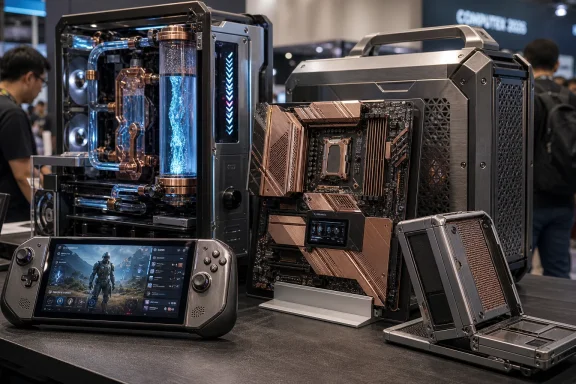 The PC Industry Finds Its Nerve Again
For the last several years, the PC hardware business has lived under a strange split personality. On one side, every vendor wants to talk about AI acceleration, TOPS, NPUs, and the inevitability of local inference. On the other, the products that still make enthusiasts stop in a booth are far more tactile: a motherboard with an absurd VRM heatsink, a case that folds flat, a cooler with visible flow, or a handheld that promises console-like mobility without surrendering PC flexibility.That tension makes TechPowerUp’s Best of Computex 2026 list more interesting than a simple awards roundup. The site covered 125 brands and more than 1,500 products at the show, but its selections skew heavily toward products that make a visual, mechanical, or thermal argument. This is not a list of the fastest benchmarks. It is a list of objects that show where the enthusiast PC market thinks emotional appeal still lives.
Computex has always been the place where the supply chain comes out from behind the curtain. CES sells narratives to consumers; Computex shows the parts those narratives will be built from. In 2026, the most compelling parts were not merely faster versions of last year’s gear. They were attempts to make the PC feel less like a commodity box and more like a personal machine again.
That matters because the desktop PC has been under aesthetic pressure from both ends. Laptops are sealed, efficient, and increasingly powerful. Game consoles are cheap, quiet, and simple. The enthusiast tower has to justify its mess of cables, fans, glass panels, and firmware menus by offering something those devices cannot: visible authorship.
Cooling Becomes the Show Floor’s Most Expressive Language
The most telling winners are cooling products, because cooling is where modern computing’s contradictions become visible. Chips are more efficient than they used to be, but they are also denser, more boost-driven, and more dependent on thermal headroom. A modern gaming PC is a negotiation between silence, sustained performance, and spectacle.Alphacool’s Xbox Series X/S cooler prototype is the purest example of that logic jumping category lines. Water-cooling an Xbox is obviously not a mainstream upgrade path. It asks users to replace the console’s chassis and stock thermal solution, which puts it firmly in the realm of modding rather than consumer accessory design.
But the idea is revealing. Consoles used to be the sealed alternative to PC tinkering. Alphacool’s prototype treats the Xbox more like a fixed-form PC with a powerful AMD system-on-chip waiting to be liberated from its acoustical compromises. The company reportedly also mentioned work on a PlayStation 5 variant, which would make the larger point even clearer: the culture of PC cooling is pushing against the walls of closed gaming hardware.
Amiiba’s ferrofluid cooling aesthetic is stranger and possibly more important as a market signal. A magnetized blob suspended in fluid and shaped by electromagnets sounds like something designed for a trade-show crowd, because it is. But the underlying move is familiar: once everyone can buy decent fans, competent pumps, and bright LCD blocks, visual identity becomes the new battlefield.
The ferrofluid element is not a better temperature chart; it is a signature. It says the cooler is not just managing heat but performing it. That may sound frivolous, but enthusiast hardware has always carried a performative layer, from cathode tubes and UV-reactive cables to RGB ecosystems and glass-panel show builds. Computex 2026 simply pushed that impulse into weirder materials.
ASRock’s Taichi Aqua 360 lands in a more practical middle ground. The cooler borrows cues from custom loops by exposing coolant movement and adding a wheel-type flow indicator, while keeping the closed-loop convenience most builders actually want. The detachable OLED screen and cableless interlocking fans are modern flourishes, but the central appeal is old-school: the user can see that the system is alive.
That is why the cooler feels smarter than yet another pump-block LCD. A screen can show anything, which eventually means it shows nothing special. Visible coolant, acrylic, and flow indicators reconnect the product to the physical work it is doing.
Cooler Master Remembers That the Socket Area Still Matters
Cooler Master’s G11M prototype makes a more technical argument. By adding a secondary cooling structure around the pump-block, including an 80 mm top-flow fan, the design tries to address a quiet casualty of the all-in-one liquid cooler era: the motherboard socket neighborhood.Traditional tower air coolers may be bulky, but their incidental airflow helps cool VRMs, memory, and nearby M.2 slots. AIOs often remove that airflow and relocate the heat exchange to a radiator, leaving the socket area cleaner but sometimes warmer. The G11M’s claim of 400 W cooling capacity inside a standard 360 mm AIO format is eye-catching, but the more interesting part is the return of directed local airflow.
This is a mature enthusiast problem. Builders who chase a clean AIO layout sometimes rediscover that motherboards and SSDs still have thermal needs beyond the CPU package. Cooler Master’s prototype suggests the market is ready for AIOs that behave less like sealed appliances and more like integrated thermal systems.
Thermal Grizzly’s DeltaMate water blocks, with a proprietary aluminium-oxynitride coating, represent the other end of the enthusiast cooling spectrum. This is not for the average builder who wants a safe install and a warranty-friendly weekend. It is for the user who buys a GeForce RTX 5090-class card and immediately thinks about replacing the factory thermal solution.
The promised support for Founders Edition and major custom-board designs is significant. Full-cover GPU blocks have always been part engineering product, part faith exercise: buyers need to believe their exact board revision will be supported, that the block will arrive in time, and that the thermal improvement will justify the risk. Thermal Grizzly’s Computex showing suggests the ultra-premium water-cooling niche remains alive precisely because GPUs have become so expensive.
Motherboards Become Luxury Objects With USB Ports
ASUS and Gigabyte both showed that motherboards are no longer satisfied being feature checklists. The ASUS ROG Crosshair 2006 is nostalgia as product strategy, a 20-year callback to the original ROG Crosshair from the Athlon 64 era. It uses the past not as a skin but as a way to justify excess.The design works because ROG itself is now old enough to have heritage. What once looked like aggressive gamer branding has become a recognizable lineage. A copper-heavy board with callbacks to the mid-2000s is not merely retro; it is a reminder of the period when enthusiast motherboards were often the center of the build rather than the thing hidden beneath a GPU and an AIO tube bundle.
The specifications are predictably maximal: a beefed-up X870E-class design, 20+2+2 power stages rated at 110 A, dual high-speed Ethernet, Wi-Fi 7, USB4, an OLED display over the primary M.2 slot, and modern convenience hardware like an AIO Q-Connector. On paper, much of this is overkill for a gaming PC. In practice, overkill is the product.
That does not make it irrational. High-end motherboards sell confidence, not just ports. They promise fewer compromises, stronger power delivery, easier building, and a platform that feels worthy of a flagship CPU and GPU. Whether most users need 10 Gb Ethernet or a tiny onboard OLED is beside the point; the buyer wants a board that looks like it was engineered with no apology.
Gigabyte’s X870E AORUS Infinity Next makes a different argument with similar pricing gravity. Its aluminium-magnesium alloy mesh heatsinks and shrouds turn motherboard cooling into industrial design. The board is not trying to evoke the past; it is trying to make the motherboard look like a finished product from a luxury equipment catalog.
This is where the PC market borrows from both automotive and sneaker culture. Materials matter because they communicate identity before a benchmark runs. Copper, aluminium-magnesium alloy, mesh, OLED, and sculpted shrouds all signal that the motherboard has become something to display.
The practical consequence is that motherboard vendors are being pulled into case-design territory. If the board is visible through glass, it must carry the build’s visual theme. That raises costs and sometimes complicates repairability, but it also gives desktop PCs a reason to remain expressive in an age when most consumer electronics are sealed slabs.
Cases Stop Pretending the Rectangle Is Sacred
The case winners may be the clearest evidence that Computex 2026 rewarded physical imagination. Corsair’s Warthog is not subtle. It revives the spirit of the old Vengeance C70 with a rugged, military-armory look, integrated handles, heavy steel, removable panels, airflow-focused design, support for reverse-connector motherboards, and a GPU anti-sag arm.The Warthog is a reminder that case design used to be much more varied before tempered glass and RGB turned half the market into variations of the same aquarium. Its appeal is not that every gamer secretly wants a weapons locker under the desk. It is that Corsair is willing to ship a case with a strong opinion again.
That opinion is also practical. Handles matter when PCs are heavy. Reverse-connector support matters as motherboard makers push cabling to the back. Cable routing systems matter because modern high-end builds are both more powerful and more visually exposed. The Warthog wraps those needs in a theme that enthusiasts will either love or dismiss instantly, which is exactly what distinctive design should do.
Geometric Future’s Model O takes a more radical route by questioning the case as a shipped object. A small-form-factor chassis that arrives flat and folds into shape with sleeved plastic and Velcro sounds almost suspicious until you remember that furniture, camping gear, and shipping logistics have spent decades refining collapsible structures. PC cases, by comparison, remain strangely inefficient objects to package and move.
The Model O’s value is not only novelty. If it can be sturdy, thermally competent, and pleasant to build in, it points toward a less wasteful way to ship small cases. Enthusiast PCs have an ecological blind spot: large boxes, foam, steel, glass, and international shipping routes for products that are often mostly air. A foldable chassis does not solve that problem by itself, but it at least admits the problem exists.
Lian Li’s DK-B desk-case hybrid shows the opposite instinct: instead of shrinking the case, absorb it into the furniture. The sit-stand walnut-topped desk with an integrated ATX-capable chassis, monitor armature, touchscreen, peg board, full-size PSU support, and room for a 360 mm AIO is the kind of product that sounds indulgent until you consider how many enthusiasts already build their entire workspaces around the PC.
At a reported $499.99 target price and Q3 2026 availability, the DK-B is not positioned like a museum piece. It is a product for the gamer-tinkerer who wants the machine to become part of the desk rather than sit on or below it. That is a very Lian Li idea: elegant, slightly excessive, and rooted in the belief that the PC is not merely a device but a workspace anchor.
Intel’s Handheld Push Is the Most Strategic Award on the List
The Intel Arc G3 selection is the most strategically important item in TechPowerUp’s list because it points beyond one product category. Handheld gaming PCs have been one of the few genuinely exciting Windows hardware stories of the last few years, but AMD has largely defined the segment. Intel’s Arc G3 effort, derived from Panther Lake/Core Ultra Series 3 silicon and aimed specifically at handhelds, is a bid to stop being an awkward laptop-chip transplant in a form factor that needs its own rules.That distinction matters. A handheld gaming PC is not just a small laptop without a keyboard. It has different thermal constraints, battery expectations, display behavior, controller integration, firmware needs, sleep/resume sensitivities, and driver pain points. The chip has to be part of a platform, not simply a SKU.
MSI’s Claw 8 EX AI+ is the first major test case in TechPowerUp’s roundup. It pairs Intel’s Arc G3 Extreme with a 9-inch 1920×1200 IPS-level touchscreen, 48–120 Hz variable refresh rate support, Hall-effect controls, an 80 Wh battery, up to 32 GB of LPDDR5X memory, dual Thunderbolt 4 ports, Wi-Fi 7, Bluetooth 6, and a reported 785 g weight. That is an ambitious spec sheet, but ambition is not the hard part in handhelds.
The hard part is price, software, and sustained efficiency. Recent listings and reporting around the Claw 8 EX AI+ suggest pricing may land well above the earlier $1,499 rumor in some configurations, with figures around $1,699 to $1,799 appearing in the channel. That pushes the device into a very different psychological bracket from the Steam Deck and even from many premium Windows handhelds.
This is where Intel’s opportunity and risk converge. If Arc G3 delivers excellent low-wattage gaming performance, strong drivers, and good battery life, Intel suddenly has a credible wedge into a category AMD has treated as its natural territory. If the device is merely fast but expensive and power-hungry, it becomes another reminder that handheld PCs are not won by silicon alone.
The Windows angle is unavoidable. These devices keep proving that Microsoft’s desktop operating system can run anywhere while also proving that it does not always feel good everywhere. Every new handheld pressures Microsoft to take the form factor more seriously, whether through Xbox-branded UI work, better controller-first navigation, improved sleep states, or a more coherent gaming shell.
The Keyboard Becomes a Control Surface
MSI’s Strike Alloy TMR keyboard and Strike Nexus sideboard are easy to underestimate because keyboards are a saturated market. Enthusiasts already have hot-swappable switches, gasket mounts, high polling rates, wireless modes, knobs, screens, and enough foam variants to make a hobbyist sound like an acoustic engineer. Yet MSI’s combination points to a real shift: the keyboard is becoming a modular command surface.The Strike Alloy TMR’s 65 percent layout, TMR precision switches, 8 kHz polling over wired and 2.4 GHz wireless, and magnesium-aluminium chassis hit the expected premium notes. The more interesting part is the sideboard. A touchscreen that can act as a numpad, PC control panel, or even an M.2 NVMe enclosure turns the keyboard into a desktop hub.
This is not entirely new; macro pads, Stream Deck-style devices, and detachable numpads have existed for years. What is changing is the level of integration. PC users increasingly run mixed workloads: gaming, streaming, coding, chatting, monitoring, tuning, and content creation. A keyboard that acknowledges those modes can become more than an input device.
There is a danger here, too. The PC peripheral market loves to create software dependencies that age badly. A control surface is only as good as its driver package, profile management, firmware updates, and compatibility over time. MSI’s hardware idea is strong, but the long-term value will depend on whether the software feels like infrastructure or bloat.
Still, the product belongs in a Best of Computex list because it extends a broader theme. The most compelling 2026 hardware is not content to do one job invisibly. It wants to mediate the user’s relationship with the whole system.
Small Desktops Refuse to Give Up the High End
ZOTAC’s Magnus One Ultra is the kind of product that keeps the small-form-factor dream alive for users who do not want to assemble a shoebox PC by hand. An 11.46-liter desktop with a Core Ultra 7 265, a desktop GeForce RTX 5080, dual DDR5 SO-DIMM slots, dual M.2 storage, Thunderbolt 4, Wi-Fi 7, and an 850 W power supply with a 12V-2x6 connector is exactly the sort of dense system that makes large towers look lazy.The catch is that small gaming desktops are never just about volume. They are about airflow paths, acoustics, serviceability, GPU compatibility, power delivery, and whether the system sounds like a leaf blower under load. A desktop RTX 5080 inside a near-shoebox chassis is impressive; keeping it civilized is the real product.
ZOTAC’s decision to omit memory and storage is also notable. It makes the Magnus One Ultra more like a barebones enthusiast platform than a locked prebuilt. That lets buyers choose their own capacity and performance mix while still avoiding the hardest SFF design work.
This category matters because not every enthusiast wants a full custom build anymore. Some want desktop-class parts in a compact machine with less risk and fewer compatibility rabbit holes. If the Magnus One Ultra executes well, it sits between the console, the gaming laptop, and the full tower in a way that makes sense for cramped desks and living rooms.
It also reinforces Computex’s larger message: the desktop PC is fragmenting into more shapes, not fewer. The tower is still here, but it now shares the enthusiast stage with desk PCs, foldable cases, handhelds, and ultra-dense prebuilts.
The Best Products Were the Ones That Escaped the AI Script
The irony of Computex 2026 is that AI may have filled the signage while the memorable products mostly came from old-fashioned hardware imagination. That does not mean AI is irrelevant to the PC market. NPUs, local models, developer tooling, and AI-assisted workflows will shape buying decisions, especially in notebooks and enterprise fleets.But for the Windows enthusiast audience, AI is not yet the thing that makes a motherboard desirable or a case worth saving for. The appeal still lives in build experience, thermal behavior, noise, serviceability, material quality, and whether a product makes the owner feel something when the side panel comes off.
TechPowerUp’s selections implicitly argue that the enthusiast market is healthy when vendors stop chasing sameness. A ferrofluid blob, a copper-heavy throwback motherboard, a military-green steel case, and a folding SFF chassis are not interchangeable products. Some will fail, some will remain niche, and some may become design cues everyone copies in two years.
That is how Computex should work. Trade shows are not only for finished answers; they are for visible experiments. The best booths make competitors uncomfortable because they reveal an idea that suddenly seems obvious.
There is also a useful corrective here for buyers. The loudest launch is not always the most important one. A small mechanical improvement in cable routing, a more thoughtful cooling path, or a better service model can matter more over five years than a spec-sheet flourish that ages after the next driver update.
The Computex 2026 Shortlist Says the Beige Box Is Not Coming Back
TechPowerUp’s award list reads like a snapshot of an enthusiast market trying to become less generic without abandoning performance. The products are not unified by category, but they are unified by a refusal to let the PC become invisible.- Alphacool’s Xbox cooler prototype shows that PC-style thermal modding is leaking into console territory.
- ASRock, Cooler Master, Amiiba, and Thermal Grizzly all suggest cooling is now as much about identity and system-level design as raw heat transfer.
- ASUS and Gigabyte are treating flagship motherboards like luxury industrial objects, not just platforms for CPUs and RAM.
- Corsair, Geometric Future, and Lian Li are challenging the assumption that a PC case has to be a conventional tower shipped as an empty metal box.
- Intel’s Arc G3 and MSI’s Claw 8 EX AI+ make handheld gaming PCs a real battleground for x86 platform design, not merely a side market for laptop chips.
- ZOTAC’s Magnus One Ultra shows that compact desktops still have room to chase flagship-class performance without becoming laptops in disguise.
The best outcome for users is not that every product on this list becomes a bestseller. It is that enough of them ship, work, and influence competitors to make the next generation of PC hardware less timid. Computex 2026’s winners show an industry rediscovering that performance alone is no longer enough; the modern PC has to earn its place on the desk, in the hand, and under the glass panel.
References
- Primary source: TechPowerUp
Published: 2026-06-19T18:50:13.690118
Best of Computex 2026 | TechPowerUp
The 2026 edition of Computex was marked by innovation from the biggest PC hardware brands. This includes otherworldly product design, a re-imagining of cases, a nostalgic motherboard resurrected, an AIO trying to be more, and a landmark processor for handheld gaming.www.techpowerup.com - Related coverage: msi.com
MSI Unveils Claw 8 EX AI+ and New AI Laptops at COMPUTEX 2026
MSI introduces the Claw 8 EX AI+, the world’s first handheld powered by Intel® Arc™ G3 Extreme processors, alongside the Titan 18 HX Dragon Edition Draco Epic and new AI-powered laptops at COMPUTEX 2026.www.msi.com - Related coverage: de.msi.com
MSI stellt auf der COMPUTEX 2026 die Claw 8 EX AI+ vor: Das erste Gaming-Handheld mit Intel® Arc™ G3 Extreme Prozessor
Auf der COMPUTEX 2026 präsentiert MSI mit der Claw 8 EX AI+ ein neues Gaming-Handheld, das auf Intels ersten speziell für Handhelds optimierten Prozessoren basiert – dem Intel® Arc™ G3 Extreme. Das Gerät wurde für mobiles AAA-Gaming entwickelt und erweitede.msi.com - Related coverage: taiwanplus.com
- Related coverage: computex-taipei.jp

開催概要 | COMPUTEX TAIPEI
COMPUTEX TAIPEI について台北国際コンピュータ見本市(COMPUTEX TAIPEI)は、世界を代表するAIとスタートアップの展示会として、世界中の起業家の皆様に産業の知識交流のためのプラットフォームを提供し、さらなる技術...
computex-taipei.jp
- Related coverage: fanaticosdelhardware.com
MSI Claw 8 EX AI+ debuta en Computex 2026 con Intel Arc G3 Extreme, Panther Lake y pantalla VRR
MSI Claw 8 EX AI+ llega a Computex 2026 con Intel Panther Lake, Arc G3 Extreme, 32 GB LPDDR5X y batería de 80 Wh.fanaticosdelhardware.com
- Related coverage: alphacool.com
Alphacool is at Computex 2026!
High End Water Cooling for: OEM Manufacturing - DIY Solutions - Industrial Cooler - Enterprise Solutions - German Development - Own Manufacturing - Since 2003! www.alphacool.com
- Related coverage: download.intel.com
