

Computex 2026 is unfolding in Taipei from June 2 through June 6, with Nvidia, Microsoft, Intel, Qualcomm, AMD, and the PC industry’s usual hardware heavyweights using the show to pitch the next personal-computing cycle around local AI, new silicon, and Windows machines built for agentic software. The easy version of the story is that this is another component show with faster chips and stranger laptops. The more important version is that Computex has become the place where the PC industry tries to prove it still controls the future of computing. For Windows users and IT departments, the reveals matter less as isolated product launches than as evidence of a platform war moving back onto the desk.
For decades, Computex was the global bazaar of motherboards, memory, cases, cooling gear, notebooks, barebones systems, and booth demos that looked one firmware update away from either greatness or smoke. It was the show where component makers came to court OEMs, distributors, reviewers, and the kind of buyer who can identify a VRM layout at ten paces. That Computex still exists, and enthusiasts still get their dose of motherboards, GPUs, mini-PCs, handhelds, chassis, and absurd RGB contraptions.
But the center of gravity has shifted. The industry’s biggest announcements now arrive wrapped in the language of AI infrastructure, agentic computing, local inference, cloud-to-edge orchestration, and developer ecosystems. The beige-box lineage is still there, but it has been absorbed into a larger contest over who defines the next user interface for the PC.
That is why the presence of Nvidia, Microsoft, Intel, Qualcomm, AMD, Asus, Acer, MSI, and the broader Taiwan supply chain matters. Computex is no longer merely where PC parts are shown; it is where the PC industry negotiates its collective response to Apple’s silicon strategy, cloud AI, Arm laptops, and the uneasy question of whether Windows can remain the default environment for high-performance personal computing.
This year’s theme is not subtle. Everyone wants to show that the PC is not being replaced by AI assistants in the cloud. Instead, they want to argue that the PC is where those assistants should live, run, reason, and act.
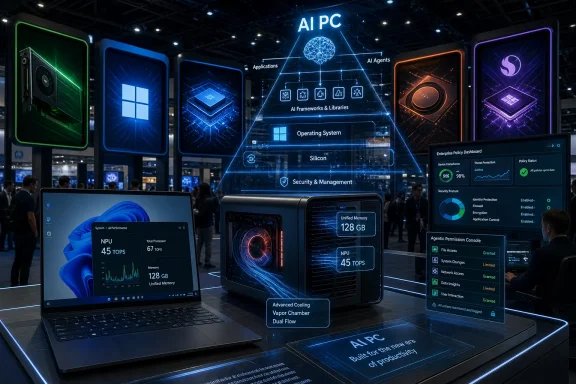
The headline reveal around Nvidia’s RTX Spark platform points to a much more ambitious target than another GPU generation. Nvidia is pushing a Windows-on-Arm device class built around a tightly integrated Arm CPU, Blackwell-derived GPU capability, and large pools of unified memory. In plain English, that means Nvidia wants laptops and compact desktops to behave less like traditional PCs with AI features and more like local AI machines that also happen to run Windows.
The inclusion of up to 128GB of unified memory in early coverage is the tell. Consumer laptops usually sell memory as a productivity convenience: more tabs, larger Photoshop files, smoother multitasking. Nvidia is selling memory as model capacity. That turns RAM from a spec-sheet afterthought into the difference between running meaningful local AI workloads and merely calling a cloud API.
Microsoft’s role is just as important. A Windows device powered by Nvidia silicon is not only a hardware story; it is an ecosystem statement. Microsoft has spent the last several years trying to make Windows on Arm credible after earlier efforts suffered from performance gaps, app compatibility concerns, and weak consumer momentum. Nvidia entering that lane gives the project a different character, because the pitch is not just battery life or thinness. It is AI performance.
The risk is that Nvidia’s definition of the future PC may be too developer- and demo-driven for ordinary buyers. “Agentic AI” sounds impressive in a keynote, but it has to become something more concrete than a chatbot with file-system permissions. Users will judge these machines by whether they improve work, gaming, creation, search, accessibility, and system management without becoming another layer of opaque automation.
Still, Nvidia has a habit of dragging the market toward its preferred assumptions. It did that with CUDA in compute, RTX in gaming, and accelerated infrastructure in AI. At Computex 2026, it is attempting the same move with the Windows PC: make the GPU company’s architecture feel like the obvious foundation for the next desktop era.
The company’s strongest argument is practical: Windows already sits in the middle of the workflows that AI agents would need to touch. Files, browsers, Office apps, Teams, developer tools, management consoles, creative apps, and line-of-business software are already there. If agents are supposed to plan tasks, retrieve information, summarize documents, automate steps, and coordinate work across applications, Windows is an obvious place to run them.
The problem is trust. Windows users have seen enough forced defaults, unsolicited prompts, telemetry debates, advertising surfaces, and feature churn to be wary when Microsoft says the operating system is becoming more helpful. An agentic Windows experience will require permissions, context, indexing, memory, and some level of observation. Those are precisely the ingredients that make security and privacy-minded users nervous.
That makes Computex 2026 a preview of the real fight ahead. Microsoft and its partners can ship AI-capable hardware, but they still need to persuade users that local AI is not merely a new justification for more expensive laptops. They also need to persuade administrators that agentic features can be governed, logged, disabled, audited, and isolated.
For enterprises, the answer will not be keynote magic. It will be Group Policy, Intune controls, documented APIs, predictable lifecycle support, and clear boundaries between local processing and cloud services. If Microsoft wants AI agents to become normal Windows citizens, it has to make them manageable as well as impressive.
That is where the Windows story may diverge from the consumer hype. The most important “AI PC” feature for many organizations will not be a dazzling assistant. It will be the ability to say no, say yes selectively, or say yes only under conditions that compliance teams can explain.
The company’s “AI everywhere” framing is therefore not just marketing. It is defensive architecture. Intel needs to show that AI workloads can run across CPUs, GPUs, NPUs, and data-center products in a way that keeps Intel relevant from laptops to enterprise infrastructure. The more the market believes AI PCs are defined by GPU-heavy local inference or Arm-based efficiency, the more Intel has to prove x86 remains the practical default.
Intel’s advantage remains enormous. It has deep OEM relationships, enterprise trust, broad software compatibility, mature platform validation, and decades of IT muscle memory behind it. For many businesses, the safest AI PC will still be an Intel laptop from an established fleet vendor running known Windows images, known security tooling, and known management stacks.
But Intel’s weakness is that “safe default” is not the same as “future-defining.” Computex is a theater of direction, and Nvidia currently owns much of the directional energy around AI. Qualcomm owns much of the mobility argument. AMD continues to pressure performance-per-dollar and integrated graphics expectations. Intel has to be more than compatible; it has to be compelling.
That is why Intel’s Computex story matters even for users who do not follow keynote slides. If Intel succeeds, the AI PC becomes a mainstream refresh category that fits into familiar procurement and support models. If it stumbles, the market fragments faster, and Windows administrators inherit a more complicated world of Arm systems, GPU-centric workstations, x86 legacy estates, and inconsistent AI capabilities.
The old Windows-on-Arm argument was often framed around mobility. The new one is framed around efficiency under persistent AI workloads. If a PC is expected to run assistants, context engines, transcription, summarization, image processing, or developer copilots throughout the day, performance per watt becomes more than a battery-life brag. It becomes the difference between a usable machine and a hot slab of compromise.
Qualcomm can credibly argue that it understands this kind of computing better than most PC incumbents. Phones have been sensor-rich, always-connected, AI-assisted devices for years. Bringing that design philosophy to laptops makes sense, particularly for users who live in browsers, Office apps, communication tools, and web services.
The remaining problem is the old one: Windows compatibility is not a vibe. It is a spreadsheet of applications, drivers, plug-ins, VPN clients, security agents, printers, peripherals, and strange business utilities last updated during the Obama administration. Qualcomm’s success depends not only on silicon but on whether Windows on Arm feels invisible to users who do not care what instruction set their laptop uses.
This is where Nvidia’s entrance could help the entire Arm side of the Windows ecosystem. If more major vendors target Arm-based Windows machines, developers have more incentive to optimize. If developers optimize, buyers become less nervous. If buyers become less nervous, OEMs ship more designs. That virtuous cycle has eluded Windows on Arm before, but Computex 2026 suggests the industry is trying to force it into existence.
That matters because not every PC buyer wants to be an early adopter in an AI platform transition. Many want a faster laptop, a better gaming desktop, a capable creator system, or a handheld that does not melt its battery in an hour. AMD’s recent strength has come from meeting those buyers with credible parts across price bands.
The AI PC wave also creates an opening for AMD’s integrated graphics and NPU strategies. Local AI will not be one workload. It will be a messy spread of media features, Windows services, developer tools, image generation, audio cleanup, game upscaling, webcam effects, coding assistants, and enterprise automation. A balanced architecture may be more useful to many users than a single spectacular benchmark.
AMD’s challenge is narrative control. Nvidia is extraordinarily good at defining the terms of a market. Intel still has institutional gravity. Qualcomm has the mobility story. AMD often wins by being adopted rather than by dictating the conversation. At Computex, that can make the company seem less central than it is.
For WindowsForum readers, the AMD angle is refreshingly concrete. If you are building or buying a PC in the next year, AMD systems may continue to offer the least exotic path to high performance without betting your workflow on the first generation of a new AI platform story. Sometimes the most important product at a hype-heavy trade show is the one that lets you ignore the hype.
Expect the show floor to produce a familiar mix: impossibly thin laptops, overbuilt gaming rigs, compact workstations, experimental cooling, modular designs, handheld PCs, creator notebooks, new displays, faster storage, and motherboards that appear designed by someone who has never known visual restraint. That spectacle is part of Computex’s charm. It is also where the AI PC story becomes testable.
A local AI machine needs more than a logo. It needs enough memory, enough storage, enough sustained cooling, and enough software polish to make the hardware useful after the demo ends. If a laptop throttles under sustained inference, if drivers are immature, if battery life collapses when AI features run locally, or if the promised assistant workflows require subscriptions anyway, buyers will notice.
The most interesting OEM designs may be the ones that treat AI as a workload rather than a sticker. That could mean more memory in mainstream configurations, better thermal design in thin laptops, faster SSDs for local model storage, privacy switches that apply to microphones and cameras used by AI features, and firmware settings that expose AI accelerators cleanly to administrators.
There is also a quiet repairability and longevity issue here. AI-capable PCs may push buyers toward soldered memory, tightly integrated packages, and vendor-specific acceleration paths. That can improve performance and efficiency, but it can also shorten the practical life of a machine if the original configuration proves inadequate. Enthusiasts have seen this trade before. The difference now is that memory capacity may determine not only multitasking comfort but access to future local AI features.
A typical organization may soon face Windows laptops with Intel NPUs, AMD NPUs, Qualcomm Arm processors, Nvidia-based Arm systems, discrete RTX GPUs, integrated GPUs with varying AI support, and cloud-connected Microsoft features layered across them all. Each device may technically be an AI PC, but the actual capabilities could differ substantially. That complicates support, imaging, application deployment, security baselines, and user training.
The term AI PC is already at risk of becoming too broad to be useful. One machine might handle webcam effects and transcription. Another might run local language models. A third might accelerate developer tools. A fourth might be sold as AI-ready because it meets a minimum NPU threshold but still depend heavily on the cloud for anything impressive. Without clearer tiers, buyers will have to read the fine print.
Security teams will also care about where data goes. If local AI is truly local, that is a meaningful advantage for sensitive work. If “local” quietly becomes “local preprocessing plus cloud inference plus account-linked memory,” the risk profile changes. Vendors will need to document this distinction plainly, because administrators will ask.
The irony is that the enterprise may eventually become the strongest argument for local AI. Regulated industries, government agencies, legal firms, healthcare organizations, and security-conscious companies all have reasons to prefer processing sensitive data on managed hardware. But that only works if the local AI stack is controllable, patchable, observable, and explainable.
Windows history is littered with promising hardware ideas that failed at the software layer. Tablet PCs arrived before the ecosystem was ready. Windows RT exposed the pain of compatibility gaps. Early always-connected PCs struggled to make their advantages outweigh their constraints. Mixed reality hardware arrived with more ambition than everyday use cases. The lesson is not that new categories always fail; it is that Windows categories succeed only when the platform, apps, hardware, and price all align.
That is why Nvidia’s RTX Spark push is so intriguing. It is either a genuine turning point for Windows on Arm and local AI, or it is another premium concept that dazzles in demos while mainstream buyers continue choosing conventional x86 laptops. The difference will be measured in application support, battery life, heat, price, and whether users can describe what the machine does better without using the phrase “agentic AI.”
Microsoft has its own burden of proof. Copilot branding has expanded faster than user trust. For the next wave to land, Microsoft must show restraint and clarity. AI features that help users recover files, automate tedious settings, summarize local documents privately, troubleshoot Windows problems, or manage accessibility could become genuinely valuable. AI features that nag, upsell, or blur privacy boundaries will become another reason power users reach for registry edits and policy templates.
The PC’s great strength has always been its messiness. It supports gamers, accountants, developers, tinkerers, designers, students, sysadmins, modders, and people running ancient peripherals for reasons no one should question. The AI PC will succeed only if it respects that mess rather than trying to smooth it into a single assistant-driven workflow.
There will be conventional PCs that run AI features opportunistically. There will be NPU-equipped mainstream machines designed for efficient background tasks. There will be GPU-heavy creator and developer systems aimed at local model work. There will be Arm laptops prioritizing battery life and persistent assistants. There may be Nvidia-powered Windows devices that try to combine workstation AI with mobile form factors.
That fragmentation is not necessarily bad. The PC market thrives when users can choose. But choice becomes a burden when branding hides meaningful differences. A $799 AI laptop and a $2,499 AI workstation may both carry similar stickers while serving entirely different purposes.
For enthusiasts, this could be an exciting period. Local AI workloads may create new reasons to care about memory bandwidth, unified memory capacity, GPU architecture, NPU TOPS, storage performance, and thermal design. The spec sheet may become interesting again in a way that goes beyond incremental CPU gains.
For ordinary consumers, the risk is confusion. The industry has a habit of turning useful technology into a fog of badges. If every laptop is an AI laptop, the label stops helping. Buyers will need reviewers, sysadmins, and technically literate friends to translate the marketing back into consequences.
That does not mean every reveal will matter. Many will be forgotten by the next refresh cycle. Some prototypes will never ship widely. Some AI features will turn out to be wrappers around services that could have run on last year’s laptop. Some products will ask buyers to pay early-adopter prices for workflows that are not yet mature.
But the direction is real. Nvidia is pushing Windows toward GPU-rich local AI. Microsoft is preparing Windows for agents. Intel is trying to keep x86 central to the transition. Qualcomm is pressing the efficiency case for Arm. AMD is positioned to make balanced performance look refreshingly practical. OEMs are about to turn all of that into machines users can actually buy, return, image, repair, complain about, and eventually depend on.
The most important Computex reveals, then, are not single products. They are the outlines of a new PC hierarchy.
 Computex Has Stopped Pretending This Is Just a Hardware Show
For decades, Computex was the global bazaar of motherboards, memory, cases, cooling gear, notebooks, barebones systems, and booth demos that looked one firmware update away from either greatness or smoke. It was the show where component makers came to court OEMs, distributors, reviewers, and the kind of buyer who can identify a VRM layout at ten paces. That Computex still exists, and enthusiasts still get their dose of motherboards, GPUs, mini-PCs, handhelds, chassis, and absurd RGB contraptions.But the center of gravity has shifted. The industry’s biggest announcements now arrive wrapped in the language of AI infrastructure, agentic computing, local inference, cloud-to-edge orchestration, and developer ecosystems. The beige-box lineage is still there, but it has been absorbed into a larger contest over who defines the next user interface for the PC.
That is why the presence of Nvidia, Microsoft, Intel, Qualcomm, AMD, Asus, Acer, MSI, and the broader Taiwan supply chain matters. Computex is no longer merely where PC parts are shown; it is where the PC industry negotiates its collective response to Apple’s silicon strategy, cloud AI, Arm laptops, and the uneasy question of whether Windows can remain the default environment for high-performance personal computing.
This year’s theme is not subtle. Everyone wants to show that the PC is not being replaced by AI assistants in the cloud. Instead, they want to argue that the PC is where those assistants should live, run, reason, and act.
Nvidia Wants the PC to Become an AI Workstation by Default
Nvidia’s Computex presence has increasingly resembled a state visit. Jensen Huang does not merely introduce products; he sketches an economic theory of computing in which accelerated hardware becomes the substrate for everything from data centers to robotics to personal devices. The company’s 2026 message extends that argument directly into Windows.The headline reveal around Nvidia’s RTX Spark platform points to a much more ambitious target than another GPU generation. Nvidia is pushing a Windows-on-Arm device class built around a tightly integrated Arm CPU, Blackwell-derived GPU capability, and large pools of unified memory. In plain English, that means Nvidia wants laptops and compact desktops to behave less like traditional PCs with AI features and more like local AI machines that also happen to run Windows.
The inclusion of up to 128GB of unified memory in early coverage is the tell. Consumer laptops usually sell memory as a productivity convenience: more tabs, larger Photoshop files, smoother multitasking. Nvidia is selling memory as model capacity. That turns RAM from a spec-sheet afterthought into the difference between running meaningful local AI workloads and merely calling a cloud API.
Microsoft’s role is just as important. A Windows device powered by Nvidia silicon is not only a hardware story; it is an ecosystem statement. Microsoft has spent the last several years trying to make Windows on Arm credible after earlier efforts suffered from performance gaps, app compatibility concerns, and weak consumer momentum. Nvidia entering that lane gives the project a different character, because the pitch is not just battery life or thinness. It is AI performance.
The risk is that Nvidia’s definition of the future PC may be too developer- and demo-driven for ordinary buyers. “Agentic AI” sounds impressive in a keynote, but it has to become something more concrete than a chatbot with file-system permissions. Users will judge these machines by whether they improve work, gaming, creation, search, accessibility, and system management without becoming another layer of opaque automation.
Still, Nvidia has a habit of dragging the market toward its preferred assumptions. It did that with CUDA in compute, RTX in gaming, and accelerated infrastructure in AI. At Computex 2026, it is attempting the same move with the Windows PC: make the GPU company’s architecture feel like the obvious foundation for the next desktop era.
Microsoft’s Bet Is That Windows Can Absorb the Agent
Microsoft arrives at this Computex with a delicate job. It has to support the AI PC narrative without making Windows feel like a platform being repainted every year to satisfy Wall Street’s appetite for artificial intelligence. That is harder than it sounds.The company’s strongest argument is practical: Windows already sits in the middle of the workflows that AI agents would need to touch. Files, browsers, Office apps, Teams, developer tools, management consoles, creative apps, and line-of-business software are already there. If agents are supposed to plan tasks, retrieve information, summarize documents, automate steps, and coordinate work across applications, Windows is an obvious place to run them.
The problem is trust. Windows users have seen enough forced defaults, unsolicited prompts, telemetry debates, advertising surfaces, and feature churn to be wary when Microsoft says the operating system is becoming more helpful. An agentic Windows experience will require permissions, context, indexing, memory, and some level of observation. Those are precisely the ingredients that make security and privacy-minded users nervous.
That makes Computex 2026 a preview of the real fight ahead. Microsoft and its partners can ship AI-capable hardware, but they still need to persuade users that local AI is not merely a new justification for more expensive laptops. They also need to persuade administrators that agentic features can be governed, logged, disabled, audited, and isolated.
For enterprises, the answer will not be keynote magic. It will be Group Policy, Intune controls, documented APIs, predictable lifecycle support, and clear boundaries between local processing and cloud services. If Microsoft wants AI agents to become normal Windows citizens, it has to make them manageable as well as impressive.
That is where the Windows story may diverge from the consumer hype. The most important “AI PC” feature for many organizations will not be a dazzling assistant. It will be the ability to say no, say yes selectively, or say yes only under conditions that compliance teams can explain.
Intel Is Fighting for the Center of the PC While the Edges Move
Intel’s Computex 2026 messaging reflects a company trying to reassert ownership of a market it once defined almost by default. For decades, the PC industry’s rhythm followed Intel’s cadence. New CPU, new platform, new chipset, new OEM designs, new enterprise refresh. That model has been under pressure from AMD in x86 performance, Apple in vertically integrated Arm systems, Qualcomm in Windows-on-Arm mobility, and Nvidia in accelerated computing.The company’s “AI everywhere” framing is therefore not just marketing. It is defensive architecture. Intel needs to show that AI workloads can run across CPUs, GPUs, NPUs, and data-center products in a way that keeps Intel relevant from laptops to enterprise infrastructure. The more the market believes AI PCs are defined by GPU-heavy local inference or Arm-based efficiency, the more Intel has to prove x86 remains the practical default.
Intel’s advantage remains enormous. It has deep OEM relationships, enterprise trust, broad software compatibility, mature platform validation, and decades of IT muscle memory behind it. For many businesses, the safest AI PC will still be an Intel laptop from an established fleet vendor running known Windows images, known security tooling, and known management stacks.
But Intel’s weakness is that “safe default” is not the same as “future-defining.” Computex is a theater of direction, and Nvidia currently owns much of the directional energy around AI. Qualcomm owns much of the mobility argument. AMD continues to pressure performance-per-dollar and integrated graphics expectations. Intel has to be more than compatible; it has to be compelling.
That is why Intel’s Computex story matters even for users who do not follow keynote slides. If Intel succeeds, the AI PC becomes a mainstream refresh category that fits into familiar procurement and support models. If it stumbles, the market fragments faster, and Windows administrators inherit a more complicated world of Arm systems, GPU-centric workstations, x86 legacy estates, and inconsistent AI capabilities.
Qualcomm Keeps Pulling Windows Toward the Phone’s Physics
Qualcomm’s role at Computex is different from Intel’s and Nvidia’s. It is not trying to make the PC more like a workstation. It is trying to make the PC inherit the phone’s strengths: instant wake, long battery life, integrated connectivity, efficient standby, and silent operation. That pitch has been around for years, but it now lands in a more favorable market because AI gives Windows-on-Arm another reason to exist.The old Windows-on-Arm argument was often framed around mobility. The new one is framed around efficiency under persistent AI workloads. If a PC is expected to run assistants, context engines, transcription, summarization, image processing, or developer copilots throughout the day, performance per watt becomes more than a battery-life brag. It becomes the difference between a usable machine and a hot slab of compromise.
Qualcomm can credibly argue that it understands this kind of computing better than most PC incumbents. Phones have been sensor-rich, always-connected, AI-assisted devices for years. Bringing that design philosophy to laptops makes sense, particularly for users who live in browsers, Office apps, communication tools, and web services.
The remaining problem is the old one: Windows compatibility is not a vibe. It is a spreadsheet of applications, drivers, plug-ins, VPN clients, security agents, printers, peripherals, and strange business utilities last updated during the Obama administration. Qualcomm’s success depends not only on silicon but on whether Windows on Arm feels invisible to users who do not care what instruction set their laptop uses.
This is where Nvidia’s entrance could help the entire Arm side of the Windows ecosystem. If more major vendors target Arm-based Windows machines, developers have more incentive to optimize. If developers optimize, buyers become less nervous. If buyers become less nervous, OEMs ship more designs. That virtuous cycle has eluded Windows on Arm before, but Computex 2026 suggests the industry is trying to force it into existence.
AMD’s Opportunity Is to Be the Sane Performance Choice
AMD does not need to own every Computex headline to benefit from the show’s direction. In a year when Nvidia is selling the AI workstation future, Intel is defending the mainstream, Qualcomm is selling mobile efficiency, and Microsoft is trying to platformize agents, AMD can occupy a valuable middle ground: strong CPUs, strong integrated graphics, competitive discrete GPUs, and a reputation among enthusiasts for practical performance.That matters because not every PC buyer wants to be an early adopter in an AI platform transition. Many want a faster laptop, a better gaming desktop, a capable creator system, or a handheld that does not melt its battery in an hour. AMD’s recent strength has come from meeting those buyers with credible parts across price bands.
The AI PC wave also creates an opening for AMD’s integrated graphics and NPU strategies. Local AI will not be one workload. It will be a messy spread of media features, Windows services, developer tools, image generation, audio cleanup, game upscaling, webcam effects, coding assistants, and enterprise automation. A balanced architecture may be more useful to many users than a single spectacular benchmark.
AMD’s challenge is narrative control. Nvidia is extraordinarily good at defining the terms of a market. Intel still has institutional gravity. Qualcomm has the mobility story. AMD often wins by being adopted rather than by dictating the conversation. At Computex, that can make the company seem less central than it is.
For WindowsForum readers, the AMD angle is refreshingly concrete. If you are building or buying a PC in the next year, AMD systems may continue to offer the least exotic path to high performance without betting your workflow on the first generation of a new AI platform story. Sometimes the most important product at a hype-heavy trade show is the one that lets you ignore the hype.
The OEMs Are Turning AI Into Shapes You Can Actually Buy
The silicon companies define the keynote language, but the OEMs decide what users see on shelves. Asus, MSI, Acer, Gigabyte, Lenovo, Dell, HP, Framework, and the mini-PC specialists are the ones who translate platform claims into thermals, keyboards, repairability, port selection, firmware quality, screen options, fan noise, and price. Computex is where those translations get weird, useful, or both.Expect the show floor to produce a familiar mix: impossibly thin laptops, overbuilt gaming rigs, compact workstations, experimental cooling, modular designs, handheld PCs, creator notebooks, new displays, faster storage, and motherboards that appear designed by someone who has never known visual restraint. That spectacle is part of Computex’s charm. It is also where the AI PC story becomes testable.
A local AI machine needs more than a logo. It needs enough memory, enough storage, enough sustained cooling, and enough software polish to make the hardware useful after the demo ends. If a laptop throttles under sustained inference, if drivers are immature, if battery life collapses when AI features run locally, or if the promised assistant workflows require subscriptions anyway, buyers will notice.
The most interesting OEM designs may be the ones that treat AI as a workload rather than a sticker. That could mean more memory in mainstream configurations, better thermal design in thin laptops, faster SSDs for local model storage, privacy switches that apply to microphones and cameras used by AI features, and firmware settings that expose AI accelerators cleanly to administrators.
There is also a quiet repairability and longevity issue here. AI-capable PCs may push buyers toward soldered memory, tightly integrated packages, and vendor-specific acceleration paths. That can improve performance and efficiency, but it can also shorten the practical life of a machine if the original configuration proves inadequate. Enthusiasts have seen this trade before. The difference now is that memory capacity may determine not only multitasking comfort but access to future local AI features.
The AI PC Is Becoming a Procurement Problem Before It Becomes a User Need
For IT departments, Computex 2026 is less a shopping event than a warning flare. The PC fleet is about to become more heterogeneous at the exact moment vendors are promising deeper automation inside the operating system. That is not automatically bad, but it is operationally significant.A typical organization may soon face Windows laptops with Intel NPUs, AMD NPUs, Qualcomm Arm processors, Nvidia-based Arm systems, discrete RTX GPUs, integrated GPUs with varying AI support, and cloud-connected Microsoft features layered across them all. Each device may technically be an AI PC, but the actual capabilities could differ substantially. That complicates support, imaging, application deployment, security baselines, and user training.
The term AI PC is already at risk of becoming too broad to be useful. One machine might handle webcam effects and transcription. Another might run local language models. A third might accelerate developer tools. A fourth might be sold as AI-ready because it meets a minimum NPU threshold but still depend heavily on the cloud for anything impressive. Without clearer tiers, buyers will have to read the fine print.
Security teams will also care about where data goes. If local AI is truly local, that is a meaningful advantage for sensitive work. If “local” quietly becomes “local preprocessing plus cloud inference plus account-linked memory,” the risk profile changes. Vendors will need to document this distinction plainly, because administrators will ask.
The irony is that the enterprise may eventually become the strongest argument for local AI. Regulated industries, government agencies, legal firms, healthcare organizations, and security-conscious companies all have reasons to prefer processing sensitive data on managed hardware. But that only works if the local AI stack is controllable, patchable, observable, and explainable.
Windows Enthusiasts Should Watch the Boring Details
The temptation with Computex is to chase the largest number and the strangest prototype. That is fun, and there is nothing wrong with fun. But the most consequential details for Windows users often live in the boring parts of the announcement: supported APIs, driver models, memory configurations, upgrade paths, firmware maturity, security defaults, and whether features survive outside a controlled demo.Windows history is littered with promising hardware ideas that failed at the software layer. Tablet PCs arrived before the ecosystem was ready. Windows RT exposed the pain of compatibility gaps. Early always-connected PCs struggled to make their advantages outweigh their constraints. Mixed reality hardware arrived with more ambition than everyday use cases. The lesson is not that new categories always fail; it is that Windows categories succeed only when the platform, apps, hardware, and price all align.
That is why Nvidia’s RTX Spark push is so intriguing. It is either a genuine turning point for Windows on Arm and local AI, or it is another premium concept that dazzles in demos while mainstream buyers continue choosing conventional x86 laptops. The difference will be measured in application support, battery life, heat, price, and whether users can describe what the machine does better without using the phrase “agentic AI.”
Microsoft has its own burden of proof. Copilot branding has expanded faster than user trust. For the next wave to land, Microsoft must show restraint and clarity. AI features that help users recover files, automate tedious settings, summarize local documents privately, troubleshoot Windows problems, or manage accessibility could become genuinely valuable. AI features that nag, upsell, or blur privacy boundaries will become another reason power users reach for registry edits and policy templates.
The PC’s great strength has always been its messiness. It supports gamers, accountants, developers, tinkerers, designers, students, sysadmins, modders, and people running ancient peripherals for reasons no one should question. The AI PC will succeed only if it respects that mess rather than trying to smooth it into a single assistant-driven workflow.
The Reveals Point to a PC Market That Is Splitting Into New Classes
Computex 2026 suggests that the old categories are no longer enough. “Laptop,” “desktop,” “workstation,” and “gaming PC” still matter, but they do not describe the emerging differences in architecture and workload. The next Windows buying decision may involve choosing what kind of intelligence, if any, you want built into the machine.There will be conventional PCs that run AI features opportunistically. There will be NPU-equipped mainstream machines designed for efficient background tasks. There will be GPU-heavy creator and developer systems aimed at local model work. There will be Arm laptops prioritizing battery life and persistent assistants. There may be Nvidia-powered Windows devices that try to combine workstation AI with mobile form factors.
That fragmentation is not necessarily bad. The PC market thrives when users can choose. But choice becomes a burden when branding hides meaningful differences. A $799 AI laptop and a $2,499 AI workstation may both carry similar stickers while serving entirely different purposes.
For enthusiasts, this could be an exciting period. Local AI workloads may create new reasons to care about memory bandwidth, unified memory capacity, GPU architecture, NPU TOPS, storage performance, and thermal design. The spec sheet may become interesting again in a way that goes beyond incremental CPU gains.
For ordinary consumers, the risk is confusion. The industry has a habit of turning useful technology into a fog of badges. If every laptop is an AI laptop, the label stops helping. Buyers will need reviewers, sysadmins, and technically literate friends to translate the marketing back into consequences.
The Taipei Message Is Clearer Than the Marketing
Computex 2026 is noisy, but its signal is not hard to find. The PC industry believes the next platform shift is not simply cloud AI added to existing computers. It believes the computer itself must change to host, accelerate, and govern AI locally.That does not mean every reveal will matter. Many will be forgotten by the next refresh cycle. Some prototypes will never ship widely. Some AI features will turn out to be wrappers around services that could have run on last year’s laptop. Some products will ask buyers to pay early-adopter prices for workflows that are not yet mature.
But the direction is real. Nvidia is pushing Windows toward GPU-rich local AI. Microsoft is preparing Windows for agents. Intel is trying to keep x86 central to the transition. Qualcomm is pressing the efficiency case for Arm. AMD is positioned to make balanced performance look refreshingly practical. OEMs are about to turn all of that into machines users can actually buy, return, image, repair, complain about, and eventually depend on.
The most important Computex reveals, then, are not single products. They are the outlines of a new PC hierarchy.
The Computex 2026 Scorecard for Windows Buyers
Before the marketing hardens into retail stickers, Windows users should treat this year’s announcements as a map of what to evaluate rather than a command to upgrade. The useful question is not whether a machine is called an AI PC. The useful question is what it can do locally, securely, repeatedly, and better than the PC already on your desk.- Nvidia’s RTX Spark push makes Windows on Arm more serious by tying it to high-end local AI performance rather than just battery life.
- Microsoft’s agentic Windows ambitions will succeed only if users and administrators can control the features as confidently as they can use them.
- Intel remains the enterprise default, but it must prove that familiar x86 platforms can be more than the safe choice in an AI-heavy refresh cycle.
- Qualcomm’s best argument is efficiency, especially if persistent AI workloads become normal on mobile PCs.
- AMD may benefit from buyers who want strong, balanced Windows machines without joining the first wave of experimental platform bets.
- The phrase “AI PC” is already too vague, so memory capacity, accelerator type, app support, thermals, and management controls matter more than the badge.
References
- Primary source: PCMag Australia
Published: Wed, 03 Jun 2026 14:32:31 GMT
Everything You Missed at Computex 2026: All the Reveals From Nvidia's RTX Spark to Asus' ROG 20th Anniversary
Follow back with us to every big reveal, trend, and hands-on from the world's biggest PC show, held in Taipei the first week of June.au.pcmag.com - Related coverage: tomshardware.com
Nvidia unveils RTX Spark Superchip for laptops and desktop PCs at Computex 2026 – new platform promises to turn Windows into an agentic AI OS with Arm CPU, Blackwell GPU, and 128GB unified memory | Tom's Hardware
Over 30 laptops and 10 desktops coming this fall with "the most efficent platform ever built"www.tomshardware.com - Related coverage: techradar.com
We're at Computex 2026! Ask our experts anything you want to know about the world's biggest computing show | TechRadar
Your inside track to the world's largest computing showwww.techradar.com - Related coverage: windowscentral.com
Surface Laptop Ultra: Microsoft and NVIDIA reveal the 128GB RAM, mini‑LED, RTX Spark powerhouse redefining Windows on Arm | Windows Central
Uncompromising raw NVIDIA N1x power meets legendary Surface craft, but can people afford it?www.windowscentral.com - Related coverage: t3.com
Here's why the Nvidia RTX Spark might be super important for the future of laptops | T3
This chipset could upset the market in a big waywww.t3.com - Related coverage: newsroom.intel.com
Computex 2026: An Intelligent World Built on Silicon - Intel Newsroom
 newsroom.intel.com
- Related coverage: nvidia.com
NVIDIA at COMPUTEX 2026: NVIDIA RTX Spark, DLSS 4.5, RTX Updates | GeForce
NVIDIA at COMPUTEX 2026: NVIDIA RTX Spark platform for AI PCs, DLSS 4.5 Ray Reconstruction, 1,000+ RTX games and apps, NVIDIA app updates, and new partner cards, laptops, and displays.www.nvidia.com - Related coverage: investor.nvidia.com
NVIDIA Corporation - NVIDIA CEO Jensen Huang and Global Technology Leaders to Showcase Age of AI at GTC 2026
Huang’s Keynote, 1,000+ Sessions and Breakthroughs Across the AI Stack Headline the World’s Leading AI Conference SANTA CLARA, Calif., March 03, 2026 (GLOBE NEWSWIRE) - NVIDIA today announced that GTC, the world’s premier conference on AI and accelerated computing, will take place March 16-19...investor.nvidia.com - Related coverage: pcgamer.com
Computex 2026 Live: The biggest PC gaming hardware announcements at this year's show | PC Gamer
It's here, it's happening, and we're on the ground covering all the latest hardware news.www.pcgamer.com - Related coverage: tomsguide.com
I'm at Computex 2026 LIVE — testing every Nvidia RTX Spark laptop and so much more on day two | Tom's Guide
The most significant Computex I've ever been to!www.tomsguide.com - Related coverage: blogs.nvidia.com
NVIDIA GTC Taipei at COMPUTEX: Live Updates on What’s Next in AI | NVIDIA Blog
At NVIDIA GTC Taipei at COMPUTEX, the world’s developers, researchers and industry leaders are converging to dive into the latest breakthroughs shaping every industry, covering topics spanning AI factories and scaling infrastructure to agentic and physical AI and more.blogs.nvidia.com - Related coverage: wareconn.com

- Related coverage: download.intel.com
- Related coverage: nvidianews.nvidia.com
