

Concentric AI’s Semantic Intelligence platform can now run its Private Scan Manager inside AWS GovCloud (U.S., giving U.S. federal agencies, contractors, and other regulated organizations a new option to process Controlled Unclassified Information (CUI) and highly sensitive data inside physically and logically isolated U.S. sovereign regions while leveraging the company’s context-aware AI for discovery, classification, remediation, and GenAI-aware data protection.
Concentric AI has steadily expanded the deployment models for its Semantic Intelligence™ data security governance platform over the past year, adding private-cloud scanning and categorization options that keep raw scanning and classification workloads inside customer-controlled environments. The company’s Private Scan Manager was first introduced to allow on-premises and private-cloud scanning for data stored in systems such as NetApp ONTAP and MongoDB, and later extended to private Microsoft Azure deployments; the latest step is explicit support for AWS GovCloud (U.S.. AWS GovCloud (U.S. is a specialized set of AWS Regions designed for U.S. government workloads that require elevated personnel, geographic, and regulatory controls—features that include physical and logical isolation, managed access by vetted U.S. persons only, and compliance baselines for FedRAMP High, ITAR, and Department of Defense Cloud Computing Security Requirements Guide (DoD CC SRG) Impact Levels such as IL4 and IL5. Running Private Scan Manager in GovCloud promises to marry Concentric’s AI-driven data discovery and monitoring with the compliance posture and sovereignty controls GovCloud provides.
That said, GovCloud deployment is not a substitute for a full authorization and procurement review. Agencies must still assess vendor certifications, shared-responsibility boundaries, telemetry and model governance, and operational scaling before rolling out sensitive scanning at scale. When those checks are satisfied, the offering promises meaningful operational improvements: better classification fidelity, reduced investigative workload, and GenAI-aware protections that can be deployed without compromising sovereignty or compliance.
Concentric’s progress—coupled with its patenting activity and state-level certifications—signals a vendor intent on aligning with public-sector requirements. Security and procurement teams should treat this capability as a worthwhile candidate for PoC and risk-assessed adoption, while insisting on architectural controls and contractual assurances that prevent accidental egress and ensure the deployment meets the full spectrum of agency compliance obligations.
Source: Business Wire https://www.businesswire.com/news/h...Government-Agencies-Partners-and-Contractors/
 Background / Overview
Concentric AI has steadily expanded the deployment models for its Semantic Intelligence™ data security governance platform over the past year, adding private-cloud scanning and categorization options that keep raw scanning and classification workloads inside customer-controlled environments. The company’s Private Scan Manager was first introduced to allow on-premises and private-cloud scanning for data stored in systems such as NetApp ONTAP and MongoDB, and later extended to private Microsoft Azure deployments; the latest step is explicit support for AWS GovCloud (U.S.. AWS GovCloud (U.S. is a specialized set of AWS Regions designed for U.S. government workloads that require elevated personnel, geographic, and regulatory controls—features that include physical and logical isolation, managed access by vetted U.S. persons only, and compliance baselines for FedRAMP High, ITAR, and Department of Defense Cloud Computing Security Requirements Guide (DoD CC SRG) Impact Levels such as IL4 and IL5. Running Private Scan Manager in GovCloud promises to marry Concentric’s AI-driven data discovery and monitoring with the compliance posture and sovereignty controls GovCloud provides. What the announcement actually delivers
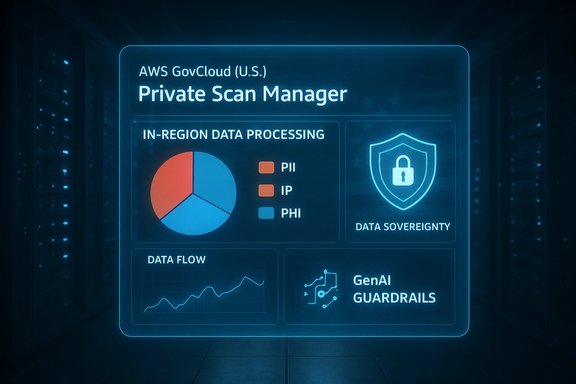
- Private Scan Manager now supports deployment inside AWS GovCloud (U.S., so organizations can host scanning and classification functions within isolated U.S. sovereign regions. This keeps raw data and scanning processes in-region and under customer control.
- The capability targets government agencies, contractors, partners, and other entities handling CUI or regulated data (for example, organizations using Microsoft 365 Government Community Cloud (GCC) High). Concentric positions the feature as a way to enforce data sovereignty while still applying the platform’s AI-driven classification and remediation workflows.
- Semantic Intelligence uses context-aware (category-aware) AI rather than keyword or regex rules to identify PII, PCI, PHI, intellectual property, and other sensitive information across structured and unstructured data; category-aware DLP and continuous remediation are highlighted as core capabilities. Concentric says those same capabilities can now operate where customers require scanning to be localized (private cloud/on-premises).
- Availability: Concentric states Private Scan Manager for AWS GovCloud (U.S. is available immediately in the Semantic Intelligence platform. Pricing and procurement details are handled through normal commercial channels.
Why AWS GovCloud (U.S. matters to government and regulated organizations
AWS GovCloud (U.S. exists specifically to address regulatory and sovereignty constraints that typical commercial cloud regions do not. The practical benefits include:- Personnel and administrative controls — administration of GovCloud regions is performed by vetted U.S. persons, a key requirement for ITAR and some DoD data flows.
- Geographic and logical isolation — GovCloud Regions are physically and logically separate, supporting U.S. data residency and reduced exposure to foreign jurisdictional risks.
- Compliance baselines — AWS GovCloud supports FedRAMP High, ITAR, DoD CC SRG impact levels (including IL4 and IL5), CJIS, and other frameworks that public-sector buyers and defense contractors require.
What Private Scan Manager actually changes in practice
Deployment model: local processing, SaaS orchestration
Private Scan Manager shifts the compute and data-processing element of Concentric’s platform into the customer’s isolated environment. That means:- Raw files and repositories are scanned and categorized locally inside the GovCloud region instead of being transmitted to Concentric’s public SaaS environments.
- Metadata, classification labels, and policy outputs can be synchronized to a central management plane if customers permit it, but the core data processing remains local to meet sovereignty and compliance demands. Concentric markets this as preserving the benefits of a SaaS control plane while respecting data residency obligations.
Capabilities that matter to compliance teams
- Contextual discovery and classification: the platform claims to identify sensitive items beyond simple PII patterns — for instance, identifying intellectual property or critical business documents by semantic similarity. This reduces false positives and the administrative burden of manual triage.
- Category-aware DLP and GenAI protections: Concentric emphasizes DLP that understands data categories and protects sensitive content across email, file sharing, and GenAI interfaces. In the GovCloud deployment, these protections can be applied without data leaving the sovereign boundary.
- Continuous risk monitoring and automated remediation: the company highlights features for detecting overexposure, misclassification, excessive permissions, and anomalous data behavior — and for applying automated remediation at scale. These automation capabilities are attractive to agencies and contractors with limited security operations bandwidth.
Strengths and strategic advantages
- Data sovereignty without sacrificing AI-driven insights. Private Scan Manager gives agencies the option to keep identification and categorization workloads inside GovCloud while leveraging Concentric’s AI models to drive governance decisions. For procurement teams, this is a pragmatic way to get modern tooling into hardened environments.
- Operational flexibility. The ability to scan across cloud and on-prem systems (the platform already advertises connectors to NetApp ONTAP, MongoDB, Microsoft 365, and other repositories) means customers can standardize discovery and classification across hybrid estates. That single pane of glass for data context is attractive to CISOs wrestling with fragmentation.
- Context-aware classification reduces noise. Moving away from brittle rules and regex toward semantic clustering can materially reduce false positives and increase the precision of DLP controls — a practical benefit for enforcement and investigative workflows. Concentric has also publicized multiple patents tied to semantic clustering and classification, which supports its claims of technology differentiation.
- Alignment with public-sector procurement constraints. Concentric’s recent TX-RAMP certification and prior public-sector engagements indicate the company is orienting itself to meet SLED and federal contracting requirements. Combining a vendor’s compliance posture with GovCloud deployment options simplifies vendor assessment processes for some buyers.
Critical caveats and risk considerations
While the offering addresses many real-world constraints, procurement, security, and architecture teams must evaluate the following carefully:- GovCloud hosting ≠ vendor FedRAMP/DoD authorization. Running a vendor’s scanning software inside AWS GovCloud does not automatically mean the vendor itself is FedRAMP-authorized or DoD approved. Customers should validate what authorizations Concentric has for specific mission needs and understand whether the deployment fits into the agency’s own ATO/authorization process. Concentric’s TX-RAMP certification is a valuable SLED milestone, but federal agency authorizations and FedRAMP package status should be confirmed during procurement.
- Shared responsibility still applies. AWS documentation is explicit: cloud provider controls the security of the cloud boundary, while customers retain responsibility for their data, identity and access management, and configuration of third-party software running in their accounts. Agencies must therefore assess the scanning deployment’s configuration hardening, access controls, and logging to meet their compliance obligations. Simply running scanning inside GovCloud is necessary but not sufficient.
- Model and telemetry handling needs scrutiny. When semantic or category-aware models operate inside customer environments, governance teams must confirm whether any model telemetry or feature updates call home, whether model artifacts are stored outside the region, and what controls exist to prevent unintended egress of derived metadata. Contract language and technical controls should explicitly limit outbound telemetry unless authorized. Concentric’s literature claims local processing, but buyers should validate the data flows during a technical review and legal analysis.
- Performance and scaling inside isolated regions. Running large-scale content scanning and semantic analysis in GovCloud may have cost and operational implications. Customers should test performance, understand compute/storage costs in GovCloud, and validate that scanning windows, deduplication, and near-duplicate detection scales to their data volumes. Architectural planning for resource sizing is essential. AWS GovCloud pricing and compute characteristics differ from commercial regions and should be factored into TCO.
- Vendor maturity and support in GovCloud. Some vendors provide first-class GovCloud support (including US-personnel operations, contract vehicles, and compliance artifacts), while others support GovCloud technically but lack deep federal procurement experience. Concentric has made moves—such as achieving TX-RAMP—but agencies will want to confirm integration, support SLAs, incident response arrangements, and the vendor’s ability to meet specific contracting vehicles (e.g., GSA schedules, agency-specific requirements).
Practical checklist for agency and contractor procurement teams
- Confirm the precise deployment model: is the scanner fully self-hosted in your GovCloud account, or does it require any managed services or synchronization to Concentric-managed systems? Validate data residency guarantees in writing.
- Request an architecture diagram and data flow maps showing exactly where raw data, derived metadata, and telemetry travel. Ensure there are contractual restrictions for telemetry egress.
- Validate Concentric’s compliance posture for your specific procurement needs — FedRAMP/JAB/FedRAMP ATO status, DoD acceptance, TX-RAMP (for Texas SLED), and any third-party audits relevant to your jurisdiction or agency.
- Run a technical proof-of-concept (PoC) in a GovCloud sandbox with representative data volumes to measure performance, false positive rates for classification, and operational impact.
- Incorporate model governance controls: verify model update mechanics, where model artifacts are stored, and whether explainability logs are available for investigations. Include these as contract exhibits.
- Define remediation playbooks and RBAC policies before deployment: automated remediation is powerful but must be constrained to prevent disruptive changes to production data or permissions.
Technical and programmatic implications for security operations
- Fewer false positives may reduce analyst fatigue. Semantic similarity and clustering can reduce noisy alerts, but that depends on model tuning and training on representative datasets. Operational teams must invest in initial tuning to realize these gains.
- Integration with existing SIEM, CASB, and M365 GCC High controls. The value of a data governance platform increases when it can feed accurate classification labels and risk signals into wider controls, enabling conditional access, DLP enforcement, and response orchestration across the security stack. Verify supported integrations and connectors for your environment.
- GenAI exposure monitoring is increasingly material. Concentric calls out protections for GenAI applications and “shadow GenAI” usage; as agencies experiment with GenAI, tools that contextualize queries and block sensitive prompt material will be increasingly important. Ensure the GovCloud deployment includes the GenAI metadata and enforcement paths you need.
How this fits into broader market and procurement trends
- Vendors are moving to offer “SaaS-like” experiences while enabling local processing for regulated data. Concentric’s Private Scan Manager is emblematic of this hybrid approach: delivering centralized analytics, policy, and reporting while permitting the heavy, sensitive data processing to remain under customer control. That pattern lowers the adoption bar for modern tooling in public sector contexts.
- AWS GovCloud (U.S. continues to be a focal point for cloud vendors seeking federal and defense customers. AWS’s investments, and the regulatory controls embedded in GovCloud, make it a natural choice for vendors who want to support agencies and contractors without forcing data to leave U.S. sovereign boundaries. Nonetheless, vendors must pair GovCloud technical support with contractual and programmatic readiness for federal procurement.
- The SLED (state, local, and education) market will pay close attention to TX-RAMP and equivalent certifications. Concentric’s pursuit of TX-RAMP indicates a strategy of prioritizing state-level procurement pathways in addition to federal channels. Buyers should evaluate certifications in the context of their procurement and compliance models.
Recommendation for security leaders evaluating Concentric’s GovCloud deployment
- Treat the offering as a promising option for modernizing discovery and DLP in high-compliance environments, but insist on rigorous technical validation. Conduct a PoC in a representative GovCloud account with real-world datasets and workflows.
- Include model governance, telemetry constraints, and incident response expectations in the procurement statement-of-work (SOW). Clarify SLAs for support personnel that can operate in GovCloud with appropriate U.S. personnel controls.
- Verify the vendor’s artifact and evidence packages for your own authorization processes—ask for SSPs (System Security Plan) or similar compliance artifacts that align with FedRAMP/DoD/FISMA requirements where applicable.
- Coordinate legal, records management, and privacy teams early to confirm that classification results and remediation actions align with records retention policies and privacy obligations.
Conclusion
Concentric AI’s move to offer Private Scan Manager within AWS GovCloud (U.S. is an important incremental development for agencies, contractors, and regulated businesses that need modern AI-driven discovery and DLP but cannot tolerate data leaving a U.S. sovereign boundary. The combination of semantic, category-aware classification with a deployment model that respects GovCloud’s personnel and residency controls addresses a persistent gap: how to bring advanced data governance into tightly constrained environments.That said, GovCloud deployment is not a substitute for a full authorization and procurement review. Agencies must still assess vendor certifications, shared-responsibility boundaries, telemetry and model governance, and operational scaling before rolling out sensitive scanning at scale. When those checks are satisfied, the offering promises meaningful operational improvements: better classification fidelity, reduced investigative workload, and GenAI-aware protections that can be deployed without compromising sovereignty or compliance.
Concentric’s progress—coupled with its patenting activity and state-level certifications—signals a vendor intent on aligning with public-sector requirements. Security and procurement teams should treat this capability as a worthwhile candidate for PoC and risk-assessed adoption, while insisting on architectural controls and contractual assurances that prevent accidental egress and ensure the deployment meets the full spectrum of agency compliance obligations.
Source: Business Wire https://www.businesswire.com/news/h...Government-Agencies-Partners-and-Contractors/
