

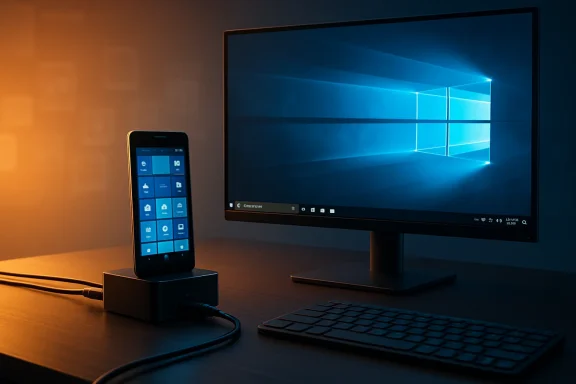
Microsoft unveiled Continuum for Windows 10 Mobile during its Build 2015 keynote in San Francisco on April 29, 2015, promising that select premium Windows phones could connect to a monitor, keyboard, and mouse to deliver a desktop-like Windows experience from a handset. The pitch was not merely that a phone could mirror a screen, but that the phone could become the user’s primary computer when the circumstances demanded it. Eleven years later, Continuum looks less like a failed gimmick than a serious idea stranded inside the wrong platform at the wrong time.
Continuum arrived at a moment when Microsoft was still trying to convince the industry that Windows could be everywhere without becoming incoherent. Windows 10 was supposed to be the reconciliation: one core, one store, one developer model, one family of devices that stretched from phones to tablets, laptops, Xbox, HoloLens, and industrial hardware. Continuum for phones was the most theatrical demonstration of that worldview.
The demo mattered because it inverted the usual smartphone accessory story. A phone was not being treated as a satellite of a PC, a notification device, or a lightweight companion. It was the compute module, identity vault, app host, and personal workspace; the monitor and keyboard were just peripherals waiting to be borrowed.
That was a genuinely modern idea. In 2026, the average smartphone has more than enough processing power for web apps, email, video meetings, document editing, messaging, remote desktop, and line-of-business dashboards. The notion that most people need a full tower or even a traditional laptop for every computing task has only become weaker with time.
But Microsoft’s problem was brutal: it was right about the shape of computing and wrong about the ecosystem that would carry it. Continuum needed developers, flagship phones, carrier confidence, consumer mindshare, and a healthy app store. Windows 10 Mobile had almost none of those in sufficient quantity.
That distinction is important. Continuum was not Windows desktop virtualization in your pocket. It did not magically turn a Lumia into a Win32 workstation. It was a responsive shell for Universal Windows Platform apps, built around the assumption that developers would target a shared Windows platform and let the interface stretch intelligently across device classes.
In other words, the feature was only as strong as Microsoft’s broader Windows 10 strategy. If UWP became the standard way developers built mainstream Windows software, Continuum could plausibly become a new kind of lightweight PC. If UWP remained a secondary target, Continuum would become a beautiful room with too little furniture.
That is exactly what happened. The early Office demonstrations were persuasive because Office was Microsoft’s home turf. The experience became harder to defend when users reached beyond Microsoft’s own apps and discovered the limits of the store, the limits of mobile silicon, and the limits of a platform that had already lost the attention war to iOS and Android.
The hardware was also a reminder that Microsoft had narrowed the addressable market before the idea had a chance to breathe. Continuum was limited to select premium phones, which made technical sense but strategic trouble. A platform already struggling for scale was attaching its most futuristic feature to a subset of a subset.
The Display Dock itself was clever, but it reinforced the problem. You needed the right phone, the right accessory, the right apps, and the right expectations. That is not fatal for an enthusiast feature, but it is a steep climb for a new computing model trying to become normal.
Continuum also suffered from the uncanny valley of desktop computing. It looked like Windows, responded to a mouse and keyboard, and ran Office-like experiences, but it was not the full Windows environment users had been trained to expect. The closer it got to a PC, the more noticeable the missing pieces became.
A missing app is annoying. An app that exists but lags behind its iOS and Android versions is corrosive. An app that might be abandoned next year tells users not to invest emotionally or operationally in the platform.
Continuum multiplied that challenge because it asked developers to care not only about Windows phones, but about Windows phones connected to large screens. Microsoft needed developers to build responsive, high-quality UWP apps that made sense on a handset, a monitor, and perhaps a tablet or Xbox. That was elegant in architecture and punishing in market reality.
The best version of Continuum assumed a virtuous cycle. Better Windows phones would attract users; more users would attract developers; better apps would make Continuum more useful; Continuum would make premium Windows phones more distinctive. The actual cycle ran in reverse.
That is the uncomfortable lesson for Microsoft. Continuum did not fail because phones cannot drive desktop-like workspaces. It failed because the phone platform underneath it was already losing oxygen. Samsung could afford to make DeX a long-running option; Microsoft needed Continuum to help rescue an operating system.
There is a difference between an experimental feature on a successful platform and a visionary feature on a collapsing one. The former can mature quietly. The latter is forced to justify the entire strategic bet.
Continuum was asked to do too much. It had to sell premium Lumias, validate UWP, differentiate Windows 10 Mobile, express Microsoft’s “one Windows” strategy, and suggest a future beyond the PC. That is a heavy load for any feature, let alone one dependent on a phone business Microsoft was already struggling to maintain.
That idea has aged well. The modern workplace is full of borrowed screens, hot desks, hotel televisions, conference-room displays, cloud PCs, browser-based productivity suites, and authentication flows tied to mobile devices. The perimeter of the computer has become fuzzier, while the importance of personal identity and secure session handoff has grown.
Continuum also anticipated the fatigue of device sprawl. Many users do not want a phone, tablet, laptop, desktop, work laptop, travel laptop, streaming box, and thin client if one or two personal devices can cover most tasks. The industry keeps rediscovering this instinct under different names: desktop mode, cloud PC, remote workspace, lapdock, foldable, thin client, edge device.
Microsoft’s version was unusually coherent because it came from a company that understood the desktop. Continuum was not just Android with a window manager bolted on. It was a Windows company trying to reinterpret the desktop around mobility.
In many cases, it was. You could not run traditional desktop applications. You were constrained by the UWP catalog. Performance was impressive for a phone in 2015 but modest by PC standards. Multitasking and windowing expectations had to be managed. Peripheral compatibility was good enough to demo but not broad enough to make every desk feel safe.
The better framing would have been “your phone becomes a workstation for the tasks your phone already owns.” That is less glamorous, but more accurate. Continuum was strongest when it extended mobile productivity to a larger canvas, not when it pretended to replace every PC workflow.
Marketing nuance rarely survives a keynote, however. Microsoft needed a big idea, and “phone as PC” was the big idea. The cost was that Continuum was judged against the entire Windows legacy rather than against the narrower and more plausible category it was inventing.
The Lumia 950 line did not solve that confidence problem. It gave enthusiasts the hardware they wanted on paper, but it arrived into a market dominated by iPhone and Android flagships with stronger app ecosystems and clearer consumer stories. Microsoft had an elegant architecture; Apple and Google had habits.
Enterprise IT could see the appeal of a secure phone that docked into a managed workspace. But enterprises also buy roadmaps, not just features. A fleet decision around Windows 10 Mobile required confidence that Microsoft, developers, carriers, and hardware partners would still be there years later.
That confidence never fully materialized. Microsoft eventually ended support for Windows 10 Mobile, with version 1709 becoming the last release and support ending in December 2019. By then, Continuum had become a memory of a future that had briefly seemed possible.
Microsoft 365 assumes your documents and identity follow you across devices. Windows 365 and Azure Virtual Desktop make the PC a streamed environment rather than a local box. Phone Link ties Android devices into Windows. Edge, Teams, OneDrive, Authenticator, Intune, and Entra ID all treat the user’s work state as something that roams.
This is Continuum without the Lumia. Instead of making the phone become the PC, Microsoft increasingly makes the PC a service and the phone an authentication, notification, capture, and access device. The dream moved from hardware convergence to cloud-mediated continuity.
That shift is rational, but less romantic. Continuum had the elegance of a single object transforming in front of you. The modern Microsoft stack is more powerful, more enterprise-ready, and more commercially successful, but it is also more diffuse. The magic trick became an architecture diagram.
For Windows enthusiasts, that loss still stings. Continuum was one of the last moments when Microsoft’s mobile strategy felt not merely defensive, but imaginative.
Microsoft, having lost the phone OS, now approaches the question from the other side. Windows remains the productivity anchor, but it increasingly depends on cloud services and cross-platform clients. The company no longer needs Windows on the phone for Microsoft to matter on the phone.
That is a victory of business pragmatism over platform purity. It is also why Continuum remains such a compelling artifact. It represents the path Microsoft could only take if Windows Mobile had become viable: not Windows everywhere as a brand slogan, but Windows everywhere as an adaptive runtime.
The market may still return to that logic. Foldables, spatial computing, ARM laptops, cloud desktops, and AI-assisted workspaces all put pressure on the old device categories. The next “PC” may not be a PC in the traditional sense; it may be whatever authenticated screen is nearest when your work state arrives.
That distinction matters. It is too easy to remember Windows 10 Mobile as a dead platform and stop there. Continuum reminds us that Microsoft was not merely copying iOS and Android from behind. In some respects, it was trying to jump ahead of them.
The tragedy is that the jump required a landing zone. Developers had to believe UWP would matter. Consumers had to believe Windows phones would last. Hardware partners had to believe there would be demand. Microsoft itself had to believe long enough to keep pushing through the ugly middle years.
Instead, Continuum became a brilliant feature attached to a shrinking bet. Its ambition now reads almost painfully clearly: one device, many contexts, no hard wall between phone and PC. The industry still wants that outcome; it just did not want it badly enough from Windows 10 Mobile.
The concrete lessons are sharper than the nostalgia:
Source: Windows Central Windows 10 Mobile's Best Idea? Looking back at the debut of Continuum
 Microsoft Saw the Post-PC World Before It Could Survive It
Continuum arrived at a moment when Microsoft was still trying to convince the industry that Windows could be everywhere without becoming incoherent. Windows 10 was supposed to be the reconciliation: one core, one store, one developer model, one family of devices that stretched from phones to tablets, laptops, Xbox, HoloLens, and industrial hardware. Continuum for phones was the most theatrical demonstration of that worldview.The demo mattered because it inverted the usual smartphone accessory story. A phone was not being treated as a satellite of a PC, a notification device, or a lightweight companion. It was the compute module, identity vault, app host, and personal workspace; the monitor and keyboard were just peripherals waiting to be borrowed.
That was a genuinely modern idea. In 2026, the average smartphone has more than enough processing power for web apps, email, video meetings, document editing, messaging, remote desktop, and line-of-business dashboards. The notion that most people need a full tower or even a traditional laptop for every computing task has only become weaker with time.
But Microsoft’s problem was brutal: it was right about the shape of computing and wrong about the ecosystem that would carry it. Continuum needed developers, flagship phones, carrier confidence, consumer mindshare, and a healthy app store. Windows 10 Mobile had almost none of those in sufficient quantity.
The Demo Was a Thesis Disguised as a Feature
At Build 2015, Continuum for phones was presented as a capability of Windows 10’s universal app model. Connect a supported phone to an external display, add a keyboard and mouse, and the interface would adapt to the larger screen. Office could look and behave more like a desktop application while still running from the phone.That distinction is important. Continuum was not Windows desktop virtualization in your pocket. It did not magically turn a Lumia into a Win32 workstation. It was a responsive shell for Universal Windows Platform apps, built around the assumption that developers would target a shared Windows platform and let the interface stretch intelligently across device classes.
In other words, the feature was only as strong as Microsoft’s broader Windows 10 strategy. If UWP became the standard way developers built mainstream Windows software, Continuum could plausibly become a new kind of lightweight PC. If UWP remained a secondary target, Continuum would become a beautiful room with too little furniture.
That is exactly what happened. The early Office demonstrations were persuasive because Office was Microsoft’s home turf. The experience became harder to defend when users reached beyond Microsoft’s own apps and discovered the limits of the store, the limits of mobile silicon, and the limits of a platform that had already lost the attention war to iOS and Android.
Lumia 950 Made the Promise Real, Then Exposed the Trap
The Lumia 950 and Lumia 950 XL gave Continuum its first real hardware stage later in 2015. With the Microsoft Display Dock, users could connect a phone to HDMI or DisplayPort, attach USB peripherals, and sit down at something that looked enough like Windows to make the imagination do the rest. It was not hard to see the pitch for students, field workers, hotel-room warriors, and anyone who lived mostly in mail, documents, and the browser.The hardware was also a reminder that Microsoft had narrowed the addressable market before the idea had a chance to breathe. Continuum was limited to select premium phones, which made technical sense but strategic trouble. A platform already struggling for scale was attaching its most futuristic feature to a subset of a subset.
The Display Dock itself was clever, but it reinforced the problem. You needed the right phone, the right accessory, the right apps, and the right expectations. That is not fatal for an enthusiast feature, but it is a steep climb for a new computing model trying to become normal.
Continuum also suffered from the uncanny valley of desktop computing. It looked like Windows, responded to a mouse and keyboard, and ran Office-like experiences, but it was not the full Windows environment users had been trained to expect. The closer it got to a PC, the more noticeable the missing pieces became.
The App Gap Was Really a Trust Gap
Windows Phone’s “app gap” is often treated as a simple inventory problem: fewer apps than iOS and Android. That framing undersells the damage. By 2015, the gap had become a trust problem for consumers, developers, banks, airlines, retailers, social networks, and IT departments.A missing app is annoying. An app that exists but lags behind its iOS and Android versions is corrosive. An app that might be abandoned next year tells users not to invest emotionally or operationally in the platform.
Continuum multiplied that challenge because it asked developers to care not only about Windows phones, but about Windows phones connected to large screens. Microsoft needed developers to build responsive, high-quality UWP apps that made sense on a handset, a monitor, and perhaps a tablet or Xbox. That was elegant in architecture and punishing in market reality.
The best version of Continuum assumed a virtuous cycle. Better Windows phones would attract users; more users would attract developers; better apps would make Continuum more useful; Continuum would make premium Windows phones more distinctive. The actual cycle ran in reverse.
Samsung Later Proved the Idea Had Legs
Samsung DeX, introduced with the Galaxy S8 generation in 2017, is the obvious comparison because it pursued a similar dream on a healthier mobile platform. DeX did not make Android a universal desktop replacement overnight, and it has never become the default way most Galaxy owners compute. But it survived because it was attached to Android, Samsung’s flagship scale, and an ecosystem that users were already committed to carrying.That is the uncomfortable lesson for Microsoft. Continuum did not fail because phones cannot drive desktop-like workspaces. It failed because the phone platform underneath it was already losing oxygen. Samsung could afford to make DeX a long-running option; Microsoft needed Continuum to help rescue an operating system.
There is a difference between an experimental feature on a successful platform and a visionary feature on a collapsing one. The former can mature quietly. The latter is forced to justify the entire strategic bet.
Continuum was asked to do too much. It had to sell premium Lumias, validate UWP, differentiate Windows 10 Mobile, express Microsoft’s “one Windows” strategy, and suggest a future beyond the PC. That is a heavy load for any feature, let alone one dependent on a phone business Microsoft was already struggling to maintain.
The Best Part of Continuum Was Its Discipline
The most interesting thing about Continuum in hindsight is not the dock, the Start menu, or the novelty of plugging in a phone. It is that Microsoft was trying to preserve context. Your files, accounts, apps, messages, and identity were already on the phone; Continuum asked why that personal compute core should be demoted the moment you sat near a larger screen.That idea has aged well. The modern workplace is full of borrowed screens, hot desks, hotel televisions, conference-room displays, cloud PCs, browser-based productivity suites, and authentication flows tied to mobile devices. The perimeter of the computer has become fuzzier, while the importance of personal identity and secure session handoff has grown.
Continuum also anticipated the fatigue of device sprawl. Many users do not want a phone, tablet, laptop, desktop, work laptop, travel laptop, streaming box, and thin client if one or two personal devices can cover most tasks. The industry keeps rediscovering this instinct under different names: desktop mode, cloud PC, remote workspace, lapdock, foldable, thin client, edge device.
Microsoft’s version was unusually coherent because it came from a company that understood the desktop. Continuum was not just Android with a window manager bolted on. It was a Windows company trying to reinterpret the desktop around mobility.
The Worst Part Was the Word “PC”
The phrase “PC in your pocket” was irresistible, and it was also dangerous. It made the promise instantly understandable, but it invited the wrong comparison. Users did not ask whether Continuum was better than a phone; they asked whether it was worse than their laptop.In many cases, it was. You could not run traditional desktop applications. You were constrained by the UWP catalog. Performance was impressive for a phone in 2015 but modest by PC standards. Multitasking and windowing expectations had to be managed. Peripheral compatibility was good enough to demo but not broad enough to make every desk feel safe.
The better framing would have been “your phone becomes a workstation for the tasks your phone already owns.” That is less glamorous, but more accurate. Continuum was strongest when it extended mobile productivity to a larger canvas, not when it pretended to replace every PC workflow.
Marketing nuance rarely survives a keynote, however. Microsoft needed a big idea, and “phone as PC” was the big idea. The cost was that Continuum was judged against the entire Windows legacy rather than against the narrower and more plausible category it was inventing.
Windows 10 Mobile Needed Time It Did Not Have
By the time Continuum reached consumers, Windows 10 Mobile was already carrying years of strategic whiplash. Microsoft had moved from Windows Mobile to Windows Phone 7, then stranded older devices, then moved to Windows Phone 8, then reframed the platform again around Windows 10 Mobile. Even loyal users had learned that resets were part of the bargain.The Lumia 950 line did not solve that confidence problem. It gave enthusiasts the hardware they wanted on paper, but it arrived into a market dominated by iPhone and Android flagships with stronger app ecosystems and clearer consumer stories. Microsoft had an elegant architecture; Apple and Google had habits.
Enterprise IT could see the appeal of a secure phone that docked into a managed workspace. But enterprises also buy roadmaps, not just features. A fleet decision around Windows 10 Mobile required confidence that Microsoft, developers, carriers, and hardware partners would still be there years later.
That confidence never fully materialized. Microsoft eventually ended support for Windows 10 Mobile, with version 1709 becoming the last release and support ending in December 2019. By then, Continuum had become a memory of a future that had briefly seemed possible.
The Ghost of Continuum Lives Inside Microsoft’s Current Strategy
The irony is that Microsoft did not abandon the underlying ambition. It abandoned the phone operating system. The company’s modern strategy is full of Continuum-shaped pieces, just distributed across other platforms.Microsoft 365 assumes your documents and identity follow you across devices. Windows 365 and Azure Virtual Desktop make the PC a streamed environment rather than a local box. Phone Link ties Android devices into Windows. Edge, Teams, OneDrive, Authenticator, Intune, and Entra ID all treat the user’s work state as something that roams.
This is Continuum without the Lumia. Instead of making the phone become the PC, Microsoft increasingly makes the PC a service and the phone an authentication, notification, capture, and access device. The dream moved from hardware convergence to cloud-mediated continuity.
That shift is rational, but less romantic. Continuum had the elegance of a single object transforming in front of you. The modern Microsoft stack is more powerful, more enterprise-ready, and more commercially successful, but it is also more diffuse. The magic trick became an architecture diagram.
For Windows enthusiasts, that loss still stings. Continuum was one of the last moments when Microsoft’s mobile strategy felt not merely defensive, but imaginative.
The Industry Still Has Not Finished the Argument
The broader market still has not settled the question Continuum raised. Is the smartphone the center of personal computing, or merely the most important endpoint? Apple has answered by making the iPhone central while keeping macOS and iPadOS distinct. Google has blurred Android and ChromeOS at the edges without fully merging them. Samsung continues to maintain DeX as a power-user and enterprise-friendly mode rather than a mass-market revolution.Microsoft, having lost the phone OS, now approaches the question from the other side. Windows remains the productivity anchor, but it increasingly depends on cloud services and cross-platform clients. The company no longer needs Windows on the phone for Microsoft to matter on the phone.
That is a victory of business pragmatism over platform purity. It is also why Continuum remains such a compelling artifact. It represents the path Microsoft could only take if Windows Mobile had become viable: not Windows everywhere as a brand slogan, but Windows everywhere as an adaptive runtime.
The market may still return to that logic. Foldables, spatial computing, ARM laptops, cloud desktops, and AI-assisted workspaces all put pressure on the old device categories. The next “PC” may not be a PC in the traditional sense; it may be whatever authenticated screen is nearest when your work state arrives.
The Little Dock That Still Explains the Big Miss
Continuum’s enduring value is that it makes Microsoft’s mobile failure more specific. The company did not simply fail because it lacked imagination. It failed despite having some of the best ideas in mobile computing, because ideas do not compensate for ecosystem collapse.That distinction matters. It is too easy to remember Windows 10 Mobile as a dead platform and stop there. Continuum reminds us that Microsoft was not merely copying iOS and Android from behind. In some respects, it was trying to jump ahead of them.
The tragedy is that the jump required a landing zone. Developers had to believe UWP would matter. Consumers had to believe Windows phones would last. Hardware partners had to believe there would be demand. Microsoft itself had to believe long enough to keep pushing through the ugly middle years.
Instead, Continuum became a brilliant feature attached to a shrinking bet. Its ambition now reads almost painfully clearly: one device, many contexts, no hard wall between phone and PC. The industry still wants that outcome; it just did not want it badly enough from Windows 10 Mobile.
The Anniversary Lesson Is Not Nostalgia, It Is Timing
Looking back from 2026, Continuum deserves neither mockery nor uncritical reverence. It was limited, compromised, and overmarketed. It was also early, coherent, and aimed at a real computing problem that has only become more visible.The concrete lessons are sharper than the nostalgia:
- Continuum debuted at Build 2015 as part of Microsoft’s larger Windows 10 strategy, not as a standalone phone trick.
- The feature depended on Universal Windows Platform apps, which made developer adoption central to its usefulness.
- The Lumia 950 and 950 XL made Continuum tangible, but limiting the feature to premium hardware narrowed its reach.
- The “phone as PC” message inspired users while also setting expectations Continuum could not fully meet.
- Samsung DeX later showed that desktop-like phone modes could endure when attached to a healthier mobile ecosystem.
- Microsoft’s current cloud and cross-device strategy preserves much of Continuum’s logic, even though Windows 10 Mobile is gone.
Source: Windows Central Windows 10 Mobile's Best Idea? Looking back at the debut of Continuum
