

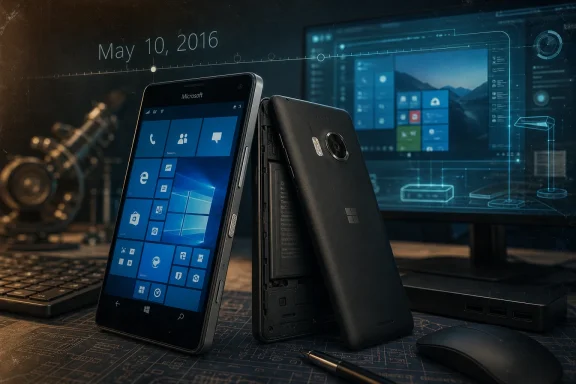
On May 10, 2016, Windows Central published Richard Devine’s personal defense of using a Lumia 950 XL as his daily phone, arguing that Microsoft’s troubled Windows 10 Mobile flagship still offered a rare blend of camera hardware, removable battery, Continuum, and enthusiast appeal. A decade later, the piece reads less like a product recommendation than a dispatch from the last livable neighborhood in Microsoft’s mobile city. The Lumia 950 XL was not enough to save Windows phones, but it explains why so many people were reluctant to admit the platform was already slipping away. Its tragedy was that it was a good answer to a question the market had stopped asking.
The Lumia 950 XL arrived at the end of 2015 as one of the first phones designed to showcase Windows 10 Mobile rather than merely inherit the Windows Phone legacy. It had the ingredients enthusiasts had been demanding: a 5.7-inch Quad HD OLED display, Qualcomm’s Snapdragon 810, 3GB of RAM, 32GB of storage, microSD expansion, USB-C, wireless charging, a removable 3340mAh battery, and a 20-megapixel PureView camera with optical image stabilization. On paper, it was not a joke. It was a serious phone.
But serious was not the same as competitive. By the time the 950 XL reached users, Apple and Samsung had already turned the smartphone market into a two-platform gravity well, and Microsoft was trying to sell not just a device but an alternate computing philosophy. Windows 10 Mobile was supposed to be the mobile face of One Windows, a world where phones, PCs, tablets, Xbox, and apps all belonged to one coherent ecosystem.
That was the promise. The lived experience was more complicated. Early Windows 10 Mobile builds were rough, app availability was uneven, and even fans often described the Lumia 950 and 950 XL as hardware that felt more practical than premium. They were powerful, but not luxurious. They were clever, but not effortless. They carried the weight of a strategy that had already burned through too many resets.
Devine’s 2016 article matters because it catches the 950 XL in the small window where the dream still felt plausible to a certain kind of user. He was not arguing that Microsoft had won mobile. He was explaining why, after buying the device with his own money, he still liked living with it. That distinction is crucial: the Lumia 950 XL was not converting the masses, but it was still serving the faithful.
The phone’s size was part of its appeal. Devine contrasted it with the Lumia 1520, a beloved but enormous earlier Windows Phone that pushed the phablet idea before the market had fully normalized giant screens. The 950 XL’s 5.7-inch display was large for the period, but the body was not cartoonishly oversized. It sat in a transitional moment when big phones were becoming mainstream but still had to justify their bulk.
Microsoft also kept a physical camera shutter button, a small piece of Lumia identity that still inspires disproportionate affection. It was not merely nostalgia. A dedicated shutter key made the phone feel like a camera in a way that tapping glass never quite replicated. The Lumia line had trained its users to expect that photography was not an afterthought, and the 950 XL carried that inheritance with real competence.
Then there was the battery. The 950 XL’s removable cell was not just a spec-sheet oddity; it was a philosophical disagreement with where smartphones were going. The rest of the industry was sealing phones into slimmer slabs, turning battery degradation into a future service appointment or a reason to upgrade. Microsoft shipped a flagship where a heavy user could carry a spare battery and keep going. That sounds old-fashioned now only because the industry successfully made user-serviceability feel abnormal.
The lesson is not that removable batteries would have saved Windows phones. They would not have. The lesson is that Microsoft’s mobile hardware often understood power users better than the market rewarded. Lumia devices were full of decisions that made sense to people who treated phones as tools rather than fashion objects. Unfortunately for Microsoft, the smartphone war was not won by the company with the most sympathetic view of sysadmins, photographers, and tinkerers.
Devine’s use case was modest and therefore believable. He described plugging the phone into a TV or a USB-C hub, catching up on work away from his desk, and appreciating that the hardware did not feel sluggish. That was the version of Continuum that made sense: not replacing a full PC, not revolutionizing the enterprise overnight, but making a phone stretch into light productivity when circumstances called for it.
The problem was that Continuum depended on everything else working. It needed strong universal apps. It needed developers to care about Windows 10 Mobile. It needed users to carry or encounter compatible docks, displays, keyboards, and mice. It needed the phone to be reliable enough that the novelty did not collapse into fiddling. It needed ecosystem momentum, and ecosystem momentum was exactly what Microsoft did not have.
In hindsight, Continuum looks less like a failed gimmick than a prototype of a computing pattern the industry still circles around. Samsung DeX, iPad external display support, cloud PCs, foldables, and desktop-class mobile chips all live somewhere in the same conceptual neighborhood. The idea that a pocket device can become a workstation was not foolish. Microsoft’s problem was timing, execution, and platform position.
That is the recurring Lumia story: the company saw pieces of the future but could not assemble them into a present-tense business. Continuum was compelling enough to remember and insufficient enough to rely on. It gave fans a reason to believe while giving developers too few reasons to invest.
Yet the operating system had real strengths. Live Tiles were genuinely distinct, giving the home screen a sense of motion and information density that static icon grids lacked. Microsoft’s first-party services were often best integrated on its own platform. Outlook, OneDrive, Office, Cortana, Xbox, Groove, and messaging features were part of a unified story, at least in theory. For users already invested in Microsoft’s world, Windows 10 Mobile could feel less like an outsider platform and more like the missing pocket limb of the PC.
That made the app gap both real and strangely personal. Some users could live with it because their needs were covered. Others hit a wall the moment a bank, workplace, transit agency, smart-home vendor, airline, social network, or authentication tool ignored the platform. Devine mentioned missing Authy, and that example aged perfectly: the absence of one trusted utility can matter more than the presence of a hundred adequate substitutes.
The app gap was never just about Snapchat jokes. It was about confidence. Users needed to believe that if a new service mattered tomorrow, their phone would get it. Developers needed to believe that if they built for Windows phones, users would arrive. Microsoft needed both sides to move at once, but the market had already chosen iOS and Android as the default venues for mobile life.
That is why Windows 10 Mobile could be both underrated and doomed. It had design ideas worth defending, but the mission assigned to it was nearly impossible. It had to be polished enough to please loyalists, differentiated enough to attract converts, and popular enough to lure developers, all while Microsoft itself was increasingly successful at putting its apps and services on rival platforms.
Devine’s article still reflected the older logic: if you lived in Microsoft services, Windows 10 Mobile offered the best overall experience. That was plausible in pockets. But Microsoft was rapidly making sure its future did not depend on owning the phone OS. The company’s customers were moving to iPhones and Android devices, and Microsoft followed them there with increasing competence.
This was not hypocrisy. It was survival. Microsoft had lost the mobile platform war, and pretending otherwise would have damaged its broader relevance. But for Lumia loyalists, it created a painful dynamic: every improvement to Microsoft apps on Android and iOS made it easier to leave Windows phones without leaving Microsoft.
The Lumia 950 XL therefore became a device for people who wanted Microsoft’s old vertical dream at the very moment Microsoft was pivoting toward horizontal ubiquity. The phone said, “Your Windows device can be your whole digital life.” The company’s broader strategy increasingly said, “Your digital life will span devices we do not control.” Both ideas had logic. Only one had a future.
That split loyalty also shaped perceptions of hardware commitment. The Lumia 950 and 950 XL were positioned as flagships for fans, but they did not feel like the beginning of a long, confident hardware cadence. Rumors and hopes around a mythical Surface Phone often overshadowed the devices that actually existed. Even supporters sometimes treated the 950 XL as a bridge to something more ambitious rather than the thing itself.
That community energy is visible throughout the 2016 piece. Devine was not writing as a neutral buyer comparing carrier deals. He was writing as someone who knew the objections and still found pleasure in the device. The camera mattered. The shutter button mattered. The size mattered. The battery mattered. Continuum mattered. Windows 10 Mobile’s interface mattered. These were the details around which loyalty formed.
Enthusiast platforms often survive emotionally long after they lose commercially. OS/2, webOS, BlackBerry 10, Windows Phone, and even certain Linux phone efforts all demonstrate the same phenomenon: a smaller group of users can love a platform more intensely precisely because the mainstream does not. Scarcity becomes identity. Workarounds become rituals. Criticism from outsiders hardens the bonds inside the group.
But community cannot replace platform economics. It can keep knowledge alive, extend usefulness, and preserve history. It can pressure vendors, build unofficial tools, and make abandonment less lonely. What it cannot do is force banks, airlines, social networks, game studios, and hardware partners to treat a shrinking platform as strategic.
That tension made the Lumia community admirable and tragic. The fans were often right about the elegance of Live Tiles, the usefulness of camera buttons, and the appeal of a phone that respected PC users. They were also trapped defending a platform whose owner was gradually learning to prosper without it.
The Lumia 950 XL’s camera was not universally crowned the best smartphone camera of its generation, but it was good enough that loyal users trusted it. That trust matters. A phone camera is not judged only by lab charts; it is judged by whether parents reach for it when a child moves, whether travelers trust it at dusk, and whether the camera launches when the moment is still there.
The physical shutter button condensed that trust into hardware. Half-press to focus, full press to shoot: it was a small ritual borrowed from dedicated cameras. It told users that photography was not just another app tile but a first-class purpose of the device. When Devine says Lumia owners were spoiled by it, he is identifying one of those seemingly minor affordances that becomes invisible until it disappears.
Modern phones have compensated with extraordinary computational photography, faster sensors, and customizable action buttons, but the Lumia approach still feels distinct. It was less about turning every image into a processed artifact and more about giving the user a tool with camera-like intent. That distinction may be romanticized, but it is not imaginary.
The irony is that the 950 XL also showed how software instability could undercut hardware excellence. Devine’s complaint that the Camera app could trigger reboots several times a week is the kind of detail that haunts a platform. A great camera that sometimes crashes the phone is not merely a bug; it is a trust fracture. Lumia’s best features often had to fight Windows 10 Mobile’s unfinished edges.
At the time, this was often framed as a power-user preference. Heavy users could carry spares. Travelers could keep going. Owners could extend the life of the device without surgery. But the larger issue was control. A removable battery made the phone feel less sealed against its owner.
That matters more now than it did then. Device longevity, right-to-repair debates, battery health management, e-waste, and sustainability have all become mainstream concerns. The smartphone industry has spent years convincing users that sealed devices are normal and inevitable, even as regulators and repair advocates push back. The Lumia 950 XL reminds us that another model was not technically impossible; it was strategically abandoned.
Of course, the 950 XL’s plastic back and removable battery also fed the criticism that it did not feel premium enough. This was the trap. A practical design choice that served longevity could be read as cheapness in a market trained to equate glass, metal, and sealed construction with value. Lumia fans appreciated the utility. Many mainstream buyers saw a flagship that did not look expensive enough.
That tension has not gone away. Consumers say they want repairability, battery life, durability, and lower replacement costs, but the market still rewards sleekness and status signals. The Lumia 950 XL was not wrong to prioritize utility. It was simply selling utility in a category increasingly governed by aspiration.
The reality was harsher. Developers build where users are active, where monetization works, and where platform owners show durable commitment. Windows had huge PC reach, but Windows Store behavior did not resemble iOS App Store behavior. A user base on paper was not the same as a market for modern mobile apps. The phone side needed developers more urgently than developers needed the phone side.
This is why the Lumia 950 XL’s strengths could not compound. A good display made apps look better, but it could not summon missing apps. Continuum made universal apps more valuable, but only if enough existed. Live Tiles made the home screen more dynamic, but only when apps updated them well. The platform’s best ideas were network effects waiting for a network.
Microsoft tried bridges, tooling, and evangelism, but the flywheel never spun fast enough. Worse, every month of uncertainty made the next developer conversation harder. If users suspected the platform was fading, they hesitated to buy. If developers saw users hesitating, they held back. If Microsoft saw both trends, it hedged toward iOS and Android services. The cycle fed itself.
For enthusiasts, this produced a uniquely frustrating form of decline. The phone in your hand might still work well. The camera might still impress. The interface might still feel more alive than a grid of icons. But the ecosystem around it would quietly thin, one missing app or abandoned update at a time.
That is also why the article is valuable as a historical document. It captures Windows 10 Mobile after the first wave of launch disappointment but before the finality of end-of-support dates. Bugs could still be fixed. Messaging Everywhere still sounded exciting. Continuum still had room to mature. The app gap was survivable if your personal app needs were narrow enough. There was still a path, at least from the user’s chair.
The path closed. Microsoft eventually stopped developing new Windows 10 Mobile features, and support for the final branch ended in December 2019. By then, the company’s mobile identity had shifted decisively toward apps, cloud services, Android partnerships, and later dual-screen experiments under the Surface brand. The Lumia line had become history.
But the emotional residue remained. Windows phone users did not merely lose a product; they lost a particular idea of how mobile computing could feel. They lost a home screen that surfaced information differently, a camera culture that prized hardware controls, and a Microsoft ecosystem that still imagined the phone as a Windows citizen rather than a device running someone else’s platform with Microsoft apps installed.
That loss explains why “On This Day” retrospectives work. They are not just content recycling. They reopen moments when outcomes were not yet settled, when fans could plausibly argue that the next update, the next app bridge, the next flagship, or the next developer push might change the trajectory. Nostalgia is powerful because it restores uncertainty to stories whose endings we already know.
Specificity is valuable, but it is not enough. A platform also needs timing, polish, developer trust, carrier support, retail clarity, and a parent company willing to absorb losses without sending mixed signals. Microsoft had money, talent, and ideas. What it lacked was the ability to make Windows phones feel inevitable.
That is the hard lesson for any company trying to build or revive an alternative platform. Users may praise differentiation, but they punish inconvenience. Developers may applaud architecture, but they follow demand. Reviewers may admire ambition, but they still compare the product against what buyers can get today from entrenched competitors. A platform cannot live on cleverness alone.
The 950 XL also warns against launching flagship hardware on top of unfinished software. Enthusiasts will tolerate rough edges longer than mainstream users, but even enthusiasts have limits. A rebooting camera app, missing panorama mode, sync quirks, and app gaps might each be survivable in isolation. Together, they create the sense that the user is subsidizing the platform’s unfinished business.
And yet, the device’s afterlife is not merely cautionary. It also shows that good ideas can outlive failed products. The industry continues to explore phones as PCs, richer glanceable interfaces, repairability, better camera controls, and deeper cross-device continuity. Lumia did not win, but it left behind arguments the rest of the market never fully answered.
The Lumia 950 XL now sits in the museum wing of modern computing: too late to change the smartphone war, too interesting to dismiss as a footnote, and too flawed to turn into a simple tale of misunderstood genius. Looking back from 2026, its value is not that it proves Microsoft should have kept making Windows phones forever. Its value is that it reminds us how much the industry loses when there are only two default answers to what a phone should be—and how quickly even a passionate community can become the custodian of a future that never quite arrived.
Source: Windows Central ON THIS DAY: Looking back on why we loved the Lumia 950 XL
 The Lumia 950 XL Was a Flagship Built for Believers, Not Converts
The Lumia 950 XL arrived at the end of 2015 as one of the first phones designed to showcase Windows 10 Mobile rather than merely inherit the Windows Phone legacy. It had the ingredients enthusiasts had been demanding: a 5.7-inch Quad HD OLED display, Qualcomm’s Snapdragon 810, 3GB of RAM, 32GB of storage, microSD expansion, USB-C, wireless charging, a removable 3340mAh battery, and a 20-megapixel PureView camera with optical image stabilization. On paper, it was not a joke. It was a serious phone.But serious was not the same as competitive. By the time the 950 XL reached users, Apple and Samsung had already turned the smartphone market into a two-platform gravity well, and Microsoft was trying to sell not just a device but an alternate computing philosophy. Windows 10 Mobile was supposed to be the mobile face of One Windows, a world where phones, PCs, tablets, Xbox, and apps all belonged to one coherent ecosystem.
That was the promise. The lived experience was more complicated. Early Windows 10 Mobile builds were rough, app availability was uneven, and even fans often described the Lumia 950 and 950 XL as hardware that felt more practical than premium. They were powerful, but not luxurious. They were clever, but not effortless. They carried the weight of a strategy that had already burned through too many resets.
Devine’s 2016 article matters because it catches the 950 XL in the small window where the dream still felt plausible to a certain kind of user. He was not arguing that Microsoft had won mobile. He was explaining why, after buying the device with his own money, he still liked living with it. That distinction is crucial: the Lumia 950 XL was not converting the masses, but it was still serving the faithful.
Microsoft’s Best Mobile Ideas Were Arriving After the Market Had Moved On
The most striking thing about the Lumia 950 XL in retrospect is how many of its virtues now look sensible again. A large but manageable screen. A good camera. USB-C. Fast charging. Expandable storage. A removable battery. A desktop-like mode that could turn the phone into a lightweight workstation. In 2016, some of that felt quirky. In 2026, it feels like a list of features users keep asking the industry to rediscover.The phone’s size was part of its appeal. Devine contrasted it with the Lumia 1520, a beloved but enormous earlier Windows Phone that pushed the phablet idea before the market had fully normalized giant screens. The 950 XL’s 5.7-inch display was large for the period, but the body was not cartoonishly oversized. It sat in a transitional moment when big phones were becoming mainstream but still had to justify their bulk.
Microsoft also kept a physical camera shutter button, a small piece of Lumia identity that still inspires disproportionate affection. It was not merely nostalgia. A dedicated shutter key made the phone feel like a camera in a way that tapping glass never quite replicated. The Lumia line had trained its users to expect that photography was not an afterthought, and the 950 XL carried that inheritance with real competence.
Then there was the battery. The 950 XL’s removable cell was not just a spec-sheet oddity; it was a philosophical disagreement with where smartphones were going. The rest of the industry was sealing phones into slimmer slabs, turning battery degradation into a future service appointment or a reason to upgrade. Microsoft shipped a flagship where a heavy user could carry a spare battery and keep going. That sounds old-fashioned now only because the industry successfully made user-serviceability feel abnormal.
The lesson is not that removable batteries would have saved Windows phones. They would not have. The lesson is that Microsoft’s mobile hardware often understood power users better than the market rewarded. Lumia devices were full of decisions that made sense to people who treated phones as tools rather than fashion objects. Unfortunately for Microsoft, the smartphone war was not won by the company with the most sympathetic view of sysadmins, photographers, and tinkerers.
Continuum Was the Future, but Not the Product
Continuum remains the purest example of Windows 10 Mobile’s ambition. Plug the Lumia 950 XL into a display dock or connect wirelessly, pair a keyboard and mouse, and the phone could drive a desktop-like interface with universal Windows apps. It was a pitch only Microsoft could make with a straight face: your phone was not merely a companion to your PC, it could become something PC-shaped.Devine’s use case was modest and therefore believable. He described plugging the phone into a TV or a USB-C hub, catching up on work away from his desk, and appreciating that the hardware did not feel sluggish. That was the version of Continuum that made sense: not replacing a full PC, not revolutionizing the enterprise overnight, but making a phone stretch into light productivity when circumstances called for it.
The problem was that Continuum depended on everything else working. It needed strong universal apps. It needed developers to care about Windows 10 Mobile. It needed users to carry or encounter compatible docks, displays, keyboards, and mice. It needed the phone to be reliable enough that the novelty did not collapse into fiddling. It needed ecosystem momentum, and ecosystem momentum was exactly what Microsoft did not have.
In hindsight, Continuum looks less like a failed gimmick than a prototype of a computing pattern the industry still circles around. Samsung DeX, iPad external display support, cloud PCs, foldables, and desktop-class mobile chips all live somewhere in the same conceptual neighborhood. The idea that a pocket device can become a workstation was not foolish. Microsoft’s problem was timing, execution, and platform position.
That is the recurring Lumia story: the company saw pieces of the future but could not assemble them into a present-tense business. Continuum was compelling enough to remember and insufficient enough to rely on. It gave fans a reason to believe while giving developers too few reasons to invest.
Windows 10 Mobile Was Better Than Its Reputation and Worse Than Its Mission Required
Devine’s most provocative claim in 2016 was not that the 950 XL had a good camera or a useful battery. It was that he actually liked Windows 10 Mobile. Even then, that was a statement that required defending. Windows Phone 8.1 had been admired for its fluidity and visual coherence, while Windows 10 Mobile often felt like a reconstruction project being carried out while people were still living in the building.Yet the operating system had real strengths. Live Tiles were genuinely distinct, giving the home screen a sense of motion and information density that static icon grids lacked. Microsoft’s first-party services were often best integrated on its own platform. Outlook, OneDrive, Office, Cortana, Xbox, Groove, and messaging features were part of a unified story, at least in theory. For users already invested in Microsoft’s world, Windows 10 Mobile could feel less like an outsider platform and more like the missing pocket limb of the PC.
That made the app gap both real and strangely personal. Some users could live with it because their needs were covered. Others hit a wall the moment a bank, workplace, transit agency, smart-home vendor, airline, social network, or authentication tool ignored the platform. Devine mentioned missing Authy, and that example aged perfectly: the absence of one trusted utility can matter more than the presence of a hundred adequate substitutes.
The app gap was never just about Snapchat jokes. It was about confidence. Users needed to believe that if a new service mattered tomorrow, their phone would get it. Developers needed to believe that if they built for Windows phones, users would arrive. Microsoft needed both sides to move at once, but the market had already chosen iOS and Android as the default venues for mobile life.
That is why Windows 10 Mobile could be both underrated and doomed. It had design ideas worth defending, but the mission assigned to it was nearly impossible. It had to be polished enough to please loyalists, differentiated enough to attract converts, and popular enough to lure developers, all while Microsoft itself was increasingly successful at putting its apps and services on rival platforms.
The 950 XL Exposed Microsoft’s Split Loyalty
By 2016, Microsoft’s mobile strategy had an internal contradiction that no Lumia could solve. The company wanted Windows phones to matter, but it also wanted Microsoft services to thrive everywhere. Under Satya Nadella, Office, Outlook, OneDrive, and other Microsoft apps became stronger on iOS and Android. That was the right business move, but it weakened one of the emotional arguments for staying on Windows phones.Devine’s article still reflected the older logic: if you lived in Microsoft services, Windows 10 Mobile offered the best overall experience. That was plausible in pockets. But Microsoft was rapidly making sure its future did not depend on owning the phone OS. The company’s customers were moving to iPhones and Android devices, and Microsoft followed them there with increasing competence.
This was not hypocrisy. It was survival. Microsoft had lost the mobile platform war, and pretending otherwise would have damaged its broader relevance. But for Lumia loyalists, it created a painful dynamic: every improvement to Microsoft apps on Android and iOS made it easier to leave Windows phones without leaving Microsoft.
The Lumia 950 XL therefore became a device for people who wanted Microsoft’s old vertical dream at the very moment Microsoft was pivoting toward horizontal ubiquity. The phone said, “Your Windows device can be your whole digital life.” The company’s broader strategy increasingly said, “Your digital life will span devices we do not control.” Both ideas had logic. Only one had a future.
That split loyalty also shaped perceptions of hardware commitment. The Lumia 950 and 950 XL were positioned as flagships for fans, but they did not feel like the beginning of a long, confident hardware cadence. Rumors and hopes around a mythical Surface Phone often overshadowed the devices that actually existed. Even supporters sometimes treated the 950 XL as a bridge to something more ambitious rather than the thing itself.
The Fan Community Became the Platform’s Life Support
The most enduring part of the Lumia era was not a single device or app. It was the community that formed around making the platform work despite the odds. Windows phone users swapped tips, defended design choices, hunted for app alternatives, tested Insider builds, replaced covers, managed battery quirks, and explained to baffled friends why they had not simply bought an iPhone.That community energy is visible throughout the 2016 piece. Devine was not writing as a neutral buyer comparing carrier deals. He was writing as someone who knew the objections and still found pleasure in the device. The camera mattered. The shutter button mattered. The size mattered. The battery mattered. Continuum mattered. Windows 10 Mobile’s interface mattered. These were the details around which loyalty formed.
Enthusiast platforms often survive emotionally long after they lose commercially. OS/2, webOS, BlackBerry 10, Windows Phone, and even certain Linux phone efforts all demonstrate the same phenomenon: a smaller group of users can love a platform more intensely precisely because the mainstream does not. Scarcity becomes identity. Workarounds become rituals. Criticism from outsiders hardens the bonds inside the group.
But community cannot replace platform economics. It can keep knowledge alive, extend usefulness, and preserve history. It can pressure vendors, build unofficial tools, and make abandonment less lonely. What it cannot do is force banks, airlines, social networks, game studios, and hardware partners to treat a shrinking platform as strategic.
That tension made the Lumia community admirable and tragic. The fans were often right about the elegance of Live Tiles, the usefulness of camera buttons, and the appeal of a phone that respected PC users. They were also trapped defending a platform whose owner was gradually learning to prosper without it.
The Camera Button Was a Symbol, Not a Feature
It is easy to reduce Lumia affection to nostalgia for colored polycarbonate and Live Tiles, but the camera experience deserves a more serious reading. Nokia and then Microsoft had built a reputation for treating mobile photography as a defining feature. PureView branding, optical stabilization, Zeiss optics on earlier models, rich capture modes, and physical shutter buttons created a lineage that users could feel.The Lumia 950 XL’s camera was not universally crowned the best smartphone camera of its generation, but it was good enough that loyal users trusted it. That trust matters. A phone camera is not judged only by lab charts; it is judged by whether parents reach for it when a child moves, whether travelers trust it at dusk, and whether the camera launches when the moment is still there.
The physical shutter button condensed that trust into hardware. Half-press to focus, full press to shoot: it was a small ritual borrowed from dedicated cameras. It told users that photography was not just another app tile but a first-class purpose of the device. When Devine says Lumia owners were spoiled by it, he is identifying one of those seemingly minor affordances that becomes invisible until it disappears.
Modern phones have compensated with extraordinary computational photography, faster sensors, and customizable action buttons, but the Lumia approach still feels distinct. It was less about turning every image into a processed artifact and more about giving the user a tool with camera-like intent. That distinction may be romanticized, but it is not imaginary.
The irony is that the 950 XL also showed how software instability could undercut hardware excellence. Devine’s complaint that the Camera app could trigger reboots several times a week is the kind of detail that haunts a platform. A great camera that sometimes crashes the phone is not merely a bug; it is a trust fracture. Lumia’s best features often had to fight Windows 10 Mobile’s unfinished edges.
The Removable Battery Now Looks Like a Road Not Taken
In 2016, removable batteries were already fading from flagship phones. Thinness, water resistance, structural rigidity, and design minimalism had become the industry’s preferred trade-offs. The Lumia 950 XL stood near the end of an era when a premium phone could still let users pop off the back and replace the battery themselves.At the time, this was often framed as a power-user preference. Heavy users could carry spares. Travelers could keep going. Owners could extend the life of the device without surgery. But the larger issue was control. A removable battery made the phone feel less sealed against its owner.
That matters more now than it did then. Device longevity, right-to-repair debates, battery health management, e-waste, and sustainability have all become mainstream concerns. The smartphone industry has spent years convincing users that sealed devices are normal and inevitable, even as regulators and repair advocates push back. The Lumia 950 XL reminds us that another model was not technically impossible; it was strategically abandoned.
Of course, the 950 XL’s plastic back and removable battery also fed the criticism that it did not feel premium enough. This was the trap. A practical design choice that served longevity could be read as cheapness in a market trained to equate glass, metal, and sealed construction with value. Lumia fans appreciated the utility. Many mainstream buyers saw a flagship that did not look expensive enough.
That tension has not gone away. Consumers say they want repairability, battery life, durability, and lower replacement costs, but the market still rewards sleekness and status signals. The Lumia 950 XL was not wrong to prioritize utility. It was simply selling utility in a category increasingly governed by aspiration.
Microsoft’s Mobile Failure Was Also a Developer Failure
No retrospective on the Lumia 950 XL can avoid the developer problem. Microsoft’s Universal Windows Platform was meant to reduce friction by allowing developers to build apps that could span phone, PC, Xbox, and other Windows devices. In theory, the massive Windows PC base would make the platform attractive even if phone share was weak.The reality was harsher. Developers build where users are active, where monetization works, and where platform owners show durable commitment. Windows had huge PC reach, but Windows Store behavior did not resemble iOS App Store behavior. A user base on paper was not the same as a market for modern mobile apps. The phone side needed developers more urgently than developers needed the phone side.
This is why the Lumia 950 XL’s strengths could not compound. A good display made apps look better, but it could not summon missing apps. Continuum made universal apps more valuable, but only if enough existed. Live Tiles made the home screen more dynamic, but only when apps updated them well. The platform’s best ideas were network effects waiting for a network.
Microsoft tried bridges, tooling, and evangelism, but the flywheel never spun fast enough. Worse, every month of uncertainty made the next developer conversation harder. If users suspected the platform was fading, they hesitated to buy. If developers saw users hesitating, they held back. If Microsoft saw both trends, it hedged toward iOS and Android services. The cycle fed itself.
For enthusiasts, this produced a uniquely frustrating form of decline. The phone in your hand might still work well. The camera might still impress. The interface might still feel more alive than a grid of icons. But the ecosystem around it would quietly thin, one missing app or abandoned update at a time.
The 2016 Optimism Aged Into a Different Kind of Evidence
Reading the 2016 piece now is not an exercise in mocking misplaced optimism. It is a reminder that users do not experience platforms as market-share charts. They experience them as mornings, commutes, photos, messages, annoyances, and habits. Devine’s defense of the Lumia 950 XL was grounded in ordinary use, which is why it still resonates.That is also why the article is valuable as a historical document. It captures Windows 10 Mobile after the first wave of launch disappointment but before the finality of end-of-support dates. Bugs could still be fixed. Messaging Everywhere still sounded exciting. Continuum still had room to mature. The app gap was survivable if your personal app needs were narrow enough. There was still a path, at least from the user’s chair.
The path closed. Microsoft eventually stopped developing new Windows 10 Mobile features, and support for the final branch ended in December 2019. By then, the company’s mobile identity had shifted decisively toward apps, cloud services, Android partnerships, and later dual-screen experiments under the Surface brand. The Lumia line had become history.
But the emotional residue remained. Windows phone users did not merely lose a product; they lost a particular idea of how mobile computing could feel. They lost a home screen that surfaced information differently, a camera culture that prized hardware controls, and a Microsoft ecosystem that still imagined the phone as a Windows citizen rather than a device running someone else’s platform with Microsoft apps installed.
That loss explains why “On This Day” retrospectives work. They are not just content recycling. They reopen moments when outcomes were not yet settled, when fans could plausibly argue that the next update, the next app bridge, the next flagship, or the next developer push might change the trajectory. Nostalgia is powerful because it restores uncertainty to stories whose endings we already know.
The Lumia 950 XL’s Afterlife Is a Warning to Every Platform Dreamer
The Lumia 950 XL is remembered fondly because it was specific. It was not a generic slab chasing the exact same priorities as every other flagship. It had a removable battery when others sealed theirs away. It had a camera button when others flattened interaction into glass. It had Continuum when others treated phones and PCs as separate kingdoms. It had Live Tiles when others arranged icons in rows.Specificity is valuable, but it is not enough. A platform also needs timing, polish, developer trust, carrier support, retail clarity, and a parent company willing to absorb losses without sending mixed signals. Microsoft had money, talent, and ideas. What it lacked was the ability to make Windows phones feel inevitable.
That is the hard lesson for any company trying to build or revive an alternative platform. Users may praise differentiation, but they punish inconvenience. Developers may applaud architecture, but they follow demand. Reviewers may admire ambition, but they still compare the product against what buyers can get today from entrenched competitors. A platform cannot live on cleverness alone.
The 950 XL also warns against launching flagship hardware on top of unfinished software. Enthusiasts will tolerate rough edges longer than mainstream users, but even enthusiasts have limits. A rebooting camera app, missing panorama mode, sync quirks, and app gaps might each be survivable in isolation. Together, they create the sense that the user is subsidizing the platform’s unfinished business.
And yet, the device’s afterlife is not merely cautionary. It also shows that good ideas can outlive failed products. The industry continues to explore phones as PCs, richer glanceable interfaces, repairability, better camera controls, and deeper cross-device continuity. Lumia did not win, but it left behind arguments the rest of the market never fully answered.
The Details That Still Matter From a Phone That Couldn’t Matter Enough
The Lumia 950 XL’s story is not that Microsoft secretly had the best phone and the world failed to notice. The more useful reading is that Microsoft built a phone with several genuinely durable ideas and attached it to a platform already running out of leverage.- The Lumia 950 XL showed that enthusiast-friendly hardware could coexist with flagship ambitions, even if the broader market preferred sealed luxury.
- Continuum anticipated a future of flexible computing, but it needed a healthier app ecosystem and more reliable platform momentum than Windows 10 Mobile could provide.
- The phone’s camera experience proved that physical controls and imaging identity could create loyalty beyond raw specifications.
- Windows 10 Mobile’s interface still had defensible advantages, but the app gap turned personal preference into practical compromise.
- Microsoft’s growing success on iOS and Android made strategic sense while quietly weakening the case for buying a Windows phone.
- The Lumia community preserved the platform’s spirit, but no enthusiast community can substitute for developer confidence and commercial scale.
The Lumia 950 XL now sits in the museum wing of modern computing: too late to change the smartphone war, too interesting to dismiss as a footnote, and too flawed to turn into a simple tale of misunderstood genius. Looking back from 2026, its value is not that it proves Microsoft should have kept making Windows phones forever. Its value is that it reminds us how much the industry loses when there are only two default answers to what a phone should be—and how quickly even a passionate community can become the custodian of a future that never quite arrived.
Source: Windows Central ON THIS DAY: Looking back on why we loved the Lumia 950 XL
