
 The Dead Platform Still Has a Pulse
The strange thing about Windows Phone in 2026 is not that it is unusable. Of course it is unusable, at least in the ordinary consumer sense. Windows Phone 8.1 left Microsoft support in July 2017, and Windows 10 Mobile followed it into end-of-support history in December 2019.
The strange thing is that anyone still cares enough to make parts of it work. Alternative stores, hobbyist social apps, unofficial messaging clients, and patched-together community services are not signs of a platform comeback. They are signs of unfinished emotional business.
That matters because Windows Phone occupies a peculiar place in Microsoft history. It was not like Zune, a product fondly remembered by a niche audience but structurally doomed by timing and scale. Nor was it like Windows RT, which felt confused almost from the start. Windows Phone had a coherent design language, a credible hardware partner in Nokia, and a genuine argument about how phones should work.
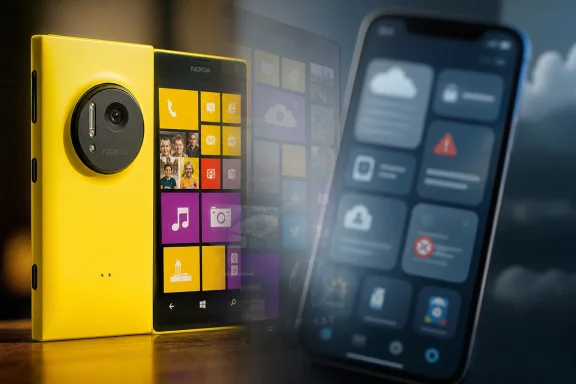
The tragedy is that coherence arrived too late, was rebooted too often, and never attracted the app economy it needed. Triggs’ Lumia 1020 revival makes that failure tangible. The phone boots, the tiles move, the camera still has presence, and then the modern web, modern apps, and modern networks immediately close the door.
Microsoft Built the Interface Everyone Else Eventually Circled Back Toward
Windows Phone’s greatest contribution was not a single feature. It was the confidence to reject the icon grid as the inevitable shape of mobile computing. Metro, later absorbed into Microsoft’s broader design vocabulary, treated the home screen as an information surface rather than a decorated app launcher.
Live Tiles were imperfect, sometimes inconsistent, and often dependent on developer support that never fully arrived. But the concept was strong. A phone should be glanceable. It should tell you something before you open anything. It should turn the home screen into a dashboard rather than a drawer.
That idea looks much less eccentric in 2026 than it did in 2011. Android has spent years improving widgets, notification surfaces, and lock-screen glanceability. Apple, once the high priest of the static icon grid, has added widgets, Live Activities, StandBy mode, and increasingly flexible lock-screen information. The industry did not copy Windows Phone wholesale, but it moved toward the same problem space.
Microsoft’s mistake was not aesthetic overreach. If anything, Windows Phone was one of the few moments when Microsoft design felt ahead of consumer expectation instead of behind it. The mistake was assuming that a better interface could compensate for arriving after iOS and Android had already become social, commercial, and developer gravity wells.
The App Gap Was a Symptom, Not the Whole Disease
It is tempting to reduce Windows Phone to the app gap, because that explanation is clean and mostly true. Users did not want a phone without the banking app their friends used, the transit app their city supported, the social app where culture was happening, or the game everyone else was playing. Developers did not want to build for users who were not there. The flywheel spun in reverse.
But the app gap was also a symptom of deeper strategic instability. Microsoft asked developers to care about Windows Phone 7, then shifted to Windows Phone 8 with architectural changes that left some earlier devices behind. It pushed Windows 8 and Windows Phone toward a shared design philosophy without delivering a simple, irresistible universal app story quickly enough. Then Windows 10 Mobile arrived promising convergence just as the market had largely stopped listening.
That churn was devastating. Mobile developers, especially in the early 2010s, were already choosing between iOS-first, Android-first, or both. Microsoft needed to lower the psychological cost of supporting its platform. Instead, it kept changing the pitch.
By the time Microsoft offered stronger incentives, bridge technologies, and a more serious universal platform vision, the question had changed. Developers were no longer asking whether Windows Phone might become the third ecosystem. They were asking whether it was worth maintaining an app for a platform already sliding out of relevance.
Nokia Gave Windows Phone Its Soul, and Microsoft Could Not Keep It Alive
The Lumia 1020 remains the perfect artifact because it shows what Windows Phone did well and why that was not enough. It had a 41-megapixel camera system, a distinctive body, and a camera-first identity that made most rival phones feel anonymous. It was not just a Windows Phone. It was a Nokia idea of what a smartphone could be.
That distinction mattered. Nokia brought color, imaging credibility, carrier relationships, and hardware personality. The Lumia line could be bright yellow, cyan, red, white, or black at a time when too many phones were slabs of corporate gray. It made the platform feel less like a Microsoft strategy deck and more like a consumer product with taste.
Microsoft’s acquisition of Nokia’s devices business looked logical on paper and ominous in practice. Once the hardware became fully Microsoft’s problem, the old Nokia magic became harder to separate from Redmond’s platform anxieties. Lumia survived for a while, but the sense of an insurgent hardware maker bending Microsoft software into something human faded.
The irony is that Microsoft later became very good at building premium hardware in the Surface line. But Surface succeeded by redefining a PC category Microsoft already owned. Lumia had to win in a phone market where Microsoft was a challenger, a latecomer, and a company whose partners were never fully sure whether Redmond was empowering them or preparing to compete with them.
The Lumia 1020 Was the Pixel Before the Pixel, With Worse Timing
Triggs’ comparison to Google’s Pixel philosophy is apt. Lumia often emphasized experience over spec-sheet dominance. The software was smooth on modest hardware. The camera pipeline mattered more than raw processor bragging rights. The result was a phone that could feel better than its silicon suggested.
That was a sophisticated bet. In a world where Android flagships were sometimes powerful but janky, Windows Phone’s fluidity gave Microsoft a real point of differentiation. The OS could run acceptably on affordable devices, which helped Nokia compete in markets where price mattered. Low-end Lumias were often better than low-end Android phones of the same era.
But there was a cost. The same restraint that made Windows Phone elegant also made it feel less futureproof. Microsoft and Nokia produced some memorable high-end devices, but the ecosystem never developed the kind of power-user halo that Samsung built with the Galaxy Note or that Apple maintained with the iPhone’s annual flagship cadence.
The Pixel comparison also exposes the missing ingredient. Google could afford to use Pixel as a strategic showcase because Android already had the ecosystem. Microsoft needed Lumia to be both showcase and lifeboat. That is a much harder job.
The Web Moved On, and That Is the Harshest Form of Obsolescence
The most brutal part of using Windows Phone today is not the missing apps. Missing apps are expected. The sharper cut is that even the web, supposedly the universal fallback, has become hostile to the old platform.
Internet Explorer on Windows Phone 8.1 belongs to a different web era. Modern sites assume newer JavaScript engines, current TLS behavior, heavier frameworks, responsive layouts tested against iOS Safari and Chromium-based browsers, and authentication flows that were never designed with dead mobile browsers in mind. The result is not merely inconvenience. It is exclusion by entropy.
This is an important lesson for anyone who thinks unsupported devices can simply live forever as “basic” computers. The basics change. A device that can connect to Wi-Fi but cannot properly load the services people rely on is functionally stranded. A phone that powers on, charges, takes photos, and animates beautifully can still be cut off from the living network around it.
Security makes the matter less romantic. A phone without current patches, current browser protections, current app validation, and current network support is not a charming minimalist alternative. It is a museum piece that can occasionally perform tricks.
Carrier Reality Finished What the Store Started
The United States is especially unforgiving to old phones. Network shutdowns, VoLTE requirements, band support, certification policies, and the industry’s migration toward 5G have made many once-functional devices impractical or impossible to use. A Lumia 1020 was not designed for the carrier world of 2026.
That is not a Windows Phone-only problem. Plenty of old Android phones and iPhones have also aged out of practical network life. But Windows Phone suffers more because there is no vendor-maintained path forward, no current model, and no supported continuity between old hardware and new network assumptions.
Triggs’ difficulty getting a Windows Phone 8.1 device to behave with a modern US SIM is therefore not incidental. It is the material reality behind platform death. Software nostalgia can be maintained by hobbyists for a surprisingly long time; carrier compatibility cannot be willed into existence by affection.
The phone, in other words, is not just missing apps. It is missing the world it was built to inhabit.
Microsoft Chose Android Because the War Was Already Over
The modern Microsoft mobile strategy is not the absence of a strategy. It is a surrender that became a business model. Microsoft put Office, OneDrive, Outlook, Teams, Edge, Copilot, Phone Link, and enterprise identity services on iOS and Android because that is where the users went.
From a shareholder perspective, this was the correct move. Microsoft under Satya Nadella stopped treating Windows as the center of every universe and started treating Microsoft accounts, subscriptions, cloud services, and productivity workflows as the durable assets. A Microsoft app on Android is more valuable than a Microsoft phone nobody buys.
Phone Link in Windows 11 is the clearest expression of this settlement. Microsoft still wants the phone and PC to cooperate, but it no longer insists that the phone run Windows. For Android users, especially Samsung users, the integration can be genuinely useful. Messages, notifications, photos, calls, and app continuity are exactly the kinds of features Windows Phone once promised in a more vertically integrated way.
The strategic loss is that Microsoft now negotiates with someone else’s platform. It can improve the bridge, but it does not own the road. Apple understands this distinction better than almost anyone, which is why the iPhone, iPad, Mac, Watch, and services ecosystem remain so sticky. Microsoft once had a chance, however narrow, to build its own version of that loop.
Windows 11 Shows the Mobile Dream Survived in Disguise
The ghost of Windows Phone is visible in Windows 11, though not always in flattering ways. Microsoft still wants glanceable surfaces, account-driven continuity, cloud-backed settings, unified notifications, cross-device identity, and a design system that stretches across form factors. It just pursues those goals from the PC outward rather than from the phone inward.
Widgets, Copilot integration, Phone Link, OneDrive sync, passkeys, and Microsoft 365 all belong to the same family of ideas. Your device should be less important than your signed-in state. Your files, messages, meetings, and AI assistant should follow you. The operating system should be a local expression of a cloud identity.
Windows Phone tried to make that feel personal. Windows 11 often makes it feel administrative. That difference is not trivial. A Lumia home screen full of Live Tiles could feel like your life had been arranged into motion. A modern Windows panel full of feeds, prompts, account nudges, and AI entry points can feel like a company has rented space in your workflow.
This is why Windows Phone nostalgia persists even among people who would never use it today. It represents a version of Microsoft integration that felt less extractive, less ad-driven, and less obsessed with steering the user toward the next service surface. Some of that memory is rose-tinted. Some of it is earned.
The Third Ecosystem Was More Valuable Than We Knew
The smartphone market did not become bad because Windows Phone died. Android and iOS have improved enormously. Modern phones are faster, safer, better supported, better photographed, and more accessible than the devices of the Windows Phone era. Users gained a lot from the duopoly’s maturation.
But competition is not only about feature checklists. It is about possibility. A third ecosystem would have created another place for developers to experiment, another negotiating counterweight for regulators and carriers, another design vocabulary for users, and another strategic path for Microsoft’s services beyond dependency on Apple and Google.
The absence is particularly noticeable now that mobile platforms are gatekeepers for identity, payments, messaging, health data, location, and AI assistants. When only two companies define the mainstream rules of mobile computing, every policy dispute becomes bigger. App store fees, browser engine restrictions, default app rules, sideloading, payment systems, messaging interoperability, and AI integration all become fights inside a constrained arena.
A viable Windows Phone would not have solved all of that. Microsoft would have imposed its own rules and extracted its own rents. But three powerful gatekeepers usually produce more room to maneuver than two, especially for enterprise customers and developers who dislike being forced into binary choices.
The Failure Was Not Inevitable, but the Window Was Narrow
It is too easy to say Windows Phone was doomed from birth. That lets Microsoft off the hook. The company made consequential mistakes before, during, and after the platform’s life.
Microsoft underestimated the iPhone at the start, clung too long to older Windows Mobile assumptions, and then lurched into a more modern strategy under pressure. It did not provide enough continuity across platform generations. It failed to make developers believe that supporting Windows Phone was a rational long-term investment. It could not turn Nokia’s hardware excellence into ecosystem momentum quickly enough.
At the same time, it is too easy to imagine that a few better decisions would have guaranteed success. Apple and Google had enormous advantages. Apple controlled hardware, software, retail presence, and cultural cachet. Google gave Android to manufacturers that desperately needed an iPhone answer. Carriers, developers, accessory makers, and consumers quickly organized around those two poles.
By the time Windows Phone became truly good, “good” was no longer enough. The market had moved from product evaluation to ecosystem commitment. People were not just choosing a phone; they were choosing their purchased apps, cloud photos, message groups, accessories, family support patterns, and workplace compatibility.
That is the cruelest lesson for platform companies. You do not merely need to be better than the incumbent. You need to be better enough to make switching feel safe.
Hobbyists Are Preserving More Than Old Code
The people keeping Windows Phone limping along in 2026 are not restoring a viable consumer platform. They are preserving a design argument. That may sound grandiose, but software history is full of ideas that disappear not because they were wrong, but because the business structure around them collapsed.
Alternative marketplaces and unofficial apps are fragile, legally awkward, and technically constrained. They also perform a kind of cultural maintenance. They let old devices demonstrate what was different about them, not just sit powered off in drawers as inert collectibles.
There is value in that for Windows enthusiasts and IT professionals. Platforms are not only supported products; they are accumulated decisions about interface, trust, distribution, hardware requirements, developer incentives, and user control. Studying a dead platform can clarify the assumptions of living ones.
Windows Phone’s afterlife also exposes how dependent modern computing is on remote services. A 1990s PC can still run its local software decades later. A 2010s smartphone is much more likely to be diminished by dead servers, revoked certificates, abandoned APIs, store shutdowns, and authentication changes. The more cloud-connected software becomes, the harder it is to preserve.
The Lumia Lesson Lands Differently After Windows 10
WindowsForum readers do not need to be told that end-of-support dates are not abstractions. Windows 10’s mainstream consumer support ended on October 14, 2025, and the ongoing debate around extended updates, hardware requirements, and Windows 11 migration has made lifecycle policy a kitchen-table issue rather than an enterprise-only concern.
That context changes how the Windows Phone story feels in 2026. It is no longer just about a dead mobile OS. It is about what happens when useful hardware is cut loose from the security, compatibility, and service fabric that makes it practical.
A Lumia 1020 and an unsupported Windows 10 PC are not equivalent. One is a dead mobile platform with no real path back. The other can still be managed, isolated, upgraded in some cases, enrolled in extended security programs in others, or replaced on a planned schedule. But the emotional pattern rhymes: the device still works, while the ecosystem says it is time to move on.
That tension will define more of computing in the next decade. AI PCs, NPUs, passkeys, cloud attestation, secure boot chains, app store policies, and subscription services will all increase the pressure to refresh hardware and stay inside supported lanes. Sometimes that pressure will be justified by security. Sometimes it will look suspiciously convenient for vendors.
The Lumia 1020’s Second Life Leaves Five Hard Truths
The Windows Phone revival is charming, but its charm should not obscure the practical lessons. A dead platform can still teach the living industry where it became complacent.
- Windows Phone’s interface was not a gimmick; its glanceable, motion-heavy design anticipated problems Android and iOS would spend years solving in their own ways.
- Microsoft’s repeated platform resets damaged developer trust at exactly the moment it needed to make Windows Phone feel like a safe long-term bet.
- Nokia’s Lumia hardware gave the platform identity, but great devices could not compensate for weak ecosystem gravity.
- Community app stores and unofficial clients can preserve nostalgia, but they cannot replace security updates, modern browsers, carrier support, or mainstream developer commitment.
- The loss of Windows Phone made the mobile market simpler for consumers in the short term and narrower for competition in the long term.
The right response to Windows Phone in 2026 is not to pretend it could be your daily driver. It is to recognize that something genuinely inventive died there. The smartphone market moved on, and in many ways it moved upward, but it also became less weird, less plural, and less open to a third answer. If Microsoft ever again tries to shape personal computing beyond the PC, the lesson of Lumia should be clear: design can win affection, but only trust, continuity, and ecosystem patience can keep a platform alive.
