

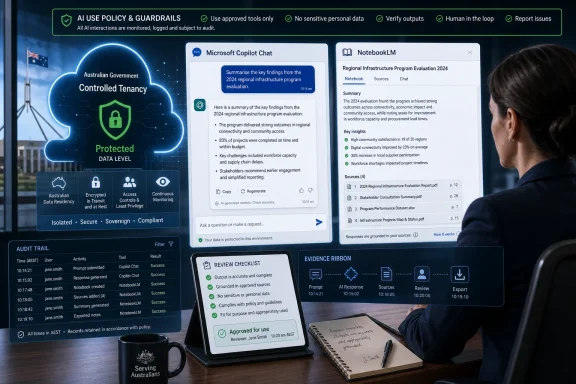
Australia’s Attorney-General’s Department has approved Microsoft Copilot Chat and Google NotebookLM for staff use on data classified up to the “protected” level, with assistant secretary Antony Spence disclosing the setup at Google Cloud Summit Sydney, according to reporting by iTnews. The move matters because it shifts public-sector generative AI from novelty to operational infrastructure. It is also a useful test case for every government department and regulated enterprise still trying to decide whether AI belongs outside the firewall, inside the tenancy, or nowhere near sensitive work.
The department’s answer is not “let the bots decide.” It is more interesting than that: give staff access to controlled AI services, keep humans accountable for the output, record meaningful use, and treat policy as a living guardrail rather than a brittle rulebook. That may sound modest compared with the grand promises attached to AI, but in government technology, modesty is often the difference between deployment and disaster.
The first wave of public-sector generative AI was designed to be safe by being nearly useless. Staff could experiment with prompts, summarise public documents, draft generic text, and learn the contours of the tools, but they were usually blocked from using the material that defined their actual work. For a department handling legal, national security, privacy, and policy-sensitive information, that limitation was not a detail. It was the product.
Spence described that early phase bluntly at the Google Cloud event, saying the department went through its own “mini hype cycle.” People became interested, tried the tools, discovered they could use only public-domain information, and then drifted away because the tools could not touch the work that mattered. That story will be familiar to almost every CIO who has watched an AI proof-of-concept win applause in a demo and then die in the workflow.
The Attorney-General’s Department is now trying to cross that gap. By standing up Copilot Chat and NotebookLM in controlled cloud tenancies certified for protected-level data, it has moved from AI as a training exercise to AI as a governed workplace capability. That does not mean staff can throw judgment into the machine. It means the department has accepted that banning sensitive data from AI indefinitely is not a sustainable policy if the same government expects productivity gains, faster drafting, better research support, and more consistent knowledge work.
The phrase “protected level” carries real weight in the Australian Government’s security taxonomy. It is not the highest classification, but it is well above ordinary public information and covers material where compromise could damage individuals, organisations, or government operations. Allowing AI tools into that zone is therefore not a mere licensing decision. It is a governance bet.
Copilot Chat is the more obvious enterprise choice because Microsoft already sits at the center of many government desktops. For WindowsForum readers, that matters. Microsoft’s AI strategy depends on persuading enterprise and public-sector customers that Copilot is not a consumer chatbot bolted onto Office, but a governed layer that can inherit identity, security, audit, and compliance controls from Microsoft 365.
NotebookLM plays a different role. Google’s tool is oriented around source-grounded research and synthesis, letting users build a working context from a defined set of documents. That model has obvious appeal in legal and policy environments where the problem is often not writing a paragraph from scratch, but understanding a corpus, extracting competing arguments, and producing a first-pass synthesis that a human can challenge.
The department’s dual-vendor approach also avoids a common enterprise trap: treating “AI” as a single procurement category. Different tools fail in different ways. A general-purpose chat assistant may be excellent for rewriting or brainstorming but weaker when fidelity to a fixed document set is essential. A notebook-style research tool may be stronger for working inside defined sources but less natural for broad productivity workflows. Sensible governance starts by admitting that tool choice is part of risk management.
This is why the iTnews report is more consequential than a routine “agency adopts AI” item. The department is not merely saying staff may use AI. It is saying staff may use particular AI tools, in controlled environments, for information that previously made generic AI impractical. That is the line many organisations have been approaching but not crossing.
A controlled tenancy does not magically solve AI risk. It does, however, change the risk surface. Identity can be managed. Access can be logged. Data boundaries can be configured. Administrators can apply policy, review usage, and respond to incidents in a way they cannot if staff are improvising with personal accounts and browser tabs.
For Microsoft, this is the entire enterprise Copilot pitch. The company wants customers to believe that if they already trust Microsoft 365 with email, documents, calendars, and identity, then Copilot can be governed through the same administrative muscle. That is attractive to IT departments because it turns the AI problem into a familiar one: permissions, retention, audit, information protection, and user education.
But it is also where the hidden difficulty lies. AI tools are only as safe as the information architecture around them. If permissions are chaotic, if old SharePoint sites expose too much, if records are poorly labeled, or if sensitive documents have been casually overshared for years, AI will not create the governance problem. It will reveal it at machine speed.
Google faces a related but distinct challenge. NotebookLM’s document-grounded approach can feel safer because users define the source material, but that safety depends on which documents are uploaded, how they are stored, who can access the notebook, and what contractual or technical controls apply. “Grounded” is not the same as “risk-free.” It simply changes the failure mode from open-ended hallucination to misuse, over-trust, leakage, or flawed interpretation of supplied sources.
Rules are attractive because they look enforceable. They also become obsolete almost immediately in AI. A rule written around one model’s limitations, one vendor’s interface, or one known risk can be bypassed by a product update, a new integration, or a use case nobody anticipated. Guardrails are less satisfying on paper but often more durable in practice because they define principles of acceptable use and force staff to apply context.
This is not an argument for vagueness. Bad guardrails become slogans. Good guardrails turn institutional values into operational habits: verify outputs, preserve records, respect classification, disclose material use, avoid automated decisions where they are not authorised, and keep human accountability attached to the work.
The Attorney-General’s Department appears to be building around that latter model. According to iTnews, users must verify generated outputs and own the final results. Spence was explicit that the department does not produce final versions straight from AI and has no automated decision-making within the organisation at this stage.
That line is crucial. In a democracy, “the model did it” is not a defence. The public will not accept it, Parliament will not accept it, and auditors should not accept it. AI can draft, summarise, compare, and suggest, but the accountable actor remains the official who uses the output.
There is a difference between glancing at AI output and accepting responsibility for it. The former is theatre. The latter requires enough domain knowledge, time, and institutional expectation for the human reviewer to catch errors, omissions, hallucinations, bias, and inappropriate framing. In legal and policy work, that distinction matters because a plausible paragraph can be more dangerous than an obviously bad one.
Generative AI is particularly seductive in bureaucratic environments because it is good at form. It can produce the tone of a ministerial brief, the structure of a policy memo, the cadence of an executive summary, and the language of procedural certainty. That surface fluency creates a trap: documents can look more finished than they are.
The department’s insistence that AI supplements rather than automates work is therefore not a conservative flourish. It is a recognition of how government legitimacy functions. A public servant cannot outsource judgment to a probabilistic system and then claim institutional accountability remains intact.
For Windows administrators, there is a practical lesson here. AI deployment is not only an endpoint, browser, or cloud-security project. It is a workflow redesign project. If users do not understand when review is substantive, when disclosure is required, and when a tool is inappropriate, then technical controls will carry more weight than they can bear.
Spence gave a useful distinction. Looking up legislation with a search engine does not necessarily require a special record. Having AI draft a speech does. Creating an image or generating substantive material crosses a threshold because the tool is no longer merely helping the user find information; it is shaping the artifact.
That approach mirrors a broader shift in AI governance from abstract ethics to administrative evidence. If an agency uses AI to help produce a brief, a letter, a public statement, or a draft decision document, future reviewers may need to know how that work was created. Not because AI use is inherently improper, but because process matters.
Records also protect staff. Without a usable recordkeeping model, AI use becomes an invisible liability. If a generated claim later proves wrong, if an image raises provenance concerns, or if a document contains language that subtly changes policy meaning, the organisation needs to reconstruct what happened. That requires more than trust and memory.
The challenge is proportionality. Government departments already operate under heavy process loads. If AI governance becomes a new paperwork regime for every prompt, users will rationally avoid official channels or under-report. The department’s decision to defer some judgment to line areas is therefore pragmatic. The people closest to the work are often best placed to decide when AI use is material.
Drafting tools influence thought. If AI produces the first version of a policy memo, it may subtly set the structure of the argument. If it summarises consultation submissions, it may compress minority views or flatten technical nuance. If it suggests correspondence, it may introduce a tone that seems official but misses the political, legal, or human context.
That is why the department’s anomaly-reporting process matters. Spence described anomalies broadly, including access to more data than expected or tools not responding as intended. In mature AI governance, unexpected outcomes are not merely bugs to be fixed; they are signals about how the system behaves in the organisation.
The best AI programs will treat anomalies as a shared intelligence layer. If one team discovers that a tool performs poorly with certain legal materials, over-summarises a class of documents, or creates misleading confidence around ambiguous text, that knowledge should not remain local. It should feed training, policy, configuration, and procurement decisions.
There is also a cultural benefit. Encouraging anomaly reporting tells staff that AI failure is not taboo. That matters because users who fear blame are less likely to report borderline issues, especially when the output is not catastrophically wrong but merely odd, incomplete, or too confident. The dangerous AI failures are often the ones that look almost right.
That centralisation has advantages. It gives departments a shared vocabulary and makes it easier to compare use cases, assess risk, and build reusable services. It also gives ministers, auditors, and the public a clearer standard against which to judge agency behaviour.
But central frameworks cannot answer every operational question. The Attorney-General’s Department’s work shows why local implementation still matters. A finance department, a legal policy agency, a health department, and a defense-adjacent body may all use AI for drafting and summarisation, but the sensitivity, consequences, and acceptable failure modes differ sharply.
The APS is therefore likely to settle into a hybrid model: whole-of-government principles, agency-level guardrails, approved enterprise tools, and line-of-business discretion. That may frustrate people looking for a single national AI rulebook. It is also probably the only workable model.
The alternative is either paralysis or chaos. A central ban would preserve theoretical safety while pushing real use into unsanctioned channels. A free-for-all would invite leakage, inconsistency, and public backlash. Controlled adoption is the narrow path between those failures.
That means IT teams should prepare for AI governance to collide with old identity and content-management debt. Overshared files, stale groups, poorly classified data, abandoned Teams, permissive SharePoint sites, and inconsistent retention policies are no longer background hygiene issues. They become AI exposure paths.
There is also a training burden that cannot be solved with a one-hour webinar. Users need practical examples: when to use Copilot Chat, when to use a source-grounded notebook, when not to use AI at all, and when generated material must be recorded. They also need permission to be skeptical of outputs that sound polished.
The Microsoft ecosystem gives administrators tools, but tools do not substitute for decisions. Someone still has to define acceptable data classes, monitor usage patterns, investigate anomalies, and decide whether a promising use case should become standard practice or remain a local experiment.
Google’s presence in the department’s setup is a reminder that Microsoft will not own every AI workflow, even in Microsoft-centric organisations. Document-grounded research, specialised notebooks, and domain-specific assistants may coexist with Copilot. The governance model must therefore span vendors rather than assume a single control plane will be enough.
The department’s answer is not “let the bots decide.” It is more interesting than that: give staff access to controlled AI services, keep humans accountable for the output, record meaningful use, and treat policy as a living guardrail rather than a brittle rulebook. That may sound modest compared with the grand promises attached to AI, but in government technology, modesty is often the difference between deployment and disaster.
 The AI Pilot Phase Has Run Out of Road
The first wave of public-sector generative AI was designed to be safe by being nearly useless. Staff could experiment with prompts, summarise public documents, draft generic text, and learn the contours of the tools, but they were usually blocked from using the material that defined their actual work. For a department handling legal, national security, privacy, and policy-sensitive information, that limitation was not a detail. It was the product.Spence described that early phase bluntly at the Google Cloud event, saying the department went through its own “mini hype cycle.” People became interested, tried the tools, discovered they could use only public-domain information, and then drifted away because the tools could not touch the work that mattered. That story will be familiar to almost every CIO who has watched an AI proof-of-concept win applause in a demo and then die in the workflow.
The Attorney-General’s Department is now trying to cross that gap. By standing up Copilot Chat and NotebookLM in controlled cloud tenancies certified for protected-level data, it has moved from AI as a training exercise to AI as a governed workplace capability. That does not mean staff can throw judgment into the machine. It means the department has accepted that banning sensitive data from AI indefinitely is not a sustainable policy if the same government expects productivity gains, faster drafting, better research support, and more consistent knowledge work.
The phrase “protected level” carries real weight in the Australian Government’s security taxonomy. It is not the highest classification, but it is well above ordinary public information and covers material where compromise could damage individuals, organisations, or government operations. Allowing AI tools into that zone is therefore not a mere licensing decision. It is a governance bet.
Microsoft and Google Win the First Serious Trust Test
There is a vendor story here, but it is not simply “Microsoft versus Google.” The notable fact is that the Attorney-General’s Department has backed both Microsoft Copilot Chat and Google NotebookLM rather than settling on a single AI stack. That reflects the way AI is actually being absorbed into knowledge work: chat assistants, document-grounded notebooks, search, drafting aids, summarisation tools, and productivity suites are converging, but they are not identical.Copilot Chat is the more obvious enterprise choice because Microsoft already sits at the center of many government desktops. For WindowsForum readers, that matters. Microsoft’s AI strategy depends on persuading enterprise and public-sector customers that Copilot is not a consumer chatbot bolted onto Office, but a governed layer that can inherit identity, security, audit, and compliance controls from Microsoft 365.
NotebookLM plays a different role. Google’s tool is oriented around source-grounded research and synthesis, letting users build a working context from a defined set of documents. That model has obvious appeal in legal and policy environments where the problem is often not writing a paragraph from scratch, but understanding a corpus, extracting competing arguments, and producing a first-pass synthesis that a human can challenge.
The department’s dual-vendor approach also avoids a common enterprise trap: treating “AI” as a single procurement category. Different tools fail in different ways. A general-purpose chat assistant may be excellent for rewriting or brainstorming but weaker when fidelity to a fixed document set is essential. A notebook-style research tool may be stronger for working inside defined sources but less natural for broad productivity workflows. Sensible governance starts by admitting that tool choice is part of risk management.
This is why the iTnews report is more consequential than a routine “agency adopts AI” item. The department is not merely saying staff may use AI. It is saying staff may use particular AI tools, in controlled environments, for information that previously made generic AI impractical. That is the line many organisations have been approaching but not crossing.
“Controlled Tenancy” Is the New AI Battleground
The most important phrase in Spence’s remarks may be “our own controlled tenancies.” That is where the public-sector AI debate has been heading since the first panic over staff pasting sensitive text into public chatbots. The question is no longer whether employees will use AI. It is whether the organisation can provide a sanctioned path that is secure enough, useful enough, and easier than the shadow alternative.A controlled tenancy does not magically solve AI risk. It does, however, change the risk surface. Identity can be managed. Access can be logged. Data boundaries can be configured. Administrators can apply policy, review usage, and respond to incidents in a way they cannot if staff are improvising with personal accounts and browser tabs.
For Microsoft, this is the entire enterprise Copilot pitch. The company wants customers to believe that if they already trust Microsoft 365 with email, documents, calendars, and identity, then Copilot can be governed through the same administrative muscle. That is attractive to IT departments because it turns the AI problem into a familiar one: permissions, retention, audit, information protection, and user education.
But it is also where the hidden difficulty lies. AI tools are only as safe as the information architecture around them. If permissions are chaotic, if old SharePoint sites expose too much, if records are poorly labeled, or if sensitive documents have been casually overshared for years, AI will not create the governance problem. It will reveal it at machine speed.
Google faces a related but distinct challenge. NotebookLM’s document-grounded approach can feel safer because users define the source material, but that safety depends on which documents are uploaded, how they are stored, who can access the notebook, and what contractual or technical controls apply. “Grounded” is not the same as “risk-free.” It simply changes the failure mode from open-ended hallucination to misuse, over-trust, leakage, or flawed interpretation of supplied sources.
Guardrails Beat Commandments, But Only If Someone Owns Them
Spence’s most interesting policy argument was that strict AI rules age too quickly. The department, he said, leaned into its privacy law background and adopted guardrails rather than traditional “thou shalt” instructions. That is a revealing choice from an agency whose work is deeply tied to law, accountability, and the machinery of government.Rules are attractive because they look enforceable. They also become obsolete almost immediately in AI. A rule written around one model’s limitations, one vendor’s interface, or one known risk can be bypassed by a product update, a new integration, or a use case nobody anticipated. Guardrails are less satisfying on paper but often more durable in practice because they define principles of acceptable use and force staff to apply context.
This is not an argument for vagueness. Bad guardrails become slogans. Good guardrails turn institutional values into operational habits: verify outputs, preserve records, respect classification, disclose material use, avoid automated decisions where they are not authorised, and keep human accountability attached to the work.
The Attorney-General’s Department appears to be building around that latter model. According to iTnews, users must verify generated outputs and own the final results. Spence was explicit that the department does not produce final versions straight from AI and has no automated decision-making within the organisation at this stage.
That line is crucial. In a democracy, “the model did it” is not a defence. The public will not accept it, Parliament will not accept it, and auditors should not accept it. AI can draft, summarise, compare, and suggest, but the accountable actor remains the official who uses the output.
Human-in-the-Loop Is Not a Checkbox
Every AI governance document now contains some version of “human in the loop.” The phrase risks becoming decorative. The Attorney-General’s Department’s framing is stronger because Spence tied human review to ownership, not merely oversight.There is a difference between glancing at AI output and accepting responsibility for it. The former is theatre. The latter requires enough domain knowledge, time, and institutional expectation for the human reviewer to catch errors, omissions, hallucinations, bias, and inappropriate framing. In legal and policy work, that distinction matters because a plausible paragraph can be more dangerous than an obviously bad one.
Generative AI is particularly seductive in bureaucratic environments because it is good at form. It can produce the tone of a ministerial brief, the structure of a policy memo, the cadence of an executive summary, and the language of procedural certainty. That surface fluency creates a trap: documents can look more finished than they are.
The department’s insistence that AI supplements rather than automates work is therefore not a conservative flourish. It is a recognition of how government legitimacy functions. A public servant cannot outsource judgment to a probabilistic system and then claim institutional accountability remains intact.
For Windows administrators, there is a practical lesson here. AI deployment is not only an endpoint, browser, or cloud-security project. It is a workflow redesign project. If users do not understand when review is substantive, when disclosure is required, and when a tool is inappropriate, then technical controls will carry more weight than they can bear.
Records Management Becomes the Quiet Center of AI Governance
One of the most grounded details in the iTnews report is that the department records where and how AI is being used, while trying not to log every trivial interaction. That balance is harder than it sounds. Record too little, and the organisation cannot explain its own decisions. Record everything, and staff will either drown in process or route around the system.Spence gave a useful distinction. Looking up legislation with a search engine does not necessarily require a special record. Having AI draft a speech does. Creating an image or generating substantive material crosses a threshold because the tool is no longer merely helping the user find information; it is shaping the artifact.
That approach mirrors a broader shift in AI governance from abstract ethics to administrative evidence. If an agency uses AI to help produce a brief, a letter, a public statement, or a draft decision document, future reviewers may need to know how that work was created. Not because AI use is inherently improper, but because process matters.
Records also protect staff. Without a usable recordkeeping model, AI use becomes an invisible liability. If a generated claim later proves wrong, if an image raises provenance concerns, or if a document contains language that subtly changes policy meaning, the organisation needs to reconstruct what happened. That requires more than trust and memory.
The challenge is proportionality. Government departments already operate under heavy process loads. If AI governance becomes a new paperwork regime for every prompt, users will rationally avoid official channels or under-report. The department’s decision to defer some judgment to line areas is therefore pragmatic. The people closest to the work are often best placed to decide when AI use is material.
The Real Risk Is Not Hallucination; It Is Institutional Drift
AI hallucination gets the headlines because it is easy to understand. A chatbot invents a case, mangles a fact, or fabricates a citation, and everyone agrees something went wrong. But in government, the deeper risk is institutional drift: a gradual shift in how work is framed, drafted, prioritised, and justified because AI-generated language becomes the default starting point.Drafting tools influence thought. If AI produces the first version of a policy memo, it may subtly set the structure of the argument. If it summarises consultation submissions, it may compress minority views or flatten technical nuance. If it suggests correspondence, it may introduce a tone that seems official but misses the political, legal, or human context.
That is why the department’s anomaly-reporting process matters. Spence described anomalies broadly, including access to more data than expected or tools not responding as intended. In mature AI governance, unexpected outcomes are not merely bugs to be fixed; they are signals about how the system behaves in the organisation.
The best AI programs will treat anomalies as a shared intelligence layer. If one team discovers that a tool performs poorly with certain legal materials, over-summarises a class of documents, or creates misleading confidence around ambiguous text, that knowledge should not remain local. It should feed training, policy, configuration, and procurement decisions.
There is also a cultural benefit. Encouraging anomaly reporting tells staff that AI failure is not taboo. That matters because users who fear blame are less likely to report borderline issues, especially when the output is not catastrophically wrong but merely odd, incomplete, or too confident. The dangerous AI failures are often the ones that look almost right.
Australia’s Public Service Is Moving From Experimentation to Operating Model
The Attorney-General’s Department’s deployment sits inside a larger Australian Government effort to formalise AI use across the public service. The Department of Finance’s AI Plan for the Australian Public Service, the Digital Transformation Agency’s responsible-use policy, and related assurance frameworks are all attempts to prevent each agency from inventing AI governance from scratch.That centralisation has advantages. It gives departments a shared vocabulary and makes it easier to compare use cases, assess risk, and build reusable services. It also gives ministers, auditors, and the public a clearer standard against which to judge agency behaviour.
But central frameworks cannot answer every operational question. The Attorney-General’s Department’s work shows why local implementation still matters. A finance department, a legal policy agency, a health department, and a defense-adjacent body may all use AI for drafting and summarisation, but the sensitivity, consequences, and acceptable failure modes differ sharply.
The APS is therefore likely to settle into a hybrid model: whole-of-government principles, agency-level guardrails, approved enterprise tools, and line-of-business discretion. That may frustrate people looking for a single national AI rulebook. It is also probably the only workable model.
The alternative is either paralysis or chaos. A central ban would preserve theoretical safety while pushing real use into unsanctioned channels. A free-for-all would invite leakage, inconsistency, and public backlash. Controlled adoption is the narrow path between those failures.
Windows Shops Should Read This as a Deployment Pattern
For Windows-heavy enterprises, the Attorney-General’s Department story is a preview of the next 18 months. Copilot Chat and related Microsoft 365 AI services will increasingly be pitched not as experimental add-ons but as standard workplace infrastructure. The technical question will move from “Should we allow AI?” to “Which AI surfaces are approved for which data, under which controls, and with which audit trail?”That means IT teams should prepare for AI governance to collide with old identity and content-management debt. Overshared files, stale groups, poorly classified data, abandoned Teams, permissive SharePoint sites, and inconsistent retention policies are no longer background hygiene issues. They become AI exposure paths.
There is also a training burden that cannot be solved with a one-hour webinar. Users need practical examples: when to use Copilot Chat, when to use a source-grounded notebook, when not to use AI at all, and when generated material must be recorded. They also need permission to be skeptical of outputs that sound polished.
The Microsoft ecosystem gives administrators tools, but tools do not substitute for decisions. Someone still has to define acceptable data classes, monitor usage patterns, investigate anomalies, and decide whether a promising use case should become standard practice or remain a local experiment.
Google’s presence in the department’s setup is a reminder that Microsoft will not own every AI workflow, even in Microsoft-centric organisations. Document-grounded research, specialised notebooks, and domain-specific assistants may coexist with Copilot. The governance model must therefore span vendors rather than assume a single control plane will be enough.
The Protected-Level Experiment Gives IT a More Honest AI Conversation
The most concrete lesson from the Attorney-General’s Department is that AI value appears only when the tool can touch relevant work, but AI risk rises for exactly the same reason. That is the uncomfortable bargain every serious organisation now faces.- The department’s controlled deployments show that public-sector AI is moving beyond public-data experiments and into sensitive operational workflows.
- Copilot Chat and NotebookLM are being treated as different tools for different work patterns, not interchangeable chatbots.
- Policy guardrails are replacing rigid rules because model capabilities, vendor features, and staff use cases change too quickly for static instructions.
- Human review is being framed as ownership of the final work, not a ceremonial approval step after the machine has done the thinking.
- Recordkeeping and anomaly reporting are becoming core AI controls because organisations must be able to explain both successful uses and unexpected failures.
- The same deployment pattern will confront Windows administrators as Copilot becomes a normal part of enterprise productivity rather than a side experiment.
