

Microsoft’s Copilot has moved decisively from “helpful search companion” to a functioning checkout surface by adding deep payment integrations with both PayPal and Stripe, and packaging the plumbing retailers need to let AI complete purchases on users’ behalf. This is not a minor UI tweak — it’s a foundational step toward agentic commerce, where an AI assistant can discover, recommend, and then execute a purchase in the same conversation without sending the buyer away from the chat window.
Agentic commerce is the emerging model that turns AI from a research tool into an active buyer’s agent. Instead of sending links and hoping the user completes checkout on a merchant site, an agentic flow collapses discovery, selection, and payment into a single, conversational surface. Microsoft’s new Copilot Checkout sits at the confluence of several industry trends: AI-powered product discovery, machine-readable product catalogs, and tokenized delegated payments that preserve PCI boundaries. This move follows similar steps by other platform vendors: OpenAI and Stripe shipped instant, in-chat checkout experiences in 2024–2025; Google and a number of smaller agent platforms have tested checkout integrations as well. Microsoft’s advantage is distribution across Copilot surfaces (Copilot.com, the Copilot sidebar, and eventual Windows integration) and its ability to lean on established commerce partners to manage the risky parts of any payment flow.
The technical rails are in place; the operational, legal, and trust rails are the next frontier. Expect intense activity around standards, audits, and governance over the next 12–24 months as this new commerce surface matures.
As reported in contemporary coverage, Copilot Checkout is available now on Copilot.com in the United States with broader rollouts planned, PayPal and Stripe are named as launch partners with distinct roles, and Microsoft is shipping merchant tooling to accelerate onboarding — a multi‑partner push that could reshape online shopping flows if the ecosystem can manage the operational and governance challenges.
Source: techAU Microsoft adds PayPal and Stripe to Copilot: The future of AI-driven commerce is here - techAU
 Background / Overview
Agentic commerce is the emerging model that turns AI from a research tool into an active buyer’s agent. Instead of sending links and hoping the user completes checkout on a merchant site, an agentic flow collapses discovery, selection, and payment into a single, conversational surface. Microsoft’s new Copilot Checkout sits at the confluence of several industry trends: AI-powered product discovery, machine-readable product catalogs, and tokenized delegated payments that preserve PCI boundaries. This move follows similar steps by other platform vendors: OpenAI and Stripe shipped instant, in-chat checkout experiences in 2024–2025; Google and a number of smaller agent platforms have tested checkout integrations as well. Microsoft’s advantage is distribution across Copilot surfaces (Copilot.com, the Copilot sidebar, and eventual Windows integration) and its ability to lean on established commerce partners to manage the risky parts of any payment flow. What Microsoft, PayPal and Stripe announced
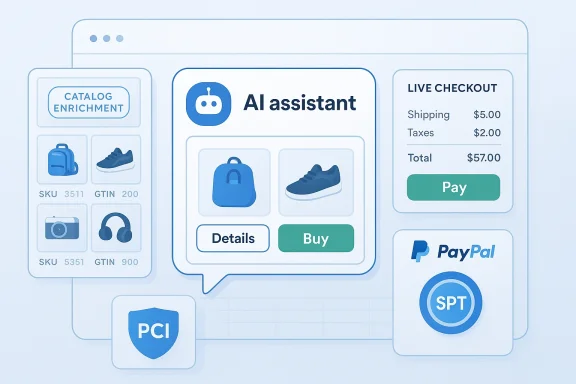
- Copilot Checkout: an embedded, in-conversation checkout widget that shows interactive product cards with Details and Buy actions. Selecting Buy opens a branded checkout inside Copilot where users confirm shipping, taxes, and payment — no full-page redirect for supported merchants.
- PayPal’s role: at launch PayPal will power inventory surfacing, branded checkout, guest checkout and credit card acceptance inside Copilot, leveraging its newly publicized store sync and other agentic commerce capabilities. PayPal emphasizes that eligible purchases retain PayPal buyer/seller protections.
- Stripe’s role: Stripe supplies the underlying agentic payment plumbing, including the Agentic Commerce Protocol (ACP) and the Shared Payment Token (SPT) primitive that lets an agent initiate a checkout without ever exposing raw card details to the assistant. Stripe’s developer docs and product messaging describe SPTs and ACP as the canonical way to connect agents, sellers, and payment processors.
- Shopify and merchant onboarding: Microsoft and Shopify will automatically enroll Shopify merchants in Copilot Checkout after an opt‑out window, creating rapid catalog scale; merchants using PayPal or Stripe can apply to participate directly. Microsoft also launched Brand Agents and a set of Copilot Studio templates (catalog enrichment, personalized shopping, store operations) to help merchants prepare inventory and control brand voice.
Technical anatomy: how Copilot Checkout actually works
1. Canonical product catalogs and catalog enrichment
Agentic discovery requires accurate, machine-readable product data. Microsoft expects merchants to provide structured feeds (SKU, GTIN, inventory, images, shipping metadata) or to rely on partner tools such as PayPal’s store sync or Shopify’s Agentic Storefronts. Copilot Studio includes a catalog enrichment agent that extracts attributes from images and metadata to reduce onboarding friction for merchants. This foundation is essential to prevent hallucinations and to provide auditable provenance linking recommendations to canonical records.2. Conversational orchestration (Copilot runtime)
The assistant interprets the shopper’s intent, asks clarifying questions (size, color, delivery window), and surfaces shoppable product cards in the conversation. These product cards include UX affordances for viewing details and initiating a purchase, and the Copilot runtime logs the provenance of decisions to support dispute resolution and analytics. Microsoft describes this layer as the orchestration glue between user intent and merchant systems.3. Delegated, tokenized checkout via ACP and Shared Payment Tokens
When the user confirms a purchase, Copilot requests a short‑lived checkout session or issues a delegated payment token on behalf of the buyer. Stripe’s Agentic Commerce Protocol defines the flows: an agent provisions a SharedPaymentToken (SPT) specific to the seller and cart amount and passes that token to the merchant’s server, which can then create a PaymentIntent and settle the transaction. The essential property here is that the agent never sees raw card data — the payments provider (Stripe, PayPal, or Shopify Checkout) handles fraud checks and PCI-sensitive operations.Security, privacy, and compliance: the promises and the gaps
Microsoft’s architecture and its partners focus heavily on reducing the attack surface around payment credentials. Tokenization — in the form of Shared Payment Tokens or short‑lived checkout sessions — is a strong control that prevents Copilot or third-party plugins from storing or exfiltrating raw card numbers. That technical separation is consistent with PCI best practices: let payment processors handle credential capture and settlement while the AI orchestrator handles UX and workflow. However, tokenization is not a panacea. Practical risks include:- Provenance and dispute resolution. If Copilot recommends a product with stale pricing or incorrect availability and the buyer completes a purchase inside the chat, resolving a dispute requires precise logs that tie the conversation, the canonical catalog entry, and the tokenized checkout together. Microsoft’s materials emphasize auditing and merchant-of-record continuity, but the operational details — SLAs, dispute-handling processes, and liability splits — will be determined in merchant contracts and partner terms.
- Fraud vectors beyond raw card data. Tokenization reduces card exposure, but agents create new attack surfaces: automated bots could attempt to trick an agent into initiating token generation for a compromised account, or social‑engineering vectors could be used to coerce an agent to approve fraudulent orders. Stripe’s Radar and PayPal’s fraud systems remain critical, but merchants must validate agent telemetry and anomalous patterns in their own order flows.
- Privacy of non-payment personal data. Even when cards stay with PSPs, Copilot will handle shipping addresses, order histories, and preference data. That information can be sensitive and may require stricter consent models and purpose-limiting controls, particularly in regulated jurisdictions such as the EU. Microsoft highlights “responsible innovation,” but specifics on data retention, sharing, and deletion across Copilot, payment providers, and merchant backends remain to be clarified in documentation and contracts.
- Automatic onboarding concerns. Shopify merchants will be auto-enrolled after an opt‑out window. That accelerates catalog coverage but raises questions for small merchants who may not have tested tokenized checkout or aligned their fulfillment operations with agent-initiated orders. Merchants should audit default enrollment notices and test agent flows before a full launch.
Business implications: who wins, who should worry
For merchants and brands
- New distribution channel: participating stores gain access to high‑intent shoppers inside Copilot’s discovery funnel without building custom integrations. Prebuilt templates and store sync tools reduce engineering overhead, making it easier for smaller sellers (including Etsy creators) to appear in AI-driven shopping surfaces.
- Conversion potential (vendor figures): Microsoft and PayPal cite internal metrics suggesting Copilot-led journeys convert more quickly — PayPal’s materials reference 53% more purchases within 30 minutes and 194% higher conversions when shopping intent is present. These are vendor-supplied observational figures and should be treated as indicative rather than independently audited benchmarks. Merchants should validate conversion uplifts with controlled A/B pilots before reassigning marketing budget.
- Operational lift required: to benefit, merchants must ensure catalog fidelity, inventory sync, accurate shipping metadata, and robust order-handling processes. Agentic commerce magnifies mistakes: a mispriced or out-of-stock SKU promoted by Copilot can lead to rapid, concentrated customer complaints. Brand Agents and catalog enrichment templates are Microsoft’s answer, but implementation work remains essential.
For payments providers
- New revenue and strategic position: PayPal and Stripe capture volumes as merchants move to agentic channels. PayPal’s wallet and buyer protections are strong consumer trust signals, while Stripe’s infrastructure and fraud telemetry (Radar) are attractive for merchants who want to integrate programmatically. Both players strengthen their strategic position by being the “rails” for agentic commerce.
For consumers
- Frictionless checkout vs. informed consent: the convenience of in-chat checkout is compelling — fewer clicks, fewer forms. But consumers need clear, real‑time visibility into merchant identity, return policies, tax and shipping costs, and buyer protections. UX design that surfaces these details before purchase will be a key determinant of long‑term trust. Microsoft and PayPal have signaled buyer protections for eligible transactions, but consumers should still verify merchant terms for each purchase.
Competition and the broader market landscape
Microsoft is not alone in pushing agentic commerce. OpenAI and Stripe already shipped in‑chat checkout features, showing the market appetite for embedded commerce. Google has tested agent-native checkout features inside Search and Shopping, and other AI players are experimenting with similar flows. Microsoft’s differentiator is integration with its broader Copilot ecosystem and the scale of Shopify catalog enrollment. From a merchant perspective, the winning strategy is likely multi‑channel: supporting discovery on Copilot, ChatGPT, Google, and marketplace partners while maintaining rigorous catalog management and operational controls. For payments providers, open standards such as the Agentic Commerce Protocol (ACP) reduce friction across ecosystems and make it easier for any agent to interact with any seller, which is why Stripe has invested heavily in ACP documentation and tooling.What to watch: three operational tests that will determine success
- Catalog Fidelity Tests
- Can merchants keep product metadata (price, availability, variants) current across store sync and Copilot’s discovery index?
- Failure mode: high rates of canceled orders and disputes due to stale information.
- Fraud and Token Abuse Detection
- Do token issuance and SPT scopes sufficiently prevent replay attacks, account takeover purchases, or merchant impersonation?
- Failure mode: sudden bursts of chargebacks tied to agent-initiated flows.
- Consumer Trust Signals and Disclosures
- Are buyer protections, merchant identity, and clear return/refund information surfaced before purchase?
- Failure mode: consumers lose confidence and refuse to transact via agents.
Practical guidance: what users and merchants should do next
For consumers (short, practical checklist)
- Link your PayPal account when prompted inside Copilot and verify Two‑Factor Authentication is enforced on your PayPal account.
- Treat in-chat purchases like any checkout: verify merchant name, total price (incl. taxes & shipping), return policy, and seller ratings before confirming.
- Monitor bank and card statements closely for the first few agentic purchases to detect any anomalous charges.
For merchants and store owners
- Audit your catalog: ensure SKUs, pricing, inventory and shipping metadata are canonical and machine-readable. Use Shopify’s Agentic Storefronts or PayPal’s store sync if available.
- Test agent-initiated orders in a low-volume pilot: validate fulfillment workflows, returns handling, and dispute resolution. Use this pilot to measure conversion uplift versus standard channels.
- Review contracts with PSPs: confirm who is liable for chargebacks, how SPTs are scoped, and what operational SLAs govern refunds and fraud signals.
Critical analysis: strengths, strategic wins, and material risks
Strengths and strategic wins
- Seamless consumer UX: collapsing discovery-to-payment reduces friction and could materially lower cart abandonment for certain purchase types (impulse buys, simple consumables). Microsoft and PayPal claim substantive short-term conversion lifts; merchant pilots will show whether those figures generalize.
- Standards-based approach: adopting ACP and tokenized SPTs is the right technical direction. This approach minimizes PCI scope for AI platforms and gives merchants a clear API surface to manage transactions. Stripe’s documentation gives a firm technical basis for secure agentic commerce flows.
- Rapid merchant scale via Shopify: automatic Shopify enrollment delivers catalog breadth quickly, which matters for discovery-first channels where long-tail products and small sellers drive unique value.
Material risks and unresolved issues
- Operational readiness of merchants: auto-enrollment pushes scale but may outpace small merchants’ ability to honor SLAs, especially around stock accuracy, shipping windows, and returns. That mismatch can result in poor buyer experiences and reputational damage.
- Vendor-supplied metrics need independent validation: the conversion figures (e.g., 53% uplift) come from vendor materials and should be validated by merchants and independent analysts before being used to justify strategic investments. Vendor metrics are useful hypotheses, not definitive proof.
- Regulatory and legal complexity: agent-initiated purchases raise novel consumer-protection questions (clear disclosure of merchant and total cost at time of agreement, return window clarity, jurisdictional tax handling) that will attract regulatory attention as volumes grow. Jurisdictions with strict e-privacy or AI transparency laws may require additional disclosures.
- Trust and UX fragility: removing the merchant’s website from the moment-of-purchase amplifies the importance of visible trust signals in the chat UI. If consumers feel uncertain about who they are buying from or how returns will be handled, adoption will slow regardless of technical convenience.
The SEO angle: keywords and phrases that matter now
For readers and editors optimizing content around this ecosystem, important phrases to use naturally in coverage and documentation include:- Copilot Checkout
- agentic commerce
- in-chat purchases
- PayPal integration
- Stripe Shared Payment Token (SPT)
- Agentic Commerce Protocol (ACP)
- tokenized checkout
- Brand Agents
- catalog enrichment
- merchant of record
- Shopify automatic enrollment
Final assessment and outlook
Microsoft’s integration of PayPal and Stripe into Copilot Checkout is a major structural step toward making AI a transactional actor in everyday commerce. The technical design — machine-readable catalogs, conversational orchestration, and tokenized delegated payments — aligns with best practices and with industry moves (Stripe’s ACP and Shared Payment Token work in particular provide a clear, secure pattern). That said, the success of agentic commerce is not purely technical. It will be decided by real-world operational discipline: catalog hygiene, fraud detection, dispute mechanics, and the quality of merchant onboarding. Vendor-provided conversion numbers are promising but need independent confirmation and careful pilot testing before merchants reallocate major marketing budgets. The automatic enrollment of Shopify merchants will accelerate scale, but it also raises responsibility for robust defaults and clear, accessible opt-out and testing mechanisms. For consumers, the benefits are tangible: faster buying journeys and the potential for more helpful, personalized shopping assistants. For merchants and payments providers, the opportunity is to capture intent at the moment it matters most. For regulators and consumer advocates, it’s time to watch closely: the rules that govern fairness, disclosure, and liability will need to catch up with the reality that AI can now press “buy” on behalf of a person.The technical rails are in place; the operational, legal, and trust rails are the next frontier. Expect intense activity around standards, audits, and governance over the next 12–24 months as this new commerce surface matures.
As reported in contemporary coverage, Copilot Checkout is available now on Copilot.com in the United States with broader rollouts planned, PayPal and Stripe are named as launch partners with distinct roles, and Microsoft is shipping merchant tooling to accelerate onboarding — a multi‑partner push that could reshape online shopping flows if the ecosystem can manage the operational and governance challenges.
Source: techAU Microsoft adds PayPal and Stripe to Copilot: The future of AI-driven commerce is here - techAU
