

Microsoft has quietly — and strategically — turned Copilot into a checkout lane, embedding a native, in‑chat purchase flow that stitches discovery, payments, and merchant tooling into a single conversational surface and thrusting Microsoft firmly into the center of the emerging agentic commerce race. verview
Copilot Checkout is Microsoft’s new in‑conversation checkout experience that lets U.S. users discover products, view details, and complete purchases without leaving the Copilot interface. The feature launched as part of a broader retail push that also introduced merchant‑facing tools — Brand Agents and Copilot Studio templates — intended to simplify onboarding, catalog enrichment, and store operations for merchants. Microsoft positions the initiative as an extension of its enterprise retail stack (Dynamics 365 Commerce, Microsoft Cloud for Retail) combined with Azure AI orchestration and third‑party payment rails. Key launch partners named by Microsoft and partners include PayPal, Stripe, and Shopify, with early merchant participants such as Urban Outfitters, Anthropologie, Ashley Furniture and select Etsy sellers. Microsoft says Copilot Checkout is live on Copilot.com in the Unitand to other Copilot surfaces over time. This move should be read in the context of a broader industry scramble: OpenAI, Google, payment providers and commerce platforms are all building protocols and tokenized rails to let AI agents not just recommend products but execute transactions at the point of conversational intent. Google recently announced a parallel initiative to bring buy‑buttons and a Universal Commerce Protocol to its AI search stack, underscoring how quickly this category is maturing.
At the same time, rapid adoption without robust governance risks a spate of operational headaches: disputes, chargeback volatility, agent misconfigurations, and regulatory pushback. The vendors that pair scale with auditable protections, transparent merchant controls, and operational SLAs will win long‑term trust.
Merchants should approach Copilot Checkout as an important new channel — one with compelling upside but also material operational and security tradeoffs. Careful onboarding, pristine catalog data, explicit governance of Brand Agents, and rigorous fraud posture will determine whether Copilot becomes a dependable revenue stream or a short‑lived experiment.
The race to own the conversational checkout moment is now in full view; Copilot Checkout is a major milestone in that sprint, but its long‑term impact will be decided by the messy, real‑world work of merchant operations, security governance, and independent verification of vendor promises.
Source: FourWeekMBA https://fourweekmba.com/microsoft-copilot-checkout-enters-the-ai-commerce-race/?utm_source=rss/
Copilot Checkout is Microsoft’s new in‑conversation checkout experience that lets U.S. users discover products, view details, and complete purchases without leaving the Copilot interface. The feature launched as part of a broader retail push that also introduced merchant‑facing tools — Brand Agents and Copilot Studio templates — intended to simplify onboarding, catalog enrichment, and store operations for merchants. Microsoft positions the initiative as an extension of its enterprise retail stack (Dynamics 365 Commerce, Microsoft Cloud for Retail) combined with Azure AI orchestration and third‑party payment rails. Key launch partners named by Microsoft and partners include PayPal, Stripe, and Shopify, with early merchant participants such as Urban Outfitters, Anthropologie, Ashley Furniture and select Etsy sellers. Microsoft says Copilot Checkout is live on Copilot.com in the Unitand to other Copilot surfaces over time. This move should be read in the context of a broader industry scramble: OpenAI, Google, payment providers and commerce platforms are all building protocols and tokenized rails to let AI agents not just recommend products but execute transactions at the point of conversational intent. Google recently announced a parallel initiative to bring buy‑buttons and a Universal Commerce Protocol to its AI search stack, underscoring how quickly this category is maturing.
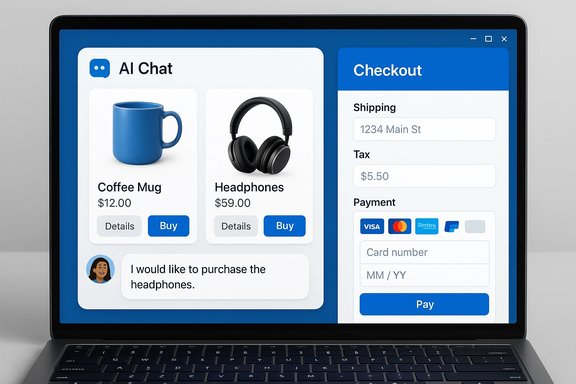 What Microsoft shipped: product set explained
Copilot Checkout — conversation to conversion
- Copilot Checkout surfaces interactive product cards inside a Copilot conversation with “Details” and “Buy” actions.
- Selecting Buy opens a branded native checkout widget inside the chat where shipping, taxs are confirmed — no redirect to merchant sites for supported sellers.
- Microsoft frames the experience as delegated and tokenized: payments and settlement are handled by partner payment processors and merchants remain the merchant of record.
Brand Agents and Copilot Studio templates
Brand Agents are prebuilt, brand‑voiced assistants merchants can train on catalogs and policies so the AI answers and recommendations reflect brand voice and rules. Copilot Studio supplies no‑code/low‑code templates for:- Personalized shopping ageime recommendations.
- Catalog enrichment agents that extract attributes from images and unstructured content.
- Store operations agents to help frontline staff query inventory, staffing, and fulfillment guidance.
Payments and partner plumbing
Microsoft is not trying to be a payments processor. Instead, it integrates partner providers:- PayPal is positioned to power inventory surfac, guest checkout, and card payments starting on Copilot.com. PayPal highlights buyer and seller protections and its store‑sync for catalog discovery.
- Stripe is described as an agentic payments partner, supplying tokenized payment rails and fraud signals via the emerging Agentic Commerce Protocol.
- Shopify provides rapid merchant coverage via an automatic enrollment flow for Shopify stores, aiming to scale participation quickly (subjec).
How it works: technical plumbing and provenance
Copilot Checkout’s architecture relies on three coordinated layers intended to reduce hallucination risk and preserve merchant control:- Canonical, machine‑readable product dantory, images, shipping metadata) sourced via store syncs or merchant feeds so the agent references auditable records rather than scraped HTML.
- Conversational orchestration within Copilot (Azure OpenAI/GPT models + Azure AI Foundry + Copilot Studio) that interprets intent, asks clarifying questions, and maintains pommendations to canonical product records.
- Delegated, tokenized checkout flows in partnership with PSPs: ephemeral Shared Payment Tokens populate checkout without exposing raw card data to the AI layer; PSPs perform settlement and risk checks and return outcomes to the merchant. That model is designed to balance convenience, security, and merchant control.
Merchant and consumer experience
From a shopper’s viewpoint, Copilot Checkout aims to be faster and more seamless:- Natural language prompts find product matches; Copilot returns curated cards.
- A “Buy” action opens the in‑chat checkout: name, shipping, payment confirmation — complete the order without leaving Copilot.
- Users can pay with familiar options (PayPal wallet, guest card, Stripe paths) and receive the usual post‑purchase protections where they apply.
The hard numbers and vendor claims — what’s verified
Vendor materials are explicit about early performance metrics: PayPal and Microsoft publicly cited substantial uplifts in purchase velocity and conversion — figures such as “53% more purchases within 30 minutes” and near‑200% higher conversion where shopping intent existed are being circulated in partner press releases and marketing materials. These numbers appear in PayPal’s announcement and Microsoft partner messaging. Critical note: these figures are vendor‑sourced and observational. They are meaningful as early signals but require independent verification across merchant cohorts, categories, and timeframes before being used as basis for large operational or iSeveral vendor claims were mirrored across partner announcements and independent press coverage, but independent audits or third‑party merchant case studies are still needed to validate representativeness.Competitive landscape: why this matters
AI agents collapsing discovery and checkout into a single surface is not unique to Microsoft. Competition and complementary efforts include:- OpenAI’s Instant Checkout with Stripe and participating merchants, which pioneered similar in‑assistant purchase flows.
- Google’s push to add buy buttons to Gemini and Search and its open Universal Commerce Protocol movement to standardize agent‑to‑merchant communications.
- Payments and commerce platforms (PayPal, Stripe, Shopify) racing to be the plumbing that connects agents to merchants and to own the services layer (fraud miagement, buyer protections).
Strengths: what Microsoft’s approach does well
- Seamless UX: Collapsing discovery, comparison and checkout into a single conversational session reduces redirects and friction, which historically drive cart abandonment.
- **ELeveraging Dynamics 365 Commerce, Azure AI Foundry and Copilot Studio gives Microsoft an enterprise‑grade stack for integrating POS, inventory and fulfillment systems — an advantage for large retailers.
- Partnered payments: Delegating payments to established PSPs (PayPal, Stripe) and using tokenization reduces the regulatory and PCI footprint for Microsoft while providing recognizable trust signals to consumers.
- Merchant tooling: Brand Agents and catalog enrichment templates target the painful, real work of catalog hygiene and metadata — a pragmatic move that will materially affect the quality of AI recommendations.
Risks and open questions — operationalory
Embedding commerce into conversational AI brings complex operational and governance challenges:- Fraud and rapid attack cycles: Tokenized flows reduce exposure to raw card data but do not eliminate account takeover, social engineering, or payment frausational purchases may amplify fraud velocity unless PSPs and merchants tighten real‑time risk controls.
- Catalog fidelity and hallucination: AI agents must reliably map a recommendation to a canonical SKU and inventory that actually exists. Poor catalog hygiene or stale feeds could result in customer dissatisfaction and dispute cost. Microsoft’s catalog enrichment tools mitigate this, but high‑quality data remains the operational bottleneck.
- Merchant governance and disputes: Being the discovery and checkout surface confers enormous influence over dispute resolution flows and buyer experience. Clear SLAs, dispute handling, and data access rules will be essential to avoid cross‑party friction.
-ooling**: Copilot Studio itself has been the subject of security scrutiny (e.g., social engineering attacks that abuse agent permissions to harvest OAuth tokens). Any vulnerability in agent configuration or content ingestion could expose credentials or tenant data — a material risk for merchants and enterprises using Brand Agents and Copilot Studio templates. - Regulatory attention and competition concerns: The platform that controls discovery and checkout can capture downstream economics even without being merchant‑of‑record; regulators may scrutinize practices around automatic merchant enrollment, fee transparency, and platform bias toward preferred partners.
Practical guidance for merchants (operational playbook)
Merchants evaluating Copilot Checkout should treat the channel like a new marketplace- Ensure canonical product feeds are complete, normalized, and live. Catalog enrichment is not optional.
- Test end‑to‑end checkout flows with payment partners (PayPal, Stripe) and validate dispute and refund processes.
- Audit Brand Agent training data and enforce strict topic scopes, response templates, and governance to prevent leakage or misleading statements.
- Negotiate clear SLAs and roles: who handles chargebacks, fraud investigations, shipping disputes and data retention.
- Monitor early KPIs (conversion lift, AOV change, dispute rates) in separate cohorts before committing significant marketing spend to the chal reduce onboarding surprises and help merchants treat Copilot as a controllable, measurable distribution channel rather than an ungoverned experiment.
Verification and how claims were checked
Key product claims and launch details were cross‑checked against Microsoft’s retail announcements and partner press releases, including PayPal’s statement on Copilot Checkout and Microsoft’s Copilot retail messaging. Independent reporting from technology outlets corroborates partner lists and the basic in‑chat UX description. Vendor performance metrics (conversion uplifts) were published in partner materials but remain vendor‑sourced; those require independent merchant pilots and third‑party audits before being treated as generalizable. Where claims could not be independently verified (for example, long‑term fraud rates, post‑purchase dispute trends, and platform economics at scale), they are flagged as vendor provided and should be validated in real merchant pilots.What this means for the industry
AI‑driven checkout is moving from experimentation to scale. By combining Copilot’s conversational frontend with enterprise retail primitives and partner payment rails, Microsoft is angling to capture a central role in the next generation of commerce experiences. If Copilot Checkout delivers consistent conversion uplifts while preserving merchant control and limiting fraud, it could shift how brands allocate discovery budgets and optimize for purchase intent.At the same time, rapid adoption without robust governance risks a spate of operational headaches: disputes, chargeback volatility, agent misconfigurations, and regulatory pushback. The vendors that pair scale with auditable protections, transparent merchant controls, and operational SLAs will win long‑term trust.
Conclusion
Copilot Checkout is a significant, well‑engineered step in the evolution of conversational commerce: it reduces friction, leverages existing payments infrastructure, and supplies merchant tooling aimenal work of making AI recommendations safe and shoppable. Microsoft’s integration with PayPal, Stripe and Shopify establishes the plumbing necessary for rapid adoption, but the real test will be operational resilience.Merchants should approach Copilot Checkout as an important new channel — one with compelling upside but also material operational and security tradeoffs. Careful onboarding, pristine catalog data, explicit governance of Brand Agents, and rigorous fraud posture will determine whether Copilot becomes a dependable revenue stream or a short‑lived experiment.
The race to own the conversational checkout moment is now in full view; Copilot Checkout is a major milestone in that sprint, but its long‑term impact will be decided by the messy, real‑world work of merchant operations, security governance, and independent verification of vendor promises.
Source: FourWeekMBA https://fourweekmba.com/microsoft-copilot-checkout-enters-the-ai-commerce-race/?utm_source=rss/
