

Microsoft is exploring a Microsoft-hosted, fine-tuned DeepSeek model, or another open-source alternative, for Copilot Cowork after moving the workplace AI agent toward usage-based pricing in June 2026. The decision is not really about DeepSeek alone. It is Microsoft’s clearest admission yet that agentic AI has a cost problem hiding beneath the productivity pitch. If Copilot is going to move from helpful sidebar to tireless office worker, Microsoft needs cheaper intelligence in the loop.
Copilot Cowork is Microsoft’s attempt to make Copilot less like a chatbot and more like a delegated employee. Instead of merely answering a question in Word or summarizing a Teams thread, Cowork is designed to carry out multi-step work across Microsoft 365: compare files, build artifacts, edit spreadsheets, research material, and move tasks forward while the human user does something else.
That shift changes the economics. A conventional chatbot interaction has a beginning and an end. An agentic workflow may call a model repeatedly, inspect intermediate results, revise its plan, call tools, query files, and try again when the first answer is not good enough.
That is why Microsoft’s reported move toward usage-based pricing matters more than the billing language suggests. Unlimited access sounds attractive when AI is a novelty. It becomes dangerous when every employee can spin up dozens or hundreds of autonomous tasks that consume compute in the background.
The old Microsoft 365 model was built around predictable seats. The Copilot Cowork model is closer to cloud infrastructure: usage grows with ambition, automation, and organizational sprawl. Microsoft is now trying to sell the dream of automated office labor without accidentally subsidizing every overenthusiastic prompt in the enterprise.
That question is particularly awkward for Microsoft. The company has spent years tying its AI story to OpenAI, Azure, and premium productivity subscriptions. But once Copilot becomes an execution engine rather than a chat interface, the expensive model cannot be the default answer for every action.
A short email, a meeting-note summary, a first-pass spreadsheet cleanup, or a document classification job does not always require the most capable model in the stack. Many tasks need speed, consistency, and low cost more than deep reasoning. If Microsoft can route those jobs to a cheaper model while reserving OpenAI or Anthropic systems for harder work, the economics improve.
This is the practical meaning of multi-model AI. It is not just consumer choice or a nice product checkbox. It is an operating model in which Microsoft decides that intelligence should be tiered, routed, and priced like compute.
But Copilot Cowork shows the limits of a single-provider story. Microsoft has already brought Anthropic technology into parts of Copilot’s enterprise experience, particularly where autonomous agents and complex workflows are involved. That move was not a rejection of OpenAI so much as an acknowledgment that no single model family is likely to be best, cheapest, safest, and fastest for every enterprise use case.
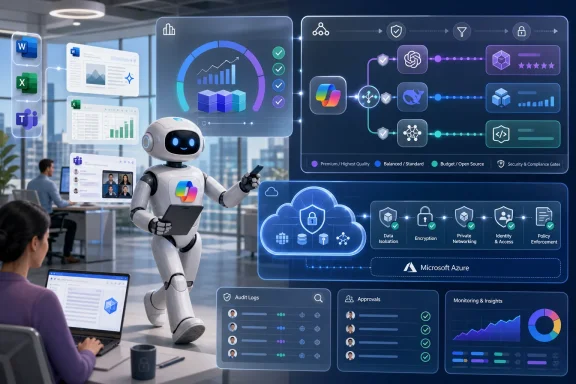
DeepSeek would extend that logic. OpenAI can remain the premium reasoning layer. Anthropic can serve particular agentic or enterprise-oriented workloads. Microsoft’s own smaller models can handle controlled tasks. An open-source or open-weight model hosted on Azure can become the discount engine where risk is lower and volume is high.
That is not fragmentation from Microsoft’s point of view. It is leverage. The more models Microsoft can safely orchestrate behind Copilot, the less dependent it becomes on any single supplier’s pricing, roadmap, or capacity constraints.
Because DeepSeek is associated with China, its use in enterprise software immediately raises questions about data governance, model provenance, regulatory exposure, and political optics. Those questions do not vanish simply because the model is cheaper. In regulated industries, they may become the first thing procurement teams ask.
Microsoft’s likely answer is Azure containment. If DeepSeek is used, the company reportedly wants it hosted inside Microsoft’s own cloud, fine-tuned and operated under Azure’s enterprise security, compliance, and data-residency controls. In other words, Microsoft would try to separate the model architecture from the infrastructure and data-handling concerns around the company that created it.
That distinction will satisfy some customers and fail to satisfy others. A self-hosted model does not phone home by default. But customers may still ask how the model was trained, whether its behavior can be audited, how it handles sensitive prompts, and whether regulators will accept it for certain classes of work.
For Microsoft, that is the bargain. DeepSeek may reduce inference costs. But the company will have to spend trust capital to put it into a mainstream workplace product.
Users do not want to think about which model should summarize a meeting, generate a PowerPoint outline, reconcile two Excel sheets, or inspect a contract draft. Administrators may want policy controls, but most workers want the system to choose correctly. That means Microsoft’s real challenge is deciding when cheaper is good enough and when cheap becomes dangerous.
A model router has to evaluate more than task type. It has to understand data sensitivity, user permissions, business context, compliance requirements, confidence thresholds, and failure costs. A low-cost model may be fine for drafting a lunch-and-learn invitation. It may be reckless for summarizing litigation documents or revising financial guidance.
This is where Copilot Cowork becomes an enterprise governance problem. The AI assistant era asked whether a response was useful. The AI coworker era asks whether an autonomous action was appropriate, auditable, and reversible.
Agentic AI breaks that tidy arrangement. The more successful the agent, the more work it performs. The more work it performs, the more model calls it makes. The more model calls it makes, the more the vendor’s cost base starts to resemble a utility bill.
That creates a delicate sales problem. Microsoft wants customers to use Copilot Cowork heavily enough to see value, but not so heavily that Microsoft eats unsustainable compute costs. Customers want automation, but not a surprise invoice because an enthusiastic team built a swarm of AI workflows that ran all weekend.
Usage-based pricing is the industry’s way of saying the magic has a meter. That does not make Copilot Cowork a bad product. It makes it a real cloud product.
The first control is visibility. Administrators need to know which models are available, which users can invoke them, what data they can access, and what actions they can take. A cheaper model option is only useful if it does not become an invisible downgrade for sensitive work.
The second control is policy. Organizations will need rules that map model choice to data classification. Public marketing drafts can tolerate one risk profile. Human resources investigations, board materials, source code, customer records, and legal files require another.
The third control is auditability. If Copilot Cowork changes a spreadsheet, drafts a response, updates a task, or synthesizes research, someone needs to know what it did and why. Agentic systems create value by taking steps users did not manually perform. That same autonomy creates accountability gaps when the output is wrong.
That matters because Microsoft does not need to convince users to install a new AI application. It can insert Cowork into the workflow layer millions of organizations already pay for. Outlook, Teams, Word, Excel, SharePoint, and OneDrive are not just apps; they are the terrain on which knowledge work happens.
If Copilot Cowork becomes cheaper to run, Microsoft can push agentic features deeper into routine office work. If it remains expensive, the product risks becoming a premium tool used selectively by large enterprises rather than a daily companion for ordinary teams.
DeepSeek, in that sense, is not an exotic side story. It is part of the machinery that determines whether agentic AI becomes a normal part of Microsoft 365 or remains a costly experiment.
An agent does not merely retrieve information. It can sequence actions. It can produce documents, modify files, generate communications, and interact with business systems through connectors and workflows. That means the blast radius of a mistake is larger than a bad chatbot answer.
Model choice becomes part of security architecture. A lower-cost model may be acceptable if its task is narrow, its permissions are constrained, and its output requires approval. The same model may be unacceptable if it can autonomously touch regulated data or send external communications.
Enterprises will need to think less in terms of “Can we use this AI?” and more in terms of “Where in the workflow can this AI act, and who signs off before consequences leave the sandbox?”
A lower-cost model tier could make agentic AI accessible to organizations that cannot justify premium AI consumption at scale. Small consultancies, retailers, universities, legal practices, municipal bodies, and operations-heavy firms may all want automation without a runaway bill.
But those same organizations may have fewer dedicated AI governance staff. That makes Microsoft’s defaults more important. If cheaper agentic AI arrives before clear controls, the customers most attracted to the savings may also be the least prepared to manage the risk.
This is the central tension of democratized AI. Lower cost widens access, but wider access multiplies the number of places where mistakes can matter.
Agentic AI is heading for the same reckoning. Copilot Cowork makes model calls feel like delegated work rather than infrastructure consumption. That abstraction is useful for workers, but dangerous for finance teams if the cost model is not transparent.
Microsoft has learned from Azure’s history. Reserved capacity, budgets, dashboards, consumption controls, and FinOps practices emerged because cloud usage needed discipline. Copilot Cowork will need the AI equivalent: budgets per team, model policies, usage reports, approval gates, and cost forecasts.
DeepSeek’s role is to reduce the unit cost. It does not eliminate the need for discipline. Cheap compute can still become expensive when multiplied by every employee, every workflow, and every recurring task.
Copilot Cowork raises the stakes because it asks users to delegate, not just query. Delegation requires trust in the system’s judgment. That judgment includes knowing when to act, when to ask, when to escalate, and increasingly, which model to use.
If Microsoft gets this right, users will not care that one task ran on OpenAI, another on Anthropic, and another on a cheaper Azure-hosted model. They will care that the work was done correctly, securely, and at a price their organization can defend.
If Microsoft gets it wrong, Copilot risks becoming another layer of enterprise complexity: powerful, expensive, unevenly governed, and politically uncomfortable when the chosen model carries baggage.
 Microsoft’s New Coworker Comes With a Meter Running
Copilot Cowork is Microsoft’s attempt to make Copilot less like a chatbot and more like a delegated employee. Instead of merely answering a question in Word or summarizing a Teams thread, Cowork is designed to carry out multi-step work across Microsoft 365: compare files, build artifacts, edit spreadsheets, research material, and move tasks forward while the human user does something else.That shift changes the economics. A conventional chatbot interaction has a beginning and an end. An agentic workflow may call a model repeatedly, inspect intermediate results, revise its plan, call tools, query files, and try again when the first answer is not good enough.
That is why Microsoft’s reported move toward usage-based pricing matters more than the billing language suggests. Unlimited access sounds attractive when AI is a novelty. It becomes dangerous when every employee can spin up dozens or hundreds of autonomous tasks that consume compute in the background.
The old Microsoft 365 model was built around predictable seats. The Copilot Cowork model is closer to cloud infrastructure: usage grows with ambition, automation, and organizational sprawl. Microsoft is now trying to sell the dream of automated office labor without accidentally subsidizing every overenthusiastic prompt in the enterprise.
DeepSeek Is the Cost-Cutting Idea Microsoft Cannot Ignore
DeepSeek entered the enterprise AI conversation because it challenged an assumption the industry had quietly accepted: that frontier-style capability would always require frontier-style spending. Whether every benchmark claim survives scrutiny is less important than the market reaction. DeepSeek made executives ask why expensive proprietary models should handle every mundane office task.That question is particularly awkward for Microsoft. The company has spent years tying its AI story to OpenAI, Azure, and premium productivity subscriptions. But once Copilot becomes an execution engine rather than a chat interface, the expensive model cannot be the default answer for every action.
A short email, a meeting-note summary, a first-pass spreadsheet cleanup, or a document classification job does not always require the most capable model in the stack. Many tasks need speed, consistency, and low cost more than deep reasoning. If Microsoft can route those jobs to a cheaper model while reserving OpenAI or Anthropic systems for harder work, the economics improve.
This is the practical meaning of multi-model AI. It is not just consumer choice or a nice product checkbox. It is an operating model in which Microsoft decides that intelligence should be tiered, routed, and priced like compute.
OpenAI Is Still Central, but It Is No Longer the Whole Story
Microsoft’s relationship with OpenAI remains one of the defining partnerships of the current AI cycle. Azure infrastructure, Copilot branding, and OpenAI model access helped Microsoft seize the enterprise AI narrative before rivals could turn generative AI into a commodity feature.But Copilot Cowork shows the limits of a single-provider story. Microsoft has already brought Anthropic technology into parts of Copilot’s enterprise experience, particularly where autonomous agents and complex workflows are involved. That move was not a rejection of OpenAI so much as an acknowledgment that no single model family is likely to be best, cheapest, safest, and fastest for every enterprise use case.
DeepSeek would extend that logic. OpenAI can remain the premium reasoning layer. Anthropic can serve particular agentic or enterprise-oriented workloads. Microsoft’s own smaller models can handle controlled tasks. An open-source or open-weight model hosted on Azure can become the discount engine where risk is lower and volume is high.
That is not fragmentation from Microsoft’s point of view. It is leverage. The more models Microsoft can safely orchestrate behind Copilot, the less dependent it becomes on any single supplier’s pricing, roadmap, or capacity constraints.
The Azure Wrapper Is Microsoft’s Answer to the DeepSeek Problem
DeepSeek’s appeal is cost. DeepSeek’s problem is trust. Those two facts cannot be separated.Because DeepSeek is associated with China, its use in enterprise software immediately raises questions about data governance, model provenance, regulatory exposure, and political optics. Those questions do not vanish simply because the model is cheaper. In regulated industries, they may become the first thing procurement teams ask.
Microsoft’s likely answer is Azure containment. If DeepSeek is used, the company reportedly wants it hosted inside Microsoft’s own cloud, fine-tuned and operated under Azure’s enterprise security, compliance, and data-residency controls. In other words, Microsoft would try to separate the model architecture from the infrastructure and data-handling concerns around the company that created it.
That distinction will satisfy some customers and fail to satisfy others. A self-hosted model does not phone home by default. But customers may still ask how the model was trained, whether its behavior can be audited, how it handles sensitive prompts, and whether regulators will accept it for certain classes of work.
For Microsoft, that is the bargain. DeepSeek may reduce inference costs. But the company will have to spend trust capital to put it into a mainstream workplace product.
The Real Product Is the Router, Not the Model
The more interesting Copilot Cowork story is not whether Microsoft picks DeepSeek V4, another open-source model, or a future in-house alternative. The strategic product is the model router that sits behind the scenes.Users do not want to think about which model should summarize a meeting, generate a PowerPoint outline, reconcile two Excel sheets, or inspect a contract draft. Administrators may want policy controls, but most workers want the system to choose correctly. That means Microsoft’s real challenge is deciding when cheaper is good enough and when cheap becomes dangerous.
A model router has to evaluate more than task type. It has to understand data sensitivity, user permissions, business context, compliance requirements, confidence thresholds, and failure costs. A low-cost model may be fine for drafting a lunch-and-learn invitation. It may be reckless for summarizing litigation documents or revising financial guidance.
This is where Copilot Cowork becomes an enterprise governance problem. The AI assistant era asked whether a response was useful. The AI coworker era asks whether an autonomous action was appropriate, auditable, and reversible.
Usage-Based Pricing Turns AI Enthusiasm Into Budget Discipline
The move away from unlimited usage is a predictable but important inflection point. For the last few years, enterprise AI has been sold as a productivity multiplier wrapped in subscription simplicity. The pitch was that workers would save time, companies would get leverage, and software vendors would enjoy higher per-seat revenue.Agentic AI breaks that tidy arrangement. The more successful the agent, the more work it performs. The more work it performs, the more model calls it makes. The more model calls it makes, the more the vendor’s cost base starts to resemble a utility bill.
That creates a delicate sales problem. Microsoft wants customers to use Copilot Cowork heavily enough to see value, but not so heavily that Microsoft eats unsustainable compute costs. Customers want automation, but not a surprise invoice because an enthusiastic team built a swarm of AI workflows that ran all weekend.
Usage-based pricing is the industry’s way of saying the magic has a meter. That does not make Copilot Cowork a bad product. It makes it a real cloud product.
Enterprise IT Will Ask for Controls Before It Asks for Magic
For WindowsForum’s core audience, the practical question is not whether DeepSeek is clever or whether Copilot Cowork looks impressive in a demo. The question is how an IT department can safely govern an AI agent that can touch Microsoft 365 data and act across business workflows.The first control is visibility. Administrators need to know which models are available, which users can invoke them, what data they can access, and what actions they can take. A cheaper model option is only useful if it does not become an invisible downgrade for sensitive work.
The second control is policy. Organizations will need rules that map model choice to data classification. Public marketing drafts can tolerate one risk profile. Human resources investigations, board materials, source code, customer records, and legal files require another.
The third control is auditability. If Copilot Cowork changes a spreadsheet, drafts a response, updates a task, or synthesizes research, someone needs to know what it did and why. Agentic systems create value by taking steps users did not manually perform. That same autonomy creates accountability gaps when the output is wrong.
Windows Users Will Feel This Through Microsoft 365, Not the Start Menu
This story is not mainly about Windows as an operating system, even if Copilot branding has been plastered across the Windows experience for years. The more consequential Copilot work is happening inside Microsoft 365, where documents, mail, meetings, chats, and business processes already live.That matters because Microsoft does not need to convince users to install a new AI application. It can insert Cowork into the workflow layer millions of organizations already pay for. Outlook, Teams, Word, Excel, SharePoint, and OneDrive are not just apps; they are the terrain on which knowledge work happens.
If Copilot Cowork becomes cheaper to run, Microsoft can push agentic features deeper into routine office work. If it remains expensive, the product risks becoming a premium tool used selectively by large enterprises rather than a daily companion for ordinary teams.
DeepSeek, in that sense, is not an exotic side story. It is part of the machinery that determines whether agentic AI becomes a normal part of Microsoft 365 or remains a costly experiment.
The Security Conversation Is Moving From Prompts to Workflows
Early Copilot debates focused heavily on data leakage: whether prompts would train models, whether sensitive documents might surface in answers, and whether permissions would be respected. Those issues still matter, but Copilot Cowork broadens the threat model.An agent does not merely retrieve information. It can sequence actions. It can produce documents, modify files, generate communications, and interact with business systems through connectors and workflows. That means the blast radius of a mistake is larger than a bad chatbot answer.
Model choice becomes part of security architecture. A lower-cost model may be acceptable if its task is narrow, its permissions are constrained, and its output requires approval. The same model may be unacceptable if it can autonomously touch regulated data or send external communications.
Enterprises will need to think less in terms of “Can we use this AI?” and more in terms of “Where in the workflow can this AI act, and who signs off before consequences leave the sandbox?”
South African Firms Are a Useful Test Case for the Global Market
The Memeburn framing rightly points to South African businesses, but the logic applies far beyond one market. Companies in regions with tighter budgets, complex compliance environments, and heavy Microsoft 365 dependence will be especially sensitive to Copilot Cowork’s price-performance tradeoff.A lower-cost model tier could make agentic AI accessible to organizations that cannot justify premium AI consumption at scale. Small consultancies, retailers, universities, legal practices, municipal bodies, and operations-heavy firms may all want automation without a runaway bill.
But those same organizations may have fewer dedicated AI governance staff. That makes Microsoft’s defaults more important. If cheaper agentic AI arrives before clear controls, the customers most attracted to the savings may also be the least prepared to manage the risk.
This is the central tension of democratized AI. Lower cost widens access, but wider access multiplies the number of places where mistakes can matter.
Microsoft Is Trying to Avoid the Cloud’s Old Pricing Mistake
Anyone who has managed cloud infrastructure knows this pattern. The first phase is excitement: teams move faster because resources are available on demand. The second phase is shock: the bill arrives, and suddenly the organization discovers that convenience and governance did not grow at the same pace.Agentic AI is heading for the same reckoning. Copilot Cowork makes model calls feel like delegated work rather than infrastructure consumption. That abstraction is useful for workers, but dangerous for finance teams if the cost model is not transparent.
Microsoft has learned from Azure’s history. Reserved capacity, budgets, dashboards, consumption controls, and FinOps practices emerged because cloud usage needed discipline. Copilot Cowork will need the AI equivalent: budgets per team, model policies, usage reports, approval gates, and cost forecasts.
DeepSeek’s role is to reduce the unit cost. It does not eliminate the need for discipline. Cheap compute can still become expensive when multiplied by every employee, every workflow, and every recurring task.
The Copilot Brand Now Has to Mean Judgment
Microsoft has used Copilot as an umbrella label for everything from code completion to Windows assistance to enterprise productivity. That breadth has helped the brand spread, but it has also made Copilot feel inconsistent. Sometimes it is a chatbot. Sometimes it is a search assistant. Sometimes it is a button. Sometimes it is an agent.Copilot Cowork raises the stakes because it asks users to delegate, not just query. Delegation requires trust in the system’s judgment. That judgment includes knowing when to act, when to ask, when to escalate, and increasingly, which model to use.
If Microsoft gets this right, users will not care that one task ran on OpenAI, another on Anthropic, and another on a cheaper Azure-hosted model. They will care that the work was done correctly, securely, and at a price their organization can defend.
If Microsoft gets it wrong, Copilot risks becoming another layer of enterprise complexity: powerful, expensive, unevenly governed, and politically uncomfortable when the chosen model carries baggage.
The Cheap Model Is Only Safe If the Expensive Guardrails Remain
The most concrete lesson from Microsoft’s DeepSeek exploration is that enterprise AI is entering its optimization phase.- Microsoft is considering an Azure-hosted DeepSeek or open-source model because agentic AI workflows consume far more compute than ordinary chatbot sessions.
- Copilot Cowork’s move toward usage-based pricing signals that unlimited access is difficult to sustain when agents can run repeated model calls in the background.
- Microsoft’s multi-model strategy reduces dependence on OpenAI while letting the company match model capability and cost to different workplace tasks.
- DeepSeek may lower costs, but its Chinese origins will force Microsoft and customers to confront questions about trust, auditability, regulation, and procurement politics.
- IT administrators should treat Copilot Cowork as a workflow automation platform, not merely a smarter chat assistant inside Microsoft 365.
- The winning enterprise AI stack will combine cheaper models with strong routing, permissioning, logging, approval gates, and data-governance controls.
References
- Primary source: Memeburn
Published: Sun, 21 Jun 2026 00:47:17 GMT
Microsoft Weighs DeepSeek for Copilot Cowork as AI Costs Bite - Memeburn
Microsoft may use DeepSeek in Copilot Cowork to cut AI costs, raising security and geopolitical questions for businesses in South Africa.memeburn.com - Related coverage: axios.com
Microsoft explores DeepSeek for Copilot Cowork
Microsoft will also shift to usage-based pricing for the enterprise agent.www.axios.com
- Related coverage: techradar.com
Microsoft makes Copilot Cowork open to everyone, and wants to help you tackle even the trickiest work tasks | TechRadar
Copilot Cowork gets an upgrade as it opens to all userswww.techradar.com - Related coverage: investing.com
Microsoft taps Anthropic for Copilot Cowork in push for AI agents By Reuters
Microsoft taps Anthropic for Copilot Cowork in push for AI agentswww.investing.com - Related coverage: windowscentral.com
This is Microsoft's new "Copilot Cowork": An experiment with Anthropic's Claude AI models that plans and delegates your work | Windows Central
Microsoft ships Copilot Cowork to its Frontier program.www.windowscentral.com - Related coverage: computerworld.com
Microsoft launches Copilot Cowork with usage-based pricing – Computerworld
Copilot Cowork customers can choose from Anthropic and OpenAI models to run the AI agent, while Microsoft reportedly plans to offer an open source model from DeepSeek to lower costs. www.computerworld.com
- Related coverage: br.investing.com
Microsoft recorre à Anthropic para o Copilot Cowork, em esforço para desenvolver agentes de IA Por Reuters
Microsoft recorre à Anthropic para o Copilot Cowork, em esforço para desenvolver agentes de IAbr.investing.com - Related coverage: itpro.com
Anthropic's Cowork tool is coming to Microsoft Copilot | IT Pro
The new Copilot Cowork tool will be made available through a new Microsoft 365 tier at the end of March.www.itpro.com - Related coverage: nl.marketscreener.com
- Related coverage: theinformation.com
Microsoft Mulls Using DeepSeek for Copilot Cowork — The Information
Microsoft is considering adding Chinese AI developer DeepSeek’s V4 as a cheaper model option for powering the Copilot Cowork AI assistant, Axios reported. The U.S. tech giant is exploring a Microsoft-hosted version of DeepSeek V4, or another open-source model, as a cheaper alternative to...www.theinformation.com - Related coverage: it.marketscreener.com
- Related coverage: es.marketscreener.com
- Related coverage: tipranks.com
- Related coverage: bourse.fortuneo.fr
Microsoft signe avec Anthropic !
Microsoft va intégrer la technologie d'IA de la startup Anthropic à son service Copilot afin de répondre à la demande croissante en agents autonomes, indique Reuters ce lundi. L'annonce intervient que...bourse.fortuneo.fr - Related coverage: en.softonic.com
- Related coverage: techriver.com
