

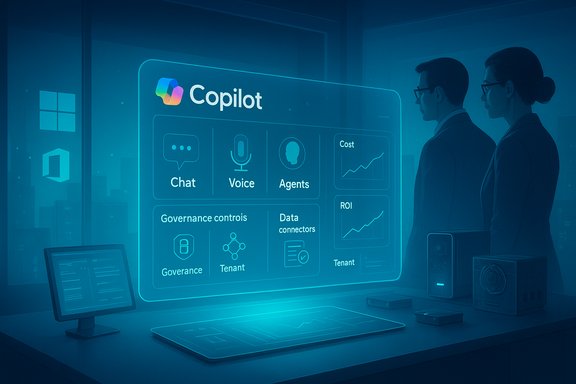
Microsoft’s Copilot has moved from a promising productivity add‑on to a full‑blown AI platform whose roadmap, business model and technical architecture are increasingly being shaped by user feedback — a shift that matters for IT teams, managers and Windows power users who must balance immediate gains against governance, privacy and operational risk.
Background / Overview
Microsoft launched Copilot as an AI assistant tied to Microsoft 365 and Windows ecosystems, and in the years since it has evolved into a multi‑modal suite that combines chat, long‑form reasoning, voice, vision and the ability to run configurable agents. Recent announcements and reporting show three converging forces shaping Copilot today: product-level feature pushes (advanced reasoning and voice), aggressive enterprise packaging and pricing, and tighter partnerships with cloud and silicon vendors to solve latency and scale. These developments are reflected in both vendor materials and community reporting. Taken together, the result is a platform designed for two goals: (1) make advanced AI available to everyday users inside Office apps and Windows, and (2) provide enterprises with managed, auditable AI features they can deploy at scale. The strategic tradeoffs Microsoft is navigating — openness vs control, convenience vs privacy, and speed vs explainability — are visible in recent product changes and partner announcements.What changed recently: features and product shifts
Think Deeper and Voice — democratising deep reasoning and hands‑free interaction
- Think Deeper: marketed as a mode that allows Copilot to take more inference time to deliver multi‑step, context‑rich answers and analyses. The capability leverages newer reasoning models and is positioned for tasks that require synthesis, e.g., multi‑document research or complex Excel analyses.
- Voice Mode: extends Copilot’s conversational layer with longer, uninterrupted voice interactions — useful for meetings, hands‑free drafting and accessibility scenarios. Community previews also show Microsoft reducing or removing prior usage caps on these modes in certain rollouts.
Multi‑modal models, GPT‑4o and the model mix
Microsoft’s product pages now list GPT‑4o as the underlying engine powering web‑grounded Copilot Chat experiences, while enterprise Copilot tiers expose “work‑grounded” features and agents that reason over tenant data. This mix — foundation models for general reasoning and task‑specific agents for work data — is central to Microsoft’s strategy.Copilot Studio and agents
Copilot Studio and the agent framework let organizations create tailored assistants that are grounded in an organization’s files, connectors (Microsoft Graph), and policies. This low‑code/no‑code approach aims to push AI closer to line‑of‑business problems while giving IT controls for governance. Early community documents and partner posts show enterprises building sales, service and finance agents with measurable gains in task time and response quality, though results vary widely by use case and deployment maturity.Technical architecture and infrastructure: how Microsoft is scaling Copilot
Multi‑modal + hybrid execution
Copilot today is best understood as a multi‑modal stack:- Foundation models (e.g., GPT‑4o for chat, vendor/partner models for specialist workloads).
- Domain‑specific agents built in Copilot Studio that use connectors (Graph, SharePoint, third‑party APIs).
- On‑device acceleration where available (Copilot+ PCs with NPUs) and hybrid cloud inference to reduce latency.
Partnerships for compute and performance
To address the compute demands of large models, Microsoft expanded and publicised its collaboration with NVIDIA in March 2024 — linking Azure with NVIDIA DGX Cloud, Omniverse and other accelerated computing services to speed model training and inference in targeted verticals such as healthcare. The NVIDIA announcements and Microsoft press statements confirm joint efforts to integrate accelerated computing into Azure AI infrastructure.Edge and latency optimizations
Microsoft has publicly discussed capacity strategies (regional scaling, Copilot Pro prioritization during peaks) and the use of specialized hardware to lower latency. For IT organizations, the takeaway is that performance characteristics will be tied to region, subscription tier and whether workloads are run on local NPUs, on Azure regions close to the users, or via partner clusters. Real‑world latency and cost behavior will vary by configuration and workload.Business implications: pricing, market opportunity and adoption patterns
Pricing and monetization
Microsoft lists Microsoft 365 Copilot at $30.00 per user per month (annual subscription) for business customers; that tier exposes work‑grounded capabilities, agent creation and analytics. Microsoft retains free/basic Copilot chat tiers for consumer access. These price points are now canonical across Microsoft’s commercial pages and reflect the company's enterprise packaging strategy. This model enables:- predictable per‑seat billing for large deployments,
- usage‑based metering for agent runtime and heavy inference workloads,
- bundling opportunities (specialized Copilots for Sales, Service, Finance are increasingly packaged into enterprise bundles in Microsoft’s product cadence).
Market sizing and economic forecasts
Independent analyst research shows generative AI has very large economic upside: McKinsey estimated generative AI could add between $2.6 trillion and $4.4 trillion annually across use cases — a framing frequently used to argue for enterprise Copilot investment. These macro numbers are directional but important for strategic planning. Be cautious with single‑figure adoption statistics reported in secondary articles. Some outlets and vendor partners cite aggressive forecasts for agent uptake; however, direct attribution to primary analyst reports can be inconsistent. For example, a widely circulated claim that “90% of global enterprises will deploy AI agents for 25% of knowledge work by 2025” appears in some roundups but cannot be reliably located in a primary Gartner report. Gartner’s public materials instead emphasize agentic AI as a top strategic trend and offer different timelines and metrics (for instance, projections about autonomous decision percentages by 2028), which suggests the 90%/2025 formulation should be treated as unverified.Real‑world ROI: customer stories and variance
Microsoft and partners have published many customer outcomes: time saved per week, reduced drafting time, faster triage for service desks and shortened research cycles. Product case lists compiled by Microsoft highlight examples where customers report double‑digit percentage productivity improvements or multi‑hour weekly savings, but individual results are heterogenous across industries and tasks. Corporate pilots can deliver large improvements in specific workflows (customer support, document summarization, code scaffolding) while delivering negligible gains in others. Treat vendor case studies as use‑case illustrations, not universal guarantees.Governance, compliance and regulatory landscape
EU AI Act and legal obligations
The EU’s AI Act establishes a risk‑based regulatory regime that imposes transparency, documentation, data‑quality, human‑oversight and audit obligations for high‑risk systems, and specific provisions for general‑purpose AI models. Critically, whether a product like Copilot is treated as “high‑risk” depends on how it’s used and the downstream application: chat in a productivity app may fall under limited risk transparency obligations, while an AI used for hiring, medical diagnosis or credit scoring could be high‑risk and require stricter compliance. The Act includes targeted obligations for general‑purpose models (GPAIs) and timelines for enforcement; organisations deploying Copilot‑style agents in regulated contexts must apply the highest scrutiny. Do not assume “Copilot = high‑risk” across the board — classification is use‑case dependent and must be evaluated by legal and compliance teams.Data protection and retention
Enterprises must ensure Copilot deployments respect:- Data residency and egress policies,
- Tenant isolation for work‑grounded Copilots,
- Logging and audit trails for model inputs/outputs used in decisioning,
- Consent and privacy notices when Copilot processes personal data.
Ethical risks: bias, hallucination and transparency
Key ethical risks are unchanged and remain urgent:- Hallucination (confident but incorrect outputs),
- Biased outputs from training data gaps,
- Unintended agentic actions (agents executing sequences across apps),
- Ad monetization and contextual ads inside AI surfaces (which raises transparency questions).
Security and operational risk
New attack surfaces
Agentic systems introduce novel threat vectors:- Prompt injection (maliciously crafted inputs that alter agent behavior),
- Credential access if connectors are misconfigured,
- Data exfiltration via content returned by models.
Performance and capacity planning
Copilot performance is influenced by:- model selection (larger models cost more and may increase response time),
- region and compute proximity (Azure region and GPU access matter),
- subscription tier (higher tiers receive priority during peak loads).
Implementation playbook for IT leaders (practical steps)
- Start small with a targeted pilot: pick a high‑value, repeatable workflow (e.g., first‑level support triage, meeting summarization, or contract clause extraction).
- Define success metrics up front: time saved, error reduction, escalation rate, user satisfaction.
- Build a governance checklist: data categories allowed, connectors authorized, retention rules, auditing requirements.
- Harden security: use dedicated service principals for connectors, apply conditional access, and restrict agent actions to safe executables.
- Run red‑team and bias tests: evaluate hallucination rates, discriminatory outputs and prompt injection susceptibility.
- Train users and admins: designate Copilot champions, publish usage guidelines and maintain an incident playbook for model‑driven errors.
- Monitor and iterate: use Copilot Analytics and tenant logging to measure ROI and adjust the model/agent configurations.
Competitive landscape and how Copilot compares
- Google (Gemini): emphasizes search grounding and cross‑product integration; strong in web grounding and cloud ML services.
- Anthropic (Claude): positioned on safety and steerability; some enterprises are piloting Anthropic models for specific workloads.
- Salesforce (Einstein) and others: focus on industry workflows, CRM integrations and verticalized agents.
Strengths, weaknesses and the tradeoffs every IT leader must weigh
Notable strengths
- Integration: Copilot’s tight tie to Microsoft 365 and Teams is a huge productivity accelerant for organizations already standardized on Microsoft tooling.
- Platform breadth: From chat to agents to low‑code Studio, Microsoft offers a one‑stop experience for building and governing enterprise AI.
- Scale and partnerships: Azure + NVIDIA integrations give Microsoft the enterprise‑grade compute pathways to scale demanding workloads.
Potential risks and blind spots
- Over‑generalized adoption claims: Some headline metrics circulating in the press (e.g., specific percentages about enterprise adoption or productivity gains tied to single vendors) are based on vendor case studies or secondary reporting and should be validated on a case‑by‑case basis. Treat them as directional, not universal.
- Regulatory complexity: The EU AI Act and similar frameworks mean that a “build fast” approach must be accompanied by documented compliance work, especially for high‑impact use cases.
- Operational costs and capacity: Metered agent usage, GPU costs, and premium tiers can push TCO higher than expected if governance and usage caps aren’t enforced.
Future outlook: where Copilot and enterprise AI are headed
- Agentification of workflows: Expect more line‑of‑business agents that combine connectors, workflows and human review loops; these will migrate from pilots into business‑critical roles over the next 24 months.
- Model pluralism: Enterprises will increasingly mix foundation models — selecting the best model for a task and managing multi‑vendor risk.
- More regulation and standards: Compliance obligations will harden; organizations will need clear model inventories and audit trails to satisfy regulators and auditors.
- Increased specialization: Verticalized Copilots (healthcare, finance, manufacturing) will proliferate because domain expertise dramatically reduces hallucination and improves utility.
- Economic impact: Macro forecasts (e.g., McKinsey’s trillions estimate) imply large opportunity, but realization depends on governance, upskilling and re‑architecting processes to capture the gains.
Final assessment: pragmatic optimism with guarded controls
Microsoft Copilot has matured into a platform that can materially accelerate knowledge work when matched to the right process and governance. Its technical strengths (multi‑modal models, close Office integration, and cloud/silicon partnerships) make it a compelling choice for Microsoft‑centric organizations. The most responsible path forward for IT and business leaders is pragmatic: test with clearly scoped pilots, measure actual impact, harden controls, and scale the deployments that deliver repeatable, auditable value.Key imperatives for responsible adoption:
- Treat vendor claims and headline percentages as starting points — verify with your own pilots.
- Build governance and security into early deployments (not as an afterthought).
- Monitor cost drivers (metered agent runtime, premium models, GPU usage) and include them in TCO models.
- Prepare for regulatory requirements, especially for public sector or safety‑critical use cases.
Quick reference (practical checklist)
- Verify the target use case: productivity vs decisioning vs compliance.
- Budget for price and metered costs: Microsoft 365 Copilot (business) $30/user/month (annual).
- Start with a pilot and define success metrics.
- Enforce least‑privilege connectors and logging.
- Schedule periodic model audits and bias tests.
- Prepare documentation for regulators (if operating in or serving the EU).
Conclusion: Copilot’s latest phase is less a single product release than a platform‑scale experiment in how enterprises will work with AI. With careful controls, clear success metrics and robust governance, organizations can capture substantial gains — but the upside will only compound if teams address the technical, regulatory and human factors that determine whether AI becomes a sustainable productivity multiplier or a costly, uncontrolled liability.
Source: Blockchain News Microsoft Copilot AI Trends: Leveraging User Feedback for Enhanced AI Experiences in 2025 | AI News Detail
