

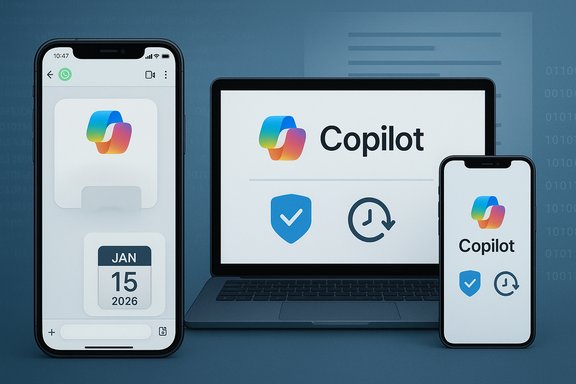
Microsoft has confirmed that its Copilot conversational AI will stop working inside WhatsApp on January 15, 2026, a move the company says is required by recent changes to WhatsApp’s Business Solution rules that bar general-purpose large-language-model chatbots from operating on the platform.
Microsoft introduced Copilot on WhatsApp as a lightweight, low-friction way for people to access AI assistance inside a messaging surface they already use, and the company says the integration reached millions of users since its rollout in late 2024. WhatsApp’s owner, Meta, updated the WhatsApp Business Solution (commonly known as the Business API) in mid‑October 2025 to add a new section addressing what it calls “AI Providers.” That policy explicitly prohibits providers of large language models, generative AI platforms, and general‑purpose assistants from using the Business Solution when such AI is the primary functionality being offered — with an enforcement date set for January 15, 2026. This is not isolated: several high‑profile assistant integrations, including OpenAI’s ChatGPT, were already reported to be winding down WhatsApp access in response to the same policy change. Independent reporting and Microsoft’s own advisory line up on the January 15, 2026 effective date.
Source: Indiablooms Microsoft Copilot AI to leave WhatsApp soon, check the date | Indiablooms - First Portal on Digital News Management
 Background
Microsoft introduced Copilot on WhatsApp as a lightweight, low-friction way for people to access AI assistance inside a messaging surface they already use, and the company says the integration reached millions of users since its rollout in late 2024. WhatsApp’s owner, Meta, updated the WhatsApp Business Solution (commonly known as the Business API) in mid‑October 2025 to add a new section addressing what it calls “AI Providers.” That policy explicitly prohibits providers of large language models, generative AI platforms, and general‑purpose assistants from using the Business Solution when such AI is the primary functionality being offered — with an enforcement date set for January 15, 2026. This is not isolated: several high‑profile assistant integrations, including OpenAI’s ChatGPT, were already reported to be winding down WhatsApp access in response to the same policy change. Independent reporting and Microsoft’s own advisory line up on the January 15, 2026 effective date. What changed in WhatsApp’s platform rules
The new “AI Providers” clause, in plain language
- Meta added language to the Business Solution terms defining a class of actors as “AI Providers”, which includes creators of LLMs, generative platforms, and general‑purpose AI assistants.
- The policy bans those providers from using the Business Solution when the AI assistant itself is the primary product or service provided through that API. The determination of “primary” is left to Meta’s discretion, per the published terms.
What remains permitted
- Business‑incidental AI — for example, bots that assist with order confirmations, appointment scheduling, or narrowly scoped customer support — is explicitly allowed to continue.
- The intent, according to WhatsApp’s public messaging and reporting, is to preserve the Business API for transactional and enterprise workflows rather than as a general distribution channel for consumer‑facing chat assistants.
Microsoft’s announcement and immediate guidance
Microsoft published a short post confirming Copilot’s WhatsApp service will be discontinued as of January 15, 2026, and provided a simple migration path: use the Copilot mobile app (iOS and Android), Copilot on the web at copilot.microsoft.com, or Copilot integrated in Windows. Microsoft also warned that conversations on WhatsApp were unauthenticated and therefore cannot be migrated automatically into Copilot’s account‑backed history — users who want to keep transcripts should export them using WhatsApp’s export tools before the shutdown date. Key public points from Microsoft’s advisory:- Copilot on WhatsApp remains available until January 15, 2026.
- Users should export any WhatsApp Copilot chats they wish to keep because the WhatsApp integration was unauthenticated.
- Microsoft is steering users to its first‑party Copilot surfaces, which support authenticated accounts, history sync, and richer multimodal features.
Why Meta’s rule change matters (and why it happened)
Operational and platform-intent rationale
WhatsApp’s Business Solution was designed for structured business communications — notifications, support threads, commerce messages — not high‑volume, open‑ended LLM conversations. Meta’s stated rationale emphasizes platform intent and operational concerns: the pattern of unbounded chatbot sessions places unusual moderation, infrastructure, and billing burdens on the Business API. The October 2025 terms edit frames that operational reality as the proximate cause for the restriction.Strategic and market effects (analysis, not an official Meta position)
While Meta’s official explanation focuses on engineering and product intent, the practical effect is a concentration of conversational AI distribution toward vendor‑owned surfaces or toward Meta’s own in‑platform AI. Independent commentary and multiple news outlets have treated the change as having competitive implications — a likely consequence is reduced access for third‑party assistants inside WhatsApp, concentrating usage and attention around Meta AI within the app. This interpretation is plausible and widely discussed, but it should be read as analytic inference rather than a direct admission from Meta.Immediate user impact: what Windows and Copilot users must do now
Microsoft’s timeline leaves a clear short window for action. For users who engaged with Copilot via WhatsApp, the practical checklist is straightforward:- Export any Copilot chats you want to keep using WhatsApp’s built‑in export function. Store the exported files securely.
- Install and sign into the Copilot mobile app (iOS/Android) or use copilot.microsoft.com on the web. These surfaces provide authenticated access and persistent history.
- If you plan to use Copilot on Windows, sign in with the Microsoft account you intend to keep, enable history and sync as appropriate, and review privacy settings.
- Use WhatsApp’s Export Chat option per conversation; include media only when necessary because exports that include images and attachments are larger and require secure storage.
- Verify the exported files open correctly and are encrypted if they contain sensitive content.
- For organizations, treat exported transcripts as potential business records and retain them in compliance with corporate policies.
Technical and privacy implications
Unauthenticated vs. authenticated integrations
Copilot’s WhatsApp presence was built on a contact‑based, unauthenticated model. That design made it easy for users to try Copilot but meant the service could not associate sessions with a Microsoft identity for history syncing, account linkage, or enterprise access controls. Microsoft emphasized this point in its advisory, and it explains why chat history cannot be automatically migrated to Microsoft’s account‑backed surfaces. The policy change exposes a fundamental tradeoff:- Unauthenticated, frictionless access drives rapid discovery and scale.
- Authenticated, account‑backed access enables continuity, richer features (like memory and account‑linked actions), and enterprise‑grade controls.
Data handling and portability
- Users who rely on the WhatsApp thread will lose in‑app continuity after January 15, 2026 unless they export chats. Microsoft cannot pull those conversations server‑side for migration because the WhatsApp integration did not create an account‑linked record that Microsoft controls.
- This creates both a privacy opportunity and a risk: exporting gives users control of their transcripts, but it also places the burden of secure storage on them. Enterprises should consider whether chats contain regulated or sensitive information and apply retention and protection measures accordingly.
Regulatory and competitive fallout
Antitrust and regulator interest
The policy edit and the resulting withdrawal of third‑party assistants from WhatsApp have attracted regulatory attention. For example, Italy’s competition authority expanded an investigation into Meta’s conduct around AI tools and WhatsApp’s Business Solution, citing concerns that policy changes and product integrations could harm competition in the AI services market. Such scrutiny highlights the broader legal and policy stakes when platform owners change access rules that affect rival services.What regulators are likely to watch
- Whether policy changes are genuinely technical/product‑driven or whether they have anti‑competitive effects that improperly favor the platform owner’s in‑app AI.
- Evidence of discriminatory enforcement or opaque discretion in how “primary functionality” is determined.
- Data portability and user choice protections — regulators may demand clearer migration paths or disclosures for users relying on third‑party services inside dominant platforms.
Developer and enterprise takeaways
For product teams and startups
- Avoid over‑reliance on a single platform’s distribution channels for your core product. Platform rules can change with little notice and can instantly cut off user access.
- Design for identity and portability: require authenticated sessions, build export APIs, and maintain an owned channel (web, native app, or PWA) for critical flows.
For businesses using chat assistants
- Reassess customer workflows that depend on unauthenticated bot contacts. Migrate to authenticated channels or narrow the chatbot’s role into permitted, business‑incidental use cases under WhatsApp’s Business Solution if you must stay on the platform.
- Ensure compliance and data governance when exporting or archiving chat transcripts that may be covered by regulatory regimes.
Risks and uncertainties — what to watch next
- Enforcement clarity: Meta’s terms grant the company discretionary authority to decide what counts as “primary” functionality. The lack of clear thresholds raises uncertainty for developers and vendors about what is allowed and what will be enforced. Expect further clarifications or case‑by‑case enforcement notices.
- Migration friction: millions of users accustomed to in‑chat convenience will face friction migrating to app or web experiences; conversion rates and retention metrics will be instructive in the coming months.
- Competitive responses: other messaging platforms may court third‑party assistants as a differentiator, or vendors may double down on native apps and the web to take control of the user relationship.
What alternatives look like for users and developers
For users who prefer in‑chat assistants
- Consider other messaging platforms that permit third‑party assistants (terms will vary by platform and may change).
- Use browser extensions, web widgets, or platform‑agnostic channels (email, SMS, web chat) that give you more control over data and portability.
For developers who want resilience
- Build your assistant as a multi‑channel service: own a web client (PWA), native mobile apps, and integrations with multiple messaging platforms where permitted.
- Prioritize account‑based experiences that let you persist history, user preferences, and privacy controls independent of any single platform’s policy.
Specific, actionable checklist for Windows users who want to retain Copilot continuity
- Export WhatsApp Copilot chats you want to keep prior to January 15, 2026. Verify the exports open locally and are stored securely.
- Install Copilot for Windows or use copilot.microsoft.com. Sign in with the Microsoft account you plan to use long‑term.
- In Copilot on Windows, enable history and sync, and review privacy controls for what data is retained and how it is used. Adjust enterprise policies accordingly if using a work account.
- For critical workflows that previously relied on WhatsApp access, rearchitect to a supported channel or constrain the WhatsApp bot to permitted, business‑incidental operations.
Broader perspective: the future of conversational AI distribution
The exit of Copilot from WhatsApp is a concrete milestone in a broader industry shift: as conversational AI matures, distribution is moving away from opportunistic piggybacking on messaging infra toward authenticated, vendor‑owned surfaces and narrowly scoped, enterprise‑incidental bots on messaging APIs. That shift has benefits — better privacy controls, richer multimodal features, and stronger enterprise controls — but it also reduces the casual, frictionless discovery that made messaging platforms attractive for early adoption. The net effect will be a rebalancing of convenience, control, and competition in the years ahead.Final analysis — strengths, risks, and what readers should take away
Microsoft’s course correction to focus Copilot on first‑party surfaces is defensible from a product and security standpoint. The company’s native apps and web portal unlock features and account protections unavailable in WhatsApp’s unauthenticated model, and Microsoft has given clear, practical guidance to users on migration and export. At the same time, the episode exposes three systemic risks:- Platform dependence: Developers who scale via another company’s API are vulnerable to sudden policy changes.
- Data portability gaps: Unauthenticated integrations leave users responsible for preserving their own conversation history.
- Competitive concentration: Platform owners controlling dominant messaging channels can materially shape competitive dynamics in conversational AI, prompting regulatory attention.
Source: Indiablooms Microsoft Copilot AI to leave WhatsApp soon, check the date | Indiablooms - First Portal on Digital News Management
