• Thread Author
Microsoft’s decision to pull Copilot off WhatsApp after January 15, 2026, is the latest and most concrete consequence of a broader policy shift by Meta that bars general-purpose large‑language‑model chatbots from using the WhatsApp Business infrastructure — and the move will reshape how consumers, businesses, and AI companies deliver conversational assistants on mobile messaging channels.

AI chat on a smartphone showing a January 15, 2026 date.Background​

Since late 2024, a growing number of AI companies have used WhatsApp as a distribution channel for consumer-facing chat assistants. WhatsApp’s Business API — originally designed to let enterprises message customers about appointments, shipping updates, and support — became an unexpected route for third‑party AI providers to reach users inside an app that counts billions of active accounts worldwide. That experiment accelerated in 2025 as LLM vendors rolled out WhatsApp integrations that let people ask questions, draft messages, and run tasks from within their existing chat environment. On October 18, 2025, WhatsApp (Meta) updated its Business API terms to add a dedicated section addressing “AI providers,” explicitly prohibiting the use of its Business Solution to distribute general‑purpose AI assistants when those assistants are the primary functionality offered. The new language takes effect January 15, 2026, and gives Meta a broad discretion to determine what counts as an “AI Provider.” Multiple outlets confirmed the policy change and Meta’s rationale that the API was intended for business‑to‑customer use cases rather than mass distribution of general chatbots. Microsoft confirmed on November 24, 2025 that its Copilot service on WhatsApp will be discontinued when the policy takes effect, and advised users to switch to Microsoft’s Copilot mobile apps, web experience, or Copilot on Windows. Microsoft also warned that WhatsApp chat threads with Copilot will not be migrated automatically because the WhatsApp integration was unauthenticated; users who want to keep their conversations should export them from WhatsApp before the January 15 cut‑off. OpenAI, which had offered ChatGPT inside WhatsApp, published guidance telling users that ChatGPT would be unavailable on WhatsApp after January 15, 2026, and encouraged its user base — which it said numbered more than 50 million on WhatsApp — to migrate to first‑party apps and link accounts for history preservation where possible.

What exactly did WhatsApp change — the policy in plain terms​

WhatsApp’s Business API update introduces a targeted prohibition against third‑party providers of general‑purpose LLM/AI assistants using the Business Solution to make those assistants available to consumers when the assistant itself is the primary functionality. The policy language is intentionally broad and gives Meta discretion to decide what qualifies as “general‑purpose.” Key takeaways:
  • The restriction applies to “AI providers,” defined to include developers of LLMs, generative AI platforms, and general‑purpose assistants.
  • The ban is scoped to WhatsApp’s Business Solution / Business API; it is not framed as a blanket ban on any AI inside WhatsApp. Business‑specific automated flows that use AI for customer support, scheduling, or order processing are explicitly outside the ban’s intent.
  • The effective date is January 15, 2026, giving companies and users roughly three months (from the policy announcement in October 2025) to adapt.
This design differentiates between AI as a customer‑service tool (still allowed) and AI as a consumer‑facing chatbot distributed via the Business API (now restricted).

Why Meta likely made this decision — infrastructure, strategy, and product control​

Meta’s public rationale centers on three themes: platform design intent, operational strain, and product strategy.
  • Platform intent: WhatsApp’s Business API was built to enable businesses to message customers with transactional and support interactions — not to operate as a free distribution channel for consumer chat assistants. Meta frames the policy as a return to that original purpose.
  • Operational load and support overhead: Companies and reporters cited Meta’s claim that the rapid growth of LLM traffic increased message volume and support demands in ways the Business API and associated infrastructure were not designed to handle. That increased load reportedly required different technical support and operational commitments.
  • Strategic and competitive incentives: Pulling third‑party general‑purpose assistants from WhatsApp clears space for Meta to position its own assistant (Meta AI) as the native, integrated AI experience. The policy’s broad wording gives Meta flexibility to enforce exclusivity in practice while still permitting AI in enterprise workflows. Analysts and commentators have framed this as a competitive move to regain control of the AI interface inside a dominant messaging product. Multiple outlets have flagged this strategic angle as likely relevant.
Taken together, the publicly stated reasons and market context suggest Meta’s change mixes legitimate operational concerns with an incentive to centralize AI experiences under its own brand.

Immediate effects: Microsoft Copilot and other LLM providers​

Microsoft’s Copilot will stop working on WhatsApp on January 15, 2026. Microsoft’s own guidance encourages users to migrate to Copilot’s web and first‑party mobile and Windows apps and instructs users to export WhatsApp chats if they want to preserve them. Microsoft explicitly notes that it cannot transfer WhatsApp conversation history into Copilot because the WhatsApp integration did not authenticate users in a manner that would link threads to a Copilot account. Other providers are affected similarly:
  • OpenAI (ChatGPT) stated it will discontinue WhatsApp support on January 15, 2026, and offered linking and migration instructions for users. OpenAI said more than 50 million people had used ChatGPT on WhatsApp before the change.
  • Perplexity, Luzia, Poke and other smaller startups that had deployed WhatsApp contacts or numbers to reach users will also need to shutter those channels or rework how they expose their assistants. Coverage from TechCrunch and other outlets lists these as directly impacted.
Given the popularity of WhatsApp as a mass‑market messaging platform, the effective ban forces user migration away from an embedded messaging shortcut to vendor‑owned apps, web experiences, or alternate messaging platforms (e.g., Telegram, SMS, or in‑browser assistants).

Data portability and preservation: real consequences for users​

A crucial and immediate user impact is data portability. Microsoft’s announcement makes clear that Copilot on WhatsApp used an unauthenticated integration; as a result Microsoft cannot migrate those conversations into Copilot’s first‑party surfaces. Microsoft therefore asks users to export their WhatsApp threads if they wish to keep them. OpenAI’s guidance also stresses linking accounts before the cut‑off to preserve history where supported. Practical implications for users:
  • Export WhatsApp threads now if you rely on past conversations with any chatbot you used on the platform. WhatsApp’s built‑in export tools can save text and media for most threads, though format and completeness vary by platform and message types.
  • If you failed to link or export chats before January 15, 2026, you may lose any conversational history with third‑party assistants that only existed inside WhatsApp. That history may be useful for ongoing tasks, saved prompts, or context for follow‑ups.
  • The unauthenticated nature of some integrations explains why transfers are nontrivial: without a persistent account mapping between a phone number and a vendor account, the vendor can’t reliably reconstitute previous threads on a new surface. Microsoft’s explicit statement on this point confirms the technical root cause.
Because exporting is an extra step, the policy change will impose friction on users and likely reduce casual usage of chat assistants by people who treated WhatsApp as the convenient front end.

Technical analysis: authentication, account linking, and the limits of the Business API​

The transition exposes a set of technical realities about messaging integrations and consumer identity:
  • Unauthenticated bot endpoints are fragile. Many WhatsApp bot integrations relied on phone‑number‑based routing rather than persistent, authenticated user accounts. That architecture is simple to deploy but makes long‑term data continuity and cross‑surface sync impossible. Microsoft explicitly called out that unauthenticated access prevents chat history migration.
  • Business API semantics vs. consumer UX. WhatsApp’s Business API supports enterprise messaging with approval and provisioning workflows. It was never primarily intended as a hosting surface for consumer AI assistants serving general queries at massive scale. Using it as such exposes scalability, rate‑limiting, and support friction. Meta’s policy change formalizes that boundary.
  • Account linking as a mitigation strategy. OpenAI’s recommended migration relies on explicit account linking — mapping a phone number to a ChatGPT account — so history can be ported before the deadline. That reduces data loss but requires users to create and manage vendor accounts. Vendors that built WhatsApp‑first UX without account models are less equipped to preserve state.
  • Alternative technical channels. Companies that want to keep messaging as a channel can consider alternatives: hosting bots on Telegram (which has different API terms), building native Android/iOS apps, embedding web chat widgets, or enabling integrations via SMS and RCS. Each channel has trade‑offs in reach, features, and cost.

Business and competitive implications​

The policy tilt toward restricting third‑party assistants on WhatsApp creates winners and losers across the ecosystem.
  • Meta benefits strategically. By restricting third‑party general‑purpose assistants via the Business API, Meta reduces a vector for rivals to reach WhatsApp’s user base, lowering friction for adoption of Meta AI. For an owner of a dominant messaging product, consolidating control over the AI endpoint can help capture engagement and data that feed other product and monetization plans. Industry observers have flagged this competitive dynamic as significant.
  • Incumbent LLM vendors must accelerate direct channels. Microsoft, OpenAI, Perplexity, and others now have a stronger incentive to drive users to first‑party apps and web experiences where they control authentication, feature velocity, and commercial models. That means increased spending on app distribution, marketing, and product features that justify a platform switch.
  • Startups and experimental deployments are hardest hit. Smaller AI vendors that used WhatsApp to quickly reach mass audiences will face higher customer acquisition costs as they redirect users to proprietary surfaces or alternate messenger platforms. Some may pivot to enterprise‑facing integrations where the Business API remains viable.
  • Business bots remain allowed — but lines are fuzzy. Meta’s carve‑out for customer‑service bots means many legitimate enterprise AI deployments will be unaffected, yet the broadness of the “AI providers” definition raises practical enforcement questions. Companies running hybrid bots that serve both customers and general queries may need to rearchitect or risk denial of access.

Legal, privacy, and regulatory angles​

The policy change intersects with several ongoing regulatory and privacy debates:
  • Data residency and processing. Moving users to vendor apps changes where data is processed and stored. Firms that migrate users to first‑party services must clarify handling, retention, and cross‑border flows in compliance with GDPR, data‑localization rules, and other regulations.
  • Consumer protection and transparency. Users may not fully grasp that an integration they used inside WhatsApp will vanish and that their conversation history might be lost. Firms should provide clear, time‑bounded notices and straightforward export or linking options to preserve trust.
  • Antitrust and competition scrutiny. While Meta frames the decision as platform governance, regulators and competitors could view the change as an anti‑competitive move to exclude rival AI from a dominant messaging channel. The policy’s broad scope might invite scrutiny in jurisdictions sensitive to platform exclusionary conduct.
  • Security and authentication expectations. The transition exposes poor practice patterns (unauthenticated interactions). Regulators and standards bodies may increasingly press for minimum authentication or portability standards for conversational AI deployed in consumer messaging environments.

Practical guidance: what users and businesses should do now​

For affected users, businesses, and developers, immediate, concrete steps can reduce disruption.
For users:
  • Export any chat threads with Copilot, ChatGPT, or other AI contacts using WhatsApp’s export tools before January 15, 2026. Microsoft and OpenAI both advise exports or account linking as applicable.
  • Install and register for first‑party apps (Copilot, ChatGPT) if you want continuity and richer capabilities like voice, vision, or file uploads.
  • Link phone numbers to vendor accounts where offered — that preserves history in some migrations. OpenAI documented a linking flow for ChatGPT on WhatsApp.
For businesses using AI:
  • Review whether your WhatsApp usage is covered by the Business API’s customer‑service carve‑out. If your AI is incidental to an enterprise workflow, you may be unaffected; otherwise plan a migration strategy.
  • Invest in authenticated account models and explicit data export / portability features so customers can preserve continuity across platform changes.
  • Assess alternate channels and user experience tradeoffs: build native apps, in‑browser assistants, or migrate to other messaging platforms that align with your distribution needs.
For developers and startups:
  • Reassess reliance on third‑party messaging platforms for primary distribution of consumer features. Where possible, own the identity and storage layer so you can migrate quickly.
  • Consider hybrid product designs where messaging is a convenience layer but not the exclusive stateful store for user data.

Risks, unanswered questions, and what to watch​

  • Enforcement ambiguity. The policy gives Meta discretion to decide what counts as “general‑purpose.” Expect case‑by‑case enforcement and potential gray zones. Watch for takedowns or account suspensions that clarify boundaries.
  • Fragmentation of user experience. Users who adopted assistants inside WhatsApp for convenience now face friction to recreate workflows in separate apps. That fragmentation favors incumbents with strong cross‑platform ecosystems.
  • Regulatory follow‑up. Antitrust regulators in multiple jurisdictions may be interested if the policy is perceived as protectionist for Meta’s own AI. Any complaints or formal investigations would be important to monitor.
  • Longer‑term platform dynamics. If major messaging platforms adopt similar stances (restricting third‑party general‑purpose assistants), distribution of conversational AI may tilt heavily toward vendor‑owned apps and web channels. That would reshape user discovery and the economics of AI assistants.

Conclusion: a decisive nudge toward first‑party AI surfaces​

Meta’s policy update and Microsoft’s subsequent Copilot exit from WhatsApp crystallize a larger market shift: messaging platforms are asserting tighter control over the presence of general‑purpose AI inside their walls. For users, the immediate ask is simple and time‑sensitive — export or link your chats before January 15, 2026 if you want to preserve them. For AI vendors, the policy forces a strategic reorientation toward owning authentication, storage, and distribution channels rather than leaning on third‑party messaging surfaces.
This episode underscores the trade‑offs of convenience versus control. Messaging apps offered frictionless reach; platform owners now demand control. The likely outcome in the near term is clearer product boundaries and a proliferation of vendor‑owned assistants with richer account models — but less serendipitous cross‑platform ubiquity. The January 15, 2026 deadline is therefore not only a service cutoff for Copilot on WhatsApp, it’s a signpost of where conversational AI distribution is headed next.
Source: TechCrunch Microsoft's AI chatbot Copilot leaves WhatsApp on January 15 | TechCrunch
 

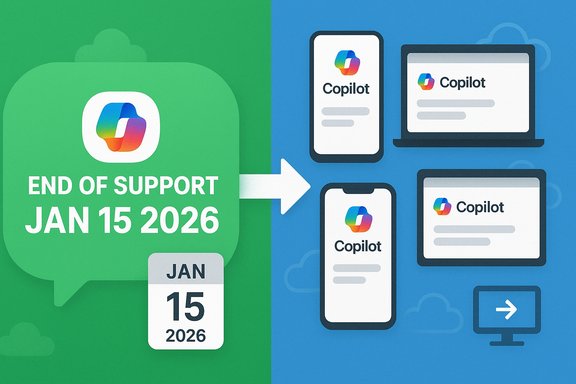
Microsoft confirmed that Copilot — its consumer-facing AI assistant — will stop responding inside WhatsApp on January 15, 2026, after WhatsApp updated its Business Solution terms to ban general-purpose large-language-model (LLM) chatbots from operating on the platform, forcing users and developers to migrate to first-party Copilot apps, the web, or native Windows integrations.

End of support for Copilot on Jan 15, 2026 across devices.Background​

Microsoft launched a lightweight Copilot integration for WhatsApp in late 2024 as part of a broader push to make its AI assistant available wherever people already communicate. The WhatsApp contact worked like a simple chat number: users could message Copilot inside their existing chats for quick answers, summaries, writing help, and basic image or media interactions without installing a new app or signing in to a Microsoft account.
In mid‑October 2025, WhatsApp (owned by Meta) revised the WhatsApp Business Solution terms to add an “AI providers” prohibition that explicitly disallows providers of LLMs, generative AI platforms, and general-purpose AI assistants from using the Business API when those AI capabilities are the primary functionality being offered. Meta set January 15, 2026 as the effective date for that change. Microsoft has now confirmed the logical consequence: Copilot on WhatsApp will be discontinued on that date and users should transition to Copilot’s other surfaces.

What changed in WhatsApp’s policy​

The new “AI providers” clause — in plain language​

WhatsApp’s updated Business Solution terms introduce a broad prohibition aimed at third‑party AI assistants. The policy distinguishes between:
  • AI that is incidental to a business workflow (for example, a travel company using AI to process bookings or answer FAQ items), which remains permitted; and
  • AI that is the primary functionality being delivered to end users via the Business API (for example, public, general-purpose chat assistants like Copilot or ChatGPT), which is now barred.
The clause gives Meta discretion to determine what counts as an “AI provider” and whether a given integration’s primary function is to deliver general-purpose AI. The practical effect is to collapse an open distribution channel that many AI vendors had been using into one where only business-anchored automation is welcome.

Why WhatsApp says it made the change​

WhatsApp’s stated rationale is operational and product‑fit driven:
  • The Business API was designed for structured business-to-customer communication (order notifications, appointment reminders, technical support), not sustained free‑form conversational traffic.
  • High-volume, open-ended chatbot traffic imposes a different class of infrastructure and moderation burden than traditional business messages.
  • Narrowing third‑party access helps preserve the API’s intended commercial model and simplifies governance and compliance.
Those official reasons are plausible on their own terms. At the same time, the broad wording and the timing leave room for strategic interpretation: by restricting third‑party assistants, Meta also preserves the option to favor its own integrated assistant across WhatsApp and other Meta properties.

Microsoft’s response and guidance to users​

Microsoft acknowledged the policy change and advised Copilot users to expect the WhatsApp integration to stop working on January 15, 2026. The company is directing users to Copilot’s first‑party surfaces as the recommended migration path:
  • Copilot mobile apps for iOS and Android.
  • Copilot on the web at the Copilot web experience.
  • Copilot on Windows and integrations in Microsoft products (Edge, Microsoft 365, etc..
Microsoft emphasized that its native Copilot experiences offer authenticated accounts, persistent history and sync, and additional multimodal features that were not available in the unauthenticated WhatsApp contact model — specifically, enhanced voice interactions, vision-driven capabilities, and companion-presence features designed to support richer interactions across devices.
Microsoft also warned users to export any WhatsApp-based Copilot chat history they want to keep before the January 15 deadline. Because the WhatsApp contact model ran without a Microsoft-account authentication link, Microsoft cannot automatically migrate those chats into Copilot account histories on its other surfaces.

Immediate user actions — a practical checklist​

If you used Copilot on WhatsApp, treat January 15, 2026 as a firm cutoff and take these steps now:
  • Export WhatsApp conversations with Copilot you want to preserve.
  • Open the chat with the Copilot contact, tap the chat header, choose “Export chat,” and pick whether to include media.
  • Save exported files to cloud storage, email, or a local folder. Export formats vary by OS and may be plain text or zip files containing media.
  • Install and sign in to Copilot’s native app(s).
  • Create or sign in with a Microsoft account to enable history sync and access to authenticated, account‑linked features.
  • Test the Copilot web experience on desktop and mobile browsers.
  • If you used Copilot in business workflows, copy essential context (notes, receipts, key prompts) into a document or note app that Copilot can access on its authenticated surfaces.
  • For teams or enterprise customers, review governance and eDiscovery policies — moving to authenticated Copilot instances changes data residency, retention, and access controls.
Exporting chats is the most urgent step because exported chat files are not importable as an active, account-linked conversation in Copilot. If you do not export before the cut‑off, those WhatsApp-only histories will likely be lost as an accessible chat session tied to Copilot.

Technical and product differences: WhatsApp vs Copilot native surfaces​

The WhatsApp integration prioritized convenience and low friction; that came with important trade-offs:
  • Authentication: The WhatsApp contact used a phone-number chat model rather than a sign‑in with Microsoft identity. That made onboarding simple but eliminated account-linked features and persistent cloud history.
  • Modalities: WhatsApp’s chat contact supported basic messaging and limited media exchange; Copilot’s native apps and web support additional inputs such as voice, file uploads, and image-based queries (vision), plus a richer UI for multi-turn interactions.
  • Data controls and compliance: Microsoft’s authenticated Copilot surfaces can be tied to Microsoft 365 controls, enterprise compliance features, and organizational policies. WhatsApp’s unauthenticated model could not provide the same enterprise controls.
  • Rate limits and reliability: Using an unauthenticated Business API contact placed different demands on WhatsApp’s messaging fabric. In contrast, first‑party Copilot surfaces are built to scale with vendor‑controlled rate limits and account-level telemetry.
For users, the trade is clear: WhatsApp offered convenience; Copilot’s native experiences offer control, continuity, and richer capabilities.

Industry impact: distribution, competition, and fragmentation​

A shift in distribution strategy​

The policy change marks a structural shift in how consumer AI assistants reach users. Messaging apps used to offer a low-friction “surface” for AI companies to reach millions without asking users to download an app or create a new account. With Business API access narrowed, vendors must now drive people to:
  • Native mobile and desktop apps.
  • Web experiences (PWA or traditional web apps).
  • Alternative messaging platforms that remain permissive (Telegram, Signal) or platform-controlled channels (SMS gateways).
That change raises the cost of user acquisition and reduces the low-friction discovery path that accelerated adoption for some AI assistants.

Competitive consequences​

By restricting third‑party, general‑purpose AI assistants, the new terms favor platform owners and first‑party assistants in a dominant messaging product. The policy’s carve-outs for business‑incident AI keep traditional enterprise automation unaffected while narrowing the field for consumer-facing assistants.
This has two consequences:
  • It strengthens the distribution advantage of platform-native assistants and services controlled by the messaging company.
  • It raises antitrust and competition questions, as gatekeeping of a major distribution channel can materially affect rival providers’ ability to reach users.

Fragmentation and user choice​

The ban will likely drive a splintered landscape where users maintain multiple assistants across platforms, and developers must contend with divergent rules among messaging providers. Convenience is likely to suffer for users who previously relied on a single, in-chat assistant inside WhatsApp.

Risks, trade-offs, and what to watch​

Data portability and user lock-in​

A core user harm is data fragmentation. Conversations saved only inside an unauthenticated WhatsApp chat cannot be seamlessly migrated to a vendor’s account-based assistant. Users who relied on such chats for ongoing projects, saved prompts, or reference material risk losing continuity unless they export and reassemble that context manually.
Practical warning: Exported WhatsApp chat logs are typically static transcripts. They are not native, interactive Copilot histories and may lack metadata, attachments, or threading that a vendor’s account history would preserve.

Moderation and safety trade-offs​

Meta argues that removing general-purpose assistants reduces platform moderation burdens and abuse vectors. That may be true operationally, but it also transfers responsibility outward: external AI providers will host those interactions on their own platforms, potentially requiring different moderation frameworks and exposing different trust and safety risks.

Market and regulatory exposure​

Large platforms narrowing third‑party access increases regulatory scrutiny. Policymakers monitoring market fairness, platform gatekeeping, and consumer choice may take interest in whether such rules favor a platform owner’s assistant and whether they harm competition in meaningful ways.

Developer friction and startup risk​

Smaller AI startups that leveraged WhatsApp for discovery now face higher acquisition costs and more friction to reach users — a potentially fatal change for business models that relied on zero‑install distribution.

Alternatives and migration strategies for users and businesses​

  • Migrate to Copilot’s native app or the web if you want continuity with Microsoft’s features and account-based history.
  • Link phone numbers to account‑based assistant services when vendors provide an account‑linking path; this is how some providers preserve history for users.
  • Export important WhatsApp chats and store them in searchable formats (plain text, PDFs, or notes) before the cutoff.
  • For developers: invest in multi-channel strategies that include native apps, web UIs, and alternative messaging platforms (Telegram, Signal) and plan for authenticated flows so history and account features survive platform policy changes.
  • For businesses using AI incidentally: confirm that your use remains compliant with the revised Business Solution terms (AI used incidentally for support flows is still permitted, but general-purpose assistant distribution is not).

Timeline and key dates​

  • Late 2024: Several AI providers, including Microsoft and OpenAI, launched WhatsApp-accessible assistants that let users interact with AI via Business API contacts.
  • October 18, 2025: WhatsApp updated the Business Solution terms to add the “AI providers” prohibition, with a clear definition targeting general-purpose LLMs and generative assistants.
  • January 15, 2026: Enforcement date for the updated terms. On that date, third‑party general-purpose assistants operating primarily through the Business API will need to cease operating on WhatsApp. Microsoft has confirmed Copilot will stop working on WhatsApp on that date.
(Users should treat January 15, 2026 as a firm operational deadline and act now to preserve any data they need.

Strategic read: why Microsoft willingly moves users, and what it gains​

Microsoft’s messaging frames the move as a minor distribution change: Copilot will continue to evolve on native apps, the web, and Windows, where Microsoft can offer authenticated experiences, richer modalities, and enterprise controls. That argument stands on solid product grounds: vendors prefer first‑party surfaces where they control identity, billing, and experience.
Benefits Microsoft gains by consolidating users onto first-party Copilot surfaces:
  • Account‑based continuity: sync, history, and personalization tied to Microsoft accounts.
  • Monetization clarity: possibility to gate advanced features behind subscriptions and enterprise contracts.
  • Better moderation and compliance controls in vendor‑owned environments.
  • Deeper integration with Microsoft 365 and Windows features, unlocking scenarios unavailable in WhatsApp.
From Microsoft’s perspective, nudging millions of users into an app or web experience it can control offers long-term product and strategic advantages. From the user perspective, that means richer features — at the price of having to adopt or sign into a new app.

Broader implications for the AI ecosystem​

The WhatsApp policy change is a bellwether: platform owners are asserting control over how third‑party LLMs can access their users. That trend signals a push toward three intertwined outcomes:
  • Greater centralization of AI interactions inside platform-owned experiences.
  • Higher emphasis on authenticated, account-based assistants that support continuity and enterprise features.
  • Fragmentation of the previously frictionless distribution model (no-login, in-chat assistants).
For consumers, the foreseeable result is a trade-off between convenience and control. For developers and startups, the change raises the bar for distribution and emphasizes the need for account-based, multi-channel strategies.

Final recommendations for readers​

  • Export any WhatsApp Copilot chats you value before January 15, 2026; do not assume any automatic migration will occur.
  • Install and sign in to Copilot’s native apps or try the web interface to preserve future history and access richer features.
  • If you are a developer or startup that used WhatsApp for discovery, urgently revise your product and go‑to‑market plan: prioritize authenticated onboarding, web-first entry, and alternative messaging channels.
  • For enterprises: conduct a privacy and compliance review of any migration from WhatsApp to Copilot’s authenticated surfaces, and update retention, eDiscovery, and data residency arrangements as needed.

Conclusion​

WhatsApp’s policy rewrite and Microsoft’s confirmation that Copilot will be removed from the platform on January 15, 2026 represent a turning point in how AI assistants are distributed and governed. The move tightens the boundaries of the Business API and forces a rapid migration from frictionless, unauthenticated chat contacts to authenticated, vendor-controlled experiences.
That transition has clear benefits — better identity, sync, and richer modalities — but it also raises material concerns about data portability, competition, and developer opportunity. For users, the immediate imperative is practical: export any WhatsApp Copilot chats you need and move to an authenticated Copilot surface. For the industry, the moment marks a decisive tilt toward centralized, account-linked assistant experiences and a new landscape where platform policy will materially shape which AI assistants users can reach and where.

Source: Windows Report Microsoft Confirms Copilot Is Leaving WhatsApp in January 2026
 

Microsoft confirmed this week that Copilot — its consumer-facing AI assistant — will stop working inside WhatsApp on January 15, 2026, following a WhatsApp Business Solution policy rewrite that bars general-purpose large‑language‑model chatbots from operating on the platform.

Illustration of an App Store ban with a policy update dated January 15, 2026.Background​

Microsoft introduced a lightweight Copilot presence on WhatsApp in late 2024 as a low‑friction way for people to interact with an AI assistant inside a familiar messaging surface. The WhatsApp deployment functioned as a contact‑style bot: users messaged Copilot like any other chat to get summaries, ideas, quick drafts, and short answers without installing a new app or signing in to a Microsoft account. Microsoft says that experience reached “millions” of users before the recent policy shift. Meta (WhatsApp’s parent company) updated the WhatsApp Business Solution terms in October 2025 to add an “AI providers” restriction that disallows providers or developers of large language models, generative AI platforms, and general‑purpose AI assistants from using the Business API when such AI is the primary functionality offered. The effective enforcement date set by Meta is January 15, 2026 — and vendors including Microsoft and OpenAI are complying by turning off their WhatsApp contacts on or before that date.

What changed in WhatsApp’s rules (plainly)​

  • New clause: WhatsApp’s Business Solution terms now explicitly prohibit “AI Providers” — a broadly worded category that covers LLM makers, generative platforms, and general‑purpose assistants — from using the Business API when the AI itself is the primary product being delivered.
  • Carve‑outs retained: Narrow, business‑incidental automations (order confirmations, support triage, transactional workflows) remain allowed under the Business Solution model.
  • Enforcement date: The policy takes effect January 15, 2026, and existing third‑party, general‑purpose assistants must cease Business API activity by then.
That re‑scopes the Business API back toward enterprise customer messaging (bookings, notifications, support) and away from acting as an app‑distribution surface for consumer chat assistants.

Why the change matters (technical and commercial)​

WhatsApp’s policy shift is consequential for three overlapping reasons: infrastructure, product fit, and platform economics.
  • Operational strain: Open‑ended LLM chat traffic tends to produce unpredictable, high‑volume message patterns, long session histories, and varied content moderation needs that differ from the predictable, structured messages the Business API was built to handle. Scaling those workloads inside the Business Solution can impose nontrivial infrastructure and moderation costs.
  • Product intent: WhatsApp’s Business Solution was designed for business‑to‑customer flows, not for hosting public, general‑purpose assistants. The updated language formalizes that distinction and gives WhatsApp discretion to judge when an integration’s primary function is “general‑purpose AI.”
  • Platform incentives: Narrowing third‑party access preserves the option for Meta to prioritize and scale its own Meta AI across WhatsApp, Instagram and Messenger. Observers — and regulators — view that as a competitive consequence of the rule change. The development has already drawn regulatory attention: Italy’s competition authority expanded an antitrust probe into Meta’s AI integrations and Business Solution changes, citing possible market‑access concerns.
These factors together explain why multiple AI providers moved quickly to announce departures rather than fight for carve‑outs: the new policy is structural and deliberately broad.

Microsoft’s public position and user guidance​

Microsoft’s Copilot team framed the decision as a platform policy enforcement rather than a Microsoft product choice. Copilot will remain available on Microsoft’s first‑party surfaces — the Copilot mobile apps (iOS and Android), copilot.microsoft.com on the web, and the Copilot experiences built into Windows — and Microsoft is encouraging users to migrate to those surfaces. The company also emphasized that Copilot’s native apps offer authenticated accounts, persistent history, sync across devices, and additional multimodal features (voice, vision and companion features) that the WhatsApp contact could not provide. Microsoft’s practical guidance to WhatsApp users is short and urgent:
  • Copilot on WhatsApp will stop functioning after January 15, 2026.
  • Because Copilot’s WhatsApp integration ran as an unauthenticated contact (no linked Microsoft account), Microsoft cannot migrate WhatsApp chat history into Copilot’s app or web histories. Users who wish to preserve conversations must export chats from WhatsApp using WhatsApp’s built‑in export tools before the deadline.
The loss of in‑place continuity — conversations that can’t be ported into a Copilot account — is the single most tangible user pain point from this change.

Cross‑checking the record​

Multiple independent outlets reported and analyzed the same timeline and policy shift. The Verge summarized vendor departures and the policy’s framing, while Reuters covered the regulatory response and the potential competition concerns. OpenAI’s own transition pages describe how ChatGPT users can link their WhatsApp number to a ChatGPT account to retain history — a capability Microsoft says it could not offer for Copilot because of its unauthenticated deployment choices. These cross‑checks confirm the central facts: the policy change, the January 15, 2026 cutoff, and the migration guidance from major vendors.

Practical impact for users​

Everyday users and small businesses will feel the change differently — but there are universal, immediate steps to take.
  • For casual Copilot users on WhatsApp:
  • Export any Copilot chats you want to keep using WhatsApp’s Export Chat feature before January 15, 2026.
  • Install the Copilot mobile app or use copilot.microsoft.com and sign in with a Microsoft account to regain a persistent, synced Copilot experience.
  • For people who prefer in‑chat AI inside messaging apps:
  • Expect less choice inside WhatsApp after the enforcement date; Meta’s own assistant will be the dominant option unless WhatsApp reverses course.
  • For businesses that built workflows around Copilot on WhatsApp:
  • Re‑architect or move automations to permitted Business Solution use cases (e.g., support bots that use constrained AI features) or shift to vendor‑controlled channels (native apps, web widgets, other messaging providers).

Step‑by‑step: exporting Copilot chats from WhatsApp​

  • Open the chat with Copilot in WhatsApp.
  • Tap the contact name → Export chat.
  • Choose whether to include media (media increases export size).
  • Select where to save the exported file (email to yourself, cloud storage, etc..
  • Verify the export file and back it up to a secure location.
Completing this export is the only reliable way to preserve the conversational record when the WhatsApp contact is turned off. Microsoft’s notice makes that unambiguous: there is no automatic migration for unauthenticated sessions.

For developers and product teams: a stronger lesson​

This episode is a case study in platform dependence and distribution risk.
  • Build identity and ownership: Integrations that link users to vendor accounts — not ephemeral contact numbers — preserve portability, personalization, and the option to migrate when platform rules change.
  • Design for portability: Provide users with export tools, account linking flows, or standard APIs that let them take their data elsewhere.
  • Diversify distribution: Relying on a single platform’s messaging API for primary distribution is brittle when that platform’s commercial priorities shift.
  • Prepare for moderation and compliance costs: If your product relies on open‑ended LLM interactions at scale, internalize the real moderation and compliance burden rather than expecting a messaging provider to shoulder it for you.

Competition, regulation, and risk​

Meta’s policy gives it discretion to decide what counts as an “AI Provider,” which creates both product safety benefits and competitive risks.
  • Competitive effect: By narrowing which assistants can operate via the Business API, Meta implicitly preserves a path for its own Meta AI to dominate conversational experiences inside WhatsApp — a dynamic that has already attracted regulatory scrutiny in Europe. Italy’s competition authority has broadened a probe into Meta’s integration of AI features and the Business Solution changes to assess possible abuse of dominance.
  • Privacy and monetization: Meta has signaled plans to surface AI experiences across its family of apps and to use those interactions to enhance personalization (and, ultimately, ad targeting). That raises policy questions about consent, data use, and how user conversations are monetized. Some observers have flagged this as a potential strategic motive behind restricting third‑party AI — a plausible but not formally admitted rationale. These interpretations should be treated as analysis rather than confirmed fact.
  • Developer recourse: If regulators conclude the policy change materially diminishes competition, there could be investigations or remedies. For now, companies are complying to avoid service disruption for their users.

Where Copilot goes from here — product differences worth noting​

Microsoft points users at three places to continue using Copilot: the Copilot mobile apps (iOS and Android), copilot.microsoft.com on the web, and Copilot on Windows. Those first‑party surfaces bring capabilities WhatsApp could not support:
  • Authenticated accounts and sync: persistent history, settings, and personalization tied to a Microsoft account.
  • Copilot Voice: continuous voice conversations and richer audio interactions.
  • Copilot Vision: image analysis and vision‑based prompts that require secure, account‑backed data handling.
  • Mico and persona features: richer agent presences and companion modes that depend on app UX rather than a constrained chat contact.
Microsoft also states that starting is free on web and mobile, though some advanced features may require subscription access. That split — basic free access + optional premium tiers — is a growth model many AI vendors are adopting as they shift away from third‑party distribution.

Strengths, weaknesses and the risks ahead — critical analysis​

Strengths of Microsoft’s position​

  • Microsoft can now consolidate users into authenticated, feature‑rich Copilot surfaces that support multimodal features, tighter safety controls, and enterprise governance.
  • Owning the account relationship enables richer personalization, cross‑device continuity, and revenue packaging (subscriptions, premium features).
  • Migration to Microsoft’s own surfaces reduces dependency on third‑party API limits and the operational quirks of external messaging platforms.

Weaknesses and user costs​

  • Removing the WhatsApp contact raises short‑term friction: millions of casual users who discovered Copilot through WhatsApp must install a new app or sign into a web interface.
  • The unauthenticated design choice used for rapid onboarding (no account linking) produced a permanent portability gap: chat histories on WhatsApp cannot be imported to Copilot accounts. That is a direct product and privacy trade‑off that now disadvantages users who relied on the low‑friction entry point.

Systemic risks and policy concerns​

  • Platform control risk: When a dominant messaging platform closes a distribution channel, it concentrates access to user attention and data. That raises legitimate competition and consumer‑welfare questions.
  • Data governance ambiguity: Different vendors will handle exported WhatsApp chat archives differently — some may store user exports in accounts, others will treat them as offline artifacts — creating fragmentation in data control and user expectations.
  • Moderation and safety costs: Moving assistants onto vendor‑owned surfaces does not eliminate moderation burdens; it merely shifts where those costs are borne and how they are regulated. Vendors will still need to invest heavily in safety, auditing, and transparency.
Where I must be cautious: suggestions about Meta’s intent to favor its own assistant for ad revenue are plausible and widely reported, but they are interpretations of commercial incentives rather than admitted facts from Meta. Those strategic inferences should be framed as analysis, not definitive proof.

What Windows users and admins should do now​

  • Export any important Copilot chats stored in WhatsApp before January 15, 2026. Microsoft cannot migrate them.
  • Install the Copilot app on iOS/Android and sign in with a Microsoft account to enable history, sync and multimodal features.
  • For enterprise or compliance contexts, review organizational policies before linking business accounts to Copilot and consult Microsoft 365 / Copilot admin controls to ensure proper data handling.
  • If your workflows relied on WhatsApp as the primary distribution channel, plan alternatives: move to permitted Business API use cases, host assistant features on your website, or use other messaging platforms that permit your desired functionality.

The bigger picture: distribution, governance, and the future of chat assistants​

This episode crystallizes a longer arc: early in the consumer AI boom, vendors piggybacked on enormous messaging audiences to drive discovery (low friction, huge reach). Now the conversation has matured into a negotiation about where those assistants should live and who should control the identity, data, and monetization around them.
The result will likely be a bifurcation:
  • Authenticated, first‑party apps and web experiences where assistants have deep capabilities, account linking, and subscription models.
  • Narrow, business‑incidental bots that use messaging APIs for transactional customer service — explicitly permitted by WhatsApp’s updated terms.
For consumers, that trade‑off means more capable assistants but fewer casual in‑chat options inside WhatsApp. For developers and regulators, it raises urgent questions about portability, non‑discriminatory platform access, and how to preserve competition in conversational AI.

Conclusion​

Microsoft’s removal of Copilot from WhatsApp is not a product failure so much as a predictable consequence of a platform rule change that redefines acceptable uses of WhatsApp’s Business Solution. The policy — and the way vendors must now react — highlights how platform governance and commercial incentives are shaping the user experience of conversational AI as much as model capability.
For users: export any important WhatsApp Copilot chats and move to Copilot’s first‑party apps or web to preserve continuity. For developers: treat this as a clear warning to build identity, portability, and multi‑channel resilience into product strategies. For policymakers: the episode underscores why competition, portability and data‑use rules will be central to how conversational AI evolves across the next wave of consumer and enterprise services.
Source: TechRepublic Microsoft’s Copilot to Leave WhatsApp in the Coming Weeks
 

WhatsApp data sync across devices with calendar and security.
Microsoft confirmed this week that Copilot will stop working inside WhatsApp on January 15, 2026, forcing users who relied on the in‑chat assistant to migrate to Microsoft’s first‑party Copilot surfaces or export any conversations they want to keep.

Background​

Microsoft launched Copilot across many surfaces — built‑in Windows integrations, a standalone mobile app, and lightweight access inside messaging services such as WhatsApp — as part of a strategy to make conversational AI available where people already communicate. The WhatsApp integration, introduced in late 2024, offered a no‑friction chat contact that let users ask questions, get quick summaries, draft short texts, and perform lightweight multimodal requests inside a familiar messenger. Microsoft says that Copilot on WhatsApp “helped millions of people connect with their AI companion,” but the WhatsApp channel will be disabled early next year. The immediate trigger is a revision to WhatsApp’s Business Solution (Business API) terms introduced by WhatsApp’s owner, Meta, in October 2025. That policy now explicitly restricts the use of the Business Solution to scenarios where the primary functionality is business‑to‑customer communications, and it bars “AI providers” from using the Business API when a general‑purpose LLM/chatbot is the main product offered via the interface. The updated terms take effect January 15, 2026 — the same date Microsoft has set for the Copilot shutdown on WhatsApp.

What Microsoft announced (the essentials)​

Microsoft’s Copilot team posted a short advisory with three clear bullets of guidance:
  • Service end date: Copilot on WhatsApp will remain functional through January 15, 2026 and then be discontinued.
  • Migration surfaces: Users who want continued Copilot access should move to the Copilot mobile app (iOS/Android), Copilot on the web (copilot.microsoft.com), or Copilot on Windows. These first‑party surfaces support authenticated accounts, persistent history, and richer multimodal features.
  • Chat history warning: Because the WhatsApp integration used an unauthenticated, contact‑based model, Microsoft cannot automatically transfer WhatsApp conversations into Copilot’s account‑backed history. Users who want a copy of their threads should export chats using WhatsApp’s export tools before the January 15 cutoff.
Those points are short, practical and leave little ambiguity about the user actions Microsoft recommends.

Why this matters: platform policy, costs and control​

A short policy timeline​

  1. October 2025 — WhatsApp revises Business Solution terms to add a broadly worded “AI Providers” restriction.
  2. January 15, 2026 — The revised terms take effect and general‑purpose LLM chatbots delivered primarily via the Business API are disallowed.
  3. November 2025 — Microsoft, OpenAI and several other AI vendors publish migration guidance in response.
This sequence is important because it shows the change is platform‑level (Meta/WhatsApp) rather than an individual vendor choice.

Operational and strategic drivers​

WhatsApp frames the decision as restoring the Business API to its original purpose — predictable, structured business messaging such as order notifications, appointment reminders and customer support — and reducing the operational strain associated with high‑volume, open‑ended chatbot traffic. That reasoning is plausible: large language models produce sessions and message volumes that differ markedly from transaction‑oriented business messages, increasing moderation and infrastructure load.
But the policy also concentrates distribution control. By disallowing third‑party general‑purpose assistants on the Business API, WhatsApp tilts the field toward vendor‑owned experiences and preserves the platform’s commercial model for verified business messaging and commerce. Observers have noted the dual effect: a technical, capacity‑driven rationale and a strategic incentive to favor native or platform‑aligned AI experiences.

What users should do now (practical migration checklist)​

If you currently use Copilot inside WhatsApp, treat January 15, 2026 as a firm deadline and follow these steps to avoid losing data or continuity.

Immediate steps (short checklist)​

  • Export any WhatsApp chat containing Copilot conversations that you want to keep. WhatsApp exports are local files you control — do this before January 15.
  • Install the Copilot mobile app (iOS/Android) and sign in with your Microsoft account to get authenticated, synced access.
  • Bookmark copilot.microsoft.com and test the web experience on desktop and mobile.
  • If you used Copilot on WhatsApp for workflows (receipts, notes, reference content), copy essential items into a notes app, cloud storage, or into your Copilot‑linked account where supported.

How to export WhatsApp chats (concise steps)​

The exact export wording can vary by platform and WhatsApp version, but these are the standard steps used by most guides:
  1. Open WhatsApp on your phone.
  2. Open the chat with Copilot (the dedicated contact you messaged).
  3. Tap the contact name (or menu ⋮) to open chat settings.
  4. Choose “Export chat” (or “More > Export chat”), then select whether to Include Media or export Without Media.
  5. Choose where to send/save the exported file (email to yourself, cloud storage, or local device). iPhone exports often produce a ZIP (text + media); Android typically produces a .txt file (plus media separately).
A few important cautions about exports: exported files are not end‑to‑end encrypted in transit once you share them; large threads with media can be enormous; and exported chats cannot be re‑imported back into WhatsApp as an internal conversation thread. Treat exported files as sensitive data and store them securely.

Feature parity and what you gain (or lose) after migration​

Microsoft emphasizes that Copilot on its native apps and web will deliver all core features available in the WhatsApp integration — and add capabilities that were never feasible inside the constrained WhatsApp contact model. Notable additions Microsoft calls out include:
  • Copilot Voice — natural voice interactions on supported devices.
  • Copilot Vision — richer image understanding and multimodal inputs.
  • Mico — an expressive companion presence that can persist across sessions.
Those features require authenticated accounts, persistent storage, and richer client capabilities, which are difficult to deliver in an unauthenticated chat contact on WhatsApp. The tradeoff is straightforward: Microsoft’s surfaces offer deeper functionality and control but require users to adopt a separate app or use the web portal rather than staying inside WhatsApp.
Be aware that some advanced features may be subscription gated or subject to usage limits. Microsoft’s blog says the Copilot app and web are free to start but certain premium features require a paid plan.

Data portability, privacy and the unauthenticated gap​

A critical, and often overlooked, consequence of the WhatsApp integration model is data portability. Microsoft confirms that the WhatsApp Copilot contact operated without account authentication and therefore Microsoft cannot migrate those chat logs into Copilot account histories. That means:
  • There is no automatic transfer of conversation history from WhatsApp into Copilot’s account‑backed surfaces. Users must export chats themselves if they want retention.
  • Exported chats leave WhatsApp’s end‑to‑end encryption protections when you share them; they must be stored and transferred carefully.
This unauthenticated deployment model was a convenience for adoption (no sign‑in friction) but creates a portability cliff when platform policies change. It underscores a broader lesson for service designers: if long‑term portability matters, build identity and account linking into initial integration designs.

Wider ecosystem impact: not just Microsoft​

Microsoft is not the only vendor forced to react. OpenAI confirmed it would also wind down its WhatsApp integration ahead of the same deadline, and other AI providers similarly face the choice to rebuild as authenticated first‑party apps or to abandon the channel. The Business API policy change therefore reshuffles where conversational AI will live: from messaging platforms back to vendor‑owned apps, web portals, and deeper OS integrations. For startups and small developers that used WhatsApp as an easy, high‑reach distribution channel, the effect will be immediate and painful: they must either negotiate a carve‑out with Meta, rearchitect toward first‑party apps, or accept losing the WhatsApp channel. The change raises questions about competitive access and whether dominant platforms can effectively gatekeep distribution for consumer‑facing AI experiences.

Developer and business implications​

  • Rearchitect for identity: Integrations that depend on unauthenticated, contact‑based models are fragile. Developers should design for account linking, portable APIs, and alternative distribution channels.
  • Diversify distribution: Relying on a single messaging platform leaves services exposed to unilateral policy changes. Plan for web, mobile, desktop and alternative messengers.
  • Prepare migration tooling: Provide scripted export helpers, bulk‑export utilities and customer‑facing docs to ease user transition when distribution channels change.
For enterprise customers that built workflows around in‑chat assistants, the policy shift may demand contractual review, stronger SLAs for new channels, and migration plans to preserve continuity of service.

Regulatory and competition questions​

Meta’s new Business API restriction focuses on product fit and platform integrity, but it also concentrates control of the conversational interface. That invites regulatory scrutiny in some jurisdictions: when platform rules cut off third‑party access to popular distribution channels, competition authorities ask whether the change is product governance or an exclusionary practice.
Policymakers will likely watch closely to see how the rule is enforced, whether carve‑outs are offered, and whether similar moves spread to other messaging platforms. The broader debate is about who gets to own the conversational layer: independent AI vendors, operating systems, or the messaging platforms themselves.

What Microsoft, Meta and users each gain and lose​

Microsoft​

  • Gains: moves users to authenticated surfaces, enabling richer features, better telemetry, and clearer monetization paths.
  • Loses: reach and convenience for casual users who prefer in‑chat assistants inside WhatsApp.

Meta / WhatsApp​

  • Gains: retains Business API capacity for verified commerce/business messaging; reduces infrastructure and moderation complexity.
  • Loses: potential user satisfaction and openness that comes from enabling third‑party assistants inside the messaging surface.

Users​

  • Gain: potential access to richer Copilot features on Microsoft’s surfaces.
  • Lose: immediate convenience of chatting with Copilot inside WhatsApp and the implicit portability of having everything in one messenger — unless they export conversations manually.

Risk checklist and open questions​

  • Data portability risk: exported WhatsApp chats cannot be reimported as native history in Copilot; this creates a fragmentation of user records. Users should assume exported copies are the only durable record unless they adopt Copilot’s authenticated surfaces.
  • Privacy risk when exporting: exported files may be unencrypted when stored or shared; users must secure them.
  • Enforcement ambiguity: the “AI providers” definition is broad and Meta retains discretion in enforcement, creating uncertainty for developers building on the Business API.
  • Competitive concentration: removing third‑party assistants from a giant messaging platform shifts distribution power to platform owners and to vendors with native apps, potentially limiting competition and consumer choice.
Unverifiable claim flagged: Microsoft’s blog states Copilot “helped millions” on WhatsApp; the precise user count and engagement metrics have not been publicly broken down by Microsoft, so any numeric precision beyond Microsoft’s language should be treated as unverified.

How to prepare — step‑by‑step action plan (for end users and small businesses)​

  1. Inventory: Identify every WhatsApp chat where Copilot was used and list critical content you want to retain (receipts, transcripts, generated copy).
  2. Export: Use WhatsApp’s Export Chat feature to back up each important thread (decide whether to include media). Save exports to encrypted cloud storage or a secure local drive.
  3. Migrate workflows: If Copilot powered operational flows (e.g., quick content generation for social posts), map those flows to Copilot on the web or mobile and test them there.
  4. Sign‑in and sync: Install the Copilot app and sign in with your Microsoft account to preserve context and enable persistent memory where appropriate.
  5. Review privacy: Remove sensitive content from exported files if you must share the content for operational continuity, and enable 2FA on your Microsoft account.

Longer‑term takeaways for the AI ecosystem​

  • Platform governance matters. Messaging platforms are no longer neutral distribution pipes; they write rules that can reshape entire product strategies overnight.
  • Identity and ownership win. If your product expects to survive policy churn, build identity, persistent storage and account‑linking early. Unauthenticated demos are fine for discovery but fragile for continuity.
  • Consumers should demand portability guarantees. When services are embedded in third‑party platforms, portability terms and migration pathways must be clear and durable.

Conclusion​

Microsoft’s decision to discontinue Copilot on WhatsApp on January 15, 2026 crystallizes a wider industry shift: open, low‑friction distribution of general‑purpose LLM assistants inside third‑party messaging platforms is being throttled by platform policy and operational reality. Users who valued the convenience of an in‑chat Copilot must export conversations and migrate to Microsoft’s first‑party surfaces to preserve continuity and gain richer capabilities. Developers and businesses that relied on WhatsApp as a distribution channel must rearchitect for identity, diversify their channels, and prepare migration tooling.
This episode is an early test case of how platform governance, technical scalability and commercial incentives intersect to determine where conversational AI lives. The January 15 deadline offers a short window to act: export your chats, sign into Copilot’s native apps, and plan for a future where authenticated, vendor‑controlled surfaces will be the primary homes of powerful, persistent AI assistants.
Source: Daily Jang Microsoft’s AI chatbot Copilot to end WhatsApp support on January 15
 

Back
Top