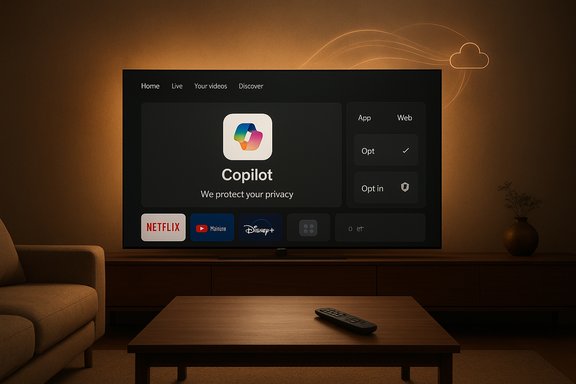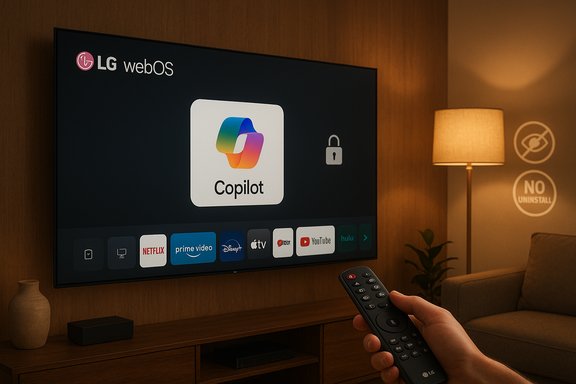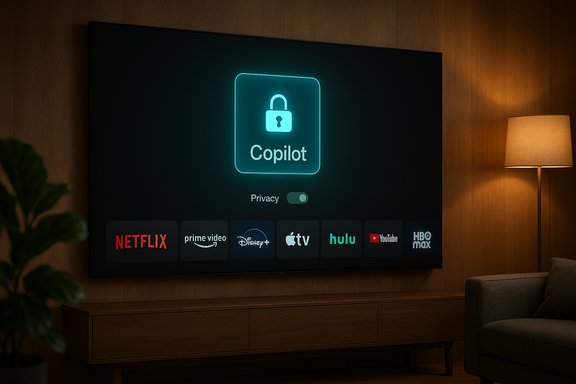
LG owners across multiple forums woke up to a routine webOS firmware update that had quietly placed Microsoft Copilot on their home screens — and for many the assistant behaved like a system-level feature that could only be hidden, not removed, touching off a sharp backlash over device autonomy, privacy, and the new commercial dynamics of smart‑TV software.
Background / Overview
In 2025 major TV manufacturers publicly signaled plans to bring conversational AI to living‑room screens. Samsung and LG both showcased integrations that would surface Microsoft Copilot on their 2025 smart‑TV lineups, pitching the assistant as an on‑screen tool for richer content discovery, conversational search, and contextual help. Samsung documented a staged rollout on select 2025 models and published consumer‑facing guidance; LG promoted a broader “AI” roadmap for webOS — including an AI Remote, LLM‑powered AI Search, and an upgraded webOS Hub — and flagged Copilot as a partner integration for its 2025 families. Despite these product roadmaps, a wave of community reports in December 2025 describes a different customer experience on already‑sold LG sets: an over‑the‑air (FOTA) update installed a visible Copilot tile or shortcut on the home ribbon, and in many cases the normal app‑management UI offered only hide or disable — not uninstall. Several owners reported that a factory reset returned the Copilot tile, strongly suggesting the component was deployed as a privileged system package or baked into the firmware image rather than as a removable store app. These community observations are well documented in forum threads and social posts.What users are reporting — the observable facts
How the Copilot appearance plays out on LG sets
- Owners receive a routine webOS firmware update (the usual FOTA channel).
- After the update a Copilot tile or shortcut appears in the home ribbon or AI section.
- When accessing the TV’s Edit / App Manager UI the Copilot entry frequently lacks a trash/uninstall affordance; the UI shows only hide or disable in many reports.
- Factory resets sometimes restore the Copilot tile, implying the component is part of the installed firmware image.
Why users are upset
Three overlapping sensitivities explain the intense reaction:- Loss of device autonomy: Consumers reasonably expect optional partner services to be removable from hardware they purchased. A service pushed as a persistent system component erodes the sense of ownership.
- Expanded telemetry surface: LG’s webOS already supports Automatic Content Recognition (ACR), marketed as Live Plus, which can identify on‑screen content for personalization and advertising. Pair a persistent assistant with default‑on ACR and the potential telemetry surface increases in both scope and sensitivity.
- Opaque update mechanics: Firmware updates traditionally deliver security fixes and stability patches. When vendor maintenance channels deliver partner services that change device behavior without a clear consent flow, trust breaks down.
Technical mechanics — why Copilot may be undeletable
Two canonical packaging patterns explain the “non‑removable” impression:- Privileged system package: OEMs can install components outside the normal app sandbox and mark them as system apps. The platform UI then exposes only limited management actions (hide/disable) rather than uninstall.
- Firmware‑baked component: The component is included in the firmware image applied by FOTA. A factory reset often re‑applies the same firmware image, reintroducing any baked‑in packages.
The commercial logic: why OEMs and Microsoft want Copilot on TVs
Embedding a conversational AI on the TV is commercially attractive:- Feature differentiation: With panel technology converging, software and AI experiences are the new battleground. An assistant provides a visible, marketable capability.
- Content discovery and convenience: Copilot can summarize episodes, answer show‑specific questions, and search across streaming services — functions that many users will find genuinely useful.
- Monetization and personalization: Smart‑TV homescreens are monetized through promotions, screensaver ads, and personalized recommendations. An assistant that improves on‑device personalization increases ad inventory value and conversion potential.
- Ecosystem reach: For Microsoft, living‑room presence expands Copilot’s footprint and integrates Microsoft services deeper into users’ daily lives. Samsung and LG likewise use AI features as a way to differentiate webOS and Tizen experiences.
Privacy implications and the Live Plus (ACR) angle
LG’s Live Plus (ACR) feature scans on‑screen content to power recommendations and targeted ads. When an assistant like Copilot is present, it could logically benefit from the same contextual signals — what’s playing, timestamps, scene markers — raising concerns about profiling and the sale of derived viewing habits to advertisers.Key points to understand:
- Live Plus is an opt‑out setting in webOS, but community reports indicate the setting may be toggled on by default on some firmware builds, which amplifies user worry that telemetry is being expanded without explicit consent.
- Claims that Copilot is actively listening beyond existing webOS audio handling or that it exfiltrates novel telemetry require vendor confirmation or independent network/firmware forensic analysis. Treat such claims as plausible but unverified until forensic evidence is published.
Cross‑checking the public record
- Samsung and Microsoft publicly announced Copilot for Samsung’s 2025 TV and monitor lineups and published rollout guidance — a staged, market‑by‑market deployment with optional sign‑in for personalization. Independent coverage and vendor press confirm this rollout.
- LG’s product communications and webOS Hub releases emphasise AI features on 2025 models (AI Remote, AI Search, webOS Hub upgrades) and list Copilot integration among platform capabilities. However, LG’s public materials do not uniformly specify whether Copilot would be deployed to previously‑sold sets as a removable Content Store app or as an integrated system component; that implementation detail is the crux of current consumer concern.
- Independent community evidence — screenshots, reset tests, and repeated reports across Reddit and enthusiast forums — supports the claim that Copilot shortcuts are being delivered via firmware and can behave like system components on many LG sets. Those observations are strong but remain community‑sourced rather than vendor‑confirmed.
Practical mitigation steps for owners
If restoring control over a current LG set is the immediate priority, the community has converged on a handful of pragmatic mitigations. These are ordered from least to most disruptive:- Disable the network connection (Wi‑Fi or Ethernet) to prevent Copilot or related cloud features from functioning.
- In Settings → Additional Settings → Privacy or Live Plus, turn off Live Plus (ACR) and any ad personalization / analytics options.
- Avoid signing in with a Microsoft account on the TV; sign‑in enables personalization, memory, and cloud‑backed features.
- Use network‑level blocking (router DNS rules, Pi‑hole, firewall) to block known Copilot endpoints if you can identify them; this requires network‑diagnostic skills and is fragile as endpoints change.
- Use an external streaming device (Apple TV, Fire TV Stick, Chromecast, streaming console) and move the TV’s home‑screen out of day‑to‑day view.
- If you’re technically proficient and willing to void warranties, investigate custom firmware or vendor rollback options — but these paths are high risk and not recommended for the majority of owners.
Risks and broader implications
For consumers
- Erosion of ownership: The precedent of shipping persistent services as system components on a purchased device shifts the product relationship toward a vendor‑managed platform model and away from discrete hardware ownership.
- Privacy creep: Default‑on personalization features paired with non‑removable assistants increase the risk that households will be profiled without clear, persistent consent.
- Fragmented remedies: Current mitigations rely on technical know‑how or blunt actions (disconnecting the TV), leaving less‑technical consumers vulnerable.
For the industry
- Regulatory scrutiny: Governments and consumer protection agencies are already scrutinizing LLM deployments and data‑driven personalization. Forced or opaque deployments raise the probability of enforcement actions or new disclosure requirements.
- Trust deficit: Reputation costs from perceived surreptitious installs may outweigh short‑term monetization gains from advertising uplift.
- Platform fragmentation: If OEMs pursue different packaging models (removable app vs system component), user experiences will diverge dramatically across brands and model years, complicating support and regulation.
What should manufacturers and Microsoft do now?
- Publish a clear technical bulletin describing the packaging model that delivered Copilot to affected firmware builds, the data flows involved, what is processed on‑device versus in the cloud, and the steps owners can take to opt out or remove the feature.
- Provide a user‑accessible uninstall or opt‑out in a post‑update firmware release. If a system‑level install is required for technical reasons, disclose that clearly and give buyers compensated alternatives (e.g., a firmware rollback or replacement option).
- Make privacy defaults opt‑in for any features that materially expand telemetry (especially ACR or any audio‑capture pathways).
- Strengthen update transparency: patch notes should list new, user‑facing components added by an update and require explicit user consent for non‑security additions on previously‑sold devices.
Separating the verified from the unverified
What is strongly supported by the public record:- Copilot has been rolled into TV platforms as part of 2025 product roadmaps from Samsung and LG; Samsung’s rollout is documented publicly, and LG’s webOS updates explicitly include AI features and Copilot integration as a marketing element.
- Multiple LG owners reported a webOS firmware update that added a Copilot tile and that the UI often lacks an uninstall affordance; several reported that a factory reset restored the tile, consistent with a privileged or firmware‑baked install. Those community observations have been widely shared and corroborated across forums.
- That Copilot is actively capturing audio or video beyond existing remote microphone behavior and relaying new telemetry to Microsoft or advertisers. These are plausible concerns given how assistants can be provisioned, but they require vendor confirmation or independent forensic network captures to verify definitively.
- The commercial deal terms between LG and Microsoft (payments, bundling mandates) that might explain non‑removability. Community speculation on these terms is widespread but unproven in public documents.
Bottom line — what this episode means for smart‑TV buyers
The Copilot‑on‑LG episode crystallizes a broader shift: smart TVs are no longer passive appliances; they are platforms where firmware, cloud services, advertising, and AI meet. That shift creates real value, but it also raises clear consumer‑protection and privacy issues.For buyers, the practical lessons are:
- Inspect privacy and update settings immediately after purchase, especially ACR/Live Plus toggles.
- Consider whether you want networked smart features at all; if not, prefer a display‑only model or plan to use a separate streaming device.
- Demand clear vendor commitments about what updates can add or remove from a TV you already own.
Copilot on TVs is an inevitable manifestation of the race to add AI to every screen; the critical question now is how that race will be governed by user expectations, industry norms, and regulatory guardrails. The present controversy is a timely reminder that consumers view the living room as a domain of privacy and ownership — and that platform owners who ignore those expectations will face swift pushback.
Source: TechSpot Users report Microsoft Copilot appearing on LG Smart TVs after software update