

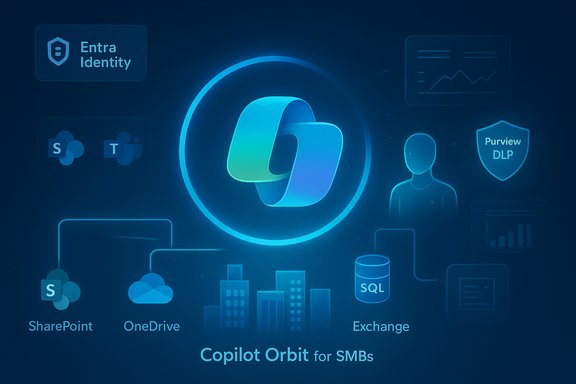
ESW’s new Copilot Orbit™ promises to take Microsoft Copilot from pilot projects to a steady, managed delivery model for small and mid-sized businesses — packaging governance, tenant grounding, Power Automate orchestration and a monthly cadence of agent rollouts into a single managed service offering.
Background / Overview
Microsoft’s Copilot platform has evolved rapidly into an ecosystem that supports tenant-grounded agents, Copilot Studio authoring, and governance controls such as Purview and Entra identities. Partners and systems integrators are now focusing on operationalizing agents — building the plumbing that turns conversational intelligence into repeatable, auditable business actions. ESW’s Copilot Orbit positions itself as one of those partner-led paths to production, aimed squarely at organizations that lack in-house AI ops teams but want continuous automation delivered without a one-off “bot build.” The announcement from ESW describes a managed-service program that combines:- Governance, security and Purview/DLP alignment,
- Grounding of agents to tenant data sources (SharePoint, Teams, OneDrive, SQL, Exchange),
- Agent and automation development (prompt engineering, Power Automate flows, Teams/SharePoint plugins),
- A predictable monthly delivery cadence for new agents and workflows, and
- Ongoing tuning, telemetry, and user enablement.
Why Copilot Orbit matters: the SMB gap in AI automation
The problem for small and mid-sized companies
Large enterprises often build internal AI teams, data engineering pipelines, and dedicated governance functions to manage agents and model-driven automation. Smaller organizations rarely have those resources. They need:- Predictable cost models rather than surprise bills from unmetered agent usage,
- Governance-by-default so sensitive data is not unintentionally exposed,
- Connector and grounding expertise to stop hallucinations and ensure provenance, and
- Sustained delivery so automations don't “rot” after an initial deployment.
Market moment: Microsoft’s SMB-friendly Copilot pricing
Microsoft’s December 2025 rollout of Microsoft 365 Copilot Business (priced at USD 21 per user per month for organizations up to 300 users) materially improves the commercial case for SMBs to adopt tenant-grounded Copilot services. That price move reduces license friction and makes managed partner services like Copilot Orbit more tractable and easier to justify.What Copilot Orbit offers — a closer look
Governance, security and data posture
Copilot Orbit emphasizes alignment with Microsoft Purview, DLP policies, and Entra-managed identities for agents. This means agents are treated as first‑class principals with lifecycle controls, access reviews and audit logs rather than ad-hoc automation scripts. For a regulated or compliance-sensitive environment, those plumbing pieces are non-negotiable: they create auditable trails and allow least-privilege enforcement. Key governance components cited in the offering:- Mapping of sensitive data and Purview/DLP policy alignment,
- Entra-based agent identities for attribution and access control,
- Telemetry and audit logging for retention and forensic needs.
Grounding, connectors and knowledge indexes
A practical, production-grade agent must be grounded to the organization’s authoritative data stores to avoid hallucinations. ESW lists SharePoint, Teams, OneDrive, SQL and Exchange as core grounding sources — standard sources for Microsoft-grounded agents — and the work of indexing, metadata mapping and permissions assessment is typically where projects reveal messy content hygiene that must be remediated before automation is safe. The reliable pattern: build secure connectors, create a knowledge index (Dataverse/Semantic Index/Graph-based retrieval), and design retrieval-augmented prompts with citation and lineage so outputs are traceable back to source artifacts.Agent and automation engineering
ESW’s service includes:- Prompt engineering and agent design,
- Power Automate flows for deterministic orchestration and retries,
- Teams and SharePoint plugins for embedded UX, and
- Testing, validation stations and telemetry for continuous improvement.
Monthly delivery cadence and lifecycle
A commercial differentiator ESW emphasizes is the cadence of delivery: a subscription model that delivers new agents or workflows monthly (tiered by Core / Plus / Scale plans). The intent is to produce predictable, repeatable value and keep automations tuned rather than letting them degrade after release. The model also forces prioritization: pick small, measurable pilots and iterate.How Copilot Orbit maps to Microsoft’s platform
Copilot Orbit leverages Microsoft product pieces that are now widely available to partners:- Copilot Studio (authoring surface for declarative and pro-code agents),
- Dataverse and Semantic Index for knowledge storage,
- Power Automate and connectors for orchestrations and deterministic actions,
- Entra/Managed Identities, Purview DLP, and Sentinel for governance and telemetry,
- Agent lifecycle tooling and the Copilot Control System for monitoring and quarantine.
Strengths: what ESW gets right
- Channel-ready operational model: Packaging governance, connector builds, delivery cadence and adoption support into a managed subscription reduces the implementation burden for SMBs that lack specialists. This is a pragmatic route to scale beyond pilots.
- Platform alignment: By building on Copilot Studio, Power Platform, SharePoint and Dataverse patterns, ESW minimizes bespoke engineering risk and leverages Microsoft’s connector ecosystem — a sensible approach to lower integration complexity.
- Emphasis on governance and observability: Explicit Purview/DLP, Entra identities and telemetry are required for audits and trust; including them as foundational elements reduces downstream incident risk.
- Repeatable value delivery: A monthly cadence encourages measurable KPIs and regular tuning, which addresses the common problem of “automation rot” where bots degrade as data and processes change.
Risks, caveats, and practical reservations
Vendor promises vs. field reality
The headline “agents that automate your company” is aspirational. Real-world automation value depends heavily on:- Data quality and content hygiene,
- Permissions and access configuration across SharePoint/OneDrive/Exchange,
- Process clarity and exception rules, and
- Ongoing change management and adoption work.
Hallucinations, provenance and decision risk
Even grounded agents can produce incorrect outputs, especially when synthesizing across disparate documents. When agents are authorized to write back to HR or financial systems, the potential consequences increase. Industry best practice: require human-in-the-loop approvals for high-risk write-backs and implement deterministic rules and exception handling for reconciliation tasks.Data residency and third‑party routing
If any component of the managed service routes prompts or content to non-Microsoft models or external inference endpoints, procurement and legal teams must confirm retention, telemetry and contractual protections. For regulated industries, in-country processing or private networking options should be clarified before deployment. If a partner routes tenant data outside agreed boundaries, treat that as a red flag until contractually clarified.FinOps and consumption surprises
Agent activity is metered; uncontrolled usage can produce unexpected expenses. SMBs must insist on consumption dashboards, monthly caps, and alerting for Copilot credits or other inference costs. A managed service should include FinOps guardrails in the service agreement.Agent sprawl and lifecycle burden
Easy authoring (Copilot Studio Lite or in-app builders) makes it tempting for every team to publish agents. Without lifecycle governance — naming, ownership, versioning, testing and retirement playbooks — organizations risk a proliferation of poorly maintained agents that create security and compliance drift. A managed plan must define ownership and handoff processes.Technical checklist: what to demand from a managed Copilot service
- Require Entra Agent IDs and regular access reviews so agents are auditable and subject to conditional access controls.
- Ask for Purview/DLP alignment evidence: mapping of sensitive sources, retention settings and DLP rule tests.
- Validate grounding and connector mapping: a clear inventory of SharePoint sites, mailboxes, Dataverse tables and SQL sources to be indexed and how permissions will be verified.
- Insist on human-in-the-loop rules for high-risk writebacks (finance, HR, legal) and a staged rollout with validation stations.
- Require consumption reporting, monthly caps and FinOps alerts to prevent billing surprises.
- Define ownership, SLAs, and a retirement policy for each agent delivered under the managed plan.
Implementation playbook for IT leaders (practical steps)
Phase 1 — Readiness & pilot scoping
- Identify 1–2 high-value, low-risk processes (invoice intake, HR onboarding, IT ticket triage).
- Confirm licensing: Microsoft 365 Copilot Business or equivalent seats where tenant grounding is required. Microsoft’s SMB Copilot Business SKU ($21/user/month, up to 300 seats) lowers licensing friction and should be considered during procurement.
- Map data sources and permissions for the pilot scope; fix obvious content hygiene and access problems.
Phase 2 — Agent design & safety engineering
- Engineer retrieval-grounded prompts, link each response to source citations, and create validation stations for human review.
- Implement Entra Agent IDs and configure least-privilege permissions.
- Wire deterministic Power Automate flows for write-backs, retry logic and error handling; reserve agents for reasoning-intensive tasks.
Phase 3 — Staged rollout & measurement
- Roll out in a confined channel or site with a known owner.
- Track KPIs: time saved, error/exception rate, ticket deflection, adoption metrics and Copilot credit consumption.
- Iterate monthly per the managed cadence and upgrade agent scope after meeting safety and accuracy thresholds.
Phase 4 — Scale and lifecycle management
- Publish vetted templates into a tenant catalog for reuse.
- Institute agent retirement and upgrade policies, and maintain telemetry dashboards and cost controls.
Commercial considerations and pricing context
Microsoft’s December 2025 SMB SKU — Microsoft 365 Copilot Business at USD 21/user/month for organizations up to 300 seats — changes the economics for small and mid-sized companies looking to deploy tenant-grounded Copilot features and agents. That move reduces license friction and makes partner-managed services more commercially attractive. IT leaders should evaluate total cost of ownership: license spend, managed service fees (monthly agent delivery cadence), integration cleanup costs, and anticipated inference/credit consumption. A managed partner should provide consumption reporting, monthly capacity packs or caps, and a clear bill-of-materials for agent delivery to avoid surprises. If the managed service charges a flat recurring fee, confirm what level of agent delivery and FinOps support is included in each tier (Core / Plus / Scale).Industry context: partners packaging Copilot into managed services
ESW’s approach mirrors a broader pattern in the Microsoft ecosystem: partners packaging Copilot/agent capabilities into recurring, governed services for customers that lack in-house AI teams. The platform primitives Microsoft provides (Copilot Studio, Dataverse, Purview, agent identity constructs) enable this channel motion, but success depends on operational rigor — indexing, permissions, testing, and telemetry — that many SMBs need help implementing.Where to be cautious — red flags in managed Copilot offers
- Any partner claim that agents will autonomously “run finance” or “remove headcount” without staged human checks should be treated skeptically. Ask for concrete pilot KPIs and evidence.
- If a managed service routes tenant data through third-party or non-Microsoft inference endpoints without explicit contractual protections for retention and processing, escalate to legal and procurement.
- Offers that omit consumption monitoring, caps, or FinOps responsibilities create a risk of runaway charges; insist these be documented in the SLA.
- Watch for vague ownership terms: if the partner retains all agent ownership and there’s no clear handoff plan, the customer may be locked in operationally. Require ownership and retirement policies in writing.
Bottom line and recommendation
ESW’s Copilot Orbit is a timely, channel‑friendly offering that addresses the practical gaps SMBs face when trying to convert Copilot pilots to production automations. The package — governance-first, tenant grounding, Power Automate determinism, and a monthly delivery cadence — maps closely to Microsoft’s recommended production patterns and to the operational realities partners encounter in the field. However, the vendor promise of “automating your company” is conditional. Real value requires upfront investments in data hygiene, permissions and change management, plus ongoing human-in-the-loop controls for high-risk write-backs. SMB buyers should insist on a scoped pilot, documented safety controls, FinOps caps, and clearly defined agent ownership before committing to managed plans.For IT leaders preparing an evaluation:
- Prioritize pilots with measurable KPIs,
- Require Purview/DLP and Entra identity artifacts as part of the onboarding,
- Insist on monthly consumption and credit reporting, and
- Demand a clear lifecycle and ownership contract for every delivered agent.
Conclusion
Copilot Orbit joins a growing class of partner-managed offerings that make Microsoft Copilot’s agent paradigm usable for companies without dedicated AI teams. The model is sensible: combine governance, grounding, deterministic flows and continuous delivery into a subscription. Yet buyers should approach with the usual mix of optimism and discipline — validate claims in a small pilot, insist on governance and FinOps guardrails, and treat agents as operational assets that require lifecycle management. When done right, agentic Copilots can reduce repetitive work, speed decision cycles, and free people for higher-value tasks — but they must be deployed with the same rigor applied to any enterprise system touching sensitive data and business-critical processes.
Source: The Manila Times ESW Introduces Copilot Orbit™, Microsoft AI Automation Services for Small and Mid-Sized Companies
